Pediatric emergency medicine trisk 547
Bạn đang xem bản rút gọn của tài liệu. Xem và tải ngay bản đầy đủ của tài liệu tại đây (112.69 KB, 4 trang )
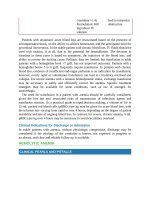
TABLE 93.2
BLOOD PRODUCTS AND DRUGS TO MANAGE BLEEDING
Product/drug
Indication(s)
Dose
Pearls
Packed red blood Anemia
cells (pRBCs)
Volume of packed
• Desired Hb level
RBCs = ([desired
dictated by
hemoglobin
clinical situation
current hemoglobin] ã 10 mL/kg of
ì patient’s blood
pRBCs should
volume)/hemoglobin
raise the Hb
of packed RBCs
about 2 g/dL
Estimated blood
(often used
volume (mL) =
empirically in
weight (kg) ì 70
acute blood loss)
mL/kg
ã Rate of transfusion
Estimated hemoglobin
is dictated by
of unit of packed
clinical
RBCs = 19–25 g/dL
presentation and
differs for acute
versus chronic
etiologies of
anemia
Platelets
One unit per 5–10 kg
(∼50–60 mL/unit),
≥5.5 × 10¹⁰
platelets/unit
OR
One apheresis unit
(∼200 mL), ≥3 ×
1011 platelets/unit
Thrombocytopenia
with bleeding
Platelet function
defects
• Use with
caution/clear
clinical need for
patients with ITP,
DIC, TTP, HIT
• Random donor
units are a pooled
donor source. An
apheresis unit is
from a single
donor
• One unit of
random donor
platelets should
increase count by
5,000–10,000/μL
in average adult
• One apheresis unit
should increase
count by 30,000–
50,000/μL in
average adult
Fresh-frozen
plasma (FFP)
Bleeding associated
with abnormal
coagulation panel
Factor deficiency
replacement
Reversal of vitamin
K antagonist
Massive transfusion
requirement
10–20 mL/kg/dose
(∼200–250
mL/unit)
Cryoprecipitate
(Cryo)
Bleeding associated 1–2 units for every 10
with deficiency of
kg of body weight
fibrinogen, FVIII,
FXIII, or VWF
• Contains all
plasma-clotting
factors, but with
variable
concentrations
• Contains
fibrinogen, FVIII,
FXIII, and VWF
Recombinant
Factor VIII products:
factor products
treatment or
prophylaxis of
FVIII deficiency
Factor IX products:
treatment or
prophylaxis of
FIX deficiency
Factor VII (rFVIIa):
treatment or
prophylaxis of
FVII deficiency or
treatment or
prophylaxis for
FVIII or FIX
patients with
inhibitors
Factor VIII: (number • Plasma-derived
of units = desired
factor
level [%] × weight
replacement
of patient [kg] × 0.5)
products also
available
Factor IX: (number of
units = desired level
[%] × weight of
patient [kg])
Factor VII:
Replacement: 15–30
mcg/kg q4–q6hr
FVIII or FIX
inhibitors: 90
mcg/kg q2hr, space
as clinically
tolerated
Antihemophilic
factor/VWF
complex
von Willebrand
disease (VWD)
Dosing based on
VWF:RCo units/kg
Prothrombin
complex
concentrates
Bleeding with
Consult hematologist,
deficiency of FII,
dose for factor
FVII, FIX, FX, or
replacement based
familial vitamin K
on specific factor
deficiency or
• Contraindicated in
DIC, HIT, or
known
hypersensitivity
reversal of vitamin
K antagonist
deficiency and target
level
Dose for reversal
depends on specific
product and predose
INR
DDAVP
Type I VWD or mild IV formulation—0.3
• Causes release of
(desmopressin)
hemophilia A (if
mcg/kg in 50-mL
VWF and FVIII
patients known to
NS by IV infusion
from endothelial
respond)
over 30 min (max
cells
dose 20 mcg)
• Can exacerbate the
Nasal spray
thrombocytopenia
formulation Stimate
seen with type 2B
(desmopressin
VWD
acetate) 1.5 mg/mL • Side effects: facial
—metered dose
flushing,
pump delivers 0.1
headache, and,
mL (150 mcg) per
rarely,
actuation for
hypertension,
patients ≥50 kg—2
hypotension, and
sprays (1/nostril);
water retention,
<50 kg—1 spray
hyponatremic
seizures have
occurred
Aminocaproic
acid (Amicar)
Mucocutaneous
bleeding
Aminocaproic acid
• Contraindicated in
(pediatric): 50–100
DIC. Avoid use
mg/kg loading dose,
with upper
then 50 mg/kg q6hr
urinary tract
(usual max: 2
bleeding
g/dose) not to
(hematuria), can
exceed 12 g/day
lead to intrarenal
obstruction
Aminocaproic acid
(adult): 5 g loading
(PO or IV), then 2–5
g q6hr, titrated by
patient need
Tranexamic acid
Mucocutaneous
bleeding
Menorrhagia
Tranexamic acid:
• Avoid use with
1,300 mg PO or 10
upper urinary
mg/kg IV TID (dose
tract bleeding
reduction for
(hematuria), can