Pediatric emergency medicine trisk 545
Bạn đang xem bản rút gọn của tài liệu. Xem và tải ngay bản đầy đủ của tài liệu tại đây (113.04 KB, 4 trang )
Hemoglobin levels may be normal in acute blood loss.
The decision to transfuse packed red blood cells (pRBCs) should be based
on the etiology, severity, and chronicity of the anemia as well as on clinical
symptoms and end-organ perfusion rather than hemoglobin values.
Patients with sickle cell disease require prompt evaluation for complications
including infection, acute chest syndrome, splenic sequestration, stroke,
vasoocclusive episodes, and priapism.
Prompt evaluation and treatment of neutropenic patients is essential to
decrease morbidity and mortality associated with infection. Appropriate
cultures should be obtained but should not delay empiric antibiotic treatment.
Disposition should be based on the underlying etiology of the neutropenia
and clinical presentation.
The management of immune thrombocytopenia (ITP) is commonly guided by
bleeding symptoms rather than platelet count.
Platelet disorders and von Willebrand disease (VWD) typically result in
mucosal-type bleeding, whereas hemophilia causes hemarthrosis and deep
muscle bleeds. Drugs that interfere with platelet function (e.g., aspirin,
nonsteroidal anti-inflammatory agents) should be avoided in patients with
hemostatic defects.
RELATED CHAPTERS
Resuscitation and Stabilization
A General Approach to the Ill or Injured Child: Chapter 7
Shock: Chapter 10
Signs and Symptoms
Gastrointestinal Bleeding: Chapter 33
Pain: Abdomen: Chapter 53
Pallor: Chapter 62
Tachycardia: Chapter 77
Medical Emergencies
Gastrointestinal Emergencies: Chapter 91
Oncologic Emergencies: Chapter 98
Trauma
Abdominal Trauma: Chapter 103
Thoracic Trauma: Chapter 115
Surgical Emergencies
Abdominal Emergencies: Chapter 116
Thoracic Emergencies: Chapter 124
The Children’s Hospital of Philadelphia Clinical Pathways
ED Clinical Pathway for Evaluation/Treatment of Sickle Cell Disease With
Fever
URL: />Authors: A. Ellison, MD; J. Lavelle, MD; C. Jacobstein, MD; C. Norris, MD;
R. Cecil, RN, MSN; T. McKnight, CRNP; H. Hartung, MD; K. Smith Whitley,
MD
Posted: January 2010, last revised March 2020
ED Clinical Pathway for Evaluation/Treatment of Sickle Cell Disease and
Pain
URL: />Authors: J. Umana, MD; A. Ellison, MD; J. Fuchs, RN; M. Wengler, CRNP;
H. Huang, Pharm D; C. Norris, MD; K. Smith-Whitley, MD; C. Jacobstein, MD;
J. Lavelle, MD
Posted: July 2010, last revised March 2020
ED Clinical Pathway for Evaluation/Treatment of Children With
Hemophilia and Closed Head Injury (CHI)
URL: />Authors: R. Butler; L. Raffini, MD; C. Witmer, MD; C. Jacobstein, MD; J.
Lavelle, MD
Posted: August 2005, last revised October 2019
ANEMIA
Goals of Treatment
Severe anemia requires rapid evaluation and treatment to prevent hypoxia, congestive
heart failure, end-organ damage, and death. When the etiology of the anemia is not
immediately apparent, management focuses simultaneously on diagnostic and
therapeutic interventions. Many management strategies for the anemic child are similar
regardless of etiology, but special considerations are necessary in the setting of a
destructive red cell process.
CLINICAL PEARLS AND PITFALLS
The stabilization of the severely anemic child is guided by the clinical
presentation more than by laboratory values. In chronic blood loss, low
hemoglobin levels may be relatively well tolerated due to compensatory
mechanisms and should not be the sole indication for transfusion.
The acuity or chronicity of a clinical condition will impact the clinical status
and thereby affect management. Prompt transfusions and isotonic fluid
resuscitation needed for acute blood loss may be detrimental in chronically
anemic patients.
Transfusion risks versus benefits must be considered based on the clinical
situation.
Current Evidence
Anemia in the pediatric patient ranges from an incidental finding in an asymptomatic
patient to acute or chronic processes presenting in a critically ill patient. The
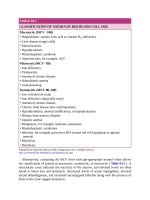
classification of causes of anemia according to (i) blood loss, (ii) increased RBC
destruction, and (iii) decreased RBC production provides a framework for the evaluation
of the anemic child.