Crc Press Mechatronics Handbook 2002 By Laxxuss Episode 1 Part 2 pptx
Bạn đang xem bản rút gọn của tài liệu. Xem và tải ngay bản đầy đủ của tài liệu tại đây (76.85 KB, 4 trang )
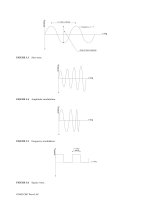
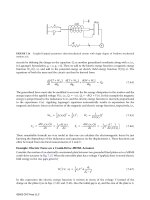
FIGURE 3.3
Sine wave.
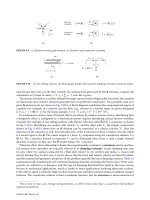
FIGURE 3.4
Amplitude modulation.
FIGURE 3.5
Frequency modulation.
FIGURE 3.6
Square wave.
Amplitude
t
= time
T
= Time = Period
f
= frequency = 1 /
T
Peak to Peak Amplitude
Amplitude
t
= time
Amplitude
t
= time
Amplitude
t
= time
T
= Time
= Period
©2002 CRC Press LLC
FIGURE 3.3
Sine wave.
FIGURE 3.4
Amplitude modulation.
FIGURE 3.5
Frequency modulation.
FIGURE 3.6
Square wave.
Amplitude
t
= time
T
= Time = Period
f
= frequency = 1 /
T
Peak to Peak Amplitude
Amplitude
t
= time
Amplitude
t
= time
Amplitude
t
= time
T
= Time
= Period
©2002 CRC Press LLC
4
Microprocessor-Based
Controllers and
Microelectronics
4.1 Introduction to Microelectronics
4.2 Digital Logic
4.3 Overview of Control Computers
4.4 Microprocessors and Microcontrollers
4.5 Programmable Logic Controllers
4.6 Digital Communications
4.1 Introduction to Microelectronics
The field of microelectronics has changed dramatically during the last two decades and digital technology
has governed most of the application fields in electronics. The design of digital systems is supported by
thousands of different integrated circuits supplied by many manufacturers across the world. This makes
both the design and the production of electronic products much easier and cost effective. The permanent
growth of integrated circuit speed, scale of integration, and reduction of costs have resulted in digital
circuits being used instead of classical analog solutions of controllers, filters, and (de)modulators.
The growth in computational power can be demonstrated with the following example. One single-
chip microcontroller has the computational power equal to that of one 1992 vintage computer notebook.
This single-chip microcontroller has the computational power equal to four 1981 vintage IBM personal
computers, or to two 1972 vintage IBM 370 mainframe computers.
Digital integrated circuits are designed to be universal and are produced in large numbers. Modern
integrated circuits have many upgraded features from earlier designs, which allow for “user-friendlier”
access and control. As the parameters of Integrated circuits (ICs) influence not only the individually
designed IC, but all the circuits that must cooperate with it, a roadmap of the future development of IC
technology is updated every year. From this roadmap we can estimate future parameters of the ICs, and
adapt our designs to future demands. The relative growth of the number of integrated transistors on a
chip is relatively stable. In the case of memory elements, it is equal to approximately 1.5 times the current
amount. In the case of other digital ICs, it is equal to approximately 1.35 times the current amount.
In digital electronics, we use quantities called logical values instead of the analog quantities of voltage
and current. Logical variables usually correspond to the voltage of the signal, but they have only two
values: log.1 and log.0. If a digital circuit processes a logical variable, a correct value is recognized because
between the logical value voltages there is a gap (see Fig. 4.1). We can arbitrarily improve the resolution
of signals by simply using more bits.
Ondrej Novak
Technical University Liberec
Ivan Dolezal
Technical University Liberec
©2002 CRC Press LLC
5
An Introduction
to Micro- and
Nanotechnology
5.1 Introduction
The Physics of Scaling • General Mechanisms of
Electromechanical Transduction • Sensor and Actuator
Transduction Characteristics
5.2 Microactuators
Electrostatic Actuation • Electromagnetic Actuation
5.3 Microsensors
Strain • Pressure • Acceleration • Force • Angular Rate
Sensing (Gyroscopes)
5.4 Nanomachines
5.1 Introduction
Originally arising from the development of processes for fabricating microelectronics, micro-scale devices
are typically classified according not only to their dimensional scale, but their composition and manu-
facture. Nanotechnology is generally considered as ranging from the smallest of these micro-scale devices
down to the assembly of individual molecules to form molecular devices. These two distinct yet over-
lapping fields of microelectromechanical systems (MEMS) and nanosystems or nanotechnology share a
common set of engineering design considerations unique from other more typical engineering systems.
Two major factors distinguish the existence, effectiveness, and development of micro-scale and nano-
scale transducers from those of conventional scale. The first is the physics of scaling and the second is
the suitability of manufacturing techniques and processes. The former is governed by the laws of physics
and is thus a fundamental factor, while the latter is related to the development of manufacturing
technology, which is a significant, though not fundamental, factor. Due to the combination of these
factors, effective micro-scale transducers can often not be constructed as geometrically scaled-down
versions of conventional-scale transducers.
The Physics of Scaling
The dominant forces that influence micro-scale devices are different from those that influence their
conventional-scale counterparts. This is because the size of a physical system bears a significant influence
on the physical phenomena that dictate the dynamic behavior of that system. For example, larger-scale
systems are influenced by inertial effects to a much greater extent than smaller-scale systems, while smaller
systems are influenced more by surface effects. As an example, consider small insects that can stand on
the surface of still water, supported only by surface tension. The same surface tension is present when
Michael Goldfarb
Vanderbilt University
Alvin Strauss
Vanderbilt University
Eric J. Barth
Vanderbilt University
©2002 CRC Press LLC