Bảo mật cho joomla part 10 pot
Bạn đang xem bản rút gọn của tài liệu. Xem và tải ngay bản đầy đủ của tài liệu tại đây (1.82 MB, 10 trang )
Chapter 4
[ 97 ]
By following all these instructions for protecting your site, this type of exploit can be
greatly diminished. Additionally, researching hacker sites for exploits related to your
extension is always a good idea.
Command Injection Attacks
If you are a Star Trek buff, you may recall when Captain Kirk was facing his mortal
enemy Khan. They were facing each other, with Khan having an advantage on
the Enterprise. Kirk ordered Spock to get the "command codes" for the Reliant (the
vessel Khan had stolen). They entered a sequence of numbers and "ordered" Reliant's
[computer] to lower her shields. In essence, they were using a command injection
attack. While the Enterprise scenario is ctitious, the command injection attack is not.
Injecting a command into your system, say a server, will render the reliability and
trustworthiness of this box null.
Here is a very good denition of a command injection attack, found at
/>"Purpose of the command injection attack is to inject and execute commands
specied by the attacker in the vulnerable application. In situation like this,
application which executes unwanted system commands is like a pseudo system
shell and the attacker may use it as any authorized system user. However,
commands are executed with the same privileges and environment as the
applications. Command injection attacks are possible in most cases because of lack of
correct input data validation, which in addition can be manipulated by the attacker
(forms, cookies, HTTP headers etc.).
There is also different variant of the injection attack called "code injection". The
difference in code injection is that the attacker adds his own code to the existing one.
The attacker extends the way the default functionality of the application without
necessity of executing system commands. Injected code is executed with the same
privileges and environment as application has."
When used normally, we see the expected output:
$ ./catWrapper Story.txt
Attack Example
If the attacker wanted to exploit you, he or she might add a semicolon and another
command to the end of this line, which allows the "ls" command to be executed by
catWrapper with no complaint, yielding the contents of the directory.
$ ./catWrapper "Story.txt; ls"
This material is copyright and is licensed for the sole use by Thomas Rosenblum on 4th December 2008
1010 SW High Ave., , Topeka, , 66604
Vulnerabilities
[ 98 ]
When last we left our heroes
Story.txt doubFree.c nullpointer.c
unstosig.c www* a.out*
format.c strlen.c useFree*
catWrapper* misnull.c strlength.c
useFree.c commandinjection.c nodefault.c
trunc.c writeWhatWhere.c
If catWrapper had been set to have a higher privilege-level than the standard user,
arbitrary commands could have been executed with that higher privilege.
Why do Vulnerabilities Exist?
There are several factors that cause aws and vulnerabilities to exist, but the core
reason is complexity. An addition is the way code can behave differently when it
interacts with other code. Each time software packages gain more features, they gain
an equally large amount of vulnerabilities that must be dealt with.
Other reasons for aws are:
Poor testing and planning
Improper server setup and conguration
Poor rewall rules
Giving out too much information
Improper variable sanitization and dangerous inputs
Not testing in a broad enough environment
Interactions with other third-party add-ons
Social engineering (yes it's a aw)
Poor patching and updating (not a cause, but a resultant exploit)
Malicious hackers that are intent in breaking into a system
Zero-day attacks (exploiting aws not yet identied and xed)
As you can see, there are multiple causes. The bottom line is that humans are not
perfect; yes it's a cliché, but one that needs constant reminding.
All programmers and developers can remedy most of these. In Chapter 5 we'll
review in detail some popular attacks and see why they work.
•
•
•
•
•
•
•
•
•
•
•
This material is copyright and is licensed for the sole use by Thomas Rosenblum on 4th December 2008
1010 SW High Ave., , Topeka, , 66604
Chapter 4
[ 99 ]
What Can be Done to Prevent Vulnerabilities?
As an end user, you may not be able to mitigate poor development, but you
can implement a testing regime. As a developer, you can reach beyond that and
eliminate more aws.
Let's examine some strategies broken down by developers and end users to see how
these aws can be mitigated, thus protecting our environment.
Developers
As a developer, you have a special responsibility to write the best code you can.
This doesn't mean that you are going to write perfect code each and every time. It
means you need to take the responsibility to deliver a quality product to the best of
your ability.
Sometimes in the technical world, we see pride kicking in, rather than common
sense. By realizing that mistakes are going to happen, you can open up yourself to
critique from your peers. In other words, don't let pride cause you to put out a bad
product or not support your environment to the best of your ability.
Poor Testing and Planning
When you design a new extension, application, or any other script, take time to
consider how it will be used and not how you envision its use. What environment
is it going into? Is your software an auto sales package? Then consider what other
items an auto dealer may want to install on his or her website.
What will be their expertise level? How will their customers interact with the
auto website?
Before you write a line of code, form a complete picture in your mind of what you
want the test to accomplish. Write out your test plan, including common problems.
For instance, if they are going to post pictures (as in the case of auto sales), will the
size of the picture matter? Will it cause errors if it is too large? Will an overlarge
picture cause errors? Can I put in some other item rather than a picture that could
cause a buffer overow, thus yielding control over to the attacker? Thinking about
these things will help you write a better code.
End user tip
Be sure to produce a helpful error message in English, and tie the solution
to the help and support portion of your website.
This material is copyright and is licensed for the sole use by Thomas Rosenblum on 4th December 2008
1010 SW High Ave., , Topeka, , 66604
Vulnerabilities
[ 100 ]
While this type of thinking could go on for pages, consider the following items in
your planning and testing:
Who is my customer?
Who is my customer's customer?
How will my product be used?
What types of variables or input data will I allow?
What permission level will my application require for use?
What other extensions may be interacting with mine?
This is not an exhaustive list, but a starting list to get you thinking. All of these
are potential areas for an attacker to exploit. Each carries with it a unique set
of challenges.
For instance, the types of variables or input data you allow will indicate what type
of array checking you will perform or variable types you will accept. In PHP, just
allowing ANY TYPE of data to be inserted into a eld is not a good idea, nor is it
conducive to your end users for having a great experience. From a programming
point of view, you want to intercept GET, POST, Cookies, and so on, and inspect
them. From a testing point of view, you will want to throw all kinds of special
characters and "stuff" into an input eld (or a SQL query) to see if you can break it.
The special characters to watch are:
' or the < or >. It is very important to check for these.
For devoted customers of your product, you will want to ensure that customers have
a great experience and are safe.
Consider an input box that asks the visitor of your site for their email address.
You could just use some code snip like this:
<html>
<head><title>Simple Email form</title></head>
<body>
<h2>Give me your email address</h2><p>
<form action="email.php" method="post">
<table>
<tr><td>What's your email address?:</td><td><input type="text"
name="Name" /></td></tr>
<tr><td colspan="2" align="center"><input type="submit" /></td></tr>
</table>
</form>
</body>
</html>
•
•
•
•
•
•
This material is copyright and is licensed for the sole use by Thomas Rosenblum on 4th December 2008
1010 SW High Ave., , Topeka, , 66604
Chapter 4
[ 101 ]
There is no proper checking for a valid email address. This is not good and certainly
not very secure for the user. There is no way to ensure that they enter a useful
address. This could allow a malicious attacker to insert "evil scripts" into your site,
putting it under their control.
How do you check for proper email addresses?
For an excellent example of code to check for valid email addresses,
please visit the following website address:
/>validation/
If you are gathering input: Test! Test! Test! And then give it to a trusted coder friend
to test. Ask him or her to break it.
When errors happen (and they will happen), having a good error-handling routine
will keep your site owing smoothly. However, you must be careful of what
information you divulge in your error reporting.
Let's examine this error: "Forbidden".
Forbidden
One important point, as stated earlier, is the tendency of applications to give out
too much information in trying to be helpful. This is a frequent problem, which
for a dedicated attacker can be a great way to gather information about how your
applications are built, on what type of technologies, and so forth.
In the following example, we see that a le request is being made and then rejected.
All's well, I suppose, until we see the Apache version.
While there are very simple ways to get that same information, a simple example is
when your server gives information due to an error that indicates the server type,
such as the following:
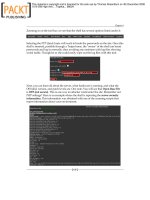
This is an example of poor handling of a 403 or FORBIDDEN error. This is
divulging details about my Apache server version, port, and some things about the
directory structure.
A better method would be to suppress the error reporting altogether in the
.htaccess le.
This material is copyright and is licensed for the sole use by Thomas Rosenblum on 4th December 2008
1010 SW High Ave., , Topeka, , 66604
Vulnerabilities
[ 102 ]
Consider this method found at :
# suppress php errors
php_flag display_startup_errors off
php_flag display_errors off
php_flag html_errors off
php_value docref_root 0
php_value docref_ext 0
This method will help you to prevent giving out information that an attacker
could use to investigate your site. Scrutinize your application to see if error messages
are being generated that would divulge things such as your SQL table design or
other sensitive information.
Improper Variable Sanitization and Dangerous
Inputs
One important and overlooked tenet of programming is to "sanitize" your input. In
other words, if you accept an input from a user, you must make sure it ts what you
are asking. If you want an email address, you must make sure it's formatted as an
email address and not as an SQL query.
This common problem leads to several bigger problems if discovered later on.
Several common exploits are due to improperly checking what is being inputted,
thus allowing things such as buffer overows, SQL injections, and remote le
injection type attacks (not an all-inclusive list).
Not Testing in a Broad Enough Environment
This is a classic resource versus time problem. You, as a developer, are very busy
and then one expects the users to know better than to try some unknown
conguration, right?
Of course, you know that's not the case. Users will bend and break the stuff just by
accident. How do you test broadly enough while attempting to keep up with the rest
of your work?
This material is copyright and is licensed for the sole use by Thomas Rosenblum on 4th December 2008
1010 SW High Ave., , Topeka, , 66604
Chapter 4
[ 103 ]
Coming back to the test plan, decide what platforms you wish to support and test
them. That means what versions of Linux or Windows your extension will run on,
and what version(s) of PHP are in widespread use. Currently (at the time of writing),
PHP 4.xx is being phased out of support and 5.xx is the new favorite. Yet, you can
rest assured that the users will still use 4.xx for some time. Testing your application
in both environments is the most responsible and professional thing you can do.
Testing for Various Versions of SQLVersions of SQL of SQL
Testing for the various versions of MySQL in popular use is another area that is
going to help you have the best application. Today, on some hosts you can select
PHP 4 or 5 and MySQL of various version numbers. Testing the most popular
combinations will ensure that you do not run into trouble. It will help you eliminate
odd errors that could open your site or your customer's site up for attack.
Interactions with Other Third-Party
Extensions
This one may be tough to do, but it's worth thinking. Consider again what extensions
you or your user base may use in conjunction with your application. Consider things
such as Google Adsense extensions, Search Engine Optimization extensions, statistics
packages, and other helper-type extensions.
What you need to ensure is that the other extensions combined with yours do not
open the system up to any weird combinational problem.
End Users
How can you as an end user protect yourself from attack? There are a few things that
we have covered to stress their importance. Let's review a few others.
Social Engineering
It is an accepted fact that the weakest link in the security chain is the natural human
willingness to accept someone at his or her word. We want to believe the person on
the other end of the phone who is pleading for help. They "lost" their password, and
they must get that report done, else their boss is going to kill them! Who hasn't been
in that spot? Your heart goes out to them and this small act of kindness to a fellow
human leaves many of us vulnerable to an attack.
This material is copyright and is licensed for the sole use by Thomas Rosenblum on 4th December 2008
1010 SW High Ave., , Topeka, , 66604
Vulnerabilities
[ 104 ]
Phishing scams are the current "in thing" to try and eece money or information
from people, yet this is only the latest "con-game" available. Conning people into
giving up something is as old as the human race. Social engineering is non-technical,
and yet an effective attack against your website or company infrastructure. If the
would-be attacker gains a foothold through your operator who answers your
phone, your tech support, your sales force or, even from you, they can gain valuable
information needed to break in.
The information could be really gutsy stuff such as calling your staff and pretending
to be the tech support group, "casing" your building, or listening to you on a phone
in the coffee shop.
A skilled social engineer will not attempt to gain access right at the start. Rather, he
or she will attempt to gain small bits of information, slowly working towards the
target, whatever that target is.
People "leak" information all the time through phone calls, emails, online chats,
garbage, and sometimes overtly by emailing out internal information, for instance.
Dumpster diving is an excellent way to gather information about the target.
People generally don't consider that something like "an old-price list" is a valuable
item to the social engineer, when they throw it away. It's not pricing usually but
gathering information to give you the impression that he or she is an insider to your
organization. The amount of information that can be gained by dumpster diving
is incredible.
The goal of any social-engineering attempt is to gain unauthorized access to your
network, bank account, building, or even your home. Piecing together things that are
in the trash (such as organizational charts, memos, phone books, and so on) gives the
attacker a roadmap to your organization, making them "o-so knowledgeable" that
you wouldn't hesitate to help a "fellow employee".
Shoulder surng is another nasty method that works very well. This is where,
literally, someone looks over your shoulder while you type in your PIN number or
your password. He or she does not need to see it on the screen or even get the whole
thing. A partial password is often enough to get the ball rolling.
Dead hard drives, yep, lots of gold in those silver platters. Destroy them completely
by having them ground up in bits for maximum security. There are several
companies that will handle this for you, some of them for free.
This material is copyright and is licensed for the sole use by Thomas Rosenblum on 4th December 2008
1010 SW High Ave., , Topeka, , 66604
Chapter 4
[ 105 ]
Persuasion, that is, being charming and friendly gets you a long way. Adding a bit
of urgency to persuasion will open many a door, especially on your help desk that
works to render assistance and help. They (the help desk's folks) are often abused by
customers for requiring validation, which is simply unacceptable and the punishment
that follows is wrong. No the punishment for this behavior should go to the
employee(s) or customers who are asking the help desk personnel to violate policy.
This is only the tip of the iceberg for this type of attack. The best countermeasure is
to educate your employees, bring in a security expert to train your staff, write, and
enforce policies such as STRONG PASSWORDS, or changing passwords every 30
days. Create a procedure to validate phone callers' identities and enforce it.
And do not forget the words of one of the greatest social engineers of all time, Kevin
Mitnick: You could spend a fortune purchasing technology and services and your network
infrastructure could still remain vulnerable to old-fashioned manipulation.
Poor Patching and Updating
That's right Mr. End User, you are responsible for your own systems and websites.
It's not the responsibility of the community to patch for you. It's up to you. With that
in mind, patches are made for a reason. Assume that (for instance) a patch arrives,
"patch Tuesday", for your XP box and you don't apply it. And further let's say an
attack arrives at your doorstep the next day and you are compromised: then you
are responsible.
Take time to review patches and security updates for your website, your personal
system, and any extensions on your site.
By regular patching, you may avoid zero-day attacks, kiddie scripts and other things
that an "intent" hacker will attempt to use to get into your box.
Summary
In this chapter, we discussed a bit about vulnerabilities, why they exist, and some
typical countermeasures. Since entire books have been written about this topic,
this chapter serves only as a starting place for securing your site. I recommend you
to read The art of Software Security Assessment: Identifying and Preventing Software
Vulnerabilities by Mark Dowd, John McDonald and Justin Schuh to learn more about
software security.
In closing, the moral of the story of the "Little Red Hen" is that when everyone
including developers, administrators, and end users work together, they can make a
stronger and safer Internet. Working against each other only serves the interest of the
criminal elements on the Internet.
This material is copyright and is licensed for the sole use by Thomas Rosenblum on 4th December 2008
1010 SW High Ave., , Topeka, , 66604
This material is copyright and is licensed for the sole use by Thomas Rosenblum on 4th December 2008
1010 SW High Ave., , Topeka, , 66604