claudechappe
Bạn đang xem bản rút gọn của tài liệu. Xem và tải ngay bản đầy đủ của tài liệu tại đây (303.97 KB, 10 trang )
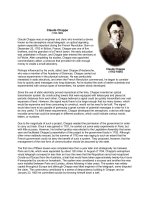
<span class='text_page_counter'>(1)</span>Claude Chappe (1763-1805). Claude Chappe was an engineer and cleric who invented a device known as the semaphore visual telegraph, an optical signaling system especially important during the French Revolution. Born on December 25, 1763 in Brûlon, France, Chappe was one of five brothers, and the grandson of a French baron. His early education was undertaken in Rouen, and Chappe later entered the seminary at la Flèche. After completing his studies, Chappe was appointed commendatory abbot, a sinecure that provided him with enough money to create a small laboratory. Perhaps influenced by his uncle, abbot Jean Chappe d'Hauteroche, who was a member of the Academy of Sciences, Chappe carried out various experiments in the physical sciences. He was particularly interested in static electricity, and when the French Revolution commenced, he began to consider how to quickly send messages over long distances. As he studied the work of earlier scientists and experimented with various types of transmitters, his system slowly developed. Since the use of static electricity proved impractical at the time, Chappe invented an optical transmission system. By constructing towers that were equipped with telescopes and placed at periodic distances from each other, Chappe believed a signal could be quickly transmitted over vast expanses of land. However, the signal would have to be large enough that too many towers, which would be expensive and time consuming to construct, would not be need to be built. The signal would also have to be capable of portraying a great number of potential messages in order for it to be very useful. To fulfill these requirements, Chappe developed the semaphore, a device with large movable arms that could be arranged in different positions, which could indicate various words, letters, or numbers. Due to the magnitude of such a project, Chappe needed the permission of the government in order to carry out trials. Once it was gained in 1791, he carried out some early experiments in Paris, but with little success. However, his brother Ignatius was elected to the Legislative Assembly that same year and facilitated Chappe's presentation of the project to the government body in 1792. Although other minor setbacks ensued, by the summer of 1793 war was raging to such an extent that the French government could not deny the benefit of such a system. They proposed, however, that the management of the new form of communication should be assumed by the state. The first line of fifteen towers was completed less than a year later and strategically ran between Paris and Lille, which were separated by about 120 miles. In August of 1794, Chappe's semaphore visual telegraph conveyed in less than an hour the news that the Republican army had recaptured Condé-sur-l'Escaut from the Austrians, a feat that would have taken approximately twenty-four hours if transported by courier on horseback. The system was considered a success and another line was soon installed between Paris and Landau, others following in later years. The system was widely copied throughout Europe and although Chappe was titled engineer of the telegraph, some disputed the claim. The controversy contributed to a sense of despondency building in Chappe, and on January 23, 1805 he committed suicide by throwing himself down a well..
<span class='text_page_counter'>(2)</span> History The telegraph was invented by Claude Chappe (1763 1805). The Chappe brothers carried out on March 3, 1791 a first public experiment of air telegraph of Brûlon with Parcé on a distance of 14 km. The air telegraphs were adopted on July 26, 1793 by national Convention. July 16, 1794 the first official line Paris-Lille was brought into service.. In a few years, 5000 km of network and nearly 533 stations were set up, covering a significant part of the French territory. The success of the optical telegraph grew blurred and Bonaparte reduced into 1800 the appropriations aloués to their construction and maintenance. Claude Chappe did not support this disavowal and desperate threw itself in a well in 1805 at the 42 years age. The brothers continued the development of the optical telegraph until 1830, date on which it was definitively stopped. The defect of the telegraph of Cap is that it does not function during the night and by time of fog. This defect had a considerable importance in the French history: At the time of the return of Napoleon during the hundred days, this one unloaded on March 1, 1815 with 1200 men with the Gulf Juan, but Paris, then under the reign of Louis XVIII, learned it by the telegraph from Cap only on March 5, 1815, due to fog. So Napoleon was not intercepted (without success) only with the lake of LAFFREY right before Grenoble, March 7, 1815.. The telegraph of Cap was replaced then by the electric telegraph.. Principle of operation the telegraph of the Chappe brothers is a 5 height m mechanical device made up: - of two wings or indicators 2 meters length and 30 cm broad. - counterweight to ensure the balance of the unit. - of a manipulator to put moving the wings..
<span class='text_page_counter'>(3)</span> Detail of a manipulator of the Chappe's telegraph exposed to the Museum. The Chappe telegraph was placed on a natural height (hill, mountain) or artificial (turn).. The Chappe's telegraph at the Museum Animated gif by Philippe Morin. The manipulator modified the position of the wings to transmit a message according to an established code. This visible message by far was observed using glasses.. Telescop for Chappes' telescop at the Museum. The codes used were not the same ones according to countries' but the objectives remained identical: speed of transmission and confidentiality of the message..
<span class='text_page_counter'>(4)</span> An original apparatus: The electric telegraph with signals Cap In 1850, i.e. approximately 17 years after the realization of the first electric needle telegraphs, an apparatus was developed by associating the modern techniques of the electric telegraph and that of the Chappe telegraph.. The electric telegraph with Chappe's signals at the Museum. This telegraph was then replaced by the recording telegraphs (Morse, Wheastone) which made it possible to keep a trace of the message sent To discover the evolution of the telegraphs, click on one of the images of the electric telegraphs with wire.. The pictures are placed by chronological apparition time of telegraph. >> Site map <<.
<span class='text_page_counter'>(5)</span> Royal Navy Semaphore Procedure Peculiar "arms" can sometimes be seen on photographs of Royal Navy warships. These were semaphores, yet another signalling device. The following description of their use in the RN has been taken from the 1913 edition of the Handbook of Signalling, printed by the Admiralty. Note that a graphic of the actual code may be found at the bottom. SEMAPHORE How Signals are to be read.. 1. The Alphabetical Sign shows from which side the signs are to be read. 2. The Signs, as a general rule, are made by a Signalman facing the ships addressed; they are read from the right-hand side of the sending Signalman. 3. As it is often necessary to signal in opposite directions by the same semaphore, Signalmen must be careful to observe in which direction the Sender is facing, more especially when he is using hand flags, so that they can tell the side they must read the signs from their point of view. It should be noted that when the Alphabetical Sign is shown it is the left arm which is extended horizontally. Rules for Semaphoring.. 1. It must be remembered by the Sender that the semaphore arms should be presented to the observer with a strongly contrasting background; it is best to have the sky as a background, but where this is not possible, the background should be that which throws the semaphore arms into the greatest relief. 2. The semaphore arms must be placed at the exact position indicating the letters or signs, the arms being moved from sign to sign by the shortest route; a distinct pause being made at each sign, according to the rate of sending. 3. At the end of each word or group the arms are to be dropped to the closed position. When double letters occur, the arms are to be dropped to the closed position after the first letter is made and then moved out to the second letter without pausing..
<span class='text_page_counter'>(6)</span> 4. As a general rule, with ships in Close Order, semaphore messages should be transmitted at the rate of 15 words per minute on the semaphore, or 20 words per minute with hand flags. 5. When using the mechanical semaphore it is important that the positions of the arms should exactly agree with the positions of the handles, and that there is a minimum of backlash in the chains. 6. When using hand flags the signs are formed in the same plane as the shoulders of the Sender, arms and staves at their full extent, forefingers along the staves. When at the closed position the arms should hang straight from the shoulder. 7. Code and Cypher Messages are not to be passed by semaphore but are to be made by Morse. The Semaphore Flag.. 1. Flag "E", hoisted either singly or inferior to Distinguishing Signals, denotes that a communication is about to be made by semaphore. The arms of the semaphore are, at the same time, to be set to the Alphabetical Sign. Method of Answering. 1. The Answering Pendant is to be hoisted at the dip immediately the ship or ships addressed see the signal and hoisted close up when they are ready to read and write down. 2. It is to be dipped when a word is lost, and the ship making the signal is then to repeat preceding words until the Answering Pendant is again hoisted close up. Procedure. 1. When the ship or ships addressed have answered, the following procedure will be carried out: Preamble: Hercules - Exmouth (full stop sign) Message - time of origin.
<span class='text_page_counter'>(7)</span> 2. If there is no doubt as to the Ship of Origin or the ship addressed, the preamble to a signal is unnecessary and should be omitted, but it is always to be included in signals passed through a ship, or made to more than one ship, or if either the Sending or Receiving Ship is in such a position as to render her identity uncertain. Special Signals. 1. A Semaphore Signal is commenced with the Alphabetical Sign. 2. The Alphabetical Sign is also to precede each distinct message. 3. The Numeral Sign is always to precede signs on the Semaphore when they represent numbers. 4. The Annul Sign denotes that the word or group immediately preceding it is erased; the Alphabetical or Numeral Sign will then be made, followed by the last word or group sent correctly, and the message continued. 5. If, after a message has been concluded, it is required to alter any particular word, words, or group, the Annul Sign should be made, followed by the word, words, or group to be erased, and then the Alphabetical or Numeral Sign followed by the correct word, words, or group. 6. Should it be required to cancel the whole message, the Annul Sign followed by the word "All" is to be made. 7. In order to render the text of a message to be semaphored perfectly clear, the following signs are to be made use of:. Full Stop. AAA. Tack-line or Break Sign. II. Words to be in parenthesis. KK. Words to be underlined. UK. Words to be in inverted commas. RR. 8. Any of the other Signs employed in Post Office Morse may also be used if required..
<span class='text_page_counter'>(8)</span> When Figures should be Spelt. 1. Unless there are special reasons to the contrary, figures and times which occur in the text of a message are to be spelt out by the Sender. Time of Origin. 1. All Signals made by semaphore are to conclude with a "Time of Origin", which is to be considered as part of the message and made by numerals. 2. The "Time of Origin" is to be the actual time at which the signal was ordered to be made. 3. It will be indicated by a group of four figures, representing hours and minutes; the first two being the hours, and the last two the minutes. The hours will be reckoned from Midnight 00 to Midnight 24. Example: . 1.12 am would be indicated by 0112 1.4 pm would be indicated by 1304 Midnight would be indicated by 2400. Hints when Semaphoring. 1. Small Affirmatives or Answering Pendants should not be left at the dip. If the sending ship does not stop in a reasonable time, the Affirmative or Answer should be hauled down, and a repetition called for. 2. "Dip and hoist" is also a useful check, though not infallible, as cases have occurred of two ships making it at the same time. 3. In large fleets it will be found convenient to arrange special flags for answering certain ships. 4. Whenever possible, each sender should have a copy of the signal, and a hand to dictate. Where semaphores are widely separated and one person attempts to dictate to two or more at the same time, mistakes are bound to occur..
<span class='text_page_counter'>(9)</span> 5. In the case of a ship repeating, it is very important that the man reading another ship should be close alongside the man repeating. 6. An acknowledgement or a repeat back should be requested for all important signals when there is any possibility of an error. Semaphore Code [this seem to show the signs from the observer's point-of-view].
<span class='text_page_counter'>(10)</span>
<span class='text_page_counter'>(11)</span>