CT viem DTnhoi mau
Bạn đang xem bản rút gọn của tài liệu. Xem và tải ngay bản đầy đủ của tài liệu tại đây (485.42 KB, 33 trang )
CT VIEM DT THIEU MAU
1
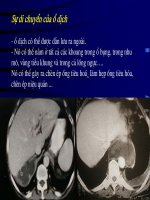
Viêm ĐT nhồi máu bên (P) ở nữ 83
Gần đây mô sợi trong tâm nhĩ and a hypotens
episode.Xuất hiện đau dua vùng đưới bên (P)
máu ở trực tràng.
CT với CE ở hai mức ở ĐT lên và góc gan.
-Dày thành đồng đều và bắt thuốc không đồn
nhất từng lớp đậm fđộ thấp và cao phù hợp v
phù
-ĐT (P) có dạng thậm nhiễm kèm tụ dịch qua
ĐT
- (S in b), pericolic fluid collections (F), and
of haustra. Diagnosis was confirmed at
colonoscopy, and ischemia resolved without
complications with conservative therapy. Flu
filled cysts are present in both kidneys
2
Figure 2. Ischemic colitis of left colon in a
67-year-old man with left lower quadrant pain
and an elevated WBC count, who was
suspected of having diverticulitis. Contrastenhanced CT scan reveals segmental colitis
involving the descending and sigmoid colon
(arrow, S). The thickened wall of the sigmoid
colon has a dry appearance with a sharply
defined, homogeneously enhancing wall,
without pericolic streakiness or fluid
collections. Sigmoidoscopy showed
hemorrhagic mucosa with patchy areas of
mucosal necrosis. Surgery 18 hours later
revealed full-thickness necrosis of the left
colon, which necessitated resection. The
rectum was normal.
3
Figure 3a. Ischemic colitis in a 47-year
old man with vasculitis, who presented
with abdominal pain and bloody diarrhe
(a) Contrast-enhanced CT scan reveals
involvement of the distal transverse col
and splenic flexure (arrows), with mark
wall thickening and pericolic streakines
(b) CT scan shows proximal descending
colon with concentric layers of low and
high attenuation (double-halo sign)
(arrow), consistent with colonic edema.
Diagnosis was confirmed at colonoscop
and biopsy. The ischemic process
resolved; however, the patient returned
months later and died of extensive bowe
infarction.
4
Figure 4a. Ischemic sigmoiditis in a
57-year-old man who presented with
fever and had an elevated WBC count
and guaiac-positive stools. (a)
Contrast-enhanced CT scan reveals a
multilocular abscess (A) in the right
lobe of the liver. (b) CT scan shows
that proximal sigmoid colon (S) has a
circumferential thickened wall (open
arrow), which contrasts with the
normal-appearing distal sigmoid colon
(solid arrows). Sigmoidoscopy with
biopsy showed erythematous mucosa,
moderate inflammation, and marked
hemosiderin deposits consistent with
ischemic colitis.
5
Figure 5a. Ischemia involving the entire
colon in a 77-year-old man with relapsing
polychondritis, arteriosclerotic heart disease,
and myocardial infarction, who had
previously undergone coronary artery
bypass surgery. Abdominal pain and rectal
bleeding were present. (a) Contrastenhanced CT scan shows heterogeneous
enhancement and wall thickening of the
transverse colon, as well as the right and left
colon (arrows), with loss of haustral
markings. (b) CT scan shows sigmoid colon
and rectum (arrows) with alternate layers of
high and low attenuation consistent with
edema. Findings mimic an acute
inflammatory colitis. Diagnosis was
confirmed at colonoscopy. A benign cyst is
present in the left kidney.
6
Figure 6a. Infarcted right colon
in a 72-year-old man with atrial
fibrillation who presented with
abdominal pain and fever and
had an elevated WBC count. (a)
Contrast-enhanced CT scan
shows pneumatosis affecting the
cecum (C) and ascending colon
(arrows) and ascites (A) in the
pelvis. (b) CT scan shows air in
the intrahepatic branches of the
portal vein (arrow). At surgery,
the right colon was infarcted,
and the pelvic fluid was infected.
7
Figure 7a. Ischemia of transverse colon in
an 81-year-old man with arteriosclerosis, a
recent syncopal episode, abdominal
tenderness, fever, an elevated WBC count,
and a decrease in the hematocrit. (a) CT
scan obtained without intravenous contrast
material shows high-attenuation fluid
consistent with abdominal hemorrhage (h)
that is associated with an ahaustral
transverse colon (T) with a thickened wall.
Small collection of air (arrow) was present
adjacent to the proximal transverse colon.
(b) Radiograph obtained after
administration of diatrizoate meglumine
(Hypaque Meglumine; Sterling Winthrop,
New York, NY) enema shows narrowing
of transverse colon (T) with small
extravasation (arrow) consistent with
sealed-off perforation. Findings obtained at
surgery performed 3 weeks after the initial
episode confirmed these findings.
8
Figure 8a. Ischemic colitis associated with
carcinoma of the colon in a 92-year-old
man who presented with abdominal pain
and rectal bleeding. (a) Contrast-enhanced
CT scan shows a circumferentially
thickened wall of the proximal sigmoid
colon (S) and a circumferential infiltrating
lesion consistent with carcinoma in the
distal sigmoid (arrows). (b) Radiograph
obtained after administration of diatrizoate
meglumine (Hypaque Meglumine; Sterling
Winthrop) enema shows the obstructing
carcinoma (curved arrow) and the
associated proximal ischemic colitis
(straight arrows). Findings were confirmed
at surgery and histopathologic
examination.
9
Figure 9a. Colonic infarction of mid–
ascending colon in a 99-year-old woman
who presented with acute right lower
quadrant pain of unknown cause. (a, b)
Contrast-enhanced CT scans obtained at
adjacent levels show a segmental area of
heterogeneous wall thickening of the right
colon (thick arrow in a and b) with
pericolic streakiness and a small pericolic
fluid collection (thin arrow in a). A large
cyst is present in the right kidney. Right
colectomy performed 6 hours later
revealed infarcted bowel. (c)
Photomicrograph from histopathologic
examination shows mucosal necrosis with
transmural hemorrhage (solid arrows) and
submucosal edema (open arrows).
(Hematoxylin-eosin stain; original
magnification, x40.)
10
11
12
13
14
15
16
17
18
19
20
21
22
23
24
25