COUNTERING TERRORISM
Bạn đang xem bản rút gọn của tài liệu. Xem và tải ngay bản đầy đủ của tài liệu tại đây (103.69 KB, 15 trang )
UNIT 11 COUNTERING TERRORISM
INTRODUCTION
Discussion
Which terrorist groups are you familiar with?
What do you understand by the word “terrorism”?
Who decides if an act is “terrorism”?
If an act comes from the state, e.g. a planned assassination of an opponent who the state considers a
threat, is the act not “terrorism”?
If something is defined as “terrorism” at one time, for example, the acts of extremist groups in
Northern Ireland, should these people ever be allowed to participate in political discussions
subsequently?
If the “terrorists” have political motives, e.g. independence for their group or minority, does this
mean they are not criminals but political prisoners if caught?
Can terrorist groups that act “for nationalistic principles”, e.g. the Basque movement, ETA, continue
without the support of the people they claim to represent?
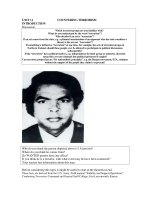
Who do you think the person depicted above is? A terrorist?
Where do you think he comes from?
Do WANTED posters have any effect?
If you think he is a terrorist, with what event may he have been connected?
Your teacher has information about this man.
Before considering this topic it might be useful to start at the theoretical end.
These texts are derived from the U.S. Army, Field manual “Stability and Support Operations”,
Combatting Terrorism, Command and General Staff College, Fort Leavenworth, Kansas
What do you think? Do these constitute terrorism?
1. Weapons and financial support for “freedom fighters” in their struggle for
independence.
2. People sabotaging important electric and communications installations during an
invasion of their country by a stronger power.
3. Nationalist separatists blowing up the ruling group’s administration buildings to
reinforce their demands for independence.
4. Supplying weapons to groups opposed to a democratically and legally-elected
government because it conflicts with the supplier’s ideological position.
5. Supplying equipment and installations to a “dangerous” state knowing that it may use
these offensively or threateningly.
Terrorism is a special type of violence. It is a tactic used in
peace, conflict and war. The threat from terrorism is ever
present and an attack is likely to occur when least expected.
A terrorist initiates the event that marks the transition from
peace to conflict or war. Combatting terrorism is a factor to
consider in all military plans and operations. Combatting
terrorism requires a continuous state of awareness; it is a
necessary practice rather than a type of military operation.
Detailed guidelines, establishing an organisational
programme to combat terrorism, including preventive and
protection measures and incident response planning can be
found in the Joint Publication 3-07-2 (1993). terrorism is a
criminal offense under nearly every national or international
legal code. With few exceptions, acts of terrorism are
forbidden in war as they are in times of peace. The Hague
Convention (1907) and the Geneva Convention of 1949
reinforce this idea.
Read the text carefully.
Is there a difference
between terrorism and
other criminal
offences?
Exercise 1 TERRORISM DEFINED
Complete the various parts of the definition.
Terrorism is the (1) ………………………… use of violence or the threat of violence to
(2)…………………fear; it is intended to (3)…………………. or intimidate governments
or societies in the (4)……………………….of goals which are generally political,
(5) ……………………. or (6)……………………… . This definition is carefully
formulated to (7) ………………….between terrorism and other forms of violence.
CHOOSE THE BEST WORD FOR EACH SPACE
1. a) special b) calculated c) considered d) intimidatory
2. a) cause b) start c) induce d) initiate
3. a) force b) compel c) coerce d) threaten
4. a) objective b) search c) accomplishment d) pursuance
5. a) religion b) philosophical c) polemic d) religious
6. a) idealistic b) illogical c) ideological d) nationalistic
7. a) differ b) distinguish c) diverge d) devolve
Exercise2
JOIN THE PARTS OF THE SENTENCES TOGETHER TO COMPLETE THE
TEXT
A. People employ terrorism …. 1. … as terrorists generally know what
they want to achieve
B. The tendency to label as “terrorism” … 2. …in the name of a variety of causes.
C. Terrorism is calculated… 3. …that is engendered in someone other
than the victim.
D. The selection of a target for terrorists… 4. …conducted for its impact on an
audience
E. Terrorism is intended to produce fear… 5. …is both planned and rational
F. Terrorism is a psychological weapon… 6. …any violent act of which we
disapprove, is erroneous.
Activity 1
VOCABULARY
Which words go with ..
goals For example: to achieve goals
fear (N) For example: to induce fear
attack (N) For example: terrorist attack; carry out an attack on …
cause (N) For example: to fight for a cause;
Exercise 3 SOME HISTORICAL PERSPECTIVES
USE THESE WORDS TO COMPLETE THE TEXT
compel/ unpredictability/
virtually/ aborted/profound/
incidental/ granted/ sought/undermine/ concessions
Throughout history, extremists have practised terrorism to generate fear and to (1)
__________________ a change in behaviour.
Frequently, terrorism was (2) _______________________ to other forms of violent
action- insurgency or war. Before the 19
th
Century, terrorists usually
(3) ____________________ immunity from attack to certain categories of people. Like
other warriors, terrorists recognized innocent people, not involved in the conflict.
Terrorists usually excluded women, children and the elderly from their activities. For
example, in late 19
th
Century Russia, radical planning the assassination of the Tsar, (4)
__________________several attacks because they risked harming innocent people. “Old-
school” terrorism was direct; it intended to produce a political effect through the injury or
death of the victim. The development of bureaucratic states led to a (5)
___________________ change in terrorism. Modern governments have a continuity that
older, personalistic governments did not. Terrorists found that the death of a single
individual, even a monarch, did not necessarily produce the policy changes they (6)
___________________. Terrorists reacted by turning to an indirect method of attack. By
the early 20t
h
Century, terrorists began to attack people previously considered innocents
to generate political pressure. These attacks had the effect of creating a public atmosphere
of anxiety and, as a result, were planned to (7)__________________ confidence in the
government. The (8) ________________________ of the attacks, their apparent
randomness made it (9) ____________________________impossible for governments to
protect potential victims. The public demands protection that the state cannot give.
Frustrated and frightened people then demand that the government make (10)
_____________________ to stop the attacks.
Activity 2 THE TERRORISTS
Terrorists are inspired by many different motives. They may be classified into three
categories: RATIONAL, PSYCHOLOGICAL OR CULTURAL. A terrorist, of course,
may be shaped by all three.
Decide into which category the statements may be placed.
a) The terrorist thinks through his goals and options, making a cost-benefit analysis.
b) “Splinter-groups” among terrorists are often more violent than their “parent” group.
c) Terrorists do not even consider they may be wrong although others’ views may be
assessed on merit.
d) Terrorists tend to project their own anti-social motivation on others, creating a
polarized “us” and “them” perspective.
e) Some political systems have no effective non-violent means for changes in power
structure or “succession”.
f) Terrorist groups ask a crucial question: Can our actions be successful in attaining our
goals without causing a backlash that will destroy the cause and perhaps our own people?
g) A terrorist group must terrorise. As a minimum it must commit violent acts to maintain
group self-esteem and legitimacy.
h) Society generally rejects as unbelievable such actions as vendettas, self-destruction,
ethnic cleansing, religious martyrdom, etc. when we observe it in others.
i) When a terrorist group approaches its stated goals, it is often inclined to re-define them.
j) A major determinate of terrorism is the perception of outsiders and anxiety about ethnic
group survival. Fear of cultural extermination leads to violence.
Can you think of authentic examples of these? For example, from Northern Ireland, from
Spain, from Chechnya, from the Middle East, from North Africa …?
Activity 3 READING
Read the text. It is an immediate response by Noam Chomsky to the September 11 attacks.Chomsky is
perhaps the most famous living linguistic scientist. He has been critical of American policy for over 30
years and is considered an extremely intelligent person, although frequently very opposed to American
foreign policy. What are your reactions to this?
Today's attacks were major atrocities. In terms of number of victims
they do not reach the level of many others, for example, Clinton's bombing of the
Sudan with no credible pretext, destroying half its pharmaceutical supplies and
probably killing tens of thousands of people (
no one knows, because the US
blocked an inquiry at the UN and no one cares to pursue it). Not to speak of
much worse cases, which easily come to mind. But that this was a horrendous
crime is not in doubt. The primary victims, as usual, were working people:
janitors, secretaries, firemen, etc. It is likely to prove to be a crushing blow to
Palestinians and other poor and oppressed people. It is also likely to
lead to harsh security controls, with many possible ramifications for
undermining civil liberties and internal freedom.
The events reveal, dramatically, the foolishness of ideas about "missile
defense." As has been obvious all along, and pointed out repeatedly by
strategic analysts, if anyone wants to cause immense damage in the US,
including weapons of mass destruction, they are highly unlikely to
launch a missile attack, thus guaranteeing their immediate destruction.
There are innumerable easier ways that are basically unstoppable. But
today's events will, nonetheless, be used to increase the pressure to
develop these systems and put them into place. "Defense" is a thin cover
for plans for militarization of space, and with good PR, even the
flimsiest arguments will carry some weight among a frightened public.
In short, the crime is a gift to the hard jingoist right, those who hope
to use force to control their domains. That is even putting aside the
likely US actions, and what they will trigger -- possibly more attacks
like this one, or worse. The prospects ahead are even more ominous than
they appeared to be before the latest atrocities.
Noam Chomsky
These words may have caused some difficulty:
janitor: caretaker of a building
flimsy-flimsier-flimsiest : weak, without any real weight or force ( a flimsy argument or excuse)
“ ..hard jingoistic right”: the right in politics is always considered more conservative, traditional,
individual-country focused and more nationalistic; “jingoistic” is an expression which goes back
to the days of the British Empire when national interests were always pursued very vigourously.
Any threat to the Empire was rapidly responded to- usually by force!
Which words or phrases mean …?
1. countless:_____________________________
2. repercussions: ________________________
3. set off/initiate a reaction or response: ______________________________
4. without any real justification: ____________________________________
Discuss the purpose and effect of the underlined sections.
READING AND DISCUSSION
FORMER OFFICER ON TRIAL FOR JUSTIFYING TORTURE
IN THE ALGERIAN WAR
Adapted from an article by Franck Johann from “Le Monde” which appeared in
“The Guardian Weekly” edition, 06 December 2001
For the first time since 1962, a high-ranking French army officer has been tried in a criminal
court on charges of justifying the use of torture during the Algerian war for independence.
General Paul Aussaresses, 83, whose memoirs caused a furore earlier this year, faces a jail
sentence of up to five years- for his writing rather than for his actions- even though he has
admitted the torture and killing of 24 suspected rebels in the eight-year conflict which ended in
1962.
A Second World War resistance hero, General Aussaresses is charged with “complicity in
justifying war crimes”. The actual crimes are covered by an amnesty offered in the 1960s to all
French soldiers who served in Algeria. Aussaresses regrets nothing, arguing that someone had to
do the dirty work in Algeria. He did it, he says, without pleasure and without pity. And he