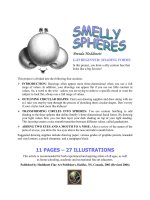
Smelly Spheres
Bạn đang xem bản rút gọn của tài liệu. Xem và tải ngay bản đầy đủ của tài liệu tại đây (969.49 KB, 11 trang )
Brenda Hoddinott
G-03 BEGINNER: SHADING FORMS
In this project, you draw a silly cartoon face that
looks like a big fat nose!
This project is divided into the following four sections:
Ü INTRODUCTION: Drawings often appear more three-dimensional when you use a full
range of values. In addition, your drawings can appear flat if you use too little contrast in
values. So, a word to the wise - unless you are trying to achieve a specific mood or want the
subject to look flat, always use a full range of values.
Ü OUTLINING CIRCULAR SHAPES: Find your drawing supplies and draw along with me
as I take you step-by-step through the process of sketching three circular shapes. Don’t worry
if your circles look more like kidneys!
Ü TRANSFORMING CIRCLES INTO SPHERES: You use contour hatching to add
shading to the three spheres that define Smelly’s three-dimensional facial forms. By drawing
your light values first, you can then layer your dark shading on top of your light shading.
This layering creates a nice smooth transition between different values, called graduations.
Ü ADDING TWO EYES AND A MOUTH TO A NOSE: After a review of the names of the
parts of an eye, you draw the two eyes above the nose and add a mouth below.
Suggested drawing supplies include drawing paper, various grades of graphite pencils, kneaded
and vinyl erasers, a pencil sharpener, and a sandpaper block.
11 PAGES – 27 ILLUSTRATIONS
This article is recommended for both experienced and aspiring artists of all ages, as well
as home schooling, academic and recreational fine art educators.
Published by Hoddinott Fine Art Publishers, Halifax, NS, Canada, 2003 (Revised 2006)
Copyright to all articles, images, text, projects, lessons and exercises within this drawing class belong to Brenda Hoddinott and may
not be reproduced or used for any commercial purposes whatsoever without the written permission of Brenda Hoddinott.
Web sites and
2
INTRODUCTION
Drawings appear more three-dimensional when you use a full range of values. Values are the
different shades of gray created in a drawing, by various means, such as varying both the density
of the shading lines, and the pressure used in holding your pencils. In addition, your drawings
can appear flat if you use too little contrast in values. Contrast measures the degree of difference
between the light and dark values within shading. Shading refers to the various shades of gray
(values) in a drawing that make the subjects appear three-dimensional.
So, a word to the wise - unless you are trying to achieve a specific mood or want the subject to
look flat, always use a full range of values.
ILLUSTRATION 03-01
Examine this illustration of the final drawing and note the
following:
Ü The light source is from the upper right. Light
source refers to the direction from which a
dominant light originates.
Ü From the highlight (which is usually left the
white of the paper), the shading begins with
very light values and then gets darker. A
highlight is the brightest area of an object;
usually, the section that is closest to the light
source.
Ü Medium and dark values are used in those areas that
receive less light, such as those surfaces that are closer to or
in the shadowed areas.
OUTLINING CIRCULAR SHAPES
Find your drawing supplies and draw along with me as I take you step-by-step through the
process of sketching three circular shapes.
ILLUSTRATION 03-02
1. With an HB pencil, lightly sketch a circle in the
middle section of your drawing space.
Don’t worry if your circle looks more like a kidney!
The bad news is: no lesson can teach how to draw a
circle. The good news is: “practice” is a fantastic
teacher.
As you sketch, try rotating your paper and looking at
your drawing from different perspectives. This little
trick often allows you insight into the problem areas.
Looking at the reflection of your circle in a mirror
will also help you to see areas in need of fixing.
Copyright to all articles, images, text, projects, lessons and exercises within this drawing class belong to Brenda Hoddinott and may
not be reproduced or used for any commercial purposes whatsoever without the written permission of Brenda Hoddinott.
Web sites and
3
ILLUSTRATION 03-03
2. Draw two smaller circles slightly
below and on either side of the
big circle.
Observe that a portion of each of
the smaller circles is drawn
inside the big circle.
ILLUSTRATION 03-04
3. Use your vinyl eraser to erase
the sections of the small
circles that are inside the big
circle.
Observe that the big circle now
appears to be in front of
(overlaps) the smaller circles.
4. Pat all your lines with your
kneader eraser until you can
barely see them.
ILLUSTRATION 03-05
5. Add neat crisp lines to redefine
your circle shapes.
Use an HB or 2B pencil. You can
draw these circles (or kidney
shapes if you wish) freehand.
However, it’s perfectly ok to use
a compass or some other tool to
help you draw circles.
6. Use your kneaded eraser to
lighten the two curved lines
that separate the three
circles.
Copyright to all articles, images, text, projects, lessons and exercises within this drawing class belong to Brenda Hoddinott and may
not be reproduced or used for any commercial purposes whatsoever without the written permission of Brenda Hoddinott.
Web sites and
4
ILLUSTRATION 03-06
7. Draw a curved line in the lower inside section
of each of the smaller circles.
If this was a nose (grin) these would be the
openings of the nostrils.
TRANSFORMING CIRCLES
INTO SPHERES
In this section, you use contour hatching to create three dimensional spheres on a two
dimensional drawing surface! Many artists prefer to work from light to dark. By drawing your
light values first (with your HB pencil), you can then layer your dark shading on top of your light
shading (with your 4B). This layering creates a nice smooth transition between different values,
called graduations. A graduation, also called graduated shading or graduated values, is a
continuous progression of values, from dark to light or light to dark. The goal of graduated
shading is to keep the transitions between the different values flowing smoothly into one another,
as in this illustration.
8. Use various pencils and curved hatching lines, to add light, medium, and dark values
(the shadow areas) to the large sphere.
ILLUSTRATION 03-07
The curved hatching lines
follow the curves of the
circle shape.
Hatching is a series of lines
(called a set) drawn closely
together to give the illusion
of values.
Note that the highlight is
left the white of the paper.
The shading graduates
down from the highlight
towards the lower right of
the sphere.
The values begin light
(close to the highlight) and
become dark and then light
again close to the lower
right edge of the sphere.
Copyright to all articles, images, text, projects, lessons and exercises within this drawing class belong to Brenda Hoddinott and may
not be reproduced or used for any commercial purposes whatsoever without the written permission of Brenda Hoddinott.
Web sites and
5
ILLUSTRATION 03-08
The tiny rim of light
at the bottom edge
is called reflected
light.
Remember to let
your pencils from
light (HB) to dark
(4B) do a lot of the
work in drawing
values. You only
need to decide
where to place all
your values.
ILLUSTRATION 03-09
9. Use the same shading technique you
used for the large sphere, to shade in
the smaller sphere on the right.
ILLUSTRATION 03-10
Pay close attention to the shading
on the lower left, which indicates
the nostril.
10. Shade in the small circle on
the left, in the same way as
the one on the right.
Refer to the two illustrations
on the following page. The
overall values of this circle
are much darker than the
other.