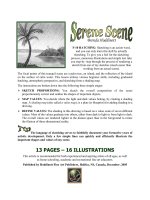
Serene Scene
Bạn đang xem bản rút gọn của tài liệu. Xem và tải ngay bản đầy đủ của tài liệu tại đây (2.22 MB, 13 trang )
Brenda Hoddinott
F-10 HATCHING: Sketching is an action word,
and you can only learn this skill by actually
sketching. To give you a feel for the sketching
process, numerous illustrations and simple text take
you step-by -step through the process of rendering a
sketch from one of my sketches (much easier than
working from an actual scene).
The focal points of this tranquil scene are a palm tree, an island, and the reflection of the island
on the surface of calm water. This lesson utilizes various beginner skills, including graduated
hatching, atmospheric perspective, and sketching from a shading map.
The instructions are broken down into the following three simple stages:
Ü SKETCH PROPORTIONS: You sketch the overall composition of the scene
proportionately correct and outline the shapes of important objects.
Ü MAP VALUES: You decide where the light and dark values belong, by creating a shading
map. A shading map (also called a value map), is a plan (or blueprint) for adding shading to a
drawing.
Ü DEFINE VALUES: The shading in this drawing is based on a value scale of seven different
values. Most of the values graduate into others, either from dark to light or from light to dark.
The overall values are rendered lighter in the distant space than in the foreground to create
the illusion of three-dimensional reality.
The language of sketching serves to faithfully document your formative years of
artistic development. Only a few simple lines can quickly and efficiently illustrate the
important shapes and values of any scene.
13 PAGES – 16 ILLUSTRATIONS
This article is recommended for both experienced and aspiring artists of all ages, as well
as home schooling, academic and recreational fine art educators.
Published by Hoddinott Fine Art Publishers, Halifax, NS, Canada, December, 2005
Copyright to all articles, images, text, projects, lessons and exercises within this drawing class belong to Brenda Hoddinott and
may not be reproduced or used for any commercial purposes whatsoever without the written permission of Brenda Hoddinott.
Web site or
2
SKETCH PROPORTIONS
The goal in this section is to very lightly render a proportionately correct map of where the
different parts of the scene are in relation to one another.
Proportion is the relationship in size of one component of a drawing to another or others. A
sketch (noun) is a simple drawing that captures the integral aspects of a subject quickly and
efficiently. To sketch (verb) refers to the process of rendering a sketch.
ILLUSTRATION 10-01
1) Study the subject.
Seeing is by far the most
important step toward
creating a proportionately
correct sketch.
Pretend that this sketch is
an actual scene. Look at the
contours and proportions.
Contour lines are formed
when the shared edges of
spaces and/or objects meet.
A contour drawing is
comprised of lines that
follow the contours of the
edges of various
components of a drawing
subject.
Observe how all the
components within the scene
interact with one another.
A scene can be separated into foreground, middle ground, and distant space by overlapping (or
layering) objects in front of one another. Identify which objects are closest to you, those that are
farther away, and objects or parts of objects that overlap others.
Overlapping refers to a technique for creating the illusion of depth in a drawing by drawing a
subject so it visually appears to be in front of another (or others). The foreground is the part of
the scene that is closest to you. The middle ground is the space or section of the scene beyond the
subjects in the foreground. Distant space refers to the components of the scene that are farthest
away such as the distant mountain range and the sky.
The focal points of this tranquil scene are a palm tree, an island, and the reflection of the island
on the surface of calm water.
Focal point is a term used to identify the most important elements in a drawing. Primary focal
point is the most important center of interest (or focus) in a drawing. Secondary focal point(s) is
a center of interest in a drawing composition that is significant, but not as important as the
primary focal point.
Copyright to all articles, images, text, projects, lessons and exercises within this drawing class belong to Brenda Hoddinott and
may not be reproduced or used for any commercial purposes whatsoever without the written permission of Brenda Hoddinott.
Web site or
3
ILLUSTRATION 10-02
2) Follow along with
the following four
illustrations and
render a sketch of
the scene.
With simple sketch
lines, indicate the
basic shapes and
outlines of the objects
in your scene in
proper proportion to
one another.
Fine detail isn’t as
important as capturing
the overall essence of
the subject.
ILLUSTRATION 10-03
As a beginner
to sketching, you may
want to draw slowly.
Accuracy is more
important than speed.
Your speed will
automatically improve
the more you practice.
A few simple lines, along
with careful observation
of your drawing subject,
can visually describe
anything.
For example, sometimes
one curved line is all you
need to record the curve
of a tree or a section of
land.
Copyright to all articles, images, text, projects, lessons and exercises within this drawing class belong to Brenda Hoddinott and
may not be reproduced or used for any commercial purposes whatsoever without the written permission of Brenda Hoddinott.
Web site or
4
ILLUSTRATION 10-04
The mountains in the background
appear smaller than the section of
the island (on the right), which is
actually much closer and smaller.
Perspective is a visual illusion in
which objects appear to become
smaller the farther away they are
from the viewer.
Pay close attention to the shapes
created by the positive and
negative spaces.
Positive space refers to the space
occupied by the drawing subject
and/or its (or his or her) various
parts. Negative space refers to
the background around and/or
behind a drawing subject such as
objects, people, or animals.
ILLUSTRATION 10-05
Continue
adjusting your
drawing until you
are happy.
Check the
relationships of
objects to one
another, and
observe that
angles, sizes, and
proportions are
accurate.
At this point, the
preliminary sketch
is complete and
everything is
where it should
be.
Copyright to all articles, images, text, projects, lessons and exercises within this drawing class belong to Brenda Hoddinott and
may not be reproduced or used for any commercial purposes whatsoever without the written permission of Brenda Hoddinott.
Web site or
5
MAP VALUES
In this section you identify where the light and dark values belong, by creating a shading map. A
shading map (also called a value map), is a plan (or blueprint) for adding shading to a drawing.
The locations and sizes of the shapes of various values are identified and/or lightly outlined.
Values are the different shades of gray created in a drawing by various means.
The shading in this drawing is based on a value scale of seven different values. Shading (noun)
refers to the various values in a drawing that make images appear three-dimensional; (verb) the
process of adding values to a drawing so as to create the illusion of texture, form and/or three-
dimensional space. A value scale refers to the range of different values from light to dark or from
dark to light.
The value scale in the next illustration is rendered with hatching. Hatching is a series of lines
(called a set) drawn closely together to give the illusion of values. The individual lines in
hatching sets can be either far apart or close together. Each different value is numbered from
light to dark with numbers 1 to 7.
ILLUSTRATION 10-06
Compare the completed drawing (on the left) with the value map. Compare the numbers on the
map (on the right) to the corresponding numbers of the values in the value scale (above). The
palm tree isn’t illustrated in the map, but is shaded with several different darker values.
ILLUSTRATION 10-07 ILLUSTRATION 10-08