Ô tô Camry 3.5Q - Phần 1 - P26
Bạn đang xem bản rút gọn của tài liệu. Xem và tải ngay bản đầy đủ của tài liệu tại đây (62.8 KB, 3 trang )
BODY ELECTRICAL– AIR CONDITIONER
BE-88
JSYSTEM CONTROL
1.General
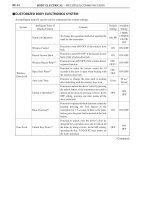
The air conditioner system has the following controls.
Control
Outline
Automatic
A/C
Manual
A/C
Neural Network
Control
[See page BE-89]
This control is capable of effecting complex control by
artificially simulating the information processing method of the
nervous system of living organisms in order to establish a
complex input/output relationship that is similar to a human
brain.
f —
Manual Control
The A/C ECU controls the damper positions (air inlet control
damper, air mix control damper and mode control damper) and
blower speed in accordance with the positions of the switches
(temperature control switch, blower switch, mode select switch
and air inlet control switch).
— f
Based on the temperature set at the temperature control switch,
the neural network control calculates the outlet air temperature
based on the input signals from various sensors.
f —
Outlet Air
Temp. Control
The temperature settings for the driver and front passenger are
controlled independently in order to provide separate vehicle
interior temperatures for the right and left sides of the cabin.
Thus, an air conditioner that accommodates the occupants’
preferences has been realized.
f —
Blower Control
Controls the blower motor in accordance with the airflow
volume that has been calculated by the neural network control
based on the input signals from various sensors.
f —
Automatically switches the air outlets in accordance with the
outlet mode that has been calculated by the neural network
control based on the input signals from various sensors.
f —
Air Outlet Control
In accordance with the engine coolant temperature, outside air
temperature, amount of sunlight, required blower, outlet
temperature, and vehicle speed conditions, this control
automatically switches the blower outlet to FOOT/DEF mode
to prevent the windows from becoming fogged when the outside
air temperature is low.
f —
Air Inlet Control
Automatically controls the air inlet control damper to achieve
the calculated required outlet air temperature.
f —
Through the calculation of the target evaporator temperature
based on various sensor signals, the A/C ECU optimally
controls the discharge capacity by regulating the opening extent
of the A/C compressor solenoid valve.
f f
Compressor
Control
The A/C ECU compares the A/C pulley speed signals, which
are transmitted by the lock sensor located on the A/C
compressor, with the engine speed signals, which are transmitted
by the ECM (crankshaft position sensor). When the A/C ECU
determines that the A/C pulley is locked, it turns off the
magnetic clutch. (Only for models with the 2GR-FE engine)
f f
Rear Window
Defogger Control
[See page BE-262]
Switches the rear defogger and outside rear view mirror heaters
on for 15 minutes to 60 minutes when the rear defogger button
is pressed. Switches them off if the button is pressed again while
they are operating.
f f
Outside
Temperature
Indication Control
Calculates the outside temperature using signals transmitted by
the outside temperature sensor. Calculated values are corrected
by the A/C ECU and then indicated on the multi-information
display.
f f
Self-Diagnosis
[See page BE-90]
A DTC (Diagnostic Trouble Code) is stored in the memory when
the A/C ECU detects a problem with the air conditioner system.
f f
BE
BODY ELECTRICAL – AIR CONDITIONER
189BE109
Input
Processing
Temp. Setting
Sensor Input
Switch Input
Control
Neural
Networking
Target Outlet
Temp.
Amount of
Sunlight Correction
Target Airflow
Volume
Outlet Mode
Inlet Mode
Compressor
Temp. Control
Correction
Various Types of
Airflow Volume
Corrections
Various Types
of Mode
Corrections
Various Types
of Corrections
Output
Processing
Air Mix Control
Damper
Blower Motor
Mode Control
Damper
Air Inlet Control
Damper
Compressor
Intermediate Layer
Input Layer
Output Layer
Outside
Temp.
Amount of
Sunlight
Room
Temp.
Target Output
Temp.
: Neural Network Operation Range
BE-89
2. Neural Network Control
D In previous automatic air conditioner systems, the A/C ECU determined the required outlet air
temperature and blower air volume in accordance with the calculation formula that has been obtained
based on information received from the sensors. However, because the senses of a person are rather
complex, a given temperature is sensed differently, depending on the environment in which the person is
situated. For example, a given amount of solar radiation can feel comfortably warm in a cold climate, or
extremely uncomfortable in a hot climate. Therefore, as a technique for effecting a higher level of control,
a neural network is used in the automatic air conditioner system. With this technique, the data that has been
collected under varying environmental conditions is stored in the A/C ECU. The A/C ECU can then effect
control to provide enhanced air conditioner comfort.
D The neural network control consists of neurons in an input layer, intermediate layer, and output layer. The
input layer neurons process the input data of the outside temperature, the amount of sunlight, and the room
temperature based on the outputs of the switches and sensors, and output them to the intermediate layer
neurons. Based on this data, the intermediate layer neurons adjust the strength of the links among the
neurons. The sum of these is then calculated by the output layer neurons in the form of the required outlet
temperature, solar correction, target airflow volume, and outlet mode control volume. Accordingly, the
A/C ECU controls the servo motors and blower motor in accordance with the control volumes that have
been calculated by the neural network control.
BODY ELECTRICAL – AIR CONDITIONER
BE-90
3. Self-Diagnosis
D The A/C ECU has a self-diagnosis function. It stores any operation failures in the air conditioner system
memory in the form of DTC (Diagnostic Trouble Code).
D There are two methods for reading DTC. One is to use an intelligent tester II, and the other is to read DTC
indicated on the heater control panel display (Only for models with automatic air conditioner).
D For details, see the Camry Repair Manual.