Tiểu luận tài chính công ngân sách giáo dục mỹ
Bạn đang xem bản rút gọn của tài liệu. Xem và tải ngay bản đầy đủ của tài liệu tại đây (1.34 MB, 24 trang )
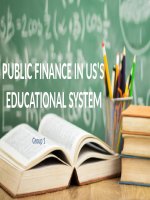
PUBLIC FINANCE IN US'S
EDUCATIONAL SYSTEM
Group 1
WWW.SITE2MAX.PRO
Free PowerPoint & KeyNote Templates
I/ Overview
1.1. USA education system
1.2. USA public finance on education overview
1.3. Funding
II. Policies
2.1. Public Finance Policy
2.2. How Do States Pay for Schools?
III. The efficacy of Public Education
3.1 The Advantages of Education to a Nation
3.2 Education and Employment
3.3 Education and Health
IV. Lesson for Viet Nam
I/ Overview – Education system
The United States is a country with a good university
system in the world. On the college rankings, US schools
continue to dominate, with over 50 of the top 200
universities in the world and are famous for the top 8
best universities – which is known as Ivy League :
Harvard, Yale, Princeton
US education is primarily a public education run by the
federal, state, and local governments in the United States
and financed by the state. The education of children in
kindergarten and kindergarten is compulsory.
I/ Overview – USA public finance on
education
America spends over $500 billion a year on public
elementary and secondary education in the United
States. On average, school districts spend $10,314 for
each individual student, although per pupil expenditures
vary greatly among states, school districts and individual
schools.
The share of education funding that federal, state, and
local governments provide has changed significantly
over time. Historically, elementary and secondary
education was funded largely by local governments and
states played only a supporting role.
II. US's policies on education Funding
Since 2002, federal funding for education has increased
by 36 percent, from $50 billion to $68 billion, according
to an analysis by the Committee for Education Funding, a
District of Columbia-based advocacy organization. It
peaked in 2009 at $97 million, thanks to an injection of
dollars from the economic stimulus, most of which went
to staving off teacher layoffs.
II. US's policies on education Funding
States rely primarily on income and sales taxes to fund
elementary and secondary education. State legislatures
generally determine the level and distribution of
funding, following different rules and procedures
depending on the state.
State funding for elementary and secondary education is
generally distributed by formula. Many states use funding
formulas that provide funding based on the number of
pupils in a district.
II. US's policies on education Funding
Property taxes support most of the funding that local
government provides for education. Local governments
collect taxes from residential and commercial properties
as a direct revenue source for the local school district.
How Do States Pay for Schools?
In the United States, in the Constitution,
education is the right for every children
and it is also compulsory and free until
age 16 or 18.
The federal government has a wide range of
instruments by which it can influence the
nation's higher education system to produce
socially desired outcomes.
- Expenditure programs
- Regulatory programs
- Tax programs.
How Do States Pay for Schools?
Major State Finance Systems
- The Foundation Program
- District Power Equalizing Systems
- Other Funding Approaches
- Financing Individual Student/District Needs and Characteristics
- Special Education Funding
- Gifted and Talented Funding Policy
A key issue related to funding formulae and the amount
of funds they provide per pupil is whether the funding
plan is equitable with respect to providing equal
opportunities for all students, regardless of their
circumstances. Another issue is whether the amount of
funding is adequate - sufficient to teach all children to
ambitious standards, laws, and requirements.
The connection between school
funding and achievement
Massachusetts in the early 1990s
reformed the state role in funding
local schools.
?
Massachusetts schools reached the
highest level of performance in the
U.S. and became increasingly
competitive internationally.
The connection between school
funding and achievement
The connection between school
funding and achievement
Economists showed that spending increases of 20 percent over the course of
the K-12 education of low-income students increases high school graduation
rates by 23 percentage points, increases annual earnings by 25 percent, and
similarly reduces poverty by 20 percentage points. These results are large
enough to close between two-thirds and all of the achievement gap on these
measures between low-income kids and those with higher income.
III. The efficacy of Public Education
The Advantages of Education to a Nation
According to Income and Poverty in the United States: 2016 Report
Income:
Median household income was $59,039 in 2016, an increase in real terms of 3.2
percent from the 2015 median of $57,230. This is the second consecutive annual
increase in median household income.
Earnings:
The total number of men and women working full-time, year-round with earnings
increased by 2.2 million between 2015 and 2016.
The 2016 real median earnings of men and women who worked full-time, yearround was $51,640 and $41,554, respectively, not statistically different from their
2015 estimates.
III. The efficacy of Public Education
The Advantages of Education to a Nation
Poverty:
The official poverty rate in 2016 was 12.7 percent, down 0.8 percentage points
from 13.5 percent in 2015. This is the second consecutive annual decline in
poverty. Since 2014, the poverty rate has fallen 2.1 percentage points from 14.8
percent to 12.7 percent.
In 2016 there were 40.6 million people in poverty, 2.5 million fewer than in 2015
and 6.0 million fewer than in 2014.
Between 2015 and 2016, the poverty rate for children under age 18 declined from
19.7 to 18.0 percent. The poverty rate for adults aged 18-64 declined from 12.4 to
11.6 percent. The poverty rate for adults aged 65 and older was 9.3 percent in
2016, not statistically different from the rate in 2015.
Education and Employment
Education and Employment
Education and Health
Pennsylvania bears significant costs for public health programs.
Over 2.1 million PA residents – 17% of all residents – receive public
health insurance (Medicaid).
The state spends over $14 billion on public health insurance each
year.
In the 10 PA counties with the highest percentage of residents
receiving public health insurance, 23% of residents receive these
benefits.
The public schools in these 10 counties are underfunded each year by
an average of nearly $2,700 per child or $67,500 per classroom of 25
children.
IV. Lessons for Viet Nam
Achievement vs. limit
• Basic Achievement:
- To complete the universalization of primary education in 2000, to popularize
junior secondary education in 2010
- The scale of education and the education network is expanding
- The people's access to education is increasing
- Budget for education is increasing (215.167 billion VND, 10% than 2016)
• Basic limitations:
- Heavy in quantity, poor in quality
- Imbalanced education (rank, occupation)
- Facilities are backward
- Access to education is still limited
- Education management still has many inadequacies: enrollment,
examinations, education testing
- The budget for education remains modest and spread (20% of total
IV. Lessons for Viet Nam
Some state subsidized education policies
• Exemptions, reduced tuition fees
• Scholarships, study supports
• support remote areas; boarding and boarding fees
• Students credit (800,000VND / 1 student / month)
• Policies supporting vocational training, training for poor people, rural
workers, etc.
• Investing and supporting investment in building facilities
• Mobilizing private resources: socializing education
References
/> />( />Book: The Price We Pay: Economic and Social Consequences of Inadequate Education
/> /> /> />NSNN 2017 Bo Tai Chinh