- Trang chủ >>
- THPT Quốc Gia >>
- Hóa
California science grade 3 (5)
Bạn đang xem bản rút gọn của tài liệu. Xem và tải ngay bản đầy đủ của tài liệu tại đây (4.65 MB, 18 trang )
Investigate and Experiment
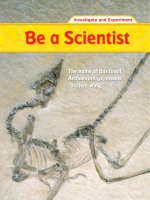
The name of this fossil,
Archaeopteryx, means
“ancient wing.”
What Is
Science?
Science is a way of understanding the world
around us. Scientists often ask questions about what
they observe. They call on many skills to help them
answer these questions. This process of asking and
answering questions in science is called inquiry.
In this section, you will see how scientists use
inquiry skills to learn about dinosaurs.
2
Investigation and
Experimentation
5. Scientific progress is made by
asking meaningful questions and
conducting careful investigations.
As a basis for understanding
this concept and addressing
the content in the other three
strands, students should develop
their own questions and perform
investigations. Students will:
a. Repeat observations to improve
accuracy and know that the
results of similar scientific
investigations seldom turn out
exactly the same because of
differences in the things being
investigated, methods being used,
or uncertainty in the observation.
b. Differentiate evidence from
opinion and know that
scientists do not rely on claims
or conclusions unless they are
backed by observations that can
be confirmed.
Inquiry Skills
These are the inquiry
skills scientists use. You
can use these skills, too.
Observe
Infer
Compare
Classify
Measure
Use Numbers
Communicate
Predict
Record Data
Analyze Data
Form a Hypothesis
Use Variables
Experiment
Make a Model
c. Use numerical data in describing
and comparing objects, events,
and measurements.
d. Predict the outcome of a simple
investigation and compare the
outcome with the prediction.
e. Collect data in an investigation
and analyze those data to develop
a logical conclusion.
3
Observation >
Are you an observant person? You might look
out the window to see if it is raining. You might even
listen for rain on the windowsill. You make
observations throughout your day. Observations
of the world around us often raise questions.
The diagram on this page shows processes
that scientists use to answer questions. Many call
this the “scientific method.” Scientists don’t
always use all of the steps. They may not use them
in the same order.
4
Inquiry Skills
When you make
observations, you use
these skills.
Observe Use your
senses to learn about an
object or event.
Classify Place things
that share properties
together in groups.
Measure Find the size,
distance, time, volume,
area, mass, weight, or
temperature of an
object or an event.
5
Question and Hypothesis >
Do you ask “why”
questions when you are
curious about things? The
work of scientists often starts with
an unanswered question. Scientists then
suggest a possible answer that can be tested
with an experiment. This is known as forming a
hypothesis. A good hypothesis must
▸ be based on what you observe.
▸ be testable by doing an experiment.
▸ be useful in predicting new findings.
Which of these dinosaurs was a meat eater and
which was a plant eater? Form a hypothesis to
answer this question.
6
Inquiry Skills
A scientific hypothesis must be testable. That
means you must be able to support or disprove your
hypothesis by experimenting. When you experiment
you do a hands-on activity to test an idea.
Scientists often do research before they experiment.
They look in books, scientific journals, or Internet
resources for information that other scientists have
found. Scientists also know that they cannot rely on
someone’s opinion or claim unless it has been backed
up by observations.
When you ask questions
and form hypotheses,
you use these skills.
Infer Form an idea
from facts or
observations.
Form a hypothesis
Make a statement that
can be tested to answer
a question.
3.IE.5.b. Differentiate evidence from opinion and know that scientists do not rely on
claims or conclusions unless they are backed by observations that can be confirmed.
7
Now it’s time to test your hypothesis with an
experiment. In experiments you change one variable to see what happens with another variable. For
example, you might make a model to find out how
the type of soil affects the shape of a dinosaur’s
footprint. What would happen if you changed both
the type of soil and the size of the dinosaur?
Experiments must be able to be repeated, too.
This allows scientists to evaluate and compare each
other’s work. They can check their own work too! So
a good experiment must:
▸ change only one variable at a time.
▸ be able to be repeated.
8
Experiment >
Inquiry Skills
Before you test a hypothesis, you must have a plan.
When scientists make a plan, they think about the
variables they want to test. A variable is something that
can be changed or controlled. It is important to change
or control only one variable at a time. Keep all other
parts of the experiment the same. That way you will
know what caused your results.
After they determine their variables, scientists
decide what materials they will need. Then they write
a procedure. A procedure is a series of numbered steps
that tell what to do first, next, and last.
After scientists have developed their procedure, they
predict what will happen when they follow it. To predict
means to tell what you think will happen.
When you experiment,
you use these skills.
Experiment Perform
a test to support or
disprove a hypothesis.
Use variables Identify
things in an experiment
that can be changed or
controlled.
Predict State possible
results of an event or
experiment.
Make a model Make
something to represent
an object or event.
9
What’s one important part of a
science experiment? Collecting
and recording good data! When
data are collected they may then
be explained, or interpreted.
Collecting and interpreting data
often requires working with
numbers.
This scientist will measure
and record the length and
weight of the dinosaur
fossil she is studying.
10
Collecting Data >
Inquiry Skills
When scientists follow their procedure, they make
observations and record data. Data is information.
Measurements are a type of data. Scientists use
measurements whenever they can to describe objects
and events. Scientists measure such things as length,
volume, mass, temperature, and time.
Scientists repeat their procedure several times.
This helps them know if their results are correct. They
often compare their results with other scientists. Other
scientists will repeat the procedure to see if they get
the same results.
When you collect and
interpret data, you use
these skills.
Use Numbers Order,
count, add, subtract,
multiply, and divide to
explain data.
Measure Find the size,
distance, time, volume,
area, mass, weight, or
temperature of an object
or an event.
Record Data
Accurately arrange
and store information
collected in science
investigations.
Analyze Data Use
the information that
has been gathered to
answer questions or
solve a problem.
11
You’ve collected and interpreted
data. Now what? It is time to draw a
conclusion. A conclusion
states whether your data
support your hypothesis.
But what if your data do not
support your hypothesis?
Perhaps different
experiments are needed.
Perhaps a new question
will result.
Scientists also share
with others what they have found.
This allows scientists around the
world to stay informed. And it allows
scientists to check each other’s work.
Scientists also share what they have
learned with the public. Have you ever
been to a museum with displays of
dinosaur fossils like this?
12
Conclusion
Inquiry Skills
Scientists organize and analyze their data to see if
the results support or disprove their hypothesis. They
determine if their prediction matched their results.
They draw conclusions and try to explain their results.
When you draw conclusions you interpret observations
to answer questions.
When you draw
conclusions and
communicate results,
you use this skill.
Communicate Share
information.
Sometimes the results of an experiment lead to new
questions. These questions can be used to form a new
hypothesis and perform new tests. The process starts
all over again. This process of asking and answering
questions is called the scientific method.
13
Forming a Hypothesis
Now it’s your turn to be a scientist and design a
good experiment.
Most science experiments start with an unanswered question.
Students wondered how dinosaur footsteps could show how
large the animal was. This was their question:
Question
• Does the length of your leg affect the distance
between your footsteps?
The students turned the question into a statement that
can be tested. This is called a hypothesis. A hypothesis is
an “if… then…” statement.
Hypothesis
If the leg is longer, then the distance between the footsteps
will be greater.
14
Defining Variables
Make a plan to test the hypothesis.
The first step is to identify what is being tested
and what is not being tested. These are called
your variables.
Controlled variables are not being tested. These
variables remain constant during an experiment.
In this experiment the controlled variables will be:
• The walking pace for each student tested
• The location of the test
• The starting point for the test
The only thing that will change is the factor you are
testing. This is the independent variable. Your
independent variables will be the length of the
leg of each student tested. The dependent variable
is what you are measuring. In this experiment
the dependent variable is the distance between
the footsteps.
15
Designing an Experiment
Design an experiment to test the hypothesis.
Here is an experiment a group of students
designed to test this hypothesis.
Procedure
1. Choose three classmates with different lengths
of leg. Measure the length from the waist to the
ground. Record each length.
2. Predict Which student will have the longest
footstep?
3. Measure a 3 meter piece of butcher paper. Mark
a START line at one end of the paper.
4. Have students take 3 normal steps from the
START line. Measure each footstep from heel to
heel. Record your measurements in a data chart.
5. Repeat the experiment to verify your results.
6. Was your prediction correct?
16
Analyzing Data
In order to communicate the results of an experiment the data
need to be presented in a clear way. These students used the
data chart to make a bar graph that shows how the length of
the leg relates to the length of the footstep.
Does this graph help others understand the results of the
experiment? Why is it important to repeat experiments?
3 IE 5.a. Repeat observations to improve accuracy and
know that the results of similar scientific investigations
seldom turn out exactly the same because of differences
in the things being investigated, methods being used, or
uncertainty in the observation. • 3 IE 5.c. Use numerical
data in describing and comparing objects, events, and
measurements. • 3 IE 5.d. Predict the outcome of a
simple investigation and compare the outcome with the
prediction. • 3 IE 5.e. Collect data in an investigation
and analyze those data to develop a logical conclusion.
17
Forming New Questions
It is important to repeat experiments. Why is this so?
Science experiments produce new ideas. New
questions may arise. After reading the results of
this experiment, other students wrote down the
following questions they were interested in studying.
The exciting thing about science experiments is that
they can cause new questions to arise. For example:
• What if you compared an adult and a student?
• What if you used an inclined plane instead of a flat
surface?
• What if you compared running footsteps?
Write a hypothesis for one of these questions or
one of your own. Talk about it with your class. Work
together to write a plan to test this new hypothesis.
18