Studies 60 1 march 2016 WEB
Bạn đang xem bản rút gọn của tài liệu. Xem và tải ngay bản đầy đủ của tài liệu tại đây (3.06 MB, 104 trang )
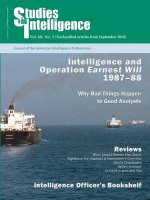
Studies in Intelligence Vol. 60, No. 1
Vol.
V
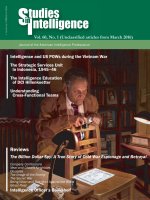
ol. 60, No. 1 (Unclassified articles from March 2016)
Journal of the American Intelligence Professional
Intelligence and US POWs during the Vietnam War
The Strategic Services Unit
in Indonesia, 1945–46
The Intelligence Education
of DCI Hillenkoetter
Understanding
Cross-Functional Teams
Reviews
The Billion Dollar Spy: A True Story of Cold War Espionage and Betrayal
Company Confessions
Near and Distant Neighbors
Disciples
The Image of the Enemy
The Secret War
Being Nixon and One Man Against the World
Ghost Fleet
Intelligence Officer’s Bookshelf
This publication is prepared primarily for the use of US government officials. The format, coverage, and
content are designed to meet their requirements. To that end, complete issues of Studies in Intelligence
may remain classified and are not circulated to the public. These printed unclassified extracts from a classified issue are provided as a courtesy to subscribers with professional or academic interest in the field of
intelligence.
All statements of fact, opinion, or analysis expressed in Studies in Intelligence are those of the authors.
They do not necessarily reflect official positions or views of the Central Intelligence Agency or any other
US government entity, past or present. Nothing in the contents should be construed as asserting or implying US government endorsement of an article’s factual statements and interpretations.
Studies in Intelligence often contains material created by individuals other than US government employees and, accordingly, such works are appropriately attributed and protected by United States copyright
law. Such items should not be reproduced or disseminated without the express permission of the copyright holder. Any potential liability associated with the unauthorized use of copyrighted material from
Studies in Intelligence rests with the third party infringer.
Studies in Intelligence is available on the Internet at: https:// www.cia.gov/library/center-for-the-study-ofintelligence/ index.html.
Requests for subscriptions should be sent to:
Center for the Study of Intelligence
Central Intelligence Agency
Washington, DC 20505
ISSN 1527-0874
The cover painting from the CIA Intelligence Art Collection is entitled, Tolkachev: Quiet Courage. It is an
oil on canvas painting by Kathy Fieramosca © 2012. The painting depicts the Soviet aviation electronics
engineer Adolf Tolkachev, who for six years provided a wealth of detailed information on highly classified
military capabilities being developed and deployed by the Soviet Union into the 1990s. He was betrayed
and executed in September 1986.
The lead book review in this issue is a review of David E. Hoffman’s biography of Tolkachev, The Billion
Dollar Spy: A True Story of Cold War Espionage and Betrayal.
Mission
The mission of Studies in Intelligence is to stimulate within the Intelligence Community the constructive discussion of important issues of the day, to expand knowledge
of lessons learned from past experiences, to increase understanding of the history
of the profession, and to provide readers with considered reviews of public media
concerning intelligence.
The journal is administered by the Center for the Study of Intelligence, which includes the CIA’s History Staff, CIA’s Lessons Learned Program, and the CIA Museum. CSI also provides the curator of the CIA’s Historical Intelligence Collection
of Literature. In addition, it houses the Emerging Trends Program, which seeks to
identify the impact of future trends on the work of US intelligence.
Contributions
Studies in Intelligence welcomes articles, book reviews, and other communications.
Hardcopy material or data discs (preferably in .doc or .rtf formats) may be mailed to:
Editor
Studies in Intelligence
Center for the Study of Intelligence
Central Intelligence Agency
Washington, DC 20505
Awards
The Sherman Kent Award of $3,500 is offered annually for the most significant
contribution to the literature of intelligence submitted for publication in Studies. The
prize may be divided if two or more articles are judged to be of equal merit, or it may
be withheld if no article is deemed sufficiently outstanding. An additional amount is
available for other prizes.
Another monetary award is given in the name of Walter L. Pforzheimer to the graduate or undergraduate student who has written the best article on an intelligence-related subject.
Unless otherwise announced from year to year, articles on any subject within the
range of Studies’ purview, as defined in its masthead, will be considered for the
awards. They will be judged primarily on substantive originality and soundness, secondarily on literary qualities. Members of the Studies Editorial Board are excluded
from the competition.
The Editorial Board welcomes readers’ nominations for awards.
Studies in Intelligence
Vol. 60, No. 1 (Extracts, March 2016)
CENTER for the STUDY of INTELLIGENCE
Contents
Washington, DC 20505
EDITORIAL POLICY
Articles for Studies in Intelligence may
be written on any historical, operational, doctrinal, or theoretical aspect of
intelligence.
The final responsibility for accepting or
rejecting an article rests with the Editorial Board.
The criterion for publication is whether,
in the opinion of the board, the article
makes a contribution to the literature of
intelligence.
EDITORIAL BOARD
Peter Usowski (Chairman)
John Bennett
William Caniano
Catherine S. Higgins
Gary Keeley
Stephen O. Maddalena
Jason Manosevitz
Terrence Markin
John McLaughlin
Fran Moore
LTG Theodore Nicholas (USA, Ret.)
Matthew J. Ouimet
Valerie P.
Jay R. Watkins
Cindy Webb
Members are all active or former
Intelligence Community officers. One
member is not listed.
EDITORS
Andres Vaart (Managing Editor)
Rebecca L. Fisher
Historical Perspectives
A Shield and a Sword
Intelligence Support to Communications with
US POWs in Vietnam1
Capt. Gordon I Peterson, USN (Ret.), and David C. Taylor
Operation ICEBERG
Transitioning into CIA:
The Strategic Services Unit in Indonesia
17
Forged by Fire
The Intelligence Education of the First
Head of CIA: Roscoe Hillenkoetter
39
William J. Rust
Richard E. Schroeder
Intelligence Today and Tomorrow
Designing for Intelligence Integration
Understanding and Creating Colocated,
Cross-Functional Teams
51
Frank Strickland and Chris Whitlock
Intelligence in Public Media
The Billion Dollar Spy: A True Story of Cold War
Espionage and Betrayal57
Reviewed by Nicholas Dujmovic
Company Confessions: Revealing CIA Secrets
Reviewed by Hayden Peake
61
Near and Distant Neighbors: A New
History of Soviet Intelligence63
Reviewed by John Ehrman
Disciples: The World War II Missions of the
CIA Directors who Fought for Wild Bill Donovan
Reviewed by Nicholas Reynolds
65
The Image of the Enemy—Intelligence
Analysis of Adversaries Since 194567
Reviewed by Jason Manosevitz
iii
The Secret War: Spies, Codes and
Guerillas, 1939–194571
Reviewed by Nigel West
Being Nixon: A Man Divided
and
One Man Against the World: The Tragedy of Richard Nixon75
Reviewed by Thomas Coffey
Ghost Fleet—A Novel of the Next World War79
Reviewed by Darby Stratford
Intelligence Officer’s Bookshelf
Compiled and reviewed by Hayden Peake
81
C ontributors
Darby Stratford is the penname of a former Directorate of Intelligence analyst now serving
in the Emerging Trends program of the Center for the Study of Intelligence.
Thomas Coffey is a former Directorate of Intelligence analyst serving with the Lessons
Learned Program of the Center for the Study of Intelligence.
Nicholas Dujmovic is a CIA historian, who, during most of his career, served in the CIA’s
Directorate of Intelligence. He is the author of The Literary Spy: The Ultimate Source for
Quotations on Espionage & Intelligence, which was published under the penname Charles
E. Lathrop.
John Ehrman is an analyst in the CIA’s Directorate of Analysis and a frequent contributor
to Studies in Intelligence.
Clayton Laurie is a CIA historian. He has served as a military historian and has taught
history at the university level.
Jason Manosevitz is an analyst in CIA’s Directorate of Analysis and a member of the Studies Editorial Board.
Hayden Peake has served in the CIA’s Directorates of Operations and Science and Technology. He has been compiling and writing reviews for the “Intelligence Officer’s Bookshelf”
since December 2002.
William Rust is the author of four books about US relations with Southeast Asia during the
Cold War. His most recent book, Eisenhower and Cambodia: Diplomacy, Covert Action,
and the Origins of the Second Indochina War, will be published by the University Press of
Kentucky in the spring of 2016.
Capt. Gordon I. Peterson (USN, Ret.), a naval aviator during the Vietnam War, flew 515
combat missions in attack helicopters with the Seawolves of HAL-3. He was a historical
consultant for the Smithsonian Channel documentary, The Spy in the Hanoi Hilton.” David
C. Taylor produced and wrote The Spy in the Hanoi Hilton. He is the recipient of numerous
awards for historical documentaries, including an Emmy and Peabody.
Nicholas Reynolds is a retired CIA officer and former CIA Museum historian.
Richard Schroeder is a retired CIA officer who serves as an adjunct professor specializing
in Cold War and intelligence issues at Georgetown University. He has served in two CIA
directorates and its Office of Congressional Affairs.
Frank Strickland and Chris Whitlock are former intelligence officers now serving as directors at Deloitte Consulting. They provide consulting services for various US government
agencies and commercial clients, focusing on change management and the use of analytics
in decisionmaking.
Nigel West is a British intelligence historian, who has since 1981 authored and coauthored
a multitude of works on intelligence, including detailed historical dictionaries of elements
of intelligence work and history.
v
Vol. 60, No. 1 (Extracts, March 2016)
v
v
v
A Shield and a Sword
Intelligence Support to Communications with
US POWs in Vietnam
Capt. Gordon I Peterson, USN (Ret.), and David C. Taylor
How was it that the US
military in Washington, DC, could know of,
consider, and communicate approval of an
escape plan the POWs
themselves had proposed?
On 2 and 4 May 1972, two US
Air Force SR-71 Blackbird reconnaissance aircraft overflew Hanoi,
North Vietnam. A third aircraft stood
back, ready to take the place of either
plane if it was unable to perform its
task. The pilots had not been told the
objective of their unusual mission. At
precisely noon on each day, flying at
supersonic speed, the lead plane set
off a sonic boom. Exactly 15 seconds
later the second aircraft’s signature
shock wave signaled to US prisoners
of war (POWs) held captive in the
Hoa Lo prison that their proposed
escape plan had been authorized.1
Earlier, in April, Adm. Thomas
H. Moorer, chairman of the Joint
Chiefs of Staff, signed a memorandum to the Commander in Chief of
the US Pacific Command approving
Operation Thunderhead, the code
name assigned to the US Seventh
Fleet’s POW rescue mission.2 The
amphibious-transport submarine USS
Grayback, with a platoon of Navy
SEALs on board, was deployed off
the coast of North Vietnam in June to
rescue any POW who had managed
to escape and reach a predetermined
rendezvous point, a small island at
the mouth of the Red River. The
platoon was directed to establish an
observation post on the island and
keep watch.3 Given the operation’s
military risks and political implications, it is reasonable to assume that
President Richard Nixon knew of and
had authorized the operation.
How was it that the US military in
Washington, DC, could know of, consider, and communicate approval of
an escape plan the POWs themselves
had proposed? How did the Navy’s
on-scene operational commanders
know the plan’s details in order to
deploy suitable forces to identify
and rescue escaping prisoners at the
correct location and time?
The answers to these questions
rest in the innovative and courageous ways the POWs in the Hoa
Lo prison—widely referred to as
the Hanoi Hilton—communicated
among themselves and then with the
outside world. Communication with
Washington involved the covert assistance of CIA, which worked with
the Pentagon and other intelligence
agencies to make possible a communication channel maintained during
the POWs’ prolonged confinement.
After their release in 1973, some
former POWs wrote in memoirs
about the covert communication techniques. Histories of POW experiences
have related others. More details are
contained in the book Spycraft: The
Secret History of the CIA’s Spytechs,
from Communism to Al-Qaeda by
former chief of CIA’s technical
operations division Robert Wallace
The views, opinions, and findings should not be construed as asserting or implying
US government endorsement of its factual statements and interpretations or representing the official positions of any component of the United States government. ©
Gordon I. Peterson and David C. Taylor, 2016.
Studies in Intelligence Vol 60, No. 1 (Extracts, March 2016)
1
A Shield and a Sword
US POW Camps in North Vietnam, 1965–1973
CHINA
Dogpatch
Lao Cai
Lai Chau
ng
So
Re
d
Ri
ve
r
Son La
iang
Ch
Bac
Thai
Lang
Son
Thai
Nguyen
Nghia
Lo
o
Ta
Tuyen
Quang
Lo
Ri
ve
r
Yen Bai
Bla
ck
CHINA
Cao Bang
Ha Gang
Mountain Camp
Vinh Phu
Viet Tri
Quang
Ninh
Ha Bac
Re
Son Tay
Briarpatch
HANOI
Faith
Skid Row
Hai
Ha
Hung
Farnsworth Tay
d
Rockpile
Ninh
Binh
Nam
Ha
r
LAOS
ve
Ri
Hoa Binh
Haiphong
Thai
Binh
Than Hoa
HANOI INSET
0
NORTH
VIETNAM
2 Kilometers
0
2 Miles
POW prison camp
Province boundary
Nghe
An
R
ed
Riv
er
Dirty
Bird
Grand
Lac
Operation
Thunderhead
Rescue Attempt
Gulf
of
Tonkin
Vinh
Vinh
1A
(Collection Camp)
Ha
Tinh
Alcatraz
Plantation
11A
(Hoa Lo)
Quang
Binh
M
e
ng
ko
Hanoi Hilton
Vinh Linh
Special Zone
6
Zoo
1A
LAOS
Vinh Linh
Demarcation
Line
SOUTH
VIETNAM
(U) Small numbers of US POWs were held in South Vietnam, Cambodia, and Laos, but the majority, mostly Navy
and Air Force aviators, were held in 15 camps dispersed in North Vietnam. The largest was Hoa Lo prison, in central
Hanoi. Data derived from map in official DOD history of Vietnam War POWs.
UNCLASSIFIED
2
MPG 16-2462 3-16
Studies in Intelligence Vol 60, No. 1 (Extracts, March 2016)
A Shield and a Sword
and coauthor Keith Melton. Additional information was contained in
the documentary film The Spy in the
Hanoi Hilton—a 2015 Smithsonian
Channel release—which provides a
still fuller accounting of the covert
communication effort.4
In Robert Wallace’s judgment,
the effort to communicate with US
POWs ranks as one of the most important operations in CIA’s history.5
Covert POW communications—radio
transmissions, messages employing
so-called secret writing, and coded
letters and postcards sent to family
members and then shared with US
intelligence agencies —made possible several important developments
during the long years of captivity
many POWs experienced. Beyond
providing opportunities to prepare
realistic escape plans, the communication network provided militarily
significant information to the Department of Defense (DoD) and US
intelligence agencies.
Information provided to POWs
also helped sustain morale. The
combination of personal fortitude,
religious faith, and communication
between prisoners and with friends
outside prison walls helped sustain
hope and life. “Knowledge was both
a shield and a sword for those of us
fighting the enemy without benefit
of conventional weapons,” said Air
Force Maj. Samuel R. Johnson, a
pilot shot down in April 1966 and
imprisoned in the Hanoi Hilton.6
Hell on Earth
According to a DoD history, 771
US military personnel were captured
during the Vietnam War. Of that
Beyond providing opportunities to realistically plan escapes, the communication network provided militarily
significant information to the Department of Defense and
US intelligence agencies.
number, 113 died in captivity and 658
were returned to US control.7 Small
numbers of prisoners were held in
South Vietnam, Cambodia, and Laos,
but the majority of POWs, mostly
Navy and Air Force aviators, were
imprisoned in 15 camps dispersed in
North Vietnam. (See map on facing
page.)
The Hoa Lo prison in central
Hanoi, built by the French during
their colonial rule of Vietnam, was
the largest. It was dubbed the Hanoi
Hilton in 1966 by Lt. Cdr. Robert
Shumaker during his imprisonment
there after he found in a shower a
bucket with the Hilton name on its
bottom.
Before North Vietnam improved
its treatment of captured aviators in
1970, many POWs were exploited
for intelligence and propaganda purposes. Intimidation, physical abuse,
and torture were used to enforce
strict obedience to prison rules, break
the will of prisoners, make them
reveal information about their fellow
prisoners, obtain written or recorded
admissions of guilt as war criminals,
and to extract statements critical of
the US-led war. “If hell is here on
earth,” Johnson observed,” “it is
located on an oddly shaped city block
in downtown Hanoi … and goes by
the name of Hoa Lo.”8
Cdr. James “Jim” B. Stockdale
was imprisoned at Hoa Lo in September 1965 after his A-4 Skyhawk
jet was downed by anti-aircraft fire
during a mission over North Vietnam. He was the senior US naval
officer held captive during the war.
Studies in Intelligence Vol 60, No. 1 (Extracts, March 2016)
During his confinement, he experienced several severe torture sessions,
was forced to wear heavy leg irons
for two years, and spent four years
in solitary confinement. He would
become one of the most inspiring
and heroic leaders in the ranks of
US POWs. Together with a number
of other POWs, he became a skilled
communicator—both within the
walls of North Vietnamese prison
camps and with US intelligence
agencies.
Stockdale quickly became adept
at learning the “tap code” that most
US prisoners had adopted and memorized by the time he was captured.
He also learned other communication
methods such as notes written on
a single piece of rough toilet paper
and left in designated “dead drops”
(concealed locations) in the camp for
Cdr. James B. Stockdale pictured on 1 January 1966. Photo © Kim Komenich/The
LIFE Images Collection/Getty
3
A Shield and a Sword
“We were texting long before the young people today, because we were texting on the wall,” said Lt. Cdr. Eugene
“Red” McDaniel, shot down in May 1967.
other prisoners to retrieve. Another
resourceful POW, Cdr. Jeremiah “Jerry” Denton, Stockdale’s classmate
at the US Naval Academy, devised
a “sweep code” under the watchful
eyes of North Vietnamese guards.
The rhythm of his broom while
sweeping in the prison court yard
transmitted coded messages throughout his cell block.
Prisoners exchanged messages
to describe their interrogations so
others knew what to anticipate when
they were subjected to questioning.
Newly captured prisoners would
pass on news and information from
beyond the prison’s walls. Resistance
and escape plans were coordinated.
A chain-of-command structure, often
led by Stockdale as the senior ranking officer (SRO), was developed to
restore military discipline and morale. He developed new rules governing prisoner behavior during con-
finement and interrogation sessions,
ultimately described as “Unity Over
Self.” Time and again, leadership,
faith, and communications sustained
a POW during the darkest days of his
imprisonment.
“We were texting long before
the young people today, because we
were texting on the wall,” said Lt.
Cdr. Eugene “Red” McDaniel, shot
down in May 1967. “If you’re out of
communications with other prisoners
for a long period of time, we found
that after 30 days you begin to go
off the deep end. You lose touch. It’s
important for you to contact people
on a daily basis.”9 As their captivity stretched from months to years,
Stockdale and other POWs became
adept communicators in other ways.
In December 1965, three months
after his capture, Stockdale was
allowed to write his first letter to his
wife, Sybil. He was authorized to
write again two months later. She
received both letters in April 1966.
Noting confusing references to
friends and nicknames used out of
context, she contacted naval intelligence officials in San Diego.
It turned out that Stockdale had
used “doubletalk” in his first letter
to suggest the names of several other
aviators held prisoner. An oblique
reference to novelist Arthur Koestler’s Darkness at Noon (a book that
describes physical and emotional
torture inside a Stalinist gulag) also
suggested conditions in the prison
were not as tolerable as the North
Vietnamese wanted people around
the world to believe.10
Sybil was soon placed in touch
with Cdr. Robert Boroughs, a Naval
Intelligence officer stationed in
Washington, DC. She met with him at
the Pentagon in May 1966 and again
in July. During the second meeting,
she told him she would cooperate
with naval intelligence to communicate covertly with her husband. “It
is a dangerous business,” Boroughs
told her, and “you are taking his life
into your own hands.”11 The collaboration between the Stockdales, naval
intelligence, and the CIA, which the
Office of Naval Intelligence engaged
for technical assistance, lasted for the
duration of the war.
The Hoa Lo prison, built by the French during their colonial rule of Vietnam. US prisoners
dubbed it the Hanoi Hilton. Official DoD photo, 31 May 1973.
4
Dangerous Business
In Love and War, the autobiography the Stockdales published, the two
described the origins of clandestine
communications with the Hanoi Hilton’s residents. Meeting at the Stock-
Studies in Intelligence Vol 60, No. 1 (Extracts, March 2016)
A Shield and a Sword
dale’s home in Coronado, CA, or in
Washington, DC, Sybil and Boroughs
coordinated their plans carefully. Her
first coded letter to Stockdale, mailed
in October 1966 included a Polaroid
photograph, prepared by a specialist in CIA. The picture contained a
covert message sandwiched between
the sealed layers of the photographic
paper. Clues in Sybil’s letter led her
husband to soak the photograph in
water.
The note Stockdale found explained that the letter in the envelope
was written on invisible carbon
paper. Future letters with an odd date
would also be written on such paper.
The paper could be used again. Any
photo with a rose pictured should be
soaked. Instructions described how to
use the treated paper to write a letter
in invisible ink. When the paper was
placed on top of an ordinary sheet
of writing paper, Stockdale could
impress an invisible message on it
that would later be revealed through
chemical processing by the CIA technician who had prepared the material.
Stockdale received the letter two
months later, on Christmas Eve.
Alone in his cell, almost by accident,
he soaked the photo to reveal its
hidden message. He realized that the
instructions and paper he held could
make him vulnerable to charges of
espionage and war crimes, but he
also recognized “a whole new world”
had opened up for him.
The World of Secret Writing
As 1966 ended, 13 months of
abuse had begun to take a toll on
Stockdale. Reflecting on his father’s
plight 47 years later, Dr. James B.
[Stockdale] realized that the instructions and paper he
held could make him vulnerable to charges of espionage
and war crimes, but he also recognized “a whole new
world” had opened up for him.
Stockdale II said, “After months and
months in solitary confinement and
realizing his prison mates were being
treated very brutally, he was looking for some way to overcome the
inevitable depressions that come with
solitary confinement.”
Stockdale’s first, one-page letter
to Sybil using the invisible carbon
paper was dated 2 January 1967. It
named more than 40 POWs held in
captivity. He also reported “experts in
torture, hand and leg irons 16 hours
a day.”a,12 A second letter followed,
updating his list of POWs, emphasizing the importance of targeting
Hanoi’s propaganda radio station
and the north-south rail lines to the
east of the city with air strikes, and
providing information on the questions being asked during prisoner
interrogations.
be exchanged. In the case of Stockdale’s first response, Sybil’s had it
in her hands in just over a week. She
notified Commander Boroughs and
sent him the letter. Stockdale and other POWs derived quiet satisfaction in
knowing that such anti-war delegations were unknowingly serving their
needs.
Boroughs arrived in Coronado
soon after and escorted Sybil to a
naval intelligence office in San Diego, where he showed her the CIA’s
chemically processed secret message
that her husband had penned. She
Before 1970, the pace of letter
exchanges depended on the whims
of North Vietnam’s leadership in
allowing religious or anti-war delegations (primarily American) to visit
and serve as mail couriers.13 Letters
could take many months or years to
a. Spurred by Stockdale’s revelations,
Sybil later expressed to the highest levels
of the US government and to the news
media her concerns over North Vietnam’s
failure to abide by the Geneva Conventions.
Encouraged by Commander Boroughs, she
met with the wives of other POWs living in
San Diego who had similar concerns. Their
efforts were instrumental in the eventual
establishment of the National League of
POW/MIA Families in 1970. The league’s
activities played an important role in
blunting North Vietnam’s strategy for using
POWs in its propaganda offensive.
Studies in Intelligence Vol 60, No. 1 (Extracts, March 2016)
POW holds letter dated July 1968. CIA’s
Technical Services Division had devised
ways to include secret writing in some
POW’s communications from home. Photo:
origin and date uncertain.
5
A Shield and a Sword
“Exfiltration of downed pilots and imprisoned soldiers
from behind enemy lines was a CIA and military priority
throughout the war.”
was devastated to learn that he was
being subjected to sustained torture.
“The letter was hard for my mother
to read and hard for her to share,” her
son James later observed.
The technology CIA’s technician
used had its origins in a World War
II, classified US Army program
known as Military Intelligence
Service “X” (MISX). From their top
secret base at Fort Hunt, Virginia,
Army intelligence officers successfully established clandestine communications with American POWs
held in all 63 German camps. The
highly classified intelligence operation helped hundreds of US POWs to
escape.14
After being established in 1947,
the CIA continued and expanded the
effort. The CIA’s technical support
for its own covert operations or to the
US military improved steadily during
the Cold War. The agency’s Technical Services Staff was established in
1951 to consolidate technical support
for field operations and to conduct
research and development to improve
collection activities.15 Renamed the
Technical Services Division (TSD) in
1960, it provided operational support
for missions in North and South Vietnam after the CIA’s initial involvement in the war in 1961.
“Exfiltration of downed pilots
and imprisoned soldiers from behind
enemy lines was a CIA and military
priority throughout the war,” Robert
Wallace and H. Keith Milton wrote
in their comprehensive account of
the agency’s technical achievements
during the Cold War.16 “The captured
6
and missing would not be forgotten
or abandoned.”
According to Wallace, his office
employed a large number of chemists during the Cold War to develop
various secret-writing compounds.
They taught secret-writing techniques
to people who might need to use
them. “The basic form of communications—covert communications
at the time—was secret writing,”
Wallace said. The TSD undercover,
working-level technical officer responsible for the program was named
David E. Coffey.a, 17 After his normal
day’s work, Coffey would return at
night to his office to work secretly
on developing the systems necessary
to enable POW covert communications.18
The program was enormously
important for several reasons. Secret
messages, sent with the cooperation
of spouses or other family members,
would boost POW morale when they
learned their welfare was a concern.
POW communications could confirm
the number and identity of prisoners,
where they were imprisoned, and the
details of their capture. This information offered valuable intelligence
to US military planners contemplating rescue operations. The families
of POWs were another important
consideration. When POWs provided lists of the names of their fellow
prisoners, their next of kin could be
informed they were alive and held
captive. The families of deceased ser-
a. In Wallacee’s book and in the film, Coffey was referred to as Brian Lipton.
vice members were afforded a degree
of closure.19
Introducing Coded Messages
During the earliest years of the
war, comparatively few opportunities for sending and receiving mail
existed.b, 20 Prisoners were moved to
new camps without notice, and prison guards conducted unannounced,
rigorous inspections of all prisoners
and cells. A prisoner caught in the
act of using the invisible-ink carbon
paper faced severe reprisals—possibly execution for espionage. Such
measures made it difficult to keep
the paper indefinitely. Stockdale, for
example, received another letter with
carbon papers from Sybil in February
1967, but he was forced to eat his last
piece of paper later that year to avoid
compromising the communication
channel.
Like most POWs, Stockdale had
not been instructed in sophisticated
methods of encryption. With the last
of his carbon paper gone, Stockdale
returned to “doubletalk” to signal
sensitive information in his letters,
a technique taught in some of the
Navy’s survival, evasion, resistance,
and escape (SERE) schools.
Fortunately, a small number of
POWs had, in fact, learned more
advanced, classified encryption methods during advanced SERE training.21 Stockdale was first exposed to
the techniques after he and 10 other
prisoners were transferred to a new
prison camp in north-central Hanoi
b. Commander Boroughs thought it would
be “sheer luck” if Stockdale received two
coded letters in a year.
Studies in Intelligence Vol 60, No. 1 (Extracts, March 2016)
A Shield and a Sword
on the grounds of the Ministry of National Defense in late October 1967.
The prison had earned the nickname
“Alcatraz.”
The North Vietnamese had decided to imprison the more senior and
“incorrigible” POWs in Alcatraz after
identifying them as POW-resistance
leaders. Two, Lt. George Coker and
Capt. George McKnight, had escaped
briefly from another prison camp.
In addition to troublesome senior officers like Stockdale and Denton, the
remaining men included some of the
POWs’ most gifted communicators.
POW memoirs name such officers
as Cdr. Howard Rutledge, Cdr. Howard Jenkins, Lt. Cdr. Nels Tanner,
Lt. Cdr. Robert Shumaker, and Cdr.
James Mulligan as powerful communicators. “Bob Shumaker was in
a class by himself,” said Denton, “…
slicker than anyone at inventing new
ways to communicate.”22 Shumaker
taught Maj. Sam Johnson how to
send coded messages while both were
imprisoned at Alcatraz.23
Held in solitary confinement
(wearing leg irons applied at night),
Stockdale learned that one of the
POWs (popularly called “the master
communicator”) had been trained in
advanced cryptography. Unable to
communicate with him directly using
the tap code, the two devised an innovative workaround to signal to one
another across the courtyard between
their cells. James Stockdale II explained that the other prisoner extended his foot almost outside the door to
his cell so that Stockdale could see
his big toe. “With his big toe using
Morse code and some other modified
methods over a period of four or
five days, the prisoner … taught dad
this cryptographic code and, again,
Son Tay prison was located more than 20 miles northwest of Hanoi. POWs held there were
able eventually communicate their location. The knowledge allowed the United States to
mount a rescue attempt. Unfortunately, the prisoners had been removed before the November 1970 raid. DoD photo dated 31 May 1973.
opened up a channel of communication that he had not anticipated.”24
US knew what was happening in the
camp.”26
Stockdale and his small group
memorized the code. POWs trained
in the encryption code would employ
it for covert communications for
the remainder of their captivity. “As
long as the POWs who did know the
code were allowed to write, they’d
secretly embed their letters home
with prisoner names, the realities of
their conditions, or whatever CAG
[i.e., Stockdale] ordered; occasionally they’d also receive letters from
their wives that the government had
encoded.”a, 25 Red McDaniel was later
instructed in the code by some of his
cellmates. “We did that as a lifeline,”
he said. “And so we knew that the
Finally, 10 of the prisoners
incarcerated at Alcatraz were returned to Hoa Lo in December 1969.
Their 11th comrade, Air Force Capt.
Ronald Storz, was not. Physically and
mentally broken by years of solitary
confinement and ruthless beatings, he
died in captivity in 1970—remembered by other Alcatraz captives as
“the hero we left behind.”b, 27
a. “CAG” was one of Stockdale’s nicknames; at the time he was shot down, he was
the commander of Air Group 16 (CAG) on
the aircraft carrier USS Oriskany (CV-34)
Studies in Intelligence Vol 60, No. 1 (Extracts, March 2016)
b. A seven-year study of POW/MIAs found
that, outside of the event of capture itself
and actual physical torture, solitary confinement is perhaps the most stressful of captor
treatments. See Edna J. Hunter, Wartime
Stress: Family Adjustment to Loss (Report
# TR-USIU-8107,San Diego, CA, United
States International University, 1981)
7
A Shield and a Sword
Intelligence and covert communications improved to the
point that new opportunities to mount rescue operations
emerged.
Son Tay
The mid-years of the POWs’
captivity in Vietnam during the late
1960s saw them experience some of
the most extreme forms of abuse and
torture. Some contemplated suicide. Some, like Stockdale, actually
attempted to take their own lives
rather than capitulate to their captors’
demands. Others prayed for death. “I
figured that I had about a one-in-four
chance of coming out alive and about
a one-in-fifty chance of coming out
sane enough to live a normal life,”
Denton said of those years.27
Mercifully, early in 1970, several
factors led to a gradual improvement
in the conditions and treatment of
most POWs. They referred to these
years as “the good-guy era.” Notably,
in May 1969, the Nixon administration, led by Secretary of Defense
Melvin Laird, renounced the Johnson
administration’s public policies with
respect to the plight of the POWs.
Nixon decided to “go public” to publicize their abuse and torture. Three
POWs released to the United States
described their harrowing experiences to the news media and in public
appearances around the country to
counter North Vietnam’s propaganda
campaign. The National League of
POW/MIA Families stepped up its
efforts.
Other developments were at play.
In November 1969, two months after
the death of Ho Chi Minh, North
Vietnam’s Politburo promulgated a
resolution to improve the treatment
of captured American pilots. One motivation for doing so was “… to win
8
over the American people.” Of note,
North Vietnam’s decree stated POWs
should be allowed to send one letter
a month and receive gifts once every
two months.28 Prison authorities soon
began to implement the new policies
in their camps in North Vietnam.
The ramifications were significant
for the POWs and US intelligence
as the flow of letters and receipt of
gift parcels surged. By the end of
1970, the families of more than 330
POWs had received more than 3,000
letters—compared to a total of just
100 families receiving 600 letters by
at the beginning of 1969.29
According to the official DoD
history of POW policy and planning
in Southeast Asia, in early 1969, “Intelligence, although improving, was
not yet reliable enough to support
possible forcible recovery efforts.”30
That assessment began to change
in 1970 as US intelligence agencies
capitalized on North Vietnam’s new
policy for mail and gift parcels. It
was now possible to smuggle more
sophisticated communications equipment and covert messages to those
POWs actively communicating with
encrypted letters. In addition, radios,
microfilm, and micro-dots were eventually added to the POWs’ inventory.
Intelligence and covert communications improved to the point that
new opportunities to mount rescue
operations emerged. This was particularly the case for POWs in the Son
Tay, for whom a raid was mounted
in November 1970. Located 22 miles
northwest of Hanoi, Son Tay never
held more than 55 POWs within its
walls.31 Lt. Jg. Danny Glenn, Stock-
dale’s roommate in at Hoa Lo for
three months in 1967, was one of the
first to be imprisoned there.
Owing to its more remote location
and isolation from other camps, the
POWs at Son Tay were anxious to
communicate their whereabouts to
US intelligence.32 Interviewed for
The Spy in the Hanoi Hilton, Glenn
confirmed that pilots who had overflown a distant mountain named Ba
Vi knew its bearing (direction) from
the camp. By determining the camp’s
direction from other locations, its
geocoordinates were calculated. The
information was included in coded
letters sent from the camp. “Our
letters were six lines, short,” Glenn
recalled. “You couldn’t say a lot in
six lines. What we were able to send
out had to be broken down—divided
up for different individuals to send
out one or two words maybe. Then,
back in Washington, it was up to
them to piece it together.”
The Defense Intelligence Agency
informed the US Pacific Command
in April 1970 that Son Tay was an
operational POW camp. One POW’s
letter included an unusual acronym:
“REQMANORSAREPKMTBAVI,”
which equated to “Request man or
SAR east peak Mt Ba Vi.”33 Reconnaissance aircraft and overhead
drones confirmed the POW’s information. “When a little red drone flies
over your compound at maybe 500
feet, you say, ‘That’s not an accident.’
And so we thought they at least know
we’re here,” Glenn reflected.34
A helicopter-borne US rescue
force raided the camp in November
1970, only to be disappointed. The
prisoners had been relocated some
time earlier. Nonetheless, as news of
Studies in Intelligence Vol 60, No. 1 (Extracts, March 2016)
A Shield and a Sword
the attempt reached POWs, morale
soared.
Sam Johnson explained how he
learned about Son Tay while eating a
piece of hard candy his wife had sent
him. “I plopped one in my mouth and
sucked on it,” he said. “I felt something stiff, like a tiny plastic sliver,
stuck against the roof of my mouth.
When I picked it out with my fingers,
I found it to be a tiny brown speck,
about the size of a pinhead.” The
miniscule particle opened quickly
after Johnson rubbed it several times.
This revealed a length of microfilm
containing the front page of the New
York Times story on Son Tay. “We
knew then that our country had not
forgotten us,” Johnson said.35
A New Day
The Son Tay raid prompted
North Vietnam in December 1970 to
consolidate POWs into a new section
of Hoa Lo the POWs called “Unity.”
For most, it was the first time they
had met face-to-face in North Vietnam. “It was a new day for American
POWs in North Vietnam,” Sam Johnson observed. “No longer separated
and isolated in tiny cubicles like wild
and dangerous animals, we were being allowed to live together in large
groups.”36 Communications between
prisoners and beyond proliferated.
“Over the next few days, we had
communications with everyone who
had been shot down up to that point,
something over 350 prisoners,” Danny Glenn remembered.37
Stockdale soon worked to restore
discipline and control to the prisoners’ covert communications back to
the United States. A six-month let-
Radio components were also secreted in the contents of
POWs’ gift packages. Concealing contraband was a double-edged sword, however. The North Vietnamese routinely searched all packages.
ter-writing moratorium was imposed
in 1971. In part an attempt to force
improved conditions in the camp,
Stockdale also needed time to create
a new communication network and
policies for encoded messages. “They
wanted to coordinate any messages
that could be sent outside the prison
so that there was no mistake about
the leadership’s depiction of reality
or what might be tried on their behalf,” said Stockdale’s son, James.38
In addition to microfilm, microdots, and 1-inch Stanhope lens
readers were concealed in packages
that prisoners received in 1970. Retired Air Force Col. Donald Heiliger
described his experiences with microfilm (concealed in cans of Spam)
and microdots (mixed into packets
of powdered Kool Aid) many years
later. “We had to filter our grape Kool
Aid, because the microdots were the
same size,” he said.41
Stockdale directed the new network for coded messages, relying on
“the master communicator” as his
principal deputy. As recounted in The
Spy in the Hanoi Hilton, the content
of a message was divided into parts
and conveyed to a team of writers in
the prison’s cellblocks. Once memorized, they were translated into encryption code and then written down
to be sent in a series of sequenced
letters. The system worked efficiently
even when letters home were limited
to six-lines six lines.
The main advantage of microdot
technology was the large amount
of information that could be photo-reduced to the size of a pinhead.
Microdots could shrink writing on a
standard sheet of typing paper to the
size of an 18-point period containing some 200 to 300 words. The
microdot program was one of the
most closely guarded secrets in the
covert-communications program.
POW leadership was also centralized, leading to “… a degree of
command and control that had never
before been possible.”39 When Air
Force Col. John Flynn assumed leadership as the senior ranking officer
in Hoa Lo, Stockdale became his
deputy for operations. Jerry Denton assisted him. “A new Pentagon
Southeast Asia had been established,”
is how Denton described the command structure.40 Hand in hand with
improved command and control, new
communication devices were being
supplied.
Studies in Intelligence Vol 60, No. 1 (Extracts, March 2016)
Radio components were also
secreted in the contents of POWs’
gift packages. Concealing contraband
was a double-edged sword, however. The North Vietnamese routinely
searched all packages. If illicit items
were found, a shakedown of all cells
could follow—jeopardizing other
covert activities.
On Christmas Day 1970, for
example, a special North Vietnamese
civilian intelligence team inspected
all cells in Unity for any contraband
delivered in parcels that had been delivered to prisoners the night before.
“As we learned later,” Jerry Denton
said, “they apparently found a tape
that had been smuggled into camp in
a package of Life Savers; it con-
9
A Shield and a Sword
tained certain information from US
intelligence. They also found parts of
a radio receiver that a prisoner was
trying to make.”42
Still, some radio-communications
equipment slipped past the prison’s
inspectors. A radio transmitter-receiver offered the means for real-time
communications, a vital capability if
a prisoner’s escape plan was to have a
higher chance of success. In his memoir, Sam Johnson describes how a
handful of POWs at Hoa Lo awaited
the remaining parts of a shortwave
radio to arrive in 1971. Components
were concealed in tubes of toothpaste. Finally, it was fabricated. “The
unit was completely assembled,
needing only a power source,” said
Johnson, “when a guard discovered it
during a routine inspection.”43
Operation Thunderhead
For some POWs at Hoa Lo, the
Son Tay rescue mission, consolidation of prisoners at Hoa Lo, and
improved covert communications
back to the United States fueled
renewed interest in escaping, and
a committee was formed. Membership on the committee varied in
1971 and 1972, but Air Force Capt.
John Dramesi, Air Force Maj. James
Kasler, and several others were key
players. They hoarded food, articles
of clothing, a signaling mirror, and
other items for an “over-the-wall”
escape plan called Tiger. A map was
covertly delivered to them to aid in
their navigation to the Red River and
beyond.44 Another small group of
POWs was also planning to escape by
tunneling out of Hoa Lo; their plan
was called Mole.45
10
Dramesi had escaped one night
in May 1969 with another prisoner,
Air Force Capt. Edwin Atterberry,
from the prison camp at Cu Loc (the
“Zoo”), only to be recaptured the next
morning. Severe reprisals followed.
The two escapees were viciously
beaten and tortured; Atterberry died
soon after. Other POWs at the Zoo
also suffered savage consequences.
“The disastrous escape attempt …
resulted in a final wave of havoc and
brutality that again pushed many of
the Northern POWs to the brink,” according to the DoD history of POWs
during the war.”46
More than 20 POWs at the prison
camp were tortured for a month to
obtain information on the escape;
then the guards came for Red McDaniel. “I was in an impossible
situation; I knew nothing about the
escape attempt, and so that began my
odyssey,” he reflected years later.47
One of McDaniel’s arms was broken,
and he was whipped with a knotted fan belt during a torture session
spanning 14 days. Retribution was
not limited to the Zoo; the effort to
prevent further escapes also spread to
other prison camps.
The courage and fierce determination to escape regardless of the
consequences displayed by Kasler
and Dramesi were unquestionable,
but other POWs were highly skeptical any escape plan would work.
Breaking out of a camp was less of
a problem than what would follow.
“I have respect for John Dramesi,
a real firebrand, tough guy. I would
love to see him be successful. But
from my vantage point, it was almost
impossible to escape from that system
and make it to the coast,” McDaniel
said.48
Following the unsuccessful
Dramesi-Atterberry attempt in 1969,
the POWs’ senior leadership imposed
a policy stipulating that no escape
plan would be approved without a
high likelihood of success and the
assurance of outside assistance.49
Undeterred, the Kasler-Dramesi
group settled on a plan to escape
from Hoa Lo, make their way to the
Red River, and continue down the
waterway to North Vietnam’s coast
for rescue by US forces. According
to Kasler’s biographers, the plan was
communicated to the United States in
encoded messages written by members of the escape team.50 Secretary
of Defense Melvin Laird approved
the plan in January 1972.a, 51 When
the Strategic Air Command’s SR-71s
signaled the plan’s approval over Hanoi on 2 and 4 May, the small group
planning to escape had satisfied the
SRO’s requirement for outside help.
By June, the Navy’s Seventh Fleet
was in position off the coast of North
Vietnam and ready to assist. USS
Grayback, with Cdr. John Chamberlain in command, arrived on station
close to the mouth of the Red River
on 3 June. Lt. M. Spence Dry, the officer in charge of Alfa Platoon, SEAL
Team One, and his 13 hand-picked
SEALs had boarded the Grayback
in April at the US Naval Station
in Subic Bay, Philippines. Seven
members of Underwater Demolition
Team Eleven were also assigned
to the submarine to operate its four
“SEAL delivery vehicles” (SDVs)—
small, free-flooding, unpressurized
mini-submarines.52
a. Veith also states, “The Escape Committee, according to Dramesi, had set up a separate channel [for communications] outside
the one normally used by the POWs.”
Studies in Intelligence Vol 60, No. 1 (Extracts, March 2016)
A Shield and a Sword
Two Navy combat search-andrescue HH-3A helicopters assigned to
Helicopter Combat Support Squadron
Seven, Detachment 110 (HC-7 Det
110), were assigned to fly aerial-surveillance missions along a specific
area of coastline off the Red River’s
delta region to search for escaping
POWs. Several Seventh Fleet ships
operating in the Tonkin Gulf, including the nuclear-powered, guided-missile cruiser USS Long Beach
(CGN-9), were designated to provide
command-and-control functions and
other support as necessary. Detailed
information about the specific purpose of their assignments was limited
to a handful of people to protect
operational security.
Misfortune and technical problems
with two SDVs plagued the small
SEAL platoon from the start. During
a night reconnaissance mission on
3 June, the batteries on Dry’s SDV
were exhausted as the craft battled a
strong current. Unable to locate the
submarine, the SDV was scuttled.
Dry and his three companions treaded
water until rescued the next morning
by one of the HH-3A helicopters assigned to the mission and were taken
to the Long Beach. Problems also
developed when the four men were
flown by helicopter from the cruiser
that night for a low-level “cast” (i.e.,
jump) to return to Grayback.
In the spring of 1972, the USS Grayback (LPSS-574) (top) a submarine designed to
carry special operations troops, was deployed with a detachment of SEALs to the coast
of North Vietnam, where they were to attempt to rescue POWs who had communicated a
plan to escape. The SEAL’s platoon commander, Lt. M. Spence Dry—shown above explaining their mission—was killed in the operation, which, in any event, would not have
located any POWs because, unknown to local commanders, an escape attempt would not
be made. Official DoD photos; lower photo by Timothy R. Reeves.
Studies in Intelligence Vol 60, No. 1 (Extracts, March 2016)
The pilots of the helicopter experienced great difficulty in identifying
the submarine’s infra-red signaling
light. Then, when they thought they
had detected the signal, the aircraft
commander was unable to maneuver
the helicopter properly during his approach for the drop. The pilot called
for the men to drop well in excess
of the maximum limits of 20 feet of
altitude and 20 knots of airspeed.
11
A Shield and a Sword
Operation Thunderhead was now history, but POW covert
communications continued until the end of hostilities between the United States and North Vietnam early in 1973.
Dry’s last words before leaping
into the darkness were, “We’ve got
to get back to the Grayback.” He was
killed instantly when he hit the water;
one of the UDT operators of the SDV
was seriously injured. The survivors
retrieved Dry’s lifeless body and
again treaded water overnight.
POWs would disrupt their hard-won
and newly formed communication
systems.”53 Veith noted that both
Dramesi and Kasler were furious but
obeyed orders. Unfortunately, POW
leaders were unable to communicate
the decision in time to abort the rescue mission.
Several hours before this mishap,
Grayback had launched a second
SDV. Improperly ballasted, it foundered and sank in 60 feet of water.
The SDV’s team surfaced safely and
they soon joined the men from Dry’s
SDV. They were all rescued by a Det
110 helicopter at dawn and taken to
the Long Beach. Dry’s body and the
seriously injured UDT operator were
flown to the aircraft carrier USS Kitty
Hawk (CV-63).
Operation Thunderhead became
history, but POW covert communications continued until the end of
hostilities between the United States
and North Vietnam early in 1973. At
the end of 1972, radio-communications equipment covertly delivered to
Hoa Lo achieved a milestone of sorts.
During the joint Seventh Fleet Air
Force-Navy Task Force 77 “Christmas bombing” offensive against
North Vietnam in late December (Operation Linebacker II), North Vietnam
claimed that B-52s had hit the prison.
The United States was able to refute
the spurious allegation authoritatively. POWs transmitted a radio message
from Hoa Lo to US reconnaissance
aircraft in Morse code: “V LIE WE
OK.”54
The Grayback continued its
surveillance. Commander Chamberlain was confident the SEAL platoon
would be able to perform its mission
with the submarine’s two remaining
SDVs. Helicopter surveillance continued along North Vietnam’s coast.
Finally, in late June, with no POW
sightings reported, Operation Thunderhead was terminated.
No sightings were possible because no POWs attempted the escape
from Hoa Lo. In May, following
the SR-71 flyovers, the two groups
planning to escape requested permission to do so from Colonel Flynn, the
camp’s SRO. After consulting with
other senior POWs (including Stockdale) in the POW leadership chain,
the requests were not approved. As
historian George J. Veith concluded,
“It was too risky, and the possible
NVA retaliation on the remaining
12
The following month, after the
signing of the Paris Peace Accords in
January, 591 POWs came home from
the north and south of Vietnam to the
United States between February and
April during Operation Homecoming.
Epilogue: “You Saved Our Lives”
President Ford awarded Admiral
Stockdale the Medal of Honor in
March 1976 for “conspicuous gallantry and intrepidity at the risk of his life
above and beyond the call of duty”
for his leadership of POW resistance
to interrogation and propaganda exploitation. A great many of his fellow
POWs were also highly decorated for
their heroism, leadership, and sacrifices during captivity.
John Dramesi remains adamant
that a POW’s principal duty is to
escape in accordance with Article III
of the US military’s Code of Conduct.
It states, in part, “I will make every
effort to escape and to aid others to
escape.” Article IV, however, states,
in part, “I will give no information or
take part in any action which might
be harmful to my comrades.”
In the face of these two potentially
conflicting provisions, it unavoidably
falls on the shoulders of the POWs’
senior ranking officer to assess and
balance the likelihood an escape plan
will be successful with the probable
consequences an attempted escape
will have on other POWs. One pilot
imprisoned at Hoa Lo, a veteran of
WW II and Korea who was captured
in June 1965, described the odds for
successfully escaping as “a big, fat
zero.”55 Clearly, the horrific retribution that followed the Dramesi-Atterberry escape in 1969 weighed
heavily on the minds of Hoa Lo’s
senior POW leaders when the SRO
disapproved any escape attempt in
May 1972.
There is no doubt, however, about
the POWs’ admiration for those
who provided the means for them to
communicate during their years of
captivity and for those who attempted
to rescue them at Son Tay and during
Operation Thunderhead.
In February 2008, Rear Adm.
Joseph D. Kernan, commander of the
Naval Special Warfare Command,
posthumously awarded Lieutenant
Studies in Intelligence Vol 60, No. 1 (Extracts, March 2016)
A Shield and a Sword
Dry a Bronze Star with Combat V
Distinguishing Device for his “heroic achievement” during Operation
Thunderhead. It was presented to
his family during a ceremony at the
Naval Academy. Col. John Dramesi was present, along with several
SEALs from Dry’s platoon, a number
of Dry’s Naval Academy classmates
(including Adm. Michael G. Mullen,
then-chairman of the Joint Chiefs of
Staff), and members of the Brigade
of Midshipmen. “I’ve been looking
forward to this day for a long time,”
Dramesi said.56
The POW community also expressed its gratitude to CIA’s David
Coffey for his inspired efforts to
support them in captivity. Many
volumes in Coffey’s large collection
of books written by former POWs are
inscribed with notes of thanks. One
says, “You saved our lives.” Another
says, “We could have never endured
without you.” Another one says,
“Thanks for the groceries.” Coffey
regularly attended POW events, was
made an honorary POW, and became
friends with a number of the former
prisoners.57
“Over the time that I worked at
night on the project,” Coffey said,
“I had the deeply satisfying personal
pleasure of seeing how grateful the
military was that they had this channel. For years, it had been unknown
what happened to many of the guys,
whether they were KIA or MIA or
POWs. After we had the communications link, not only did the military
know, but a lot of these families also
began to get reliable information
about their sons, fathers, and husbands.”a, 58
a. In 1997, in connection with CIA’s celebration of its 50th anniversary, David E.
“This represents one of those cases where a unique
capability within the CIA was used not only for national
intelligence purposes . . . but in a very tactical way to support people who were not only in harm’s way, but were
actually [being] harmed.”
Asked to describe what the CIA’s
covert efforts to assist POWs during
the Vietnam War represented to the
prisoners themselves, Robert Wallace replied, “This represents one of
those cases where a unique capability
within the CIA was used not only for
national intelligence purposes in the
sense of strategic intelligence, but in
a very tactical way to support people
who were not only in harm’s way, but
were actually [being] harmed.”59 In
Wallace’s mind, scores—if not hundreds—of POWs were able to survive
as a result.
v
v
v
Coffey was named a CIA Trailblazer. His
citation on cia.gov reads: “Mr. Coffey’s
exceptional ability to solve operational
problems with technology culminated in his
successful creation and maintenance of an
extremely sensitive covert communications
capability. His leadership significantly enhanced the integration of technical support
into espionage operations.” (http://www.
internet2.cia/news-information/press-releases-statements/press-release-archive-1997-1/
trailblazers.html) David E. Coffey died in
April 2008.
Studies in Intelligence Vol 60, No. 1 (Extracts, March 2016)
13
A Shield and a Sword
Endnotes
1. Kevin Dockery, Operation Thunderhead (Berkley Publishing Group, 2008), 231–32.
2. Admiral Thomas H. Moorer, CJCS, Memorandum to Admiral John S. McCain, CINCPAC, 28 April 1972. Copies of declassified memoranda and naval message traffic relating to Operation Thunderhead are filed in the POW records section of the Library of Congress
Public Document Section LC92/302 Reel 61.
3. LCDR Edwin L. Towers, USN (Ret.), Operation Thunderhead: Hope for Freedom (Lane & Associates, 1981). Towers participated in
the Seventh Fleet’s planning for Thunderhead and flew in HC-7 Detachment 110’s helicopter surveillance flights during the operation.
His eyewitness account is the most comprehensive and authoritative history of the Navy’s role in the POW rescue mission.
4. Robert W. Wallace and Keith Melton, Spycraft: The Secret History of the CIA’s Spytechs from Communism to Al-Qaeda (Plume Penguin
Group paperback edition, 2009), 21. The Smithsonian Channel documentary, The Spy in the Hanoi Hilton, initially aired on 27 April
2015. David C. Taylor, a coauthor of this article, produced the documentary. Coauthor Capt. Gordon I. Peterson was a historical consultant for the project. The memoir and Wallace’s comments in the film were reviewed and approved for classification purposes by CIA’s
Publication Review Board.
5. David Taylor interview with Robert W. Wallace, former director of the CIA’s Office of Technical Service,13 May 2014.
6. Samuel R. Johnson and Jan Winebrenner, Captive Warriors: A Vietnam POW’s Story (Texas A&M University Press, 1992), 133.
7. Stuart I. Rochester and Frederick Kiley, Honor Bound (Naval Institute Press, paperback edition, 2007), 17. Originally published in 1998
by the Office of the Secretary of Defense, Historical Office.
8. Johnson and Winebrenner,73.
9. David Taylor interview with Capt. Eugene “Red” McDaniel, USN (Ret.), 13 May 2014.
10. Jim and Sybil Stockdale, In Love and War! (Harper & Row Publishers, 1984), 124–131.
11. Ibid., 137.
12. Ibid., 198, 207.
13. Johnson and Winebrenner, 207. Major Samuel Johnson’s first letter to his wife was delivered to her three-and-a-half years after his
capture in April 1966.
14. Naomi Nix, “Fort Hunt in WW II: MIS-X Escape & Evasion,” www.patch.com (Virginia, Greater Alexandria), 23 June 2011.
15. Wallace and Melton, Spycraft, 21.
16. Ibid., 296–97.
17. Taylor-Wallace interview, 13 May 2014.
18. Wallace and Melton, 300.
19. Taylor-Wallace interview, 13 May 2014.
20. In Love and War, 215.
21. Alvin Townley, Defiant (Thomas Dunne Books, 2014), 205.
22. Jeremiah A. Denton, Jr, with Ed Brandt, When Hell Was in Session (WND Books, 1998), 153.
23. Johnson and Winebrenner, 225.
24. David Taylor interview with Dr. James Stockdale II, 26 May 2014.
25. Townley, 205.
26. Taylor-McDaniel interview.
27. Denton, 199.
28. Nguyen Quy, Editor, Van Kien Dang Toan Tap, 30, 1969 [Collected Party Documents, Volume 30, 1969] (Hanoi: National Political
Publishing House, 2004), 303-305. Translated and published by Merle L. Pribbenow, the Woodrow Wilson International Center for
Scholars-Cold War International History Project. It is available on line at www.wilsoncenter.org/treatment-american-pows-north-vietnam [URL is actually />29. Perry D. Luckett and Charles L. Byler, Tempered Steel (Potomac Books, 2006), 182.
30. Vernon Davis, The Long Road Home: U.S. Prisoner of War Policy and Planning in Southeast Asia (Historical Office, Office of the
Secretary of Defense, 2000), 53.
31. Rochester and Kiley, 380.
32. David Taylor interview with Cdr. Danny E. Glenn, 12 June 2014.
33. George J. Veith, Code-Name Bright Light, the Untold Story of U.S. POW Rescue Efforts During the Vietnam War (Dell Publishing,
1998), 298. Veith’s history of POW rescue operations is meticulously researched, relying heavily on personal interviews and declassified DoD/CIA documents.
34. Taylor-Glenn interview.
35. C.V. Clines, “Our Country Had Not Forgotten,” Air Force Magazine, November 1995.
36. Johnson and Winebrenner, 244.
37. Taylor-Glenn interview.
38. Taylor-Stockdale interview.
14
Studies in Intelligence Vol 60, No. 1 (Extracts, March 2016)
A Shield and a Sword
39.
40.
41.
42.
43.
44.
45.
46.
47.
48.
49.
50.
51.
52.
Rochester and Kiley, 534.
Denton, 230.
Oral History Interview with Donald L. Heiliger, (Madison, WI, Wisconsin Veterans Museum, 1999), 77. (www.wisvetsmuseum.com)
Denton, 239.
Johnson and Winebrenner, 250.
Luckett and Byler, 185
Rochester and Kiley, 550.
Ibid., 479.
Taylor-McDaniel interview.
Ibid.
Dockery, 219.
Luckett and Byler, 186.
Veith, 372.
The description of the Navy’s conduct of Operation Thunderhead is drawn from “Spence Dry: A SEAL’s Story,” by Capt. Michael G.
Slattery, USN (Ret.) and Capt. Gordon I. Peterson, USN (Ret.), U.S. Naval Institute Proceedings 131, no. 7 (July 2005):54–59.
53. Veith, 377.
54. Rochester and Kiley, 569 page note.
55. Ibid, 481.
56. Steve Vogel, “A Tribute Long Coming,” Washingon Post, 26 February 2008.
57. Taylor-Wallace interview.
58. Wallace and Melton, 303.
59. Taylor-Wallace interview.
The images of the Hoa Lo and Son Tay prisons and the POW holding a letter from home can all be found in NARA 342B-VN-117, Filed:
Air Force Activities (Vietnam) Prisons and Prisoners.
v
v
v
Studies in Intelligence Vol 60, No. 1 (Extracts, March 2016)
15
Operation ICEBERG
Transitioning into CIA:
The Strategic Services Unit in Indonesia
William J. Rust
Introduction.
In short, SSUs continued the business
of intelligence in new
environments, but in
ways that very much
looked like the work of
intelligence in the field
today.
The end of World War II in Europe
and the Pacific in 1945 refocused the
missions of virtually all US entities
then posted abroad. Purely military
units could begin the process of
returning home, but US intelligence
around the world, in particular Office
of Strategic Services (OSS) units,
entered a peculiarly ambiguous zone
in which the fog of war gave way to
a kind of fog of peace. OSS members
suddenly found themselves unclear
about their post-war futures: Would
they go home or not? Did they have
futures in intelligence? What work
were they obliged to do while riding
through the uncertainty? The answers were debated and gradually
answered in Washington. OSS would
be abolished and an interim organization housed in the War Department,
the Strategic Services Unit (SSU),
would hold some OSS operational
equities and capabilities, and carry on the foreign intelligence and
counterintelligence functions of the
OSS. Eventually the centralization
of civilian, national-level (strategic)
intelligence that OSS chief William
Donovan had wanted appeared with
the creation of the Central Intelligence Agency (CIA) in 1947.a
a. A brief take on this history by former
CIA historian Michael Warner appeared in
Studies in Intelligence 39, No. 5 (1996).
While most intelligence histories
of this period focus on high-level
institution-building, the following
account looks in detail at the challenges personnel, mostly of the OSS,
faced in the Netherlands East Indies
(NEI), from the time of Japan’s
surrender in August 1945 to the
formal dissolution in October 1946
of the SSU, the organization into
which most had been absorbed. The
short-lived entity’s field stations in
the colonial world—NEI, Vietnam,
India, and Egypt, among others, took
on the unfamiliar: POW repatriation;
dealing with suspicious, sometimes
hostile, colonial hosts; and connecting with and assessing and reporting
on revolutionary leaders and their
movements. In short, SSUs continued
the business of intelligence in new
environments, but in ways that very
much looked like the work of intelligence in the field today.b —Editor
v
v
v
Frederick E. Crockett arrived at
the port of Batavia on 15 September
1945—one month after Japan’s surrender ended World War II. A major
in the Office of Strategic Services
b. Circumstances in Europe are described
in David Alvarez and Eduard Mark, Spying
Through a Glass Darkly (University Press
of Kansas, 2016).
The views, opinions, and findings should not be construed as asserting or implying
US government endorsement of its factual statements and interpretations or representing the official positions of any component of the United States government.
© William J. Rust, 2016
Studies in Intelligence Vol 60, No. 1 (Extracts, March 2016)
17