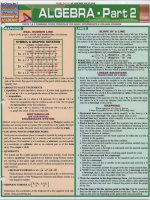
Quick study academic algebra part 2 600dpi
Bạn đang xem bản rút gọn của tài liệu. Xem và tải ngay bản đầy đủ của tài liệu tại đây (13.49 MB, 6 trang )
~
Q
~. -a
m
~~~~". . .PA
.. R
. TS
.. .1.&.
. 2 .C.O.M.
. BI.N.E.D. C. O.
. V.E.
R.
P.R..C
IN .I.L.S....B~.
P.E. FOR IA SIC,,~TE
' IN ~.RpM.D
.E.I.A.E.
T. &. C.
.O.L.L.E.G.E.C. O.
. U.RS. E.
. S ...................
(~
II1II1 1=1--.....
Z
~rj;'.":J:1I
REAL NUMBER LINE
SLOPE OF A LINE
Chart of the graphs, on the real number line, of solutions
to one-variable equations:
SYMBOL & GRAPHIC NOTATION
- SYMBOL - CLOSED CIRCLE
Ex. X = -2 • I I •
-4
-2
I
I
0
I
I
2
I
II
4
> SYMBOL - OPEN CIRCLE AND A RAY
Ex. x>4 ·1
-2
I
I
0
I
I
2
I
ED
4
I
I~
6
< SYMBOL - OPEN CIRCLE AND A RAY
Ex. x<-1 04 1 I EEl I I I I I II
-3
-1 0
2
4
" SYMBOL - CLOSED CIRCLE AND A RAY
Ex. X ~ 3 • I I I I I I I .
-4
2
0
2
3
I~
4
" SYMBOL - CLOSED CIRCLE AND A RAY
Ex. xs2
-4
2
0
2"
4
* Direction of ray
is determined by picking (at random) a value on each
side of the circle. Ray goes in direction of the point which makes the in
equality true.
• ABSOLUTE VALUE STATEMENTS
I. Equalities: To solve lax+bl= c, where c > 0, solve both equations ax +
b = c and ax + b = -c, and graph the union of the two solutions.
2. Inequalities:
__ a. To solve lax + bl < c, where c> 0, solve ax + b < c and ax + b > -c;
these two inequalities may be written as one -c < ax + b < c; graph
the intersection of the two solutions.
b. To solve lax + bl > c, where c > 0, solve ax + b > C or ax + b <
c; graph the union of the two solutions.
The slope ofa line can loosely be described as the slant ofthe line. If the line ~
slants up on the right end olthe line, then the slope will be a positive numbel:
Ifthe line slants up on the lefi: end ofthe line. then the slope will be a nega
tive numbel: lfthe line is horizontal, then the slope is zero. Ilthe line is verti
cal. then the line has no slope; it is undefined.
• FORMULA: If line is not vertical, then slope (indicated by m) can be
found using two distinct points A = (Xl, Yl) and B = (X2, Y2) of the line
and using x-coordinates and y-coordinates in the formula:
m = ( y 2 - YI) change in y = Ay = rise
change in X Ax run
X2 -XI
• PARALLEL: The slopes of parallel lines are equal.
• PERPENDICULAR: The slopes of perpendicular lines are negative re
ciprocals. If the slope of L, is m, and the slope of L2 is m2, and the lines
are perpendicular, then m, = -11m2 or (m,)(m2) = -I. EX: If the slope ofa
line is _112, then the slope of the line which is perpendicular to it is +2.
LINEAR EQUATIONS
(EQUATIONS OF LINES)
I. Since the coordinate system has an x-axis and a y-axis, lines which in
tersect the x-axis contain the variable x in the linear equation; lines
which intersect the y-axis contain the variable y in the linear equation;
and lines which intersect both the x-axis and the y-axis have both vari
lilt...
ables x and y in the linear equation.
2. Slope-intercept form of equation of a line is y = mx + b, where m is ~
the slope of the line and b is the y-intercept (y-value of the point where
the line intersects y-axis).
3. Standard form of the equation ofa line is ax + by = c, where the number values for a, b, and c are integers (note that the b does not represent the y-intercept in this form).
Q
-a
GRAPHING
m
Z
When equation ola line is known,
it may be graphed in Qliy olthefollowing ways:
~
1.
Horizontal
lines
have
equations
which
simplify
to
the
form
y
=
b,
RECTANGULAR
where b is the y-intercept. The slope of these lines is zero.
(OR CARTESIAN)
2. Vertical lines have equations which simplify to form x = c, where c is
COORDINATE SYSTEM
the X-intercept. They have no slope.
Method. using two perpendicular lines (intersecting at 90-degree angle~). for
3. Find at least two points which make the equation true and are, there
locating and naming points ofa plane. The vertical line is the y-axis. The hori
fore, on the line. Finding a third point is one method of checking for er
zontalline is the x-axis. The point where they intersect is called the origin.
rors. If all three points do not form a line, then there is an error in at
least one of the points. To find these points:
• LOCATING POINTS (ORDERED PAIRS)
a. Choose a number at random.
Each point on coordinate plane is named or located by using an ordered
b. Substitute the number into the linear equation for either the x or the y
variable in the equation.
pair of numbers separated by a comma and enclosed in a set of
c. Solve the resulting equation for the other variables.
parentheses; first number is x-coordinate or abscissa; second number
d. The randomly selected number (step a) and solution number (step c)
is y-coordinate or ordinate; that is, an ordered pair is of the form
result in one point: (x,y).
(x,y). The origin is (0,0).
e. Repeat above steps a through d as indicated until the desired number
of points have been created .
• QUADRANTS
f. Plot points and connect them; resulting graph should be a line.
The x-axis and the y-axis separate the plane into fourths. Each fourth
4. Plot the X-intercept and the y-intercept.
is called a quadrant. The quadrants are labeled using Roman numer
a. Substitute zero for the y variable in the equation and solve for x to
find the X-intercept.
als, starting in the upper right section, and continuing counterclock
b. Substitute zero for the x variable in the equation and solve for y to
wise through quadrants I, IJ, III, and IV (which is located in the lower
find the y-intercept.
lilt...
right section).
c. Plot these two points and draw the graph ofthe Line which contains them. ,..
d. NOTE: Lines which have the same point as the y-intercept and the
• DISTANCE FORMULA: d= ~(a-c)2 +(b--d)2
x-intercept, that is, the origin (0,0) must have at least one other point
Finds distance between two points, (a,b) and (c,d); is derived from
located in order to draw the graph of the line .
"""
the application of the Pythagorean Theorem and always results in a
5. Write the equation in the slope-intercept form , plot the point where
non-negative number.
the line crosses the y-axis (the b value), use the slope to plot additional
points on the line (rise over run). Connect the points to draw the graph
• MIDPOINT FORMULA: (Xl ;x 2 , YI ;Y2 )
of the line.
Q
-a
m
Z
Determines the coordinates of the midpoint of a line segment with end
points of (x"y,) and (X2,Y2).
6. Find the slope ofthe line and one point on the line. Plot the point first.
then use the slope to plot additional points on the line. That is, count the
slope as rise over run beginning at the point which was just plotted.
~
LINES
• TO FIND THE SOLUTION TO A SYSTEM OF EQUATIONS, USE
ONE OF THESE METHODS:
1. Graph Method - graph the equations and locate the point of intersection.
if there is one. The point can be checked by substituting the X value and
the y value into all of the equations. If it is the correct point, it should
make all of the equations true. This method is weak. since an approx
imation ofthe coordinates ofthe point is ojten all that is possible.
2. Substitution Method for solving consistent systems of linear
equations includes following steps:
a. Solve one of the equations for one of the variables. It is easiest to
solve for a variable which has a coefficient of one (if such a variable
coefficient is in the system) because fractions can be avoided until
the very end.
b. Substitute the resulting expression for the variable into the other
equation, not the same equation which was just used.
c. Solve the resulting equation for the remaining variable. This should
result in a numerical value for the variable, either X or y, if the sys
tem was originally only two equations.
d. Substitute this numerical value back into one of the original cquations
and solve for the other variable.
e. The solution is the point containing these x and y-values, (x,y).
f. Check the solution in all of the original equations.
3. Elimination Method or the Add/Subtract Method or the Linear
Combination Method - eliminate either the x or the y variable
through either addition or subtraction of the t\vO equations. These are
the steps for consistent systems of two linear equations:
a. Write both equations in the same order, usually ax + by = c, where
a, b, and c are real numbers.
b. Observe the coefficients of the x and y variables in both equations
to determine:
1. If the x coefficients or the y coefficients are the same, subtract
the equations.
11. If they are additive inverses (opposite signs: such as 3 and -3).
add the equations.
iii. If the coefficients of the x variables are not the same and are not
additive inverses, and the same is true of the coefficients of the
y variables, then multiply the equations to make one of these
conditions true so the equations can be either added or subtracted to
eliminate one of the variables.
c. The above steps should result in one equation with only one vari
able, either x or y, but not both. If the resulting equation has both
x and y, an error was made in following the steps indicated in num
ber 2 above. Correct the error.
d. Solve the resulting equation for the one variable (x or y).
e. Substitute this numerical value back into either of the original equa
tions and solve for the one remaining variable.
f. The solution is the point (x,y) with the resulting x and y-values.
g. Check the solution in all of the original equations.
4. Matrix method - involves substantial matrix theory for a system of
more than two equations and will not be covered here. Systems of two
linear equations can be solved using Cramer's Rule, which is based
on determinants.
a. For the system of equations: alx + blY = CI and a2X + b2Y = C2, where
all of the a, b, and c values are real numbers, the point of intersec
tion is (x,y) where x = (D,)/O and y = (Dy)/O.
b. The determinant D in these equations is a numerical value found in
this manner:
_ Ia , bl l_
D-alb z -a 2 b l
'a2 b 2
(CONTINUED)
FINDING THE EQUATION OF A LINE
• HORIZONTAL LINES: The slope is zero and the equation of the line
takes the form of y = b, where b is the y-intercept (the y-value of the
point of intersection of the line and the y-axis).
• VERTICAL LINES: There is no slope and the equation of the line takes
the form ofx = c, where c is the x-intercept (the x-value of the point of
intersection of the line and the x-axis).
• NEITHER HORIZONTAL NOR VERTICAL:
1. Given the slope and the y-intercept values: Substitute these numeri
cal values in the slope-intercept form of a linear equation, y = mx + b,
where m is the slope and b is the y-intercept.
2. Given the slope and one point, either:
a. Use the formula for slope m = (Y2 - YI)/(xz - Xl), or the point-slope
form (xz - XI) m = (yz - YI).
i. Substitute the coordinates from the point for the Xl and YI vari
ables and the slope value for the m.
ii. The equation is then changed to standard form ax + by = c, where
a, b, and c are integers.
b. Or, use the slope-intercept form oflinear equation, y = mx + b, twice.
i. The first time, substitute the coordinates from the point in the
equation for the variables x and y, and substitute the slope value
for the m; solve for b.
ii. The second time, use the slope-intercept form of a linear equation.
Substitute the numerical value for the slope m and the intercept b,
leave the variables x and y in the equation. The result is the equa
tion of the line in slope-intercept form.
3. Given two points:
a. Using the points in the slope formula, find the value for the slope, m.
b. Using the slope value and either one of the two points (pick at random),
follow the steps given in item b above for the slope and one point.
4. Given the equation of another line:
a. Parallel to the requested line
i. Use the given equation to find the slope. Parallel lines have the
same slope .
ii. Use this slope value and any other given information and follow the steps
1, 2, or 3 above, depending on the type of information which is given.
b. Perpendicular to the requested line
i. Use the given equation to find the slope. The slope of the requested
linear equation is the negative reciprocal of this slope, so change
the sign and flip the number to find the slope of the requested
line.
ii. Use this slope value and any other information given in steps 1. 2,
or 3 above, depending on the type of information which is given.
GRAPHING LINEAR INEQUALITIES
• GRAPHS OF LINEAR INEQUALITIES, SUCH AS > AND <, ARE
HALF-PLANES.
1. Replace the inequality symbol with = and graph this linear equality as a
broken line to indicate that it is only the separation and not part ofthe graph.
2. To graph the inequality, randomly pick any point above this line and
any point below this line.
3. Substitute each point into the original inequality.
4. Whichever point makes the inequality true is in the graph of the in
equality, so shade all points in the coordinate plane which are on the
same side of the line with this point.
• GRAPHS OF LINEAR INEQUALITIES, SUCH AS :l!; AND s,
INCLUDE BOTH THE HALF-PLANES AND THE LINES.
1. The same methods given in item I above apply, except the line is drawn
in solid form because it is part of the graph since the inequalities also
include the equal sign.
FINDING THE INTERSECTION OF LINES;
SYSTEMS OF LINEAR EQUATIONS
The purpose offinding the intersection of lines is to find the point
which makes two or more equations true at the same time. These equa
tions form a system of equations. These methods are extremely useful in
solving word problems.
• THE SYSTEM OF EQUATIONS IS EITHER:
1. Consistent; that is, the lines intersect in one point.
2. Inconsistent; that is, the lines are parallel and since they do not inter
sect, there is no solution to the system of equations. The solution set is
the empty set.
3. Dependent; that is, the graphs are the same line. All of the points
which make one equation true also make the others true. The lines have
all points in common and are, therefore, dependent equations.
c. The determinant D, in these equations is a numerical value found in
this manner:
D, -- Ic , bl l_
-c l b 2 -c2 b l
C2 b 2
d. The determinant Dy in these equations is a numerical value
found in this manner: _~I cl i.
Dv -alcz -azc l
.
z C2
e. Substitute the numerical values found from applying the formulas in
steps b through d into the formulas for x and y in step a above.
2
FUNCTIONS
All linear equatiolls, excepl Ihose jiJr vertical lilies, are.!illlctiolls.
BASIC CONCEPTS
POLYNOMIAL FUNCTIONS
• RELATION
I . Set of ordered pairs; in the coordinate plane (x,y).
•
•
•
•
• WRITTEN FORM
I. f(x) = a" x" + a" _ I x" - I + ... + al x + a" for real number values for all
of the as, a" #- 0.
a. If a relation, R, is the set of ordered pairs (x,y), then the inverse
• MAY HAVE TO HAVE RESTRICTED DOMAINS AND/OR
of this relation is the set of ordered pairs (y,x) and is indicated by
RANGES TO QUALIFY AS A FUNCTION.
the notation R·I.
I. Without restrictions, some equations would only qualify as relations
and not functions.
DOMAIN
• FIND THE EQUATION OF THE INVERSE OJ<' A FUNCTION.
1. Set of the first components of the ordered pairs of the relation; in the
1. Exchange x and y variables in equation of the function and then solve
coordinate plane, a set of the x-values.
for y. FI!1ally, replace y with f-I(X). Not all inverses of functions are al
RANGE
so functions .
I. Set of the second components of the ordered pairs of the relation; in • TO GRAPH
I. Use the Remainder Theorem- if a polynomial P(x) is divided by x - r, the
the coordinate plane, a set of the y-values.
remainder is P(r}-to determine remainders through substitution.
2. Use the Factor Theorem-if a polynomial P(x) has a factor x - r if and on
FUNCTION
ly if Per) = O-to find the zeros, roots, and factors of the polynomial.
I . Relation in which there is exactly one second component for each of
3. Find number of turning points of graph ofa polynomial of degree n to
the first components.
be n - 1 turning points at most.
4. Sketch, using slashed lines, all vertical and/or horizontal asymptotes, if
a. y is a function of x if exactly one value of y can be found for each
there are any.
value of x in the domain; that is, each x-value has only one y-value
5. Find the signs of P(x) in intervals between and to each side of the in
tercepts. ThiS is done to determine the placement of the graph above or
but different x-values could have the same y-value, so the y-values
below the x-axis.
may be used more than once for different x-values.
6. Plot a few points in each interval to find the exact graph placement.
Also, plot all intercepts.
VERTICAL LINE TEST
7. Note: The graphs ofmverse functions are reflections about the graph of
I. Indicates a relation is also a function if no vertical line intersects the
the linear equation y = x.
graph of the relation in more than one point.
EXPONENTIAL FUNCTIONS
• ONE-TO-ONE FUNCTIONS
I. A function , f. is one-to-one if f(a) = f(b) only when a = b.
• DEFINITION
I. An exponential function has the form f (x) = a", where a > 0, a #- 1,
and the constant real number, a, is called the base.
.
.
Example of an
• PROPERTIES.
I. The graph always 1I1tersects the y-aXiS at (0,1) Exponent Function
because aO = 1.
~
2. The domain is the set of all real numbers .
_r
3. The range is the set of all positive real numbers Y
x
because a is always positive.
4. When a > 1, the function is increasing; when a < I,
the function is decreasing.
5. Inverses of exponential functions are logarithmic functions.
• HORIZONTAL LINE TEST
I . Indicates a one-to-one function ifno horizontal line intersects the graph
of the function in more than one point.
NOTATION
• f(x) IS READ AS "f of x"
I. Does not indicate the operation of multiplication. Rather, it indi
cates a function of x.
LOGARITHMIC FUNCTIONS
a. f(x) is another way of writing y in that the equation y = x + 5 may
also be written as f(x) = x + 5 and the ordered pair (x,y) may also
be written (x,f(x)).
• DEFINITIONS:
1. A logarithm is an exponent, such that for all posi
Exampleofa
tive numbers a, where a #- 1, Y = log a x if and on Logarithmic
Function
ly
ifx
=
a
Y;
notice
that
this
is
the
logarithmic
func
b. To evaluate f(x), use whatever expression is found in the set of
tion of base a.
parentheses following the f to substitute into the rest of the equa
2. The common logarithm, log x, has no base indi
tion for the variable x, then simplify completely.
cated and the understood base is always 10.
3. The natural logarithm, In x, has no base indicat
• COMPOSITE FUNCTIONS: f [g(x)l
ed, is written In instead of log, and the lmderstood
1. Composition of the function f with the function g, and it may also be
base is always the number e.
• PROPERTIES WITH THE VARIABLE a REPRESENTING A
written as f 0 g(x) .
POSITIVE REAL NUMBER NOT EQUAL TO ONE:
2. The composition, f [g(x»), is simplified by evaluating the g function
1. alog"x= x
2. logaa X = x
3. log_a = I
first and then using this result to evaluate the f function.
5. If logau = log_v, then u = v.
4. log_I =
6. If log"u = 10gbu and u #- 1, then a = b.
7. log" xy = log" x + log" y
• (f + g)(x) EQUALS f(x) + g (x)
Y~I'o~:~ lf
8.
That is, it represents the sum of the functions.
• (f - g)(x) EQUALS f(x) - g (x)
°
10ga(~ )=
log. x -log. Y
9.
IOg.(+)=-IOg. x
10. log. x" = n(log. x), where n is a real number.
11. Change of Base Rule: If a> 0, a #- 1, b > 0, b #- I , and x> 0, then
log x = (10g bx)
. ~
(lOgb a ) . .
(log x)
12. Fmdmg Natural Loganthms: In x = (10 e)'
• COMMON MISTAKES!
g
I. log_ (x+y) = log. x+logaY FALSE!
2. log. x" = (log_x)" FALSE!
That is, it represents the difference of the functions.
• (fg)(x) EQUALS f(x) • g(x)
That is, it represents multiplication of the functions .
• (f/g)(x) EQUALS f(x)/g(x)
That is, it represents the division of f(x) by g(x).
3. (log,x) =log (.x-y) FALSE!
•
(log. y)
NOTICE TO STUDENT: This QUICKSTUDY'" guide is the second of
2 guides outlining the major topics taught in Algebra courses.
Keep it handy as a quick reference source in the classroom, while
doing homework and use it as a memory refresher when reviewing pri
or to exams. It is a durable and inexpensive study tool that can be re
peatedly referred to during and well beyond your college years. Due
to its condensed format, however, use it as an Algebra guide and not
as a replacement for assigned course work.
• SOLVING LOGARlTHM1C EQUATIONS
1. Put all logarithm expressions on one side of the equals sign .
2. Use the properties to simplity the equation to one logarithm statement
on one side of the equals sign.
3. Convert the equation to the equivalent exponential form.
4 . Solve and check the solution.
3
~'1 ::::{PIIJ =t ~ Lei ~ =t:1 I~
RATIONAL FUNCTIONS
Definition: f(x) =
~~:~,
where P(x) and Q(x) are polynomials that are
relatively prime (lowest terms), Q(x) has degree greater than zero, and Q(x) :F- O.
TO GRAPH
·DOMAIN
I . The domain is all real numbers, except for those numbers that make Q(x)
= O.
• INTERCEPTS
1. y-intercept: Set x = 0 and solve for y; there is one y-intercept; if Q(x) =
o when x = 0, then y is undefined and the function does not intersect the
y-~xis.
.
P(x)
2. x-mtercepts: Set y = 0; SInce f(x) = Q(x) can equal zero only when
P(x)
= 0, the x-intercepts are the roots of the equation P(x) = O.
ASYMPTOTES
A line that the graph of the function approaches, getting closer with each
point. but never intersecting.
• HORIZONTAL ASYMPTOTES
1. Horizontal asymptotes exist when the degree of P(x) is less than or equal
to the degree of Q(x).
2. The x-axis is a horizontal asymptote whenever P(x) is a constant and has
degree equal to zero.
3. Steps to find horizontal asymptotes:
a. Factor out the highest power of x found in P(x).
b. Factor out the highest power of x found in Q(x).
c. Reduce the function; that is, cancel common factors found in P(x) and Q(x).
d. Let Ixl increase, and disregard all fractions in P(x) and in Q(x) that have
any power of x greater than zero in the denominators, because these
fractions approach zero and may be disregarded completely.
e. When the result of the previous step is:
i. a constant, c, the equation of the horizontal asymptote is y = c.
ii. a fraction such as c/xn, where c is a constant and n :F- 0, the
asymptote, is the x-axis.
iii. neither a constant nor a fraction, there is no horizontal asymptote.
• VERTICAL ASYMPTOTES
I. Vertical' asymptotes exist for values of x that make Q(x) = 0; that is, for
values of x that make the denominator equal to zero and, therefore, make
the rational expression undefined.
2. There can be several vertical asymptotes.
3. Steps to find vertical asymptotes:
a. Set the denominator, Q(x), equal to zero.
b. Factor if possible.
c. Solve for x.
d. The vertical asymptotes are vertical lines whose equations are ofthe form
x = r, where r is a solution of Q(x) = 0 because each r value will make
the denominator, Q(x), equal to zero when it is substituted for x into Q(x).
SYMMETRY
• DESCRIPTION
I. Graphs are symmetric with respect to a line if, when folded along the
drawn line, the two parts of the graph then land upon each other.
2. Graphs are symmetric with respect to the origin if, when the paper is
folded twice, the first fold being along the x-axis (do not open this fold
before completing the second fold) and the second fold being along the
y-axis, the two parts of the graph land upon each other.
• GRAPHS ARE SYMMETRIC WITH RESPECT TO:
1. The x-axis if replacing y with -y results in an equivalent equation.
2. The y-axis ifreplacing x with -x results in an equivalent equation.
3. The origin if replacing both x with -x and y with -y results in an
equivalent equation.
• DETERMINE POINTS
I. Create a few points, by substituting values for x and solving for f (x), that
make the rational function equation true.
2.lnclude points from each region created by the vertical asymptotes
(choose values for x from these regions).
3. Include the y-intercept (if there is one) and any x-intercepts.
4. Apply symmetry (if the graph is found to be symmetric after testing for
symmetry) to find additional points; that is, if the graph is symmetric with
respect to the x-axis and point (3,-7) makes the equation f (x) true, then the
point (-3,-7) will be on the graph and should also make the equation true.
• PLOT THE GRAPH
I . Sketch any horizontal or vertical asymptotes by drawing them as broken
or dashed lines.
2. Plot the points, some from each region created by the vertical asymptotes,
that make the equation f(x) true.
3. Draw the graph of the rational function equation, f(x) = P(x)/Q(x),
applying any symmetry that applies.
4
DEFINITIONS
• INFINITE SEQUENCE is a function with a domain that is
the set of positive integers; written as aI, a2, a3, .... , with each
aj representing a term.
o FINITE SEQUENCE is a function with a domain of only
the first n positive integers; written as a., a2, aJ, ... , an-., an.
o
SUMMATION:
f
ak = al+a2+ ... + a m_. + am, where k is the
1:=1
index of the summation and is always an integer that begins
with the value found at the bottom of the summation sign and
increases by 1 until it ends with the value written at the top of
the summation sign.
o nTH PARTIAL SUM: Sn =
ak = a. + a2 + ... + an_.+ an.
~
i.e.
rate;
: in 6
hop
..arol
:t,-,
o
ARITHMETIC SEQUENCE OR ARITHMETIC PRO
GRESSION is a sequence in which each term differs from the
preceding term by a constant amount, called the common dif
ference; that is, an = an-. + d where d is the common difference.
o GEOMETRIC
SEQUENCE
OR
GEOMETRIC
PROGRESSION is a sequence in which each term is a
constant multiple of the preceding term; that is, an = ra n_., where
o
r is the constant multiple and is called the common ratio.
n! = n(n - 1)(n - 2)(n - 3) ... (3)(2)(1); this is read "n
factorial." NOTE: O! = 1.
PROPERTIES OF SUMS, SEQUENCES & SERIES
,-,
1:=1
2.
:t ca,
= ct
10;=1
nth
,-,
a, , where c is a constant.
l=1
= nc, where c is a constant.
3. t c
k=1
4. The nth term of an arithmetic sequence is an = a. + (n -l)d,
where d is common difference.
ralto
5. The sum of the first n terms of an arithmetic sequence,
with a. as the first term and d as the common difference, is
So
n
n
= 2(a, + an)orsn = 2[2a, + (n - I)d] .
6. The nth term of a geometric sequence, with a. as the first
term and r as the common ratio, is an = alr n-I.
7. The sum of the first n terms of a geometric sequence,
with a. as the first term and r as the common ratio and
r :F- 1 is
,
S 0
[a,(1 - rn)]
(I-r)
8.The sum of the terms of an infinite geometric sequence, with
a. as the first term and r as the common ratio where
Irl< Lis 1~ r ; if Irl > 1 or Irl = 1 , the sum does not exist.
9.The rth term of the binomial expansion of (x + y)n is
n!
xn-(r-Ij (r- .)
[n-(r-l)]!(r-l)!
y
fi ts
fl O
nio n
nd a
CONIC SECTIONS
The charts below contain all general equation forms ofconic sections; these general forms can be used both to graph and to determine equations
ofconic sections; the values for hand k can be any real number, including zero.
DESCRIPTION
Conic sections represent the intersections of a plane and a right circular cone; that is, parabolas, circles, ellipses and hyperbolas;
in addition, when the plane passes through the vertex ofthe cone, it may determine a degenemte conic section; that is, a point, line or two intersecting lines.
GENERAL EQUATION
The general form of the equation of a conic section, with axes parallel to the coordinate axes, is:
Ax2 +Bxy + Cy2 + Dx + Ey + F = 0, where A and C are not both zero.
TYPE: CIRCLE
TYPE: LINE
GENERAL EQUATION: y = fiX
+b
GENERAL EQUATION:
(X - h)Z + (y - k)2 = r2
Notation: I. m is slope.
2. b is y-intercept.
Values:
I. m > 0, then the line is
higher on the right end.
2. m < 0, then the line is
higher on the left end.
x
x
(h,k)
Notation:
1. X2 tenn and y' term , both with
the same positive coefficient.
2. r' is a positive number.
3. (h,k) is center.
4. r is radius.
Values: None.
y
(O ,b)
TYPE: HORIZONTAL LINE
/
TYPE: ELLIPSE
GENERAL EQUATION: y = b
Notation:
GENERAL EQUATION:
b is y-intercept.
y
Values:
)
m = 0, then the line is
horizontal through (O,b).
1.
i
'(
Z
~
~ A.
x
2.
3.
(h,k)
4.
y
TYPE: VERTICAL LINE
(c,O)
GENERAL EQUATION: X =
\
1.
c
Notation: c is X-intercept.
Values:
=
2.
I. No slope.
2. Vertical line through (c,O).
(x-h)' +(y-k)' =1
a'
b'
Notation:
x' term and y' term with different
coefficients.
(h,k) is center.
a is horizontal distance to left and
right of (h,k).
b is vertical di stance above and
below (h,k).
Values:
a> b, then major axis is horizontal and
foci are (h ± c, k), where c'= a'- \)2.
b> a, then major axis is vertical and
foci are h, k ± c), where c' = b' - a'.
TYPE: HYPERBOLA
GENERAL EQUATION:
(y-k)' _ (x-h)' = 1
a'
b'
TYPE: PARABOLA
GENERAL EQUATION: y = a(x - h)2
Notation:
l.x' term and y' term, with a negati ve
coeffici ent for x' term.
2.(h,k) is center of a rectangle.
3. b is horizontal distance to left and
right of (h,k).
4.a is vertical di stance above and below
(h,k) to the vertices.
Values:
+k
STANDARD FORM: (X - h)2 = 4p(y - k)
x
:f
:f
'f
- . .::::::=~
Notation:
I. X2 term and yl term.
2. (h,k) is vertex.
3. (h, k ± p) is center offocus, where P = 7;;a .
~==::::::3-·4. y = k ± P is directrix equation, where P = 7;;a.
1.
(h,k)
2.
3.
4.
a
y - k = ± 1>(x - h)
Value:
a > 0, then opens up.
a < 0, then open~ down.
X= h is equation of line of symmetry.
Larger lal = thinner parabola;
smaller lal = fatter parabola.
are equations of asymptotes.
TYPE: HYPERBOLA
GENERAL EQUATION:
(x - h )' _ (y - k )' = 1
TYPE: PARABOLA
b'
Notation:
1. x' term and y' term, with a negative
coefficient for y' term.
2. (h,k) is center of a rectangle.
3. a is hori zontal di stance to left and
right of (h,k) to the vertices.
4. b is vertical distance above and
below (h,k).
Values:
k
= ± Q( x - h)
Y
a
are equations of asymptotes.
a'
GENERAL EQUATION: x = a (y - k)' + h
STANDARD FORM: (y - k)' = 4p (x - h)
Notation:
1. Xl term and y2 term.
x 2. (h,k) is vertex.
/
--===~ ~=~1iIt~3. (h ± p, k) is focus, where P = } 4a .
4. X= h ± p is directrix equation, where P = 7;;a .
Values:
1. a > 0, then opens right.
2. a < 0, then opens left.
3. y = k is equation of line of symmetry.
5
PROBLEM SOLVING
DISTANCE
DIRECTIONS
NOTATION
~ I . Read the problem carefully.
d is distance; r is rate, i.e. speed; t is time, value indicated in the speed, i.e.
2. Note the given information, the question asked and the value requested.
miles per hour has time in hours
3. Categorize the given information, removing unnecessary mformatlOn.
NOTE: Add or subtract speed of wind or water current with the rate;
4. Read the problem again to check for accuracy, to determme what, If any,
(r ± wind) or (r ± current).
III
formulas are needed and to establish the needed variables.
5. Write the needed equation(s) and determine the method of solution to use;
•
FORMULAS
"
this will depend on the degree of the equations, the number of vanabies and
I. d = rt
III
the number of equations.
Example: John traveled 200 miles in 4 hours.
~
6. Solve the problem. Check the solution. Read the problem again to make
Equation: 200 = r . 4
II.I-__~u~~the~==~rg~~
s~re == answe~ive~n~s
i~~==o
the ~ne
~~~~
requ~ste~.
e7~d~==~~~~~~~~
-I 2. dto = dreturning
.IIIIlI
ODD NUMBERS, EVEN NUMBERS, MULTIPLES
Example: With a 30-mph head wind, a plane can fly a certain distance in 6
'liliiii
NOTATION
hours. Returning, flying in opposite direction, it takes one hour less.
d is the common difference between any two consecutive numbers of a
Equation: (r - 30)6 = (r + 30)5
set of numbers.
3. d. + d2 = dtotal
FORMULAS
First number = x
Second number = x+d
Example: Lucy and Carol live 400 miles apart. They agree to meet at a shop
Third number = x+2d Fourth number = x+3d; etc.
ping mall located between their homes. Lucy drove at 60 mph, and Carol
Example: The first 5 multiples of3 are x, x+3, x+6, x+9, and x+l2 because d = 3.
drove at 50 mph and left one hour later.
Equation: 60t + 50(t-l) = 400
RECTANGLES
Z
~
____
NOTATION
SIMPLE INTEREST
P is perimeter; I is length; w is width; A is area
NOTATION
FORMULAS
1. P = 21 + 2w
2. A = Iw
I is interest; P is principal, amount borrowed, saved, or loaned;
S is total amount, or I + P; r is % interest rate;
Example: The length ofa rectangle is 5 more than the width and the perimeter is 38.
Equation: 38 = 2(w + 5) + 2w
t is time expressed in years; p is monthly payment
FORMULAS
TRIANGLES
I. 1= Prt
Example: Anna borrowed $800 for 2 years and paid $120 interest.
Equation: 120 = 800 r(2)
2. S = P + Prt
Example: Alex borrowed $4,600 at 9.3% for 6 months.
Equation: S = 4,600 + 4,600 (.093)(.5)
NOTE: 9.3% = .093 and 6 months = 0.5 year.
NOTATION
P is perimeter; S is side length; A is area; a is altitude; b is base
NOTE: Altitude and base must be perpendicular. i. e. form 90° angles.
FORMULAS
I. P = S. + S2 + S3
2. A = 112 ab
Example: The base of a triangle is 3 times the altitude and the area is 24.
Equation: 24 = ·12 • a • 3a
CIRCLE
Z
3 p_P+Prt
. - t-12
Example: Evan borrowed $3,000 for a used car and is paying it otT month
ly over 2 years at 10% interest.
NOTATION
C is circumference; A is area; d is diameter; r is radius; 1t is pi = 3.14...
FORMULAS
,
l.C=1td
2.A=1tr2
3.d=2r
Example: The radius of a circle is 4 and the circumference is 25.12.
Equation' p - (3 000 + 3 000 ( 1)(2)( / (2)(12)
·1_E~u~a~ti~o~n:~2~5~.1~2~1t~'~8~______________________________-I~--~---~I~~~rn~~~~~~no~-----------r~
· - '
'
'
"
PROPORTION & VARIATION
III
PYTHAGOREAN THEOREM
NOTATION
~
NOTATION
a, b, c, d are quantities specified in the problem; k O.
II
a is a leg; b is a leg; c is a hypotenuse
FORMULAS
.IIIIlI
NOTE: Hypotenuse is the longest side.
1. Proportion: ~ =~ ; cross-multiply to get ad = bc.
'liliiii
FORMULA
b d
a 2 + b 2 = c2
2. Direct Variation: y = kx
k
NOTE: Applies to right triangles only.
Example: The hypotenuse of a right triangle is 2 times the shortest leg. The other
3. I.nverse Variation: y =-;
r;;
Examples:
leg is ,, 3 times the shortest leg.
1. Proportion: If 360 acres are dividcd between John and Bobbie in the ratio
Equation: a 2 +( -J3 a)2 = (2a)2
4~5, how many acres does each receive?
III
'*
Equation: B~obhb~e .so
MONEY, COINS, BILLS, PURCHASES
~ = -36-g---J
NOTATION
V is currency value; C is number of coins, bills, or purchased items
2. Direct Variation: If the price of gold varies directly as the square of its
mass, and 4.2 grams of gold is worth $88.20, what will be the value of 10
grams of gold?
Equation: 88.20 = k(4.2)2; solve to find k = 5; then, use the equation
v = 5(10)2, where y is the value of 10 grams of gold.
3. inverse Variation: If a varies inversely as b and a = 4 when b = 10, find a
when b = 5.
FORMULA
V.C. + V2C2 =Vtotal
Example: Jack bought black pens at $1.25 each and bluepens at $0.90 each.
He bought 5 more blue pens than black pens and spent $36.75.
E uation: I.25x + 0.90(x+5) = 36.75
MIXTURE
fir~.~e~~~~?o~ution;
V. is first volume; PI is
Y2 is second volume;
P2 is second percent solution; VF.S fmal volume; PF.S fmal percent solutIOn
NOTE: Water could be 0% solution and pure solution could be 100%.
Equation: 4 =
l~ , so k = 40; then,
a=
FORMULA
ISBN-13: 978-157222922-8
ISBN-1D: 157222922-5
VIP. +V2P2 =VFPF
Example: How much water should be added to 20 liters of 80% acid solution
to yield 70% acid solution?
Equation: x(O) + 20(0.80) = (x+20)(0.70)
911~ lllJllll~llll11~11111111111111111 lIillll
WORK
NOTATION
W I is rate of one person or machine multiplied by the time it would take
for the entire job to be completed by 2 or more. people or machmes;
W2 is the rate of the second person or machine multiplIed by tune for entIre Job;
1 represents the whole job.
NOTE: Rate is the part of the job completed by one person or machine.
free
& at
nundiwn
re~ad.s
ol.tltles
~O to find a.
All ri2hls me rH':d. No part of this publiclluon JllOI> be repr0
duced llr Inmsmitlcd in any form. ()r b) uoy lTlCans, electronic Of
mechanical. inc luding pho tocopy. R:cording. or any inronnauon
SfOfaall: and ret rieval ~ystcm . without \\ r ilu."I1 pcmllSSlon from Iht
publisher.
21~)2 8I rCh ut~.
Int. Boea Raton. f L 01()H
Author: S.B. Kizlik
U.S. $5.95 CAN. $8.95
qUlc 5 uuy.com
FORMULA
W. +W2 = 1
Example: J,ohn can paint a house in 4 days, while Sam takes 5 days. How long would
they take if they worked together?
Equation: lx+!x=l
4
Customer Hotline # 1.800.230.9522
We welcome your feedback so we can
maintain and exceed your expectations.
5
6
,1,.1,.
20922