Practicing FCE reading part 2
Bạn đang xem bản rút gọn của tài liệu. Xem và tải ngay bản đầy đủ của tài liệu tại đây (257.8 KB, 9 trang )
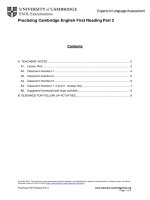
Practising Cambridge English First Reading Part 2
Contents
A. TEACHERS’ NOTES ........................................................................................................ 2
A1. Lesson Plan............................................................................................................... 2
A2. Classroom Handout 1 ................................................................................................ 4
A3. Classroom Handout 2 ................................................................................................ 5
A4. Classroom Handout 3 ................................................................................................ 6
A5. Classroom Handout 1, 2 and 3 - Answer Key ............................................................ 7
A6. Suggested homework/self study activities.................................................................. 8
B. GUIDANCE FOR FOLLOW UP ACTIVITIES..................................................................... 9
© UCLES 2012. This material may be photocopied (without alteration) and distributed for classroom use provided no charge is made. For further
information see our Terms of Use at />
Practising FCE Reading Part 2
www.teachers.cambridgeesol.org
Page 1 of 9
Practising Cambridge English First Reading Part 2
A. TEACHERS’ NOTES
Description
Time required:
50 minutes
Materials
required:
Classroom Handout 1 – one per pair of students
Classroom Handout 2 – one per pair of students the sentences
should be cut up before the lesson and kept separate from the text.
Classroom Handout 3
To practise the skills required for Part 2 of the First Reading Exam
by focusing on identifying grammatical and lexical clues
Aims:
A1. Lesson Plan
1. Warmer: Write ‘Harrods offers all things for all people, everywhere’. Elicit or explain that
Harrods is a famous London department store. Ask students what they think of the
statement – it is quite ambitious. Elicit the kind of things students think that Harrods might
not be able to sell.
Timing: 5 mins
2. Give out A2. Classroom Handout 1. Ask students to read the passage and find three
animals that Harrods sells. Which animal do they think this story is going to be about and
why? (Answers: cat, dog, lion; lion – because there is a lot of background information
about the lion).
Timing: 5 mins
3. Explain that in Part 2 of Cambridge First Reading candidates have to read a passage and
put some sentences in the correct position in the passage. To do this they need to use
their knowledge of reading and of the English Language to help them.
When they first look at the gaps (before looking at the missing sentences), they need to
think about what kind of information might come in the gaps. They need to identify the
topic area and predict the information.
In pairs, ask students to look at the gaps in the reading passage (A2. Classroom Handout
1) and make some notes in the gaps of the kind of information that might be missing.
Remind them to look at the sentences before and after the gaps as this information could
be helpful in making a prediction.
Timing: 15 mins
© UCLES 2012. This material may be photocopied (without alteration) and distributed for classroom use provided no charge is made. For further
information see our Terms of Use at />
Practising FCE Reading Part 2
www.teachers.cambridgeesol.org
Page 2 of 9
Practising Cambridge English First Reading Part 2
5. Go through the predictions as a class. On the board, write down any sensible predictions
based on the sentences before and after the gap. See Suggested Answers in A5:
Classroom Handout 1, 2 and 3 - Answer Key
Timing: 5 mins
6. Then give out A3: Classroom Handout 2 - the missing sentences for the students to put in
the correct gaps – it shouldn’t be too difficult following the previous exercise. Answers (1B,
2D, 3E, 4A, 5C).
Timing: 5 mins
7. Explain that in the Part 2 of the First Reading exam there will be seven sentences missing
from the text and candidates have to choose from 7 sentences plus an additional
sentence (distracter). It is therefore more difficult, and candidates should not rely on
selecting sentences by using just the topic. They should also look for: lexical clues,
repetition of a word in a previous sentence or a paraphrase of that word; grammatical
clues – for example a word (often a pronoun) that refers back to the subject or object of
the previous sentence.
8. Give out the complete text with the missing sentences highlighted (A4: Classroom
Handout 3) and ask students to find an example of a lexical clue and a grammatical clue.
(See detailed list of lexical and grammatical clues in A5. Classroom Handout 1, 2 and 3 –
Answer Key). After you have highlighted one lexical clue and one grammatical clue to the
class, let them look for other clues on their own and compare with a partner. Check
answers together.
Timing: 15 mins
© UCLES 2012. This material may be photocopied (without alteration) and distributed for classroom use provided no charge is made. For further
information see our Terms of Use at />
Practising FCE Reading Part 2
www.teachers.cambridgeesol.org
Page 3 of 9
Practising Cambridge English First Reading Part 2
A2. Classroom Handout 1
In August, 1969, four lion cubs were born in a small zoo in the south-west of England. There
were three females and a male. (1)…………………………………………………..................
In October, when the summer was over and the tourists had gone, the cubs were sold. Two
of the females were bought by a circus. (2)…………………………………………………......
Three months earlier, in May, 1969, two young Australian men, Anthony (‘Ace’) Bourke and
John Rendall, had left Australia for the first time. They had finished university and had done a
number of jobs. (3) ……………………………………………………………………………….
They visited the usual tourist attractions like the Tower of London, and then, one day, they
went to Harrods.
Harrods was a very special department store. The owners of Harrods used to proudly say
that the store offered ‘all things for all people, everywhere’. At that time, there was even a
zoo in the shop. (4) …………………………………………………………………………………
They went to the zoo on the second floor to see the animals for sale. And there, in a small
cage between the cats and the dogs, they saw the two lion cubs.
The female cub seemed bad-tempered and showed her teeth to shoppers who looked at her.
Her brother seemed quite easy-going. (5)………………………………………………………..
Ace and John immediately fell in love with him. They sat down beside the cage and stayed
there for hours.
---------------------------------------------------------------------------------------------------------------------------
© UCLES 2012. This material may be photocopied (without alteration) and distributed for classroom use provided no charge is made. For further
information see our Terms of Use at />
Practising FCE Reading Part 2
www.teachers.cambridgeesol.org
Page 4 of 9
Practising Cambridge English First Reading Part 2
A3. Classroom Handout 2
Missing Sentences (cut these sentences up before the lesson)
A. Ace and John wanted to see if they could really buy ‘anything’ in
Harrods.
B. Their father, Butch, came from Rotterdam Zoo in the Netherlands and
their mother, Mary, from a zoo in Jerusalem, Israel.
C. He didn’t pay attention to anybody.
D. The other female and the male were bought by Harrods, a very
famous department store in London.
E. After travelling on their own around Europe in search of adventure,
Ace and John met up again in London.
© UCLES 2012. This material may be photocopied (without alteration) and distributed for classroom use provided no charge is made. For further
information see our Terms of Use at />
Practising FCE Reading Part 2
www.teachers.cambridgeesol.org
Page 5 of 9
Practising Cambridge English First Reading Part 2
A4. Classroom Handout 3
A Lion Called Christian’ by Anthony Burke & John Rendall
In August, 1969, four lion cubs were born in a small zoo in the south-west of England. There
were three females and a male. (1) Their father, Butch, came from Rotterdam Zoo in the
Netherlands and their mother, Mary, from a zoo in Jerusalem, Israel. In October, when the
summer was over and the tourists had gone, the cubs were sold. Two of the females were
bought by a circus. (2) The other female and the male were bought by Harrods, a very
famous department store in London.
Three months earlier, in May, 1969, two young Australian men, Anthony (‘Ace’) Bourke and
John Rendall, had left Australia for the first time. They had finished university and had done a
number of jobs. (3) After travelling on their own around Europe in search of adventure, Ace
and John met up again in London. They visited the usual tourist attractions like the Tower of
London, and then, one day, they went to Harrods.
Harrods was a very special department store. The owners of Harrods used to proudly say
that the store offered ‘all things for all people, everywhere’. At that time, there was even a
zoo in the shop. (4) Ace and John wanted to see if they could really buy ‘anything’ in
Harrods. They went to the zoo on the second floor to see the animals for sale. And there, in a
small cage between the cats and the dogs, they saw the two lion cubs.
The female cub seemed bad-tempered and showed her teeth to shoppers who looked at her.
Her brother seemed quite easy-going. (5) He didn’t pay attention to anybody. Ace and John
immediately fell in love with him. They sat down beside the cage and stayed there for hours.
© UCLES 2012. This material may be photocopied (without alteration) and distributed for classroom use provided no charge is made. For further
information see our Terms of Use at />
Practising FCE Reading Part 2
www.teachers.cambridgeesol.org
Page 6 of 9
Practising Cambridge English First Reading Part 2
A5. Classroom Handout 1, 2 and 3 - Answer Key
For Stage 5 of lesson plan
Here are some suggestions for the kind of information the students might predict:
1. some other information about the lion family
2. what happened to the other two (only two out of four lions mentioned in the preceding
sentence)
3. something about their jobs/something about them coming to London
4. something about Ace and Jon going to Harrods (because of ‘They’ in line following)
5. some other information about the male lion
Classroom Handout 3
Lexical clues
Grammatical clues
(1) father/mother refers to the family – the
parents of the cubs
(1) Their father/mother – refers back to the
cubs
(2) female and male – matches lexis in
previous sentence
(2) The other – two of the cubs have been
mentioned but there were four cubs…
(3) travelling, Europe, adventure – follows on
from previous sentence, which is talking
about them finishing studying and leaving
Australia.
Ace and John – repetition of names
introduced in previous sentence.
London is introduced in this sentence and
then expanded on in the next sentence.
(4) anything in sentence is a paraphrase of
‘all things for all people, everywhere’.
Harrods – repetition of store name
(5) didn’t pay attention to anybody is more an
expansion on ‘easy-going’ and contrasts to
(5) He – refers back to ‘her brother’
the behaviour of the female cub.
© UCLES 2012. This material may be photocopied (without alteration) and distributed for classroom use provided no charge is made. For further
information see our Terms of Use at />
Practising FCE Reading Part 2
www.teachers.cambridgeesol.org
Page 7 of 9
Practising Cambridge English First Reading Part 2
A6. Suggested homework/self study activities
1. Get students to look at/read books as much as possible. The more exposure they have to
different types of texts, the more confident they will become with this part of the exam.
2. As a follow on activity, ask your students to select a page of text from a reader (make
them a photocopy of their chosen page to work on). At home or in the next class students
can select sentences to delete from the text – ask them to write their sentences on strips
of paper before deleting them from the main text by using tippex or a strip from a sticky
label. They can then give the activity to another student in the class to do. When students
do the activity, make sure that they are following the procedure used in this lesson – trying
to predict what comes in the gaps before matching the missing sentences, then checking
by looking for lexical and grammatical clues.
3. This can then lead into doing a practice exam task. Students will have found this lesson
and accompanying activities easier than an exam task – this will hopefully have built their
confidence and helped them to focus on the skills required for doing this part of the exam.
© UCLES 2012. This material may be photocopied (without alteration) and distributed for classroom use provided no charge is made. For further
information see our Terms of Use at />
Practising FCE Reading Part 2
www.teachers.cambridgeesol.org
Page 8 of 9
Practising Cambridge English First Reading Part 2
B. GUIDANCE FOR FOLLOW UP ACTIVITIES
1. The text for this activity was taken from a reader at Upper Intermediate level (A Lion
Called Christian, Scholastic). If you want to do a similar activity to this one, it is good to
choose a reader at this level. You will then know that the language used is appropriate for
your students.
2. Note that you can also find samples of readers online at publisher’s websites. For
example,
/>Cambridge-English-Readers-Sample-chapters/?site_locale=en_GB¤t
Level 4 is FCE level.
3. If the class are all reading a specific reader in class, you could take a passage from the
next chapter and do a gap-fill as a warmer to review the exam skills they need. This will
then lead in to talking about the story.
© UCLES 2012. This material may be photocopied (without alteration) and distributed for classroom use provided no charge is made. For further
information see our Terms of Use at />
Practising FCE Reading Part 2
www.teachers.cambridgeesol.org
Page 9 of 9