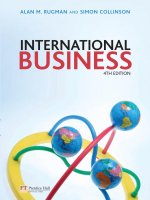
International business 4th rugman and simson collinson
Bạn đang xem bản rút gọn của tài liệu. Xem và tải ngay bản đầy đủ của tài liệu tại đây (31.19 MB, 699 trang )
0273701746_04_COVER
15/11/05
11:39 am
Page 1
Outsourcing. Emerging economies. Environmental impacts. These are just three of the many key issues
currently facing international businesses, all of which are examined in the fourth edition of this wellrespected textbook.
Taking a regional approach, the text challenges some of the underlying assumptions behind globalization and
focuses on both the dominant economies – the EU, the US and Japan – as well as emerging markets, such as
Brazil, India and China, of world trade. The book also integrates analysis of the competitive environment and
the internal resources of the firm to provide a strategic view of international business.
The text is an engaging and comprehensive account of the realities of international business today. It will be
invaluable for anyone studying international business as part of a degree programme and aiming to attain a
confident and thorough understanding of the subject.
“Professor Rugman brings his diverse and knowledgeable background to
this highly successful textbook, making it the most practical, interesting
and current international business management text available.”
Marcel Kohler, University of KwaZulu-Natal
“The book is well written, richly
illustrated with real-life cases and
gives an excellent overview of the
field. The fourth edition particularly
addresses a number of topics that are
often overlooked, or underestimated,
in other international business
publications.”
Dr Matthijs Wolters, Vrije Universiteit
Amsterdam
Alan M. Rugman is Professor of International Business and L. Leslie Waters Chair in
International Business, Indiana University and Associate Fellow at Templeton College,
University of Oxford.
Simon Collinson is Senior Lecturer in International Business at Warwick Business
School, the University of Warwick.
An imprint of
Cover image © Alamy Images
www.pearson-books.com
4TH
EDITION
RUGMAN
COLLINSON
Key features include:
• 100 up-to-date cases on organizations such as
Amazon, Carrefour and Kodak
• Detailed exploration of culture, corporate
responsibility and the natural environment
• Specific coverage of key geographical regions of
international business
• Analysis of the environment and firm provides central
strategic focus
• Interactive teaching and learning resources including
animation and video at www.pearsoned.co.uk/rugman
INTERNATIONAL BUSINESS
“This excellent text provides a focused, comprehensive and relevant coverage of
contemporary international business. Theory and practice are combined, making a highly
readable text, and its wealth of case material makes it a text that students should find
both stimulating and challenging.”
Jean Barclay, Sheffield Hallam University
ALAN M. RUGMAN
AND
SIMON COLLINSON
INTERNATIONAL
BUSINESS
4TH EDITION
INBU_A01.QXD
11/11/05
12:00 AM
Page i
INTERNATIONAL BUSINESS
Visit the International Business, fourth edition, Companion Website
at www.pearsoned.co.uk/rugman to find valuable student learning
material, including:
●
Engaging interactivities to reinforce learning
●
Video clips that illustrate core international business issues
and stimulate discussion
●
Multiple-choice questions to test understanding
●
Extensive links to valuable resources on the web
●
An online glossary to explain key terms
●
Interactive online flashcards that allow the reader to check
definitions against the key terms during revision
INBU_A01.QXD
11/11/05
12:00 AM
Page ii
We work with leading authors to develop the strongest
educational materials in business, bringing cutting-edge
thinking and best learning practice to a global market.
Under a range of well-known imprints, including
Financial Times Prentice Hall, we craft high quality print
and electronic publications which help readers to
understand and apply their content, whether studying
or at work.
To find out more about the complete range of our
publishing please visit us on the World Wide Web at:
www.pearsoned.co.uk
INBU_A01.QXD
11/11/05
12:00 AM
Page iii
Fourth Edition
INTERNATIONAL BUSINESS
Alan M. Rugman
Kelley School of Business, Indiana University
Simon Collinson
Warwick Business School, The University of Warwick
Richard M. Hodgetts
(deceased)
INBU_A01.QXD
11/11/05
12:00 AM
Page iv
Pearson Education Limited
Edinburgh Gate
Harlow
Essex CM20 2JE
England
and Associated Companies throughout the world
Visit us on the World Wide Web at:
First published by McGraw-Hill, Inc. 1995
Fourth edition 2006
© Pearson Education Limited 2000, 2006
The rights of Alan M. Rugman and Simon Collinson to be identified as authors of this work have been
asserted by them in accordance with the Copyright, Designs and Patents Act 1988.
All rights reserved; no part of this publication may be reproduced, stored in a retrieval
system, or transmitted in any form or by any means, electronic, mechanical, photocopying,
recording, or otherwise without either the prior written permission of the Publishers or a
license permitting restricted copying in the United Kingdom issued by the Copyright
Licensing Agency Ltd, 90 Tottenham Court Road, London W1T 4LP.
All trademarks used herein are the property of their respective owners. The use of any
trademark in the text does not vest in the author or publisher any trademark ownership
rights in such trademarks, nor does the use of such trademarks imply any affiliation
with or endorsement of this book by such owners.
ISBN 13: 978-0-273-70174-3
ISBN 10: 0-273-70174-6
British Library Cataloguing-in-Publication Data
A catalogue record for this book is available from the British Library.
Library of Congress Cataloging-in-Publication Data
Rugman, Alan M.
International business / Alan M. Rugman, Simon Collinson, Richard M. Hodgetts.—4th ed.
p. cm.
Includes bibliographical references and index.
ISBN 0-273-70174-6 (paperback)
1. International business enterprises—Management. I. Collinson, Simon. II. Hodgetts,
Richard M. III. Title.
HD62.4.R843 2005
658'.049—dc22
10 9 8 7 6 5 4 3 2 1
09 08 07 06
Typeset by 72 in 10/12.5 Minion
Printed by Mateu Cromo Artes Graficas, Spain
2005054646
INBU_A01.QXD
11/11/05
12:00 AM
Page v
Contents in Brief
List of Figures, Tables, and Maps
Preface
About the Authors
Guide to the Case Studies
Guided Tour of the Book
Guided Tour of the Companion Website
Acknowledgments
Part One
THE WORLD OF INTERNATIONAL BUSINESS
Chapter 1
Chapter 2
Chapter 3
Regional and Global Strategy
The Multinational Enterprise
The Triad and International Business
Part Two
THE ENVIRONMENT OF INTERNATIONAL BUSINESS
Chapter 4
Chapter 5
Chapter 6
Chapter 7
International Politics
International Culture
International Trade
International Financial Markets and Institutions
xv
xix
xx
xxiii
xxviii
xxx
xxxii
3
36
67
99
127
157
191
Part Three INTERNATIONAL BUSINESS STRATEGIES
Chapter 8
Chapter 9
Chapter 10
Chapter 11
Chapter 12
Chapter 13
Chapter 14
Multinational Strategy
Organizing Strategy
Production Strategy
Marketing Strategy
Human Resource Management Strategy
Political Risk and Negotiation Strategies
International Financial Management
Part Four
INTERNATIONAL BUSINESS STRATEGIES IN ACTION
Chapter 15
Chapter 16
Chapter 17
Chapter 18
Chapter 19
Chapter 20
Corporate Strategy and National Competitiveness
European Union
Japan
North America
Emerging Economies
Ethics and the Natural Environment
Glossary
Subject Index
Company Index
Name Index
225
252
278
310
339
370
404
441
470
501
539
568
606
631
643
654
657
v
INBU_A01.QXD
11/11/05
12:00 AM
Page vi
Contents
List of Figures, Tables, and Maps
Preface
About the Authors
Guide to the Case Studies
Guided Tour of the Book
Guided Tour of the Companion Website
Acknowledgments
xv
xix
xx
xxiii
xxviii
xxx
xxxii
Part One
THE WORLD OF
INTERNATIONAL BUSINESS
Regional and Global Strategy
3
Objectives of the chapter
3
■ ACTIVE LEARNING CASE
Introduction
World business: a brief overview
Exports and imports
Foreign direct investment
The triad
Today’s international environment
International trade regulation
Technology
Small and medium-sized enterprises (SMEs)
4
5
6
6
7
10
12
12
13
13
■ INTERNATIONAL BUSINESS STRATEGY IN ACTION
Amazon.com
Globalization and strategic management
Regional triad strategies
Maintaining economic competitiveness
Multinationals in action
14
15
15
16
19
■ INTERNATIONAL BUSINESS STRATEGY IN ACTION
The Italian tile industry
The study of international business
From general to strategic emphasis
Framework for this book
Key points
vi
25
25
■ REAL CASES
Big oil gets bigger
Wal-Mart
Endnotes
Additional bibliography
Appendixes to Chapter 1
26
27
29
29
31
Chapter 2
Chapter 1
Coke goes worldwide with a local
strategy
Key terms
Review and discussion questions
20
22
22
23
25
The Multinational Enterprise
36
Objectives of the chapter
36
■ ACTIVE LEARNING CASE
Disneyland in Europe
Introduction
The nature of multinational enterprises
Characteristics of multinational
enterprises
The internationalization process
Why firms become multinational
enterprises
37
38
39
39
41
43
■ INTERNATIONAL BUSINESS STRATEGY IN ACTION
Italian family firms
The strategic philosophy of multinational
enterprises
Strategic management and multinational
enterprises
Strategic management of MNEs: an
introduction
44
45
46
46
■ INTERNATIONAL BUSINESS STRATEGY IN ACTION
Nestlé
A framework for global strategies:
the CSA-FSA matrix
The competitive advantage matrix
Multinationals in action
Solectron
BMW
Levi Strauss
Canon
Zara
48
49
50
52
52
52
53
54
54
INBU_A01.QXD
11/11/05
12:00 AM
Page vii
CONTENTS
Key points
Key terms
Review and discussion questions
57
57
58
■ REAL CASES
Starbucks
Sony
Endnotes
Additional bibliography
Appendixes to Chapter 2
58
59
61
61
63
Part Two
THE ENVIRONMENT OF
INTERNATIONAL BUSINESS
Chapter 4
International Politics
99
Objectives of the chapter
99
■ ACTIVE LEARNING CASE
How risky is investment in Russia?
Chapter 3
The Triad and International Business
67
Objectives of the chapter
67
■ INTERNATIONAL BUSINESS STRATEGY IN ACTION
■ ACTIVE LEARNING CASE
Boeing versus Airbus
Introduction
Reasons for foreign direct investment
Increase sales and profits
Enter rapidly growing markets
Reduce costs
68
69
70
71
72
72
■ INTERNATIONAL BUSINESS STRATEGY IN ACTION
Aflac
73
Gain a foothold in economic blocs
Protect domestic markets
Protect foreign markets
Acquire technological and managerial
know-how
Foreign direct investment and trade
by triad members
The triad’s domination of FDI and trade
Triad FDI clusters
Multinationals in action: regional
business strategy
The world’s regional automotive
industry
Mergers and acquisitions
Key points
Key terms
Review and discussion questions
74
75
76
76
76
77
77
78
Endnotes
Additional bibliography
Appendix to Chapter 3
Non-governmental organizations and
political power
112
The European Union (EU)
114
Other examples of economic integration
116
Economic integration and strategic management 118
Strategic alliances and acquisitions
118
Localization of business operations
119
Key points
121
Key terms
122
Review and discussion questions
122
■ REAL CASES
79
80
86
87
87
88
How environmental regulations can be
used as trade barriers
Embracer vs. Bombardier
Endnotes
Additional bibliography
123
124
125
125
Chapter 5
■ REAL CASES
Matsushita and Philips
Toys ”R“ Us in Europe and Japan
104
Government control of assets
105
Government–business cooperation
106
Economic integration
108
Trade creation and trade diversion
108
Levels of economic integration
109
Economic integration: an overall perspective
110
Ethics, environment, MNEs, and the civil society 111
Softwood lumber: not-so-free trade
■ INTERNATIONAL BUSINESS STRATEGY IN ACTION
■ INTERNATIONAL BUSINESS STRATEGY IN ACTION
Lafarge and Cemex: concrete multinationals
Introduction
Political ideologies and economics
Political systems
Economic systems
100
101
102
102
103
88
89
90
91
93
International Culture
127
Objectives of the chapter
127
■ ACTIVE LEARNING CASE
Culture clash at Pharmacia and Upjohn
128
vii
INBU_A01.QXD
11/11/05
12:00 AM
Page viii
CONTENTS
Introduction
What is culture?
The importance of culture in different
business contexts
Culture has always been important
129
129
131
132
■ INTERNATIONAL BUSINESS STRATEGY IN ACTION
McDonald’s
National stereotypes and key dimensions
of culture
Culture at two levels
Hofstede’s four dimensions of culture
Trompenaars’ seven dimensions of culture
The GLOBE project’s nine dimensions
of culture
Applying the national culture frameworks
“The way we do things here:” The
implications of cultural differences for
organizations and managers
Cross-cultural management
Organization
Leadership
Communication
The corporate response
Multinational organization structures:
imperialist or independent?
Culture-clash in cross-border M&A and JVs
133
Culture embodied in national
institutions
France: cultural and social characteristics
that create a national distinctiveness
Key points
Key terms
Review and discussion questions
134
134
134
135
137
138
139
141
141
142
142
143
144
145
146
148
149
150
151
151
■ REAL CASES
Do not throw your “meishi”!
Cultural differences in international sports
Endnotes
Additional bibliography
160
160
161
162
163
164
165
■ INTERNATIONAL BUSINESS STRATEGY IN ACTION
■ INTERNATIONAL BUSINESS STRATEGY IN ACTION
Danone and Parmalat—going international,
staying local
Introduction
International trade theory
Theory of absolute advantage
Theory of comparative advantage
Factor endowment theory
International product life cycle theory
Other important considerations
152
153
154
155
China’s organic food exports
Barriers to trade
Reasons for trade barriers
Commonly used barriers
Tariffs
166
167
167
168
169
■ INTERNATIONAL BUSINESS STRATEGY IN ACTION
The EU–US courier wars
US trade policy
Non-tariff barriers to trade
Quotas
“Buy national” restrictions
Customs valuation
Technical barriers
Antidumping legislation, subsidies, and
countervailing duties
Agricultural products
Export restraints
Other economic developments
Countertrade
Trade in services
Free trade zones
Key points
Key terms
Review and discussion questions
171
172
172
173
173
174
174
174
175
175
175
175
176
177
178
179
179
■ REAL CASES
Outsourcing to China
Dumping on trade complaints
Endnotes
Additional bibliography
Appendix to Chapter 6
180
181
182
182
184
Chapter 7
International Financial Markets
and Institutions
191
Objectives of the chapter
191
Chapter 6
International Trade
157
Objectives of the chapter
157
■ ACTIVE LEARNING CASE
Trade of the triad and China
viii
158
■ ACTIVE LEARNING CASE
Barclays Bank international financial
dealings
Introduction
192
193
INBU_A01.QXD
11/11/05
12:00 AM
Page ix
CONTENTS
Foreign exchange markets
Foreign exchange markets in the United States
Determination of the exchange rate
Purchasing power parity
International Fisher effect
Combined equilibrium relationships
194
195
200
200
201
201
■ INTERNATIONAL BUSINESS STRATEGY IN ACTION
The Wall Street crash of 2001
Protecting against exchange risk
Alternatives to minimize exchange risk
Foreign money and capital markets
MNEs and national money markets
MNEs and national capital markets
Regional money and capital markets
The eurocurrency market
Eurocurrency interest rates
Other market characteristics
Criticisms of the euromarkets
Eurobonds and euroequities
203
203
204
205
206
206
207
207
209
209
210
211
■ INTERNATIONAL BUSINESS STRATEGY IN ACTION
AngloGold Ashanti
The IMF system
Unresolved problems with the IMF system
MNEs and international financial markets
and institutions
Key points
Key terms
Review and discussion questions
212
213
215
Endnotes
Additional Bibliography
216
217
217
218
219
220
221
230
231
234
238
239
239
■ INTERNATIONAL BUSINESS STRATEGY IN ACTION
Fuji Xerox and Xerox
Ownership
Functional strategies
Control and evaluation
Common methods of measurement
Key points
Key terms
Review and discussion questions
240
240
242
243
244
245
246
246
■ REAL CASES
Mountain Equipment Co-op: a small business
Benetton
Endnotes
Additional bibliography
247
248
249
250
Organizing Strategy
252
Objectives of the chapter
252
Procter & Gamble
Introduction
Organizational structures
Early organizational structures
The international division
Global organizational structures
253
254
254
255
256
256
■ INTERNATIONAL BUSINESS STRATEGY IN ACTION
Aventis
257
■ INTERNATIONAL BUSINESS STRATEGY IN ACTION
Making matrix work
Chapter 8
Multinational Strategy
225
Objectives of the chapter
225
■ ACTIVE LEARNING CASE
Vodafone and the triad telecom market
Strategy formulation
External environmental assessment
Internal environmental assessment
Goal setting
Strategy implementation
Location
229
■ ACTIVE LEARNING CASE
Part Three
INTERNATIONAL BUSINESS
STRATEGIES
Introduction
Strategic orientations
Arthur Andersen, Accenture, and McKinsey
Chapter 9
■ REAL CASES
HSBC
World financial crises
■ INTERNATIONAL BUSINESS STRATEGY IN ACTION
226
227
228
Strategic management and organizing strategy
Analysis of key structural variables
Coordination
Key points
Key terms
Review and discussion questions
263
266
266
267
272
272
273
■ REAL CASES
LVMH: organizing luxury products in
the international arena
273
ix
INBU_A01.QXD
11/11/05
12:00 AM
Page x
CONTENTS
Command Alkon: a small software business
Endnotes
Additional bibliography
274
275
276
Chapter 10
Production Strategy
278
Objectives of the chapter
278
■ ACTIVE LEARNING CASE
The GE production process and Six Sigma
Introduction
Research, development, and innovation
279
280
281
■ INTERNATIONAL BUSINESS STRATEGY IN ACTION
When the rubber hits the road: Michelin,
Ford, and Firestone
Speed-to-market
Generation of goods and services
Global sourcing
Manufacturing of goods
284
285
287
287
288
■ INTERNATIONAL BUSINESS STRATEGY IN ACTION
Greening the supply chain
Inventory control
Developing a strong service orientation
International logistics
Transportation
Choice criteria
Packaging
Different kinds of global production systems
Strategic management and production strategy
Technology and production design
Continuous improvement
Alliances and acquisitions
Key points
Key terms
Review and discussion questions
289
293
293
295
295
296
297
298
299
300
300
301
303
304
304
■ REAL CASES
Flextronics
Nike
Endnotes
Additional bibliography
305
306
307
308
Introduction
International market assessment
Initial screening: basic need and potential
Second screening: financial and economic
conditions
Third screening: political and legal forces
Fourth Screening: sociocultural forces
Fifth screening: competitive environment
Final selection
Product strategies
Little or no modification
Moderate to high moderation
312
312
313
313
314
314
314
315
315
315
316
■ INTERNATIONAL BUSINESS STRATEGY IN ACTION
Kola Real Group
Promotion
Nature of the product
Advertising
318
320
321
321
■ INTERNATIONAL BUSINESS STRATEGY IN ACTION
IKEA in international markets
Personal selling
Pricing
Government controls
Market diversity
Currency fluctuations
Price escalation forces
Place
Different distribution systems
Choosing the best distribution system
Strategic management and marketing strategy
Ongoing market assessment
New product development
Effective pricing
Key points
Key terms
Review and discussion questions
322
323
324
324
324
325
325
326
326
327
328
330
331
332
332
333
333
■ REAL CASES
Citigroup in China
Brazilian soap operas: a world market
Endnotes
Additional bibliography
334
335
337
338
Chapter 12
Chapter 11
Marketing Strategy
310
Human Resource Management
Strategy
339
Objectives of the chapter
310
Objectives of the chapter
339
■ ACTIVE LEARNING CASE
Volkswagen in the United States
x
■ ACTIVE LEARNING CASE
311
The Coca-Cola Company thinks local
340
INBU_A01.QXD
11/11/05
12:00 AM
Page xi
CONTENTS
Introduction
Selection and repatriation
International screening criteria
and selection procedures
Repatriation of expats
Training and development
Types of training
341
342
Quantifying risk vulnerability
Accounting for country risk
Negotiation strategies
343
345
346
347
■ INTERNATIONAL BUSINESS STRATEGY IN ACTION
348
Transparency and corruption: politically
sensitive political risk
Behavioral characteristics of the participants
in negotiations
349
■ INTERNATIONAL BUSINESS STRATEGY IN ACTION
349
351
353
354
Strategic management and political risk
Use of integrative and protective/defensive
techniques
Key points
Key terms
Review and discussion questions
■ INTERNATIONAL BUSINESS STRATEGY IN ACTION
P&O cruise ships
Compensation
Common elements in an international
compensation package
Current compensation trends
Labor relations
Labor relations practices
■ INTERNATIONAL BUSINESS STRATEGY IN ACTION
German management gets tough
Industrial democracy
Industrial democracy in action
Strategic management and IHRM strategies
Language training
Cultural adaptation
Cultural assimilators
Competitive compensation
Specially designed HRM programs
Key points
Key terms
Review and discussion questions
355
356
357
358
358
359
359
361
362
363
364
364
■ REAL CASES
Outsourcing to India
Executive search firms
Endnotes
Additional bibliography
365
366
367
368
Chapter 13
Political Risk and Negotiation Strategy
370
Objectives of the chapter
370
■ ACTIVE LEARNING CASE
Kodak in China: changing the rules of the game
Introduction
Generic PEST analysis
Political risk
Deregulation and political risk
The nature of political risk
Sources of political risk
Country analysis and political risk assessment
Online risk information resources
Political risk for De Beers
371
373
373
375
376
377
379
379
380
Dell goes to Brazil
380
383
384
387
388
390
391
393
394
396
397
398
■ REAL CASES
Yukos and the Russian oligarchs
Problems with ports
Endnotes
Additional bibliography
WWW resources
398
400
401
402
403
Chapter 14
International Financial
Management
404
Objectives of the chapter
404
■ ACTIVE LEARNING CASE
British Airways
Introduction
Determining parent–subsidiary relationships
Polycentric solution
Ethnocentric solution
Geocentric solution
Managing global cash flows
Internal funds flows
Funds positioning techniques
Transfer pricing
Use of tax havens
Fronting loans
Multilateral netting
405
406
408
408
408
408
409
409
410
410
413
413
413
■ INTERNATIONAL BUSINESS STRATEGY IN ACTION
Tax havens
Managing cash
414
416
■ INTERNATIONAL BUSINESS STRATEGY IN ACTION
News Corp
418
xi
INBU_A01.QXD
11/11/05
12:00 AM
Page xii
CONTENTS
Exchange risk management
Transaction risk
Translation risk
Economic risk
An example of exchange risk management
Developing forecasting and reporting
systems
Capital budgeting in the multinational
enterprise
Use of net present value
Institutional features
International financing in the MNE
Financial structure
Control: Identifying objectives, evaluating
affiliate performance, and making performance
consistent with goals
Strategic international finance
Establishing overseas operations
Reducing financial risk
Alliances
Cost-cutting
Key points
Key terms
Review and discussion questions
419
419
419
420
421
423
424
425
427
428
428
430
430
431
432
432
432
433
434
434
■ REAL CASES
Skandia
Repsol’s acquisition of YPF
Endnotes
Additional bibliography
435
436
437
437
Part Four
INTERNATIONAL BUSINESS
STRATEGIES IN ACTION
■ INTERNATIONAL BUSINESS STRATEGY IN ACTION
Nokia and Ericsson
Mexico and the double diamond
Globalization and corporate strategy
■ INTERNATIONAL BUSINESS STRATEGY IN ACTION
Kodak
455
Integration versus national
responsiveness
Balancing the trade-offs
Competitiveness in the triad
456
457
460
Key points
Key terms
Review and discussion questions
463
463
464
■ REAL CASES
There is no global beer, only local
IBM
Endnotes
Additional bibliography
Corporate Strategy and National
Competitiveness
441
Objectives of the chapter
441
■ ACTIVE LEARNING CASE
xii
466
468
European Union
470
Objectives of the chapter
470
■ ACTIVE LEARNING CASE
France Telecom
The EU environment
Emergence of a single European market
The competitive status of the EU
Conducting a strategic analysis
Using competitive analysis
Evaluating locations
471
472
472
477
479
480
480
■ INTERNATIONAL BUSINESS STRATEGY IN ACTION
Chapter 15
Introduction
Porter’s diamond
Determinants and external variables
Critique and evaluation of the model
Other “diamond” models: two case examples
Canada and the double diamond
464
465
Chapter 16
Ford and Volvo
Worldwide operations and local strategies
of ABB
449
452
454
Strategy issues
Overall strategic analysis for
the European Union
Exporting
Strategic acquisitions and alliances
481
484
484
486
487
■ INTERNATIONAL BUSINESS STRATEGY IN ACTION
Kingfisher as a European Retailer
442
443
443
444
444
447
447
Marketing considerations
Manufacturing considerations
Management considerations
Barriers to EU market access
Key points
Key terms
Review and discussion questions
488
489
490
493
493
495
496
496
INBU_A01.QXD
11/11/05
12:00 AM
Page xiii
CONTENTS
■ REAL CASES
Accor budget hotels
Carrefour
Endnotes
Additional bibliography
497
498
499
500
Chapter 17
Japan
501
Objectives of the chapter
501
■ ACTIVE LEARNING CASE
Doing business in Japan
Introduction
Political, social, and cultural characteristics
A traditionally strong government role
in the economy
Distinctive cultural characteristics
Economic characteristics
Japan and China: the new Asian powerhouse?
Business characteristics
Manufacturing strengths
Strong applied R&D
Keiretsu
502
504
504
504
505
507
510
511
511
512
512
■ INTERNATIONAL BUSINESS STRATEGY IN ACTION
516
Distribution, retailing, and customer orientation 517
Japanese corporations
517
A changing nation
520
Restructuring capital markets
521
Deregulation, increased M&A, and
inward FDI
522
Kirin beer goes international
■ INTERNATIONAL BUSINESS STRATEGY IN ACTION
Wal-Mart takes Seiyu
Restructuring corporations
The decline of manufacturing and
distribution keiretsu
The growth of outward FDI and off-shore
manufacturing
The decline of lifetime employment
and changing HR management practices
Diversification strategies
Conclusions
Key points
Key terms
Review and discussion questions
525
527
537
538
Chapter 18
North America
539
Objectives of the chapter
539
■ ACTIVE LEARNING CASE
The free trade area of the Americas builds
on NAFTA
Introduction
Canada
Canada’s economy
541
542
542
542
■ INTERNATIONAL BUSINESS STRATEGY IN ACTION
Bombardier
Differences in the business environment
Canada’s multinationals
Multilateral agreement on investment (MAI)
Business opportunities in Canada
Franchising
Mexico
Mexico’s economy
Mexico and NAFTA
Regional trade agreements
Doing business in Mexico
544
546
549
551
552
554
555
555
556
556
557
■ INTERNATIONAL BUSINESS STRATEGY IN ACTION
Mexico and NAFTA
Key points
Key terms
Review and discussion questions
558
562
562
562
■ REAL CASES
Jumex of Mexico: fruit juices for the United States
GlaxoSmithKline in the United States
Endnotes
Additional bibliography
563
564
565
566
528
528
528
529
530
531
531
532
■ REAL CASES
Nissan-Renault: no pain, no gain
Canon Group
Endnotes
Additional bibliography
532
535
Chapter 19
Emerging Economies
568
Objectives of the chapter
568
■ ACTIVE LEARNING CASE
Acer Taiwan goes international
Introduction
Triad firms and emerging economy firms:
why the mutual interest?
An overview of emerging economies, by region
Asia-Pacific and the Middle-East
569
570
570
572
574
xiii
INBU_A01.QXD
11/11/05
12:00 AM
Page xiv
CONTENTS
Central and Eastern Europe
Latin America and the Caribbean
Africa
575
579
580
■ INTERNATIONAL BUSINESS STRATEGY IN ACTION
From Oserian to Tesco: The Kenya cut
flower industry
Shifting patterns of comparative and
competitive advantage
Flying Geese model
Market access to the triad
China
MNE investment into China
Getting into China
Outward investment and the new
multinationals from China
Key points
Key terms
Review and discussion questions
3M
581
583
584
586
587
589
591
592
593
598
599
599
■ REAL CASES
Korean chaebols: different paths for
Hyundai and Samsung
The Indian IT, software, and services
industry
Endnotes
Additional bibliography
608
608
608
■ INTERNATIONAL BUSINESS STRATEGY IN ACTION
■ INTERNATIONAL BUSINESS STRATEGY IN ACTION
Oxford Instruments in China
Introduction
Developing effective strategies
Going where the action is
599
International business research
frameworks
Theories of international business
Practical applications of the theory
Developing business networks
Forging new business networks
Coping with changing environments
Political environment
Economic environment
Trade and investment frameworks
Environment and MNEs
610
610
611
611
612
612
613
614
615
618
620
■ INTERNATIONAL BUSINESS STRATEGY IN ACTION
Is The Body Shop an ethical business?
The pattern of MNE responses
Key points
Key terms
Review and discussion questions
621
624
626
626
626
■ REAL CASES
601
603
604
Endnotes
Additional bibliography
627
628
629
629
Glossary
Subject Index
Company Index
Name Index
631
643
654
657
Dell: B2C
Merck
Chapter 20
Ethics and the Natural Environment
606
Objectives of the chapter
606
■ ACTIVE LEARNING CASE
The environment, NGOs, and MNEs
xiv
607
INBU_A01.QXD
11/11/05
12:00 AM
Page xv
List of Figures, Tables, and Maps
Figures
1.1 Model for this book
2.1 The multinational enterprise and its
environment
2.2 Entry into foreign markets: the
internationalization process
2.3 The strategic management process in
action
2.4 The basic components of international
business
2.5 The competitive advantage matrix
3.1 Wal-Mart’s globalization: regional
distribution of stores
4.1 European Union’s institutions
5.1 Cross-cultural business contexts
5.2 Hofstede’s power distance against
individualism for 20 countries
5.3 Excerpts from Trompenaars’ Cultural
Attitudes Survey
5.4 Management dimensions of culture
5.5 Shared characteristics stemming from
common cultural influences
6.1 The international product life cycle
6.2 Impacts of a tariff
7.1 The foreign exchange market for €
in New York
7.2 US foreign exchange markets
7.3 Exchange rate determination
7.4 Interest rates on deposits, domestic
and eurodollar
7.5 3-month eurocurrency deposit rates
(year-end)
7.6 The special drawing right
(on October 15, 2004)
8.1 The five forces of industry competitiveness
8.2 The five forces model applied to
the semiconductor industry
8.3 A basic value chain
8.4 The value chain for IBM
8.5 Generic strategies in worldwide
shipbuilding
8.6 The control and evaluation process
9.1 An export department structure
9.2 Use of subsidiaries during the early
stages of internationalization
24
40
41
47
50
51
80
116
131
135
140
142
149
164
170
195
196
202
9.3
9.4
9.5
9.6
9.7
9.8
9.9
9.10
9.11
10.1
10.2
10.3
10.4
11.1
11.2
12.1
12.2
12.3
13.1
13.2
13.3
13.4
13.5
208
13.6
209
215
232
14.1
14.2
14.3
233
236
237
237
243
255
256
14.4
15.1
15.2
15.3
15.4
15.5
15.6
An international division structure
A global product structure
A global area structure
A global functional structure
Geographic matrix structure
A multinational matrix structure
A mixed structure
Transnational network structure
Organizational epigrams
Global R&D: markets and hierarchies
Cost reduction approaches:
the United States versus Japan
Product- and service-dominated businesses
Global production systems: where is the
value added?
Selected examples of product modification
in the international arena
Product life cycles: two different approaches
The management of multinational
enterprises
Cost of expatriate managers
Labor unions worldwide, 1995
(% of labor force that is unionized)
Kodak’s structure in China
PEST framework for country analysis
Types and levels of political risk
FDI drivers: the strategic objectives
of MNEs, host country attractiveness,
and host government requirements
Zones of acceptance in the negotiating
process (in millions of US $)
Select examples of the use of protective/
defensive techniques
Financial management in the MNE
Common examples of internal sources
and flows of funds
Multilateral dollar flows between
subsidiaries
Centralized netting process in action
Porter’s single diamond framework
The four stages of national development
and the current position of select nations
The single diamond view
Canadian–US double diamond
The shape of North America
US–Mexican double diamond
258
258
260
261
261
262
264
265
271
282
290
294
299
316
320
342
352
353
372
374
377
385
392
395
407
410
415
416
443
445
448
448
453
453
xv
INBU_A01.QXD
11/11/05
12:00 AM
Page xvi
LIST OF FIGURES, TABLES, AND MAPS
15.7 Integration and national responsiveness
16.1 Productivity: percentage increase in
output per hour, 1992–2000
16.2 Business strategies for the EU
16.3 Pan-European manufacturing systems
16.4 Competition and shelter-based strategies
17.1 Japan: Major exports (%)
17.2 Japan: Major imports (%)
17.3 Destination of Japanese overseas
business investment, 2002–2004
17.4 Company spending on R&D:
Japan compared
17.5 International patenting output:
Japan compared
17.6 The Fuyo-keiretsu group before
restructuring
17.7 Bank group consolidation in Japan
17.8 Declining cross-shareholding in Japan
17.9 Increasing foreign ownership in Japan
17.10 Number of Japan-related M&A transactions
17.11 Renault-Nissan alliance basics
457
478
484
492
494
509
509
511
513
513
514
522
522
523
524
534
19.1 What is the attraction for triad and non-triad
firms investing in each other’s home regions?
19.2 Flying Geese model: changing
national-level specialization
19.3 Flying Geese model: the shifting location
of industrial production
19.4 Flying Geese pattern of shifting
comparative advantage
19.5 Accelerated structural transformation
19.6 Firm-specific advantages (FSAs) for
the new multinationals
20.1 Network linkage and the changing
shape of international distribution
systems
20.2 Network linkages for successful MNEs
20.3 Foreign direct investment and NAFTA
20.4 NAFTA and the EU
20.5 The different perceptions of the WTO
20.6 The institutional alternatives for trade
and investment
20.7 Multinational enterprise strategies
and civil society
571
584
585
585
586
596
613
614
619
620
623
623
624
Tables
1.1
1.2
1.3a
1.3b
1.4
1A
1B
1C
1D
1E
1F
2.1
2.2
2.3
2A
2B
2C
2D
xvi
World trade, 2002
Intra-regional trade in the triad,
1980–2002
Foreign direct investment in the
United States, 2002
Foreign direct investment by the
United States, 2002
Comparative differences in the study
of international business, 1950–2010
The top 25 importers in the world, 2002
The top 25 exporters in the world, 2002
Direction of world trade flows, 1993–2002
World trade flows by major countries
and regions, 2002
Inward stocks of world foreign direct
investment
Outward stocks of world foreign direct
investment
The world’s largest 500 multinational
enterprises, 2003
The international expansion of four MNEs
The top 100 economies and MNEs, 2003
The 25 largest US MNEs, 2003
The 25 largest European MNEs, 2003
The 25 largest Japanese MNEs, 2003
The 25 largest Canadian MNEs, 2003
7
2E
8
3.1
3.2
3.3a
3.3b
3.4
8
9
23
31
32
33
5.1
5.2
5.3
33
6.1
34
35
39
46
56
63
64
65
65
6.2
6.3
6A
6B
6C
7.1
7.2
The 25 largest MNEs from developing
countries, 2003
Intra-regional FDI in the triad, 1986–2000
The largest triad-based MNEs, 2001
Ten years of triad FDI
Ten years of triad trade
The regional nature of the motor
vehicles & parts industries
World population percentages in terms
of home region, language, and religion
Average and intra-country ranking of
work goals: a seven nation comparison
Organization types reflecting cultural
predispositions
Members of the Organization of
Petroleum Exporting Countries
(OPEC), 2004
Common non-tariff barriers to trade
US balance of current account, 2002
Balance of payments: IMF presentation
US international transactions: 2002
and 2003
US merchandise trade, 2002 and 2003
Exchange rates in the interbank market
Currency futures contract specifications
at the Chicago Mercantile Exchange
66
70
71
78
78
81
130
141
145
168
173
176
185
189
190
197
199
INBU_A01.QXD
11/11/05
12:00 AM
Page xvii
LIST OF FIGURES, TABLES, AND MAPS
8.1
8.2
9.1
Typical strategic orientations of MNEs
Typical goals of an MNE
Factors that encourage centralization or
decentralization of decision making in
multinational operations
The cost of arriving late to market
(and still be on budget)
Japan’s biggest business groups that
regularly attend monthly council meetings
The effect of MNE pricing on final
consumer costs
International market penetration:
location of subsidiaries, holdings, and
joint ventures
Employer incentive practices around
the world
A cultural assimilator situation
Cost of living in select cities
(New York=100), 2004
Human resource management practices
in select countries
Changes in national regulations on FDI,
1991–2003
Political risk: sources, agents, and effects
The Weighted Country Risk Assessment
Model
Twelve examples of the difference in
verbal behaviors among Japanese, US,
and Brazilian negotiators
Shifting profits by transfer pricing
Transfer pricing through tax havens
Net cash positions of subsidiaries
Exchange risk hedging techniques
International sources of credit
(including markets and intrafirm
transfers)
Stocks of FDI by Canada, the US, and
Mexico, 1991–2002 (in millions of US $)
Products most affected by CVD and AD
laws in the United States, 1980–2003
Economic profile of the big three
(in US dollars)
Hourly compensation costs in
manufacturing, 1995–2003
10.1
10.2
11.1
11.2
12.1
12.2
12.3
12.4
13.1
13.2
13.3
13.4
14.1
14.2
14.3
14.4
14.5
15.1
15.2
16.1
16.2
228
238
16.3
16.4
268
16.5
286
301
326
328
352
360
16.6
16.7
17.1
17.2
17.3
17.4
17.5
17.6
17.7
361
362
376
378
18.1
18.2
18.3
18.4
18.5
381
18.6
393
411
413
415
421
428
19.1
19.2
19.3
19.4
19.5
19.6
452
460
19.7
19.8
473
20.1
The world’s most competitive nations,
1989 and 2005
Comparison of investment incentives in
selected EU countries based on an actual
project evaluation
Comparison of location factors:
one example
Direction of EU trade, 1994–2003
EU antidumping cases by sector, 1998–2002
Economic and trade data for Japan
Japan’s FDI imbalance
Japan’s FDI inflows and outflows by
source and destination
The top 40 Japanese firms
Out-in M&As in major developed
countries and value of inward FDI
Main “out-in” M&A in Japan in 2002
The global distribution of Renault and
Nissan Sales, 2002
Direction of US trade
Direction of Canada’s trade
Direction of Mexico’s trade
The largest Canadian-owned companies,
by revenues
The largest foreign-owned companies
in Canada, by size
The largest Canadian-based firms,
by degree of multinationality
FDI inflows, by host region and
economy, 1980–2003
FDI from developing countries,
1980–2003
The top 50 non-financial TNCs from
developing economies
China: key economic indicators
China: key trade indicators
Selected inbound foreign acquisitions
in China, 2004
China’s top 10 import-export traders
Chinese firms in the Forbes
2000 list, 2005
The world’s major trade agreements
479
482
483
486
494
507
507
508
519
524
526
533
540
540
540
550
551
552
573
574
576
588
589
590
594
597
616
477
Maps
1.1
10.1
14.1
16.1
The European Union timetable
Ford Fiesta production network
World tax havens
The European Union
11
292
412
474
17.1 Japan 2003
18.1 North America, Canada, Mexico,
and United States
19.1 South and East Asia (including China)
508
543
588
xvii
INBU_A01.QXD
11/11/05
12:00 AM
Page xviii
Supporting resources
Visit www.pearsoned.co.uk/rugman to find valuable resources.
Companion Website for students
●
Engaging interactivities to reinforce learning
●
Video clips that illustrate core international business issues and
stimulate discussion
●
Multiple-choice questions to test understanding
●
Extensive links to valuable resources on the web
●
An online glossary to explain key terms
●
Interactive online flashcards that allow the reader to check
definitions against the key terms during revision
For instructors
●
Complete, downloadable Instructor’s Manual, including:
●
●
●
Chapter objectives, summaries, and outlines
Suggested class schedules and assignments
Answers to review and discussion questions
●
PowerPoint slides that can be downloaded and used as OHTs
●
Testbank of over 2,000 questions
●
Extensive links to valuable resources on the web
●
A gradebook function that allows you to create classes in which
you can track and monitor your students’ grades
Also: The Companion Website provides the following features:
● Search tool to help locate specific items of content
● Online help and support to assist with website usage and
troubleshooting
For more information please contact your local Pearson Education sales
representative or visit www.pearsoned.co.uk/rugman.
xviii
INBU_A01.QXD
11/11/05
12:00 AM
Page xix
Preface
Major improvements were made to this Fourth Edition
of one of the leading international business textbooks in
Europe and Asia. We have retained the focus on the
“triad” economies of the EU, Japan, and North America
but also increased coverage of the non-triad economies,
especially with a greatly increased emphasis on the role
of China and India in Chapter 19. This chapter, along
with Chapters 5, 13, and 17, was prepared by Simon
Collinson of Warwick Business School. Simon joins us as
co-author of the textbook, and he will take an even
greater role in future editions. He represents a younger
generation of teachers and scholars who use this book.
The four chapters by Simon have been totally reorganized and rewritten to update the text.
The other major changes involve international financial
management—Chapters 7 and 14—which have been prepared by Robert Grosse of Thunderbird. These also update
and improve the text. Along with a greater theoretical
emphasis in the first three chapters and in Chapter 20 on
analytical frameworks for the field, these rewritten chapters serve to upgrade the analytical content of the book, as
requested by many adopters.
Features of the Fourth Edition
■
Chapter 19 was completely reworked with much
new material in emerging Asian markets, including
China and India, and adding the software industry
and outsourcing.
■
Chapter 20 was rewritten to increase its emphasis on
corporate ethics and the natural environment.
■
Of the 100 cases, approximately 40 new ones were developed, as indicated in the case list. All the other
cases were updated.
■
Chapter 5 on culture has been extensively revised and
includes new materials such as John Mole’s framework and insights from the GLOBE Research
Program.
■
The focus on regional activity is even greater, with
additional firm level data on the world’s 500 largest
firms (in Chapters 1–3). Also new triad diagrams
showing intraregional trade and FDI have been added
to give an upfront focus on regional business.
■
The basic integrative FSA/CSA matrix has been
moved from Chapter 20 to Chapter 2, to serve as a
synthesizing device. The Dunning eclectic model has
been added as an appendix to Chapter 3.
■
Chapters 7 and 14 were totally rewritten with more
advanced material on international financial management and several new cases.
■
The treatment of the transnational network has been
extended with a three-part diagram in Chapter 9.
■
Chapter 13 on political risk now focuses on country
risk analysis and links this to investment appraisal
and NPV final analysis.
■
Chapter 17 on Japan was rewritten with an historical
approach to explain the background of its current
economic state. The Renault/Nissan case was entirely
revised and moved to Chapter 17 from Chapter 6.
■
All tables were updated.
■
Photos were added, including logo pictures of MNEs.
We wish to thank several professors who made extremely helpful comments on earlier drafts of this Fourth
Edition. Their names are given on page xxxii.
At Pearson we thank Editor Matthew Walker,
Development Editors Stuart Hay and Paula Parish, and
Production Editors Nicola Chilvers and Mary Lince. We
also thank Helen Rugman and Melanie Hunter for
proofreading the manuscript, and most of all, Cecilia
Brain for excellent research assistance and contributions
to the resources available on the companion website and
Mildred Harris for exceptional dedication in the preparation of this book and its supporting materials.
Alan M. Rugman, Indiana
Simon Collinson, Warwick
xix
INBU_A01.QXD
11/11/05
12:00 AM
Page xx
About the Authors
Dr. Alan M. Rugman is L. Leslie Waters Chair of
International Business at the Kelley School of Business,
Indiana University, where he is also Professor of
International Business and Professor of Business
Economics and Public Policy. He is also Director of the
IU CIBER. He was Thames Water Fellow in Strategic
Management at Templeton College, University of Oxford
from 1998–2001 where he remains an Associate Fellow.
Previously he was Professor of International Business
at the University of Toronto 1987–1998, Dalhousie
University 1979–1987, and the University of Winnipeg
1970–1978. He has also been a visiting professor at
Columbia Business School, London Business School,
Harvard University, U.C.L.A., M.I.T., Warwick Business
School, and the University of Paris-La Sorbonne.
Dr. Rugman has published over 200 articles dealing
with the economic, managerial, and strategic aspects of
multinational enterprises and with trade and investment
policy. These have appeared in such leading refereed
journals as The American Economic Review, Strategic
Management Journal, Journal of International Business
Studies, and California Management Review.
His 40 books include Inside the Multinationals
(Columbia University Press, 1981); Multinationals and
Transfer Pricing (co-author) (St. Martin’s Press, 1985);
Administered Protection in America (co-author)
(Routledge, 1987); Global Corporate Strategy and Trade
Policy (co-author) (Routledge, 1990); Foreign Investment
and North American Free Trade (ed.) (University of South
Carolina Press, 1994); International Business (co-author)
(McGraw-Hill, 1985, 1995); The Theory of multinational Enterprises and Multinational Enterprises and
Trade Policy (Elgar, 1996); Environmental Regulations and
Corporate Strategy (co-author) (Oxford University Press,
1999); Multinationals as Flagship Firms (co-author)
(Oxford University Press, 2000); International Business
(FT/Prentice Hall, 2000, 2003); The End of Globalization
(Random House, 2000; AMACOM 2001); The Oxford
Handbook of International Business (co-ed) (Oxford
University Press, 2001); and The Regional Multinationals
(Cambridge University Press, 2005).
As a leading authority in international business,
Dr. Rugman served as Vice-President of the Academy of
International Business in 1989–1990 and was elected a
xx
Fellow of the Academy in 1991. He is now serving as
President of AIB from 2004–2006. He is also a Fellow of
the Royal Society of Arts, elected 1998. He serves on the
Editorial Boards of Strategic Management Journal,
Management International Review, Journal of International Business Studies, and several others.
In 1994 he received the Booz, Allen Hamilton Award as
Eminent Scholar in International Management, Academy
of Management. He was also honored at a special plenary session of the European International Business
Association annual meetings, Slovenia, December 2004
for the 25th Anniversary of his 1979 book, International
Diversification and the Multinational Enterprise.
Born in England in 1945, Dr. Rugman became a
Canadian citizen in 1973 and a US resident in 2002. He
earned his BA in economics from Leeds University in 1966,
MSc in economic development from London University’s
School of Oriental and African Studies (SOAS) in 1967,
and his PhD in economics from Simon Fraser University in
1974. He was elected to an MA (Oxon) in 1998.
He has been a consultant to major private-sector
companies, research institutes, and government agencies. These include Exxon/Imperial Oil, Kodak, Royal
Bank of Canada, Northern Telecom, the United Nations
(UNCTAD), NAFTA’s Commission on Environmental
Co-operation, and the Organization for Economic
Co-operation and Development (OECD). Dr. Rugman
served as an outside advisor on free trade, foreign investment, and international competitiveness to two
Canadian Prime Ministers over the 1986–1993 period.
Dr. Simon Collinson is Senior Lecturer in International
Business at Warwick Business School, the University of
Warwick, UK. He teaches International Business at
Undergraduate, MBA, and Executive levels and previously
held the post of Associate Dean (MBAs) at Warwick
Business School, heading one of the largest and most
highly-rated MBA programs in Europe. Dr. Collinson has
had visiting positions as Senior Research Fellow at the
Australian Graduate School of Management (AGSM) in
Sydney and Visiting Professor at the Kelley School of
Business, Indiana University. He is also an Associate at the
Center for the Study of Globalization and Regionalization
(CSGR), University of Warwick, and UK Representative
INBU_A01.QXD
11/11/05
12:00 AM
Page xxi
ABOUT THE AUTHORS
for the Academy of Management (AOM) International
Management Division.
Dr. Collinson was formerly Lecturer and Senior
Research Fellow at Edinburgh University Management
School and the Assistant Director of the Japanese–
European Technology Studies (JETS) institute for seven
years. During this period he was awarded a Royal Society
Fellowship to study in Japan, hosted by the National
Institute for Science and Technology Policy (NISTEP) in
Tokyo.
His research interests include global innovation
strategies, R&D, knowledge and intellectual asset management in multinational firms; the competitiveness of
international UK firms; national systems of innovation
and emerging economies; high-technology entrepreneurship, small firm networks, and regional development; Japan and China: local business practices and
cross-cultural management, foreign direct investment,
and economic change. Dr. Collinson has received research funding awards from the UK Economic and
Social Research Council, the UK government’s
Department of Trade and Industry, Japan’s Science and
Technology Agency, the British Royal Society, and
DGXII of the European Union. He has research, consulting, and executive teaching experience with firms
such as British Aerospace, Corus Steel, Diageo, HSBC,
ICI, GKN, Jones Lang LaSalle, Kodak (Japan), Lloyd’s
Register, Nippon Steel, Philips, Prudential, and Sony.
In addition to numerous book chapters and a sole-authored book, Small and Successful in Japan (Ashgate
Publishing, 1996), he has published in a range of refereed
journals including Organization Studies, International
Journal of Technology Management, European Management Journal, R&D Management, Organization
Dynamics, and Technology Analysis and Strategic
Management.
Born in Tanzania in 1964, Dr. Collinson earned a
Joint-BA (Hons.) in geography and sociology at Leeds
University and an MA in Human Geography at the
University of Florida, Gainesville. He was awarded his
DPhil from the Science Policy Research Unit (SPRU) at
Sussex University in 1991.
In Memoriam: Richard M. Hodgetts
Richard M. Hodgetts passed away in November 2001,
having battled cancer for several years. Richard was an
enthusiastic, involved, and dedicated scholar who excelled in producing clearly written text that is relevant
and readable for management students.
Richard Hodgetts was a Professor of Management in
the Department of Management and International
Business at Florida International University (FIU). He
earned his BS at New York University in 1963, his MBA at
Indiana University in 1964, and his PhD at the University
of Oklahoma in 1968. He was at the University of
Nebraska, Lincoln (1966–1975); Texas Tech University
(1975–1976); and Florida International University (FIU)
from 1976–2001. Dr. Hodgetts published over 125 articles and research papers. He was the author or co-author
of 50 different books. Overall, Richard Hodgetts sold one
million copies of his textbooks.
Professor Hodgetts also served as a consultant for a
wide variety of organizations and firms including
Advanced Micro Systems, AT&T Technologies, Digital
Equipment, Eastman Kodak, General Electric, General
Motors, Hewlett Packard, Motorola, Procter & Gamble,
Wal-Mart, and the US Federal Reserve System.
Professor Hodgetts was the recipient of a number of
awards including the Outstanding Educator Award,
Academy of Management (1999), the John F. Mee,
Management Contribution Award, Management
History Division, Academy of Management (1998), and
the Professorial Excellence Program Award, FIU (1997).
xxi
INBU_A01.QXD
11/11/05
12:00 AM
Page xxii
INBU_A01.QXD
11/11/05
12:00 AM
Page xxiii
Guide to the Case Studies
CHAPTER
TYPE OF CASE
Chapter 1
■ Active Learning Case
Regional and
Global Strategy
PAGE
■ International
Amazon.com
US
14
■ International
The Italian tile industry
EU: Italy
20
■ Real
Case
Big oil gets bigger
US/EU/Japan
26
■ Real
Case
Wal-Mart
US
Disneyland in Europe
US
■ Active
Learning Case
■ International
Business
Strategy in Action
✔
27
37
Italian family firms
44
EU: Italy
■ International
Nestlé
■ Real
Case
Starbucks
■ Real
Case
Sony
Japan
Boeing versus Airbus
US/EU
68
Japan/US
73
■ Active
Learning Case
EU/Emerging
Economies
✔
48
US
✔
✔
58
59
■ International
Aflac
■ International
Lafarge and Cemex:
concrete multinationals
US/Emerging
Economies
■ Real
Case
Matsushita and Philips
Japan/EU
■ Real
Case
Toys “ R ” Us in Europe and Japan
US/EU/Japan
How risky is investment in Russia?
Emerging
Economies
100
■ International
Softwood lumber: not-so-free trade
US
104
■ International
Non-governmental origanizations
and political power
US/EU
112
■ Real
Case
How environmental regulations can
be used as trade barriers
US/Emerging
Economies
123
■ Real
Case
Embraer versus Bombardier
US/Emerging
Economies:
Brazil/US
✔
Culture clash at Pharmacia and
Upjohn
EU: Sweden
and Italy/US
✔
128
US
✔
133
Business
Strategy in Action
Business
Strategy in Action
■ Active
Learning Case
Business
Strategy in Action
Business
Strategy in Action
Chapter 5
International
Culture
NEW?
4
Business
Strategy in Action
Chapter 4
International
Politics
REGION
US
Business
Strategy in Action
Chapter 3
The Triad and
International
Business
COUNTRY/
Coke goes worldwide with a local
strategy
Business
Strategy in Action
Chapter 2
The
Multinational
Enterprise
ORGANIZATION/INDUSTRY
■ Active
Learning Case
■ International
McDonald’s
■ International
Danone and Parmalat –
going international, staying local
Business
Strategy in Action
Business
Strategy in Action
✔
74
88
✔
EU: Sweden
and Italy/US
89
124
146
xxiii
INBU_A01.QXD
11/11/05
12:00 AM
Page xxiv
GUIDE TO THE CASE STUDIES
CHAPTER
Chapter 6
International
Trade
TYPE OF CASE
■ Real
Case
Do not throw your “meishi”!
■ Real
Case
Cultural differences in
international sport
■ Active
Learning Case
✔
152
US/EU/Japan/
Emerging
Economies:
China
158
■ Real
Case
Outsourcing to China
US
■ Real
Case
Dumping on trade complaints
Learning Case
PAGE
153
US
■ Active
NEW?
EU/US
The EU-US courier wars
Emerging
Economies:
China
✔
166
✔
171
✔
180
181
Barclays Bank international
financial dealings
EU: UK
■ International
The Wall Stret crash of 2001
US
203
■ International
AngloGold Ashanti
Emerging
Economies:
South Africa
212
■ Real
Case
HSBC
EU: UK
218
■ Real
Case
World financial crises
Emerging
Economies
219
Vodafone and the triad telecom market
EU
226
■ International
Arthur Andersen, Accenture,
and McKinsey
US
229
■ International
Fuji Xerox and Xerox
US/Japan
240
■ Real
Case
Mountain Equipment
Co-op: a small business
Emerging
Economies:
Canada
247
■ Real
Case
Benetton
EU: Italy
248
Business
Strategy in Action
■ Active
Learning Case
Business
Strategy in Action
Business
Strategy in Action
■ Active
Learning Case
Procter & Gamble
■ International
Aventis
■ International
Making matrix work
Business
Strategy in Action
Business
Strategy in Action
xxiv
EU: UK/Japan
■ International
Business
Strategy in Action
Chapter 9
Organizing
Strategy
REGION
China’s organic food exports
Business
Strategy in Action
Chapter 8
Multinational
Strategy
Trade of the Triad and China
COUNTRY/
■ International
Business
Strategy in Action
Chapter 7
International
Financial
Markets and
Institutions
ORGANIZATION/INDUSTRY
✔
192
US
✔
253
EU: France/
Germany
✔
257
EU/US/Japan
263