- Trang chủ >>
- THPT Quốc Gia >>
- Ngoại Ngữ
Đề khảo sát chất lượng môn Tiếng Anh ôn thi đại học số 30
Bạn đang xem bản rút gọn của tài liệu. Xem và tải ngay bản đầy đủ của tài liệu tại đây (130.6 KB, 5 trang )
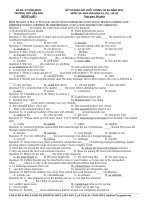
SỞ GD- ĐT VĨNH PHÚC
TRƯỜNG THPT LIỄN SƠN
(ĐỀ THI CHÍNH THỨC)
ĐỀ THI KHẢO SÁT CHẤT LƯỢNG THI ĐH NĂM 2014
MÔN THI: ANH VĂN (Khối A1, D1) - ĐỀ 30
Thời gian: 90 phút
I. Mark the letter A, B, C, or D to show the underlined part that needs correction.
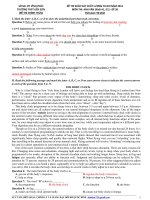
Question 1: Below are some pieces of advice that can help you reduce the feeling of pressure and creating
A B C
a good impression on your interviewer.
D
Question 2: What I love most about the book that was the close-knit friendship of the three friends.
A B C D
Question 3: No matter how young are yo u , you should take responsibility to do some housework family
A B C
to help your parents
D
Question 4: Irrigation often studied together with drainage, which is the natural or artificial removal of the
A B C
surface and sub-surface water from a given area.
D
Question 5: Studies of Mars indicate that enough water might be collected on the planet’s surface
A B C
sustain prolonged missions by human space crews
D
II. Read the following passage and mark the letter A, B, C, or D on your answer sheet to indicate the correct answer
to each of the questions from 6 to 15.
THE BODY CLOCK
Why is it that flying to New York from London will leave you feeling less tired than flying to London from New
York? The answer may be a clear case of biology not being able to keep up with technology. Deep inside the brain
there is a “clock” that governs every aspect of the body’s functioning: sleep and wake cycles, levels of alertness,
performance, mood, hormone levels, digestion, body temperature and so on. It regulates all of these functions on a 24-
hour basis and is called the circadian clock (from the Latin, circa “about” + dies “day”).
This body clock programmes us to be sleepy twice a day, between 3-5 a.m and again between 3-5 p.m. Afternoon
tea and siesta times are all cultural responses to our natural biological sleepiness in the afternoon. One of the major
causes of the travelers’ malady known as jet lag is the non-alignment of a person’s internal body clock with clocks in
the external world. Crossing different time zones confuses the circadian clock, which then has to adjust to the new time
and patterns of light and activity. To make matters more complex, not all internal body functions adjust at the same
rate. So your sleep/wake may adjust to a new time zone at one rate, while your temperature adjusts at a different pace.
Your digestion may be on a different schedule altogether.
Though we live in a 24-hour day, the natural tendency of the body clock is to extend our day beyond 24 hours. It is
contrary to our biological programming to shrink our day. That is why travelling in a westward direction is more body-
clock friendly than flying east. NASA studies of long haul pilots showed that westward travel was associated with
significantly better sleep quantity and quality than eastward flights. When flying west, you are “extending” your day,
thus travelling in the natural direction of your internal clock. Flying eastward will involve “shrinking” or reducing your
day and is in direct opposition to your internal clock’s natural tendency.
One of the more common complaints of travelers is that their sleep becomes disrupted. There are many reasons for
this: Changing time zones and schedules, changing light and activity levels, trying to sleep when your body clock is
programmed to be awake, disruption of the internal circadian clock and working longer hours. Sleep loss, jet lag and
fatigue can seriously affect our ability to function well. Judgment and decision-making can be reduced by 50%,
attention by 75 percent, memory by 20 percent and communication by 30 percent. It is often suggested that you adjust
your watch as soon as you board a plane, supposedly to try to help you adjust to your destination’s schedule as soon as
you arrive. But it can take the body clock several days to several weeks to fully adjust to a new time zone.
Question 6: The main function of the body clock is to_________
A. govern all the body’s responses. B. regulate the body’s functions.
C. help us sleep. D. help us adapt to a 24-hour cycle.
Question 7: The word “It” refers to_________
A. the programme B. the body clock C. the function D. the brain
Question 8: Jet lag _________
A. makes our body clock operate badly. B. causes our body clock to change.
SƯU TẦM, BIÊN SOẠN, CHỈNH LÝ VÀ GIẢNG DẠY BỞI ĐỖ QUỐC BÌNH –
1
C. extends the hours of our body clock. D. upsets our body’s rhythms.
Question 9: The word “malady” is closest in meaning to
A. illness B. bore C. thought D. feeling
Question 10: The direction you fly in_________
A. helps you sleep better. B. alters your body’s natural rhythms.
C. affects the degree of jet lag. D. extends or shrinks your body clock.
Question 11: According to the article, _________
A. various factors stop us sleeping when we fly.
B. travelers complain about the negative effects of flying.
C. flying seriously affects your judgment and decision-making.
D. jet lag can affect different abilities differently.
Question 12: On the subject of avoiding jet lag the article_________
A. makes no suggestions. B. says there is nothing you can do.
C. proposes gradually adjusting your body clock. D. suggests changing the time on your watch.
Question 13: According to the author, which of the following reasons disrupt travelers’ sleep?
A. Travelers try to sleep between 3-5 p.m.
B. Travelers’ attention is reduced by 75 percent.
C. The traveler’s internal circadian clock has to adjust to patterns of light and activity.
D. Travelers fly in the natural direction of their internal clock.
Question 14: It can be inferred from the passage that_________
A. travelers have to spend more money flying westward than eastward.
B. there are more travelers in westward flights than in eastward ones.
C. westward travelers become friendlier than eastward ones.
D. travelers do not sleep as well in eastward flights as in westward ones.
Question 15: The word “fatigue” is closest in meaning to_________
A. obsession B. exhaustion C. sleeplessness D. frustration
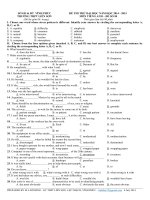
III. Mark the letter A, B, C, or D to indicate the correct answer to each of the following questions.
Question 16: Anyone _____ to another country needs special papers.
A. is travelled B. travelling C. travelled D. is travelling
Question 17: It is very importance for a firm or a company to _____ changes in the market.
A. keep pace of B. keep track with C. keep in touch with D. keep pace with
Question 18: It’s high time we_____.
A. leave B. were leaving C. to leave D. had left
Question 19: Last time the doctor_____ that she_____.
A. suggested/ not smoke B. suggested/should have not smoked
C. had suggested/should not smoke D. suggested/ did not smoke
Question 20: It tasted so _____ of the lemon that the other flavours were lost
A. fully B. forcefully C. hardly D. strongly
Question 21: "How would you like your steak?" "______"
A. Yes, sir. B. Rare, please. C. Not too bad. D. Very good.
Question 22: “Would you like some beer?” “Not while I’m _____”
A. in order B. on duty C. under control D. in the act
Question 23: He spent part of___ afternoon telling them___ news he could not tell them by____ telephone.
A. an/__/ the B. an/ the/ the C. the/__/the D. the/ the/ __
Question 24: We are supposed to attend_____ on “Brain Electronics” tomorrow
A. a discussion B. a lecture C. a meeting D. a say
Question 25: I will have your car_____ by the end of the day
A. repairing B. repair C. to repair D. repaired
Question 26: He always did it well at school_____ having his early education disrupted by illness.
A. in spite of B. on account of C. even though D. in addition to
Question 27: According to a recent survey, most people are on good_____ with their neighbours
A. terms B. acquaintance C. relations D. relationships
Question 28: He _____ off alone a month ago and _____ of since.
A. set/ hasn’t been heard B. set/hasn’t heard C. settled/ hasn’t heard D. settled/ hadn’t been heard
Question 29: But for their help, he_____
SƯU TẦM, BIÊN SOẠN, CHỈNH LÝ VÀ GIẢNG DẠY BỞI ĐỖ QUỐC BÌNH –
2
A. has failed B. would have failed C. has not failed D. wouldn’t have failed
Question 30: "______" "What happened?"
A. What did you do today? B. I had a bad day. C. How was your day? D. Have a nice day.
Question 31: _____ will Mr. Thanh be able to regain control of the company
A. No matter how does he work hardly B. Not until his work hard
C. Only with hard work D. Only if he works hardly
Question 32: An eyewitness described how ten people_____ in the fire
A. had killed B. had been being killed C. had been killed D. were killed
Question 33: She was so frightened that she was shaking like_____
A. a flag B. a leaf C. jelly D. the wind
Question 34: _____ provided a living for nearly 90 percent of the population of the American colonies.
A. Farming was B. What farming C. Farming was what D. What was farming
Question 35: I can’t go with you today; I have_____ things to do
A. a great many B. a great deal C. great many D. many a great
Question 36: If Thang hadn’t quarreled with the bad boys at school, he_____ a black eye.
A. would have had B. hadn’t had C. won’t have had D. wouldn’t have had
Question 37: He objected to _____.
A. his mistakes being laughed at B. his mistakes laughing at
C. laughing his mistakes at D. his mistakes at laughing
Question 38: "This cupboard is broken." "______"
A. We'll get it fixed. B. But it's small. C. But it's big. D. We have to pay extra money.
Question 39: "I have an idea. Let's go on a picnic on Saturday." "______"
A. I know. B. Okay. C. You're kidding. D. I'm sure.
Question 40: This film is really sad. I think_____.
A. I’ll cry B. I cry C. I’m going to cry D. I’m crying
Question 41: "I'd like to place an order for delivery, please." "______"
A. Sure, what time is it? B. Sure, what would you like?
C. Sure, how much is it? D. We actually take orders at five.
Question 42: We expected her at nine but she finally_____ at midnight.
A. turned out B. came off C. turned up D. came to
Question 43: It was ten years ago_____ Mr. Thang returned from America.
A. when that B. when C. since D. that
Question 44: He teaches_____ piano and _____ violin.
A. the/the B. a/the C. __/__ D. the/a
Question 45: _____ I love you, I can’t let you do whatever you like.
A. Despite B. Whether C. Much as D. Whatever
IV. Mark the letter A, B, C, or D on your answer sheet to indicate the sentence that is closest in meaning to each of
the following questions.
Question 46: Nobody is allowed to enter the area without permission.
A. You are not allowed to enter the area because of the permission.
B. You can’t enter the area under any circumstances.
C. You can’t enter the area if you are not allowed to.
D. You can enter the area if you ask for permission.
Question 47: Strong as he is, he still can’t lift that box.
A. He’s very strong, but he still can lift that box. B. He still can’t lift that box because he’s not as strong.
C. The box was too heavy for him to lift. D. However strong he is, he still can’t lift that box.
Question 48: “Why I haven’t thought of this before,” Dung said to himself
A. Dung suggested himself not thinking of that before.
B. Dung advised himself not to have thought of that before.
C. Dung wondered why he hadn’t thought of that before.
D. Dung said that why he hadn’t thought that before.
Question 49: The company turned down Hung’s offer
A. The company accepted Hung’s offer. B. The company offered Hung a job.
C. The company discussed Hung’s offer. D. The company rejected Hung’s offer.
SƯU TẦM, BIÊN SOẠN, CHỈNH LÝ VÀ GIẢNG DẠY BỞI ĐỖ QUỐC BÌNH –
3
Question 50: “I claim that you took my money,” she said to the housekeeper.
A. She warned the housekeeper against taking her money.
B. She admitted the housekeeper having taken her money.
C. She accused the housekeeper of having taken her money.
D. She insisted on the housekeeper taking her money.
Question 51: What he did came as no surprise to me
A. His behaviour surprised me. B. He was surprised when I came.
C. I was not surprised by his actions. D. he told me that he was not surprised.
Question 52: If I were in your shoe, I would let him go.
A. I was wearing your shoe and would like to let him go. B. I suggest that you let him go.
C. I advise you to wear your shoe and let him go. D. I would like to be in your shoe so he could let him go.
Question 53: So far as you’ve explained the problem, it doesn’t sound too bad.
A. If you hadn’t explained it so well, the problem would seem worse.
B. The problem wouldn’t have a bad sound if you explained it.
C. The problem can’t be any worse than you’ve made it sound.
D. The problem didn’t seem very bad until you’ve explained it.
Question 54: I found it difficult to communicate in English.
A. I didn’t like to communicate in English. B. I preferred communicating in English.
C. I was not used to communicating in English. D. I had no difficulty communicating in English.
Question 55: The firemen were in time to save the people but not the house.
A. Both the people and the house were lost in the fire. B. The people were saved but the house was lost.
C. The house was saved but the people were lost. D. The people were saved and so was the house.
V. Read the following passage and mark the letter A, B, C, or D on your answer sheet to indicate the correct answer
to each of the questions from 56 to 65.
Prehistoric horses were far removed from the horses that Christopher Columbus brought on his ships during his
second voyage to the New World. Although fossil remains of “dawn horses” have been excavated in several sites in
Wyoming and New Mexico, these animal, which were biologically different from contemporary horses, had been
extinct several millennia before onset of the Indian era. Although moviegoers visualize an Indian as a horse rider,
Indians were not familiar with horses until the Spanish brought them to Mexico, New Mexico, Florida, and the West
Indies in 1519. Those that escaped from the conquerors or were left behind became the ancestors of the wild horses
that still roam the southwestern regions of the country. The Indian tribe scattered in the western plains began to breed
horse about 1600.
The arrival of the horse produced a ripple effect throughout the Great Plains as the Indians living there were not
nomadic and engaged in rudimentary farming and grazing land hunting. Tracking stampeding herds of buffalo and elk
on foot was not the best way to stock quantities of meat to adequately feed the entire tribe during the winter. However,
mounted on horses, the hunting team could cover ground within a substantial distance from their camps and transport
their game back to be roasted, dried into jerky, or smoke for preservation. The hunters responsible for tribe provisions
stayed on the move almost continuously, replacing their earth-and-sod lodges with tepees. Horses carried not only their
riders but also their possessions and booty. The Blackfoot Indians of the Canadian plains turned almost exclusive
hunters, and the Crow split off from the mainstream Indian farming in favor of hunting. In fact, some of the Apache
splinter groups abandoned agricultural cultivation altogether.
The horse also drastically altered Indian warfare by allowing rapid maneuvering before, during, and after
skirmishes. With the advent of the horse, the Apache, Arapahoe, and Cheyenne established themselves as territorial
monopoly in the Plains. Because Indians did not have the wheel and had dragged their belongings from one settlement
to another, horse also enabled them to become more mobile and expedient during tribal migration. In fact, the
Cheyenne abolished the custom of discarding belongings and tepee skins simply because there were no means to
transport them
Question 56: The word “excavated” is closest in meaning to___________
A. hunted down B. exasperated C. dug up D. extinguished
Question 57: According to the passage, how many genetic species of horses are known today?
A. Three. B. Two. C. One D. Four
Question 58: The word “Those” refers to___________
A. Indians B. horses C. West Indies D. The Spanish
Question 59: According to the passage, American Indians___________
A. were exposed to horses in the 1500s. B. farmed with horses in the 1500s.
C. have ridden horses since prehistoric times D. tamed horses in the early 1500s.
SƯU TẦM, BIÊN SOẠN, CHỈNH LÝ VÀ GIẢNG DẠY BỞI ĐỖ QUỐC BÌNH –
4
Question 60: The author of the passage probably believes that the popular image of American Indians before the
arrival of Europeans___________
A. cannot be discussed briefly. B. is not historically accurate.
C. is not theoretically viable. D. cannot be realistically described.
Question 61: According to the passage, after the arrival of Europeans, the Indian tribes inhabiting the Great
Plains___________
A. played communicated hunting games. B. herded undomesticated buffalo.
C. had sedentary and tranquil life-styles. D. improved their hunting techniques.
Question 62: The word “provisions” is closest in meaning to___________
A. weapons B. supplies C. attire D. health
Question 63: According to the passage, American Indians invented various methods for___________
A. dislocating their traps. B. communicating over great distances.
C. keeping their possessions. D. conducting their hostile excursions.
Question 64: It can be inferred from the passage that Indians did NOT___________
A. pursue stampedes. B. accrue tribal wealth. C. assign sustenance tasks. D. use covered wagons.
Question 65: It can be inferred from the passage that the arrival of horses in the Americas___________
A. altered the future course of the Indian way of life.
B. made the Indian tribes relinquish their territorial monopolies.
C. shattered the advancement of the Indian culture.
D. led to the dispersal of the Indian tribes throughout the continent.
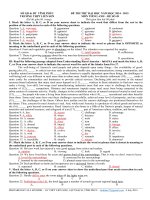
VI. Mark the letter A, B, C, or D on your answer sheet to indicate the word that differs from the rest in the position
of the main stress in each of the following questions.
Question 66: A. interruptive B. application C. academic D. kindergarten
Question 67: A. category B. compulsory C. discourteous D. curriculum
Question 68: A. communicative B. disobedient C. generational D. argumentative
Question 69: A. valuable B. significance C. ceremony D. ancestor
Question 70: A. creature B. confidence C. creative D. nervousness
VII. Read the following passage and mark the letter A, B, C, or D on your answer sheet to indicate the correct word
for each of the blanks from 71 to 80.
LISTENING
Human beings have a strong need to put their experiences and problems into words. That is why everyone___71__a
“friendly ear”- someone who is ___72__ to listen to their troubles and joys. But few people__73___ what a complex
skill listening is. To be a good listener requires great powers of concentration, which can only be gained through
practice.
There are two reasons why listening is often such hard___74__ The first is simply that people much prefer to speak.
How often have you missed what someone has said because you were thinking about what you were going to
say__75___? The second reason is that people speak too slowly. The average speed is about 125 words per minute,
__76___ is not fast enough for the human brain. It ___77__ too much time for the concentration to fail, as the brain
tries to keep itself busy with other, irrelevant thoughts.
Next time you are in a listening___78__ ,try to predict what the speaker is going to say. Ask yourself questions
about what is being said, and __79___ if the speaker answers them. Finally, make quick summaries in your head of the
main points that have been made. All of these things will___80__ you to concentrate and make you a better listener.
Question 71: A. applauds B. attracts C. appreciates D. approves
Question 72: A. agreed B. wanting C. capable D. willing
Question 73: A. realise B. believe C. detect D. relate
Question 74: A. work B. job C. act D. task
Question 75: A. by report B. through answer C. in reply D. in turn
Question 76: A. which B. that C. what D. this
Question 77: A. makes B. admits C. allows D. lets
Question 78: A. atmosphere B. circumstance C. station D. situation
Question 79: A. tell B. see C. watch D. look
Question 80: A. aid B. help C. give D. serve
SƯU TẦM, BIÊN SOẠN, CHỈNH LÝ VÀ GIẢNG DẠY BỞI ĐỖ QUỐC BÌNH –
5