Anh văn - Ngữ pháp tổng hợp - P1
Bạn đang xem bản rút gọn của tài liệu. Xem và tải ngay bản đầy đủ của tài liệu tại đây (549.86 KB, 179 trang )
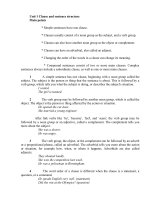
Unit 1 Clause and sentence structure
Main points
* Simple sentences have one clause.
* Clauses usually consist of a noun group as the subject, and a verb group.
* Clauses can also have another noun group as the object or complement.
* Clauses can have an adverbial, also called an adjunct.
* Changing the order of the words in a clause can change its meaning.
* Compound sentences consist of two or more main clauses. Complex
sentences always include a subordinate clause, as well as one or more main clauses.
1 A simple sentence has one clause, beginning with a noun group called the
subject. The subject is the person or thing that the sentence is about. This is followed by a
verb group, which tells you what the subject is doing, or describes the subject's situation.
I waited.
The girl screamed.
2 The verb group may be followed by another noun group, which is called the
object. The object is the person or thing affected by the action or situation.
He opened the car door.
She married a young engineer.
After link verbs like `be', `become', `feel', and `seem', the verb group may be
followed by a noun group or an adjective, called a complement. The complement tells you
more about the subject.
She was a doctor.
He was angry.
3 The verb group, the object, or the complement can be followed by an adverb
or a prepositional phrase, called an adverbial. The adverbial tells you more about the action
or situation, for example how, when, or where it happens. Adverbials are also called
adjuncts.
They shouted loudly.
She won the competition last week.
He was a policeman in Birmingham.
4 The word order of a clause is different when the clause is a statement, a
question, or a command.
He speaks English very well. (statement)
Did she win at the Olympics? (question)
Stop her. (command)
Note that the subject is omitted in commands, so the verb comes first.
5 A compound sentence has two or more main clauses: that is, clauses which
are equally important. You join them with `and', `but', or `or'.
He met Jane at the station and went shopping.
I wanted to go but I felt too ill.
You can come now or you can meet us there later.
Note that the order of the two clauses can change the meaning of the sentence.
He went shopping and met Jane at the station.
If the subject of both clauses is the same, you usually omit the subject in the second
clause.
I wanted to go but felt too ill.
6 A complex sentence contains a subordinate clause and at least one main
clause. A subordinate clause gives information about a main clause, and is introduced by a
conjunction such as `because', `if', `that', or a `wh'-word. Subordinate clauses can come
before, after, or inside the main clause.
When he stopped, no one said anything.
If you want, I'll teach you.
They were going by car because it was more comfortable.
I told him that nothing was going to happen to me.
The car that I drove was a Ford.
The man who came into the room was small.
Unit 2 The noun group
Main points
* Noun groups can be the subject, object, or complement of a verb, or the
object of a preposition.
* Noun groups can be nouns on their own, but often include other words
such as determiners, numbers, and adjectives.
* Noun groups can also be pronouns.
* Singular noun groups take singular verbs, plural noun groups take plural
verbs.
1 Noun groups are used to say which people or things you are talking about.
They can be the subject or object of a verb.
Strawberries are very expensive now.
Keith likes strawberries.
A noun group can also be the complement of a link verb such as `be', `become',
`feel', or `seem'.
She became champion in 1964.
He seemed a nice man.
A noun group can be used after a preposition, and is often called the object of the
preposition.
I saw him in town.
She was very ill for six months.
2 A noun group can be a noun on its own, but it often includes other words. A
noun group can have a determiner such as `the' or `a'. You put determiners at the beginning
of the noun group.
The girls were not in the house.
He was eating an apple.
3 A noun group can include an adjective. You usually put the adjective in
front of the noun.
He was using blue ink.
I like living in a big city.
Sometimes you can use another noun in front of the noun.
I like chocolate cake.
She wanted a job in the oil industry.
A noun with 's (apostrophe s) is used in front of another noun to show who or what
something belongs to or is connected with.
I held Sheila's hand very tightly.
He pressed a button on the ship's radio.
4 A noun group can also have an adverbial, a relative clause, or a `to'-
infinitive clause after it, which makes it more precise.
I spoke to a girl in a dark grey dress.
She wrote to the man who employed me.
I was trying to think of a way to stop him.
A common adverbial used after a noun is a prepositional phrase beginning with
`of'.
He tied the rope to a large block of stone.
The front door of the house was wide open.
I hated the idea of leaving him alone.
Participles and some adjectives can also be used after a noun.
See Units 19 and 29.
She pointed to the three cards lying on the table.
He is the only man available.
5 Numbers come after determiners and before adjectives.
I had to pay a thousand dollars.
Three tall men came out of the shed.
6 A noun group can also be a pronoun. You often use a pronoun when you are
referring back to a person or thing that you have already mentioned.
I've got two boys, and they both enjoy playing football.
You also use a pronoun when you do not know who the person or thing is, or do
not want to be precise.
Someone is coming to mend it tomorrow.
7 A noun group can refer to one or more people or things. Many nouns have a
singular form referring to one person or thing, and a plural form referring to more than one
person or thing.
See Unit 4.
My dog never bites people.
She likes dogs.
Similarly, different pronouns are used in the singular and in the plural.
I am going home now.
We want more money.
When a singular noun group is the subject, it takes a singular verb. When a plural
noun group is the subject, it takes a plural verb.
His son plays football for the school.
Her letters are always very short.
Unit 3 The verb group
Main points
* In a clause, the verb group usually comes after the subject and always has
a main verb.
* The main verb has several different forms.
* Verb groups can also include one or two auxiliaries, or a modal, or a
modal and one or two auxiliaries.
* The verb group changes in negative clauses and questions.
* Some verb groups are followed by an adverbial, a complement, an object,
or two objects.
1 The verb group in a clause is used to say what is happening in an action or
situation. You usually put the verb group immediately after the subject. The verb group
always includes a main verb.
I waited.
They killed the elephants.
2 Regular verbs have four forms: the base form, the third person singular form
of the present simple, the `-ing' form or present participle, and the `-ed' form used for the
past simple and for the past participle.
ask* asks* asking* asked
dance* dances* dancing* danced
reach* reaches* reaching* reached
try* tries* trying* tried
dip* dips* dipping* dipped
Irregular verbs may have three forms, four forms, or five forms. Note that `be' has
eight forms.
cost* costs* costing
think* thinks* thinking* thought
swim* swims* swimming* swam* swum
be* am/is/are* being* was/were* been
See the Appendix for details of verb forms.
3 The main verb can have one or two auxiliaries in front of it.
I had met him in Zermatt.
The car was being repaired.
The main verb can have a modal in front of it.
You can go now.
I would like to ask you a question.
The main verb can have a modal and one or two auxiliaries in front of it.
I could have spent the whole year on it.
She would have been delighted to see you.
4 In negative clauses, you have to use a modal or auxiliary and put `not' after
the first word of the verb group.
He does not speak English very well.
I was not smiling.
It could not have been wrong.
Note that you often use short forms rather than `not'.
I didn't know that.
He couldn't see it.
5 In `yes/no' questions, you have to put an auxiliary or modal first, then the
subject, then the rest of the verb group.
Did you meet George?
Couldn't you have been a bit quieter?
In `wh'-questions, you put the `wh'-word first. If the `wh'-word is the subject, you
put the verb group next.
Which came first?
Who could have done it?
If the `wh'-word is the object or an adverbial, you must use an auxiliary or modal
next, then the subject, then the rest of the verb group.
What did you do?
Where could she be going?
6 Some verb groups have an object or two objects after them.
See Units 72 and 73.
He closed the door.
She sends you her love.
Verb groups involving link verbs, such as `be', have a complement after them.
See Unit 80.
They were sailors.
She felt happy.
Some verb groups have an adverbial after them.
We walked through the park.
She put the letter on the table.
Unit 4 The imperative and `let'
Main points
* The imperative is the same as the base form of a verb.
* You form a negative imperative with `do not', `don't', or `never'.
* You use the imperative to ask or tell someone to do something, or to give
advice, warnings, or instructions on how to do something.
* You use `let' when you are offering to do something, making suggestions,
or telling someone to do something.
1 The imperative is the same as the base form of a verb. You do not use a
pronoun in front of it.
Come to my place.
Start when you hear the bell.
2 You form a negative imperative by putting `do not', `don't', or `never' in
front of the verb.
Do not write in this book.
Don't go so fast.
Never open the front door to strangers.
3 You use the imperative when you are:
* asking or telling someone to do something
Pass the salt.
Hurry up!
* giving someone advice or a warning
Mind your head.
Take care!
* giving someone instructions on how to do something
Put this bit over here, so it fits into that hole.
Turn right off Broadway into Caxton Street.
4 When you want to make an imperative more polite or more emphatic, you
can put `do' in front of it.
Do have a chocolate biscuit.
Do stop crying.
Do be careful.
5 The imperative is also used in written instructions on how to do something,
for example on notices and packets of food, and in books.
To report faults, dial 6666.
Store in a dry place.
Fry the chopped onion and pepper in the oil.
Note that written instructions usually have to be short. This means that words such
as `the' are often omitted.
Wear rubber gloves. Turn off switch. Wipe bulb.
Written imperatives are also used to give warnings.
Reduce speed now.
6 You use `let me' followed by the base form of a verb when you are offering
to do something for someone.
Let me take your coat.
Let me give you a few details.
7 You use `let's' followed by the base form of a verb when you are suggesting
what you and someone else should do.
Let's go outside.
Let's look at our map.
Note that the form `let us' is only used in formal or written English.
Let us consider a very simple example.
You put `do' before `let's' when you are very keen to do something.
Do let's get a taxi.
The negative of `let's' is `let's not' or `don't let's'.
Let's not talk about that.
Don't let's actually write it in the book.
8 You use `let' followed by a noun group and the base form of a verb when
you are telling someone to do something or to allow someone else to do it.
Let me see it.
Let Philip have a look at it.
Unit 5 Questions
Main points
* In most questions the first verb comes before the subject.
* `Yes/no'-questions begin with an auxiliary or a modal.
* `Wh'-questions begin with a `wh'-word.
1 Questions which can be answered `yes' or `no' are called `yes/no'-questions.
`Are you ready?' - `Yes.'
`Have you read this magazine?' - `No.'
If the verb group has more than one word, the first word comes at the beginning of
the sentence, before the subject. The rest of the verb group comes after the subject.
Is he coming?
Can John swim?
Will you have finished by lunchtime?
Couldn't you have been a bit quieter?
Has he been working?
2 If the verb group consists of only a main verb, you use the auxiliary `do',
`does', or `did' at the beginning of the sentence, before the subject. After the subject you use
the base form of the verb.
Do the British take sport seriously?
Does that sound like anyone you know?
Did he go to the fair?
Note that when the main verb is `do', you still have to add `do', `does', or `did'
before the subject.
Do they do the work themselves?
Did you do an `O' Level in German?
3 If the main verb is `have', you usually put `do', `does', or `did' before the
subject.
Does anyone have a question?
Did you have a good flight?
When `have' means `own' or `possess', you can put it before the subject, without
using `do', `does', or `did', but this is less common.
Has he any idea what it's like?
4 If the main verb is the present simple or past simple of `be', you put the verb
at the beginning of the sentence, before the subject.
Are you ready?
Was it lonely without us?
5 When you want someone to give you more information than just `yes' or
`no', you ask a `wh'-question, which begins with a `wh'-word:
whatwherewhowhose
whenwhichwhomwhyhow
Note that `whom' is only used in formal English.
6 When a `wh'-word is the subject of a question, the `wh'-word comes first,
then the verb group. You do not add `do', `does', or `did' as an auxiliary.
What happened?
Which is the best restaurant?
Who could have done it?
7 When a `wh'-word is the object of a verb or preposition, the `wh'-word
comes first, then you follow the rules for `yes/no'-questions, adding `do', `does', or `did'
where necessary.
How many are there?
Which do you like best?
If there is a preposition, it comes at the end. However, you always put the
preposition before `whom'.
What's this for?
With whom were you talking?
Note that you follow the same rules as for `wh'-words as objects when the question
begins with `when', `where', `why', or `how'.
When would you be coming down?
Why did you do it?
Where did you get that from?
8 You can also use `what', `which', `whose', `how many', and `how much' with
a noun.
Whose idea was it?
How much money have we got in the bank?
You can use `which', `how many', and `how much' with `of' and a noun group.
Which of the suggested answers was the correct one?
How many of them bothered to come?
See Unit 6 for more information on `wh'-words.
Unit 6 `Wh'-questions
Main points
* You use `who', `whom', and `whose' to ask about people, and `which' to
ask about people or things.
* You use `what' to ask about things, and `what for' to ask about reasons and
purposes.
* You use `how' to ask about the way something happens.
* You use `when' to ask about times, `why' to ask about reasons, and `where'
to ask about places and directions.
1 You use `who', `whom', or `whose' in questions about people. `Who' is used
to ask questions about the subject or object of the verb, or about the object of a preposition.
Who discovered this?
Who did he marry?
Who did you dance with?
In formal English, `whom' is used as the object of a verb or preposition. The
preposition always comes in front of `whom'.
Whom did you see?
For whom were they supposed to do it?
You use `whose' to ask which person something belongs to or is related to. `Whose'
can be the subject or the object.
Whose is nearer?
Whose did you prefer, hers or mine?
2 You use `which' to ask about one person or thing, out of a number of people
or things. `Which' can be the subject or object.
Which is your son?
Which does she want?
3 You use `what' to ask about things, for example about actions and events.
`What' can be the subject or object.
What has happened to him?
What is he selling?
What will you talk about?
You use `what for' to ask about the reason for an action, or the purpose of an
object.
What are you going there for?
What are those lights for?
4 You use `how' to ask about the way in which something happens or is done.
How did you know we were coming?
How are you going to get home?
You also use `how' to ask about the way a person or thing feels or looks.
`How are you?' - `Well, how do I look?'
5 `How' is also used:
* with adjectives to ask about the degree of quality that someone or something has
How good are you at Maths?
How hot shall I make the curry?
* with adjectives such as `big', `old', and `far' to ask about size, age, and distance
How old are your children?
How far is it to Montreal from here?
Note that you do not normally use `How small', `How young', or `How near'.
* with adverbs such as `long' and `often' to ask about time, or `well' to ask about
abilities
How long have you lived here?
How well can you read?
* with `many' and `much' to ask about the number or amount of something
How many were there?
How much did he tell you?
6 You use `when' to ask about points in time or periods of time, `why' to ask
about the reason for an action, and `where' to ask about place and direction.
When are you coming home?
When were you in London?
Why are you here?
Where is the station?
Where are you going?
You can also ask about direction using `which direction in' or `which way'.
Which direction did he go in?
Which way did he go?
Unit 7 Question tags: forms
Main points
* You add a question tag to a statement to turn it into a question.
* A question tag consists of a verb and a pronoun. The verb in a question tag
is always an auxiliary, a modal, or a form of the main verb `be'.
* With a positive statement, you usually use a negative question tag
containing a short form ending in `-n't'.
* With a negative statement, you always use a positive question tag.
1 A question tag is a short phrase that is added to the end of a statement to turn
it into a `yes/no'-question. You use question tags when you want to ask someone to confirm
or disagree with what you are saying, or when you want to sound more polite. Question tags
are rarely used in formal written English.
He's very friendly, isn't he?
You haven't seen it before, have you?
2 You form a question tag by using an auxiliary, a modal, or a form of the
main verb `be', followed by a pronoun. The pronoun refers to the subject of the statement.
David's school is quite nice, isn't it?
She made a remarkable recovery, didn't she?
3 If the statement contains an auxiliary or modal, the same auxiliary or modal
is used in the question tag.
Jill's coming tomorrow, isn't she?
You didn't know I was an artist, did you?
You've never been to Benidorm, have you?
You will stay in touch, won't you?
4 If the statement does not contain an auxiliary, a modal, or `be' as a main
verb, you use `do', `does', or `did' in the question tag.
You like it here, don't you?
Sally still works there, doesn't she?
He played for Ireland, didn't he?
5 If the statement contains the present simple or past simple of `be' as a main
verb, the same form of the verb `be' is used in the question tag.
It is quite warm, isn't it?
They were really rude, weren't they?
6 If the statement contains the simple present or simple past of `have' as a
main verb, you usually use `do', `does', or `did' in the question tag.
He has a problem, doesn't he?
You can also use the same form of `have' in the question tag, but this is not very
common.
She has a large house, hasn't she?
7 With a positive statement you normally use a negative question tag, formed
by adding `-n't' to the verb.
You like Ralph a lot, don't you?
They are beautiful, aren't they?
Note that the negative question tag with `I' is `aren't'.
I'm a fool, aren't I?
8 With a negative statement you always use a positive question tag.
It doesn't work, does it?
You won't tell anyone else, will you?
Unit 8 Question tags: uses
Main points
* You can use negative statements with positive question tags to make
requests.
* You use positive statements with positive question tags to show reactions.
* You use some question tags to make imperatives more polite.
1 You can use a negative statement and a positive question tag to ask people
for things, or to ask for help or information.
You wouldn't sell it to me, would you?
You won't tell anyone else this, will you?
2 When you want to show your reaction to what someone has just said, for
example by expressing interest, surprise, doubt, or anger, you use a positive statement with a
positive question tag.
You've been to North America before, have you?
You fell on your back, did you?
I borrowed your car last night. - Oh, you did, did you?
3 When you use an imperative, you can be more polite by adding one of the
following question tags.
will youwon't youwould you
See that she gets safely back, won't you?
Look at that, would you?
When you use a negative imperative, you can only use `will you' as a question tag.
Don't tell Howard, will you?
`Will you' and `won't you' can also be used to emphasize anger or impatience.
`Can't you' is also used in this way.
Oh, hurry up, will you!
For goodness sake be quiet, can't you!
4 You use the question tag `shall we' when you make a suggestion using `let's'.
Let's forget it, shall we?
You use the question tag `shall I' after `I'll'.
I'll tell you, shall I?
5 You use `they' in question tags after `anybody', `anyone', `everybody',
`everyone', `nobody', `no one', `somebody' or `someone'.
Everyone will be leaving on Friday, won't they?
Nobody had bothered to plant new ones, had they?
You use `it' in question tags after `anything', `everything', `nothing', or `something'.
Nothing matters now, does it?
Something should be done, shouldn't it?
You use `there' in question tags after `there is', `there are', `there was', or `there
were'.
There's a new course out now, isn't there?
6 When you are replying to a question tag, your answer refers to the statement,
not the question tag.
If you want to confirm a positive statement, you say `yes'. For example, if you have
finished a piece of work and someone says to you `You've finished that, haven't you?', the
answer is `yes'.
`It became stronger, didn't it?' - `Yes, it did.'
If you want to disagree with a positive statement, you say `no'. For example, if you
have not finished your work and someone says `You've finished that, haven't you?', the
answer is `no'.
You've just seen a performance of the play, haven't you? - No, not yet.
If you want to confirm a negative statement, you say `no'. For example, if you have
not finished your work and someone says `You haven't finished that, have you?', the answer
is `no'.
`You didn't know that, did you?' - `No.'
If you want to disagree with a negative statement, you say `yes'. For example, if
you have finished a piece of work and someone says `You haven't finished that, have you?',
the answer is `yes'.
`You haven't been there, have you?' - `Yes, I have.'
Unit 10 Short answers
Main points
* A short answer uses an auxiliary, a modal, or the main verb `be'.
* A short answer can be in the form of a statement or a question.
1 Short answers are very common in spoken English. For example, when
someone asks you a `yes/no'-question, you can give a short answer by using a pronoun with
an auxiliary, modal, or the main verb `be'. You usually put `yes' or `no' before the short
answer.
`Does she still want to come?' - `Yes, she does.'
`Can you imagine what it might feel like?' - `No, I can't.'
`Are you married?' - `I am.'
Note that a short answer such as `Yes, I will' is more polite or friendly than just
`Yes', or than repeating all the words used in the question. People often repeat all the words
used in the question when they feel angry or impatient.
`Will you have finished by lunchtime?' - `Yes, I will have finished by
lunchtime.'
2 You can also use short answers to agree or disagree with what someone
says.
`You don't like Joan?' - `No, I don't.'
`I'm not coming with you.' - `Yes, you are.'
If the statement that you are commenting on does not contain an auxiliary, modal,
or the main verb `be', you use a form of `do' in the short answer.
`He never comes on time.' - `Oh yes he does.'
3 You often reply to what has been said by using a short question.
`He's not in Japan now.' - `Oh, isn't he?'
`He gets free meals.' - `Does he?'
Note that questions like these are not always asked to get information, but are often
used to express your reaction to what has been said, for example to show interest or surprise.
`Dad doesn't help me at all.' - `Doesn't he? Why not?'
`Penny has been climbing before.' - `Oh, has she? When was that?'
4 If you want to show that you definitely agree with a positive statement that
someone has just made, you can use a negative short question.
`Well, that was very nice.' - `Yes, wasn't it?'
5 When you want to ask for more information, you can use a `wh'-word on its
own or with a noun as a short answer.
`He saw a snake.' - `Where?'
`He knew my cousin.' - `Which cousin?'
You can also use `Which one' and `Which ones'.
`Can you pass me the cup?' - `Which one?'
6 Sometimes a statement about one person also applies to another person.
When this is the case, you can use a short answer with `so' for positive statements, and with
`neither' or `nor' for negative statements, using the same verb that was used in the statement.
You use `so', `neither', or `nor' with an auxiliary, modal, or the main verb `be'. The
verb comes before the subject.
`You were different then.' - `So were you.'
`I don't normally drink at lunch.' - `Neither do I.'
`I can't do it.' - `Nor can I.'
You can use `not either' instead of `neither', in which case the verb comes after the
subject.
`He doesn't understand.' - `We don't either.'
7 You often use `so' in short answers after verbs such as `think', `hope',
`expect', `imagine', and `suppose', when you think that the answer to the question is `yes'.
`You'll be home at six?' - `I hope so.'
`So it was worth doing?' - `I suppose so.'
You use `I'm afraid so' when you are sorry that the answer is `yes'.
`Is it raining?' - `I'm afraid so.'
With `suppose', `think', `imagine', or `expect' in short answers, you also form
negatives with `so'.
`Will I see you again?' - `I don't suppose so.'
`Is Barry Knight a golfer?' - `No, I don't think so.'
However, you say `I hope not' and `I'm afraid not'.
`It isn't empty, is it?' - `I hope not.'
Unit 11 Sentences with `not'
Main points
* `Not' is often shortened to `-n't' and added to some verbs.
* You put `not' after the first verb in the verb group, or you use a short form.
1 In spoken and in informal written English, `not' is often shortened to `-n't'
and added to an auxiliary, a modal, or a form of the main verb `be'.
I haven't heard from her recently.
I wasn't angry.
Here is a list of short forms.
isn'thaven'tdon'tcan'tshan'tdaren't
aren'thasn'tdoesn'tcouldn'tshouldn'tneedn't
wasn'thadn'tdidn'tmightn'twon't
weren'tmustn'twouldn't
oughtn't
If the verb is already shortened, you cannot add `-n't'.
It's not easy.
I've not had time.
You cannot add `-n't' to `am'. You use `I'm not'.
I'm not excited.
2 If the verb group has more than one word, you put `not' after the first word,
or you use a short form.
I was not smiling.
He hadn't attended many meetings.
They might not notice.
I haven't been playing football recently.
3 If the sentence only contains a main verb other than `be', you use the
auxiliary `do'.
You use `do not', `does not', `did not', or a short form, followed by the base form of
the main verb.
They do not need to talk.
He does not speak English very well.
I didn't know that.
Note that if the main verb is `do', you still use a form of `do' as an auxiliary.
They didn't do anything about it.
4 If the main verb is the present or past simple of `be', you put `not'
immediately after it, or you use a short form.
It is not difficult to understand.
It's not the same, is it?
He wasn't a bad actor actually.
5 If the main verb is `have', you usually use a form of `do' as an auxiliary.
They don't have any money.
You can also use a short form, or you can put `not' after the verb but this is not very
common.
He hadn't enough money.
6 You can put `not' in front of an `-ing' form or a `to'-infinitive.
We stood there, not knowing what to do.
Try not to worry.
7 In negative questions, you use a short form.
Why didn't she win at the Olympics?
Hasn't he put on weight?
Aren't you bored?
8 You can use a negative question:
* to express your feelings, for example to show that you are surprised or
disappointed
Hasn't he done it yet?
* in exclamations
Isn't the weather awful!
* when you think you know something and you just want someone to agree with
you
`Aren't you Joanne's brother?' - `Yes, I am.'
9 Note the meaning of `yes' and `no' in answers to negative questions.
`Isn't Tracey going to get a bit bored in Birmingham?'
- `Yes.' (She is going to get bored.)
- `No.' (She is not going to get bored.)
Unit 12 Negative words
Main points
* A negative sentence contains a negative word.
* You do not normally use two negative words in the same clause.
1 Negative statements contain a negative word.
notnobodyneither
neverno onenor
nonothing
nonenowhere
See Unit 11 for negative statements using `not'.
2 You use `never' to say that something was not the case at any time, or will
not be the case at any time.
If the verb group has more than one word, you put `never' after the first word.
I've never had such a horrible meal.
He could never trust her again.
3 If the only verb in the sentence is the present simple or past simple of any
main verb except `be', you put `never' before the verb.
She never goes abroad.
He never went to university.
If the only verb in the sentence is the simple present or simple past of the main verb
`be', you normally put `never' after the verb.
He's never late.
There were never any people in the house.
You can also use `never' at the beginning of an imperative sentence.
Never walk alone late at night.
4 You use `no' before a noun to say that something does not exist or is not
available.
He has given no reason for his decision.
The island has no trees at all.
Note that if there is another negative word in the clause, you use `any', not `no'.
It won't do any good.
5 You use `none' or `none of' to say that there is not even one thing or person,
or not even a small amount of something.
You can't go to a college here because there are none in this area.
`Where's the coffee?' - `There's none left.'
None of us understood the play.
See Unit 27 for more information on `none' and `none of'.
6 You also use `nobody', `no one', `nothing', and `nowhere' in negative
statements.
You use `nobody' or `no one' to talk about people.
Nobody in her house knows any English.
No one knew.
`No one' can also be written `no-one'.
There's no-one here.
You use `nothing' to talk about things.
There's nothing you can do.
You use `nowhere' to talk about places.
There's almost nowhere left to go.
See Unit 21 for more information about these words.
7 You do not normally use two negative words in the same clause. For
example, you do not say `Nobody could see nothing'. You say `Nobody could see anything'.
You use `anything', `anyone', `anybody', and `anywhere' instead of `nothing', `no
one', `nobody', and `nowhere' when the clause already contains a negative word.
No-one can find Howard or Barbara anywhere.
I could never discuss anything with them.
8 The only negative words that are often used together in the same clause are
`neither' and `nor'.
You use `neither' and `nor' together to say that two alternatives are not possible, not
likely, or not true.
Neither Margaret nor John was there.
They had neither food nor money.
Unit 13 Count nouns
Main points
* Count nouns have two forms, singular and plural.
* They can be used with numbers.
* Singular count nouns always take a determiner.
* Plural count nouns do not need a determiner.
* Singular count nouns take a singular verb and plural count nouns take a
plural verb.
* In English, some things are thought of as individual items that can be
counted directly. The nouns which refer to these countable things are called count nouns.
Most nouns in English are count nouns.
See Unit 15 for information on uncount nouns.
1 Count nouns have two forms. The singular form refers to one thing or
person.
a book the teacher.
The plural form refers to more than one thing or person.
books some teachers.
2 You add `-s' to form the plural of most nouns.
book* booksschool* schools
You add `-es' to nouns ending in `-ss', `-ch', `-s', `-sh', or `-x'.
class* classeswatch* watches
gas* gasesdish* dishes
fox* foxes
Some nouns ending in `-o' add `-s', and some add `-es'.
photo* photos piano* pianos
hero* heroes potato* potatoes
Nouns ending in a consonant and `-y' change to `-ies'.
country* countries lady* ladies
party* parties victory* victories
Nouns ending in a vowel and `-y' add an `-s'.
boy* boys day* days
key* keys valley* valleys
Some common nouns have irregular plurals.
child* children foot* feet
man* men mouse* mice
tooth* teeth woman* women
WARNING: Some nouns that end in `-s' are uncount nouns, for example `athletics'
and `physics'. See Unit 15.
3 Count nouns can be used with numbers.
one table two cats three hundred pounds.
4 Singular count nouns cannot be used alone, but always take a determiner
such as `a', `another', `every', or `the'.
We've killed a pig.
He was eating another apple.
I parked the car over there.
5 Plural count nouns can be used with or without a determiner. They do not
take a determiner when they refer to things or people in general.
Does the hotel have large rooms?
The film is not suitable for children.
Plural count nouns do take a determiner when they refer precisely to particular
things or people.
Our computers are very expensive.
These cakes are delicious.
See Unit 23 for more information on determiners.
6 When a count noun is the subject of a verb, a singular count noun takes a
singular verb.
My son likes playing football.
The address on the letter was wrong.
A plural count noun takes a plural verb.
Bigger cars cost more.
I thought more people were coming.
See also Unit 14 on collective nouns.
Unit 14 Singular and plural
Main points
* Singular nouns are used only in the singular, always with a determiner.
* Plural nouns are used only in the plural, some with a determiner.
* Collective nouns can be used with singular or plural verbs.
1 Some nouns are used in particular meanings in the singular with a
determiner, like count nouns, but are not used in the plural with that meaning. They are often
called `singular nouns'.
Some of these nouns are normally used with `the' because they refer to things that
are unique.
airdaytimemoonsky
countryendpastsun
countrysidefutureseawind
darkgroundseasideworld
The sun was shining.
I am scared of the dark.
Other singular nouns are normally used with `a' because they refer to things that we
usually talk about one at a time.
bathgoridesnooze
chancejogrunstart
drinkmoveshowerwalk
fightrestsmokewash
I went upstairs and had a wash.
Why don't we go outside for a smoke?
2 Some nouns are used in particular meanings in the plural with or without
determiners, like count nouns, but are not used in the singular with that meaning. They are
often called `plural nouns'.
His clothes looked terribly dirty.
Troops are being sent in today.
Some of these nouns are always used with determiners.
activitiesfeelingspicturestravels
authoritieslikessights
I went to the pictures with Tina.
You hurt his feelings.
Some are usually used without determiners.
airsgoodsriches
expensesrefreshments
Refreshments are available inside.
They have agreed to pay for travel and expenses.
WARNING: `Police' is a plural noun, but does not end in `-s'.
The police were informed immediately.
3 A small group of plural nouns refer to single items that have two linked
parts. They refer to tools that people use or things that people wear.
binocularsglassestrousers
pincersjeans
pliersknickers
scalespants
scissorspyjamas
shearsshorts
tweezerstights
She was wearing brown trousers.
These scissors are sharp.
You can use `a pair of' to make it clear you are talking about one item, or a number
with `pairs of' when you are talking about several items.
I was sent out to buy a pair of scissors.
Liza had given me three pairs of jeans.
Note that you also use `a pair of' with words such as `gloves', `shoes', and `socks'
that you often talk about in twos.
4 With some nouns that refer to a group of people or things, the same form
can be used with singular or plural verbs, because you can think of the group as a unit or as
individuals. Similarly, you can use singular or plural pronouns to refer back to them. These
nouns are often called `collective nouns'.
army, audience, committee, company, crew, data, enemy, family, flock, gang,
government, group, herd, media, navy, press, public, staff, team
Our little group is complete again.
The largest group are the boys.
Our family isn't poor any more.
My family are perfectly normal.
The names of many organizations and sports teams are also collective nouns, but
are normally used with plural verbs in spoken English.
The BBC is showing the programme on Saturday.
The BBC are planning to use the new satellite.
Liverpool is leading 1-0.
Liverpool are attacking again.
Unit 15 Uncount nouns
Main points
* Uncount nouns have only one form, and take a singular verb.