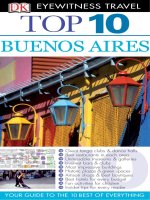
top 10 buenos aires
Bạn đang xem bản rút gọn của tài liệu. Xem và tải ngay bản đầy đủ của tài liệu tại đây (11.51 MB, 131 trang )
YOUR GUIDE TO THE 10 BEST OF EVERYTHING
EYEWITNESS TRAVEL
TOP
10
BUENOS AIRES
10
10
10
10
10
10
10
10
10
10
10
&$//($$/6,1$
&$//(6 8
&$//(
3(//
&(60
(5
$/
'
&$//( 025(12
7$&8$5
%2/9$5
%
$/&$5&(
3(
$
&$/
/
$95
2
$
9
/
$
5
%
,
'
$
&$
0
$'(52
$9,1
*
+8(
$BUFESBM
1FSÞ
1MB[B
.BZP
#PMJWBS
"
WEF
.
BZP
1JFESBT
1BSRVF
$PMØO
%DQFR
+LSRWHFDULR
1DFLRQDO
/D&DWHGUDO
0HWURSROLWDQD
([HGLILFLR
/D3UHQVD
3LD]]ROOD
7DQJR
%DQFRGHOD
1DFLµQ
0XVHRGH
OD&LXGDG
0DQ]DQDGH
ODV/XFHV
&DVD
5RVDGD
0LQLVWHULRGH
(FRQRPLD
&DI«
7RUWRQL
3DODFLR
9HUD
(O&DELOGR
(GLILFLR
'UDEEOH
0LAZAŽDE
-AYO
!VENIDAŽDEŽ-AYO
Great tango clubs & dance halls
Best restaurants in each area
Unmissable museums & galleries
Liveliest bars & clubs
Most impressive buildings
Historic plazas & green spaces
Artisan shops & best boutiques
Best hotels for every budget
Fun activities for children
Insider tips for every reader
BUENOS AIRES
DECLAN MCGARVEY
JONATHAN SCHULTZ
EYEWITNESS TRAVEL
10
TO P
Contents
Cover: Front – Alamy Images: James Brunker main; Blaine Harrington III bl. Spine – DK Images: Demetrio
Carrasco b. Back – DK Images: Demetrio Carrasco tl, tc, tr.
The information in this DK Eyewitness Top 10 Travel Guide is checked regularly.
Every effort has been made to ensure that this book is as up-to-date as possible at the time of
going to press. Some details, however, such as telephone numbers, opening hours, prices,
gallery hanging arrangements and travel information are liable to change. The publishers
cannot accept responsibility for any consequences arising from the use of this book, nor for
any material on third party websites, and cannot guarantee that any website address in this
book will be a suitable source of travel information. We value the views and suggestions of
our readers very highly. Please write to: Publisher, DK Eyewitness Travel Guides,
Dorling Kindersley, 80 Strand, London WC2R 0RL.
Left Tango show Center Painting at Kelly’s shop Right Cementerio de la Recoleta
2
Contents
Buenos Aires’ Top 10
Buenos Aires’ Highlights 6
Plaza de Mayo 8
Cementerio de la
Recoleta 10
Teatro Colón 12
Avenida de Mayo 14
Museo Nacional de
Bellas Artes 16
San Telmo 18
Avenida 9 de Julio 20
MALBA 22
Colonia del Sacramento,
Uruguay 24
Tango 26
Moments in History 32
Design, Editorial, and Picture Research, by
Quadrum Solutions, Krishnamai, 33B, Sir
Pochkanwala Road, Worli, Mumbai, India
Reproduced by Colourscan, Singapore
Printed and bound in China by
Leo Paper Products Ltd
First American Edition, 2009
Published in the United States by
DK Publishing, Inc., 375 Hudson Street,
New York, New York 10014
Copyright 2009 © Dorling Kindersley Limited,
London, A Penguin Company
All rights reserved under International and Pan-
American Copyright Conventions. No part of this
publication may be reproduced, stored in a retrieval
system, or transmitted in any form or by any means,
electronic, mechanical, photocopying, recording, or
otherwise, without prior written permission of the
copyright owner. Published in Great Britain by
Dorling Kindersley Limited.
A CIP catalogue record is available
from the British Library.
ISSN: 1479-344X
ISBN: 978 0 7566 3954 9
Within each Top 10 list in this book, no hierarchy of
quality or popularity is implied. All 10 are, in the
editor’s opinion, of roughly equal merit.
Floors are referred to throughout in accordance
with American usage; ie the “first floor” is the floor
above ground level.
10 9 8 7 6 5 4 3
Contents
Left Exhibits at MALBA Center Café Tortoni Right Interior of Galerías Pacífico
3
Key to abbreviations
Adm admission charge
Striking Buildings 34
Plazas and Green Spaces 36
Argentinian Artisan
Stores 38
Intimate Museums 40
Festivals 42
Tango Clubs and Milongas 44
Nightclubs 46
Gay Clubs and Hangouts 48
Culinary Highlights 52
Parrillas 54
Restaurants 56
Porteño Personalities 58
Activities for Children 60
Around Town
Barrio Norte, Recoleta
& Around 64
San Telmo & La Boca 72
Microcentro, Puerto
Madero & Retiro 80
Palermo 86
Beyond Buenos Aires 94
Streetsmart
Practical Information 102
Places to Stay 112
General Index 118
Phrase Book 126
Left El Caminito, La Boca Right Congreso Nacional
TOP 10
Buenos Aires’
Highlights
6–7
Plaza de Mayo
8–9
Cementerio de
la Recoleta
10–11
Teatro Colón
12–13
Avenida de Mayo
14–15
Museo Nacional
de Bellas Artes
16–17
San Telmo
18–19
Avenida 9 de Julio
20–21
Museo de Arte
Latinoamericano de
Buenos Aires
22–23
Colonia del
Sacramento, Uruguay
24–25
Tango
26–29
BUENOS AIRES’ TOP 10
$9(1,'$*(1(5$//$6+(5$6
$9(1,'$
&$//(
$ 8
7
2
3
,
6
7
$
&$//(
$9(1,'$
$
9
(
1
,
'
$
'
(
/
/
,
%
( 5
7
$
'
2
5
$
9
6
$
1
7
$
)
(
$ 9(1
,
' $ & $
/ /
$ 2
$9
& $ / /
$
2
3
8
(
<5
5(
'
1
$9
(
1 ,'$35
(
6 ) ,* 8
(
5 2$$/& 2
5
7$
$
9
$9 ( 1,'$( 175 ( 5 26
$9(1,'$
$9(1,'$
$9( 1,'
$
$
9
(
1
,
'
$
3/$=$
52'5,*8(=
3($
3/$=$
$/9($5
3/$=$'(/
&21*5(62
%DUULR1RUWH
5HFROHWD
Buenos Aires’ Top 10
Buenos Aires’ Highlights
Argentina’s romantic, reinvigorated soul, Buenos Aires is la Capital, where
tango combos keep time in crowded milongas (dance halls), young men cry
out deliriously at gargantuan soccer stadiums, and taxis swap lanes across
some of the world’s widest avenues. Porteños, as the residents of this
sophisticated metropolis are called, move to a rhythm all of their own, while
making time to dine, dress, and even rest, extraordinarily well. With
spectacular museums, lovely open spaces, and rich architecture brimming
with history, the city is warm as well as energetic.
6
Plaza de
Mayo
This square has seen
post-World Cup
soccer victory dances
as well as the deaf-
ening silence of the
Mothers of the Plaza
de Mayo’s weekly
marches (see pp8–9).
@
Cementerio de
la Recoleta
As monument and
metaphor for a country’s
fortunes – both gained and
lost – la Recoleta contrasts
impeccable mausoleums
with crumbling marble
tombs (see pp10–11).
Teatro Colón
Having celebrated its
centennial under scaffold-
ing, the grandest of all Latin
American opera houses
reopens in 2010 after an
exhaustive restoration. El
Colón is arguably the most
beloved building in all of
Argentina (see pp12–13).
$
Avenida de Mayo
Buenos Aires’ prized avenue
is a boon to architecture buffs –
it contains the continent’s best
preserved Belle Époque, Art
Nouveau, and Art Deco address-
es. Old bookstores and cafés add
to the charm (see pp14–15).
%
Museo Nacional de Bellas Artes
The modest scale of Argentina’s
national fine art museum belies a wonder-
fully curated permanent collection, which
ranges from
imposing Rodin
bronzes to oils
depicting the
mythical
Argentinian
Pampa. The
museum holds
great works by
many inter-
national artists
(see pp16–17).
!
£
Preceding pages El Caminito, La Boca
&$//(
/,%(57$'
$
9
(
1
,
'
$
&
2
6
7
$
1
(
5
$
5
2
%
/
,
*
$
'
2
$956(1=3($
&255,(17(6
$9(1,'$,17&$5/2612,
/$9$//(
$9( 1,' $ $17 $ 5 *
(
1 7 ,1$
3
5
(
6
$
5
78
52
8
0
%
(
5
7
2
,
/
/
,
$
-'3(51
*(1
&$//(60$571
&$//(6$/7$
$9-$52&$
%(/*5$12
$9(1,'$$/,&,$025($8'(-8672
$9(1,'$'(-8/,2
$
9
(
1
,
'$
3
5
(6
5 6
&$67,//2
$
9
(
1
,
'
$
/
1
$/(
0
$
9(1,' $( 0$
' ( 5 2
$9(1,'$'(-8/,2
'(//, %(57$'2 5
$9(1,'$'(0$<2
6$1-8$1
,1'(3(1'(1&,$
$9(1,'$,1*+8(5*2
$93$6(2&2/1
$
9
(
1
,
'
$
-8 $1'(*$5 $<
&%2/9$5
&5'2%$
3/$=$
6$1
0$57,1
3/$=$'(/$
5(3%/,&$
3/$=$
'(0$<2
0LFURFHQWUR
6DQ
7HOPR
5HWLUR
NP
ZBSET
NFUFST
Buenos Aires’ Top 10
7
^
San Telmo
Among the city’s oldest barrios,
cobblestoned San Telmo guards the
lyrical spirit of the bodegón – the
quintessentially porteño bar/café
where a vermouth or croissant can be
arranged anytime. Lanes lined with
19th-century homes brim
with performers on
Sundays (see
pp18–19).
&
Avenida 9 de Julio
The grandest of Latin American
avenues is flanked by dozens of cultural
highlights, the biggest of which is Teatro
Colón. Take care when crossing its 12-
lane width, which takes a few traffic-light
cycles to accomplish (see pp20–21).
(
Colonia del
Sacramento,
Uruguay
Founded by Portuguese
traders, Colonia is a
picturesque town. Its
colorful colonial streets,
Portuguese architecture,
and relaxed pace, make
it a popular weekend
spot (see pp24–25).
Tango
Jaunty and humorous or dirge-like and
mournful, tango – the capital’s dance,
musical, and poetic art form – is still in full
swoon, 120 years after its creation. With
classes and performances galore, it is
integral to the city’s culture and continues
to captivate the people of Buenos Aires
and the rest of the world (see pp26–29).
*
Museo de Arte Latinoamericano
de Buenos Aires (MALBA)
MALBA has quickly asserted itself since
its 2001 opening. Its collection of Latin
American artwork, which includes Diego
Rivera and Xul Solar, has been sup-
plemented with film screenings and a
unique museum gift shop (see pp22–23).
)
Share your travel recommendations on traveldk.com
Buenos Aires’ Top 10
Plaza de Mayo
8
Top 10 Features
1
Casa Rosada
2
El Cabildo
3
La Catedral Metropolitana
4
Pirámide de Mayo
5
Las Madres de Plaza
de Mayo
6
Banco de la Nación
7
Monument to General
Belgrano
8
Protests
9
Ministerio de Economía
0
Plazoleta de San Francisco
!
Casa Rosada
The President holds
meetings in the Casa
Rosada (above). Visitors
can go back in time in the
building’s museum, contain-
ing artifacts from the city’s
original fortification.
@
El Cabildo
This viceroy govern-
ment building, built in 1725,
guards a collection of relics
that hint at Argentina’s
pre-independence stature.
Its rear patio hosts an
artisans’ market on
Thursdays and Fridays.
£
La Catedral
Metropolitana
This large Neo Classical
cathedral (below) was
consecrated in 1836. A
look inside reveals a
Rococo-style altar and the
mausoleum of Argentina’s
liberator, General José de
San Martín.
Like spokes on a wheel, some of Buenos Aires’ most important avenues
radiate outward from Plaza de Mayo. Nearly every era of the city’s history
is reflected in the plaza’s surroundings. The 18th-century government’s
diminutive seat of power, El Cabildo, is divested of any official duty, yet it
still manages to exude an imposing aura opposite the much larger current
executive governmental offices, the Casa Rosada. The landscaped space in
between has been the scene of Argentina’s fiercest internal struggles and
greatest joys, from the naval attacks of 1955 to pulsating parties following
World Cup soccer victories in 1978 and 1986. For all its formidable history,
Plaza de Mayo can still offer a quiet bench to read the paper or sip a maté.
• Map F2
• Casa Rosada: Calle
Hipólito Yrigoyen 216;
4344-3802; www.
museo.gov.ar
• El Cabildo: Calle
Bolívar 65; 4342-6729;
www.cultura.gov.ar
• La Catedral
Metropolitana: Cnr Avda.
Rivadavia & Calle San
Martín; 4331-2845;
www.arzbaires.org.ar/
catedral.htm
• Ministerio de
Economía: Calle Hipólito
Yrigoyen 250; 4349-
5000; www.mecon.
gov.ar
Plazoleta de San Francisco
If you are visiting
between March and
November, take a trip
to the nearby Casa
de la Cultura (see
p15) for the free
dance performances
at 6pm.
Have cakes and
coffee just two
blocks away at Café
La Puerto Rico (Calle
Alsina 420).
For information on Argentina’s history, See pp32–3.
Buenos Aires’ Top 10
9
30 Years of
Las Madres
Heralded with rock
concerts, TV specials,
and political interest,
the Madres de la Plaza
de Mayo marked 30
years in 2007. Despite a
1986 rift, the Madres’
message has never
been diluted or co-
opted. Today, their
efforts are directed
toward identifying
young adults who, as
infants, were taken
away from their birth
mothers, as well as
bringing to justice ex-
military officers from
the dictatorship era.
Pirámide de
Mayo
The Pirámide (right) is dedi-
cated to the revolutionaries
of 1810, who orchestrated
Argentina’s independence.
A nearby plaque commemo-
rates Julio López, a key
witness who went missing
during a trial in 2006.
%
Las Madres de Plaza de Mayo
A plaza fixture since 1977, Las Madres are the
defiant mothers of the young men and women who
disappeared during the 1976–82 military dictatorship.
Anyone is welcome to join in the weekly marches.
&
Monument to
General Belgrano
Although not remem-
bered as a great military
tactician, General Manuel
Belgrano is credited with
designing Argentina’s
flag. He is thus depicted
on horseback bearing the
national colors
(above).
*
Protests
Befitting the political
heart of the nation, lively
protests (left) are staged
nearly every day in and
around the Plaza. Always
peaceful, an exception
was the riot of December
2001
(see p33).
(
Ministerio de
Economía
The Economy Ministry
ushered in the Officialist
architectural style, later
championed by Perón
(see p35). Check the lob-
by for two brooding 1939
oil paintings by muralists
Naguil and Quirós.
)
Plazoleta de San
Francisco
This sculpture garden
contains four marble
figures that previously
surrounded the Pirámide
de Mayo. Individually, the
statues represent
Astronomy, Navigation,
Geography, and Industry.
^
Banco de la
Nación
The national bank
contains an amusing
scale model of the Plaza
as it appeared during the
bank’s mid-20th-century
construction, with fine
details of pedestrians
and cars. Also a show-
stopper is the building’s
superb central dome.
$
Cementerio de la Recoleta
10
Top 10 Features
1
Eva Duarte de Perón
2
The Leloir Family
3
Domingo Faustino Sarmiento
4
Benediction Chapel
5
José C. Paz
6
Pantheon of Outstanding
Citizens
7
Dorrego-Ortíz Basualdo
8
Carlos Pellegrini
9
William Brown
0
Pantheon of the Fallen in the
1890 Revolution
@
The Leloir Family
Built in the style of a
Greek temple, this grandi-
ose family mausoleum
embodies the ambition and
confidence of Argentina’s
19th-century elite. Like
many other tombs here, its
sculptures were fashioned
in the studios of Europe.
!
Eva Duarte de Perón
Evita lies embalmed
within this rather modest
family vault (below). Tribute
plaques inscribed with fiery
quotes such as, “I will
return and be millions!”
crowd its walls and flowers
always adorn its entrance.
One of the world’s great necropolises, the Recoleta Cemetery, located in the
upscale, northern barrio of the same name, has been the burial place of
choice for Argentina’s elite since the mid-19th century. Presidents, military
generals, artists, aristocracy, and, most famously, Eva Perón lie interred here
in fabulous mausoleums of granite and bronze. Built tightly against each
other, the tombs are visited via a labyrinth of streets and narrow passage-
ways. The architectural styles are numerous and fascinating: grandiose Greek
temples stand adjacent to diminutive Egyptian pyramids and Art Nouveau
vaults are next to monumental cenotaphs. Added in 1881, an imposing Doric-
columned entrance protects this extraordinary city of the dead.
• Map N4
• Junín 1760, btwn
Guido and Vicente López
• 4803-1594
• Open 7am–6pm daily
• Free English-language
guided tours: 11am Tue
& Thu
#
Domingo Faustino
Sarmiento
Sarmiento, president of
Argentina from 1868 to
1874, was a Freemason.
His tomb, which he
designed himself, bears
Masonic symbols such as
pyramids, compasses, and
the “all-seeing eye.”
Benediction Chapel
A number of tour
operators arrange
walking tours of the
cemetery. Eternautas
(5031-9916; www.
eternautas.com), run
by a team of local
historians, is among
the best. You can also
buy a map at the
cemetery entrance.
Grab a coffee at La
Biela (see p70), a
Parisian-style café
and one-time haunt
of the city’s
intelligentsia and
the automobile
racing fraternity.
$
Benediction Chapel
This 1882 chapel is
unusual for the remarkable
crucifix that stands over its
small altar. Sculpted from
marble by Italian artist
Giulio Monteverde, the
Cristo Morto shows Christ
in death, on the cross.
Buenos Aires’ Top 10
Souvenir books on the cemetery can be bought at the information
stand near the entrance. Proceeds go to cemetery upkeep.
11
Origins of the
Cementerio de
la Recoleta
This cemetery was built
in 1822, on what was
then the northern limit
of the city. The land was
confiscated by the
Argentinian government
from the Recoleta
monks of the adjacent
Pilar Church. The city’s
first public cemetery, it
was used initially for the
burial of freed slaves
and the proletariat
before it became the
reserve of the rich from
1860s onward.
^
Pantheon of Outstanding Citizens
This historical corner of the cemetery contains
the tombs of several Independence-era heroes.
Alongside the tombs, cenotaphs commemorate other
pivotal figures from the same period.
*
Carlos Pellegrini
As president in 1890,
Pellegrini steered the
country through a severe
financial crisis. His
magnificent tomb sees
him issuing orders from
atop his coffin. A female
figure and child, symbol-
izing the republic and its
future, stand at his feet.
&
Dorrego-Ortíz
Basualdo
This sepulcher (above)
features both a crucifix
and a menorah, symbol-
izing the conversion from
Judaism to Catholicism
of this family’s ancestors
on arrival in Argentina in
the 16th century.
Pantheon of
the Fallen in the
1890 Revolution
This memorial (right)
remembers the dead
from the failed revolu-
tion. Sculptures depict
workers brandishing
rifles. Several leaders of
the Radical Party are
buried here.
(
William Brown
Brown’s fame as founder
of Argentina’s navy is over-
shadowed in death by the
tragic story of his daughter,
whose ashes lie here too.
She drowned herself after
her fiance’s death.
)
%
José C. Paz
Resting place of the
founder of La Prensa
newspaper, this is the
cemetry’s most beautiful
monument (left). An
allegory of the immortal
soul, it depicts an angel
leaving its body and hois-
ting the soul heavenward.
Buenos Aires’ Top 10
Buenos Aires’ Top 10
Teatro Colón
12
Top 10 Features
1
Entrance Hall
2
El Salón de Bustos &
El Salón Dorado
3
Official Boxes
4
Vitreaux
5
La Sala
6
El Paraíso
7
Library
8
La Cúpula
9
Pasaje de los Carruajes
0
Workshops
!
Entrance Hall
Neo-Romanesque
colonnades and a dazzling
Belle Époque stained-glass
dome distinguish the
Colón’s entrance hall
(below). Four kinds of
European marble were
employed in the foyer’s
construction, indicating how
highly prized Old World
materials and craftsmanship
were in the design.
@
El Salón de Bustos
& El Salón Dorado
Busts of Wagner, Rossini,
and Beethoven keep watch
over theatergoers passing
in the entrance hall below.
The Golden Salon is
Versailles-worthy Baroque.
Chamber-music concerts
and special exhibitions are
held here.
#
Official Boxes
Reached via El Salón
de Bustos, these palcos
are reserved for digni-
taries, the president, and
the municipal governor.
Most porteños say that
much politicking occurs
in these boxes, which are
accessible to the public
on guided tours.
For its sheer size, near-perfect acoustics, and stately elegance, the Teatro
Colón ranks among the world’s top opera houses. Yet for Porteños, the Neo-
Classical structure represents far more. “Rich as an Argentine” was a phrase
regularly heard on the streets of New York and Paris around the theater’s
1908 completion, and to experience the Colón’s grandeur is to visit that
bygone era. Tales of the theater’s construction read like a Verdi libretto. The
theater’s current renovation, once complete, will see La Sala’s balcones and
palcos fill up every night, as they have for more than 100 years.
• Map P5
• Cerrito, btwn Tucumán
& Viamonte • 4378-7344
• Closed for renovation
until 2010
• Adm (varies)
• English-language
tours: 11am & 3pm
Mon–Fri; 9am, 11am,
3pm Sat; 11am, 1pm,
3pm Sun (reservations
for English-language
tours strongly
recommended);
tour US$4 • www.
teatrocolon.org.ar
Façade of Teatro Colón
Check ahead for
El Colón por Dos
Pesos concert
program, when
select seats are
available at an
absurd 2 pesos.
Grab a cappuccino
and dessert at
El Petit Colón
confitería (see p57).
Share your travel recommendations on traveldk.com
Buenos Aires’ Top 10
13
A Fraught
Opening Act
The Colón’s cornerstone
was laid in 1889, yet the
theater would not open
for two decades. The
lead architect died
during construction,
leaving his assistant in
charge until his own
death in 1904, followed
by the chief financier’s
assassination. A Belgian
then inherited the
project, imparting many
French Baroque
touches. Verdi’s Aida
finally inaugurated the
house in 1908.
$
Vitreaux
The massive vitreaux
(above) in the entrance hall is
impressive, but do not miss
the pair in El Salón Dorado,
depicting Greek mythology.
^
El Paraíso
The cheapest “seats”
also happen to boast
some of the best
acoustics. Here, in the
ironically named Paraíso
(Paradise), more than 500
standing audience
members can pack in.
Optimal sight lines,
however, are guaranteed
only for early arrivals.
*
La Cúpula
A 3,423-sq ft (318-sq
m) dome above La Sala’s
floor forms the crown on
el Colón (left). Its original
paintings deteriorated –
the present ones were
rendered in the 1960s.
&
Library
El Colón’s formidable
archives, accessible to
all, contain first-edition
librettos, artifacts from
past performances, and
rich ballet and opera
reference materials. The
library’s main attraction is
its complete set of
programs from theater
performances, dating
from its 1908 opening.
(
Pasaje de los Carruajes
At the top of the entrance hall stairs is this
narrow hallway where, prior to the automobile’s
popularization in Buenos Aires, carriage drivers would
pick up and drop off their affluent charges.
La Sala
There is no such
thing as a bad seat
within the Colón’s
auditorium, where
upward of 2,500
spectators (right)
seated in red velvet
seats are treated to
acoustics only
afforded by a thea-
ter with the optimal
horse-shoe shape.
%
Workshops
In the three
basements, artisans
construct sets, sew
costumes, and design
props. Performers hold
rehearsals on the
replicated stage
(right).
)
Buenos Aires’ Top 10
Avenida de Mayo
14
Top 10 Features
1
Edificio la Inmobiliaria
2
Hotel Chile
3
Palacio Barolo
4
Hotel Castelar
5
Café Tortoni
6
Café Los 36 Billares
7
Palacio Vera
8
Teatro Avenida
9
Edificio Drabble
0
Casa de la Cultura
!
Edificio la
Inmobiliaria
Built in 1910, this distin-
guished building (above)
of the Plaza de los Dos
Congresos takes its design
from the Italian Neo-
Renaissance movement.
@
Hotel Chile
Painted brilliant white
and accented by gold and
blue mosaic tiles, Hotel
Chile (right) is rhapsodically
Art Nouveau. It puts on its
best face on the outside.
£
Palacio Barolo
This ornate building,
built in 1923, was the
tallest until the Kavanagh’s
(see p34) completion in
1935. Its lobby has vaulted
ceilings, gargoyle motifs,
intricately patterned floor
tiles, and wrought-iron
elevator cages.
From its inception, Avenida de Mayo was an emphatic statement to the world
that Buenos Aires was a cosmopolitan city. The Parisian-style boulevard, lined
by uncharacteristically wide sidewalks, links the National Congress to the
Casa Rosada, breaking midway at 9 de Julio. While today’s mundane shops
and stores do their best to diminish the grandeur, Avenida de Mayo’s
buildings can render even a casual architecture buff mute. Belle Époque, Art
Nouveau, and Art Deco façades in varying states of repair coalesce into a
textbook study of late-19th- and early-20th-century forms. Some of Buenos
Aires’ oldest bars, cafés, and bookstores are here, while underfoot, polished
teak cars rattle along the city’s oldest subway, the Línea A.
• Map E2
• Hotel Chile: Avda.
1297; 4383-7877
• Palacio Barolo: Avda.
de Mayo 1370;
4383-1065
• Hotel Castelar: Avda.
de Mayo 1152;
4383-5000
• Café Los 36 Billares:
Avda. de Mayo 1265–
71; 4381-5696
• Palacio Vera: Avda. de
Mayo 769–777;
4345-8800
• Teatro Avenida: Avda.
de Mayo 1222;
4381-0662; www.
balirica.org.ar
• Casa de la Cultura:
Avda. de Mayo 575;
4323-9407; www.
buenosaires.gov.ar
Casa de la Cultura
The Avenida is just
13 blocks, making for
a relaxed stroll.
Stop at Café Iberia
(cnr Avda. de Mayo
and Calle Salta) for
tortilla española.
Non-guests can take advantage of Hotel Castelar’s renowned day
spa (open 10am–9pm Mon–Fri, 8am–8pm Sat–Sun).
Buenos Aires’ Top 10
15
New Avenue,
New Attitude
Avenida de Mayo was
Buenos Aires’ first fully
planned boulevard, a
project whose scale and
expense had never
before been imagined
on the continent.
Torcuato de Alvear (see
p59) referenced Paris’
Belle Époque-spawned
urban planning in the
1880s, but by the time
architects started
building, Art Nouveau
was the rage, resulting
in the present structure.
^
Café Los 36
Billares
36 Billares (center) is an
1894 dandy, sporting a
Movado clock, rich wood
paneling, and a billiards
hall, thick with smoke
and ambience. It offers
great coffee, tango
shows, and lessons.
%
Café Tortoni
The Tortoni (right) offers tango, coffee, and
conversation. It is the city’s oldest café, having
opened in 1858, and
is intrinsic to any
discussion of the
city’s lore (see p26).
Teatro Avenida
The Teatro Avenida
(right) was founded in
1908 to promote the
Spanish light opera
tradition of the zarzuela.
Following a fire in 1979,
it was restored to its old
splendor and re-
opened in 1994.
&
Palacio Vera
In this Avenida
building’s lobby, visitors
can gawk at the sixth-
story glass vitreaux and
delicate molding. El Túnel
and El Ventanal are two
of the most evocative vin-
tage bookstores in town.
(
Edificio Drabble
The 1893 Edificio
Drabble once housed the
upscale hotel Chacabuco
Mansions. Today, its
crumbling balconies and
Mansard roof are
reminders of the city’s
temperamental fortunes.
)
Casa de la Cultura
Casa de la Cultura,
former home of the
newspaper La Prensa,
is pure Neo-Baroque.
The culture ministry desk
inside offers a program
of the cultural events in
the city.
$
Hotel Castelar
Its name flows elegantly
across its awning, an emblem
of the Avenida’s bygone el-
egance. The Castelar (above),
which opened in 1929,
lodged the Spanish novelist
Federico García Lorca.
*
4BFO[
1F×B
$BUFESBM
#PMJWBS
1MB[B
.BZP
"WEF
.BZP
-JNB
3/$=$'(/
&21*5(62
3/$=$'(
0$<2
&68,3$&+$
&$//(35(6/
6(1=3($
&6$1-26
&3,('5$6
&7$&8$5
&%$572/200,75(
&7$/&$+8$12
$9'(0$<2
&6 $/7$
$9-$52&$
$9(1,'$
'(-8/,2
&/,%(57$'
$956(1=3($
If pushed for time, head straight for the stunning modern
masters’ exhibits – turn right at the main entrance hall.
Buenos Aires’ Top 10
Museo Nacional de Bellas Artes
16
Top 10 Features
1
Hirsch Collection
2
Francisco de Goya y
Lucientes
3
Graphic Arts 1940–70
4
Pre-Columbian Andean
Textiles
5
Di Tella Collection
6
Quirós’ Collection
7
1960s Argentinian Art:
The New Figuration
8
Sculpture Patio
9
Mercedes Santamarina
Collection
0
1970s Argentinian Art:
Realism
!
Hirsch Collection
Located within the
Old Masters wing, this
collection features 16th-
and 17th-century Dutch and
Flemish artists, including
works by Rubens and
Rembrandt; the latter’s
Portrait of the Artist’s Sister
(above) is a brilliant study in
light and shade. A French
tapestry from 1627 and a
stunning Venetian Neptune
bronze complete the salon.
@
Francisco de Goya
y Lucientes
Goya’s oil paintings (1808–
12) of the Napoleonic Wars
depict battlefield scenes in
desolate black-gray
landscapes, lit only by the
orange and red of fire and
bloodletting
(below).
The outstanding National Museum of Fine Arts was founded
in 1896 as part of a drive to inculcate a taste for the arts in
Argentina. It moved to its present location in 1932, and today
preserves over 12,000 works of art. Around 800 of these are
in permanent collections boasting the greatest gathering of
international masters in Latin America. On display are works
by Rubens, Rembrandt, Goya, Rodin, Monet, Renoir, Cezanne,
Van Gogh, Picasso, Kandinsky, Pollock, Miró, and Rothko.
Argentinian greats to look out for here include Cándido López,
Antonio Berni, Benito Quinquela Martín, and Guillermo Kuitca.
• Map N3
• Avda. del Libertador
1473
• 4801-3390
• Open 12:30–8:30pm
Tue–Fri; 9:30am–8:30pm
Sat–Sun
• www.mnba.org.ar
• Modena Design:Avda.
Figueroa Alcorta
2220/70; 4809-0567
Exterior of MNBA
Hand-held audio
guides in Spanish
and English can be
rented from the gift
shop on the ground
floor, which also
stocks excellent
written guides to
the museum.
Located behind the
museum, the sleek
Modena Design
restaurant has tasty
snacks and a full
menu, plus an
outside terrace.
MNBA Poster
Film screenings take place in the museum’s second-floor
auditorium daily.
Buenos Aires’ Top 10
17
Museum Guide
The museum’s perma-
nent collections are set
chronologically across
three floors. The first
floor displays inter-
national art from the
Middle Ages to the 20th
century; the second
floor, Argentinian art
from the 19th and 20th
centuries, and Latin
American art; the third
floor, photography and
sculpture. A ground
level pavilion hosts
temporary exhibitions.
(
Mercedes
Santamarina
Collection
Pastels by Degas and
bronzes sculpted by
Rodin are the
highlights here.
Ming-dynasty cera-
mics and paintings
by Renoir and
Cezanne complete
this collection.
%
Di Tella Collection
Spread throughout
the museum, this collec-
tion finds best expression
in the European avant-
garde and American
abstract art sections.
^
Quirós Collection
Cesáreo Bernaldo de
Quirós’ paintings idealize
the wild gaucho as the
final stand against
modernization and urban-
ization. The Butcher and
Don Juan Sandoval, the
Boss (below) are iconic.
&
1960s Argentinian
Art: The New
Figuration
In 1961, four Argentinian
artists depicted social
breakdown and individual
alienation. The fragmen-
ted forms in their works
replace unity with chaos.
#
Graphic Arts
1940–70
Socialist artists in the
1960s revived engraving
in Argentina. Antonio
Berni was its greatest
exponent. His innovative
3-D technique is seen in
The Bullfighter (above).
)
1970s Argentinian Art: Realism
In the 1970s, Argentinian artists addressed the
horrors of the Junta years. Segui’s The Distance of
the Gaze portrays desolation. Heredia’s The Gaggings
expresses terror and censure via absent screams.
*
Sculpture Patio
Naturalistic sculp-
tures (right) by
Argentinian artists
girdle the museum’s
terrace, where the
contours of
Pedro Zonza
Briano’s
Be
Fruitful and
Multiply ooze
sensuality.
Pre-Columbian
Andean Textiles
Shawls, ponchos, and
headdresses here date
from the Nazca (0–600
AD) and Chancay (900–
1476 AD) cultures of
modern-day Peru (right).
$
The no. 29 bus line connects San Telmo to La Boca. On its return
it descends Calle Defensa, stopping at Plaza Dorrego.
Buenos Aires’ Top 10
San Telmo
18
Top 10 Features
1
Plaza Dorrego
2
Feria de Antigüedades
3
Parque Lezama
4
Monumento del Canto
al Trabajo
5
Museo de Arte Moderno
6
Street Performers
7
Mercado de San Telmo
8
Balconies
9
Iglesia Nuestra Señora
de Belén
0
Pasaje de la Defensa
!
Plaza Dorrego
At the heart of San
Telmo, picturesque Plaza
Dorrego dates from the
colonial period and is
ringed by antiques stores,
old tango bars, and sepia-
toned cafés.
Parque Lezama
A popular recreation
area, this park (right) is
believed to be the spot
where Buenos Aires was
founded. A statue of the
city’s founder, Pedro de
Mendoza, stands at the
park’s northwestern corner.
@
Feria de
Antigüedades
This Sunday antiques fair
(left) has been taking place
on Plaza Dorrego since
1970. Items range from
19th-century Art-Nouveau
ornaments to the kooky
and kitschy. Rummage
around for a bargain.
The heart of colonial Buenos Aires, lovely San Telmo is the city’s
most romantic neighborhood with its cobblestone streets,
colonial houses, Spanish churches, and antiques stores. It was
first inhabited by elite families who fled during a yellow fever
outbreak in 1871, their mansions becoming tenement houses or
conventillos for poor European immigrants. San Telmo soon
became a melting pot of cultures, a working-class stronghold,
and later, a Bohemian quarter synonymous with tango. Newly
fashionable and sprinkled with slick loft apartments, chic restau-
rants, and boutique hotels, it retains an engagingly gritty feel.
• Map F4
• Feria de Antigüedades:
Open 10am–5pm Sun
• Museo de Arte
Moderno: Avda. San
Juan 350; 4361-1121;
www.aamamba.com.ar;
4342-2970
• Street performers:
Calle Defensa btwn
Plaza Dorrego & Avda.
Belgrano
• Mercado de San
Telmo: Avda. Carlos
Calvo and Bolívar
• Iglesia Nuestra Senora:
Avda. Humberto Primo
378
• Pasaje la Defensa:
Defensa 1179
Street market, San Telmo
There are numerous
places to watch
tango in San Telmo.
El Viejo Almacén (see
p45) and Bar Sur
(Estados Unidos 299;
4362-6086) are two
of the best.
A great place for a
snack is El Federal
(see p57), a bar-café.
Antique jar
#
$9-8$ 1'(* $5$<
$9&$6(526
&
&
+
$
&
$
%
8
&
2
&'()(16$
&'()(16$
$96$1-8$1
$9(
1
,'$
%
5$6,/
&$//(&$5/26&$/92
&$//((67$'281 , '26
&$//(+80%(572|
$9(1,'$,1'(3(1'(1&,$
$9,1*+8(5*2
$9(1,'$
3$6(2
&2/21
$90*$5&$
$
8
7
2
3
,
6
7
$
'
(
0
$
<
2
4BO+VBO
*OEFQFOEFODJB
If you have only one day to enjoy San Telmo make it a Sunday,
when the famous antiques fair takes place.
Buenos Aires’ Top 10
19
The Founding of
Buenos Aires
In 1536, Spanish explor-
er Pedro de Mendoza
led an expedition to the
River Plate. He built a
settlement at Parque
Lezama, calling the
town Nuestra Señora
Santa María del Buen
Aire. Faced with attack
from the natives, the
settlement was aban-
doned in 1541(see p42).
$
Monumento del
Canto al Trabajo
A muscular allegory of
the collective worker,
this iconic monument
(above) depicts work-
ers bound together in
hard labor. Facultad de
Ingeniería is nearby.
(
Iglesia Nuestra
Señora de Belén
Built in 1733, this church
has a Neo-Baroque
façade and Andalusian
towers, which were
added in 1852. The inte-
rior reflects the church’s
colonial origins, with nine
altars and saints’ statues.
&
Mercado de
San Telmo
This 1890s indoor market
(below) retains its original
structure. Food and meat
stalls occupy the central
patio, while knick-knacks
are in the outer spaces.
^
Street Performers
On Sundays, bands
(above) cram the side-
walks of Calle Defensa
while dancers perform on
the cobblestone path.
Tango is a big draw here.
*
Balconies
San Telmo’s antique
balconies (below) range
from wrought iron to
balustraded stone and
span several styles.
Many are hung with laun-
dry or bird cages, offer-
ing a glimpse into San
Telmo’s working class.
)
Pasaje de la
Defensa
This residence built for
the Ezeiza family in 1872
later became a conven-
tillo housing over 30
immigrant families at a
time. Today it is home to
a colorful flea market.
%
Museo de
Arte Moderno
At the center of San
Telmo’s art scene, the
MAMBA displays
modern Argentinian art and
work by masters such as
Dalí, Matisse, and Picasso.
Buenos Aires’ Top 10
Avenida 9 de Julio
20
Top 10 Features
1
El Obelisco
2
French Embassy
3
Teatro Colón
4
Estatua del Quijote
5
Ex-Ministry of Public Works
6
Estación Constitución
7
Calle Levalle
8
Museo de Arte
Hispanoamericano Isaac
Fernández Blanco
9
Mansión Alzaga Unzué
0
Plazoleta Cataluña
!
El Obelisco
This monument (right)
commemorates the 400th
anniversary of the capital’s
founding and is the site for
concerts, performances,
and rallies
.
@
French Embassy
Slated for demolition
under the Avenida’s original
blueprints, the fine
1913-Belle Époque-styled
French Embassy (above)
was spared after protests.
Teatro Colón
The Colón (right) is an
engineering marvel. Its
wonderful wrought iron and
glass-covered workshops
jut out from the main
building
(see pp12–13).
Though it appears as integrated into the cityscape as the rubber trees and
crumbling sidewalks, the 460-ft (140-m) wide, 12-lane Avenida 9 de Julio
is among the city’s youngest public works, having reached its current length
— from Avenida Alem to Plaza Constitución — only in 1980. Thousands were
displaced when the project broke ground in 1937. The grand houses and
churches, including the 18th-century San Nicolás cathedral, became landfill.
To their credit, the planners designed a plazoleta-peppered thoroughfare that
showcases public art and some of the city’s prime attractions. Still, traffic
moves at a breakneck pace, conversation gets swallowed by noise, and the
Avenida’s width does not let pedestrians cross in one traffic-signal cycle.
• Map P6
• French Embassy:
Calle Cerrito 1399; 4515-
2930; open 10:30am–
5pm Tue–Fri, 1:30–6pm
Sat–Sun
• Estación Constitución:
Cnr Calles Lima & Brasil;
4306-7919; open 24
hours; keep watch on
cameras and purses
• Museo de Arte
Hispanoamericano:
Calle Suipacha 1422;
4327-0272; open 2–7pm
Tue–Sun; adm US$1;
www.museos.
buenosaires.gov.ar/
mifb.htm
Calle Levalle
Take a detour down
the curving Calle
Arroyo to glimpse
Retiro’s most
sophisticated street.
Treat yourself to a
glass of Malbec
at Winery (Avda.
del Libertador 500;
4325-5200).
£
Buenos Aires’ Top 10
21
An Avenida Amble
Start at the Obelisco
and move northward up
Carlos Pellegrini. Take a
tour or check out perfor-
mances at the Teatro
Colón, followed by a
bite at the Petit Colón
confitería (see p57).
Walk beyond the French
Embassy to the Plaza
Cataluña before heading
into the Recoleta along
Avenida Alvear.
$
Estatua del
Quijote
Miguel Cervántes’ gran-
diose anti-hero Don
Quixote is cast here in
mid-gallop in dramatic
bronze on a white
stone base.
^
Estación
Constitución
After a six-year
restoration, this 1887
Beaux Arts structure
(above) is the city’s
grandest train station.
&
Calle Levalle
Levalle’s eastern
section is lined with
bingo parlors, second-run
movie houses, and
chintzy restaurants. It
exudes a gaudy charm,
especially after nightfall.
)
Plazoleta Cataluña
Plazoleta Cataluña is distinguished by a Rambla-
style fountain lamp gifted by Barcelona’s governors
and French chateau-style tromp l’oeil treatment.
(
Mansión Alzaga
Unzué
The Louis XIII-style
Alzaga Unzué (left), built
in 1919 for an aristocratic
porteño family, is today
an annex of the Four
Seasons hotel (see p112).
*
Museo de Arte
Hispanoamericano
Isaac Fernández
Blanco
This Neo-Colonial style
mansion (above) houses
the Fernández Blanco
collection of colonial
Latin American ecclesi-
astical art and antiquities.
%
Ex-Ministry of
Public Works
This hulking 1936 federal
building was the only
Avenida structure spared
demolition besides the
French Embassy.
"WEF.BZP
1MB[B
.BZP
1FMMFHSJOJ
#FMHSBOP
*OEFQFOEFODJB
4BO+VBO
$POTUJUVDJØO
3FUJSP
5SJCVOBMFT
&
5 '2%$
$9'(0$<2
$9(1,'$
&255,(17(6
,1'(3(1'(1&,$
%(/*5$12
$9(1,'$
$9(1,'$
$9(1,'$
&/$9$//(
$9'(-8/,2
$9'(
-8/,2
$8
72
3
,67
$
'
(
0
$
<
2
$
9
-
8
$1
'
(
*
$
5
$<
$
9
6
$
1
7
$
)
(
Sign up for DK’s email newsletter on traveldk.com
Buenos Aires’ Top 10
Museo de Arte Latinoamericano
de Buenos Aires (MALBA)
22
Top 10 Features
1
Tiendamalba
2
Xul Solar – Pareja (1923)
3
Pablo Curatella Manes –
El Acordeonista (1922)
4
Antonio Seguí – La Distancia
de la Mirada (1976)
5
MALBA Cine
6
Guillermo Kuitca –
Various Pieces
7
Fernando Botero –
Los Viudos (1968)
8
Antonio Berni –
Manifestación (1934)
9
Ernesto Deira – Nine
Variations Over a Well-Tensed
Canvas (1965)
0
Frida Kahlo – Autoretrato
con Chango y Loro (1942)
@
Xul Solar
– Pareja (1923)
Wildly imaginative Solar
(see p88) is at the
height of his powers
with Pareja (below).
The warmth and
light he achieved
earned him many
comparisons to
European masters.
£
Pablo Curatella
Manes – El
Acordeonista (1922)
This 20th-century sculptor
befriended Cubism god-
father Juan Gris while in
Paris in the 1920s. The
Spaniard’s influence is
seen in
El Acordeonista.
!
Tiendamalba
MALBA’s gift shop
stocks the requisite post-
cards and books, but
what sets Tiendamalba
apart are its plush dolls,
leather cow figurines,
and knick-knacks
(below).
Almost at the same time as the collapse of the Argentinian economy, a vital
new pillar of national culture rose in Palermo Chico. Since September 2001
the Constantini Collection, a previously nomadic cache of more than 200
prized Latin-American artworks, has lodged in the modern, airy, multilevel
institution known as MALBA. Like New York’s revamped Museum of Modern
Art, the building has been accused of diminishing its paintings, sculptures,
recordings, and photographs. Yet visitors strolling through the permanent
collection or taking in an art-house film find the scale surprisingly intimate.
• Map M2
• Avda. Figueroa Alcorta
3415 • 4808-6500
• Open noon–8pm Thu–
Mon; noon–9pm Wed;
closed Tue
• MALBA’s Restaurant:
open 9am–9pm Sun–
Wed; 9am–1pm Thu–Sat
• Adm US$15; free entry
Wed
• www.malba.org.ar
MALBA’s façade
English-language
guided tours are
available for groups
who make a reser-
vation in advance.
MALBA’s restaurant
serves international
fare in a bright,
modern setting.
Paseo Alcorta’s
(see p39) food court
offers dozens of
lunch options too.
1
2
3
4
5
6
Entrance
MALBA can be enjoyed in an afternoon.
Buenos Aires’ Top 10
23
The New
Argentinian
Avant-Garde
Paradoxically, the period
following the 2001–2002
economic crisis saw
Buenos Aires’ commer-
cial art scene explode.
Artists retreated to La
Boca, Almagro, and
Barrancas’ decrepit
homes and warehouses
to produce aesthetic
responses – often
mixed-media and digital
art – to the chaos befal-
ling their country.
)
Frida Kahlo –
Autoretrato con
Chango y Loro (1942)
Mexican Surrealism is
represented in this self-
portrait containing two of
Kahlo’s favorite motifs –
birds and monkeys.
&
Fernando
Botero – Los
Viudos (1968)
Fernando Botero might
today be known for his
controversial Abu Ghraib
painting series but his
legacy are the rotund
figures in Los Viudos
and other similar works.
^
Guillermo Kuitca –
Various Pieces
Having occupied the Argentinian
Pavilion at the Venice Biennale in 2007
and worked in a wide range of media,
Kuitca is the most famous in the
contemporary art scene (below).
%
MALBA Cine
From Thursday to Sunday, the
city’s cineastes descend on MALBA
to take in international art-house, cult-
classic, and domestic films (left).
MALBA’s programmers include some
Abbot and Costello comedies amid
the Jean-Luc Godard thought pieces.
*
Antonio Berni – Manifestación (1934)
Berni was a great proponent of social
realism. Evident in Manifestación (below) is his
previous dabbling in surrealism.
(
Ernesto Deira –
Nine Variations
Over a Well-Tensed
Canvas (1965)
Occupying nine canvases
on an entire wall, this
work’s subtext exalts in,
and questions, chaos.
$
Antonio Seguí – La Distancia
de la Mirada (1976)
Antonio Seguí, a native of Córdoba,
injects a bit of humor into his otherwise
dystopian graphite and oil pieces. On a
background of gray planes, la Mirada’s
English bulldog gazes out at the
viewer indifferently.
First floor
Second floor
Third floor
Key
7
8
9
0