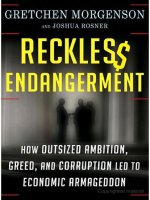
reckless endangerment - gretchen morgenson
Bạn đang xem bản rút gọn của tài liệu. Xem và tải ngay bản đầy đủ của tài liệu tại đây (5.56 MB, 1,087 trang )
FANNIE MAE AND FRIENDS
James A. Johnson, chief executive
officer, Fannie Mae, 1991-1998,
director, Goldman Sachs; former
director, KB Home; former chairman of
The Brookings Institution and The
Kennedy Center for the Performing Arts
Franklin Delano Raines, former director,
Office of Management
and Budget; chief executive officer,
Fannie Mae, 1999-2005 David O.
Maxwell, chief executive officer, Fannie
Mae, 1981-1991 William Jefferson
Clinton, forty-second president of the
United States
Barney Frank, Democratic
congressman from Massachusetts Robert
Zoellick, executive vice president,
Fannie Mae, 1993-1997 Thomas
Donilon, head of government affairs,
Fannie Mae, 1999-2005
LaRRy SummERS, deputy secretary,
United States Treasury, 1995-
1999. Secretary of the Treasury,
1999-2001 Robert Rubin, Secretary of
the United States Treasury, 1995-1999
Richard Holbrooke, cofounder with
James Johnson of Public
Strategies, consulting firm Leland
Brendsel, former chief executive,
Freddie Mac, 1987-2003
Timothy Howard, chief financial
officer, Fannie Mae, 1990-2005 Thomas
Nides, executive vice president, human
resources, Fannie Mae, 1998-2001
Herb Moses, community affairs
official, Fannie Mae, 1991-1998,
and former partner of Barney Frank
R. Glenn Hubbard, Columbia Graduate
School of Business Peter Orszag, senior
economist, Council of Economic
Advisors, 1995-1996
Bruce Vento, Democratic
representative from Minnesota, 1977-
2000
Robert Bennett, Republican senator
from Utah, 1993-2010 Kit Bond,
Republican senator from Missouri,
1987-2003 Stephen Friedman, former
director, Fannie Mae, and former chief
executive, Goldman Sachs Maxine
Waters, Democratic representative from
California
DOUBTERS AND THOSE WHO
PUSHED BACK
Dean Baker, codirector, Center for
Economic & Policy Research Anne
Canfield, lobbyist for community banks
and author of The GSE Report
Marvin Phaup, former director,
Financial Studies/Budget Process
group, Congressional Budget Office
June O'Neill, director, Congressional
Budget Office, 1995-1999 Walker Todd,
former chief counsel at Federal Reserve
Bank of Cleveland
Richard S. Carnell, assistant
secretary for financial institutions,
United States Treasury
EDwArd) DeMarco, director, office
of Financial Institutions Policy,
Treasury Department, 1993-2003
William Lightfoot, former D.C. Council
member Armando Falcon, director,
Office of Federal Housing Enterprise
Oversight, 1995-2005 Roy E.
Barnes, governor of Georgia, 1999-
2003, and predatory
lending adversary William J.
Brennan Jr., former director, Home
Defense Program,
Atlanta Legal Aid Janet Ahmad,
president, Homeowners for Better
Building, San Antonio
Marc Cohodes, former money
manager, Marin County, California
SUBPRIME LENDERS AND
THEIR ENABLERS
Angelo Mozilo, cofounder and
former chief executive, Countrywide
Financial Wright H. Andrews Jr.,
subprime lending lobbyist Walter Falk,
founder, Metropolitan Mortgage of
Miami David Silipigno, founder,
National Finance Company J. Terrell
Brown, former chief executive, United
Companies Financial
Scott Hartman, former chairman,
NovaStar W. Lance Anderson, former
chief executive, NovaStar Bruce Karatz,
former chief executive, KB Home Henry
Cisneros, secretary, Housing & Urban
Development, 1993-1997
Murray Zoota, former chief
executive, Fremont Investment & Loan
David McIntyre, former chief executive,
Fremont Corporation Louis Rampino,
former chief executive, Fremont General
FECKLESS REGULATORS
Timothy F. Geithner, president,
Federal Reserve Bank of New York,
2003-2008
RogER FERGUSON, vice-chairman
of the FEDERAL ReServE, 1999-2006
Andrew Cuomo, secretary, Housing
& Urban Development, 1997-2001
Robert Peach and John McCarthy,
researchers at the Federal
Reserve Bank of New York Alan
Greenspan, chairman, Federal Reserve
Board, 1987-2006 Frederic Mishkin,
governor, Federal Reserve Board, 2006-
2008
written about the epic financial crisis of
2008 and neither will it be the last. But
Josh and I believe that Reckless
Endangerment is different from the
others in two important ways. It
identifies powerful people whose
involvement in the debacle has not yet
been chronicled and it connects key
incidents that have seemed heretofore
unrelated.
As a veteran business reporter and
columnist for the New York Times, I've
covered my share of big and juicy
financial scandals over the years. For
more than a decade as an established
financial and policy analyst, Josh has
seen just about every trick there is.
But none of the scandals and
financial improprieties we experienced
before felt nearly as momentous or
mystifying as the events that culminated
in this most recent economic storm.
That's why we felt that this calamity, and
the conduct that brought it on, needed to
be thoroughly investigated, detailed, and
explained.
The disaster was so great—its
impact so far-reaching—that we knew
we were not the only ones who wanted
to understand how such a thing could
happen in America in the new
millennium.
Even now, more than four years after
the cracks in the financial foundation
could no longer be ignored, people
remain bewildered about the causes of
the steepest economic downturn since
the Great Depression. And they wonder
why we are still mired in it.
Then there is the maddening
aftermath—watching hundreds of
billions of taxpayer dollars get funneled
to rescue some of the very institutions
that drove the country into the ditch.
The American people realize they've
been robbed. They're just not sure by
whom.
Reckless Endangerment is an
economic whodunit, on an international
scale. But instead of a dead body as
evidence, we have trillions of dollars in
investments lost around the world,
millions of Americans jettisoned from
their homes and fourteen million U.S.
workers without jobs. Such is the nature
of this particular crime.
Recognizing that a disaster this large
could not have occurred overnight, Josh
and I set out to detail who did it, how,
and why. We found that this was a crisis
that crept up, building almost
imperceptibly over the past two
decades. More disturbing, it was the
result of actions taken by people at the
height of power in both the public and
the private sectors, people who
continue, even now, to hold sway in the
corridors of Washington and Wall
Street.
Reckless Endangerment is a story of
what happens when unfettered risk
taking, with an eye to huge personal
paydays, gains the upper hand in
corporate executive suites and on Wall
Street trading floors. It is a story of the
consequences of regulators who are
captured by the institutions they are
charged with regulating. And it is a story
of what happens when Washington
decides, in its infinite wisdom, that
every living, breathing citizen should
own a home.
Josh and I felt compelled to write
this book because we are angry that the
American economy was almost wrecked
by a crowd of self-interested, politically
influential, and arrogant people who
have not been held accountable for their
actions. We also believe that it is
important to credit the courageous and
civically minded people who tried to
warn of the impending crisis but who
were run over or ignored by their
celebrated adversaries.
Familiar as we are with the ways of
Wall Street, neither Josh nor I was
surprised that the large investment firms
played such a prominent role in the
debacle. But we are disturbed that so
many who contributed to the mess are
still in positions of power or have risen
to even higher ranks. And while some
architects of the crisis may no longer
command center stage, they remain
respected members of the business or
regulatory community. The failure to
hold central figures accountable for their
actions sets a dangerous precedent. A
system where perpetrators of such a
crime are allowed to slip quietly from
the scene is just plain wrong.
In the end, analyzing the financial
crisis, its origins and its framers,
requires identifying powerful
participants who would rather not be
named. It requires identifying events that
seemed meaningless when they occurred
but had unintended consequences that
have turned out to be integral to the
outcome. It requires an unrelenting
search for the facts, an ability to speak
truth to power.
Investigating the origins of the
financial crisis means shedding light on
exceedingly dark corners in Washington
and on Wall Street. Hidden in these
shadows are people, places, and
incidents that can help us understand the
nature of this disaster so that we can
keep anything like it from happening
again.
was preaching to the choir when he
made that proclamation in 1994, just two
years into his first term. Facing an
enthusiastic crowd at the National
Association of Realtors' annual meeting
in Washington, D.C., Clinton launched
the National Partners in
Homeownership, a private-public
cooperative with one goal: raising the
numbers of homeowners across
America.
Determined to reverse what some in
Washington saw as a troubling decline
of homeownership during the previous
decade, Clinton urged private enterprise
to join with public agencies to ensure
that by the year 2000, some 70 percent
of the populace would own their own
homes.
An owner in every home. It was the
prosperous, 1990s version of the
Depression-era "A Chicken in Every
Pot."
With homeownership standing at
around 64 percent, Clinton's program
was ambitious. But it was hardly
groundbreaking. The
U.S. government had often used
housing to achieve its public policy
goals. Abraham Lincoln's Homestead
Act of 1862 gave away public land in
the nation's western precincts to
individuals committed to developing it.
And even earlier, during the