fixed income, derivative,and alternative investments
Bạn đang xem bản rút gọn của tài liệu. Xem và tải ngay bản đầy đủ của tài liệu tại đây (9.96 MB, 292 trang )
-_ -
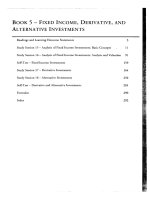
BOOK
5 - FIXED
INCOME,
DERIVATIVE,
AND
ALTERNATIVE INVESTMENTS
Readings
and
Learning
Outcome
Statements 3
Study
Session 15 - Analysis
of
Fixed
Income
Investments: Basic
Concepts
11
Study
Session 16 - Analysis
of
Fixed
Income
Investments: Analysis
and
Valuation 91
Self-Test
- Fixed
Income
Investments
159
Study
Session 17 - Derivative Investments
164
Study
Session 18 - Alternative Investments
250
Self-Test - Derivative
and
Alternative Investments
285
Formulas
290
Index
292
I
If
rhis
book
d~~s
nor
have
a
front
and
back
cover, it was
distributed
witho~lt
permission
of
S~hweser,
a
Division
of
Kaplan,
Inc.,
and
I is
in
diw:1:
vioLnion
or
global
copyright
Jaws. Your
assistance
in
pursuing
potentiai
violators
or
this
law
is
greatiy
appreciated.
L __
.________
_ _
Required
CFA
Institute® disclaimer: "CFA")
and.
Chanered
Fina~iaJ
Analyst0'i
are
trade~:;ks
owned
by
crA
Insti~=;-CFA
Instiwte
(formerlyl
the
Association for
investment
Managemenr and Research) docs not endorse, prom(lle, review. or warrant the
accur~cv
of
rhe produC[s or serviccs I
offered
by
Schweser
Study
Program"'-"
Cenain
materials
contained
within
this text are the copyrightcd property ofCFA
Imtiwtc.
The
following
i.s
the copyright disciuStlre
It>r
these matc-
rials:
"Copyrighr,
2008,
CFA
Institute. Reproduced and republished from 2008 Learning OUlcome SwcmcIHs,
eFA
Institute Still/dard, o(l'rolc5-
sional Conduct,
and
CFA
Institute's Global investment
PerfOrmance
Standards with permission froIll CFA Institute.
All
Right, Reserved."
These
materials may
not
be copied without written permission from the author.
The
unauthorized
duplication
of
these notes
is
a violation
of
global
copyright
laws
and
the
CFA
Institute
Code
of
Ethics. Your assistance in pursui
ng
potential violators
of
th
is
law
is
greatlv al'llreciared.
Disclaimer:
The
Schweser
Notes
should be used
in
conjunction with the original readings
as
set
fonh
by
eFA
Institute
in
their
2008
CIA
Leuel J
Study
Guide.
The
information
contained
in
these Notes covers topics contained
in
the readings referenced by
eFA
Institute
and
is
believed to be
accurate. However,
their
accuracy cannot
be
guaranteed nor
is
any warranry conveyed
as
to
your ultimate exam success.
The
authors
of
the
referenced readings
have
not
endorsed or sponsored these Notes, nor are they affiliated
with
Schweser Study Program.
Page
2
©2008
Schweser
READINGS
AND
LEARNING
OUTCOME
STATEMENTS
READINGS
The follow;'lg material
is
a reuiew
of
the Fixed Income, Deriuative,
and
Alternative Investments principles designed
tli
addreJJ the learning outcome statements
.let
forth
by
CFA
Imtitute.
Reading
Assignments
Derivatives
and
Alternative
IrweJtments, CFA Program
Curriculum,
Volume 6 (CFA
Institute,
2008)
70. Derivative
Markets
and
Instruments
page 164
71. Forward
Markets
and
Contracts
page 171
72. Futures
Markets
and
Contracts
page 187
73.
Option
Markets
and
Contracts
page 198
74. Swap Markets
and
Contracts
page 225
75. Risk
Management
Applications
of
Option
Strategies page 239
STUDY
SESSION
15
I,
~
.'
- -
Reading
Assignments
Equi~y
and
Fixed Income, CFA Program
Curriculum,
Volume 5 (CFA
Institute,
2008)
62. Features
of
Debt
Securities
63. Risks Associated with Investing in Bonds
64. Overview
of
Bond
Sectors
and
Instruments
65.
Understanding
Yield Spreads
66.
Monetary
Policy in an
Environment
of
Global
Financial Markets
STUDY.;bESSION 16
. .
Reading
Assignments
Equity
and
Fixed Income, CFA Program
Curriculum,
Volume 5 (CFA
Institute,
2008)
67.
Introduction
to
the Valuation
of
Debt
Securities
68. Yield Measures, Spot Rates,
and
Forward Rates
69.
Introduction
to
the
Measurement
of
Interest
Rate Risk
'STUDY"SESSIQN 17
" ' • •
l~,
_
page
11
page 24
page
45
page 68
page 85
page
91
page 105
page 137
"
STUDY
SESSION
18
Reading
Assignments
Derivatives
and
Alternative
Investments, CFA Program
Curriculum,
Volume 6 (CFA
Institute,
2008)
76. Alternative
Investments
page
250
Fixed Income, Derivative, and Alternative Investments
Readings
and
Learning
Outcome
Statements
LEARNING
OUTCOME
STATEMENTS
(LOS)
The CPA
Institute
Learning Outcome Statements are Listed
beLow.
These are repeated in
each topic review; however, the order
may
have been changed
in
order to get a better
fit
with
the
flow
of
the review.
STUDY
SESSION
15
, • 1
Page 4
62.
63.
The topicaL coverage corresponds
with
the
fOLLowing
CPA
Institute
assigned reading:
Features
of
Debt
Securities
The
candidate
should be able
to:
a.
explain
the
purposes
of
a
bond's
indenture,
and
describe
affirmative
and
negative
covenants.
(page 11)
b.
describe
the
basic features
of
a
bond,
the
various
coupon
rate
structures,
and
the
structure
of
floating-rate
securities. (page 12)
c.
define
accrued
interest,
full
price,
and
dean
price.
(page
13)
d.
explain
the
provisions
for
redemption
and
retirement
of
bonds.
(page 14)
e.
identify
the
common
options
embedded
in a
bond
issue,
explain
the
importance
of
embedded
options,
and
state
whether
such
options
benefit
the
issuer
or
the
bondholder.
(page 16)
f.
describe
methods
used
by
institutional
investors
in
the
bond
market
to
finance
the
purchase
of
a
security
(i.e.,
margin
buying
and
repurchase
agreements).
(page
17)
The topicaL coverage
cormponds
with
the
fOLLowing
CPA
Institute
assigned reading:
Risks
Associated
with
Investing
in
Bonds
The
candidate
should
be able to:
a.
explain
the
risks
associated
with
investing
in
bonds.
(page 24)
b.
identify
the
relations
among
a
bond's
coupon
rate,
the
yield
required
by
the
market,
and
the
bond's
price
relative to
par
value
(i.e.,
discount,
premium,
or
equal
to
par).
(page 26)
c.
explain
how
features
of
a
bond
(e.g.,
maturity,
coupon,
and
embedded
options)
and
the
level
of
a
bond's
yield affect
the
bond's
interest
rate
risk.
(page
27)
d.
identify
the
relationship
among
the
price
of
a callable
bond,
the
price
of
an
option-free
bond,
and
the
price
of
the
embedded
call
option.
(page 28)
e.
explain
the
interest
rate risk
of
a
floating-rate
security
and
why
such
a
security's price may differ
from
par
value. (page 29)
f.
compute
and
interpret
the
duration
and
dollar
duration
of
a
bond.
(page 29)
g.
describe
yield
curve
risk
and
explain
why
duration
does
not
account
for
yield
curve
risk for a
portfolio
of
bonds.
(page 32)
h.
explain
the
disadvantages
of
a callable
or
prepayable
security
to an
investor.
(page
33)
1.
identify
the
factors
that
affect
the
reinvestment
risk
of
a securiry
and
explain
why
prepayable
amortizing
securities
expose
investors
to
greater
reinvestment
risk
than
nonamorrizing
securities. (page
33)
©2008
Schweser
Fixed Income, Derivative, and Alternative Investments
Readings
and
Learning Outcome Statements
).
describe
the
various forms
of
credit
risk
and
describe
the
meaning
and
role
of
credit
ratings. (page
34)
k.
explain
liquidity
risk
and
why
it
might
be
important
to
investors even
if
they
expect
to
hold
a
security
to
the
maturity
date.
(page
35)
I.
describe
the
exchange
rate
risk
an
investor
faces
when
a
bond
makes
payments
in a foreign currency. (page
36)
m.
explain
inflation
risk. (page
36)
n.
explain
how
yield
volatility
affects
the
price
of
a
bond
with
an
embedded
option
and
how
changes
in
volatility affect
the
value
of
a callable
bond
and
a
putable
bond.
(page
36)
o.
describe
the
various forms
of
event
risk. (page
37)
The topical coverage corresponds with the
fillowing
CFA Institute assigned reading:
64.
Overview
of
Bond
Sectors
and
Instruments
The
candidate
should
be
able
to:
a.
describe
the
features,
credit
risk
characteristics,
and
distribution
methods
for
government
securities. (page
45)
b.
describe
the
types
of
securities issued by
the
U.S.
Department
of
the
Treasury
(e.g., bills, notes,
bonds,
and
inflation
protection
securities),
and
differentiate
between
on-the-run
and
off-the-run
Treasury
securities.
(page
46)
c.
describe
how
stripped
Treasury securities are
created
and
distinguish
between
coupon
strips
and
principal
strips.
(page
48)
d.
describe
the
types
and
characteristics
of
securities
issued by U.S. federal
agencies. (page
48)
e.
describe
the
types
and
characteristics
of
mortgage-backed
securities
and
explain
the
cash flow,
prepayments,
and
prepayment
risk
for
each
type.
(page
49)
f.
state
the
motivation
for
creating
a
collateralized
mortgage
obligation.
(page 51)
g. describe
the
types
of
securities issued by
municipalities
in
the
United
States,
and
distinguish
between
tax-backed
debt
and
revenue
bonds.
(page
5])
h. describe
the
characteristics
and
motivation
for
the
various types
of
debt
issued
by
corporations
(including
corporate
bonds,
medium-term
notes.
structured
notes,
commercial
paper,
negotiable
CDs,
and
bankers
acceptances).
(page 53)
1.
define
an
asset-backed
security,
describe
the
role
of
a special
purpose
vehicle
in
an
asset-backed
security's
transacrion,
state
rhe
motivation
for
a
corporation
[0
issue an
asset-backed
securiry,
and
describe
the
types
of
external
credir
enhancements
for asser-backed securities. (page 57)
J.
describe
collateralized
debr
obligarions.
(page 58)
k.
describe
the
mechanisms
available for
placing
bonds
in
the
primary
market
and
differentiate
the
primary
and
secondary
markets
in
bonds.
(page 59)
The topical coverage cormponds with the following CFA Institute assigned reading:
65.
Understanding
Yield
Spreads
The
candidate
should
be able
[0:
a.
identify
the
interest
rate policy tools available
to
a central
bank
(e.g.,
the
U.S.
Federal Reserve). (page
68)
©2008'Schweser
Page 5
Fixed Income,.Derivative, and Alternative Investments
Readings
and
Learning
Outcome
Statements
b.
describe
a yield
curve
and
the
various
shapes
of
the
yield curve. (page
69)
c. explain
the
hasic
theories
of
the
term
structure
of
interest
rates
and
describe
the
implications
of
each
theory
for
the
shape
of
the
yield
curve.
(page 70)
d.
define
a
spot
rate. (page 72)
e.
compute,
compare,
and
contrast
the
various
yield
spread
measures.
(page
73)
f.
descrihe
a
credit
spread
and
discuss
the
suggested
relation
between
credit
spreads
and
the
well-being
of
the
economy.
(page 74)
g.
identify
how
emhedded
options
affect yield
spreads.
(page 74)
h.
explain
how
the
liquidity
or
issue-size
of
a
hond
affects its yield
spread
relative
to
risk-free
securities
and
relative
to
other
securities.
(page
75)
1.
compute
the
after-tax
yield
of
a taxable
security
and
the
tax-equivalent
yield
of
a
tax-exempt
secutity.
(page
75)
J.
define
LIROR
and
explain
its
importance
to
funded
investors
who
borrow
short
term.
(page 76)
66.
The topicaL coverage corresponds
with
the foLLowing CFA Institute assigned reading:
Monetary
Policy
in
an
Environment
of
Global
Financial
Markets
The
candidate
should
be
able
to:
a.
identify
how
central
bank
behavior
affects
short-term
interest
rates,
systemic
liquidi
ty,
and
market
expecta
tions,
thereby
affecting
financial
markets.
(page 85)
b.
describe
the
importance
of
communication
between
a
central
bank
and
the
financial
markets.
(page 86)
c. discuss
the
problem
of
information
asymmetry
and
the
importance
of
predictability,
credibility,
and
transparency
of
monetary
policy. (page 86)
';S;rUDY
SESSION
16
,.
Page 6
67.
The topicaL coverage corresponds
with
the foLLowing CFA Institute assigned reading:
Introduction
to
the
Valuation
of
Debt
Securities
The
candidate
should
be
able
to:
a.
explain
the
steps
in
the
bond
valuation
process.
(page
9
I)
b.
identify
the
types
of
bonds
for
which
estimating
the
expected
cash flows
is
difficult,
and
explain
the
problems
encountered
when
estimating
the
cash flows for
these
bonds.
(page 91)
c.
compute
the
value
of
a
bond
and
the
change
in
value
that
is
attributable
to
a
change
in
the
discount
rate. (page 92)
d.
explain
how
the
price
of
a
bond
changes
as
the
bond
approaches
its
maturity
date,
and
compute
the
change
in
value
that
is
attributable
to
the
passage
of
time.
(page 95) .
e.
compute
the
value
of
a
zero-coupon
bond.
(page
96)
f.
explain
the
arbitrage-free
valuation
approach
and
the
market
process
that
forces
the
ptice
of
a
bond
toward
its
arbitrage-free
value,
and
explain
how
a
dealer
can
generate
an
arbitrage
profit
if
a
bond
is
mispriced.
(page
97)
©2008
Schweser
Fixed Income, Derivative,
and
Alternative Investments
Readings
and
Learning
Outcome
Statements
The topical coverage corresponds
with
thefOllowing CFA Institute assigned reading:
68.
Yield
Measures,
Spot
Rates,
and
Forward
Rates
The
candidate
should
be able to:
a.
explain
the
sources
of
return
from
investing
in
a
bond.
(page 105)
b.
compute
and
interpret
the
traditional
yield measures for fixed-rate
bonds,
and
explain
their
limitations
and
assumptions.
(page 106)
c.
explain
the
importance
of
reinvestment
income
in
generating
the yield
computed
at
the
time
of
purchase,
calculate
the
amount
of
income
required to
generate
that
yield,
and
discuss the factors
that
affect
reinvestment
risk. (page 112)
d.
compute
and
interpret
the
bond
equivalent
yield
of
an
annual-pay
bond
and
the
annual-pay
yield
of
a
semiannual-pay
bond.
(page 113)
e.
describe the
methodology
for
computing
the
theoretical
Treasury
sPOt
rate curve,
and
compute
the value
of
a
bond
using
spot
rates. (page 114)
f.
differentiate
between
the
nominal
spread,
the
zero-volarility
spread,
and
the
option-adjusted
spread. (page 118)
g.
describe
how
the
option-adjusted
spread
accounts
for the
option
cost in a
bond
with
an
embedded
option.
(page 120)
h. explain a
forward
rate,
and
compute
sPOt rates
from
forward rates,
forward rates from
spot
rates,
and
the value
of
a
bond
using
forward
rates. (page 120)
The topical
co'verage
corresponds
with
the fOllowing CFA Institute assigned reading:
69.
Introduction
to
the
Measurement
of
Interest
Rate
Risk
The
candidate
should
be able to:
a.
distinguish
between
the
full
valuation
approach
(the
scenario analysis
approach)
and
the
duration/convexity
approach
for
measuring
interest
rate risk,
and
explain
the
advantage
of
using
the
full
valuation
approach.
(page 137)
b.
demonstrate
the price volatility
characteristics
for
option-free,
callable,
prepayable.
and
putable
bonds
when
interest
rates change. (page 139)
c. describe positive convexity, negative convexity,
and
their
relation
to
bond
price
and
yield. (page 139)
d.
compute
and
interpret
the effective
duration
of
a
bond,
given
information
about
how
the
bond's
price
will increase
and
decrease for
given
changes
in
interest
rates,
and
compute
the
approximate
percentage
price
change
for a
bond,
given the
bond's
effective
duration
and
a
specified
change
in
yield. (page 142)
e.
distinguish
among
the
alternative
definitions
of
duration,
and
explain
why effective
duration
is
the
most
appropriate
measure
of
interest
rate
risk for
bonds
with
embedded
options.
(page 145)
f.
compute
the
Juration
of
a
portfolio,
given the
duration
of
the
bonds
comprising
the
portfolio,
and
explain
the
limitations
of
portfolio
duration.
(page 146)
g.
describe
the
convexity measure
of
a
bond,
and
estimate
a bond's
percentage
price change, given
the
bond's
duration
and
convexity
and
a
specified
change
in
interest
rates. (page 147)
h.
differentiate
between
modified
convexity
and
effective convexity.
(page 149)
I.
compute
the
price value
of
a basis
point
(PVBP),
and
explain its
relationship
to
duration.
(page 150)
©2008
Schweser
Page 7
Fixed Income, Derivative,
and
Alternative Investments
Readings
and
Learning
Outcome
Statements
" '
STUDY SESSION 17
•
.'
'I
I,
•
Page 8
70.
71.
72.
The topical coverage corresponds
with
the follo'Ding
Cf"A
Il1Stitute assigned reading:
Derivative
Markets
and
Instruments
The
candidate
should
be able
to:
a.
define
a
derivative
and
differentiate
between
exchange-traded
and
over-
the-coun
ter derivatives. (page 164)
b.
define
a forward
commitment
and
a
contingenr
claim,
and
describe
the
basic
characteristics
of
forward
contracts,
futures
contracts,
options
(calls
and
puts),
and
swaps. (page 164)
c. discuss
the
purposes
and
criticisms
of
derivative
markets.
(page 165)
d. explain
arbitrage
and
the
role it plays in
determining
prices
and
promoting
market
efficiency. (page 166)
The topical coverage corresponds
with
the following CFA Institute assigned reading:
Forward
Markets
and
Contracts
The
candidate
should
be able to:
a.
differentiate
between
the
positions
held
by
the
long
and
shorr
parries
to
a
forward
contract
in
terms
of
deliverylsettlemenr
and
default
risk.
(page 171)
b.
describe
the
procedures
for
settling
a
forward
contract
at
expiration,
and
discuss
how
termination
alternatives
prior
to
expiration
can
affect
credit
risk. (page
172)
c.
differentiate
between
a
dealer
and
an
end
user
of
a
forward
contraCt.
(page
173)
d. describe
the
characteristics
of
equity
forward
contracts
and
forward
contracts
on
zero-coupon
and
coupon
bonds.
(page 174)
e.
describe
the
characteristics
of
the
Eurodollar
time
deposit
market,
define
LIBOR
and
Euribor. (page 176)
f.
describe
the
charaCteristics
of
forwatd
rate
agreements
(FRAs). (page 176)
g. .calculate
and
inrerpret
the
payoff
of
an
FRA
and
explain each
of
the
component
terms. (page 177)
h. describe
the
characteristics
of
currency
forward
contracts.
(page 178)
The topical coverage corresponds
with
the
followingCFA
Institute assigned reading:
Futures
Markets
and
Contracts
The
candidate
should
be able
to:
a.
describe
the
characteristics
of
futures coneracts,
and
distinguish
between
fu tures
con
tracts
and
for'Nard
contracts.
(page 187)
b.
differentiate
between
margin
in
the
securities
markets
and
margin
in
the
futures
markets;
and
define
initial
margin,
maintenance
margin,
variation
margin,
and
settlement
price.
(page 188)
c. describe
price
limits
and
the
process
of
marking
to
market,
and
compute
and
interpret
the
margin
balance, given
the
previous
day's balance
and
the
new
change
in
the
futures
price. (page 190)
d. describe
how
a futures
contract
can be
terminated
by a
close-out
(i.e.,
offset)
at
expiration
(or
prior
to
expiration),
delivery,
an
equivalent
cash
settlement,
or
an
exchange-for-physicals.
(page 191)
e.
describe
the
characteristics
of
the
following types
of
futures
contracts:
Eurodollar,
Treasury
bond,
stock
index,
and
currency. (page 192)
©2008
Schweser
Fixed
Income,
Derivative,
and
Alternative
Investments
Readings
and
Learning
Outcome
Statements
The topica! coverage corresponds with the following CFA Institute assigned reading:
73.
Option
Markets
and
Contracts
The
candidate
should
be able to:
a.
define
European
option,
American
option,
and
moneyness,
and
differentiate
between
exchange-traded
options
and
over-the-countet
options.
(page 199)
b.
identify
the
types
of
options
in
terms
of
the
underlying
instruments.
(page
201)
c.
compate
and
contrast
interest
rate
options
to
forward
rate
agreements
(FRAs). (page
202)
d.
define
interest
rate caps, floors,
and
collars. (page 203)
e.
compute
and
interpret
option
payoffs,
and
explain
how
interest
rate
option
payoffs differ from
the
payoffs
of
other
types
of
options.
(page 204)
f.
define
intrinsic
value
and
time
value,
and
explain
their
relationship.
(page
205)
g.
determine
the
minimum
and
maximum
values
of
European
options
and
American
options.
(page
208)
h.
calculate
and
interpret
the
lowest prices
of
European
and
American
calls
and
puts
based
on
the
rules for
minimum
values
and
lower
bounds.
(page
208)
I.
explain
how
option
prices are
affected
by
the
exercise
price
and
the
time
to
expiration.
(page 212)
J.
explain
put-call
parity
for
European
options,
and
relate
put-call
parity
to
arbitrage
and
the
construction
of
synthetic
options.
(page
214)
k.
contrast
American
options
with
European
options
in
terms
of
the
lower
bounds
on
option
prices
and
the
possibility
of
early exercise. (page
216)
l.
explain
how
cash flows
on
the
underlying
asset affect
put-call
parity
and
the
lower
bounds
of
option
prices. (page
216)
m.
indicate
the
directional
effect
of
an
interest
rate
change
or
volatility
change
on
an
option's
price. (page
217)
The topica! coverage corresponds
with
thefollowing CFA Institute assigned reading:
74.
Swap
Markets
and
Contracts
The
candidate
should
be
able
to:
a.
describe
the
characteristics
of
swap
contracts
and
explain
how
swaps are
terminated.
(page
226)
b.
define
and
give examples
of
currency
swaps, plain vanilla
interest
rate
swaps,
and
equity
swaps,
and
calculate
and
interpret
the
payments
on
each. (page
227)
The topica! coverage corresponds with the following CFA
Imtitttle
assigned reading:
75.
Risk
Management
Applications
of
Option
Strategies
The
candidate
should
be able to:
a.
determine
the
value
at
expiration,
profit,
maximum
profit,
maximum
loss,
breakeven
underlying
price at
expiration,
and
general
shape
of
the
graph
of
the
strategies
o~'
buying
and
selling calls
and
puts,
and
indicate
the
market
outlook
of
invescors
using
these strategies. (page
239)
©2008
Schweser
Page
9
Fixed
Income,
Derivative,
and
Alternative
Investments
Readings
and
Learning
Outcome
Statements
b.
determine
the
value at
expiration,
profit,
maximum
profit,
maximum
loss, breakeven
underlying
price
at
expiration,
and
general
shape
of
the
graph
of
a covered call
strategy
and
a
protective
pur
strategy,
and
explain
the
risk
management
application
of
each strategy. (page
242)
-STUDY SESSION 18
Page
10
76.
The topical coverage corresponds
with
the following
CFA
Institute assigned reading:
Alternative
Investments
The
candidate
should
be able to:
a.
differentiate
between an
open-end
and
a
closed-end
fund,
and
explain
how
net
asset value
of
a
fund
is
calculated
and
the
nature
of
fees
charged
by
investment
companies.
(page
250)
b.
distinguish
among
style, seeror, index, global,
and
stable value strategies
in
equity
investment
and
among
exchange
traded
funds
(ETFs),
traditional
mutual
funds,
and
closed
end
funds. (page
253)
c. explain
the
advantages
and
risks
of
ETFs.
(page
254)
d: describe
the
forms
of
real
estate
investment
and
explain
their
characteristics
as
an
investable
asset class. (page
255)
e.
describe
the
various
approaches
to
the
valuation
of
real estate. (page
256)
f.
calculate
the
net
operating
income
(NOr)
from
a real estate
investment,
the
value
of
a
property
using
the
sales
comparison
and
income
approaches,
and
the
after-tax
cash flows,
net
present
value,
and
yield
of
a
real estate
investment.
(page
258)
g.
explain
the
stages
in
venture
capital
investing,
venture
capital
investment
characteristics,
and
challenges
to
venture
capital
valuation
and
performance
measurement.
(page
261)
h. calculate
the
net
present
value
(NPV)
of
a
venture
capital project, given
the
project's possible payoff
and
conditional
failure probabilities. (page
262)
1. discuss
the
descriptive
accuracy
of
the
term
"hedge
fund,"
define
hedge
fund
in
terms
of
objectives, legal
structure,
and
fee
structure,
and
describe
the
various classifications
of
hedge
funds. (page
263)
J.
explain
the
benefits
and
drawbacks
to
fund
of
funds
investing.
(page
264)
k. discuss
the
leverage
and
unique
risks
of
hedge
funds. (page
264)
I.
discuss
the
performance
of
hedge
funds, the biases
present
in
hedge
fund
performance
measurement,
and
explain
the
effect
of
survivorship bias
on
the
reported
return
and
risk measures for a hedge
fund
database. (page
265)
m.
explain
how
the
legal
environment
affects
the
valuation
of
closely
held
companies.
(page
266)
n. describe
alternative
valuation
methods
for closely
held
companies
and
distinguish
among
the
bases for
the
discounts
and
premiums
for these
companies.
(page 267)
o. discuss distressed securities
investing
and
compare
venture
capital
investing
with
distressed securities
investing.
(page
267)
p. discuss
the
role
of
commodities
as
a vehicle for
investing
in
production
and
consumption.
(page
268)
q. explain
the
motivation
for
investing
in
commodities,
commodities
derivatives,
and
commodity-linked
securities. (page
269)
r. discuss
the
sources
of
return
on
a collateralized
commodity
futures
position.
(page
269)
©2008
Schweser
The
following is a review
of
the
Analysis
of
Fixed
Income
Investments
principles
designed
to
address the
learning
outcome
statements
set
forth
by CFA
Institute.
This
topic is also covered in:
FEATURES OF
DEBT
SECURITIES
Study
Session
15
EXAM Focus
Fixed
income
securities, historically, were
promises
to
pay
a
stream
of
semiannual
payments
for a given
number
of
years
and
then
repay
the
loan
amount
at
the
maturity
date.
The
contract
between
the
borrower
and
the
lender
(the
indenture)
can
really
be
designed
to have
any
payment
stream
or
pattern
that
the
parties agree to. Types
of
contracts
that
are
used
frequently
have specific
names,
and
there
is
no
shortage
of
those
(for
you
to
learn) here.
You
should
pay
special
attention
to
how
the
periodic
payments
are
determined
(fixed, floating,
and
variants
of
these)
and
to
how/when
the
principal
is
repaid
(calls,
puts,
sinking
funds,
a!J2ordzation,
and
prepayments).
These
features all
affect
the
value
of
the
securities
and
will
come
up
again
when
you
learn
how
to
value these
securities
and
compare
their
risks,
both
at
Level 1
and
Level 2.
LOS
62.a:
Explain
the
purposes
of
a
bond's
indenture,
and
describe
affirmative
and
negative
covenants.
The
contract
that
specifies all
the
rights
and
obligations
of
the
issuer
and
the
owners
of
a fixed
income
security
is
called
the
bond
indenture.
The
indenture
defines
the
obligations
of
and
restrictions
on
the
borrower
and
forms
the
basis
for
all
future
transactions
between
the
bondholder
and
the
issuer.
These
contract
provisions
are
known
as
covenants
and
include
both
negative covenants
(prohibitions
on
the
borrower)
and
affirmative
covenants (actions
that
the
borrower
promises
to
perform)
sections.
Negative
covenants
include
restrictions
on
asset sales (the
company
can't sell assets
that
have been
pledged
as
collateral), negative
pledge
of
collateral
(the
company
can't
claim
that
the
same assets
back
several
debt
issues
simultaneously),
and
restrictions
on
additional
borrowings
(the
company
can't
borrow
additional
money
unless
certain
financial
conditions
are
met).
Affirmative
covenants
include
the
maintenance
of
certain
financial ratios
and
the
timely
payment
of
principal
and
interest.
For
example,
the
borrower
might
promise
to
maintain
the
company's
current
ratio
at
a value
of
two
or
higher.
If
this
value
of
the
current
ratio
is
not
maintained,
then
the
bonds
could
be
considered
to
be in (technical)
default.
©2008
Schwesei:
Page
11
Study Session
IS
Cross-Reference ro CFA Insrirure Assigned
Reading
#62
- Fearures
of
Debr
Securiries
LOS
62.b:
Describe
the
basic
features
of
a
bond,
the
various
coupon
rate
structures,
and
the
structure
of
floating-rate
securities.
A
"straight"
(option-free)
bond
is
the
simplest
case.
Consider
a
Treasury
bond
that
has
a
6%
coupon
and
matures
five years
from
today
in
the
amount
of
$1
,000.
This
bond
is
a
promise
by
the
issuer
(tile U.S. Treasury)
to
pay
6%
of
[he
$1,000
par
value
(i.e.,
$60)
each year for five years
and
to
repay
the
$1,000
five years
from
today.
With
Treasury
bonds
and
almost
all
U.S.
corporate
bonds,
the
annual
interest
is
paid
in
two
semiannual
installments.
Therefore,
this
bond
will
make
nine
coupon
payments
(one
every six
months)
of
$30
and
a final
payment
of
$1
,030
(the
par
value plus
the
final
coupon
payment),at
the
end
of
five years.
This
stream
of
payments
is
fixed
when
the
bonds
are issued
and
does
not
change
over
the
life
of
the
bond.
Note
that
each
semiannual
coupon
is
one-half
the
coupon
rate
(which
is
always
expressed
as
an
annual
rate)
times
the
par
value,
which
is
sometimes
called
the
face
value
or
maturity value.
An
8%
Treasury
note
with
a face value
of
$1
00,000
will
make
a
coupon
payment
of
$4,000
every six
months
and
a final
payment
of
$104,000
at
maturity.
A
U.S.
Treasury
bond
is
denominated
(of
course) in
U.S.
dollars.
Bonds
can
be
issued
in
other
currencies
as
well.
The
currency
denomination
of
a
bond
issued by
the
Mexican
government
will likely be
Mexican
pesos.
Bonds
can
be
issued
that
promise
to
make
payments
in
any
currency.
Coupon
Rate
Structures:
Zero-Coupon
Bonds,
Step-Up
Notes,
Deferred
Coupon
Bonds
Zero-coupon
bonds
are
bonds
that
do
not
pay
periodic
interest.
They
pay
the
par
value
at
maturity
and
the
interest
results
from
the
fact
that
zero-coupon
bonds
are
initially
sold
at
a
price
below
par
value (i.e.,
they
are
sold
at a
significant
discount
to
par
value).
Sometimes
we will call
debt
securities
with
no
explicit
interest
payments
pure
discount
securities.
Accrual
bonds
are
similar
to
zero-coupon
bonds
in
that
they
make
no
periodic
interest
payments
prior
to
maturity,
but
different
in
that
they
are
sold
originally
at
(or close to)
par
value.
There
is
a
stated
coupon
rate,
but
the
coupon
interest
accrues
(builds
up)
at
a
compound
rate
until
maturity.
At
maturity,
the
par value,
plus
all
of
the
interest
that
has
accrued
over
the
life
of
the
bond,
is
paid.
Step-up
notes
have
coupon
rates
that
increase over
time
at
a
specified
rate.
The
increase
may
take place
once
or
more
during
the
life
of
the
issue.
Deferred-coupon
bonds
carry
coupons,
but
the
initial
coupon
payments
are
deferred
for
some
period.
The
coupon
paymeuts
accrue,
at
a
compound
rate, over
the
deferral
period
and
are
paid
as
a
lump
sum
at
the
end
of
that
period.
After
the
initial
deferment
period
has passed,
these
bonds
pay
regular
coupon
interest
for
the
rest
of
the
life
of
the
issue (to
maturity).
Page 12
©2008
Schweser
Study
Session 15
Cross-Reference
to
CFA
Institute
Assigned
Reading
#62
-
Features
of
Debt
Securities
Floating-
Rate
Securities
Floating-rate
securities
are
bonds
for
which
the
coupon
interest
payments
over
the
life
of
the
security
vary based
on
a specified
interest
rate
or
index.
For
example,
if
market
interest
rates are
moving
up,
the
coupons
on
straight
floaters will rise
as
well.
In
essence, these
bonds
have
coupons
that
are reset
periodically
(normally
every 3, 6,
or
12
months)
based
on
prevailing
market
interest
rates.
The
most
common
procedure
for
setting
the
coupon
rates
on
floating-rate
securities
is
one
which
starts
with
a reference rate (such as
the
rate
on
certain
U.S. Treasury
securities or the
London
Interbank
Offered
Rate
rUBOR])
and
then
adds
or
subtracts
a
stated
margin to
or
from
that
reference rate.
The
quoted
margin
may
also vary over
time
according
to a
schedule
that
is
stated
in
the
indenture.
The
schedule
is
often
referred
to
as the coupon formula.
Thus,
to
find
the
new
coupon
rate, you
would
use
the
following
coupon
formula:
new
coupon
rate
=:
reference rate
+/-
quoted
margin
Just
as
with
a
fixed-coupon
bond,
a
semiannual
coupon
payment
will be
one-half
the
(annual)
coupon
mte.
An
inverse
floater
is
a
floating-rate
security
with
a
coupon
formula
that
actually
increases the
coupon
rate
when
a reference interest rate decreases,
and
vice versa. A
coupon
formula
such
as
coupon
rate = 12% - reference rate accomplishes this.
Some
floating-rate
securities have
coupon
formulas
based
on
inflation
and
are referred
to
as
inflation-indexed
bonds.
A
bond
with
a
coupon
formula
of
3%
+
annual
change
in
CPI
is
an example
of
such
an
inflat,ion-linked security.
Caps
and
floors.
The
parties
to
the
bond
contract
can
limit
their
exposure
to
extreme
fluctuations
in
the
reference rate by
placing
upper
and
lower
limits
on
the
coupon
rate.
The
upper
limit,
which
is
called a cap,
puts
a
maximum
on
the
interest
rate
paid
by the
borrower/issuer.
The
lower
limit,
called a floor,
puts
a
minimum
on
the
periodic
coupon
interest
payments
received by
the
lender/security
owner.
When
both
limits
are
present
simultaneously,
the
combination
is
called a collar.
Consider
a floating-rate
security
(floater)
with
a
coupon
rate
at
issuance
of
5%,
a
7%
cap,
and
a 3% floor.
If
~he
coupon
rate (reference rate plus
the
margin)
rises above
7°/b,
the
borrower
will
pay
(lender
will receive)
only
7%
for as
long
as
the
coupon
rate,
according
to
the
formula,
remains
at
or
above
7%.
If
the
coupon
rate falls below
3%,
the
borrower
will pay 3% for
as
long
as
the
coupon
rate.
according
to
the
formula,
remains
at
or
below
3%.
LOS
62.c:
Define
accrued
interest,
full
price,
and
clean
price.
When
a
bond
trfldes between coupon dates,
the
seller
is
entitled
to receive any
interest
earned
from
the
previolls
coupon
date
through
the
date
of
the
sale.
This
is
known
as
accrued
interest
and
is
an
amount
that
is
payable by
the
buyer
(new
owner)
of
the
bond.
The
new
owner
of
the
bond
will receive all
of
the
next
coupon
payment
and
will
©2008
Schweser
Page 13
Study
Session 15
Cross-Reference
to
CFA
Institute
Assigned
Reading
#62
-
Features
of
Debt
Securities
then
recover any accrued
imerest
paid
on
the
date
of
purchase.
The
accrued
interest
is
calculated
as
the
fraction
of
the
coupon
period
that
has passed times the
coupon.
In
the
U.S.,
the
convention
is
for
the
bond
buyer to pay
any
accrued
interest
to
the
bond
seller.
The
amount
that
the
buyer
pays
to
the
seller
is
the
agreed-upon
price
of
the
bond
(the
clean
price) plus any accrued interest. In
the
U.S.,
bonds
trade
with
the
next
coupon
attached,
which
is
termed
cum coupon. A
bond
traded
without
the
right
to
the
next
coupon
is
said to be
trading
ex-coupon.
The
total
amount
paid,
including
accrued
interest,
is
known
as
the
full
(or
dirty)
price
of
the
bond.
The
full
price
= clean
price
+
accrued
interest.
If
the
issuer
of
the
bond
is
in
default
(i.e., has
not
made
periodic
obligatory
coupon
payments),
the
bond
will
trade
without
accrued
interest,
and
it
is
said
to
be
trading/lat.
LOS
62.d:
Explain
the
provisions
for
redemption
and
retirement
of
bonds.
The
redemption
provisions for a
bond
refer to how,
when,
and
under
what
circumstances
the
principal
will be repaid.
Coupon
Treasury
bonds
and
most
corporate
bonds
are
nonamortizing;
that
is,
they
pay
only
interest
until
maturity,
at
which
time
the
entire
par
or
face value
is
repaid.
This
repayment
structure
is
referred to
as
a
"bullet
bond"
or
"bullet
maturity."
Alternatively,
the
bond
terms
may
specify
that
the
principal
be
repaid
through
a series
of
payments
over
time
or
all
at
once
prior
to
maturity,
at
the
option
of
either
the
bondholder
or
the
issuer
(pu
table
and
callable
bonds).
Amortizing
securities
make
periodic
interest
and
principal
payments
over the life
of
the
bond.
A
conventional
mortgage
is
an
example
of
an
amortizing
loan;
the
payments
are
all equal,
and
each
payment
consists
of
the
periodic
interest
payment
and
the
repayment
of
a
portion
of
the
original
principal.
For
a fully
amortizing
loan,
the
final
(level)
payment
at
maturity
retires
the
last
remaining
principal
on
the
loan (e.g., a
typical
automobile
loan).
Prepayment
options
give
the
issuer/borrower
the
right
to accelerate
the
principal
repayment
on
a loan.
These
options
are
present
in
mortgages
and
other
amortizing
loans,
such
as
automobile
loans.
Amortizing
loans require a series
of
equal
payments
that
cover
the
periodic
interest
and
reduce
the
outstanding
principal
each time a
payment
is
made.
When
a
person
gets a
home
mortgage
or
an
automobile
Joan, she
often
has
the
right
to
prepay
it at
any
time,
in
whole
or
in
part.
If
the
borrower
sells
the
home
or
auto,
she
is
required
to
pay
the
loan
off
in full.
The
significance
of
a
prepayment
option
to
an
investor
in a
mortgage
or
mortgage-backed
security
is
that
there
is
additional
uncertainty
about
the
cash flows to be received
compared
to a
security
that
does
not
permit
prepayment.
Call
provisions
give
the
issuer
the
right
(but
not
the
obligation)
to retire
all
or a
part
of
an issue
prior
to
maturity.
If
the
bonds
are "called,"
the
bondholders
have no
choice
but
to
surrender
their
bonds
for
the
call
price
because
the
bonds
quit
paying
interest
when
they
are called. Call features give
the
issuer
the
opportunity
to replace
higher-than-
market
coupon
bonds
with
lower-coupon
issues.
Page 14
Study Session 15
Cross-Reference to CFA
Institute
Assigned Reading
#62
- Features
cf
Debt
Securities
Typically,
there
is
a
period
of
years
after
issuance
during
which
the
bonds
cannot
be
called.
This
is
termed
the
period
of
callprotection
because
the
bondholder
is
protected
from
a call
over
this
period.
After
the
period
(if
any)
of
call
protection
has passed,
the
bonds
are
referred
to
as currently callable.
There
may
be several call
dates
specified
in
the
indenture,
each
with
a
lower
call
price.
Customarily,
when
a
bond
is
called
on
the
first
permissible
call
date,
the
call
price
is
above
the
par
value.
If
the
bonds
are
not
called
entirely
or
not
called
at
all,
the
call
price
declines
over
time
according
to
a
schedule.
For
example,
a call
schedule
may
specify
that
a
20-year
bond
can
be
called
after
five years
at
a
price
of
110
(110%
of
par),
with
the
call
price
declining
to
105
after
ten
years
and
100
in
the
15th
year.
Nonrefundable
bonds
prohibit
the
call
of
an
issue
using
the
proceeds
from
a
lower
coupon
bond
issue.
Thus,
a
bond
may
be callable
but
not
refundable.
Abond
that
is
noncallable has
absolute
protection
against
a call
prior
to
maturity.
In
contrast,
a
callable
but
nonrefundable
bond
can
be
called
for
any
reason
other
than
refunding.
When
bonds
are
called
through
a call
option
or
through
the
provisions
of
a
sinking
fund,
the
bonds
are
said
to
be
redeemed.
If
a
lower
coupon
issue is
sold
to
provide
the
funds
to
call
the
bonds,
the
bonds
are
said
to
be
refunded.
Sinking
fund
provisions
provide
for
the
repayment
of
principal
through
a series
of
payments
over
the
life
of
the
issue.
For
example,
a
20-year'
issue
with
a face
amount
of
$300
million
may
req
uire
that
the
issuer
retire
$20
million
of
the
principal
every
year
beginning
in
the
sixth
year.
This
can
be
accomplished
in
one
of
two
ways-cash
or
delivery:
• Cash payment.
The
issuer
may
deposit
the
required
cash
amount
annually
with
the
issue's
trustee
who
will
then
retire
the
applicable
proportion
of
bonds
(1/15
in
this
example)
by
using
a
selection
method
such
as a lottery.
The
bonds
selected
by
the
trustee
are
typically
retired
at
par.
• Delivery ofsecurities.
The
issuer
may
purchase
bonds
with
a
total
par
value
equal
to
the
amount
that
is
to
be
retired
in
that
year
in
the
market
and
deliver
them
to
the
trustee
who
will
retire
them.
If
the
bonds
are
trading
below
par
value,
delivery
of
bonds
purchased
in
the
open
market
is
the
less
expensive
alternative.
If
the
bonds
are
trading
above
the
par
value,
delivering
cash
to
the
trustee
to
retire
the
bonds
at
par
is
the
less
expensive
way
to
satisfy
the
sinking
fund
req
uiremen
t.
An
accelerated
sinking
fund
provision
allows
the
issuer
the
choice
of
retiring
more
than
the
amount
of
bonds
specified
in
the
sinking
fund
requirement.
As an
example,
the
issuer
may
be
required
to
redeem
$5
million
par
value
of
bonds
each
year
but
may
choose
to
retire
up
to
$10
million
par
value
of
the
issue.
Regular
and
Special
Redemption
Prices
When
bonds
are
redeemed
under
the
call
provisions
specified
in
the
bond
indenture,
these
are
known
as
regular
redemptions,
and
the
call prices are referred
to
as
regular
redemption
prices.
However,
when
bonds
are
redeemed
to
comply
with. a
sinking
fund
provision
or
because
of
a
property
sale
mandated
by
government
authority,
the
redemption
prices
(typically
par
value) are
referred
to
as
special
redemption
prices.
©2008
Schweser
Page 15
Study
Session 15
Cross-Reference
to
CFA
Institute
Assigned
Reading
#62
- Features
of
Debt
Securities
Asset sales
may
be forced by a regularory
aurhority
(e.g., the forced
divestiture
of
an
operating
division by
antitrust
authorities
or
through
a
governmental
unit's right
of
eminent
domain).
Examples
of
sales forced
through
the
government's
right
of
eminent
domain
would
be a forced sale
of
privately
held
land
for
erection
of
electric utility lines
or
for
construerion
of
a freeway.
LOS
62.e:
Identify
the
common
options
embedded
in a
bond
issue,
explain
the
importance
of
embedded
options,
and
state
whether
such
options
benefit
the
issuer
or
the
bondholder.
The
following are examples
of
embedded optiollS,
embedded
in
the
sense
that
they are
an
integral
part
of
the
bond
con
traer
~,lJY!not
a separate security.
Some
embedded
options
are exercisable
at
the
option
of
the
issuer
of
the
bond,
and
some
are exercisable
at
the
option
of
the
purchaser
of
the
bond.
Security
owner
options.
In
the
following cases,
the
option
embedded
in
the
fixed-
income
security
is
an
option
granted
to
the
security
holder
(lender)
and
gives
additional
value ro
the
security,
compared
to
an
otherwise-identical
straight
(option-
free) security. .
1.
A conversion option
grants
the
holder
of
a
bond
the
right
to
convert
the
bond
into
a
fixed
number
of
common
shares
of
the
issuer.
This
choice/option
has value for
the
bondholder.
An
exchange
option
is
similar
but
allows
conversion
of
the
bond
into
a
security
other
than
the
common
srock
of
the
issuer.
2.
Put
provisions give
bondholders
the
right
to sell (pur)
the
bond
to
the issuer
at
a
specified price
prior
to
maturity.
The
pur
price
is
generally
par
if
the
bonds
were
originally issued
at
or
close
to
par.
If
interest
rates have risen
and/or
the
creditworthiness
of
the
issuer has
deteriorated
so
that
the
market
price
of
such
bonds
has fallen below par,
the
bondholder
may choose
to
exercise
the
put
option
and
require
the
issuer
to
redeem
the
bonds
at
the
put
price.
3. Floors set a
minimum
on
the
coupon
rate for a floating-rate
bond,
a
bond
with
a
coupon
rate
that
changes each
period
based
on
a reference rate, usually a
short-term
rate
such
as
LIBOR
or
the
T-bill rate.
Security
issuer
options.
In these cases,
the
embedded
option
is
exercisable at the
option
of
the
issuer
of
the
fixed
income
security. Securities where
the
issuer chooses
whether
to
exercise
the
embedded
option
will be
priced
less (or
with
a
higher
coupon)
than
otherwise
identical
securities
that
do
not
contain
such
an
option.
1.
Call
provisions give
the
bond
issuer
the
right
to
redeem
(payoff)
the
issue
prior
to
maturity.
The
details
of
a call feature are covered later in this
topic
review.
2. Prepayment options are
included
in
many
amortizing
securities,
such
as those backed
by
mortgages
or
car loans. A
prepayment
option
gives
the
borrower/issuer
the
right
to
prepay
the
loan
balance
prior
to
maturity,
in whole or in
part,
withour
penalty.
Loans
may
be
prepaid
for a variety
of
reasons,
such
as
the
refinancing
of
a
mortgage
due
to
a
drop
in
interest
rates
or
the
sale
of
a
home
prior
to its
loan
maturity
date.
Page
16
©2008
Schweser
Study Session
15
Cross-Reference
to
CFA
Institute
Assigned Reading
#62
- Features
of
Debt
Securities
3. Accelerated
sinking
fund
provisions are
embedded
options
held
by the issuer
that
allow
the
issuer to (annually) retire a larger
proportion
of
the issue
than
is
required
by
the
sinking
fund
provision,
up
to
a specified limit.
4.
Caps
set a
maximum
on
the
coupon
rate for a floating-rate
bond,
a
bond
with
a
coupon
rate
that
changes each
period
based
on
a reference rate, usually a
short-
term
rate
such
as
LIBOR
or
the T-bill rate.
To summarize,
the
following
embedded
options
favor
the
issuer/borrower: (1) the
right
to
call the issue, (2)
an
accelerated
sinking
f ,'ild provision, (3) a
prepayment
option,
and
(4) a cap
on
the
floating
coupon
rate
that
limits
the
amount
of
interest
payable by
the
borrower/issuer. Bonds
with
these
options
will
tend
to have
higher
market
yields
since
bondholders
will require a
premium
relative to
otherwise
identical
option-free
bonds.
The
following
embedded
options
favor the bondholders: (1) conversion provisions, (2) a
floor
that
guarantees
a
minimum
interest
payment
to the
bondholder,
and
(3) a
put
option.
The
market
yields
on
bonds
with
these
options
will
tend
to be lower
than
'"
otherwise
identical
option-free
bonds
since
bondholders
will find these
options
attractive.
LOS
62.f:
Describe
methods
used
by
institutional
investors
in
the
bond
market
to
finance
the
purchase
of
a
security
(i.e.,
margin
buying
and
repurchase
agreements).
Margin
buying
involves
borrowing
funds from a
broker
or
a
bank
to
purchase
securities where
the
securities themselves are
the
collateral for
the
margin
loan.
The
margin
amount
(percentage
of
the
bonds'
value)
is
regulated
by the Federal Reserve
in
the
U.S.,
under
the
Securities
and
Exchange Act
of
1934.
A
repurchase
(repa)
agreement
is
an
arrangement
by
which
an
institution
sells a
security
with
a
commitment
to buy
it
back
at
a later date
at
a specified (higher) price.
The
repurchase price
is
greater
than
the selling price
and
accounts
for the
interest
charged
by
the
buyer,
who
is, in effect,
lending
funds to
the
seller.
The
interest
rate
implied
by
the
two prices
is
called
the
repo
rate,
which
is
the
annualized
percentage
difference between the two prices. A repurchase
agreement
for
one
day
is
called an
overnight repo,
and
an
agreement
covering a
longer
period
is
called a term
repo.
The
interest
cost
of
a repo
is
customarily
less
than
the
rate a
bank
or
brokerage
would
charge
on
a
margin
loan.
Most bond-dealer
financing
is
achieved through repurchase agreements rather
than
through
margin loans.
Repurchase
agreements are
not
regulated by the Federal Reserve,
and
the
collateral
position
of
the
lender/buyer
in
a repo
is
better
in
the
event
of
bankruptcy
of
the
dealer, since
the
security
is
owned
by the "lender."
The
lender
has
only
the
obligarion to sell
it
back
at
the
price specified in
the
repurchase
agreement,
rather
than
simply
having a claim against the assets
of
the
dealer
for
the
margin loan
amount.
©2008
Schweser
Page 17
Study
Session
15
Cross-Reference
to
CFA
Institute
Assigned
Reading
#62
-
Features
of
Debt
Securities
, "
KEy
CONCEPTS - , "
I
~.'
, , ,
1.
The
obligations, rights,
and
any
options
the
issuer
or
owner
of
a
bond
may
have
are
contained
in
the
bond
indenture.
The
specific
conditions
of
the
obligation
are covenants. Affirmative covenants specify acts
that
the
borrower
must
perform,
and
negative covenants
prohibit
the
borrower from
performing
certain
acts.
2. Bonds have
the
following features:
•
Maturity-the
term
of
the
loan
agreement.
• Par
value-the
principal
amount
of
the
fixed
income
security
that
the
borrower promises to
pay
the
lender
on
or
before the
bond
expires at
maturity.
•
Coupon-the
rate
that
determines
the
periodic
interest
to
be
paid
on
the
principal
amount.
Interest
can be
paid
annually
or
semiannually,
depending
on
the terms.
Coupons
may be fixed
or
variable.
3. Types
of
fixed-income securities:
•
Zero-coupon
bonds
pay
no
periodic
interest
and
are sold at a
discount
to
par
value.
• Accrual
bonds
pay
compounded
interest,
but
the
cash
payment
is
deferred
until
maturity.
•
Step-up
notes have a
coupon
rate
that
increases over
time
according
to
a
specified schedule.
• Deferred
coupon
bonds
initially
make
no
coupon
payments
(they are deferred
for a
period
of
time).
At
the
end
of
the
deferral period,
the
accrued
(compound)
interest
is
paid,
and
the
bonds
then
make regular
coupon
payments.
4. A floating (variable) rate
bond
has a
coupon
formula
that
is
based
on
a reference
rate (usually
LIBOR)
and
a
quoted
margin.
Caps
are a
maximum
on
the
coupon
rate
that
the
issuer
must
pay,
and
a floor
is
a
minimum
on
the
coupon
rate
that
the
bondholder
will receive.
5.
Accrued
interest
is
the
interest
earned
since
the
last
coupon
payment
date
and
is
paid
by a
bond
buyer
to
a
bond
seller.
Clean
price
is
the
quoted
price
of
the
bond
without
accrued interest,
and
full price refers
to
the
quoted
price plus
any
accrued interest.
6.
Bond
payoff
provisions:
•
Amortizing
securities make
periodic
payments
that
include
both
interest
and
principal
payments
so
that
the
entire
principal
is
paid
off
with
the
last
payment
unless
prepayment
occurs.
• A
prepayment
provision
is
present
in some
amortizing
loans
and
allows
the
borrower
to
payoff
principal
at
any
time
prior
to
maturity,
in
whole
or
in
part.
• Sinking
fund
provisions require
that
a
part
of
a
bond
issue be retired at
specified dates, usually annually.
• Call provisions enable
the
borrower
to
buy back the
bonds
from
the
investors
(redeem
them)
at a price(s) specified in
the
bond
indenture.
'
• Callable
bur
nonrefundable
bonds
can be called,
bur
their
redemption
cannot
be
funded
by
the
simultaneous
issuance
of
lower
coupon
bonds.
Page
18
©2008
Schweser
Srudy Session 15
Cross-Reference
to
CFA
Institute
Assigned
Reading
#62
-
Features
of
Debt
Securities
7.
Regular
redemption
prices refer
to
prices specified for calls; special
redemption
prices (usually
par
value) are prices for
bonds
that
are
redeemed
to
satisfy
sinking
fund
provisions
or
other
provisions
for early
retirement,
such
as
the
forced sale
of
firm
assets.
8.
Embedded
options
that
benefit
the
issuer
reduce
the
bond's
value
to
a
bond
purchaser;
examples
are
call
provisions
and
accelerated
sinking
fund
provisions.
9.
Embedded
options
that
benefit
bondholders
increase
the
bond's
value
to
a
bond
purchaser;
examples
are conversieR-Options
(the
option
of
bondholders
[0
convert
their
bonds
into
a
certain
number
of
shares
of
the
bond
issuer's
common
stock)
and
put
options
(the
option
of
bondholders
to
return
their
bonds
to
the
issuer
at
a
preset
price).
10.
Institutions
can
finance
secondary
market
bond
purchases
by
margin
buying
(borrowing
some
of
the
purchase
price,
using
the
securities
as
colIa[eral) or,
most
commonly,
by
repurchase
(repo)
agreements
(an
arrangement
in
which
all
institution
sells a
security
with
a
promise
to
buy
it
back
at an
agreed-upon
higher
price
at
a specified
later
date).
©2008
Schweser
Page
19
Srudy Sessi.on
15
Cross-Reference
to
CFA
Institute
Assigned
Reading
#62
-
Features
of
Debt
Securities
Page
22
11.
12.
13.
14.
Which
of
the
following
statements
is
most accurate?
A.
An investor
would
benefit
from
having his
or
her
bonds
called
under
the
provision
of
the
sinking
fund.
B.
An investor will receive a
premium
if
the
bond
is
redeemed
prior
to
maturIty.
C.
The
bonds
do
not
have an accelerated
sinking
fund
provision.
D.
The
issuer
would
likely deliver
bonds
to
satisfy
the
sinking
fund
provision.
An investor
buying
bonds
on
margin:
A. can achieve lower
funding
costs
than
one
using
repurchase
agreements.
B.
must
pay
interest
on
a loan.
e.
is
not
restricted by
government
regulation
of
margin
lending.
D.
actually "loans"
the
bonds
to
a
bank
or
brokerage house.
Which
of
the
following
is
least likely a provision for
tbe
early
retirement
of
debt
by
the
issuer?
A. A
conversion
option.
B.
A call
option.
C. A
prepayment
option.
D.
A
sinking
fund.
A
mortgage
is
least likely:
A.
a collateralized loan.
B.
subject
to
early
retirement.
e.
an
amortizing
security.
D.
characterized by highly
predictable
cash flows.
©2008
Schwesei
Scudy Session
15
Cross-Reference
to
CFA
Institute
Assigned
Reading
#62
-
Features
of
Debt
Securities
ANSWERS - CONCEPT CHECKERS
" " " . .
~
:,
~
1.
B
An
indenture
is
the
contract
between
the
company
and
its
bondholders
and
contains
the
bond's
covenants,
2. A
The
annual
interest
is
8.5%
of
the
$5.000
pat
value.
or
$425.
Each
semiannual
payment
is
one-half
of
that.
or
$212.50.
3. C A
put
option.
conversion
option.
and
exchange
option
all have positive value
to
the
bondholder.
The
other
options
favor
the
issuer
and
have a lower value
than
a
straight
bond.
4. C
This
pattern
desctibes a
deferred
coupon
bond.
The
first
payment
of
$229.25
is
the
value
of
the
accrued
coupon
payments
for
the
first three years.
5. B
The
coupon
rate
is
6.5 t 1.25 =
7.75.
The
(semiannual)
coupon
payment
equals
(0.5)(0.0775)($1,000.000)
=
$38.750.
6. B A cap is a
maximum
on
the
coupon
rate
and
is
advantageous
to
the
issuer. A floor
is
a
minimum
on
the
coupon
rate
and
is
therefore advantageous
to
the
bondholder.
7. C
The
full price includes
accrued
interest. while the clean price does
nor.
Therefore,
the
clean price
is
1.059.04
-
23.54
=
$1,035.50.
8. B A call provision gives
the
bond
issuer
the
right
to
call
the
bond
at
a price specified
in
the
bond
indenture.
A
bond
issuer may
want
to
call a
bond
if
interest
rates have
decreased so
that
borro'wing costs can be decreased by replacing
the
bond
with
a lower
coupon
Issue.
9.
B·
Whenever
the
price
of
the
bond
increases above the strike price
stipulated
on
the
call
option,
it will be
optimal
for tlle issuer
to
call
the
bond.
So theoretically,
the
price
of
a
currently
callable
bond
should
never rise above its call price.
10. B
The
bonds
are callable in
2005.
indicating
that
there
is
no
period
of
call
protection.
We have
no
information
about
the
pricing
of
the
bonds
at issuance.
The
company
may
not
refill1d
the
bonds
(i.t
.•
they
cannot
call the
bonds
with
the
proceeds
of
a new
debt
offering at the
currently
lower
market
yield).
The
call
option
benefits the issuer.
not
the
invesror.
11. C
The
sinking
fund provision does
not
provide
for an acceleration
of
the
sinking
fund
redemptions.
With
rates
currently
below
the
coupon
rate.
the
bonds
will be
trading
at
a
premium
to
par value.
Thus.
a
sinking
fund
call at
par
would
not
benefit
a
bondholder.
and
the issuer
would
likely deliver cash
to
the
trustee
to
satisfy
the
sinking
fund provision,
rather
than
buying
bonds
to deliver
to
the
trustee. A
redemption
under
a
sinking
fund
provision
is
typically
at
par.
12. B
Margin
loans require
the
payment
of
interest,
and
the rate
is
typically
higher
than
funding
costs
when
repurchase agreements are used.
13. A A conversion
option
allows
bondholders
ro exchange their
bonds
for
common
srock.
14. D A
mortgage
can typically be rerired eatly in whole
or
in
part
(a
prepayment
option),
and
[his makes [he cash nows difficult
to
predict
with
any accuracy.
©2008
Schweser
Page
23
The
following
is
a review
of
the
Analysis
of
Fixed
Income
Investments
principles
designed
to
address
the
learning
outcome
statements
set
forth
by
CFA
Institute.
This
topic
is
also
covered
in:
RISKS ASSOCIATED
WITH
INVESTING
IN
BONDS
Study
Session
I 5
EXAM
Focus
This
topic
revIew
introduces
various
sources
of
risk
that
investors
are
exposed
to
when
investing
111
fixed
income
securities.
The
key
word
here
is
"introduces."
The
most
important
source
of
risk,
interest
rate
risk, has its
own
full
topic
review
in
Study
Session 15
and
is
more
fully
developed
after
the
material
on
the
valuation
of
fixed
Income
securities.
Prepayment
risk has its
own
topic
review
at
Level
2,
and
credit
risk
and
reinvestment
risk are
revisited
to
a
significant
extent
In
other
parts
of
the
Level J
curriculum.
In this review, we
presenr
some
working
definitions
of
the
risk
measures
and
identify
the
factors
that
will affect
these
risks. To
avoid
unnecessary
repetition,
some
of
the
material
is
abbreviated
here,
but
be
assured
that
your
understanding
of
this
material
will
be
complete
by
the
time
you
work
through
this
study
session
and
the
one
that
follows.
Page 24
LOS 63.a: Explain
the
risks associated
with
investing
in
bonds.
Interest
rate
risk
refers
to
the
effect
of
changes
in
the
prevailing
market
rate
of
interest
on
bond
values.
When
interest
rates rise,
bond
values fall.
This
is
the
source
of
interest
rate
risk
which
is
approximated
by a
measure
called
duration.
Yield
curve
risk
arises
from
the
possibility
of
changes
in
the
shape
of
the
yield
curve
(which
shows
the
relation
benveen
bond
yields
and
maturity).
\X/hile
duration
is
a
useful
measure
of
interest
rate
risk for
equal
changes
in yield
at
every
maturity
(parallel
changes
in
the
yield
curve),
changes
in
the
shape
of
the
yield
curve
mean
that
yields
change
by
different
amounts
for
bonds
with
differenr
maturities.
Call
risk
arises
from
the
fact
that
when
inrerest
rates fall, a callable
bond
investor's
principal
may
be
returned
and
must
be
reinvested
at
the
new
lower
rates.
Certainly
bonds
that
are
not
callable have
no
call risk,
and
call
protection
reduces call risk.
When
interest
rates are
more
volatile,
callable
bonds
have relatively
more
call risk
because
of
an
increased
probability
of
yields falling
to
a level
where
the
bonds
will
be
called.
Prepayment
risk
is
similar
to
call risk.
Prepayments
are
principal
repayments
in
excess
of
those
required
on
amortizing
loans,
such
as
residential
mortgages.
If
rates fall,
causing
prepayments
to
increase,
an
investor
must
reinvest
these
prepayments
at
the
new
lower
rate.
Just
as
with
call risk,
an
increase in
inrerest
rate
volatility
increases
prepayment
risk.
©2008
Schweser
Study
Session
15
Cross-Reference to CFA
Institute
Assigned
Reading
#63 - Risks Associated
with
Investing
in
Bonds
·Reinvestment
risk
refers to the fact
that
when
market
rates fall,
the
cash flows
(both
interest
and
principal)
from
fixed-income
securities
must
be reinvested at
lower
rates,
reducing
the
returns
an
investor
will earn.
Note
that
reinvestment
risk
is
related
to call
risk
and
prepayment
risk. In
both
of
these cases, it
is
the
reinvestment
of
principal
cash
flows
at
lower rates
than
were
expected
that
negatively
impacts
the
investor.
Coupon
bonds
that
contain
neither
call
nor
prepayment
provisions
will also be
subject
to
reinvestment
risk, since the
coupon
interest
payments
must
be
reinvested
as
they
are
received.
Note
that
investors can be Faced
with
a
choice
between
reinvestment
risk
and
price risk.
A
non-callable
zero-coupon
bond
has
no
reinvestment
risk over its life since
there
are
no
cash flows to reinvest,
but
a zero
coupon
bond
(as we will
cover
shortly)
has
more
interest
rate
risk
than
a
coupon
bond
of
the
same
maturity.
Therefore,
the
coupon
bond
will have
more
reinvestment
risk
and
less
price
risk.
Credit
risk
is
the
risk
that
the
creditworthiness
of
a
fixed-income
security's issuer will
deteriorate,
increasing
the
required
return
and
decreasing
the
security's value.
Liquidity
risk
has to
do
with
the risk
that
the
sale
of
a
fixed-income
security
must
be
made
at
a price less
than
fair
market
value because
of
a lack
of
liquidity
for a
particular
issue.
Treasury
bonds
have excellent
liquidity,
so
selling
a few
million
dollars
worth
at
the
prevailing
market
price can be easily
and
quickly
accomplished.
At
the
other
end
of
the
liquidity
spectrum,
a
valuable
painting,
collectible
antique
automobile,
or
unique
and
expensive
home
may
be
quite
difficult
to sell
quickly
at
fair-market
value.
Since
investors prefer
more
liquidity
to
less, a decrease in a security's
liquidity
will decrease
its price, as the
required
yield
will
be
higher.
Exchange-rate
risk
arises
from
the
uncertainty
about
the
value
of
foreign
currency
cash
flows
to
an
investor
in
terms
of
his
home-country
currency.
While
a U.S.
Treasury
bill
(T-bill)
may
be
considered
quite
low risk
or
even risk-free
to
a
U.S based
investor,
the
value
of
the T-bill to a
European
investor
will
be
reduced
by a
depreciation
of
the
U.S.
dollar's value relative to the euro.
Inflation
risk
migh
t be
better
descri
bed
as
unexpected
inflation
risk
and
even
more
descriptively
as
purchasing-power
risk.
While
a
$10.000
zero-coupon
Treasury
bond
can
provide
a
payment
of
$1
0,000
in
the
future
with
(almost)
certainty,
there
is
uncertainty
about
the
amount
of
goods
and
services
that
$10,000
will
buy
at
the
future
date.
This
uncertainty
about
the
amount
of
goods
and
services
that
a security's cash
flows will
purchase
is
referred
to
here
as
inflation
risk.
Volatility
risk
is
present
for
fixed-income
securities
that
have
embedded
options,
such
as
call
options,
prepayment
options,
or
put
options.
Changes
in
interest
rate volarility
affect
rhe
value
of
these
options
and
thus
aFfect the values
of
securities
with
embedded
opoons.
Event
risk
encompasses
the
risks
outside
the
risks
of
financial
markets,
such
as
the
risks
posed
by
na tUtal disasters
and
corporate
takeovers.
Sovereign
risk
refers
to
changes
in
governmental
attirudes
and
policies
toward
the
repaymenc
and
servicing
of
debt.
Governmel1ts may
impose
restrictions
on
the
outflows
of
foreign
exchange
to
service
debt
even by private
borrowers.
Foreign
municipaliries
may
adopt
different
payment
policies
due
to
varying
political
priorities.
©2008
Schweser
Page 25 .
Study
Session
15
Cross-Reference
to
CFA
Institute
Assigned
Reading
#b3 - Risks Associated
with
Investing
in
Bonds
A
change
in
government
may
lead
to
a refusal
to
repay
debt
incurred
by a
prior
regime.
Remember,
the
quality
of
a
debt
obligation
depends
not
only
on
the
borrower's
ability
to
repay
but
also
on
the
borrower's
desire
or
willingness
to
repay.
This
is
true
of
sovereign
debt
as
well,
and
we
can
think
of
sovereign risk as
having
two components: a
change
in a
government's
willingness
to
repay
and
a
change
in
a
country's
ability
to
repay.
The
second
component
has
been
the
important
one
in
most
defaults
and
downgrades
of
sovereign
debt.
LOS 63.b:
Identify
the
relations
among
a
bond's
coupon
rate,
the
yield
required
by
the
market,
and
the
bond's
price
relative
to
par
value
(i.e.,
discount,
premium,
or
equal
to
par).
When
the
coupon
rate
on
a
bond
is
equal
to
its
market
yield,
the
bond
will
trade
at
its
par
value.
When
issued,
the
coupon
rate
on
bonds
is
typically
set
at
or
near
the
prevailing
market
yield
on
similar
bonds
so
that
the
bonds
trade
initially
at
or
near
their
par
value.
If
the
yield
required
in
the
market
for
the
bond
subsequently
rises,
the
price
of
the
bond
will fall
and
it
will
trade
at
a
discount
to
(below)
its
par
value.
The
required
yield
can
increase
because
interest
rates have
increased,
because
the
extra
yield
investors
require
to
compensate
for
the
bond's
risk
has
increased,
or
because
the
risk
of
the
bond
has
increased
since
it
was
issued.
Conversely,
if
therequired
yield
falls,
the
bond
price
will
increase
and
the
bond
will
trade
at
a
premium
to
(above) its
par
value.
The
relation
is
illustrated
in
Figure
1.
Figure
1:
Market
Yield
vs.
Bond
Value
for
an
8%
Coupon
Bond
Bond
Value
Par Value
Premium
I
to
Par
- .
10%
9%
8%
7%
6%
'
~
Market
Yield
Professor's Note: This
is
a cruciaL concept
and
the reasons underlying this reLation
wiLL
be clear after you cover the materiaL on
bond
vaLuation methods
in
the
next
study session.
Page
26
©2008
Schweser
Study
Sc:ssion 15
Cross-Reference
to CFA
Institute
Assigned
Reading
#63
- Risks Associated
with
Investing
in
Bonds
LOS 63.c:
Explain
how
features
of
a
bond
(e.g.,
maturity,
coupon,
and
embedded
options)
and
the
level
of
a
bond's
yield affect
the
bond's
interest
rate
risk.
Interest
rate
risk,
as
we are
using
it
here, refers to
the
sensitivity
of
a
bond's
value to
changes
in
market
interest
rates/yields.
Remember
that
there
is
an inverse
relationship
between yield
and
bond
prices-when
yields increase,
bond
prices decrease.
The
term
we use for
the
measure
of
interest
rate risk
is
duration,
which
gives
us
a
good
approximation
of
a
bond's
change
in price for a given
change
in yield.
~
Professor's Note: This
is
a very
important
concept. Notice
that
the terms interest
,
rate risk, interest rate sensitivity,
and
duration are used interchangeably.
We
introduce
this
concepr
by
simply
looking
at
how
a
bond's
maturity
and
coupon
affect its price
sensitivity
to
interest
rate changes.
With
respect
to
maturity,
if
two
bonds
are identical
except
for
maturity,
the
one
with
the
longer
maturity
has the greater
duration
since it will have a
greater
percentage
change
in
value for a given
change
in
yield.
For
rwo
otherwise
identical
bonds,
the
one
with
rhe
higher
coupon
rate has rhe
lower
duration.
The
price
of
the
bond
with
the
higher
coupon
rate will
change
less for
a given
change
in
yield
than
the
price
of
the
lower
coupon
bond
will.
The
presence
of
embedded
options
also affects
the
sensitivity
of
a
bond's
value to
interest
rate changes (its
duration).
Prices
of
putable
and
callable
bonds
will react
differently
to changes
in
yield
than
the
prices
of
straight
(option-free)
bonds
will.
A call feature limirs
the
upside
price
movement
of
a
bond
when
interest
rares decline;
loosely
speaking,
the
bond
price will
not
rise above
the
call price.
This
leads
to
the
conclusion
that
the
value
of
a callable
bond
wiIl be less sensitive
to
interest
rate changes
than
an
otherwise
identical
option-free
bond.
A
put
feature limits
the
downside
price
movement
of
a
bond
when
interest
rates rise;
loosely speaking,
the
bond
price
will
not
fall
below
the
put
price.
This
leads
to
rhe
conclusion
that
the
value
of
a
purable
bond
will
be
less sensitive to
interest
rare changes
than
an
otherwise
identical
option-free
bond.
The
relations we have
developed
so far are
summarized
in Figure 2.
Figure
2:
Bond
Characteristics
and
Interest
Rate
Risk
Characteristic
Maturity
up
Coupon
up
Add
a call
Add
a
put
Interest Rate
Risk
Interest
rate
risk
up
Inrerest
rate
risk
down
Interest
rate
risk
down
Imerest
rate
risk
down
©2008
Schweser
Drtl'lltioil
Duration
up
Duration
down
Duration
down
Duration
down
Page
27