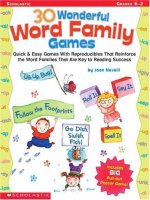
30 Wonderful Word Family Games pot
Bạn đang xem bản rút gọn của tài liệu. Xem và tải ngay bản đầy đủ của tài liệu tại đây (11.26 MB, 51 trang )
0
3
00
33
Wonderful
Word Family
Games
by Joan Novelli
NEW YORK • TORONTO • LONDON • AUCKLAND • SYDNEY
MEXICO CITY • NEW DELHI • HONG KONG • BUENOS AIRES
SCHOLASTIC
B
P
ROFESSIONAL OOKS
30 Wonderful Word Family Games © Joan Novelli, Scholastic Teaching Resources
Scholastic Inc. grants teachers permission to photocopy the reproducible activity pages from this book for classroom use.
No other part of this publication may be reproduced in whole or in part, or stored in a retrieval system, or transmitted in any
form or by any means, electronic, mechanical, photocopying, recording, or otherwise, without written permission of the pub-
lisher. For information regarding permission, write to Scholastic Inc., 557 Broadway, New York, NY 10012.
Cover design by Norma Ortiz
Interior design by Solutions by Design, Inc.
Interior art by James Graham Hale except pages 45-48 by Kathy Couri
Poster artwork by Kathy Couri
ISBN: 0-439-20153-5
Copyright © 2002 by Joan Novelli.
Published by Scholastic Inc.
All rights reserved. Printed in the U.S.A.
1 2 3 4 5 6 7 8 9 10 40 09 07 06 05 04 03 02 01
For my young word lover, Dylan
30 Wonderful Word Family Games © Joan Novelli, Scholastic Teaching Resources
Contents
About This Book 4
Sample Word Family Lists 7
Games
Good-Morning Game 9
Beach-Ball Word Builders 9
Ug, Ug, Bug! 10
Whispering Words 11
Rhyming Freeze 11
The Hot Spot 12
Follow the Footprints 13
Add-a-Word Beanbag Toss 13
Shake a Sound 14
Roll It, Say It, Spell It 15
Guess the Missing Letters 15
Roll-a-Rhyme 16
Fishing for Words 16
Go Dish, Swish, Fish! 17
Ring Around Words 18
“Did You Ever See?” Silly Sentences 19
How Many in a Minute? 20
Musical Words 20
Ringo! 21
Move and Make Words 22
Back to the Beehive 23
How Many Words Can We Make? 23
Rhyming-Word Relay Race 24
I’m Taking a Trip 24
Find-the-Rhyme Basketball 25
Cleanup Spelling 26
Silly Sentence Scramble 27
Rhyming-Word Dominoes 27
Same-Sounds Scavenger Hunt 28
Snaking Sounds 28
Rhyming Red Rover 29
Teaching With the Poster:
Read-Around-the-Town Rhyming Game 30
Reproducible Activity Pages 31
. . . . . . . . . . . . . . . . . . . . . .
30 Wonderful Word Family Games © Joan Novelli, Scholastic Teaching Resources
About This Book
Nursery rhymes like this are easily picked up by many young
children, who take great pride in being able to recite these tiny
stories in their entirety. What nursery rhymes have in common, of
course, is predictable text—in this case, words that rhyme.
Children pick up on the repeated sounds of rhyming words and
more easily remember them.
Rhyming words often (though not always) contain the same
word family—a spelling pattern that stands for a sound. In “Jack
and Jill,” the words Jill and hill are part of the same word family
(-ill), as are down and crown (diphthong /ou/). Teaching
phonograms or word families as part of a reading program gives
children tools for quickly and efficiently decoding many words—
building success into early experiences with print.
This book is full of games you can use with your students to
teach any word families. (A starter list of word families and words
appears on pages 7 and 8.) W
ord families are by nature playful,
making games the perfect approach for teaching them. By
presenting this area of instruction in a playful way
, you can
reinforce the idea that learning to read can be full of fun. Some of
the games, such as Ug, Ug, Bug! (see page 10), reinforce word
families through twists on traditional games. Other games, such as
Back to the Beehive (see page 23), come with reproducible activity
sheets for reinforcing the skill. There are quiet games, such as
Shake a Sound (see page 14), that children can play at their desks
independently or with partners, and more active group games, such
as Beach-Ball Word Builders (see page 9). The assortment of games
makes it easy for you to vary the way students learn about word
families, keeping their interest high as they strengthen reading
skills.
4
Jack and Jill went up the hill
to fetch a pail of water.
Jack fell down and broke his crown…
30 Wonderful Word Family Games © Joan Novelli, Scholastic Teaching Resources
Three Reasons to Teach With Word Families
Children learn lots of words quickly.
Children with fairly good alphabet recognition skills can
recognize consonants and the sounds they represent. These
children can then easily learn a phonogram and apply the
sound those letters make to read and spell new words. For
example, a child who knows consonant sounds and the
sound that the phonogram -at makes can read and write a
good number of words, such as bat, cat, sat, mat, hat, pat,
rat, and that. Imagine the number of words a child can learn
to read and write with just a few phonograms! That list
grows quickly with every new phonogram taught.
Word families can help children access more
complicated phonics concepts.
Learning a phonogram sometimes makes more sense than
learning the sounds that individual letters make. For
example, in the word car, the letters a and r form the
phonogram -ar. Knowing this, children can go on to
recognize the words far, jar, star, and so on. This approach
is more accessible to children than, for example, teaching r-
controlled vowels.
Word families lend themselves to playful learning
experiences that stick with children.
Teaching with phonograms encourages playfulness with
language. Rhyming words are fun to say and are predictable,
making it easy for most children to latch onto the strategy
and build reading fluency
.
33
33
22
22
11
11
5
Sample Word
Family Lists
Sample word family
lists appear on pages
7 and 8. These word
families include
phonograms from
which the greatest
number of primary-
grade words can be
generated. For a more
complete list of word
families, see Phonics
Fr
om A to Z, by W
iley
Blevins (Scholastic
Professional Books,
1998).
Teaching phonograms
helps strengthen spelling
skills, too. Phonograms
have highly reliable
spelling patterns. For
example, children can
confidently use the
letters a, c, and k in that
or
der to spell wor
ds,
such as Jack, that have
the –ack sound. The
same idea applies to
other phonograms
children lear
n.
Phonograms and Rimes
A phonogram, the letters in a word family that stand for a
sound, may also be referred to as a rime. The word rime is
often used in conjunction with the word onset. Onset and
rime refer to the two parts of a syllable. The onset is the
consonant, consonant blend, or digraph that comes first. The
rime is the vowel and everything that comes after
. In the one-
syllable word truck, the letters tr are the onset and the letters
uck are the rime. In the two-syllable word window, ther
e are
two onsets (w, d ) and two rimes (in, ow). Some wor
ds—for
example, at—have no onset. (The letters at are the rime.)
30 Wonderful Word Family Games © Joan Novelli, Scholastic Teaching Resources
To Learn More
The Great Big Book of Fun Phonics Activities, by Claire Daniel,
Deborah Eaton, and Carole Osterink (Scholastic Professional
Books, 1999). Use this jumbo collection of easy activities,
games, skill pages, and more to build early reading skills.
Mother Goose Phonics, by Deborah Schecter (Scholastic
Professional Books, 1999). Activities, games, manipulatives, and
learning center ideas for using favorite nursery rhymes to teach
phonics skills.
Phonics From A to Z, by W
iley Blevins (Scholastic Professional
Books, 1998). Pages 120 to 132 of this guide contain lists of
phonograms, including short vowel, long vowel, variant vowel,
and diphthong phonograms.
Phonics Games Kids Can’t Resist, by Michelle K. Ramsey
(Scholastic Professional Books, 1999). Easy-to-make-and-play
games reinforce a range of phonics skills and are adaptable for
both individual and group learning.
Phonics Make-and-Take Manipulatives, by Joan Novelli
(Scholastic Professional Books, 1999). Reinforce word families
and other phonics skills with reproducible mini-puzzles, word
wheels, and more.
Word Family Wheels, by Liza Charlesworth (Scholastic
Professional Books, 2000). These reproducible manipulative
wheels help children master phonograms and strengthen
reading skills.
6
30 Wonderful Word Family Games © Joan Novelli, Scholastic Teaching Resources
Sample Word Family Lists
SHORT VOWELS
7
Short-a Phonograms
-ack back, hack, Jack, lack, quack,
rack, sack, tack, black, clack,
crack, knack, shack, slack,
smack, stack, track, whack
-an ban, can, Dan, fan, man, pan,
ran, tan, van, bran, clan, plan,
scan, span, than
-ank bank, Hank, rank, sank, thank,
tank, blank, clank, crank, drank,
Frank, plank, prank
-ap cap, gap, lap, map, nap, rap,
sap, tap, chap, clap, scrap,
slap, snap, strap, trap, wrap
-ash back, cash, dash, gash, hash,
mash, rash, sash, clash, flash,
smash, trash
-at bat, cat, fat, gnat, hat, mat,
pat, rat, sat, vat, brat, chat, flat,
scat, slat, spat, that
Short-e phonograms
-ell bell, cell, fell, jell, Nell, sell, tell,
well, yell, shell, smell, spell, swell
-est best, jest, nest, pest, rest, test,
vest, west, zest, chest, crest,
quest
Short-o Phonograms
-ock dock, knock, lock, rock, sock,
block, clock, crock, flock, shock,
smock, stock
-op bop, cop, hop, mop, pop, top,
chop, cr
op, dr
op, flop, plop,
prop, shop, slop, stop
Short-i Phonograms
-ick Dick, kick, lick, Nick, pick, quick,
Rick, sick, tick, wick, brick, chick,
click, flick, slick, stick, thick, trick,
wick
-ill ill, bill, dill, fill, gill, hill, Jill, kill, mill,
pill, quill, sill, will, chill, drill, grill,
skill, spill, still, thrill
-in bin, fin, kin, pin, tin, win, chin,
grin, shin, skin, spin, thin, twin
-ing bing, ding, king, ping, ring, sing,
wing, zing, bring, cling, fling,
sling, spring, sting, string, swing,
thing, wring
-ink kink, link, mink, pink, rink, sink,
wink, blink, clink, drink, shrink,
slink, stink, think
-ip dip, hip, lip, nip, rip, sip, tip, zip,
blip, chip, clip, drip, fli
p
, grip,
ship, skip, slip, snip, strip, trip,
whip
Short-u Phonograms
-uck buck, duck, luck, muck, puck,
suck, tuck, Chuck, cluck, pluck,
stuck, struck, truck
-ug bug, dug, hug, jug, lug, mug,
pug, rug, tug, chug, drug, plug,
shrug, slug, smug, snug
-ump bump, dump, hump, jump,
lump, pump, chump, clump,
grump, plump, slump, stump,
thump
-unk bunk, dunk, junk, sunk, chunk,
plunk, shrunk, skunk, slunk, spunk,
stunk, trunk
30 Wonderful Word Family Games © Joan Novelli, Scholastic Teaching Resources
Sample Word Family Lists
LONG VOWELS
8
Long-a Phonograms
-ail bail, fail, Gail, hail, jai,l mail,
pail, quail, rail, sail, tail, wail,
fl
ail, frail, snail, trail
-ake bake, cake, fake, Jake, lake,
make, quake, rake, sake, take,
wake, brake, flake, shake,
snake, stake
-ale bale, Dale, gale, male, pale,
sale, tale, scale, stale, whale
-ame came, fame, game, lame,
name, same, tame, blame,
flame, frame, shame
-ate date, fate, gate, hate, Kate,
late, mate, rate, crate, grate,
plate, skate, state
-ay bay, day, gay, hay, jay, lay,
may, pay, ray, say, way, clay,
gray, play, spray, stay, stray,
sway, tray
Long-e Phonograms
-eat eat, beat, feat, heat, meat,
neat, peat, seat, bleat, cheat,
cleat, pleat, tr
eat, wheat
Long-o Phonograms
-oke joke, poke, woke, yoke, broke,
choke, smoke, spoke, stroke
Long-i Phonograms
-ice dice, lice, mice, nice, rice,
price, slice, splice, twice
-ide hide, ride, side, tide, wide,
bride, glide, pride, slide, snide,
stride
-ight fight, knight, light, might, night,
right, sight, tight, bright, flight,
fright, plight, slight
Variant Vowel Phonograms
-aw gnaw, jaw, law, paw, raw, saw,
claw, draw, flaw, straw
-ir fir, sir, stir, whir
30 Wonderful Word Family Games © Joan Novelli, Scholastic Teaching Resources
Good-Morning Game
Start the day with a game that lets students take
time to visit a bit while building awareness of word
patterns.
Make sets of cards on which you’ve written words that
contain phonograms you are teaching. Use cards in fun
shapes, such as stars or flowers, to add appeal.
Place a card in each child’s cubby before the start of
school. As children arrive, have them check their cubbies
for their cards. Have them tape the cards to their shirts (or you
may string them from yarn to make necklaces before putting
them in cubbies) and then mingle with their classmates, saying
“Good Morning” as they look for classmates with matching
word family cards.
Beach-Ball Word Builders
Bring out a beach ball for a game your students
will want to play again and again!
Cut pieces of masking tape and place them on the stripes
of a beach ball. Write a phonogram on each piece of
tape—for example, /ig/, /at/, /ock/, /ack/, /unk/, /ip/, and /est/.
Gather children in a circle and toss the ball to one child.
Have the child who catches the ball choose the
phonogram on the stripe
under one of his or her
hands and say a word that
contains that word
family—for example, if the
child’s hand is on /unk/, he
or she can say skunk.
That child then
tosses the ball to
another child, who repeats
the procedure. Continue
until everyone has had a turn.
33
33
22
22
11
11
22
22
11
11
9
You can easily vary this
game to keep it fresh
and fun. Reinforce a
single phonogram by
writing words from one
word family on the
tape. Have children
read the words on the
stripes under their
hands and then toss
the ball to the next
player. Or play Hot
Potato. Have children
say the word or words
as quickly as possible
and then toss the ball
to the next person. You
may time students to
see how quickly they
can read the words
and toss the ball
around the entire
circle.
30 Wonderful Word Family Games © Joan Novelli, Scholastic Teaching Resources
Ug, Ug, Bug!
Put a twist on the favorite game of Duck, Duck,
Goose to reinforce children’s understanding of any
word family you want to teach.
Start by gathering children in a circle. Introduce a word
family, such as /ug/. Let children suggest words that
rhyme with ug—for example, bug, dug, jug, and rug.
Explain that you are going to go around the circle and tap
children gently on the head or shoulder as you say “Ug,
ug, ug.” When you tap a child and say a word with the /ug/
sound, that child gets up and chases you around the circle, in
the manner of Duck, Duck, Goose, trying to tag you before you
sit in that child’s space.
Once children understand the game, play a round using
the phonogram and word you used to introduce the game.
If you get to the child’
s space before he or she catches
you, take that child’
s place in the circle. Then have that
child go around the circle, tapping children and saying “Ug, ug,
ug,” finally saying a word in the /ug/ word family and then
repeating the chase around the circle.
If the child catches you first, that child sits back down
and you repeat the circle procedure.
Repeat the game, using the same phonogram or
introducing a new one. Children will enjoy the movement
aspect and will listen carefully as they wait for you (or a
classmate) to say the word that lets the chase begin.
66
66
55
55
44
44
33
33
22
22
11
11
10
30 Wonderful Word Family Games © Joan Novelli, Scholastic Teaching Resources
Whispering Words
Children strengthen listening skills as they tune in to
similar sounds in this quiet game.
Write word family pairs on index cards, one word per
card. Make sure there is a card for each child and that
each child will have a match.
Have children sit at their desks or tables and put their
heads down and hands out. Go around the room, placing a
card in each child’s hand. When everyone has a card, have
children look at their words then hold them facedown so that
nobody can see their words.
Ask children to stand up and move about the room,
whispering their words and listening for a child who is
whispering a word that rhymes.
When children find their word partners, have them sit
together. Play until everyone finds a match. Let children
share their words (whispering them, of course), then let others
add additional rhyming words that contain that phonogram.
Rhyming Freeze
Children listen for different word families in this
fun-filled movement game.
Gather children in an open area. Invite them to run
around as you shout out words that belong to the same
word family. When they hear a word that doesn’t belong, they
should “freeze.” Children who don’t freeze sit down.
Play until one child is left. This child can then take a turn
calling out words. Continue, using a different word family
each time.
22
22
11
11
44
44
33
33
22
22
11
11
11
30 Wonderful Word Family Games © Joan Novelli, Scholastic Teaching Resources
The Hot Spot
In this variation on musical chairs, players try to stay
off the “hot spot” by listening to rhyming words.
To start, choose three phonograms to focus on. Write
words that belong to these word families on index cards,
one word per card. Shuffle the cards and give one to each child.
Gather children in a circle. Cut out a large circle and tape
it in the center of the circle. Label the circle, “Hot Spot.”
Stand in the center of the hot spot. Explain to students
that you are the caller. You are going to say rhyming
words, for example, spot, hot, pot, and cot. Children should
listen to see whether the words you are saying rhyme with the
word on their card. When they hear a word that doesn’t belong
in their word family—for example, fish—they step outside the
circle and then go quickly around the circle to find and take an
empty spot.
At the same time children are moving to a new spot on
the circle, you should take one of their places. The child
who does not get a space on the circle now goes to the hot spot
and becomes the caller.
The new caller chooses one of
the target words and starts
calling out rhyming words, for
example, cat, hat, pat, and sat. Again,
when the caller says a word that
doesn’t rhyme, for example, hop,
children who have words in the target
word family step outside the circle
and go around the circle to find an
empty spot. (The caller also needs to
quickly take a spot on the circle.) The
player who ends up without a space
goes to the hot spot and the game
continues.
55
55
44
44
33
33
22
22
11
11
12
To keep the game
fresh, have children
trade cards after a few
rounds. Keep extra sets
of word cards on hand
so that you can easily
incorporate new
phonograms.
30 Wonderful Word Family Games © Joan Novelli, Scholastic Teaching Resources
Follow the Footprints
Children strengthen word recognition skills as
they hop from one end of a giant footprint path to
the other.
Cut out a large foot shape. Use it to trace and cut out
enough to stretch from one end of the room to the other.
Tape the footprints securely to the floor, spacing them to
allow children to hop from one to another.
Write a word on each footprint.
Include words from several word
families. Alternate words so that the words
from any one family are mixed in with
words from the other word families.
Write additional words from the same
word families on smaller footprint
shapes. Place them in a basket or box.
To play, have children take turns
selecting a word from the basket and
then hopping on all the footprints that
rhyme with that word.
Add-a-Word Beanbag Toss
Gather children in a circle for this fast-paced word
family game.
Think of a word family you want to teach—for example,
/ack/. While holding a beanbag (or some other soft object
to toss), call out a word in that family, such as quack. T
oss the
beanbag to a child and have that child say another word in that
family, such as stack.
Continue having children toss the beanbag to each other
and say new words. Play until each child has had a turn. If
you have more students than there are words, start a new game
with a new phonogram. Encourage children to toss the beanbag
to someone who hasn’
t had a turn.
22
22
11
11
55
55
44
44
33
33
22
22
11
11
13
Keep extra footprints
handy. When you
introduce a new
phonogram, replace
some of the footprints
on the floor with fresh
footprints (and new
words).
Make a beanbag by
filling a zipper-lock
sandwich bag with
dried beans. Close
securely and toss!
30 Wonderful Word Family Games © Joan Novelli, Scholastic Teaching Resources
Shake a Sound
Turn egg cartons into quick-and-easy game boards,
to strengthen word recognition and spelling skills.
Start by writing a phonogram in each space of an empty
cardboard egg carton. Prepare several egg cartons with
different groups of phonograms, and let children play with
partners.
Give each pair of children an egg carton, a penny, and a
sheet of paper and a pencil.
Have players take turns placing the penny in the egg
carton, closing the lid, and shaking the container. The
player then opens the lid, removes the penny from the space,
and says a word that contains the letter cluster shown. For
example, if the penny lands on /ock/, the child might say clock.
Have children record the words they make. Players can
vary the game by guessing how many turns it will take to
have the penny land at least once in every space. Or, after so
many turns, players can sort their words by phonograms to see
how many of each they have.
44
44
33
33
22
22
11
11
14
30 Wonderful Word Family Games © Joan Novelli, Scholastic Teaching Resources
Roll It, Say It, Spell It
In this easy-to-make
game, children use
phonograms to build
words.
Give each child a copy of the letter cube pattern on page
31. Guide students in following the directions (see right)
to make the letter cubes.
Have children roll their cubes, say the sound, then add a
letter or letters to make a word. For example, if a child
rolls an /ig/, she might say big. If a child rolls an /at/, he might
say bat.
Copy the blank cube template on page 32 to make new
word-building cubes. W
rite a different phonogram on
each side of the cube. Copy for students to assemble.
Guess the Missing Letters
This game challenges children to find one phonogram
that will complete all the words in a set.
Give children the following word frames:
b __ __ f l __ __ t __ __ w __ __
Ask: “What two letters can you add to each of the words
here to complete them?” (Remind students that the same
letters have to work for each word.) Invite students to share
their answers and tell the words they made. (One answer is -ag.)
Let children make their own versions of the game to share
with classmates. Review them first to make sure they
work, then compile them and make copies for students to try
.
33
33
22
22
11
11
33
33
22
22
11
11
15
Let children take home
their letter cubes.
Invite families to play
together, recording
words they make.
Have children bring
their lists to school to
share. How many
different words for
each word family did
they make?
To simplify the game,
write several
phonogram choices
on the chalkboard.
Children can find the
right one to fill in the
words.
30 Wonderful Word Family Games © Joan Novelli, Scholastic Teaching Resources
Roll-a-Rhyme
A ball is all you need for this simple rhyming game.
Have children sit in a circle. Roll a ball to one child, saying
a word that contains a phonogram you want to reinforce.
Have the child who gets the ball say a word in the same
family and then roll the ball to another classmate. That
child says a new word that contains the same phonogram and
rolls the ball to a new child.
The game continues until you’ve exhausted words with
that phonogram or everyone has had a turn.
Start again with a new word family. Try playing with
word families that correspond to children’s names in the
class—for example, Jill.
Fishing for Words
Stock a “pond” with “fish” and let children go fishing
for words!
To make the pond, use a small wading pool. Or decorate a
big cardboard box with blue paper.
Make multiple copies of the fish on page 33. Write a word
from target word families on each fish. Then have
children color in the fish and cut them out.
Attach a paper clip to each fish and
place it in the pond. Make a fishing
pole by tying string to a dowel. Tie a magnet
to the end of the string.
Let children use the fishing pole to
catch fish, touching the magnet at the
end of the string to the paper clip on a fish.
Post chart paper next to the pond. Let
children record the words they “catch”
(grouping them by word families) and then
add other words with the same phonogram.
55
55
44
44
33
33
22
22
11
11
44
44
33
33
22
22
11
11
16
30 Wonderful Word Family Games © Joan Novelli, Scholastic Teaching Resources
Go Dish, Swish, Fish!
This version of the card game Go Fish lets children
make matches by collecting rhyming words.
Make multiple copies of the cards on page 33. Write one
word on each card, making sure that each card has two
word family matches. (See sample rhyming word pairs, below.)
Let children play in groups of two to four.
Guide children in following these steps to play.
Deal seven cards to each player. Place remaining
cards facedown in the middle.
Have children take turns asking another player for a
card by saying “Do you have a card that rhymes with
[word]?” If the child asked has the card, he or she
gives it to the other child, who then places the
matching cards faceup on the table and reads them
aloud.
Another player with a card that matches this word
family may add his or her card to the set.
If the child does not have the card in question, he or
she says “Go Fish” and the player selects a card from
the deck.
Play continues until children match all of their cards.
22
22
11
11
17
Make extra sets of the
game cards and place
them in zipper-lock
sandwich bags. Let
children take turns
taking the games
home to play with
their families.
Go Fish Word List
Sample rhyming word pairs for
Go Fish follow:
Long-a: cake, lake; face, race
Long-e: bee, tree; feet, meet
Long-i: bike, hike; mice, nice
Long-o:
rose, nose; no, go
Short-a: bat, cat; cap, nap
Short-e: jet, pet; bell, tell
Short-i: pig, big; fish, dish
Short-o: hop, pop; r
ock, sock
Short-u: cup, pup; sun, fun
30 Wonderful Word Family Games © Joan Novelli, Scholastic Teaching Resources
Ring Around Words
This arcadelike game will help children reinforce
spelling and reading skills.
Fill five to ten large plastic soda bottles with water and
cap tightly. (Add a few drops of food coloring to each, if
desired.) Tape a label on each bottle. On each label write a word
that represents a phonogram you’re teaching. Underline the
phonogram. Assign each bottle a number of points and write
that number beneath the word.
Arrange the bottles in an open area, placing the bottle
worth the most points farthest away from a line on which
children will stand to play. Gather several large rubber rings for
children to toss around the bottles. Copy the score sheet on
page 34 for each student.
To play, have children follow these steps.
Stand on the tape. Toss a ring around a bottle.
If you ring a bottle, say a word that is part of the
same word family. On your score sheet, record the
word under “Ring Around. . . .” Write your new word
under “My New Word.” Write the number of points
you got for that bottle under “Points.”
Toss the rest of your rings. Record your new words
and points. Add up the total number of points. Play
again. Can you beat your score?
33
33
22
22
11
11
18
To vary the game, play
a cooperative version.
Have children combine
their points and
calculate the total. Let
them play again and
try to beat the class
score.
30 Wonderful Word Family Games © Joan Novelli, Scholastic Teaching Resources
“Did You Ever See?”
Silly Sentences
Turn a favorite Raffi song into a game that will bring
out the giggles in your classroom!
Sing the Raffi song “Down by the Bay” together. The
song is available on the CD Singable Songs for the Very
Young and in the book Down by the Bay: Raffi Songs to Read
(Crown, 1999). Keep the rhyming fun going by using the
repeating pattern in the song to play a rhyming game.
Share the following sentence starter with students: “Did
you ever see a king sitting on a _
_
____ ?” Ask students to
complete the sentence with a word that rhymes with king—for
example, swing.
Now try this sentence starter: “Did you ever see a bat
_________?” Let children complete the sentence any way
they like, as long as the last word rhymes with bat—for
example, Did you ever see a bat wearing a hat?
Once your students are comfortable with the procedure,
share a new sentence starter that ends in a word that is
easily rhymed. Let a volunteer complete the sentence as before.
This child can then suggest a new sentence starter and choose a
child to complete it. Play until you run out of ideas or time!
44
44
33
33
22
22
11
11
19
Children will have fun
thinking of their own silly
sentence starters. But if
you’d like to write some
on chart paper just in
case, suggestions follow.
Did you ever see a
dog…
Did you ever see Jake
(or Jill or Kim…)…
Did you ever see a
clam…
Did you ever see a
sock…
Did you ever see a
bug…
30 Wonderful Word Family Games © Joan Novelli, Scholastic Teaching Resources
How Many in a Minute?
Children try to beat the clock when they play this
word-building game.
Copy the phonogram cards on page 35 and the letter
cards on page 36. (Use the blank cards to program other
phonograms and word beginnings you wish to teach.) Give each
child a set. Have children cut apart the cards.
Demonstrate how to form a word by placing a letter card
and phonogram card together, as shown.
Tell children that you will time them for one minute while
they build words with the letter and phonogram cards. They
then build as many words as they can without reusing the letters.
When the minute is up, have children take turns reading
aloud the words they made. Record them on chart paper,
leaving out duplications. Count the words together. Play again
and try to beat the class total.
Musical Words
This game will have children singing along as they
learn about letter sounds and spellings.
Set up the game by writing on paper plates words that
belong to target phonograms, one per plate. Make as many
plates as there are children. On a slip of paper, write a word that
belongs to each word family. Place these words in a bag.
Arrange the plates in a large circle and ask
each child to stand by one (on the outside).
Start the music and ask children to skip or walk
around the circle. Stop the music and have children
stand still in front of the nearest plate.
Pull a word out of the bag, then say it and
show it. Have the child standing in front of the
plate that has a matching phonogram read his or her
word. Continue until each child has a chance to read
a matching word.
33
33
22
22
11
11
44
44
33
33
22
22
11
11
20
30 Wonderful Word Family Games © Joan Novelli, Scholastic Teaching Resources
Ringo!
Help children recognize word parts and patterns with
Ringo!, a rhyming word version of Bingo.
Make a class set of the blank Ringo! board on page 37. On
the chalkboard, write 30 words that represent different
word families. (See sample list below.)
Have children write one word in each square. They can
write the words in any order, not necessarily the order in
which they appear on the chalkboard. Tell students that they
can use any of the words but that they will not use all of them.
(This will result in each child having a different Ringo! board.)
For each word on the chalkboard, write a word on a slip
of paper that belongs to the same word family. Place the
papers in a bag.
To play, select one word at a time and read it aloud. Have
children find a word on their boards that has the same
phonogram. For example, if you say the word hop, a child might
find the word stop. Have children place markers on squares that
contain the same phonograms as the words you read.
Play until someone gets five across, down, or diagonally
.
Continue playing to allow more children to get “Ringo!”
55
55
44
44
33
33
22
22
11
11
21
Ringo! Word List
Use one word in each pair for the Ringo! board list. Write
the remaining word on a slip of paper to be read aloud.
mash, dash
bug, tug
hop, stop
fan, ran
pack, stack
cake, lake
game, name
tap, cap
cat, bat
gate, late
say, way
seat, neat
bell, tell
nest, rest
nice, rice
kick, stick
will, hill
fin, win
line, fine
sing, wing
sink, pink
zip, lip
stir, whir
clock, rock
joke, poke
more, store
dog, frog
duck, luck
bump, pump
dunk, chunk
RINGO!
37
N
ame
_______________________________________________________________________________________________________
D
ate
____________________________________
30 Wonderful Word Family Games Scholastic Professional Books
30 Wonderful Word Family Games © Joan Novelli, Scholastic Teaching Resources
Move and Make Words
In this cooperative game, children match up to form
new words.
On large squares of tagboard, write words that include
phonograms you’re teaching. For each word, write the
onset (first letter or blend) on one square and the phonogram on
a separate square. For example, write the letter f on one square
and the letters ish on another to spell fish. Make sure that there
is one square for each child. You may have more than one onset
card with the same letter
. (See samples, left.)
Pass out the squares, put on some music, and let children
roam around the room looking for children they can team
up with to build words.
When everyone has formed a word, let a volunteer from
each pair read the word. (Depending on how children get
together to form their words, some may end up without
partners. This is a good time to have children work
cooperatively
, rearranging themselves so that everyone is part
of a word.)
33
33
22
22
11
11
22
Move and
Make Words
Word Card Sets
f ish
bug
tr uck
sk unk
b ack
p ail
c ake
fan
b ank
bat
b ell
b est
n ice
p ick
h ide
p in
m ine
r ing
p ink
cl ock
j oke
pop
d uck
To simplify the activity,
pass out letter squares
for one word at a time.
For example, give
three children the
letters su and n. Ask
these children to
stand up and arrange
themselves to for
m a
wor
d. Have a volunteer
read the word aloud,
and then let others
suggest words in the
same word family.
30 Wonderful Word Family Games © Joan Novelli, Scholastic Teaching Resources
Back to the Beehive
In this word-building game, children help a bee find its hive.
Photocopy the game board and markers on pages 38 and 39.
Tape the board together as indicated. Color and laminate, if
desired.
Give each pair of children a game board and two markers.
Have children cut and place one marker each on S
TART.
To play, have children take turns tossing two pennies. If they
both land heads-up, the player moves one space. If they both
land tails-up, the player moves two spaces. If one lands heads-up
and the other tails-up, the player moves three spaces.
After moving the correct number of spaces, the player says
the sound represented by the phonogram on the space, then
makes it into a word by adding a letter or blend to the beginning.
For example, if a child lands on a space that says /ick/, he or she
says the sound those letters make, then calls out a word in that
family, such as chick. Let children play until both players reach
the beehive.
How Many Words Can We Make?
Children team up to build words, words, and more words!
Write a phonogram on tagboard squares, one letter per
square—for example, write the letter u on one square and
the letter n on another. Write consonants and blends on additional
squares.
Give the phonograms to children, one letter per child, and
have them stand in front of the room. Give each remaining
child a card with a consonant or blend on it.
Ask children to guess how many words they can make by
combining their cards with the letters in front (the phono-
gram). Have children take turns going to the front to combine
their letters with the phonogram. Record words they make.
Compare the total with the estimate. Did they make more
words than they expected?
44
44
33
33
22
22
11
11
44
44
33
33
22
22
11
11
23
30 Wonderful Word Family Games © Joan Novelli, Scholastic Teaching Resources
Rhyming-Word Relay Race
Children work in relay teams to generate rhyming
words as fast as they can.
Form groups of four to five students each for a relay race.
Divide the chalkboard into as many sections as there are
teams (or post chart paper for each team). Place masking tape
on the floor where you want each team to line up.
Have students line up and close their eyes. Explain that
you are going to write a word on the board for each team.
When you say “Go!” they should open their eyes and, one at a
time, go to the board and write a rhyming word under the team
word. Team members may help one another with words and
spelling.
Play until a set time is up (such as two minutes). Let a
volunteer from each team read aloud the words. (See
sample word sets, left.)
For more fun, give children additional relay race directions
to incorporate as they go to and from the chalkboard—for
example, “Hop on one foot to the chalkboard, write your word,
then turn around three times before heading back to your team.”
I’m Taking a Trip
Try this variation on an old favorite to reinforce
phonogram sounds.
Gather children in a circle. Start by saying “I’m going on a
trip and I’m taking a trunk.”
Have the child to your left repeat your sentence and add a
new word that has the same phonogram as your last word
(trunk)—for example, “I’m going on a trip and I’m taking a
trunk and a skunk.”
The next child continues—for example, “I’m going on a
trip and I’m taking a trunk, a skunk, and a bunk.”
Play until children run out of words. Then suggest a new
beginning and let children continue around the circle.
44
44
33
33
22
22
11
11
44
44
33
33
22
22
11
11
24
Rhyming-Word
Relay Race
For each team,
choose words
that are equally
easy to rhyme.
Sample word sets
(based on four
teams) follow.
Set 1: cab, can,
dad, bat
Set 2: jet, nest,
fell, bed
Set 3: hid, pin,
dip, sit
Set 4: cake,
name, day,
cave
30 Wonderful Word Family Games © Joan Novelli, Scholastic Teaching Resources