THE BALANCE SHEET POCKET BOOK phần 2 potx
Bạn đang xem bản rút gọn của tài liệu. Xem và tải ngay bản đầy đủ của tài liệu tại đây (83.58 KB, 10 trang )
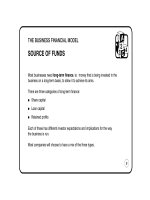
THE BUSINESS FINANCIAL MODEL
SOURCE OF FUNDS
Most businesses need long-term finance, ie: money that is being invested in the
business on a long-term basis, to allow it to achieve its aims.
There are three categories of long-term finance:
● Share capital
● Loan capital
● Retained profits
Each of these has different investor expectations and implications for the way
the business is run.
Most companies will choose to have a mix of the three types.
9
2
THE BUSINESS FINANCIAL MODEL
SOURCE OF FUNDS
SHARE CAPITAL
Definition:
Individuals or financial institutions provide capital by buying shares in the business.
They do this in anticipation of a return comprising:
- dividends
- growth
Dividends:
● Generally paid twice a year - an interim dividend based on the half-year
accounts - a final dividend dependent on the full year’s result
● No legal obligation for the company to pay a dividend
Growth:
● The investment increases in value, creating the opportunity to sell at a profit
10
2
THE BUSINESS FINANCIAL MODEL
SOURCE OF FUNDS
IMPLICATIONS OF SHARE CAPITAL
● The shareholders own the business, not the Chief Executive and Board of Directors
● Shareholder expectations, therefore, have to be treated with respect
● If the performance of the business does not meet shareholder expectations:
- some or all of the Board may be dismissed
- investors may sell their shares, leading to a fall in share prices, thus
- making the business vulnerable to being `taken over’
Note To acquire the business a predator has to buy the shares, not the land,
buildings, stock, etc. If the share price falls, the business becomes cheaper to buy.
11
2
THE BUSINESS FINANCIAL MODEL
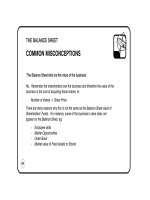
COMMON MISCONCEPTIONS
‘If the company’s share price rises it has more money. If it falls, it has less.’
Apart from when the company wishes to raise new share capital or is warding off a takeover
bid, the share price has no immediate impact on the business.
Example: Alex invests £1,000 in the shares of a new business.
The company receives £1,000 which it uses to buy stock and machinery. Alex receives
a piece of paper a Share Certificate.
When the company prospers, Bill offers to buy the shares for £1,200. Alex hands over
the piece of paper; Bill hands over the £1,200.
Alex has made a gain of £200. The company has no involvement in the transaction and
its finances are therefore unaffected. Similarly, if the share value falls and Bill decides to
sell, he will lose out but there will be no effect on the company accounts.
12
2
THE BUSINESS FINANCIAL MODEL
SOURCE OF FUNDS
LOAN CAPITAL
Definition:
Money on loan to the business which will have to be repaid
● The first thing any potential lender will want to see is the Business Plan
● Having satisfied himself that the proposed venture is viable, the lender will require
- interest on the loan
- eventual repayment of the loan itself
● The terms of the loan will be defined by a contractual agreement
13
2
THE BUSINESS FINANCIAL MODEL
SOURCE OF FUNDS
IMPLICATIONS OF LOAN CAPITAL
Borrowing money, ie: loan capital, entails financial risk
● The terms of the loan are defined by contractual agreement
● The business has to keep making the payments of Interest and Capital,
whether or not it is trading profitably
● The lender will require security or collateral (so that the loan can be recovered
if the borrower defaults)
14
2
THE BUSINESS FINANCIAL MODEL
SOURCE OF FUNDS
LOAN CAPITAL - EXAMPLE
Taking out a mortgage is a similar process to a business loan:
1 The lender considers the ‘business plan’
● The real value of the property
● How much you wish to borrow
● Your income and existing outgoings
2 The mortgage agreement defines the terms of the loan
3 As security, the lender retains the title deeds in case you default on your payments
15
2
THE BUSINESS FINANCIAL MODEL
SOURCE OF FUNDS
RETAINED PROFITS
Definition:
When a business makes ‘profits’ it has the opportunity to plough back some of the
money it has made to self-finance its future growth.
● Retained profit is money the business has made itself
● It is therefore the cheapest source of long-term finance avoiding:
- dividend payments
- interest payments
Hence the company financing a larger proportion of its business
with Retained Profits has a
C O M P E T I T I V E A D V A N T A G E
16
2
THE BUSINESS FINANCIAL MODEL
SOURCE OF FUNDS
SUMMARY
Summary of the categories of Long-term Finance:
17
2
SHARE CAPITAL LOAN CAPITAL
RETAINED PROFITS
EXPECTATIONS AND IMPLICATIONS
No Dividend
No Interest
Competitive advantage
Dividends
Growth
Ownership
Powers
Interest
Repayment
Collateral/Security
SOURCE OF FUNDS
THE BUSINESS FINANCIAL MODEL
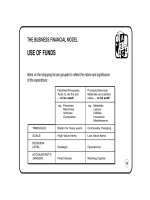
USE OF FUNDS
A business raises Long-term Funds in order
to spend it on things required
to run the business:
18
2