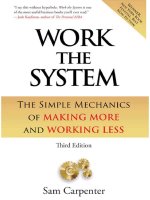
work the system the simple mechanics of making more and working less 3rd edit
Bạn đang xem bản rút gọn của tài liệu. Xem và tải ngay bản đầy đủ của tài liệu tại đây (1.31 MB, 331 trang )
PRAISE FOR THE SECOND EDITION OF
WORK THE SYSTEM
“The best management book of the year. Follow Sam’s path and your business will become
orderly, disciplined, repeatable, and profitable.”
—Thomas Cox, founder of Cox Business Consulting
“Work the System gives you the tools you need to take giant steps in adding value to your
business and freedom to your life.”
—Nancy Hagan, executive productivity coach, Effective Executive
“Instead of ‘follow your bliss and the money will appear’ Sam advocates, ‘fix the mechanics in
your life and business, and the bliss will appear’.”
—Rodney Sampson, Author, Kingonomics
“What Sam Carpenter teaches in Work the System will revolutionize your work and your life!”
—Michael Jans, president, Insurance Profit Systems
“Sam Carpenter brings together the practices of the biggest and best companies to help you
succeed in your small business.”
—Rich Sloan, co-founder of StartupNation.com
“This book is a reality check for small business owners and department managers who are
struggling.”
—Susan Solovic, CEO, SBTV.com
“I usually do not rave about books I read. One way I judge if a book is good is if I actually take
action as a result of reading it. I love this book and have taken action …”
—Jim Estill, CEO, Nu Horizons; author, Time LeadershipPublished by Greenleaf Book Group Press
Austin,Texas
www.gbgpress.com
Copyright ©2011 Sam Carpenter
All rights reserved.
No part of this book may be reproduced, stored in a retrieval system, or transmitted by any means,
electronic, mechanical, photocopying, recording, or otherwise, without written permis- sion from the
copyright holder.
Distributed by Greenleaf Book Group LLC
For ordering information or special discounts for bulk purchases, please contact Greenleaf Book
Group LLC at PO Box 91869, Austin, TX 78709, 512.891.6100.
Design by Greenleaf Book Group LLC
Cover design by Linda Carpenter and Greenleaf Book Group LLC
Ebook ISBN: 978-1-60832-052-3
Ebook Edition
To Linda, of course
One should choose the simplest explanation, the one requiring the fewest assumptions and
principles.
—WILLIAM OF OCKHAM, FOURTEENTH-CENTURY ENGLISH PHILOSOPHER
“People’s lives improve and humankind makes progress when we share our best ideas and
others can act on them. This overwhelms all the bad stuff”
—VINCE CERF, CO-INVENTOR OF THE INTERNET
CONTENTS
FOREWORD
PREFACE TO THE THIRD EDITION: Working the System of Work the System
PREFACE TO THE FIRST EDITION: It’s Just Mechanics
ACKNOWLEDGMENTS
INTRODUCTION: The Simplest Solution
PART ONE: The Systems Mindset
1. Control Is a Good Thing
2. Events Did Not Unfold as Anticipated
3. The Attack of the Moles
4. Gun-to-the-Head Enlightenment
5. Execution and Transformation: Creating the Machine
6. Systems Revealed, Systems Managed
7. Getting It
PART Two: Make It So: Critical Documentation
8. Swallowing the Horse Pill
9. We Are Project Engineers
10. Your Strategic Objective and General Operating Principles
11. Your Working Procedures
PART THREE: So Say We All: Further Considerations
12. Good Enough
13. Errors of Omission
14. Quiet Courage
15. Point-of-Sale Thinking
16. Extraordinary Systems Operated by Great People
17. Consistency and Cold Coffee
18. Communication: Grease for the Wheels
19. Prime Time
20. The Traffic Circles of Pakistan
21. System Improvement as a Way of Life
EPILOGUE
APPENDIX A: Centratel’s Strategic Objective
APPENDIX B: Centratel’s Thirty Principles
APPENDIX C: Sample Working Procedures
APPENDIX D: The Work the System Academy
APPENDIX E: Become a Work the System Consultant
APPENDIX F: Find a Consultant
APPENDIX G: Ockham’s Razor and the TSR
APPENDIX H: Centratel’s Procedure for Procedures
APPENDIX I: Centratel’s System for Communication
APPENDIX J: Business Documentation Software
APPENDIX K: Other Offerings
KASHMIR FAMILY AID
INDEX
FOREWORD
“If I had eight hours to cut down a tree, I’d spend six sharpening my axe.”
—ABRAHAM LINCOLN
I say this without hyperbole: Work the System is one of the most useful business books you’ll ever
read. I should know—I read business books for a living, and teach creative people from all over the
world how to build businesses that are profitable, enjoyable, and sustainable.
Here are the top three questions I’m asked every single day:
• “Starting a business seems so complicated. Where do I begin?”
• “I’m working a lot, but not making much money. How can I improve my profitability?”
• “I’m constantly stressed and anxious. How can I run my business without going crazy?”
The answer to these questions is always the same: learn how to work the system.
Fundamentally, every business is a system: a collection of processes that, together, reliably
produces an intended result. The more you focus on improving your business systems, the better
results you’ll produce. It’s as simple as that.
When most people hear the word “system,” however, their eyes glaze over. Most of us are trained
to think that standard operating procedures, checklists, documentation, and the like are boring and
bureaucratic.
Nothing could be further from the truth. Here’s what happens when you begin improving your
systems:
• You make more money, but do less work.
• You have more focus and energy to do your best work.
• You make far fewer errors and mistakes.
• You fix the mistakes you make quickly and permanently.
• You feel more calm, collected, and under control.
Solid business systems are largely a product of calm, rational, straightforward thinking. It’s a skill
that can be learned quickly, and a method that can be applied to improve every aspect of your life.
I use the ideas in Work the System every day when building my own business, and I’ve
recommended this book to my readers and clients since the publication of the first edition.
I’m glad this book has found its way into your hands. Work the System will help you make better
decisions, get more done, and have more fun along the way.
—Josh Kaufman, author of The Personal MBA
PREFACE TO THE THIRD EDITION
Working the System of Work the System
This book is different.
Its main thrust goes beyond providing new information, although it does that. The root purpose of
Work the System is to guide you to a new way of perceiving your life so you can gain better command
of it and therefore be better able to get what you want. I like to call this mini-awakening getting it,
and I describe what it is and how to achieve it in part one.
I changed my life after a moment of insight, moving from a nightmarish, impoverished existence to
a life of peace and prosperity. I now work two hours a week instead of eighty. Yes, I’m wealthy now,
too: 100 percent self-made. I’ve had the same small business for twenty-seven years, and this is the
story of how I transformed it from a chaotic ordeal into an ATM machine, pulling my staff upward
with me while delivering the highest quality of service available in my particular industry. How I
broke free, and how you can too, is described in detail. This is not theory; it’s fact, and believe me, if
I can do it, so can you! Careerwise, you may have to do something different than what you do now in
order to reach your goals of freedom and prosperity, but probably not. People who follow my strategy
become hyperefficient, and most of them keep doing what they have been doing all along, as they
finally leave the competition in the dust or suddenly streak up the corporate ladder. There are no
gimmicks or mysterious theories here. No Six Sigma-type complexities. No hype. No BS. What I
discuss, including the getting-it insight you will experience, will make perfect sense.
Sound interesting? The broad, nutshell premise?
There are an infinite number of puzzle pieces out there, and for each of us to get what we want in
our lives, it’s just a matter of seeing those pieces, making a proper selection, and then assembling
them in a way that produces the results we desire. And no, in focusing on the mechanical, you won’t
lose your humanity.
Work the System is not rah-rah, pumping you up but offering nowhere to go. After you achieve the
systems mindset perspective, I carefully explain the mechanical steps you can take in order to create
prosperity and peace in your life (in parts two and three). There’s more beyond the book, too. I’ll talk
about that in a minute.
Despite the sly title, there is nothing sinister in these pages, and there’s nothing that won’t seem
logical. It’s a simple message presented in a thorough way: contrary to popular opinion, the workings
of the world make perfect sense. There is an inherent order that is stunningly evident if one drops
preconceived notions and quietly observes life-as-it-is. By internalizing this new insight—by going
one layer deeper—it’s an easy matter to arrange things in order to “get what one wants.”
The added bonus: speculative, menu-driven presumptions about work, business, politics, health,
and relationships drop away to be replaced by commonsense, gut-certanties.
The most satisfying outcome is that life-theory and hard reality become congruent. This means one
is no longer swayed by peers, public opinion, what feels good, or moment-to-moment expediency.
Addressing raw reality head-on, one confidently makes up one’s own mind about things and then
consistently applies that certainty to the real world—and it works. It works because reality operates
in the same way everywhere, all the time.
It’s been three years since I first released Work the System, and at the time I hoped it would help
readers get better control of their businesses and their lives. At the risk of braggadocio, that has
happened. More on this soon, too.
I’ll say this here at the beginning: each of us has a mechanical aspect and an emotional aspect, and
contrary to a boatload of pop-psychology books, tapes, videos, etc., I say it’s a good thing to separate
the two. If we don’t, things get muddied and neither aspect turns out so well. And I take issue with the
presumption that the road to freedom and rosperity begins with the elimination of personal emotional
hang-ups. Work the System is about straightening out the mechanics of a life first: get the machine
right, and emotional improvement will tag along naturally. Can one have emotional hang-ups together
with wealth and freedom? Of course. We all know people like that. But hang-ups or not, obtaining
wealth and freedom will go a long way toward making life better.
Yes, you can flip a switch and your life can become what you want it to be. This is because the
switch is located in your head and therefore is readily accessible.
I’ve found that not everyone is interested in making more and working less. Some people want to
make more while working the same amount of time or to just become more efficient at work and at
home. It seems that a large number of readers simply want to feel more in control of their lives, to
have their worlds make more sense. Work the System serves all these purposes because it’s about
becoming more life-efficient.
I’ve had a number of readers ask why I don’t use the term lifestyle design, the phrase made popular
by Timothy Ferriss in his book The 4-Hour Workweek . The reason is simple: I don’t care for it.
Forgive my loose interpretation of proper English usage, but turning the word “life” into an adjective
for the noun “style” seems cosmetic. Should a life’s purpose be to achieve style? I’m a form-follows-
function kind of a guy, so it seems to me that if we have to give a label to the noble attempt to steer a
life into something better, why not call it life design and altogether toss out the word “style”?
Anyway, as of this edition, I haven’t read The 4-Hour Workweek, and I can only guess that the
prolific Mr. Ferriss hasn’t read Work the System.
Relative to the second edition, is there new material in the third edition? No, not a lot, and my
defense is that base reality doesn’t change over time. It can just be better explained, which is the
primary reason I assembled this third edition. I’ve made massive improvement in how it reads. There
are literally thousands of small enhancements. I want the reader to get it easier and faster. I am also
finding some serious self-satisfaction in producing a better quality representation of what I believe.
A central fact remains unchanged: 90 percent of people struggle. On the surface, it seems this is
because they don’t set direction, they don’t get organized, and they spend too much time on
trivialities. That’s true. Yet, when the mechanisims of life one layer deeper are seen, the root, casual
reason for the struggle becomes strikingly obvious. Nevertheless, because most of us spend our days
dealing with bad results, we don’t think about submerging to a deeper place to make adjustments
where the results are propagated. We humans just have a penchant for thrashing around on the surface,
complicating what isn’t complicated.
Since the second edition was published two years ago, how was I able to make a “massive
improvement”? For starters, after repeatedly delivering the concept to groups, individuals, and the
media, I’m able to explain it better. Practice makes perfect. Another reason is that I’ve lived these
concepts day and night for a couple more years now; I simply understand the principles better and, in
my head, have tied some loose ends together. Also, via reader feedback, I’ve witnessed the success
of the principles as I’ve seen them applied in a variety of situations, and this gives me a wider
perspective of how they work outside my own experience. And finally, after more than two years of
weekly posts on my website, I’m simply a better writer. (This means my older writing can sometimes
be a bit of an embarrassment to me. Ouch. To that end, if you have a hard copy of one of my previous
editions, softcover or hardcover, send it to me and I’ll send you a free copy of this latest edition.
There’s a very minimal charge for handling. Go to workthesystem.com/newbook for details. No, I
can’t do a book exchange for PDF or audio versions, and I may cease this offer at some time in the
future.)
I’ll go here at the risk of proselytizing: in group presentations as I begin to discuss my
nonholistic/mechanical take on life, there is always some initial head shaking from the follow-your-
bliss contingent (of which I used to be a member) who feel that they are called to rise above the
mechanical world in order to focus on the spiritual. They believe the spiritual pursuit is noble and
superior and shouldn’t be hampered by the restrictive job of dealing with petty issues in the here and
now. My response, which invariably gets them head nodding instead of head shaking, is that we are
all spiritual beings existing in a mechanical world. Until we learn to assertively steer the raw
mechanics of our lives, we cannot get to a place that gives us the freedom to pursue what is beyond
this concrete reality because we will always be pulled back into it out of sheer necessity. We must
get our physical world, with all its boring and base considerations, straightened out before it will
allow us to focus on anything beyond it. Yet, having said that, this beautifully orchestrated
mechanical existence that we experience from day to day can be perceived as a powerfully spiritual
place if we can stop judging it and simply see it for what it is. For Westerners especially, it’s a
reverse tack to use the mechanical to enter the spiritual. Give it a shot if the other sequence hasn’t met
your expectations.
And, back to the subject of producing a better-quality book: there is this system-improvement thing.
Work the System is about systems, and a book is a system in itself. It’s an enclosed entity, with a
multitude of spinning wheels, all contributing to the singular purpose of that entity, that is, to
accomplish a goal. And like our lives, a book is never perfect, and so there is always room for
betterment, for “system improvement.” Herein lies a problem within the publishing industry that I
have managed to circumvent. Read on.
I have an interesting contractual relationship with my publisher, Greenleaf Book Group. It’s
fundamentally different from 99.9 percent of author/publisher deals because I have been able to keep
the rights to my manuscript. I can tweak it to my own heart’s delight when I feel the need (of course,
all the while paying close attention to the recommendations of Greenleaf’s fine editors).
Normally, getting published means the author’s rights to the work are forfeited forever to the
publishing company. New authors, frantic to avoid permanent residence in the dustbin of the self-
published, sell their souls to traditional publishing companies. The consequence is that, for starters,
the original manuscript is handed over to an editor who, depending on competence, style, personality,
attitude, mood of the moment, degree of belief/interest in the subject matter, and experience (often
editors for firstbook authors are just out of college), will often render the originally submitted
manuscript unrecognizable. There is no recourse for the author. The editors have the final say on the
content of the published book and any subsequent renditions.
“Here,” says the new author to the publisher, “I want to be published so, yes, take my wife and do
what you want with her.”
And, beyond that profound abdication, good luck to the industrious scribe who wants to make
changes in his/her work later on and asks the publisher for another printing or, heaven forbid,
requests a new edition. There’s no going back to tweak the book without the publisher’s line-byline
approval, and 99 percent of the time that approval won’t be forthcoming.
So, because I wanted precise control over this master statement of what I believe, I sought an
alternative to the traditional publishing deal. I think you’ll find the following chronology of the book’s
development interesting for that reason, and for another: the history of Work the System is a perfect
illustration of the systems mindset that is the centerpiece of the book itself.
I self-published Work the System in the spring of 2008. This first printing was softcover. I had
spent two years and thousands of hours (really) getting the book right. It was the very, very best I
could do at the time. It was perfect, I thought, as the manuscript headed off to the printer, sans
publisher.
But when the boxes of new books arrived at our house six weeks later and I opened one, I gasped
at a horrible miscalculation: the cover was an embarrassing gaffe. How arrogant was this, as a first-
time author, to splash my photo across it? Then I opened a copy, and within seconds I blanched again
because it could have been said so much better. There were clumsy sentence structures, flat-out
grammatical errors, poor flows of thoughts, and way too much repetition. Nevertheless, disappointed,
I put the book out there because the message was solid. It sold pretty well, and a month later I could
see there would have to be another printing and this would give me the opportunity to make things
right.
Enthusiastically I went to work tweaking, working day and night to fix the deficiencies, including
getting rid of the cover photo. I hammered. The message was unchanged, but there was a lot to fix in
the delivery, and it was a satisfying exercise because I was certainly going to get it right with the
second self-published printing. This upgraded version would also be softcover, and I decided on a
plain white, glossy cover this time.
The shipment arrived. I opened a box with confidence that this would prove to be the penultimate,
perfect representation of what I believe about work and life. Whoops. For starters, my minimalist
cover was amateurish. And inside, I found that despite the countless additional grammatical and
sentence-structure revisions and the continued soundness of the message, it was still grammatically
and structurally butterfingered.
A few more months passed, Greenleaf Book Group accepted the book, we signed a deal, and
preparation for a second edition/third printing ensued. This time, with two first-class professional
editors via Greenleaf, the book’s contents were shuffled around and literally thousands of additional
grammatical and sentence structure enhancements were made. It would be hardcover this time, to be
delivered in the spring of 2009.
When the books arrived, I was disappointed again! The new cover was awesome, but the
experimental glossy cover material was too absorbent, instantly smudged by the fingerprints of
anyone who picked up the book. And, yes, so much inside could have been better said!
For the fourth printing six months later, again hardcover, we fixed the cover and made many more
internal enhancements. The books arrived and, sure enough, I was disappointed once more.
Arrghhh!
But what I haven’t said until now—and this is my key point in all of this, so pay attention here—is
that because of my serial disappointments and the resultant jillion improvements that I made because
of those disappointments, the book’s quality had improved enormously. Despite my nitpicky self-
recriminations, I had to admit, the second printing of the second edition wasn’t half bad, due to the
incessant system-improvement gyrations of the previous three versions.
And yet, for the reasons I previously mentioned, this third edition/fifth printing has thousands of
additional refinements in the copy, and my Greenleaf editors have again come in behind me to smooth
things out even further.
As mentioned earlier, from the first edition through this third edition, the message itself is virtually
unchanged. It’s the delivery that’s improved.
As I look back, it’s clear to me that I should have known the book would never be what I wanted it
to be the first time, or even the second, third, or fourth time. I knew better!
In any case, I’ve had the unique opportunity as a first-time author to repeatedly tweak my book
through five printings, controlling the content completely while paying close attention to the advice of
the top-notch Greenleaf editors and designers who have assisted me. The end result? Each additional
version has been of better quality than the previous version.
I tell you all of this to make a point beyond self-aggrandizement: Work the System’s relentless
evolution, in itself, is a perfect illustration of the system-improvement process that is at the core of its
own message.
I’ll also use this chronology to point out the beauty of personal freedom—of having the opportunity
to chart one’s own course.
It’s my hope that with this book you will not just develop the capacity to see the processes of your
world from moment to moment, but you will also reach deep down inside to discover that the key to
reaching goals is to spend your time incessantly tweaking those processes, to make them better and
better. Hunker down and relentlessly improve the systems of your world, and soon the fire killing
will cease and you’ll have the time and money to enjoy the life you have always wanted.
I hope you get that.
There are many examples and illustrations in this book, but it was never meant to be a collection of
stories or anecdotes. I wanted to go a layer deeper and really help my readers to make changes in
their lives by providing a set of clear, tangible instructions to follow. Work the System is written to
be a master guideline to working the systems of your life. It’s thorough. But if you wish to go further,
there is a multimedia course that I’ve created with my U.K. business partner, Mike Giles. It goes far
beyond the book in scope and is designed to jar procrastinating business owners out of their state of
inaction. It’s a one- to three-month program (the time necessary to complete it depends on the
complexity of the business and the owner’s availability to make changes). It’s called the Work the
System Academy (see appendix D and go to workthesystemacademy.com for the most up-to-date
information). For some readers, the work the system method has literally become another department
of their operation, such as accounting, IT, or sales. You could call it a blanket department because it
overlays all other departments, making each department super efficient and drawing all of them
together into a single, super-productive business machine. The Academy provides business owners
with a simple and fast bolt-on installation of the method.
I’ve been wanting to write another book, one more suitable for the nonbusiness general public. I
visualize it being one-third the size of this one. It would be an easy read, again emphasizing the
systems mindset. But I haven’t been able to start that book because this book isn’t finished yet, even
after a careful birth and several subsequent re-births. Will this third edition/fifth printing be the final
product? It seems so. I now see it as 98 percent of what I always wanted it to be.
My website is workthesystem.com, and I post when I feel inspired. Please join me there. Also take
a look at my list of suggested reading at workthesystem.com/reading.
One more thing regarding system improvement and it has to do with the very last tweak I’m making
to this third edition, literally on the day Greenleaf sends the book to the printer—August 22, 2011.
Linda and I were talking on the phone this morning (she’s in Seattle; I’m in Bend) and when I asked
her if I had missed anything in this edition, she said, “Well, yes.” She said I had failed to emphasize
—at the beginning of the book—the unavoidable it’s-hard-before-it’s-easy part; the it-comes-with-
the-territory trauma of an entrepreneurial start-up or company re-invention. After she told me this, I
asked her to write down her thoughts. I heard from her within 30 minutes. Here’s what she emailed
me:
“I’m standing on the deck, looking out over Puget Sound—cup of coffee in one
hand, phone in the other, as I talk to Sam, who is still in Bend. For two weeks
I’ve been here in our Seattle apartment, working 16-hour days. I came up here to
sequester myself in order to meet the deadline for my part of the Work the System
Academy project. And Sam is using his time alone in Bend to work at the same
demanding pace, as is our business partner, Mike, in London. The three of us are
collaborating on building an online machine which, once built, will of course be
operated by others (per the Work the System methodology it advocates). The
three of us have been working for nine months on this venture and the launch is
three weeks away.
Sam and I are talking about the physical and mental demands of this work. The
weight of it is heavy on both of us. And while we talk, I remember what I had
forgotten … this is the way it is at the start. This is how all new ventures are:
it’s crazy-busy in the beginning . But what most of us forget is that we have a
choice: we can stay suspended in this place of struggle, constantly fighting it …
or we relax in it and go with the flow of it, knowing that this is the only way it
can be. In a company’s beginning—or in a company rebirth—the owner of the
enterprise must be in the thick of it. Things are hard before they’re easy . These
are the steps we have to take to get to the other side. Zen philosophy applies:
Stop agonizing about how this isn’t the way it should be, accept that this is the
way it is, and put all of your energy into making it what you want it to be.”
One more thing: know that business is art. The ability to patiently ascend the learning curve, to
relentlessly plow through enormous obstacles, to keep improving things no matter what, to ultimately
create something of beauty out of the miscalculations of the past—to weather the storms—is a
beautiful thing. A successful business is a self-sustaining entity of worth that creates value for all
involved. As you stumble, walk, and sprint to that end, don’t underestimate your accomplishment and
your contribution.
Sam Carpenter
August 2011
PREFACE TO THE FIRST EDITION
It’s Just Mechanics
I work the system, but not just one. I work all the systems in my world—professional, financial,
social, biological, and mechanical. You have your own systems. Do you see them? Do you control
them? It doesn’t matter whether you are an entrepreneur, CEO, employee, stay-at-home mom or dad,
retiree, or student. Your life is composed of systems that are yours to command—or not command.
In the slang sense of the term, someone who works the system uses a bureaucratic loophole as an
excuse to break rules in order to secure personal gain. But winning the life game means following the
rules, for if we don’t, any win is a ruse. Be assured that you will find nothing deceitful or unsavory in
these pages. Nor does the work the system methodology have anything to do with esoteric theory,
politics, or religion. It’s about common sense and simple mechanics. I call it a workingman’s
philosophy.
Life is serious business, and whether you know it or not—or whether you like it or not—your
personal systems are the threads in the fabric of your existence. Together, they add up to you. And if
you are like most people, you negotiate your days without seeing these processes as the singular
entities they are, some working well and some not so well.
In the complexity that is your world, what if you could distinctly see each of these systems? What if
you could reach in and pluck one of these not-so-efficient processes out of that complexity, make it
perfect, and then reinsert it? What if you could perform this routine with every system that composes
your being? What if you could reengineer your existence piece by piece to make it exactly what you
want it to be without having to count on luck, providence, blind faith, or someone else’s largesse?
The foundational thrust of Work the System is not to educate you in the ten steps to peace and
prosperity or to warn you of the five most common mistakes in seeking happiness. The method digs
deeper than that, causing a modification in the way you see the elements of your world. And when this
quiet yet profound mechanical shift in your life perception occurs (you will remember the exact
moment you get it), the simple methodology will make irrefutable sense and you will never be the
same.
I call this new way of seeing things the systems mindset.
The book also provides a framework—yes, a compendium of do’s and don’ts—through which you
can channel this new perspective to get what you want out of your life.
TWO VIEWPOINTS
In a broad sense, there are two psychological approaches to finding a way to lead a full, positive
existence. The first holds that the events of the past and the mindset we formed as a result of those
events determine today’s happiness. In this view, we are victims of unpleasant circumstance and have
a chance at peace only if we face and then disarm the psychic monsters planted in our minds long ago.
That’s the Freudian stance.
The second approach, the cognitive, maintains that the thoughts we feed ourselves today are what
matter most, and the events of the past are just that—in the past—and gone forever unless we insist on
swirling them back into the present moment.
The cognitive approach is more practical than the Freudian because it’s simple and clean, enabling
one to steer the thought process rather than wallow helplessly in mental negativity from years gone
by. I believe that what we do today will determine tomorrow, and blaming the past or the world or
someone else is a debilitating way to travel through this precious one-time event called life.
Blue-blood, old-school psychologists who see endless dour complexity in the human condition
will sniff at the simplicity of the Work the System message. Things are more complicated than that,
they’ll say. I thank them in advance for the oblique compliment. This is an elementary, dispassionate,
drop-the-load dispatch that describes lives as they really are: simple cause-and-effect mechanisms
that can be logical, predictable, and satisfying.
No PhD necessary.
So take the title of this book at literal face value, understanding you will be working your systems.
In these pages I challenge you to first see, then dissect, and then refine them one by one until each is
perfect. (I call this process system improvement.) You will create new systems too, while discarding
the ones holding you back, the ones that have been invisibly sabotaging your best efforts. Command
the systems of your life and move toward inner serenity, prosperity, and the best for those around you.
LEADER AND HIGH EARNER
Five years ago I participated in Cycle Oregon, a weeklong bicycle tour. It was early September, and
two thousand of us pedaled an average of seventy-five miles each day through remote eastern Oregon.
At night we camped in ad hoc tent cities planted at various locations along the route—rural high
school football fields, small town parks, and wheat fields. Seldom did we have cellular telephone
coverage. That was just fine as we, en masse, divorced ourselves from the damn things for this seven-
day break from the regular world.
At dusk on the last night of the tour, as my friend Steve and I were casually walking through the
surrounding sea of tents, we encountered a group of young men sitting around drinking beer, being
boisterous. We overheard them laughing, waging bets about how many voice mail messages one of
them would have the next day when he was back within cell phone range and able to check his
messages. Clearly, back in the real world these guys worked together in an office. One predicted the
total messages would be 150, another, 250. The young man on the receiving end of the jest was robust
and confident. He smiled at the fawning. It was obvious this man was important in his work. He was
well respected, a leader, and most probably a high earner—a success. People depended on him.
For twenty-seven years I have been owner, general manager, and CEO of a small telecom business
in Bend, Oregon. Centratel is profitable and has thirty-five employees and a solid, loyal client base.
The part I play is important; in my world I’m also a leader and high earner. Many people depend on
me, too.
When I checked my voice mail the next day as I began the long drive home, there was just one
message. Andi, my COO, had left an update because she knew I would want to get caught up on things
when I was again able to pick up my messages. She reported that all was well in the office, and she
hoped I had had a fun week away from things. “Drive home safely,” she said. That was it. She didn’t
need to address the obvious: during the week, without an ounce of input from me, and without a hitch,
the business had functioned perfectly as it churned out thousands of dollars of profits.
It didn’t matter that I was absent.
Who knows what that voice mail-inundated young man from the bicycle tour does for a living, but I
tell you this: he is mismanaging things if his gig can’t proceed for a single week without his direct
influence; if the slew of processes in which he is involved all come to a halt when he is not available.
Yes, all those voice mail messages (and God only knows how many e-mail messages) attest to his
status and importance, but in the bigger picture he is a slave to his job—and the people who depend
on him are slaves to his presence. They wait for his response and can’t move ahead until he provides
input. In his absence, because he fails to set up business processes that keep producing while he is
gone, things come to a standstill in the same way water accumulates behind a dam.
He was probably twenty-five years younger than me. People and circumstances change with time.
Not too long ago, my world was just like his.
HOOKED UP
Here’s a more general observation: in the past thirty years the lure of instant gratification has seized a
huge chunk of our population. For the hooked-up masses—those seriously addicted to smart phones,
Twitter, Facebook, and the immediacy/pervasiveness of the entertainment industry—it’s a stretch to
dig down to consider the root of things. The gratification of the moment is a distraction from
thoughtful contemplation of the reasons why events happen as they do. Today, unlike twenty years
ago, a good now is available by just plugging in and tuning out. For too many of us, slowing down to
examine things is not entertaining, and that’s too bad because it’s mandatory that we take the time to
understand the machinery of our lives if we are to modify that machinery to produce the results we
desire.
Yes, the work the system methodology is a throwback of sorts, back to an age when there was
careful preparation with no expectation of immediate payback. But having said that, know that an
investment in the strategy will show quick tangible benefits. Maybe not tomorrow, but certainly
within a few weeks.
CLOSED-SYSTEM LABORATORY
Centratel is a high-tech telephone answering service. For fifteen years it floundered, my personal life
a reflection of its chaos. Then I attained the new mindset, and immediately the pressure began to drop.
Not too far down the line, as I continued to methodically apply the protocols described here, my
workweek was reduced 98 percent while my bottomline income increased more than twentyfold.
Moreover, my time away from work is smooth and easy now. In the morning I awake serenely,
looking forward to yet another day of quiet, steady enhancement on all fronts. In the course of a week
I spend far more time reading, writing, traveling, hanging out with friends, going to the movies,
climbing mountains, and riding bicycles than working. My life is in control. It’s what I want it to be.
What I’ve learned for sure is this: despite the almost visceral societal belief to the contrary, there
is a direct connection between happiness and the amount of control we attain.
The nature of the telephone-answering service business, with its multitude of interacting processes
both human and otherwise, made Centratel the perfect closed-system laboratory for developing the
work the system methodology. It’s logical and convenient to use my business as the explanatory
platform for these chaos-to-order processes. And things can get too dry and theoretical without real-
life examples, so describing the method within the framework of my business adds some fun to the
party.
The strategies described here are not just for the small-business owner; they’re also for those who
work in a managerial capacity for a business owned by someone else. There are lessons for those
born with a silver spoon and for those who are self-made wealthy, too. We will be dealing with
reality, and reality works in the same way for everyone, everywhere, all the time; so when I offer a
business illustration, read between the lines and find your own application.
When I refer to business and use the word “manager,” understand that the label also applies to
personal life. We are the managers of our lives, and as I said, the foundational protocols described
here are universal.
The word “system” is a pointed and unique unit of language; it’s so precise that it doesn’t have a
lot of synonyms. But it has a few almost-equivalents that I like to use occasionally because they add
spice in certain narratives. They are the words “process,” “mechanism,” and “machine.”
The principles are simple, but it is not enough to memorize or understand them. They must be
internalized deep down. There is a difference between learning something new and undergoing an
epiphany. On a gut level, getting it is key, and for this reason some repetition will occur as I
approach the concepts from different angles.
Trust that the get-it epiphany will arrive soon, and probably when you least expect it.
A qualifier: I don’t adhere to the work the system principles and guidelines every minute. I fall
down on the job now and then. Nonetheless, because I have structured my existence around the
methodology, the details of the day continue to take care of themselves despite any temporary
distraction or physical/mental slump. My systems keep things moving forward no matter what.
The same will hold for you too, should you choose to take command of the systems of your life.
ACKNOWLEDGMENTS
Thank you to Sam Kirkaldie, my partner and friend, for your calm strength; Andi Freeman, for your
faith in me and our systems—you really get it as you never fail to watch my back; Hollee Wilson, for
being on top of every situation, and for never, ever letting me down; Pattie Casner, for enduring the
hard times and for making our Quality Department sing; Lannie Dell, our longest-term employee, for
sticking it out for over twenty years; Sandra Packard, our other twenty-year veteran, for your
insistence on perfection and for weathering those storms with me; Linda Morgan, for your
dependability and calm demeanor; Carla Hoekstra, for always being there to do what must be done;
Denise Jones, for your nonstop, positive attitude; Dan Blomquist, master of the IT universe—and
undisputed gadget-champion of the world, thank you for your quiet expertise and your subtle humor.
And to the Centratel TSR staff, how to thank you enough for your utterly incredible performance,
day after day, year after year? I am profoundly grateful: you are the heart of Centratel’s success.
A long time ago, Lindsay Stevens gave me my first inkling that a business should be directed, not
indulged. Reese Shepard insisted there be a plan. Roger Shields, retired banker, smacked me in the
head with his air bat when I needed it most. Robert Killen, formerly of Columbia River Bank, gave
me a break when everyone else equivocated, and “RC” Roger Christensen, former president of
Columbia River Bank, cut me some slack when the two of us were at the bottom of our respective
career ladders.
Back in the ’70s, the NYS Ranger School faculty taught me about common sense and hard work.
And Lane Powell, my mentor at Central Electric Cooperative, now deceased, left an indelible mark
on my being. There is much of Lane Powell in this book.
Special appreciation to the Greenleaf Book Group gang: editors Jay Hodges, Linda O’Doughda,
Theresa Reding, and Jeanne Hansen, who edited this third edition. Also, Justin Branch and Kristen
Sears for keeping the administrative balls rolling, and to Clint Greenleaf who makes it possible for
authors like me to continue to own and therefore improve our work. You’ve earned your success.
Thank you audio engineers Tim Underwood and Jay Townsend of Underwood Productions for your
patient and insightful input as I recorded the audio version of the book.
My gratitude to freelancers Sarah Max and Linda Chestney for preliminary editing; Bobbi Swanson
for masterful indexing; Shukria, Khizar Abassi, for assisting me in helping the backcountry people of
Azad Jammu and Kashmir and for welcoming me and Linda into your home; and to Ahsan and Mina
Rashid for showing us the real Pakistan.
Gratitude to my father, Tom Carpenter, retired English teacher, who insisted I become proficient
with the written word despite my strident resistance; my author-mother Nancy Fox, for your gang-
buster inspiration that had everything to do with me becoming a writer; Anne Pietz, my wonderful
mother-in-law, for your concise, nitpicky input. And Dad and Ma and Anne: thanks to each of you for
proofreading this third edition. You are inspirational examples of vibrant, contributing, and engaged
individuals who are well into their 90s.
You’re a good man, brother Steve. You can put the abstract in a nutshell and do it with humor (and
thanks much for your contribution to the space shuttle illustration); and thanks to Jack Cornelius for
your “Great Machine” story.
And Linda Carpenter, I’m permanently beholden for your incredible patience and invariably on-
target suggestions.
And my appreciation to my daughter Jennifer, for confirming that a penchant for living on the edge
is indeed a genetic trait. I love you.