Sat - MC Grawhill part 82 ppt
Bạn đang xem bản rút gọn của tài liệu. Xem và tải ngay bản đầy đủ của tài liệu tại đây (246.67 KB, 10 trang )
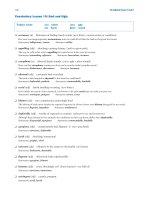
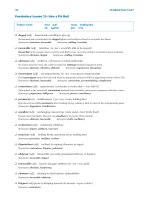
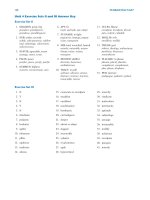
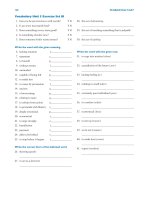
800 MCGRAW-HILL’S SAT
6 6 666 6
GO ON TO THE NEXT PAGE
Questions 10–16 are based on the following passage.
The following passage was written by a natural-
ist about his studies of the wildlife in the African
plains, particularly Serengeti National Park in
Tanzania.
How can so many wild animals manage to
survive in the Serengeti? Their migrations of
course tell part of the story. By moving from
place to place with the changing seasons, they
do not overuse and damage the grass in any
one area. But other, less obvious factors also
are involved.
Here on the eastern plains in January, it is
clear that most of the animals are eating the
abundant grass that springs up like a well-
mown lawn between low clumps of Sodom
apple and indigo plants. Nearly all of them,
from 1,500-pound eland bulls to tiny 10-pound
Thomson’s gazelle calves, are grazers, rather
than browsers, which feed on shrubs or the
leaves of trees. Singly or in pairs, long lines,
or little groups, they move over the green
pastures, never remaining long in one place.
Where the grass is all short, as it will be when
it has been heavily grazed, all the animals ap-
parently eat much the same sort of grass. But
where the grass is of varied lengths and tough-
ness, we can see that each animal copes dif-
ferently with the available fodder.
The herds of zebras tend to roam in areas
separate from the rest of the grazing multi-
tude. Unlike all the other grazers on the plain,
they have teeth in both jaws. This enables
them to deal with taller, coarser grass than can
the other herbivores. All the rest are various
species of antelope, which nip off the grass be-
tween their lower incisors and toothless upper
palates. Thus, the zebras eat down the longer
grasses to a certain level and then move on.
Following the zebras come the wildebeests
and, in better-wooded areas, hartebeests.
These animals eat the grass down a stage fur-
ther, until it is really short. (They also eat new
growth before it has had a chance to grow
tall.) Then the Thomson’s gazelles take over.
With their tails flicking constantly, they nibble
at the individual leaves of the tussocks and on
the tiny plants that grow between them. By the
time all of them have finished, the plain resem-
bles a closely but rather unevenly mown lawn.
Thus, one species or another of animal
often predominates over a great expanse of the
plain, depending on the height to which the
grass has grown or has been grazed. Finally,
when all has been eaten down rather short,
most of the grazers leave the area altogether.
Two or three weeks later, when more rain
has brought on fresh growth, the herds may
return to feed over the area again. Perhaps
they move about in response to the intensity
of local showers, which can vary a good deal
over a distance of only a mile or two. In any
case, the result of their returning again and
again to the same areas is to keep the grass
green and short, just as the repeated mowing
of a lawn in summer does.
If, as a result of badly drawn park bound-
aries or some other cause, the migrant herds
of Serengeti were confined to either the west-
ern woodlands or the eastern short-grass
plains, they would be forced to return to the
same areas too often and would eventually so
weaken the grass that it would die out. But as
they eat it down, they move away and the
grass recovers.
10. As a whole, this passage is primarily con-
cerned with
(A) criticizing human intervention in a nat-
ural habitat
(B) describing the life cycle of particular plants
(C) suggesting a way to avert a natural
disaster
(D) showing how to distinguish grazers from
browsers
(E) describing how a particular ecosystem
works
Line
5
10
15
20
25
30
35
40
45
50
55
60
65
70
Excerpted from
The Life of the African Plains,
Leslie Brown,
McGraw-Hill, 1972. Reprinted with permission of The
McGraw-Hill Companies.
CHAPTER 16 / PRACTICE TEST 4 801
GO ON TO THE NEXT PAGE
11. Lines 22–24 (“Where the grass . . . the available
fodder”) discuss the relationship between
(A) what they eat
(B) the seasons and relative animal populations
(C) plant size and dietary variety
(D) zebras and antelopes
(E) climate and plant health
12. According to the passage, browsers differ from
grazers primarily in terms of
(A) what they eat
(B) how quickly they eat
(C) their weight
(D) how they digest their food
(E) the season in which they migrate
13. The passage indicates that the various species of
antelope that graze on the Serengeti
(A) feed on shrubs and leaves of trees
(B) lack upper teeth
(C) can easily eat tall and coarse grass
(D) usually graze with zebras
(E) tend to consume all of the vegetation in
an area before moving on
14. The passage suggests that the sequence of graz-
ers described in lines 25–45— zebras followed
by wildebeests followed by Thomson’s gazelles—
is generally maintained UNLESS
(A) the grazers arrive at a new pasture
(B) the grass is of various lengths and
textures
(C) there are browsers among them
(D) fresh rains have fallen
(E) all of the available grass is short
15. According to the passage, rain affects the feeding
habits of Serengeti grazers primarily by
(A) flooding and destroying some of the
pastures
(B) forcing the browsers to take shelter
under trees
(C) rendering the plants edible again
(D) weakening the grass
(E) confining the herds to high plateaus
6 6 666 6
16. The final paragraph suggests that maintaining
the grasslands of the Serengeti requires
(A) freedom of the grazers to move as they
wish
(B) frequent rainless periods
(C) frequent removal of dead plants
(D) the restriction of grazers to the
woodlands
(E) a separation of grazers and browsers
Questions 17–24 are based on the following passage.
The following is an excerpt from an essay by
George Bernard Shaw, written in 1889, on the
economic basis of socialism.
All economic analyses begin with the culti-
vation of the earth. To the mind’s eye of the
astronomer the earth is a ball spinning in
space without ulterior motives. To the bodily
eye of the primitive cultivator it is a vast green
plain, from which, by sticking a spade into it,
wheat and other edible matters can be made
to spring. To the eye of the sophisticated city
man this vast green plain appears rather as a
great gaming table, your chances in the game
depending chiefly on the place where you de-
posit your stakes. To the economist, again, the
green plain is a sort of burial place of hidden
treasure, where all the forethought and indus-
try of man are set at naught by the caprice of
the power which hid the treasure. The wise
and patient workman strikes his spade in
here, and with heavy toil can discover nothing
but a poor quality of barley, some potatoes,
and plentiful nettles, with a few dock leaves to
cure his stings. The foolish spendthrift on the
other side of the hedge, gazing idly at the sand
glittering in the sun, suddenly realizes that the
earth is offering him gold—is dancing it be-
fore his listless eyes lest it should escape him.
Another man, searching for some more of this
tempting gold, comes upon a great hoard of
coal, or taps a jet of petroleum. Thus is Man
mocked by Earth his stepmother, and never
knows as he tugs at her closed hand whether
Line
5
10
15
20
25
30
802 MCGRAW-HILL’S SAT
GO ON TO THE NEXT PAGE
6 6 666 6
it contains diamonds or flints, good red wheat
or a few clayey and blighted cabbages. Thus
too he becomes a gambler, and scoffs at the
theorists who prate of industry and honesty
and equality. Yet against this fate he eternally
rebels. For since in gambling the many must
lose in order that the few may win; since dis-
honesty is mere shadow-grasping where
everyone is dishonest; and since inequality is
bitter to all except the highest, and miserably
lonely for him, men come greatly to desire
that these capricious gifts of Nature might be
intercepted by some agency having the power
and the goodwill to distribute them justly
according to the labor done by each in the
collective search for them. This desire is
Socialism; and, as a means to its fulfillment,
Socialists have devised communes, kingdoms,
principalities, churches, manors, and finally,
when all these had succumbed to the old
gambling spirit, the Social Democratic State,
which yet remains to be tried. As against
Socialism, the gambling spirit urges man to
allow no rival to come between his private in-
dividual powers and Stepmother Earth, but
rather to secure some acres of her and take
his chance of getting diamonds instead of cab-
bages. This is private property or Unsocialism.
Our own choice is shown by our continual
aspiration to possess property, our common
hailing of it as sacred, our setting apart of the
word Respectable for those who have attained
it, our ascription of pre-eminent religiousness
to commandments forbidding its violation,
and our identification of law and order among
men with its protection. Therefore is it vital to
a living knowledge of our society that Private
Property should be known in every step of its
progress from its source in cupidity to its end
in confusion.
17. Which of the following best summarizes the
main idea of this passage?
(A) Socialism provides the best means for
humanity to manage the capriciousness
of nature.
(B) Astronomers, farmers, and economists
have much to learn from each other.
(C) Patient and diligent farmers will always
be rewarded.
(D) Foolish people are often just as lucky as
industrious workers.
(E) All people properly aspire to own prop-
erty and earn respectability.
18. The “primitive cultivator” (line 5) is
(A) a supernatural creator
(B) an astronomer
(C) a farmer
(D) a machine
(E) a philosopher
19. According to the passage, the perspective of the
“astronomer” (line 3) differs primarily from the
perspective of the “foolish spendthrift” (line 21)
in that the astronomer views the earth as
(A) generous, while the spendthrift views the
earth as stingy
(B) a beautiful gem, while the spendthrift
views the earth as a dull, sandy expanse
(C) dangerously capricious, while the spend-
thrift views the earth as a source of un-
limited riches
(D) lacking regard for humankind, while the
spendthrift views the earth as generous
(E) moving in an orderly fashion, while the
spendthrift views the earth’s movements
as dangerously random
20. The “closed hand” in line 30 refers to
(A) the strength of the farmer
(B) the tendency of the earth to hide its
treasures
(C) the abundance of resources that spring
from the earth
(D) the laziness of the foolish spendthrift
(E) the fact that the earth is inanimate and
lacking will
35
40
45
50
55
60
65
70
George Bernard Shaw, and H. G. Wilshire. Various authors. See
Contents.
Fabian Essays in Socialism.
New York: Humboldt
Publishing Co., ed. George Bernard Shaw, H. G. Wilshire,
and W. D. P. Bliss, 1891. [Online] available from www.
econlib.org/library/
CHAPTER 16 / PRACTICE TEST 4 803
21. The author mentions “industry and honesty
and equality” (lines 34–35) in order to make
the point that
(A) some moral habits are not as valuable as
many claim
(B) fate tends to favor those who are
virtuous
(C) too many people disdain ethical
behavior
(D) the natural order reflects a moral order
(E) hard work and morality are their own
reward
22. The “fate” mentioned in line 35 is the fate of
(A) the hard-working farmer
(B) the theorist who preaches honesty and
equality
(C) the gambler
(D) the owner of private property
(E) the socialist
6 6 666 6
23. The author qualifies his view of the “Social De-
mocratic State” by indicating that it
(A) appeals to the gambling instinct
(B) will discourage workers from being
industrious
(C) places a high value on selfishness
(D) encourages people to be wasteful
(E) has not yet been attempted
24. The sentence “Our own choice . . . its protec-
tion” (lines 59–66) suggests that most people
of the author’s era
(A) are deeply religious
(B) are becoming skeptical of the concept of
respectability
(C) place a high value on the concept of pri-
vate property
(D) desire a socialist democratic state
(E) are not as industrious as they believe
themselves to be
STOP
If you finish before time is called, you may
check your work on this section only. Do not
turn to any other section of the test.
804 MCGRAW-HILL’S SAT
GO ON TO THE NEXT PAGE
7 7 777 7
1. If 3x + 5x + 8x = 32, what is the value of x?
(A) 1
(B) 2
(C) 3
(D) 4
(E) 5
2. If (6x) = 8, then x =
(A) 1
(B) 2
(C) 3
(D) 4
(E) 5
1
3x
x
⎛
⎝
⎜
⎞
⎠
⎟
⎛
⎝
⎜
⎞
⎠
⎟
3. If 5b − 10 ≥ 15, which of the following expresses
all of the possible values of b?
(A) b ≥ 5
(B) b ≥ 1
(C) b ≥ 9
(D) b ≤ 1
(E) b ≤ 5
4. If t% of 60 is equal to 30% of 50, what is the
value of t?
(A) 12
(B) 15
(C) 25
(D) 30
(E) 35
SECTION 7
Time—20 minutes
16 questions
Turn to Section 7 of your answer sheet to answer the questions in this section.
Directions: For this section, solve each problem and decide which is the best of the choices given. Fill in
the corresponding circle on the answer sheet. You may use any available space for scratchwork.
1. The use of a calculator is permitted.
2. All numbers used are real numbers.
3. Figures that accompany problems in this test are intended to provide information useful in solv-
ing the problems. They are drawn as accurately as possible EXCEPT when it is stated in a spe-
cific problem that the figure is not drawn to scale. All figures lie in a plane unless otherwise
indicated.
4. Unless otherwise specified, the domain of any function f is assumed to be the set of all real num-
bers x for which f(x) is a real number.
The number of degrees of arc in a circle is 360.
The sum of the measures in degrees of the angles of a triangle is 180.
NotesReference Information
r
A = πr
2
C=2πr
ᐉ
w
A =
ᐉw V = ᐉwh V = πr
2
h
Special right triangles
c
2
= a
2
+ b
2
A =
1
/
2
bh
h
b
ᐉ
w
h
r
h
b
c
a
2x
x
x
s
s
s
3
2
30°
60°
45°
45°
CHAPTER 16 / PRACTICE TEST 4 805
GO ON TO THE NEXT PAGE
8. Which of the following graphs best represents
the data presented in the table above?
9. If the sum of seven integers is even, at most
how many of these integers could be odd?
(A) 3
(B) 4
(C) 5
(D) 6
(E) 7
Miles
per
gallon
age
(years)
Miles
per
gallon
age
(years)
Miles
per
gallon
age
(years)
Miles
per
gallon
age
(years)
Miles
per
gallon
age
(years)
(A)
(B)
(C)
(D)
(E)
7 7 777 7
5. If it takes 40 minutes to write h holiday cards,
then in terms of h, how many holiday cards
can be written at that rate in 8 hours?
(A)
(B) 8h
(C) 12h
(D)
(E)
6. Which of the labeled points on the number line
above could represent the product −1.5 × 1.25?
(A) A
(B) B
(C) C
(D) D
(E) E
7. If four people share 100 baseball cards and
each person must receive a different positive
whole number of cards, what is the greatest
possible number of cards any one person may
have?
(A) 28
(B) 29
(C) 94
(D) 95
(E) 97
ABC D E
–2 –1 0 1 2
12
h
5
h
5
h
FUEL EFFICIENCY OVER TIME
Miles per
gallon
Age of car
(in years)
12345
36 35 31 26 20
806 MCGRAW-HILL’S SAT
GO ON TO THE NEXT PAGE
10. In a particular year, if January 22 is the fourth
Wednesday of the month, what is the date of
the fourth Monday in January?
(A) January 20
(B) January 21
(C) January 26
(D) January 27
(E) January 28
11. The graph above shows the number of teach-
ers in Hamden who live in a house, the num-
ber of teachers who live in an apartment, and
the number of each who use gas or oil heat. Of
the teachers who use gas heat, what fraction
live in a house?
(A)
(B)
(C)
(D)
(E)
12. If 5x + 7y = 18 and 2x − 4y = 6, what is the value
of 7x + 3y?
(A) 7
(B) 12
(C) 19
(D) 24
(E) 31
73
80
60
73
60
80
73
100
60
100
7 7 777 7
13. In the figure above, if l⏐⏐m, what is the value of
x in terms of y and z?
(A) y − z
(B) z − y
(C) z + y
(D) 180 − y − z
(E) 90 − z − y
14. Julie Ann commutes to work one morning at
an average speed of 40 mph. She returns home
along the same route at an average speed of
24 mph. If she spends a total of 2 hours traveling
to and from work that day, how many miles is
her commute to work?
(A) 24
(B) 30
(C) 32
(D) 34
(E) 40
y
°
z
°
x
°
l
m
house
gas
oil
apartment
60
20
13
7
20
80
Hamden
CHAPTER 16 / PRACTICE TEST 4 807
15. Given the graph of y = f(x) above, which of
the following represents the graph of
y = f(x − 2) + 4?
y = f(x)
y
x
(5,0)
(0,5)
O
Note: Figure not drawn to scale.
16. Line segment BD
––
is tangent to the circle with
center O at point A. If DO = BO = 12, what is
the area of the unshaded
region of ΔBOD?
(A)
(B)
(C) 36 − 12π
(D)
(E)
72 3 36−
π
72 2 36−
π
36 2 12−
π
36 3 12−
π
B
AD
O
30
°
y
x
(5,0)
(0,5)
O
(A)
(C)
y
x
(5,0)
(0,5)
O
(B)
(D)
y
x
(5,0)
(0,5)
O
y
x
(5,0)
(0,5)
O
(E)
y
x
(5,0)
(0,5)
O
7 7 777 7
STOP
If you finish before time is called, you may
check your work on this section only. Do not
turn to any other section of the test.
808 MCGRAW-HILL’S SAT
GO ON TO THE NEXT PAGE
2. The of James Joyce’s early works, which
used clear prose to reveal the inner dimensions
of his characters, gave way to and arcane
style of writing in such books as Ulysses and
Finnegans, Wake, which explored character
through neologisms and obscure literary
tricks.
(A) inspiration . . an emotional
(B) lucidity . . an opaque
(C) vagueness . . a simple
(D) popularity . . a concise
(E) anachronism . . a derivative
3. Critics of former British Prime Minister Win-
ston Churchill complained that he too often
acted , choosing his strategies arbitrarily
without much explanation.
(A) diligently
(B) impulsively
(C) viciously
(D) malevolently
(E) savagely
4. Sixteenth-century British monarch Henry VIII
was a king who demanded from his
courtiers; he did not hesitate to execute anyone
who acted irreverently.
(A) insolence
(B) impudence
(C) truculence
(D) deference
(E) ignominy
1. The with which technology is advancing
makes it difficult for businesses to stay current,
and as a result, they often find themselves
using equipment.
(A) urgency . . progressive
(B) swiftness . . conventional
(C) torpidity . . antiquated
(D) lassitude . . innovative
(E) rapidity . . outdated
8 8 888 8
SECTION 8
Time—20 minutes
19 questions
Turn to Section 8 of your answer sheet to answer the questions in this section.
Directions: For each question in this section, select the best answer from among the choices given and
fill in the corresponding circle on the answer sheet.
Each sentence below has one or two blanks,
each blank indicating that something has been
omitted. Beneath the sentence are five words
or sets of words labeled A through E. Choose
the word or set of words that, when inserted
in the sentence, best
fits the meaning of the
sentence as a whole.
EXAMPLE:
Rather than accepting the theory unquestion-
ingly, Deborah regarded it with
.
(A) mirth
(B) sadness
(C) responsibility
(D) ignorance
(E) skepticism
A
C D
E
B
CHAPTER 16 / PRACTICE TEST 4 809
GO ON TO THE NEXT PAGE
5. In the 1600s, Italian scientist Galileo Galilei
was and sentenced to life in prison for
being a when, contrary to church teach-
ings, he proposed that the sun, rather than the
earth, was the center of the universe.
(A) ostracized . . hermit
(B) venerated . . demagogue
(C) hallowed . . revisionist
(D) denounced . . heretic
(E) reviled . . luminary
6. Known for her and iconoclastic stance on
most political matters, the senator had a hard
time securing the votes of the more party
members during her presidential campaign.
(A) contentious . . orthodox
(B) controversial . . litigious
(C) disingenuous . . vituperative
(D) dissident . . idolatrous
(E) heretical . . polemical
8 8 888 8
heeding the injunction, cast down his bucket,
and it came up full of fresh, sparkling water
from the mouth of the Amazon River. To those
of my race who depend upon bettering their
condition in a foreign land or who underesti-
mate the importance of cultivating friendly rela-
tions with the Southern white man, who is their
next-door neighbor, I would say: “Cast down
your bucket where you are”—cast it down in
making friends in every manly way of the peo-
ple of all races by whom we are surrounded.
Cast it down in agriculture, in mechanics,
in commerce, in domestic service, and in the
professions. And in this connection it is well
to bear, when it comes to business, pure and
simple, it is in the South that the Negro
1
is
given a man’s chance in the commercial
world, and in nothing is this Exposition more
eloquent than in emphasizing this chance.
Our greatest danger is that in the great leap
from slavery to freedom we may overlook the
fact that the masses of us are to live by the
production of our hands, and fail to keep in
mind that we shall prosper in proportion as
we learn to dignify and glorify common labor
and put brains and skill into the common oc-
cupations of life; shall prosper in proportion
as we learn to draw the line between the su-
perficial and the substantial, the ornamental
gew-gaws of life and the useful. No race can
prosper till it learns that there is as much dig-
nity in tilling a field as in writing a poem. It is
at the bottom of life we must begin, and not at
the top. Nor should we permit our grievances
to overshadow our opportunities.
To those of the white race who look to the in-
coming of those of foreign birth and strange
tongue and habits for the prosperity of the
South, were I permitted I would repeat what I
say to my own race, “Cast down your bucket
where you are.” Cast it down among the eight
millions of Negroes whose habits you know,
whose fidelity and love you have tested in days
when to have proved treacherous meant the ruin
of your firesides. Cast down your bucket among
these people who have, without strikes and
labor wars, tilled your fields, cleared your
Line
5
10
15
20
25
30
35
40
45
50
55
1
African American
Questions 7–19 are based on the following passages.
The following passages present two viewpoints on
the assimilation of ex-slaves into American cul-
ture in the late 19th century. Passage 1 is from a
speech given by Booker T. Washington, an African
American ex-slave and prominent educator, at the
Atlanta Exposition in 1895. Passage 2 is an ex-
cerpt from a paper entitled The Conservation of
Races written by W. E. B. Du Bois in 1897.
PASSAGE 1
A ship lost at sea for many days suddenly
sighted a friendly vessel. From the mast of the
unfortunate vessel was seen a signal, “Water,
water; we die of thirst!” The answer from the
friendly vessel at once came back, “Cast down
your bucket where you are.” And a second,
third and fourth signal for water were an-
swered, “Cast down your bucket where you
are.” The captain of the distressed vessel, at last
The passages below are followed by questions
based on their content; questions following a
pair of related passages may also be based on
the relationship between the paired passages.
Answer the questions on the basis of what is
stated
or implied in the passage and in any in-
troductory material that may be provided.