Sat - MC Grawhill part 10 pptx
Bạn đang xem bản rút gọn của tài liệu. Xem và tải ngay bản đầy đủ của tài liệu tại đây (250.7 KB, 10 trang )
1 THE COLLEGE HILL METHOD FOR SAT WORD POWER
80 MCGRAW-HILL’S SAT
if you want to learn the word magnanimity, you
should notice that it has three parts: magna (great) +
anima (spirit or life) + -ity (suffix indicating a quality).
It means generosity, and you should see why from its
roots.
Use the Patterns of Words in Sentences
When you run across a new word in a sentence, make
a guess about its meaning based on how it’s used. Con-
sider this sentence: Even her favorite toy could not pla-
cate the screaming child. Even if you have never seen
the word placate before, you should be able to tell from
the sentence that it is a verb. Even more, you can tell
that it’s something a favorite toy might do to a scream-
ing child (even though it wasn’t successful in this
case). Since screaming children need to be calmed
down, and since toys often can do that, it’s a good bet
that placate means something like “calm down.”
Simplify Your Task by Connecting
Words in Groups
Memorizing is always easier when you can group the
information into chunks. Most words are related to
other words with the same basic meaning (syn-
onyms), the opposite meaning (antonyms), or the
same root (cognates). The lessons in this chapter help
you to group words in many ways: into theme groups
(such as “words about talking”), synonym groups,
antonym groups, and cognate groups.
Connect New Words to Your Own
Experience or Knowledge
To learn a new word, you must connect it to some-
thing you understand. Word meanings aren’t isolated
facts to memorize. Think about how to use your new
words. For instance, when learning the word enervate
(to weaken or decrease in strength or vitality), think
about what enervates you (a 4-hour standardized test,
perhaps?) or about examples of enervation in books
you’ve read (such as the enervation of Moby Dick as
Captain Ahab hunts him down). Visualize them and
say them out loud: “The SAT can be an enervating
experience,” and “Moby Dick was enervated by the
incessant chase and his many harpoon wounds.”
Consider Alternative Strategies Such as the
ALIVE Visual Mnemonic System
Some words are hard to memorize because they have
obscure meanings or are hard to connect to other
words. For such words, College Hill Coaching’s
ALIVE visual mnemonic system is a great tool. Here’s
how it works:
A strong vocabulary is essential to achieving a top
SAT critical reading score. But building a solid vocab-
ulary doesn’t mean just memorizing thousands of
flashcards. In fact, the way most students use flash-
cards is not only dull, but utterly ineffective. Believe
it or not, you’ve been using a much better system for
years. If you’re a normal 16-year-old, you have about
a 40,000-word vocabulary. Did you memorize all those
words with flashcards? No. You didn’t “study” them
at all. You just absorbed them by trying to understand
and communicate with the people around you.
When you take words out of the context of real
communication, your brain’s “vocabulary machine”
doesn’t work very well. So don’t just study flashcards
to memorize word meanings in isolation. Instead, fol-
low these rules while using the College Hill flashcard
system (which is discussed below) to study the words
in the lessons in this chapter.
Surround Yourself with Good Language
When you were a baby, you were surrounded by peo-
ple with much stronger vocabularies than yours, so
your vocabulary grew very quickly. As you got older,
however, your vocabulary grew to match that of the
people you hung out with, so its growth slowed. How
do you rev it up again? Talk to smart adults. Hang
around friends with good vocabularies. Read college-
level books. Watch documentaries on television rather
than mindless game shows, soap operas, and reality
shows. Listen to National Public Radio. Read The New
York Times Op-Ed page and Sunday Magazine. Read
articles and stories from Harper’s, Atlantic Monthly,
New Yorker, The Nation, and Scientific American.
Use Your New Vocabulary with
Friends and Family
To build your vocabulary, you have to try out your
new words. If you feel self-conscious about trying out
new words (and most teens do), find a close friend or
relative to practice vocabulary with—maybe a friend
who’s also prepping for the SAT. On the next couple
of pages we’ll give you lots of good strategies for
building vocabulary with a friend.
Analyze Words as You Read and Speak
As you run across new words, think about their roots,
their synonyms, and their antonyms. The 49 lessons
in this chapter include 200 of the key roots, prefixes,
and suffixes, as well as lists of synonyms and antonyms
for each word. Reinforce your new words by breaking
them into their roots, prefixes, and suffixes and connect-
ing them to other words that share them. For instance,
1. Break down the sounds of the word, and turn those
sounds into a picture. Let’s say that you’re trying
to learn the word polemic. First, break down its
syllables. It sounds like pole and lemon, so imag-
ine a lemon on the end of a pole. (You might break
it down differently, for instance, as pole and Mick.
That’s fine, as long as you turn it into a picture!)
2. Imagine a picture for the meaning of the word.
Polemic means “a strong verbal or written attack,”
so you might visualize someone arguing loudly
with a politician at a debate. Try to picture some-
one you actually know, if possible, someone with
strong opinions.
3. Put the two pictures together into one. See the
debater hitting the politician with the lemon on the
end of the pole. The crazier the picture, the better!
4. Make your image come ALIVE. As you visualize
your picture, make it come ALIVE—active, link-
ing, illogical, vivid, and exaggerated. Here’s how:
• Give the picture action by making it move like a
wacky animated cartoon.
• Make sure the picture links two things: the
sound of the word and the meaning of the word.
• Make the picture bizarre and illogical so that it’s
more memorable.
• Make it so vivid that you see it in 3-D, in color,
and in rich detail.
• Work on exaggerating the picture so that the
meaning of the word “pops out.”
Keep a Vocabulary Notebook
Keep a small notebook handy when you’re reading.
When you run across a new or interesting word, jot it
down so that you can look it up later and make a flash-
card for it using the system described below. Have a
good collegiate dictionary handy, too—one with a
pronunciation guide and etymology for each word.
Study with the College Hill Coaching
Flashcard System—10 Minutes a Day
Flashcards are enormously helpful for building
vocabulary, but only if you use them the right way. Get
in the habit of making and studying 30 to 40 flashcards
per week of SAT words from this chapter, your practice
tests, or your reading. But don’t just make plain old
flashcards. College Hill flashcards are far more effective.
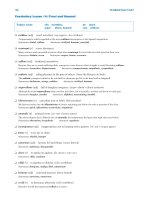
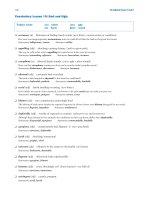
Each one looks like the figures at the top of this page.
When you’ve made a card for any word from the
lessons in this chapter, check it off the list. Keep your
cards handy in a plastic recipe box, and study them
daily for at least 10 minutes. Don’t just study these
cards to memorize definitions by rote. Instead, shuffle
through the following seven study methods on a regu-
lar basis.
• Study Method 1. Your friend reads you the word,
and then you create a new sentence using that
word. The sentence must show that you under-
stand the meaning of the word. For instance, “The
boy was obsequious” doesn’t really show that you
know what obsequious means.
• Study Method 2. Your friend reads you the word,
and then you give its roots and, for each root, as
many words as you can that share that root.
• Study Method 3. Your friend reads the definition
from the back of the card and gives you the first
letter of the word, and then you give the word.
• Study Method 4. Your friend reads the word, and
then you describe three different situations in
which the word would be appropriate.
• Study Method 5. Your friend reads the word, and
then you teach your friend any clever ALIVE
mnemonics you have created for the word.
• Study Method 6. Your friend reads the sentence,
and then you give the definition of the word.
• Study Method 7. Post a bunch of flashcards around
your room where you’ll see them every day. Think
of appropriate places to post them, such as narcis-
sist on the mirror, lethargic on the bed, and so on.
Check Your Understanding with the Review
Exercises
At the end of each vocabulary unit in this chapter is a
set of exercises to check your understanding of the
words you’ve studied. Do them faithfully at the end
of each seven-lesson unit. They provide great rein-
forcement and help you to see which words you may
need to go back and review.
CHAPTER 3 / BUILDING AN IMPRESSIVE VOCABULARY 81
Back: Write the definition of the word, then,
in parentheses, the definition of any roots or
affixes. Beneath, write the first letter of the word.
Front: Write a meaningful sentence using the
word. Write the word in CAPITALS and
underline any roots.
Vocabulary Unit I
Vocabulary Lesson 1: Get to the Point!
82 MCGRAW-HILL’S SAT
❑ concise (adj) brief and to the point (con- altogether + cis cut)
Ricky, try to be a bit more concise in this paper; the assignment was for a three-page paper; yours was 106.
Synonyms: succinct, terse Antonyms: prolix, discursive, protracted, circumlocutory, verbose
❑ laconic (adj) disposed to using few words (from Latin term for Spartans, who spoke little)
I’ve known Lucy for ten years, but she’s so laconic that I hardly know anything about her past.
Synonyms: taciturn, reticent Antonyms: garrulous, loquacious
❑ succinct (adj) spoken or written in a clear and precise manner
Because commercial time during the Super Bowl runs over $3 million per minute, it’s good to be succinct.
Synonyms: terse, concise Antonyms: prolix, discursive, protracted, circumlocutory, verbose
❑ brusque (adj) rudely abrupt
My girlfriend tends to be brusque when she’s mad; she just tells me to “talk to the hand.”
Synonyms: curt, abrupt, petulant
❑ abridge (v) to shorten a written text
The dictionary was 1,400 pages long before it was abridged by the publishers to 850 pages.
Synonym: abbreviate Antonyms: augment, amplify, protract
❑ brevity (n) quality of succinct expression (brev- brief + -ity quality of)
Speeches at the Academy Awards are not known for their brevity; they often go on long past their allotted time.
Synonyms: conciseness, pithiness, succinctness, laconism
❑ conspire (v) to plan together secretly to commit an illegal act (con- together + -spire breathe)
Synonyms: collude, collaborate
❑ concur (v) to agree (con- together + -cur run)
Synonyms: accord, harmonize, cohere
❑ concord (n) a state of harmony (con- together + -cord heart)
Synonyms: unanimity, consensus
❑ congenital (adj) existing at birth (con- together + gen born)
Synonyms: innate, inborn
❑ schism (n) a division into political or religious factions (cis cut)
Synonyms: faction, rift, divergence
❑ incisive (adj) having or indicating keen insight (in- in + cis cut)
Synonyms: acute, keen, astute, canny, perspicacious, judicious, shrewd
Today’s roots: co-, con- together, with brev brief
cis cut cur run, course
❑ judicious (adj) showing sound judgment; prudent (jud- judge + -ious full of)
After much thought, I decided that the most judicious thing to do was to avoid the swamp full of alligators.
Synonyms: prudent, sensible, circumspect, sagacious Antonyms: improvident, rash
❑ adjudicate (v) to hear and judge a case (jud judge + -ate to do)
Sometimes when my two children fight, I feel like I’m adjudicating a capital crime rather than settling a quarrel.
❑ astute (adj) shrewd; keen
The young Sherlock Holmes was quite the astute investigator; he always unraveled even the toughest mysteries.
Synonyms: sagacious, shrewd, incisive, canny, perspicacious Antonyms: vacuous, vapid, obtuse
❑ scrutinize (v) to examine carefully (scruta examine + -ize to do)
Before buying an apple, scrutinize it to be sure that it has no bruises.
Synonyms: analyze, peruse
❑ pragmatic (adj) concerned with practical outcomes
The architects chose a solarium design that was less aesthetic than pragmatic: it was not beautiful, but it kept heating and
lighting costs down.
❑ perjure (v) to lie under oath ( per- through + jur oath)
The mobster told blatant lies while on the stand, perjuring himself to keep his partners out of jail.
Synonym: prevaricate
❑ prudent (adj) using good judgment ( prudentia knowledge)
It would not be prudent to sneak out of your room again tonight; your parents will ground you if they catch you!
Synonyms: judicious, sensible Antonyms: improvident, rash
❑ jurisprudence (n) the science or philosophy of law ( jur- law + prudentia knowledge)
❑ jurisdiction (n) the sphere of authority or control ( jur- law + dictio declaration)
Synonym: domain
❑ adjure (v) to command solemnly, as under oath (ad- to + jur oath)
Synonyms: enjoin, entreat, beseech
❑ adjudge (v) to determine based upon law (ad- to + jud judge)
Synonym: adjudicate
❑ acumen (n) keenness of judgment (acus sharp)
Synonyms: discernment, perspicacity, shrewdness
❑ inscrutable (adj) beyond comprehension or examination (in- not + scruta examine)
Synonyms: enigmatic, recondite, abstruse
❑ allegation (n) a formal accusation (ad- to + legare dispute)
Synonyms: contention, assertion, charge
CHAPTER 3 / BUILDING AN IMPRESSIVE VOCABULARY 83
Vocabulary Lesson 2: Think Before You Judge
Today’s roots: jud judge leg law
jur oath, law scrut to examine
Vocabulary Lesson 3: Let’s Talk About It
84 MCGRAW-HILL’S SAT
Today’s roots: locu, loqu talk circum around
verb word e-, ex- out
❑ eloquent (adj) well spoken (e- out + loqu talk)
She is an eloquent spokeswoman for animal rights; she conveys her ideas with great ease and fluidity.
Synonyms: articulate, fluent Antonym: inarticulate
❑ loquacious (adj) very talkative (loqu- talk + -ious full of)
That guy never stops talking; now I understand why they call him “Loquacious Larry”!
Synonyms: garrulous, voluble Antonyms: laconic, taciturn, reticent
❑ circumlocution (n) evasive speech; talking around the subject (circum- around + loqu talk)
The politician had perfected the art of circumlocution; he knew exactly how to avoid answering direct questions.
Synonym: evasion
❑ colloquial (adj) conversational; using everyday language (co- together + loqu talk)
I like Professor Thompson because she is so colloquial; yesterday she said my thesis idea was “really cool.”
❑ grandiloquent (adj) speaking in a pompous manner (grand- great + loqu talk + -ent adjective)
His speech was pompous and grandiloquent; it seemed he was just trying to use as many big words as possible.
Synonyms: pontifical, portentous
❑ elocution (n) expressive delivery of public speech (e- out + loqu talk + -tion noun)
James is adept at elocution; his expressions and mannerisms add a new level of meaning to his words.
❑ garrulous (adj) talkative
Karl is always ready to talk about any subject, no matter how trivial, but at parties he is even more garrulous.
Synonyms: loquacious, voluble
❑ pontificate (v) to speak pompously (pontifex high priest)
Synonyms: declaim, sermonize, dogmatize
❑ verbose (adj) wordy (verb- word + -ose full of)
Synonyms: prolix, discursive, digressive
❑ verbatim (adv) word for word (verb- word)
I followed the recipe verbatim.
❑ ineffable (adj) unable to be expressed in words (in- not + effari utter)
Try as he might to express his love in a poem, his feelings seemed ineffable.
❑ tangential (adj) only superficially relevant; off-topic
Synonyms: irrelevant, incidental, immaterial
❑ tout (v) to promote or praise energetically
Synonyms: acclaim, herald, laud
❑ anecdote (n) a short and often humorous story
Don’t confuse with antidote (n), a remedy.
❑ discursive (adj) straying from the topic (dis- away + curs course)
Synonyms: digressive, desultory
Vocabulary Lesson 4: “Good, Thanks”
CHAPTER 3 / BUILDING AN IMPRESSIVE VOCABULARY 85
Today’s roots: ben, bene, bon good eu good
grat to please, thank vole wish
❑ benefactor (n) one who supports or helps another (bene- good + fact to make)
Mr. King is the benefactor who generously donated the money for the new children’s wing in the hospital.
Synonyms: philanthropist, patron Antonyms: malefactor, nemesis, antagonist, adversary
❑ benign (adj) harmless (bene good)
She was relieved to find out that her tumor was benign.
Synonym: innocuous Antonyms: malignant, virulent
❑ benevolent (adj) kind; considerate (bene- good + vole wish)
The benevolent Cub Scout did his good deed for the day when he helped a motorist change a tire.
Synonyms: gracious, altruistic, magnanimous Antonyms: malevolent, malicious, inimical, pernicious
❑ benediction (n) an expression of good wishes (bene- good + dictus declaration)
At the reception, the father of the bride offered a benediction, wishing the couple never-ending love and happiness.
Synonyms: blessing, sanction Antonyms: curse, malediction, execration
❑ euphemism (n) the substitution of an inoffensive term for an offensive one (eu- good + pheme speech)
A good journalist avoids the euphemisms of war, like “ordnance” for bombs and “collateral damage” for casualties.
❑ eulogy (n) a praising tribute (eu- good + logia discourse) (Although associated with funerals, “eulogy” has
a positive tone.)
His touching eulogy for his fallen friend left all the mourners weeping.
Synonyms: encomium, laudation, extolment, paean Antonyms: denunciation, execration, censure
❑ ingratiate (v) to put oneself in good favor with another (in- in + grat to please)
When starting at a new school, Mary sought to ingratiate herself with her classmates by being excessively nice.
Synonyms: flatter, wheedle, toady, cajole
❑ beneficiary (n) one who receives benefits (bene- good + fic to make)
Synonyms: heir, recipient, legatee
❑ gratuity (n) a small payment in gratitude (grat- thank)
Don’t confuse with gratuitous (adj) unnecessary
❑ gratis (adj) free of charge (grat- thank)
He let me borrow his car gratis.
❑ gratify (v) to please (grat- please)
Synonyms: appease, mollify, indulge
❑ euphoria (n) a feeling of extreme happiness (eu- good)
Synonyms: elation, rapture, jubilation, ecstasy
❑ euphonious (n) sweet sounding (eu- good + phon sound)
Synonyms: mellifluous, dulcet, lyrical
Vocabulary Lesson 5: Changes
86 MCGRAW-HILL’S SAT
Today’s roots: rupt break morph form, shape
mut change meta change, beyond
❑ immutable (adj) unchangeable (im- not + mut change)
Emily is an immutable vegetarian. No matter how hard we try, we cannot get her to eat meat.
Synonyms: permanent, inveterate Antonyms: mutable, protean, vacillating, mercurial
❑ metamorphosis (n) a transformation (meta- change + morph form)
The old house underwent a metamorphosis from a rundown shack into a beautiful cottage.
Synonyms: transformation, mutation, transmogrification
❑ rupture (v) to break open (rupt- break)
When the vat of smelly liquid ruptured, we picked up our feet to avoid getting the stuff on our shoes.
Synonyms: burst, fissure, cleave
❑ transmute (v) to transform (trans- across + mut change)
Harry Potter was able to transmute a feather into a frog using a spell he learned in incantations class.
Synonyms: metamorphose, alter, transmogrify
❑ amorphous (adj) lacking shape; changeable in form (a- without + morph shape)
Rather than marching in precise formation, the battalion broke down into an amorphous mass of charging soldiers.
Synonyms: shapeless, nebulous, vague, nondescript Antonym: crystalline
❑ mercurial (adj) erratic; subject to wild changes in character (from the speedy god Mercury)
Molly is the most mercurial person in the office; we can never tell if she’ll be the evil Molly or the sympathetic Molly.
Synonyms: fickle, capricious, vacillating Antonyms: immutable, stable
❑ protean (adj) capable of assuming different forms (from the form-changing sea god Proteus)
He has changed his position on issues so many times that he is considered the most protean member of Congress.
Synonyms: polymorphous, labile Antonyms: immutable, stable
❑ mutate (v) to change form (mut- change)
Synonyms: transform, transmogrify
❑ fickle (adj) likely to change opinion unpredictably
Synonyms: capricious, vacillating, mercurial
❑ fluctuate (v) to vary irregularly ( flux flow)
Synonyms: vacillate, waver
❑ vacillate (v) to change one’s mind repeatedly
Synonyms: fluctuate, waver
❑ revamp (v) to revise; to renovate (re- again)
Synonyms: refurbish, renovate
❑ amend (v) to improve; to remove the faults of
Synonyms: rectify, redress, ameliorate, mitigate
CHAPTER 3 / BUILDING AN IMPRESSIVE VOCABULARY 87
Vocabulary Lesson 6: One Boring World
Today’s roots: vac empty uni one
mund world anima spirit, mind
❑ hackneyed (adj) overused; trite
This film was a hackneyed remake with a storyline that has been done a hundred times.
Synonyms: trite, prosaic, banal Antonyms: original, novel
❑ mundane (adj) ordinary; typical (mund- world)
Having worked for years behind a desk, she wanted to leave the mundane world behind for exotic adventures abroad.
Synonyms: routine, workaday, banal Antonyms: singular, extraordinary, sublime
❑ vacuous (adj) lacking substance (vac- empty)
His latest book is widely criticized as vacuous and unintelligent.
Synonyms: inane, asinine, fatuous Antonyms: profound, thoughtful, deep
❑ prosaic (adj) unimaginative; ordinary
I don’t understand why his oration was selected as the best; it was so prosaic that I nearly fell asleep.
Synonyms: mundane, pedestrian Antonyms: innovative, quixotic, whimsical
❑ insipid (adj) uninteresting; dull; without flavor (in- not + sapere taste)
Christine is the life of the party, but Tom is as insipid as they come; hardly anyone wants to talk with him.
Synonyms: bland, nondescript, vapid Antonyms: engaging, enchanting, piquant
❑ banal (adj) ordinary; trivial
That show used to be my favorite, but its story lines became so banal that I could no longer stand it.
Synonyms: hackneyed, trite Antonyms: extraordinary, singular, sublime
❑ pedestrian (adj) commonplace; ordinary
Synonyms: prosaic, banal, vapid
❑ dormant (adj) inactive; sleeping (dormire sleep)
Synonyms: inert, fallow
❑ unanimous (adj) in full agreement (un- one + anima mind)
Synonyms: concordant, concerted
❑ uniform (adj) unvarying; always the same (un- one + forma form)
Synonym: homogeneous
❑ equanimity (n) the quality of being even-tempered (equa- same + anima mind)
Synonyms: composure, imperturbability, aplomb
❑ magnanimous (adj) noble of heart; generous; forgiving (magna- great + anima mind)
Synonyms: philanthropic, altruistic, merciful
88 MCGRAW-HILL’S SAT
Vocabulary Lesson 7: The Humours
Today’s roots: sanguis blood melan black
choler bile anima spirit, mind
In medieval Europe, it was widely believed that one’s health and disposition were largely determined by the bal-
ance of four bodily liquids called “humours”: blood (sang), phlegm, black bile (melancholer), and yellow bile
(choler).
❑ sanguine (adj) cheerfully optimistic (sanguis blood)
After acing his final, David was sanguine about his prospects for a good overall course grade.
Synonyms: blithe, buoyant Antonyms: morose, forlorn, melancholy, sullen
❑ phlegmatic (adj) sluggish
His prolonged illness turned Julio from a spry, happy bon vivant into a morose and phlegmatic bore.
Synonyms: languorous, lethargic, somnolent, torpid Antonyms: vigorous, vibrant, hale, spry
❑ melancholy (adj) sad, depressed (melan- black + choler bile)
She has been so melancholy ever since she broke up with her boyfriend; sometimes she is even too depressed to talk with
her friends.
Synonyms: morose, despondent, disconsolate, sullen Antonyms: blithe, buoyant, sanguine
❑ choleric (adj) easily angered (choler- bile + -ic characterized by)
Gena’s mom is really nice but her dad is choleric; he freaks out about the smallest things.
Synonyms: irascible, fractious, bilious, splenetic
❑ recalcitrant (adj) stubbornly resistant to authority (re- back + calcitrare kick)
Christine is a talented volleyball player, but she’s so recalcitrant that our coach often keeps her on the bench.
Synonyms: refractory, intractable Antonyms: compliant, docile, tractable, obsequious, obeisant
❑ lethargic (adj) sluggish; dully apathetic
After three weeks of factoring polynomials, my entire class became lethargic; we were bored to death!
Synonyms: languorous, phlegmatic, torpid Antonyms: vigorous, vibrant, hale, spry
❑ splenetic (adj) irritable; easily angered (splen- spleen)
Synonyms: bilious, choleric
❑ querulous (adj) disposed to complaining
Synonyms: peevish, captious, carping, caviling
❑ dolorous (adj) marked by or expressive of sorrow or pain (dolor- pain)
Synonyms: lugubrious, doleful
❑ animosity (n) hostility; ill-will (animosus bold)
Synonyms: malevolence, antagonism, invidiousness
❑ pusillanimous (adj) cowardly (pusillus weak + anima spirit)
Synonyms: timorous, craven, dastardly
❑ lassitude (n) feeling of weakness or listlessness
Synonyms: lethargy, languor, torpor, stupor
CHAPTER 3 / BUILDING AN IMPRESSIVE VOCABULARY 89
Vocabulary Unit I Exercise Set I
Time—8 minutes
For each question, select the best answer among the choices given. Note any vocabulary words to
review on the Hit List below.
1. Julia is amazingly for a 5-year-old: She
adeptly persuaded her reluctant parents to let
her stay up to watch another thirty minutes of
television.
(A) concise
(B) astute
(C) verbose
(D) recalcitrant
(E) capricious
2. He recited the President’s speech back to me
; it was almost as if he had written it
himself.
(A) loquaciously
(B) insipidly
(C) verbatim
(D) curtly
(E) diffidently
3. Those not used to Larry’s speaking style
found him to be and did not like him at
first.
(A) monosyllabic . . incisive
(B) surly . . congenial
(C) laconic . . brusque
(D) circumlocutory . . direct
(E) garrulous . . phlegmatic
4. During his first year at boarding school, Ricardo
underwent from a shy and reserved young
boy to a garrulous and extroverted teenager.
(A) a schism
(B) an adjudication
(C) a benediction
(D) a soliloquy
(E) a metamorphosis
5. Janice is so that she over even the sim-
plest decision.
(A) shrewd . . perjures
(B) magnanimous . . denigrates
(C) pusillanimous . . admonishes
(D) surreptitious . . purges
(E) fickle . . vacillates
6. Despite having always been at heart, Paula
found herself about the near future at work.
(A) pessimistic . . sanguine
(B) lethargic . . placid
(C) morose . . querulous
(D) prudent . . verbose
(E) succinct . . terse
7. Kemal was the of his father’s generosity
while at the supermarket because he got to eat
an ice cream treat on the way home.
(A) beneficiary
(B) benefactor
(C) benediction
(D) patron
(E) sanction
8. Because we are short on time, would be
appreciated; we need to leave in five minutes to
catch the last bus of the night.
(A) circumlocution
(B) allegation
(C) pontification
(D) brevity
(E) lassitude
9. The audience found the presentation to be
and vacuous; it was unimaginative and lacking
substance.
(A) dormant
(B) unanimous
(C) amorphous
(D) dolorous
(E) prosaic
10. The play was a blend of the mirthful and the
; many scenes were , while others
made me cry like a baby.
(A) melancholy . . hilarious
(B) reprehensible . . wistful
(C) somber . . bitter
(D) humorous . . jocular
(E) despicable . . whimsical
HIT LIST