Sat - MC Grawhill part 30 pps
Bạn đang xem bản rút gọn của tài liệu. Xem và tải ngay bản đầy đủ của tài liệu tại đây (213.88 KB, 10 trang )
280 MCGRAW-HILL’S SAT
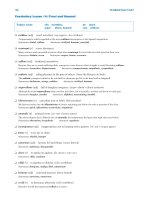
1. If 4 quarts of apple juice are mixed with
5 quarts of cranberry juice and 3 quarts of
grape juice, what part of the total mixture is
apple juice?
(A) (B) (C)
(D) (E)
2. For what value of y does ?
(A) −3 (B) (C)
(D) 3 (E) 6
3. Which of the following is greatest?
(A) (B) (C)
(D) (E)
4. If , then x =
(A) (B) (C)
(D) (E) 10
5. If , then m =
(A) (B) (C)
(D) 3 (E) 5
6. If x ≠ y and x + y = 0, then
(A) −1 (B) 0 (C)
1
⁄2
(D) 1 (E) 2
x
y
=
2
3
2
5
1
3
1
2
15
6
+=
m
5
2
2
5
1
5
1
10
1
2
5
x
=
2
3
1÷
2
3
2
3
÷
1
2
3
÷1
2
3
−
2
3
1×
1
3
−
1
3
1
3
y
=−
2
3
4
9
1
3
1
4
1
6
7. If , then m + 2n =
(A) (B) (C) 5 (D) 7 (E) 14
8. If z ≠ 0, which of the following is equivalent
to ?
(A) 1 (B) (C)
(D) (E)
9. Five-eighths of Ms. Talbott’s students are boys,
and two-thirds of the girls do not have dark
hair. What fraction of Ms. Talbott’s students
are girls with dark hair?
(A) (B) (C)
(D) (E)
10. If , then x =
2
3
6
7
1
6
2
3
1
6
1
+−=−+
x
1
3
1
4
1
8
1
10
1
24
z
z
2
1+
z
z +1
2
z
1
2z
1
1
z
z
+
7
2
7
4
mn
42
7
8
+=
SAT Practice 3: Fractions
1
2
3
4
5
7
8
9
6
1
0
2
3
4
5
7
8
9
6
1
0
2
3
4
5
7
8
9
6
1
0
2
3
4
5
7
8
9
6
11. If n > 1, and , then x =
(A) (B) (C)
(D) (E)
m
n
+
+
1
1
m
n
+
−
1
1
m
n
+1m
n +1
m
n −1
nx
mx+
= 1
CHAPTER 7 / ESSENTIAL PRE-ALGEBRA SKILLS 281
Concept Review 3
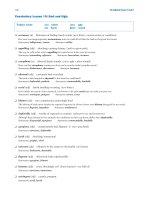
1. 19/35 (Use zip-zap-zup: it’s better than using your
calculator!)
2. 20/3 (Change to 5/2 × 8/3.)
3. 8/3 (Divide numerator and denominator by their
common factor: 7.)
4. 8/45 (Change to 2/9 × 4/5.)
5. (12x + 14)/21x (Use zip-zap-zup.)
6. 4x/3z (Change to 3x/2 × 8/9z and simplify.)
7. (3m + 1)/(2m + 1) (Factor and cancel 4 from the
numerator and denominator.)
8. −1/(6x) (Change to −2/(9x
2
) × 3x/4 and simplify.)
9. 13/12 (Change to 6/12 + 4/12 + 3/12.)
10. (3 − 2x)/4 (Use zip-zap-zup and simplify.)
11. x + 5 (As long as x ≠ 5.) (Factor as
and cancel the common factor. For factoring re-
view, see Chapter 8, Lesson 5.)
xx
x
−
()
+
()
−
()
55
5
12. (2n + 3)/4n (Divide numerator and denominator
by the common factor: 3. Don’t forget to “distrib-
ute” the division in the numerator!)
13.
1
⁄
4
14.
1
⁄
5
15.
1
⁄
10
16.
1
⁄
3
(Knowing how to “convert” numbers back and
forth from percents to decimals to fractions can
be very helpful in simplifying problems!)
17. Multiply by the reciprocal of the fraction.
18. “Cross-multiply” to get the new numerators, and
multiply the denominators to get the new
denominator, then just add (or subtract) the
numerators.
19. Only common factors. (Factors = terms in
products.)
20. Just divide the numbers by hand or on a calculator.
21. 4/9 (Not 4/5! Remember the fraction is a part of
the whole, which is 27 students, 12/27 = 4/9.)
22. 27 (If 2/3 are girls, 1/3 are boys: t/3 = 9, so t = 27.)
23. It must have a value between 0 and 1 (“bottom-
heavy”).
Answer Key 3: Fractions
SAT Practice 3
1. C 4/(4+5+3) = 4/12 = 1/3
2. B
Multiply by y: 1 =−3y
Divide by −3:
3. C
4. A Multiply by x:
Multiply by :
1
10
= x
1
5
1
2
5= x
1
2
5
x
=
1
2
3
3
3
2
3
1
3
0 333
1
2
3
1
3
2
15
2
3
2
3
2
3
−=−= =
÷=× =
÷=
.
××= =
÷= × =
3
2
6
6
1
2
3
1
2
3
1 0 666.
2
3
1 0 666×=.
−=
1
3
y
1
3
y
=−
5. D Multiply by 6m: 3m + 6 = 5m
Subtract 3m: 6 = 2m
Divide by 2: 3 = m
6. A The quotient of opposites is always −1. (Try
x = 2 and y =−2 or any other solution.)
7. B To turn into m + 2n, we only need to
multiply by 4!
8. E You can solve this by “plugging in” a number
for z or by simplifying algebraically. To plug in,
pick z = 2 and notice that the expression equals
2
⁄5
or 4. Substituting z = 2 into the choices shows
that only (E) is .4.
Alternatively, you can simplify by just multiply-
ing numerator and denominator by z:
9. C
5
⁄8 are boys, so
3
⁄8 must be girls. Of the girls,
2
⁄3
do not have dark hair, so
1
⁄3 do. Therefore,
1
⁄3 of
3
⁄8
of the class are girls with dark hair.
1
⁄3 ×
3
⁄8 =
1
⁄8.
1
1
1
1
1
2
z
z
z
zz
z
z
z
+
=
×
+
⎛
⎝
⎜
⎞
⎠
⎟
=
×
mn
mn
+= +
⎛
⎝
⎜
⎞
⎠
⎟
=
⎛
⎝
⎜
⎞
⎠
⎟
==24
42
4
7
8
28
8
7
2
mn
42
+
1
2
15
6
+=
m
11. A Multiply by m + x: nx = m + x
Subtract x: nx − x = m
Factor: x(n − 1) = m
Divide by (n − 1):
x
m
n
=
−1
nx
mx+
= 1
10. 7/6 or 1.16 or 1.17 Begin by subtracting 2/3
from both sides and adding −1/6 to both sides, to
simplify. This gives . Just “reciprocate”
both sides or cross-multiply.
6
7
1
=
x
282 MCGRAW-HILL’S SAT
CHAPTER 7 / ESSENTIAL PRE-ALGEBRA SKILLS 283
Working with Ratios
When you see a ratio—such as 5:6—don’t let it
confuse you. If it is not a part-to-part ratio,
then just think of it as a fraction. For instance,
5:6 = 5/6. If it is a part-to-part ratio, just divide
each number by the sum to find the fraction of
each part to the whole. For instance, if the
ratio of boys to girls in a class is 5:6, then the
sum is 5 + 6 = 11, so the boys make up 5/11 of
the whole class, and the girls make up 6/11 of
the whole class. (Notice that these fractions
must add up to 1!)
Example:
If a $200 prize is divided up among three people
in a 1:4:5 ratio, then how much does each person
receive? The total of the parts is 1 + 4 + 5 = 10.
Therefore, the three people receive 1/10, 4/10, and
5/10 of the prize, respectively. So one person gets
(1/10) ϫ $200 = $20, another gets (4/10) ϫ $200 =
$80, and the other gets (5/10) ϫ $200 = $100.
Working with Proportions
A proportion is just an equation that says that
two fractions are equal, as in 3/5 = 9/15. Two
ways to simplify proportions are with the law
of cross-multiplication and with the law of cross-
swapping. The law of cross-multiplication says
that if two fractions are equal, then their
“cross-products” also must be equal. The law
of cross-swapping says that if two fractions are
equal, then “cross-swapping” terms will create
another true proportion.
Example:
If we know that then by the law of
cross-multiplication, we know that 7x = 12, and
by the law of cross-swapping, that .
In a word problem, the phrase “at this rate”
means that you can set up a proportion to
solve the problem. A rate is just a ratio of some
quantity to time. For instance, your reading
rate is in words per minute; that is, it is the ratio
x
3
4
7
=
x
4
3
7
= ,
of the number of words you read divided by
the number of minutes it takes you to read
them. (The word per acts like the : in the ratio.)
IMPORTANT: When setting up the propor-
tion, check that the units “match up”—that the
numerators share the same unit and the de-
nominators share the same unit.
Example:
A bird can fly 420 miles in one day if it flies con-
tinuously. At this rate, how many miles can the
bird fly in 14 hours?
To solve this, we can set up a proportion that says that
the two rates are the same.
Notice that the units “match up”—miles in the nu-
merator and hours in the denominator. Now we can
cross-multiply to get 420 ϫ 14 = 24x and divide by 24
to get x = 245 miles.
Similarity
Two triangles are similar (have the same shape)
if their corresponding angles all have the same
measure. If two triangles are similar, then their
corresponding sides are proportional.
Example:
In the figure above,
When setting up proportions of sides in simi-
lar figures, double-check that the correspond-
ing sides “match up” in the proportion. For
instance, notice how the terms “match up” in
the proportions above.
m
k
n
l
r
m
n
k
l
==o
m
n
kl
420 miles
24 hours
miles
hours
=
x
14
Lesson 4: Ratios and Proportions
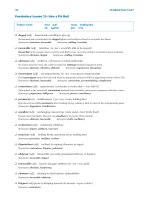
1. A speed is a ratio of __________ to __________. 2. An average is a ratio of __________ to __________.
3. Define a proportion:
__________________________________________________________________________________________________
__________________________________________________________________________________________________
4. Write the law of cross-multiplication as an “If . . . then . . .” statement:
If _________________________________________________________________________________________________
then ______________________________________________________________________________________________
5. Write three equations that are equivalent to . 5. a)__________
b)__________
c)__________
6. Three people split a $24,000 prize in a ratio of 2:3:5. What is the value of each portion? 6. a)__________
b)__________
c)__________
7. A machine, working at a constant rate, manufactures 25 bottles every 6 minutes. 7. ____________
At this rate, how many hours will it take to produce 1,000 bottles?
8. If m meteorites enter the Earth’s atmosphere every x days (m > 0), then, at this rate, 8. ____________
how many meteors will enter the Earth’s atmosphere in mx days?
9. In the diagram above, ᐉ
1
⏐⏐ ᐉ
2
, AC = 4, BC = 5, and CE = 6. What is DE? 9. ____________
10. There are 12 boys and g girls in Class A, and there are 27 girls and b boys in Class B. 10. ____________
In each class, the ratio of boys to girls is the same. If b = g, then how many
students are in Class A?
A
B
C
D
E
ᐉ
1
ᐉ
2
2
3x
y
=
Concept Review 4: Ratios and Proportions
284 MCGRAW-HILL’S SAT
CHAPTER 7 / ESSENTIAL PRE-ALGEBRA SKILLS 285
1. If x is the product of .03 and .2, then x is equiv-
alent to the ratio of 6 to what number?
6. If 3,600 baseball caps are distributed to 4 stores
in the ratio of 1:2:3:4, what is the maximum num-
ber of caps that any one store receives?
(A) 360 (B) 720 (C) 1,080
(D) 1,440 (E) 14,400
7. David’s motorcycle uses of a gallon of gaso-
line to travel 8 miles. At this rate, how many
miles will it travel on 5 gallons of gasoline?
2
5
SAT Practice 4: Ratios and Proportions
1
2
3
4
5
7
8
9
6
1
0
2
3
4
5
7
8
9
6
1
0
2
3
4
5
7
8
9
6
1
0
2
3
4
5
7
8
9
6
2. Jar A contains six red marbles and no green
marbles. Jar B contains two red marbles and
four green marbles. How many green marbles
must be moved from Jar B to Jar A so that the
ratio of green marbles to red marbles is the
same for both jars?
(A) 0 (B) 1 (C) 2 (D) 3 (E) 4
3. 90 students are at a meeting. The ratio of girls
to boys at the meeting is 2 to 3. How many
girls are at the meeting?
(A) 30 (B) 36 (C) 40
(D) 54 (E) 60
4. If , then 5x + 1 =
(A) 3y + 1 (B) 3y + 2 (C) 3y + 3
(D) 3y + 4 (E) 3y + 5
5. On a map that is drawn to scale, two towns
that are x miles apart are represented as being
4 inches apart. If two other towns are
x + 2 miles apart, how many inches apart
would they be on the same map?
(A) 4(x + 2) (B) 6 (C)
(D) (E)
6
x
42x
x
+
()
4
2
x
x +
x
y +
=
1
3
5
1
2
3
4
5
7
8
9
6
1
0
2
3
4
5
7
8
9
6
1
0
2
3
4
5
7
8
9
6
1
0
2
3
4
5
7
8
9
6
8. On a blueprint that is drawn to scale, the draw-
ing of a rectangular patio has dimensions 5 cm
by 7.5 cm. If the longer side of the actual patio
measures 21 feet, what is the area, in square
feet, of the actual patio?
(A) 157.5
(B) 294.0
(C) 356.5
(D) 441.0
(E) 640.5
9. To make a certain purple dye, red dye and blue
dye are mixed in a ratio of 3:4. To make a cer-
tain orange dye, red dye and yellow dye are
mixed in a ratio of 3:2. If equal amounts of the
purple and orange dye are mixed, what frac-
tion of the new mixture is red dye?
(A) (B) (C)
(D) (E)
1
1
27
40
18
35
1
2
9
20
286 MCGRAW-HILL’S SAT
Concept Review 4
1. distance to time
2. a sum to the number of terms in the sum
3. A proportion is a statement that two fractions or
ratios are equal to each other.
4. If two fractions are equal, then the two “cross-
products” must also be equal.
5. a) 6 = xy b) c)
6. $4,800, $7,200, and $12,000. The sum of the parts
is 2 + 3 + 5 = 10, so the parts are 2/10, 3/10, and
5/10 of the whole.
7. 4.
Cross-multiply: 25x = 6,000
Divide by 25: x = 240 minutes
Convert to hours:
240
1
4mins
hour
60 mins
hrs×
⎛
⎝
⎜
⎞
⎠
⎟
=
25 bottles
6 minutes
=
1,000 bottles
minutesx
2
3y
x
=
3
2x
y
=
8. m
2
. “At this rate . . .” implies a proportion:
Cross-multiply: m
2
x = ?x
Divide by x: m
2
= ?
9. 12.5. Because ᐉ
1
⏐⏐ ᐉ
2
; ΔABC is similar to ΔADE.
Thus, . Substituting x for DE gives
.
Cross-multiply: 4x = 50
Divide by 4: x = 12.5
10. 30. Since the ratios are the same, .
Cross-multiply: bg = 324
Substitute b for g: b
2
= 324
Take the square root: b = 18
So the number of students in Class A = 12 + 18 = 30.
12
27g
b
=
4
46
5
+
=
x
AC
AE
BC
DE
=
m
xmx
meteorites
days
? meteorites
days
=
Answer Key 4: Ratios and Proportions
SAT Practice 4
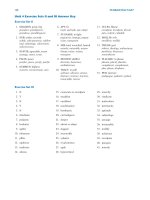
1. 1,000. .03 × .2 = 6/x
Simplify: .006 = 6/x
Multiply by x: .006x = 6
Divide by .006: x = 1,000
2. D Moving three green marbles from Jar B to Jar
A leaves three green marbles and six red marbles
in Jar A and one green marble and two red marbles
in Jar B. 3:6 = 1:2.
3. B 2:3 is a “part to part” ratio, with a sum of 5.
Therefore 2/5 of the students are girls and 3/5 are
boys. 2/5 of 90 = 36.
4. D Cross-multiply: 5(x) = 3(y + 1)
Simplify: 5x = 3y + 3
Add 1: 5x + 1 = 3y + 4
5. D Since the map is “to scale,” the correspond-
ing measures are proportional:
Cross-multiply: ?x = 4(x + 2)
Divide by x:
6. D The ratio is a “ratio of parts” with a sum of
1 + 2 + 3 + 4 = 10. The largest part, then, is 4/10 of
the whole. 4/10 of 3,600 = .4 × 3,600 = 1,440.
? =
+
()
42x
x
xx
4
2
=
+
?
7. 100. “At this rate” implies a proportion:
Cross-multiply:
Multiply by :
8. B
Set up the proportion:
Cross-multiply: 7.5x = 105
Divide by 7.5: x = 14 feet
Find the area: Area = 21 × 14 = 294 ft
2
9. C Each ratio is a “ratio of parts.” In the purple
dye, the red dye is 3/(3 + 4), or 3/7, of the total, and
in the orange dye, the red dye is 3/(3 + 2), or 3/5, of
the total. If the mixture is half purple and half
orange, the fraction of red is
1
2
3
7
1
2
3
5
3
14
3
10
72
140
18
35
⎛
⎝
⎜
⎞
⎠
⎟
+
⎛
⎝
⎜
⎞
⎠
⎟
=+= =
75
5
21.
=
x
7.5 cm
5 cm
21 feet
x feet
x =× = =
5
2
40
200
2
100 miles
5
2
2
5
40x =
2
5
5
gallon
8miles
gallons
miles
=
x
CHAPTER 7 / ESSENTIAL PRE-ALGEBRA SKILLS 287
Word Problems with Percents
The word percent simply means divided by 100.
Word problems are easy to solve once you
know how to translate sentences into equa-
tions. Use this key:
Example:
What number is 5 percent of 36?
Use the translation key to translate the question
into
Then simplify to get x = 1.8.
Example:
28 is what percent of 70?
Use the translation key to translate the question
into
Then simplify to get 28 = .7x and divide by .7 to get
x = 40.
To convert a percent into a decimal, just re-
member that percent means divided by 100
and that dividing by 100 just means moving
the decimal two places to the left.
Example:
35.7% = 35.7÷100 = .357 .04% = .04÷100 = .0004
Finding “Percent Change”
Some word problems ask you to find the “per-
cent change” in a quantity, that is, by what per-
cent the quantity increased or decreased. A
percent change is always the percent that the
change is of the original amount. To solve
these, use the formula
28
100
70=×
x
x =×
5
100
36
Percent change =
final amount – starting amount
× 100%
starting amount
Example:
If the population of Bradford increased from
30,000 to 40,000, what was the percent increase?
According to the formula, the percent change is
Increasing or Decreasing by Percents
When most people want to leave a 20% tip at a restau-
rant, they do two calculations: First, they calculate
20% of the bill, and then they add the result to the orig-
inal bill. But there’s a simpler, one-step method: Just
multiply the bill by 1.20! This idea can be enormously
helpful on tough percent problems. Here’s the idea:
When increasing or decreasing a quantity by a
given percent, use the one-step shortcut: Just
multiply the quantity by the final percentage.
For instance, if you decrease a quantity by
10%, your final percentage is 100% – 10% =
90%, so just multiply by 0.9. If you increase a
quantity by 10%, your final percentage is 100% +
10% = 110%, so just multiply by 1.1.
Example:
If the price of a shirt is $60 but there is a 20% off
sale and a 6% tax, what is the final price?
Just multiply $60 by .80 and by 1.06: $60 ϫ .80 ϫ
1.06 = $50.88
Here’s a cool fact that simplifies some percent
problems: a% of b is always equal to b% of a.
So, for instance, if you can’t find 36% of 25 in
your head, just remember that it’s equal to
25% of 36! That means 1/4 of 36, which is 9.
40 000 30 000
30 000
100 33
1
3
,,
,
%%
−
×=
Lesson 5: Percents
percent means ÷100
is means =
of means ×
what means x, y, n, etc.
288 MCGRAW-HILL’S SAT
Concept Review 5: Percents
1. Complete the translation key:
2. Write the formula for “percent change”:
3. To increase a quantity by 30%, multiply it by _____ 4. To decrease a quantity by 19%, multiply it by _____
5. To increase a quantity by 120%, multiply it by _____ 6. To decrease a quantity by 120%, multiply it by _____
Translate the following word problems and solve them.
7. 5 is what percent of 26? Translation: ____________________ Solution: __________________
8. 35% of what number is 28? Translation: ____________________ Solution: __________________
9. 60 is 15% of what number? Translation: ____________________ Solution: __________________
10. What percent is 35 of 20? Translation: ____________________ Solution: __________________
11. What percent greater than 1,200 is 1,500? 11. ___________
12. If the price of a sweater is marked down from $80 to $68, what is the percent markdown? 12. ___________
13. The population of a city increases from 32,000 to 44,800. What is the percent increase? 13. ___________
14. What number is 30% greater than 20? 14. ___________
15. Increasing a number by 20%, then decreasing the new number by 20%, is the same as multiplying the orig-
inal by _____.
16. Why don’t the changes in problem 15 “cancel out”?
__________________________________________________________________________________________________
17. If the sides of a square are decreased by 5%, by what percent is the area of the 17. ___________
square decreased?
18. 28% of 50 is the same as _____percent of _____, which equals _____.
19. 48% of 25 is the same as _____percent of _____, which equals _____.
Word(s) in problem Symbol in equation
what, what number, how much
of
=
percent
SAT Practice 5: Percents
CHAPTER 7 / ESSENTIAL PRE-ALGEBRA SKILLS 289
1. David has a total of $3,500 in monthly
expenses. He spends $2,200 per month on rent
and utilities, $600 per month on clothing and
food, and the rest on miscellaneous expenses.
On a pie graph of his monthly expenses, what
would be the degree measure of the central
angle of the sector representing miscellaneous
expenses?
(A) 45° (B) 50° (C) 70°
(D) 72° (E) 75°
2. In one year, the price of one share of ABC
stock increased by 20% in Quarter I, increased
by 25% in Quarter II, decreased by 20% in
Quarter III, and increased by 10% in Quarter
IV. By what percent did the price of the stock
increase for the whole year? (Ignore the %
symbol when gridding.)
5. The cost of a pack of batteries, after a 5% tax,
is $8.40. What was the price before tax?
(A) $5.60
(B) $7.98
(C) $8.00
(D) $8.35
(E) $8.82
6. If the population of Town B is 50% greater
than the population of Town A, and the popu-
lation of Town C is 20% greater than the pop-
ulation of Town A, then what percent greater
is the population of Town B than the popula-
tion of Town C?
(A) 20% (B) 25% (C) 30%
(D) 35% (E) 40%
7. If the length of a rectangle is increased by 20%
and the width is increased by 30%, then by
what percent is the area of the rectangle
increased?
(A) 10% (B) 50%
(C) 56% (D) 65%
(E) It cannot be determined from the given
information.
8. If 12 ounces of a 30% salt solution are mixed
with 24 ounces of a 60% salt solution, what is
the percent concentration of salt in the mixture?
(A) 45% (B) 48% (C) 50%
(D) 52% (E) 56%
9. The freshman class at Hillside High School
has 45 more girls than boys. If the class has n
boys, then what percent of the freshman class
are girls?
(A) (B)
(C) (D)
(E)
100 45
45
n
n
+
()
+
%
100 45
245
n
n
+
()
+
%
100
245
n
n +
%
n
n
+
+
45
245
%
n
n + 45
%
1
2
3
4
5
7
8
9
6
1
0
2
3
4
5
7
8
9
6
1
0
2
3
4
5
7
8
9
6
1
0
2
3
4
5
7
8
9
6
3. On a two-part test, Barbara answered 60% of
the questions correctly on Part I and 90% cor-
rectly on Part II. If there were 40 questions on
Part I and 80 questions on Part II, and if each
question on both parts was worth 1 point,
what was her score, as a percent of the total?
(A) 48% (B) 75% (C) 80%
(D) 82% (E) 96%
4. If x is of 90, then 1 − x =
(A) −59 (B) −5 (C) 0
(D) 0.4 (E) 0.94
2
3
%