Master gmat 2010 part 12 pps
Bạn đang xem bản rút gọn của tài liệu. Xem và tải ngay bản đầy đủ của tài liệu tại đây (41.17 KB, 10 trang )
Verbal Section
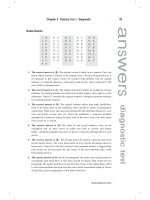
1. B
2. C
3. B
4. D
5. B
6. D
7. E
8. C
9. D
10. E
11. A
12. A
13. E
14. A
15. C
16. E
17. D
18. C
19. E
20. A
21. A
22. E
23. E
24. A
25. B
26. C
27. D
28. B
29. E
30. A
31. B
32. D
33. B
34. D
35. E
36. A
37. D
38. B
39. C
40. C
41. C
1. The correct answer is (B). The original version is faulty in two respects. First, the
plural subject benefits is followed by the singular verb is. Second, the preposition by is
not idiomatic in this context. Choice (B) remedies both problems with the original
sentence—by using the plural are, which agrees with benefits, and by replacing by with
from (which is idiomatic here).
2. The correct answer is (C). The original statement includes an ambiguous pronoun
reference. It is unclear whether they refers to the bounty hunters, their captives, or the
authorities. Choice (C) remedies the original sentence’s ambiguous pronoun reference
by reconstructing the sentence.
3. The correct answer is (B). The original sentence suffers from faulty parallelism.
Each of the three items in the underlined clause should be similar in grammatical
construction. While actors and musicians both describe the celebrities themselves, some
other high-profile vocation does not. Choice (B) establishes a consistent (parallel)
grammatical construction among the three items in the series; each of the three items
refers clearly to a vocation.
4. The correct answer is (D). The claim (in the second sentence) relies on the
assumption that all other factors in weight loss—such as exercise and dietary
habits—remained unchanged from prior to the two-week period through the two-week
period.
5. The correct answer is (B). The passage draws the general conclusion that home
buyers should “always” buy a new house based on a few specific advantages that new
houses offer. Choice (B) is the best criticism of the argument because it suggests that
these factors are not necessarily the only factors, or the most important ones, in the
home-buying decision.
6. The correct answer is (D). In the first paragraph, the author cites certain erroneous
assumptions upon which the U.S. New Town concept was based. Then, in the next two
paragraphs, the author describes how and why New Towns in the United States failed
to solve urban problems and to provide the sort of social environment hoped for. Choice
(D) provides a good recapitulation of this entire discussion.
answers
diagnostic test
Chapter 3: Practice Test 1: Diagnostic 93
www.petersons.com
7. The correct answer is (E). In the second paragraph, the author states that one of the
effects of New Towns was to draw high-income citizens away from the cities—
essentially what choice (E) indicates.
8. The correct answer is (C). According to the first sentence of the passage, New Towns
were originally conceptualized as a way to absorb growth. Based on other information
in the passage, it appears that U.S. New Towns achieved this objective—at least to
some extent—since city residents who could afford to move away from urban centers did
so. At the same time, however, the cities were left with new problems, such as an
insufficient tax base to support themselves and to retain businesses. Thus, like the
phenomenon that choice (C) describes, New Towns were an innovation that served to
solve one problem but created another along the way.
9. The correct answer is (D). The original sentence suffers from faulty parallelism. The
second occurrence of from should be deleted to restore the proper parallelism between
the phrases the host and the diplomat’s. At the same time, the word both is redundant
in light of the words the other at the end of the sentence, thereby confusing the meaning
of the sentence. Choice (D) remedies the original sentence’s faulty parallelism by
reconstructing the phrase, using the subjunctive form (that be).
10. The correct answer is (E). If the statement in choice (E) is true, it suggests that
Company X’s experience is comparable to that of other merging companies, and
therefore it is unlikely that many more Company X workers will leave as a result of
the merger.
11. The correct answer is (A). Gwen’s argument relies on the assumption that expensive
restaurants are not as popular among the college students as inexpensive restaurants.
Jose provides one reason why expensive restaurants are not necessarily less popular
among the college students, suggesting that the disagreement is about whether
expensive restaurants are in fact less popular among the college students than
inexpensive ones.
12. The correct answer is (A). The original version is the best one. The noun clause
whether the universe is bound is properly considered the subject of the sentence.
13. The correct answer is (E). The original sentence improperly uses less instead of fewer
in reference to a numerical quantity (the number of chemicals tested). Also, the modifier
most of which is separated from its antecedent (thirty), resulting in confusion as to
whether most of which refers to the thirty chemicals tested or the tests themselves.
Choice (E) remedies both problems in the original sentence.
14. The correct answer is (A). The original sentence correctly uses the singular pronoun
its in referring to the singular bureaucracy. Also, Choice (A) is consistent in its use of
the future tense.
15. The correct answer is (C). The passage describes an imaginary debate over the
American democratic ideal among the writers of the American Renaissance, in which
Emerson, Thoreau, and Whitman are grouped together in one school of thought while
Hawthorne and Melville are paired in another. Choice (C) nicely matches this recap.
94 PART II: Diagnosing Strengths and Weaknesses
www.petersons.com
16. The correct answer is (E). The passage is clear throughout that Emerson is an
idealist, which is just the opposite of a pragmatist.
17. The correct answer is (D). According to the passage, Melville, through his story
Pierre, conveyed the notion that democratic idealism was based on “misguided
assumptions.” Although the author is not as explicit that Hawthorne also believed
idealists to be misguided, Hawthorne’s conclusion that transcendental freedom leads to
moral anarchy can reasonably be interpreted this way.
18. The correct answer is (C). The argument’s conclusion is that the new lifeguard was
not a factor in the declining number of deaths from last year to this year. Choice (C)
rules out one other possible explanation for the decline in the number of drownings, in
turn rendering it more likely that the additional lifeguard did contribute to the decline.
19. The correct answer is (E). The conclusion in choice (E) is logically inferable from two
premises given in the passage: (1) If MetaCorp continues to show a profit, then analysts
will continue to recommend it (in symbolic form: If A, then B), and (2) if analysts
recommend MetaCorp stock, then the stock’s price will at least remain at its current
level—in other words, either remain the same or increase (in symbolic form: If B,
then C). From these two premises, choice (E) is logically inferable (in symbolic form:
If A, then C).
20. The correct answer is (A). The argument that the public is interested in high culture
relies on the assumption that opera, ballet, and classical music are considered “high
culture.” Choice (A) provides some evidence that this necessary assumption is a
questionable one.
21. The correct answer is (A). The discrepancy among the cited studies involves the
increase in the level of violence in television programming over the last twenty years.
One possible explanation for the discrepancy is that the recent studies relied on
different previous studies, which disagreed as to what the level was twenty years ago.
22. The correct answer is (E). The original version improperly uses derive instead of the
proper idiom are derived from. Choice (E) corrects this diction error.
23. The correct answer is (E). The original sentence is faulty in its use of the pronoun
them instead of the possessive their where the object of a verb (opposed) is a gerund
(trivializing). Choice (E) corrects the improper use of them, replacing it with the
possessive their, which properly precedes the gerund trivializing.
24. The correct answer is (A). The original sentence is correct in its use of the idiomatic
phrase have yet to.
25. The correct answer is (B). The factual information cited in the passage suggests that
eating high-fat foods does not cause obesity. However, that information is no help in
determining the real cause. By showing that the rise in obesity has coincided with an
increase in the sales of high-sugar foods, choice (B) suggests that excessive sugar
consumption might be the cause. Although this correlation in itself does not irrefutably
prove that sugar is the culprit, it nevertheless helps strengthen the case.
answers
diagnostic test
Chapter 3: Practice Test 1: Diagnostic 95
www.petersons.com
26. The correct answer is (C). The argument’s first sentence suggests that the supply-
demand ratio for rental apartments with two or more bedrooms is decreasing at a faster
rate than the supply-demand ratio of rental apartments with one or fewer bedrooms.
One possible explanation for the difference is the one that choice (C) provides.
27. The correct answer is (D). The original version is faulty in two respects. First, the
placement of the commas sets up a flawed parallel structure between the progressive
verbs was considered and will be considered. Second, the phrase considered as is
idiomatically questionable here. A person is considered or considered to be, not
considered as, at least in the broader context of this sentence. Choice (D) remedies both
problems with the original sentence.
28. The correct answer is (B). According to the passage, all cells of an organism contain
the same genotype as the fertilized egg (lines 14–16). Thus, choice (B) contradicts the
information in the passage.
29. The correct answer is (E). According to the passage, the maternal programming of
early development and the genomic control of later differentiation are “especially well
documented” (line 46).
30. The correct answer is (A). In the first two paragraphs, the author discusses the
process of cell differentiation in embryonic development. While the author is
particularly concerned with examining the mechanisms involved, no specific type of
organism (animal) is discussed as an illustration until the final paragraph (which
focuses on the sea urchin). Accordingly, choice (A) properly reflects the flow of the
author’s discussion.
31. The correct answer is (B). The passage allows you to confidently conclude that
biotechnology firms will in fact continue to replace equipment more frequently than
other businesses, and therefore will stand to benefit from the proposed law more than
other businesses. It would make sense, then, that the biotechnology lobbyists might be
behind the proposal.
32. The correct answer is (D). Higher admission standards would reduce the number of
options available to new college graduates, thereby increasing the likelihood that a new
college graduate would enter one of the lower-paying professions that requires only a
four-year degree.
33. The correct answer is (B). The original sentence awkwardly mixes the active voice
(first clause) and the passive voice (second clause). It also includes the unnecessarily
wordy by way of. Choice (B) corrects both problems with a concise second clause in the
active voice.
34. The correct answer is (D). The original sentence misplaces the phrase Even for high
school freshmen and sophomores. This phrase is intended to modify many students;
therefore, the author should reconstruct the sentence so that the two phrases appear
nearer to each other. Choice (D) moves the initial phrase to the end of the sentence,
clarifying the sentence’s meaning.
96 PART II: Diagnosing Strengths and Weaknesses
www.petersons.com
35. The correct answer is (E). The argument suggests that the key to a third-world
country’s political stability is to afford its citizens certain powers. However, the
argument relies entirely on one observed case (Country X) in which both characteristics
are present. To be convincing, the argument must at least show that these powers
actually contributed to Country X’s political stability. Choice (E) provides one plausible
scenario in which these powers could have nothing to do with the country’s
political stability.
36. The correct answer is (A). It is reasonably inferable from the first paragraph as a
whole that the “standard repertory” mentioned in line 15 refers to the music of Bach
and Telemann as well as to other (“modern”) music from their time (first half of the
eighteenth century). In the second paragraph, the author mentions that the music of
Bach, Telemann, and their contemporaries called for obsolete instruments (lines 33–36).
Thus, the standard repertory might have included music that called for the use of
obsolete instruments, as choice (A) indicates.
37. The correct answer is (D). Although the passage does indicate that early music often
called for the use of obsolete instruments, the passage does not state explicitly that
performance practice involved determining which musical instrument to use.
38. The correct answer is (B). According to the passage, the German musicologists did
not study the music of Mozart and Haydn (post-1750 music) because, among other
reasons, their music, “having never ceased to be performed, had maintained some kind
of oral tradition of performance practice” (lines 51–54). Unannotated music is music
that is not written, but strictly oral. Choice (B) restates the author’s point in these lines.
39. The correct answer is (C). According to the passage, performance practice was
developed alongside the modern (early twentieth-century) collegium musicum, which
was part of the German university. While the modern collegium musicum performed
music from before the time of Bach and Handel, scholars in the field of performance
practice studied certain aspects (e.g., choice of instruments, deciphering notation) of
music from the same time period.
40. The correct answer is (C). If there are other ways to prevent one’s cat from
accumulating hairballs, then there is no reason to risk the cat’s developing an allergic
reaction (and in turn a harmful infection) by feeding it the medicated food.
41. The correct answer is (C). The original sentence contains a misplaced modifying
phrase (following the comma). The sentence’s construction suggests that it is the
electorate that cannot reasonably be disputed, although this makes little sense in the
context of the sentence as a whole. Choice (C) remedies the underlined phrase’s faulty
construction by rephrasing it as a noun clause.
answers
diagnostic test
Chapter 3: Practice Test 1: Diagnostic 97
www.petersons.com
P
ART III
GMAT ANALYTICAL
WRITING ASSESSMENT
CHAPTER 4 Issue Analysis
CHAPTER 5 Argument Analysis
CHAPTER 6 Writing Style and Mechanics
OVERVIEW
• The 7-step plan
• “Qualifying” your viewpoint
• Debating a statement’s pros and cons
• Developing rhetorical arguments
• Putting it all together
• Rhetorical effectiveness and your essay’s structure
• Keys to writing a successful GMAT issue analysis essay
• Summing it up
THE 7-STEP PLAN
In this part of the book, you’ll learn the basics and some advanced techniques
for writing effective GMAT Issue Analysis and Argument Analysis essays that
will earn you a better-than-average Analytical Writing Assessment score of at
least 4 on the 0–6 scale. Specifically, you will learn the following:
• A step-by-step approach to brainstorming, organizing, composing,
and proofreading your essays, all comfortably within the 30-minute
time limit for each writing task
• Success keys to scoring higher with your essays than most GMAT
test takers
• Useful tips for writing mechanics and for developing a writing style
that’s appropriate for the GMAT
For a high-scoring Issue Analysis essay, you need to accomplish these four
basic tasks:
Recognize and deal with the complexities and implications of the
Issue
Organize, develop, and express your ideas in a coherent and persua-
sive manner
chapter 4
101
Support your ideas with sound reasons and relevant examples
Demonstrate adequate control of the elements of Standard Written English (gram-
mar, syntax, and usage)
The 30 minutes you’re allowed to write your Issue essay isn’t much time, so you will need to
use the time wisely. This does not mean using every one of your 30 minutes to peck away at
the keyboard like mad. You should spend some time up front thinking about what you should
write and how you should organize your ideas. And you should save some time at the end to
proofread and fine-tune your essay. Here’s a 7-step game plan to help you budget your time so
you can accomplish all four tasks listed above within your 30-minute time limit (suggested
times are in parentheses):
Brainstorm and make notes (3 min.)
Review your notes and decide on a viewpoint (1 min.)
Organize your ideas into a logical sequence (1 min.)
Compose a brief introductory paragraph (2 min.)
Compose the body of your essay (16 min.)
Compose a brief concluding or summary paragraph (2 min.)
Proofread for glaring mechanical problems (5 min.)
Notice that, by following the suggested times for each step, you’ll spend about 5 minutes
planning your essay, 20 minutes writing it, and 5 minutes proofreading it.
In the following pages, you’ll walk through each step in turn, applying the following Issue
statement, which is similar to some of the statements in the official pool.
Issue Statement 1 (and Directive)
“Schools should be responsible not only for teaching academic skills but also for
teaching ethical and social values.”
Discuss the extent to which you agree or disagree with the foregoing statement.
Support your perspective using reasons and/or examples from your experience,
observation, reading, or academic studies.
Step One: Brainstorm and Make Notes (3 min.)
Your first step in developing your Issue essay is to brainstorm for ideas that are relevant to
the topic. Try to think of some reasons and examples supporting not just one side but both
sides of the issue. As you conjure up ideas, don’t commit to a position on the issue, and don’t
try to filter out what you think might be unconvincing reasons or weak examples. Just let all
your ideas flow onto your scratch paper, in no particular order. (You can sort through them
102 PART III: GMAT Analytical Writing Assessment
NOTE
These suggested
time limits for
each step are
merely guidelines.
As you practice
composing your
Issue essays under
timed conditions,
you can adjust to
a pace that
works best
for you.
www.petersons.com