Gale Encyclopedia Of American Law 3Rd Edition Volume 2 P13 docx
Bạn đang xem bản rút gọn của tài liệu. Xem và tải ngay bản đầy đủ của tài liệu tại đây (503.14 KB, 10 trang )
reform by serving as unpaid counsel in several
PUBLIC INTEREST cases. Brandeis was on e of the
first U.S. lawyers to offer pro bono services (free
legal services for people unable to afford an
attorney). Along with a passionate belief in the
virtue of volunteer legal work, Brandeis had a
sense of fairness that compelled him to compen-
sate his firm for any time spent in public service.
Brandeis worked without a fee to fight
monopolistic streetcar franchises in Boston and
to improve the questionable practices of life
insurance companies. One of his most satisfying
achievements was the creation of a savings bank
plan that enabled people to obtain life insurance
at reasonable rates. Brandeis also argued for
the constitutionality of maximum hour and
MINIMUM WAGE laws.
In 1914 Brandeis published Other People’s
Money—and How the Bankers Use It, a denun-
ciation of trusts and investment banking. The
book helped inspire important antitrust legisla-
tion and earned the antipathy of many U.S.
bankers and businesspeople.
Brandeis also created a new style of legal
writing, appropriately called the Brandeis brief.
With his sister-in-law Josephine Goldmark, of
the National Consumer ’s League, Brandeis
produced the first legal brief to include copious
supporting data. For Muller v. State of Oregon,
208 U.S. 412, 28 S. Ct. 324, 52 L. Ed. 551
(1908), Brandeis wrote more than one hundred
pages in favor of an Oregon state law mandating
a maximum ten-hour workday for women.
Later, when asked for an appropriate title for
the seminal Muller brief, Brandeis replied, What
Any Fool Knows. In the document, he described
the deleterious physical and mental effects on
women of extended periods of manual labor.
He included references to sociology, psycholo-
gy, history, politics, employment statistics, and
economics; this method of amassing data from
several different disciplines to persuade the court
became popular with other lawyers. The legal
principles of the case were discussed in about
two pages.
In 1916 Brandeis was appointed by Presi-
dent Woodrow Wilson to fill the associate
justice seat vacated by
JOSEPH R. LAMAR. Brandeis
thus became the first Jewish American to be
nominated for the High Court. His Senate
confirmation hearing was a bitter, drawn-out
affair because of business’s fierce opposition to
him and his progressive politics. Anti-Semitism
was also an element in the extended, four-month
proceedings. Despite virulent criticism from
insurance and banking officials, Brandeis was
confirmed by the Senate, 47–22.
As a Supreme Court justice, Brandeis is
remembered for his eloquent dissents, often
joined by colleague Oliver Wendell Holmes
Jr. Brandeis’s dissents frequently signaled how
the Court would rule in future cases. For
example, his 1928 dissent in
OLMSTEAD V. UNITED
STATES
, 277 U.S. 438, 48 S. Ct. 564, 72 L. Ed. 944,
anticipated the reasoning and outcome of a
Supreme Court case heard years later.
In Olmstead, Brandeis objected to the nearly
unrestricted use of government wiretaps. Al-
though the Olmstead majority approved state
WIRETAPPING unless a physical trespass was
involved, Brande is considered wholesale eaves-
dropping unconstitutional. In his view it violated
the
FOURTH AMENDMENT,prohibitingunreasonable
government searches, and the
FIFTH AMENDMENT,
forbidding the deprivation of liberty without
due process. Brandeis argued that the right to be
left alone was guaranteed by the Constitution.
Almost forty years later, his views on privacy
were adopted in Katz v. United States, 389 U.S.
347, 88 S. Ct. 507, 19 L. Ed. 2d 576 (1967). In
Katz, relying heavily on Brandeis’s reasoning,
the Court overturned Olmstead, ruling that
government wiretaps were permissible only if
they met procedural requirements of the Fourth
Amendment.
Despite his own clear convictions, Brandeis
refused to declare a law uncon stitutional simply
because he disagreed with it. Particularly in
economic matters, Brandeis exercised judicial
restraint by deferring to Congress and its legisla-
tive power.
Brandeis was an ardent defender of civil
liberties. Throughout his career, he strongly
urged the Court to use the
FOURTEENTH AMEND-
MENT
to apply the BILL OF RIGHTS to the states. In
particular, Brandeis declared that laws abridging
free speech and assembly must be challenged
if no emergency exists to justify them. Unless
speech causes clear and imminent danger, it is
unreservedly protected.
Although Brandeis was a nonobservant Jew,
he was a respected leader of the American Zionist
movement. From 1914 to 1921, Brandeis gave
his name and public support to the movement
to create a Jewish state in Palestine. In his later
GALE ENCYCLOPEDIA OF AMERICAN LAW, 3RD E DITION
108 BRANDEIS, LOUIS DEMBITZ
years Brandeis advised President FRANKLIN D.
ROOSEVELT on the establishment of a Jewish
homeland and the
BOYCOTT of German products.
Brandeis retired from the Court on Febru-
ary 13, 1939. He died at age 84 on October 5,
1941.
Brandeis was honored in 1948 when a new
institution of higher learning was named after
him. Brandeis University is a private, Jewish-
sponsored, coeducational college in Waltham,
Massachusetts. The nonsectarian school offers
both undergraduate and graduate degrees.
FURTHER READINGS
Baskerville, Stephen W. 1994. Of Laws and Limitations: An
Intellectual Portrait of Louis Dembitz Brandeis. Ruther-
ford, NJ: Fairleigh Dickinson Univ. Press.
Bracey, Christopher A. 2001. “Louis Brandeis and the Race
Question.” Alabama Law Review 52 (spring).
Goodhart, Arthur L. 2000. Five Jewish Lawyers of the
Common Law. Clark, NJ: Lawbook Exchange.
Schroeder, Mary Murphy. 2000. “The Brandeis Legacy.” San
Diego Law Review 37 (summer).
Strum, Philippa S. 1999. “The Unlikely Radical: After a
Violent Strike Shattered Louis Brandeis’ Assumptions
About the Legal System, He Transformed His Practice
and Became the Country’s Most Influential Public
Interest Advocate.” American Lawyer 21 (December).
CROSS REFERENCES
Antitrust Law; “Brief for the Defendant in Error, Muller v.
Oregon” (Appendix, Primary Document); Electronic Sur-
veillance; Olmstead v. United States; Privacy; Wiretapping.
BREACH OF MARRIAGE PROMISE
A common-law right of action for breaking a
commitment to enter into matrimony.
The
RIGHT OF ACTION for breach of a MARRIAGE
promise has been abolished in a majority of
states.
Agreement to Marry
An agreement to marry is different from all
other contractual relations. The reason for this
is that both its object and the relationship created
between the parties are completely different
from those of any other contract. In order to
recover for breach of promise, the
PLAINTIFF
must establish that the two parties had a valid
existing contract to marry. This can be accom-
plished by a showing that both parties had a
clear intent for the agreement to be binding.
If the parties to a contract to marry are
incapable of creating a valid agreement due to a
legal disability, a lawsuit for breach of marriage
promise cannot be sustained. Generally, a valid
defense to such an action is the infancy of the
promisor at the time of the agreement. The
infancy of the promisee, however, is not a valid
defense. Statutes provide the ages of infancy.
An individual who is incapable of making a
contract due to in competence will not be held
liable for breach of promise. Similarly, a
promise to marry someone who is already
married is invalid, provided the promisee knew
this fact. When the plaintiff was unaware that
the promisor was already married, however, he
or she may recover. Upon the legal termination
of the marriage by
DIVORCE, ANNULMENT,or
death of the former spouse, a
DEFENDANT who
breaches a promise to marry the plaintiff may
be held liable.
A breach of contract action cannot be
maintained when a marriage would be unlawful
due to
INCEST.
Offer and Acceptance
Fundamental elements to the creation of a
marriage contract are an offer and acceptance. It
is not necessary that the offer be in formal
language. The key requirement is that both
parties comprehend that there was a clearly
intended offer of marriage. A statement of the
intention to marry to a third person, absent any
other indicated intent, is not enough.
An acceptance of an offer to marry must be
given within a reasonable period of time. Such
acceptance need not be formal but may be
implied from the promisee’s behavior.
For a marriage contract to be enforceable,
there must be a showing that there has been a
meeting of the minds of the individua ls to the
agreement. A promise to marry induced by
DURESS is in valid. Similarly, a promise to marry
made by
FRAUDULENT inducement—or fraudu-
lent concealment of facts that would prevent the
making of the agreement if revealed or
disclosed—will render the promise invalid and
relieve the innocent party from all
LIABILITY.
A promise to marry must be based upon
legal consideration. Generally, one individual’s
promise is adequate consideration for the
promise of the other party. A promise to marry
must not be based solely upon illegal or
immoral consideration, such as sexual relations
between the parties. A promise based upon legal
consideration will not, however, be vitiated
merely because unlawful sexual intercourse
GALE ENCYCLOPEDIA OF AMERICAN LAW, 3RD E DITION
BREACH OF MARRIAGE PROMISE 109
took place between the parties either prior to or
following the promise.
If a promise to marry is conditional, liability
for its breach will arise only following the
performance or occurrence of the agreed
condition.
A contract to marry may be manifested by
many promises made at diff erent times; howev-
er, there is only a single contract, and only a
single breach can take place.
A contract to marry can be rescinded either
by mutual consent of the parties or in instances
of
FRAUD or duress. The consent to postpone a
marriage alone does not constitute a release of
the obligation to perform it.
Breach
Unless there is a legally justifiable reason, an
unwillingness to perfo rm one’s promise to
marry creates a breach of promise to marry.
Mere postponement of the wedding does not
constitute a breach unless it is done arbitrarily
and for no good reason. In such case, the
postponement can be regarded as equivalent to
a refusal to comply with the marital promise.
Defenses
Defenses exist other than the invalidity or
termination of the marriage contract and lack
of capacity.
The invalidity of the plaintiff’s divorce from
a former spouse may be used as a defense only if
the issue of the divorce is raised on the ground
that there was a lack of jurisdiction on the
part of the court to permit the divorce. If the
plaintiff had an invalid divorce, the defendant
cannot be held liable for breach of the marriage
promise because the plaintiff was still lawfully
married to his or her former mate and,
therefore, could not validly contract a marriage
with the defendant.
A valid defense to a breach of marriage
promise is the plaintiff’s refusal to marry the
defendant. The defendant cannot later defend
himself or herself on the basis of the fact that
he or she subsequently offered to marry the
plaintiff. The engagement of the plaintiff to
another individual at the time of entering into a
contract with the defendant is not a defense.
Similarly, the marriage of the plaintiff to
another party subsequent to the defendant’s
breach does not excuse the defendant of liability
for a breach. Unattractive personality traits, or
offensive conduct, such as
DRUNKENNESS, cannot
be used as a defense. When the objectionable
behavior amounts to a
FELONY, howev er, it can
be used as a defense against the plaintiff in a
breach of marriage promise action.
Generally, a defendant will successfully
defeat an action by alleging physical incapacity
or disease that makes it either unsafe or
improper to enter into marriage. If a defendant
has knowledge of the disability when he or she
promises to marry the plaintiff there is no
defense. A disability on the part of the defendant
that would not interfere with the marital
relationship is insufficient to relieve a defendant
of his promise.
Damages
The nature and form of an action for breach of
marriage promise is contractual. Recoverable
damages include
COMPENSATORY DAMAGES for
injury to the feelings and health of the plaintiff
as well as to his or her reputation. A plaintiff
may also recover damages for any financial
loss resulting from the breach, comparable to
the recovery in a breach of any other contract
action, in addition to compensation for loss of
advantages that would have stemmed from a
marital relationship with the defendant.
FURTHER READINGS
Hirshman, Linda, and Jane Larson. 1998. Hard Bargains:
The Politics of Sex. New York: Oxford Univ. Press.
Tushnet, Rebecca. 1998. “Rules of Engagement: Laws
Regarding Broken Marital Engagements.” Yale Law
Journal 107 (June).
Wallman, Lester, and Sharon McDonnell. 1994. Cupid,
Couples, and Contracts: A Guide to Living Together,
Prenuptial Agreements, and Divorce. Sandy, OR: Mas-
termedia.
CROSS REFERENCES
Divorce; Irretrievable Breakdown of Marriage; Marriage.
BREACH OF THE PEACE
A comprehensive term encompassing acts or
conduct that seriously endanger or disturb public
peace and order.
A breach of the peace was a common-law
offense, but is presently governed by statute in
many states. It is frequently defined as consti-
tuting a form of
DISORDERLY CONDUCT. Examples
include using abusive or
OBSCENE language in
a public place, resisting a lawful arrest, and
trespassing or damaging property when accom-
panied by violence.
GALE ENCYCLOPEDIA OF AMERICAN LAW, 3RD E DITION
110 BREACH OF THE PEACE
Statutes commonly require that conduct
constituting a breach of the peace must be
clearly a type of misbehavior resulting in
public unrest or disturbance. As an example, a
prostitute who solicited men walking by on a
public street from her window was found guilty
of breaching the peace, but a man who raised
his voice to a police officer while the officer was
issuing a ticket to him w as not guilty of the
same offense.
A breach of the peace is synonymous with
a
DISTURBANCE OF THE PEACE. Jurisdictions that do
not have a specific statutory provision for the
offense may punish it as a form of disorderly
conduct. The usual penalty imposed is either
a fine,
IMPRISONMENT, or both.
BREAKING
To use physical force to separate or damage a
solid obje ct.
When used in criminal statutes as an element
of
BURGLARY or HOUSEBREAKING, to forcibly remove
anypartofahousethatprotectsitfrom
unauthorized entry such as locks, latches, win-
dows, or doors, to gain access to the house with
the intent to commit a crime; to use force or
violence in escaping from a hous e after a
FELONY
has been committed or attempted therein.
The slightest physical force—for example,
lifting a latch, releasing a bolt, or opening an
unlocked door or window—is enough to consti-
tute breaking.
v
BRECKENRIDGE, JOHN
John Breckenridge served as the fifth attorney
general of the United States and was the second
of three attorneys general who served under
President
THOMAS JEFFERSON. Breckenridge was
born on December 2, 1760, in Augusta County
near Staunton, Virginia. He attended Augusta
Academy, now known as Washington and Lee
University, and later transferred to the College
of William and Mary located in Williamsburg,
Virginia. One of his professors at William
and Mary was
GEORGE WYTHE, a distinguished
teacher and scholar who counted
JOHN MARSHALL,
HENRY CLAY, and Thomas Jefferson among his
students.
At age 19, the ambitious Breckenridge
was elected to the Virginia House of Delegates
in 1780 but was not permitted to take the
position because of his youth. Breckenridge
served in the Virginia
MILITIA during the
Revolutionary War. Afterwards he studied law
under the tutelage of a Virginia lawyer, and he
was admitted to the Virginia bar in 1785.
Breckenridge established a law practice in
Charlotte, Virginia, and re-entered the poli tical
arena. In 1792, he was elected to the U.S. House
of Representatives of the Third Congress. Before
his congressional term commenced, he resigned
his seat in order to move to Lexington, Kentucky.
The following year, Breckenridge established a
law practice in Lexington and once again turned
to politics. He ran for a U.S. Senate seat in 1794
and was defeated, but he was appointed attorney
general for the state of Kentucky in 1795. He
served until 1797, when he resigne d his position
to make a successful run for the U.S. House of
Representatives. Breckenridge was elected to
Congress in 1798 and became speaker of the
house in 1799.
Breckenridge, a Republican, ran for the
senate and was elected in 1800. Taking office in
1801, Breckenridge strongly supported Presi-
dent Thomas Jefferson. Several times Breck-
enridge introduced as his own legislation bills
that Jefferson had drafted, a maneuver that did
not always meet with success. One bill, which
John Breckinridge 1760–1806
▼▼
▼▼
17501750
18251825
18001800
17751775
❖
◆
◆
◆
◆
❖
1760 Born,
Augusta County, Va.
(near Staunton)
1780 Elected to Virginia
House of Delegates but
was too young to serve
1775–83
American Revolution
1789 U.S.
Constitution ratified
1803 U.S. purchased
Louisiana Territory
1785 Admitted to
the Virginia bar
1801–05
Served
as U.S.
Senator
for Ky.
1806 Died,
Lexington, Ky.
1805–06 Served as
U.S. attorney general
GALE ENCYCLOPEDIA OF AMERICAN LAW, 3RD E DITION
BRECKENRIDGE, JOHN 111
was rejected by some who viewed Breckenridge
as a mouthpiece for the president, would have
allowed Jefferson and the territorial governor
to rule the newly purchased Louisiana Territory
by
EXECUTIVE ORDER.
Breckenridge also advocated the
IMPEACH-
MENT
of John Pickering and SAMUEL CHASE ,two
federal district court judges who had ties to the
rival
FEDERALIST PARTY. Pickering, who had
ALCOHOL and mental problems, was removed.
The move to
IMPEACH Chase was more patently
political: Chase had cast accusations that the
supporters of Jefferson were atheists and had
made other anti-Republican remarks from the
bench. Though the House voted to impeach
Chase, the Senate voted by a narrow margin to
ACQUIT him. By refusing to allow political state-
ments to be considered within the rubric of high
crimes and misdemeanors, the Senate strengthened
the concept of an independent judiciary.
Jefferson ran again for presiden t in 1804.
After rejecting the bid of
AARON BURR for a
second term as vice-president, the Republicans
briefly considered Breckenridge for the position.
He lost to Democrat George Clinton.
Breckenridge’s ardent support of Jefferson
and his political ambitions were rewarded
when Jefferson appointed Breckenridge U.S.
attorney general. At the time, the position
was part-time, and Breckenridge was able to
continue spending many of his days in
Lexington, Kentucky. Brec kenridge held the
position of attorney general until his death in
Lexington on December 14, 1806.
FURTHER READINGS
Eicher, John H., and David J. Eicher. 2001. Civil War High
Commands. Palo Alto, CA: Stanford Univ. Press.
Hall, Kermit L. 2008. The Magic Mirror: Law in American
History. 2d ed. New York: Oxford Univ. Press.
Justice Department. 1985. Attorneys General of the United
States, 1789–1985. Washington, D.C.: GPO. Available
online at />website home page: (accessed
July 8, 2009).
CROSS REFERENCES
Attorney General; Je fferson, Thomas; Republican Party.
v
BREESE, SIDNEY
Sidney Breese was born July 15, 1800, in
Whitesboro, New York. He graduated from
Union College in Schenectady, New York, in
1818. Breese was admitted to the Illinois bar
in 1820 and concentrated his career efforts in
that state.
In 1821 Breese was appointed postmaster of
Kaskasia, Illinois. From 1822 to 1826 he served
as prosecuting attorney for the Illinois
CIRCUIT
COURT
, and from 1827 to 1829 he performed the
duties of federal
DISTRICT ATTORNEY. In 1831 he
published Breese’s Reports, a compilation of the
decisions of the Illinois Supreme Court from
1820 to 1831.
In 1832 Breese fought in the Black Hawk
War, which was a conflict between the white
settlers of Illinois and the Sac and Fox Indians.
After the war Breese resumed his legal career. In
1835 Breese was selected as a judge for the
Illinois Circuit Court and he remained on the
bench until 1841. From 1841 to 1842 he served
as justice of the Supreme Court of Illinois.
Breese’s career continued to be varied
during the latter part of his life. He was elected
to the United States Senate in 1843, and
represented Illinois until 1849. During his
senatorial term, from 1845 to 1849, he also
acted as administrator of the Smithsonian
Institution. In 1850 he became a member of
the House of Representatives of Illinois. In 1857
Sidney Breese 1800–1878
❖
❖
1775-1783
American Revolution
1800 Born,
Whitesboro, N.Y.
◆
◆◆
◆
◆
◆
◆
1822–26 Served as
prosecuting attorney
for Illinois Circuit Court
1827–29
Served as
federal district
attorney
1843 Elected to U.S. Senate
1841 Selected as a justice of the
Supreme Court of Illinois
1850 Elected
to the U.S.
House of
Representatives
1861–65
U.S. Civil War
1857 Selected
again to Illinois
Supreme Court
judgeship
1878 Died,
Pinckneyville, Ill.
1876 Granger Cases decided
1873 Became chief justice of
the Illinois Supreme Court
1869 Origin and History of the
Pacific Railroad published
▼▼
▼▼
18001800
17751775
18251825
18501850
18751875
19001900
WITH NATIONS,
MIGHT IS TOO
COMMONLY
REGARDED AS RIGHT
.
—SIDNEY BREESE
GALE ENCYCLOPEDIA OF AMERICAN LAW, 3RD E DITION
112 BREESE, SIDNEY
he was again selected to act as justice of the
Supreme Court of Illinois. He served on the
bench until 1878, becoming chief justice of this
court in 1873. In 1876 Breese was responsible
for the noteworthy court decision in the so-
called Granger Cases, specifically Munn v.
Illinois, 69 Ill. 80, by deciding in favor of states’
rights in the regulation of grain elevators. This
ruling was upheld by the U.S. Supreme Court
the follow ing year. 94 U.S. 113 (1877) .
As an author, Breese gained prominence
with the publication in 1869 of Origin and
History of the Pacific Railroad. He died June 27,
1878, in Pinckneyville, Illinois.
v
BRENNAN, WILLIAM JOSEPH, JR.
William Joseph Brennan Jr. was the first
Roman Catholic appointed to the Supreme
Court; he served as associate justice of the
Court from 1956 to 1990. His unshakable belief
in the Constitution as the guardian of individual
rights and liberties garnered both respect and
criticism.
Brennan was born April 25, 1906, in
Newark, New Jersey. He was the second of
eight children of William Joseph Brennan and
Agnes McDermott Brennan, Irish immigrants
who settled in Newark in the 1890s. His father
worked as a coal shoveler in a brewery and,
according to Brennan, was the most influential
person in Brennan’s life. He was also a labor
leader and municipal reformer who imbued
Brennan with a profound social conscience and
an affinity for activism.
Brennan received his early education in
Newark public schools, and attended the
Wharton School of Finance and
COMMERCE,at
the University of Pennsylvania, where he received
his bachelor of science degree, cum laude, in
1928. He earned a scholarship to Harvard
University Law School, where he studied under
FELIX FRANKFURTER, who would later be his
colleague on the Supreme Court. Brennan
graduated near the top of his class in 1931.
He began his legal career in 1932 with the
Newark law firm of Pitney, Hardin, and
Skinner. The firm later added Bren nan as a
partner and became Pitney, Hardin, Ward, and
Brennan. He specialized in
LABOR LAW and
showed a unique talent for successfully
▼▼
▼▼
William Joseph Brennan Jr. 1906–1997
19001900
19501950
19751975
20002000
19251925
❖ ❖
1939–45
World War II
1950–53
Korean War
1961–73
Vietnam War
1914–18
World War I
1906 Born,
Newark, N.J.
1949 Appointed to New
Jersey Superior Court
1950 Appointed to New
Jersey Appellate Court
1931 Graduated from
Harvard Law School
◆◆ ◆◆◆ ◆ ◆
◆
◆
1928 Received
B.S. degree
from Wharton
(U. Penn)
1956
Nominated to
U.S. Supreme
Court by
President
Eisenhower
1952 Nominated to the New
Jersey Supreme Court
1962 Wrote
majority
opinion for
Baker v. Carr
1972 Furman v. Georgia invalidated
existing capital punishment statutes
1990
Retired from
the Court
1997 Died,
Arlington, Va.
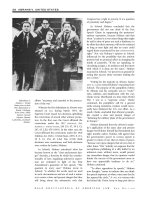
William J. Brennan
Jr.
PHOTOGRAPH BY
ROBERT S. OAKES,
COLLECTION OF THE
SUPREME COURT OF THE
UNITED STATES.
GALE ENCYCLOPEDIA OF AMERICAN LAW, 3
RD E DITION
BRENNAN, WILLIAM JOSEPH, JR. 113
negotiating employer-employee disputes. Dur-
ing WORLD WAR II, Brennan served in the U.S.
Army and eventually became the labor branch
chief, Civilian Personnel Division of Army
Ordnance. He rose to the rank of colonel and
was awarded the Legion of Merit for services to
the Army and Army Air Forces procurement
programs.
After his army service, Brennan returned to
private practice, counseling large manufacturing
corporations on labor matters. In 1949 he was
tapped by New Jersey’s Republican governor to
serve on the state’s superior court. Assigned to
the
APPELLATE division, he distinguished himself
by implementing reforms that relieved conges-
tion in the court calendar. He was appointed to
the New Jersey Supreme Court, and took his
seat on Ma rch 24, 1952. While there he helped
institute a
PRETRIAL CONFERENCE system that
shortened and simplified trials and encouraged
settlements, resulting in fewer and speedier trials.
Brennan had served only four years on the
New Jersey Supreme Court when, to the
surprise of everyone, including Brennan, Presi-
dent
DWIGHT D. EISENHOWER no minated him to
serve on the U.S. Supreme Court. Eisenhower, a
Republican, would later regard his appointment
of the liberal Democrat as one of his worst
mistakes, along with his earlier appointment of
Chief Justice
EARL WARREN. Together, Brennan
and Warren led the Court into an unprecedent-
ed era of judicial activism that was anathema to
conservatives such as Eisenhower.
Brennan quickly established himself as a
staunch supporter of the rights and liberties
guaranteed by the Constitution. He insisted that
the
BILL OF RIGHTS applies to all U.S. citizens,
whether of the lowest or the highest stature.
Brennan invited controversy with his view that
the Constitution’sguaranteesmustbeconstantly
evolving. Said Brennan, “The genius of the
Constitution rests not in any static meaning it
might have had in a world that is dead and gone,
but in the adaptability of its great principles to
cope with current problems.”
Brennan’s broad interpretation of the Con-
stitution put him at odds with more conservative
court members who construe the Constitution
as narrowly as possible and attempted to
ascertain the
ORIGINAL INTENT of the drafters.
Conservatives believe that if a right or freedom
is not clearly conferred by the Constitution or
by judicial precedent, it is not the job of the
Court to try to find it there. They place the
burden on the individual to show that the right
or protection sought exists. Conversely, like-
minded liberals (and Brennan was one) ap-
proach a case by asking whether anything in
the Bill of Rights explicitly prevents the Court
from finding that the right or protection exists,
and they look to the government to prove that
the right does not exist. Ironically, when a case
involves the use of government power, the
opposing groups tend to adopt each other’s
philosophy: Conservatives ask whether anything
in the law prevents the exercise of the power,
and liberals ask whether the power is explicitly
allowed by the Constitution or some other statute.
In spite of his single-minded determination
to read the Constitution as broadly as possible,
Brennan often acted as a mediator between the
liberal and conservative wings of the Court. A
warm and charming man who was univers ally
well liked, he used his formidable in tellectual
and technical skills in tandem with his innate
diplomacy to build coalitions on some of the
most divisive issues of the time. “You cannot
dislike this man on a personal level, no matter
how destructive he’s been to the values you
hold dear,” declared Charles J. Cooper, assistant
attorney general under President
RONALD REAGAN
and an ideological archenemy of Brennan.
Brennan was respected by friends and adver-
saries alike. In fact, although he was a lifelong
Democrat, his appointments to the judiciary
were recommended by conservative Republicans.
It is impossible to overstate the effect
Brennan had on the
LAW OF THE LAND from
1960 to 1990. He was the architect of pivotal
decisions that shaped U.S. life during those
years, including Eisenstadt v. Baird, 405 U.S.
438, 92 S. Ct. 1029, 31 L. Ed. 2d 349, a 1972
decision that struck down a law prohibiting
the distribution of contraceptives to unmarried
women. Brennan recognized a constitutional
“right to privacy” protecting “the decision
whether to bear or beget a child.” His reasoning
in Eisenstad t became the foundation for
ROE V.
WADE, 410 U.S. 113, 93 S. Ct. 705, 35 L. Ed. 2d
147, the 1973 decision that removed many
barriers to legal abortions.
Early in his career Brennan wrote the
majority opinion in
BAKER V. CARR , 369 U.S.
186, 82 S. Ct. 691, 7 L. Ed. 2d 663 (1962), which
allowed federal courts to hear challenges to
legislative
APPORTIONMENT and paved the way for
“LAW CANNOT
STAND APART FROM
THE SOCIAL CHANGES
AROUND IT
.”
—WILLIAM
BRENNAN JR.
GALE ENCYCLOPEDIA OF AMERICAN LAW, 3RD E DITION
114 BRENNAN, WILLIAM JOSEPH, JR.
later Supreme Court cases establishing the
concept of ONE PERSON, ONE VOTE. In New York
Times v. Sullivan, 376 U.S. 254, 84 S. Ct. 710, 11
L. Ed. 2d 686 (1964), Brennan wrote that the
FIRST AMENDMENT protects the press from libel
suits brought by public officials, unless actual
malice is proved. He extended the
FIFTH
AMENDMENT
right against SELF-INCRIMINATION to
prohibit mandatory registration of Communist
party members in Albertson v. Subversive Activi-
ties Control Board (382 U.S. 70, 86 S. Ct. 194,
15 L. Ed. 2d 165 [1965]).
Brennan found that the Constitution pro-
hibits unequal treatment based on race, age, or
gender, in a number of decisions, including
IN
RE WINSHIP
(establishing use of the REASONABLE
DOUBT
standard for juveniles); FRONTIERO V.
RICHARDSON (extending constitutional scrutiny
to gender-based classifications); and Craig v.
Boren (declaring that gender-based classifications
are unconstitutional unless they are substantially
related to the achievement of an important
government objective) (In re Winship, 397 U.S.
358, 90 S. Ct. 1068, 25 L. Ed. 2d 368 [1970];
Frontiero v. Richardson, 411 U.S. 677, 93 S. Ct.
1764, 36 L. Ed. 2d 583 [1973]; and Craig v.
Boren, 429 U.S. 190, 97 S. Ct. 451, 50 L. Ed. 2d
397 [1976]).
Brennan was a strong be liever that
AFFIRMA-
TIVE ACTION
was a way to remedy past discrimi-
nation, and he wrote numerous opinions on the
subject. In United States v. Weber Aircraft Corp.,
465 U.S. 792, 104 S. Ct. 1488, 79 L. Ed. 2d 814
(1984), the Court held that it is lawful for
employers to adopt voluntary affirmative action
programs that are race conscious. Brennan wrote
the opinion that upheld limited preferential
treatment on the job for women and minorities
in Johnson v. Transportation Agency of Santa
Clara County, 480 U.S. 616, 107 S. Ct. 1442, 94 L.
Ed. 2d 615 (1987), and found in United States v.
Paradise, 480 U.S. 149, 107 S. Ct. 1053, 94 L. Ed.
2d 203 (1987), that a one-black-for-one-white
promotions quota did not violate the Constitu-
tion. Finally, in one of his last opinions on
affirmative action, Brennan wrote that the
Constitution permits preferential treatment of
minorities in the awarding of FCC broadcast
licenses (Metro
BROADCASTING v. FCC, 497 U.S.
547, 110 S. Ct. 2997, 111 L. Ed. 2d 445 [1990]).
Brennan was an adamant defender of free
expression even for the most reprehensible
words or acts. In
TEXAS V. JOHNSON (491 U.S.
397, 109 S. Ct. 2533, 105 L. Ed. 2d 342 [1989])
and in United States v. Eichman (496 U.S. 310,
110 S. Ct. 2404, 110 L. Ed. 2d 287 [1990]), he
wrote opinions invalidating statutes that banned
flag desecration, on the grounds that they
violated the First Amendment. Although recog-
nizing the “special place reserved for the flag in
this Nation,” he stated, “we do not consecrate
the flag by punishing its desecration, for in doing
so we dilute the freedom that this cherished
emblem represents” (Johnson).
He was also an ardent defender of the
rights of children, declaring that we must teach
young people “that our Constitution is a living
reality, not parchment preserved under glass.”
He was appalled by cases in which the Court
seemed to hold that the Bill of R ights does n ot
apply to schoolchildren, and wrote in one
dissent that the majority’s decision had given
school officials the license to act as “thought
police” and taught the students “to discount
important principles of our government as
mere platitudes” (Hazelwood School Dist. v.
Kuhlmeier, 484 U.S. 2 60, 285, 290, 108 S. Ct.
562, 577, 580, 98 L. Ed. 2d 592 [1988]).
Brennan earned the highest praise as well as
the harshest criticism from his opinions in cases
involving the rights of the accused. He stead-
fastly opposed the use of
CAPITAL PUNISHMENT,
labeling it state-sanctioned killing, and in one
of his final decisions on the Court, he voted
against an execution by the state of Virginia.
Taking human life, he said, “is God’s work, not
man’s.” When that statement was dismissed as
mere sentimentality, he replied, “The most vile
MURDER does not, in my view, release the state
from constitutional restraints on the destruction
of human dignity The fatal constitutional
infirmity of capital punishment is that it treats
members of the human race as nonhuman,
as objects to be toyed with and discarded.”
Brennan’s critics pointed out that his opposition
to the death penalty did not seem in harmony
with his support of women’srightto
ABORTION,
which some consider “state-sanctioned killing.”
Brennan passionately defended the protec-
tions afforded by the Fourth Amendment’s
prohibition of unreasonable searches and sei-
zures. His interpretation of the amendment
helped establish the
EXCLUSIONARY RULE, which
holds that any evidence obtained illegally is
tainted and cannot be used against the accused.
During the 1980s the Supreme Court recognized
GALE ENCYCLOPEDIA OF AMERICAN LAW, 3RD E DITION
BRENNAN, WILLIAM JOSEPH, JR. 115
a growing number of exceptions to the rule,
prompting Brennan to redouble his efforts to
bolster its strength. His
ADVOCACY of the rights of
criminal defendants brought him sharp criti-
cism, particularly from the media, which often
portrayed him as a libertarian who supported
the rights of criminals while ignoring those
of victims. In a radio interview in 1987,
Brennan became uncharacteristically agitated
when asked, “Why do you let some of those
creeps go? They do such bad things, and on a
technicality, you let them go.” Brennan replied
sharply,
You and the media ought to be ashamed of
yourself to call the provisions and the
guarantees of the Bill of Rights technicalities.
They’re not. We are what we are because we
have those guarantees, and this Court exists
to see that they are faithfully enforced. These
guarantees have to be sustained—even
though the immediate result is to help out
some very unpleasant person. They’re there
to protect all of us.
Citing advancing age and health concerns,
Brennan retired from the Court in July 1990,
after 34 years as an associate justice. He was
replaced by Associate Justice
DAVID H. SOUTER.
Although he eventually slowed his pace consid-
erably, he continued to be sought as a speaker
and used every opportunity to carry on his
campaign for individual rights and liberties.
During his tenure on the Supreme Court,
Brennan wrote almost 1,600 opinions, many of
which have had a significant impact on the
American justice system. In 1995, as a tribute to
Brennan’s legacy, a number of former law clerks,
along with family and friends created the Brennan
Center. The center, which is housed at New York
University’s School of Law, pursues an ambitious
agenda of
LITIGATION, teaching, research, and
advocacy in
PUBLIC POLICY areas, including democ-
racy, poverty, and criminal justice. Brennan died
on July 24, 1997, in Arlington, Virginia.
FURTHER READINGS
Brennan Center for Justice at New York Univ. School of Law
Web site. Available online at nnancen-
ter.org (accessed July 9, 2009).
Urofsky, Melvin I. 1994. The Supreme Court Justices: A
Biographical Dictionary. New York: Garland.
Woodward, Bob, and Scott Armstrong. 2005. The Brethren:
Inside the Supreme Court. New York: Simon & Schuster.
CROSS REFERENCES
Freedom of the Press; Freedom of Speech; Judicial Review;
Warren Court.
v
BREWER, DAVID JOSIAH
David Josiah Brewer was an associate justice
of the Supreme Court from 1890 to 1910. A
defender of personal liberty and property
rights, he also supported states’ rights and was
opposed to centralization of power in the federal
government.
Brewer was born June 20, 1837, in Smyrna,
Asia Minor (now Turkey). His father, Josiah
Brewer, was a Yale graduate who worked in
Turkey as a missionary. His mother, Emilia
Field, was the sister of Supreme Court justice
STEPHEN J. FIELD,withwhomBrewereventually
served. After returning to the United States from
their missionary work, the Brewers settled in
Wethersfield, Connecticut. Brewer attended
Wesleyan University for two years before
transferring to Yale, where he graduated with
honors in 1856. He studied law for a year with
an uncle and then enrolled in Albany Law
School. He received his law degree in 1858 and
was admitted to the New York bar the same year.
Brewer decided to stake his future on the
frontier West. He settled in Leavenworth,
Kansas, and almost immediately began his long
judicial career. He was appointed
COMMISSIONER
of the U.S. CIRCUIT COURT for the District of
Kansas in 1861 and was elected judge of the
probate and criminal courts of Leavenworth
County in 1862. Brewer served as a judge of
the first judicial district of Kansas from 1865
to 1869. He briefly left the judiciary in 1869
to become Leavenworth’s city attorney, but
returned in 1870 when, at the age of thirty-
three, he was elected to the Kansas Supreme
Court. He sat on the Kansas bench until 1884
when President
CHESTER ARTHUR named him to
the federal circuit court for the eighth circuit.
Five years later, President
WILLIAM H. HARRISON
appointed him to the U.S. Supreme Court,
where he remained until his death.
As a Supreme Court justice, Brewer was
known for his ardent support of individual
rights against the tyranny of the majority. “Here
there is no monarch threatening trespass upon
an individual,” he once said. “The danger is
from the multitude—the majority with whom
lies the power.” Brewer had great compassion
for the marginalized members of U.S. society.
In 1908 he wrote the opinion for a unanimous
Court in Muller v. Oregon, 208 U.S. 412, 28 S.
Ct. 324, 52 L. Ed. 551, upholding a statute that
established maximum work hours for women
GALE ENCYCLOPEDIA OF AMERICAN LAW, 3RD E DITION
116 BREWER, DAVID JOSIAH
toiling in laundries. Although he had in 1905
voted to invalida te a similar statute that applied
to bakers, in
LOCHNER V. NEW YORK (198 U.S. 45,
25 S. Ct. 539, 49 L. Ed. 937 [1905]), Brewer was
convinced that the particular statute at issue in
Muller did not unnecessarily limit an indivi-
dual’s contract liberty.
Brewer also wrote strong dissents in several
cases limiting the rights of Chinese and Japanese
immigrants (see Fong v. United States, 149 U.S.
698, 13 S. Ct. 1016, 37 L. Ed. 905 [1893]; United
States v. Sing Tuck, 194 U.S. 161, 24 S. Ct. 621,
48 L. Ed. 917 [1904]; United States v. Ju Toy, 198
U.S. 253, 25 S. Ct. 644, 49 L. Ed. 1040 [1905];
the Japanese Immigrant case, 189 U.S. 86, 23 S.
Ct. 611, 47 L. Ed. 721 [1903]). His dissent in
Fong, in which the Court found that the power
of Congress to deport
ALIENS was inherent in
national
SOVEREIGNTY, included this sarcastic
indictment of what he considered Congress’s
arbitrary denial of plaintiffs’ rights: “In view of
this enactment of the highest legislative body
of the foremost Christian nation, may not the
thoughtful Chinese disciple of Confucius ask,
Why do they send missionaries here?”
Brewer was, in most cases, a moderate
conservative. He spoke out against racial
DISFRANCHISEMENT in Giles v. Harris, 189 U.S.
475, 23 S. Ct. 639, 47 L. Ed. 909 (1903).
However, reflecting his belief in states’ rights, he
held that a state had the right to prohibit
INTEGRATION in an institution it had created
(Berea College v. Kentucky, 211 U.S. 45, 29 S. Ct.
33, 53 L. Ed. 81 [1908]) and that the federal
government lacked power to
PROSECUTE a case of
racially motiv ated harassment (Hodges v. United
States, 203 U.S. 1, 27 S. Ct. 6, 51 L. Ed. 65
[1906]). A lifelong
ADVOCATE of international
peace, Brewer served as president of a
congressional commission investigating a bor-
der dispute between Venezuela and British
Guyana, and later served on the tribunal that
ended the controversy. Brewer advocated
women’s
SUFFRAGE and restrictions on IMMIGRA-
TION
. He was a vigorous anti-imperialist who
believed that the Philippines should be given
independence with guaranteed neutrality.
Brewer was an unusually outgoing justice
who lectured frequently and wrote several
David Josiah Brewer 1837–1910
❖
❖
◆
◆
◆
◆
◆
1837 Born, Smyrna,
Asia Minor
(now Turkey)
1856 Graduated
with honors from
Yale University
1862 Elected judge of probate and
criminal courts of Leavenworth County
1861–65
U.S. Civil War
1870 Appointed
to Kansas
Supreme Court
1865–69 Served as a judge of the
first judicial district of Kansas
1884 Appointed
circuit judge for
Eighth U.S.
Circuit
1889 Nominated to
the U.S. Supreme
Court by President
Harrison
1906 Cyclopedia of
Law and Procedure published
1910 Died,
Washington, D.C.
1908 Wrote opinion for
Muller v. Oregon
◆
▼▼
▼▼
1850
1825
1875
1900
1925
◆
David J. Brewer.
LIBRARY OF CONGRESS
YOU CANNOT
DISASSOCIATE THE
CHARACTER OF THE
NATION AND THAT OF
ITS CITIZENS
.
—DAVID BREWER
GALE ENCYCLOPEDIA OF AMERICAN LAW, 3RD E DITION
BREWER, DAVID JOSIAH 117