Gale Encyclopedia Of American Law 3Rd Edition Volume 1 P13 doc
Bạn đang xem bản rút gọn của tài liệu. Xem và tải ngay bản đầy đủ của tài liệu tại đây (271.33 KB, 10 trang )
allowed to offer evidence of their suitability for
early release from INCARCERATION. The strict rules
observed in a courtroom do not apply to these
hearings, and the board’s decisions must acc-
ount for the public interest as well as the rights
of the prisoners.
FURTHER READINGS
Aman, Alfred C., Jr., and William T. Mayton. 2001 Aman
and Mayton’s Hornbook on Administrative Law. 2d ed.
Eagan, MN: West.
Barksdale, Yvette M. 1993. “The Presidency and Adminis-
trative Value Selection.” American Univ. Law Review 42.
Diver, Colin S. 1987. “The Uneasy Constitutional Status of
the Administrative Agencies, Part II: Presidential
Oversight of Regulatory Decisionmaking: Commentary:
Presidential Powers.” American Univ. Law Review 36.
Pierce, Richard J. 2002 (updated 2008). Administrative Law
Treatise. 4th ed. Frederick, MD: Aspen.
U.S. Government Manual Web site. Available online
at (accessed
July 3, 2009).
CROSS REFERENCES
Administrative Conference of the United States; Adminis-
trative Law and Procedure; Bureaucracy; National Industrial
Recovery Act of 1933; Schechter Poultry Corp. v. United
States. See also entries for specific federal agencies (e.g.,
Food and Drug Administration).
ADMINISTRATIVE BOARD
A comprehensive phrase that can refer to any
administrative agency but usually means a public
agency that holds hearings.
An administrative board is usually obligated
to represent the
PUBLIC INTEREST; courts, in
contrast, must remain impartial between the
two parties before them. A
PAROLE board, for
example, holds informal hearings where prison-
ers are allowed to offer evidence of their
suitability for early release from prison. The
strict rules observed in a courtroom do not
apply to board hearings like these, and the
board’s decision must take into account the
public’s interest as well as the prisoner’ s righ ts.
ADMINISTRATIVE CONFERENCE OF
THE UNITED STATES
Created in 1968, the Administrative Conference
of the United States (ACUS) was a federal
independent agency and advisory committee
chartered for the purpose of ensuring the fair
and efficient administration of various federal
agencies. The ACUS studied administrative
processes and recommended improvements
in the procedures by which federal agencies
administered regulatory, benefit, and other gov-
ernment programs. It had no power to enact its
recommendations into law, or to enforce them
once they were enacted, but it did carry great
weight in the formulation of procedures and
policies of federal administrative agencies.
The ACUS consisted of heads of adminis-
trative agencies , private lawyers, university
professors, various federal officials, and other
experts in administrative law and government.
These experts collectively conducted continuing
studies of selected prob lems that existed in the
procedures of federal administrative agencies.
The specific charge of ACUS was to harness the
experience and judgment of the administrative
agency specialists to improve the fairness and
effectiveness of administrative procedures and
functions.
From 1968 to 1995 the ACUS issued
approximately two hundred recommendations,
the majority of which were at least partially
implemented. In 1995 Congress terminated
funding for the ACUS, and it ceased operation.
FURTHER READINGS
“Administrative Conference of the United States” (Sympo-
sium). 1998. Arizona State Law Journal 30 (spring).
Funk, William. “R.I.P. A.C.U.S.” ABA Network: Adminis-
trative & Regulatory Law News. Available online at
www.abanet.org/adminlaw/news/vol21no2/acus_rip.
html (acc essed Mar. 31, 2010).
“Recommendations of the Administrative Conference of the
United States.” ABA Administrative Procedure Data-
base. Available online at www.law.fsu.edu/library/
admin/acus/acustoc.html (accessed Mar. 31, 2010).
CROSS REFERENCES
Administrative Agency; Administrative Law and Procedure.
ADMINISTRATIVE DISCRETION
The exercise of professional expertise and judg-
ment, as opposed to strict adherence to regulations
or statutes, in making a decision or performing
official acts or duties.
A discretionary action is informal and,
therefore, unprotected by the safeguards inher-
ent in formal procedure. A public official, for
example, has
ADMINISTRATIVE DISCRETION when he
or she has the freedom to make a choice among
potential courses of action.
ABUSE OF DISCRETION
is the failure to exercise reasonable judgment
or discretion. It might provide a
CAUSE OF ACTION
for an unconstitutional invasion of rights
protected by the Due Process Clause of the
Constitution.
GALE ENCYCLOPEDIA OF AMERICAN LAW, 3RD E DITION
108 ADMINISTRATIVE BOARD
ADMINISTRATIVE LAW AND
PROCEDURE
Administrative law is the body of law that allows
for the creation of public regulatory agencies and
contains all of the statutes, judicial decisions,
and regulations that govern them. It is created by
administrative agencies to implement their powers
and duties in the form of rules, regulations, orders,
and decisions. Administrative procedure constitu-
tes the methods and processes before administra-
tive agencies, as distinguished from judicial
procedure, which applies to courts.
The Administrative Procedure Act (5 U.S.C.
§§ 551-706) governs the practice and proceed-
ings before federal administrative agencies. The
procedural rules and regulations of most federal
agencies are set forth in the
CODE OF FEDERAL
REGULATIONS
(CFR).
The fundamental challenge of administra-
tive law is in designing a system of checks that
will minimize the risks of bureaucratic arbitrar-
iness and overreaching, while preserving for the
agencies the flexibility that they need in order to
act effectively. Administrative law thus seeks to
limit the powers and actions of agencies and to
fix their place in U.S. scheme of government
and law. It contrasts with traditional notions
that the three branches of the U.S. government
must be kept separate, that they must not
delegate their responsibilities to bureaucrats,
and that the formalities of due process must be
observed.
Separation of Powers
The U.S. Constitu tion establishes a three-part
system of government, consisting of the Legis-
lative Branch, which makes the laws; the
EXECUTIVE BRANCH, which carries out or enforces
the laws; and the Judicial Branch, which
interprets the laws. This system of che cks and
balances is designed to keep any one branch
from exercising too much power. Administra-
tive agencies do not fit neatly into any of the
three branches. They are frequently created by
the legislature and are sometimes placed in the
Executive Branch, but their functions reach into
all three areas of government.
For example, the
SECURITIES AND EXCHANGE
COMMISSION
(SEC) administers laws governing the
registration, offering, and sale of securities, such
as stocks and bonds. The SEC formulates laws
like a legislature does by writing rules that spell
out what disclosures must be made in a
PROSPECTUS that descr ibes shares of stock that will
be offered for sale. The SEC enforces its rules in
the way that the Executive Branch of government
does, by prosecuting violators. It can bring
disciplinary ac tions against broker-dealers, or it
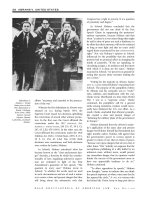
The Securities and
Exchange
Commission
administers laws
governing the actions
of these traders on the
floor of the New York
Stock Exchange. The
SEC is an
independent agency
that enforces its rules
without need for
approval from
Congress or the
executive branch of
the government.
AP IMAGES
GALE ENCYCLOPEDIA OF AMERICAN LAW, 3
RD E DITION
ADMINISTRATIVE LAW AND PROCEDURE 109
can issue stop orders against corporate issuers of
securities. The SEC acts as judge and jury when
it conducts adjudicatory hearings to determine
violations or to prescribe punishment. Although
SEC commissioners are appointed by the presi-
dent subject to the approval of the Senate, the
SEC is an independent agency. It is n ot part
of Congress, nor is it part of any executive
department.
Combining the three functions of govern-
ment allows an age ncy to tackle a problem and
to get the job done most efficiently, but this
combination has not b een accepted without
a struggle. Some observers have taken the
position that the basic structure of the admini-
strative law system is an unconstitutional
violation of the principle of the
SEPARATION OF
POWERS
.
Delegation of Authority
The first issue that is encountered in the study
of administrative law concerns the way in which
Congress can effectively delegate its legislative
power to an administrative agency. Article I,
Section I, of the U.S. Constitution provi des that
all legislative power is vested in Congress.
Despite early resistance, the U.S. Supreme
Court gradually accepted the delegation of
legislative authority so long as Congress sets
clear standards for the administration of the
duties in order to limit the scope of agency
discretion. With this basic principle as their
guide, courts have invalidated laws that grant
too much legislative power to an administrative
agency. President
FRANKLIN D. ROOSEVELT learned
just how far the Court would go in allowing
the delegation of authority, in two cases that
stemmed from his administrative-agency actions
to support his
NEW DEAL program.
The National Industrial Recovery Act (15
U.S.C.A. § 701 et seq., 40 U.S.C.A. § 401 et seq.
[1933]) authorized the president to prohibit
interstate shipments of oil that had been
produced in violation of state board rules that
attempted to regulate crude -oil production to
match consumer demand. The Panam a Refin-
ing Company sued to prevent federal officials
from enforcing the prohibition, known as the
“hot oil” la w (Panama Refining Co. v. Ryan, 293
U.S. 388, 55 S. Ct. 241, 79 L. Ed. 446 [1935]).
The U.S. Supreme Court found the law to be
unconstitutional. Congress could have passed a
law prohibiting interstate shipments of hot oil,
but it did not do so; instead, it gave that power
to the president. This instance has been called
a case of delegation run amok because the law
had no clear standards defining when and how
the president should use the authority that the
statute delegated to him.
Four months later, the Court invalidated a
criminal prosecution for violation of the Live
Poultry Code, an unfair-competition law that
President Roosevelt had signed in 1934 pur-
suant to another section of the National
Industrial Recov ery Act. This was the case of
Schechter Poultry v. United States, 295 U.S. 495,
55 S. Ct. 837, 79 L. Ed. 1570 (1935). The
problem in this case was not that the delegation
of authority was ill-defined, but that it seemed
limitless. The president was given the authority
to “formulate codes of fair competition” for any
industry if these codes would “tend to effectuate
the policy” of the law. Comprehensive codes
were created, establishing an elaborate regula-
tion of prices, minimum wages, and maximum
hours for different kinds of businesses. But
there were no procedural safeguards from
arbitrariness or abuses by enforcement agencies.
Someone who was charged with a violation was
not given the right to notice of the charges, the
right to be heard at an agency hearing, or the
right to challenge the agency’s determination in a
lawsuit. The Court struck this law down, stating
that the unfair procedures helped strong indus-
trial groups to use these codes to improve their
commercial advantage over small producers.
As a result of Panam a Refining and Schechter
Poultry, when Congress delegates authority to
agencies, it also sets out important provisions
detailing procedures that protect against arbi-
trary administrative actions.
Resolving Conflicts of Authority
On some occasions, the courts have to deter-
mine which agency is the proper body to
exercise authority over a certain action. For
instance, in Coeur Alaska, Inc. v. Southeast
Alaska Conservation Council, No. 07-984, 2009
WL 1738643 (2009), the Supreme Court
reviewed a case involving the issuance of a
permit that would allow a company to dump
rock materials into a lake. The U.S. Army Corps
of Engineers originally issued the permit, but a
citizens’ group argued that the
ENVIRONMENTAL
PROTECTION AGENCY
was the proper body to issue
the permit. The Court determined that the
GALE ENCYCLOPEDIA OF AMERICAN LAW, 3RD E DITION
110 ADMINISTRATIVE LAW AND PROCEDURE
CLEAN WATER ACT, 33 U.S.C. § 1251 et seq., had
delegated authority in the specific instance
presented by the case to the Corps of Engineers.
Due Process of Law
The Fifth and Fourteenth Amendments guaran-
tee that the federal governmen t and the state
governments, respectively, will not deprive a
person of his or her life, liberty, or property
without
DUE PROCESS OF LAW. An administrative
agency thus may not deprive anyone of life,
liberty, or property without providing that
person with a reasonable opportunity, appro-
priate under the circumstances, to challenge the
agency’s action. People must be given fair
warning of the limits that an agency will place
on their actions, federal courts routinely uphold
very broad delegations of authority. When
reviewing administrative agency actions, courts
ask whether the agency afforded those under
its jurisdiction due process of law as guaranteed
by the U.S. Constitution.
The U.S. Supreme Court has held it
improper for a state agency to den y w elfare
benefits to applicants who meet the conditions
for entitlement to those benefits as defined by
the legislature. The state must afford due
process (in these cases, an oral hearing) before
it can terminate benefits (Goldberg v. Kelly,
397 U.S. 254, 90 S. Ct. 1011, 25 L. Ed. 2d 287
[1970]). Likewise, when a state grants all child-
ren the right to attend public schools and
establishes rules specifying the grounds for
suspension, it cannot suspend a given student
for alleged misconduct without affording the
student at least a limited prior hearing (Goss v.
Lopez, 419 U.S. 565, 95 S. Ct. 729, 42 L. Ed. 2d
725 [1975]).
Political Controls over Agency Action:
Legislative and Executive Oversight
Government institutions that set and enforce
PUBLIC POLICY must be politically accountable to
the electorate. When the legislature delegates
broad lawmaking powers to an administrative
agency, the popular control provided by direct
election of decision makers is absent, but this
does not mean that administrative agencies are
free from political accountability. In many
areas, policy oversight by elected officials in
the legisl ature or the Executive Branch is a
more important che ck on agency power than is
JUDICIAL REVIEW.
Federal agencies are dependent upon Con-
gress and the president for their budgets and
operating authority. An agency that loses the
support of these bodies or overstep s the bounds
of political acceptability may be subjected to
radical restructuring. In the 1970s the Atomic
Energy Commission (AEC) took the politically
unpopular position of promoting
NUCLEAR
POWER
, while underemphasizing safety and
environmental protection. It paid the price
when some of its promotional functions were
transferred to a newly created
DEPARTMENT OF
ENERGY
, and the AEC was restructured into the
NUCLEAR REGULATORY COMMISSION, which was
responsible for the former agency’s regulatory
duties.
Federal administrative agencies must be
responsive to legislative and executive oversight
mechanisms. During the 1970s many members
of Congress began to feel that the normal
process of legislation was too cumbersome
for effective control of administrative action.
They devised a solution called the legislative
VETO. Legislative vetoes took a variety of forms,
but most of them directed agencies to transmit
final administrative rules to Congress for
review before they became effective. Just as this
approach was gaining in popularity and use, the
U.S. Supreme Court declared the legislative
veto unconstitutional. This ruling involved the
IMMIGRATION and Nationality Act (8 U.S.C. §
1101 et seq.), which allowed either house of
Congress to nullify a decision by the attorney
general suspending
DEPORTATION of an alien.
Jagdish Rai Chadha brought suit when the
House of Representatives exercised this power
in his case. The Court held, in INS v. Chadha,
462 U.S. 919, 103 S. Ct. 2764, 77 L. Ed. 2d 317
(1983), that the legislative veto was essentially a
one-house ve t o, and therefore it violated Article
I, Section 7, of the Constitution, which states
that no legislation is valid unless passed
by both houses of Congress and signed by
the president (or, if the president vetoes it,
repassed by two-thirds of each house). The
Court said that in Chadha, the House veto of
the attorney general’s decision was a legislative
action, and therefore Article I, Section 7,
applied. The Chadha decision invalidated all of
the nearly 200 legislative-veto provisions that
were on the books.
Another important legislative-oversight mech-
anism is the annual appropriations process.
GALE ENCYCLOPEDIA OF AMERICAN LAW, 3RD E DITION
ADMINISTRATIVE LAW AND PROCEDURE 111
Congress determines the budget and appro-
priates money for the vari ous adm inistrati ve
agencies. An administrative agency that angers
Congress,orakeymemberofeitherhouse,
could find itself with less money to work with
in the next year, or could even see certain
programs eliminated. A legislature may also
enact a
SUNSET PROVISION, which provides for
automatic termination of an agency after a
stated time unless the legislature is convinced
that the need for the agency continues.
Sometimes, a sunset provision is written into
the statute that creates a particular agency,
but a general sunset law may terminate any
agency that cannot periodically demonstrate
its effectiveness. A useful agency can always
be revived or retained by the enactment of a
new statute.
Like Congress, the president uses a variety
of powers and techniques to oversee and
influence the operations of administrative
agencies. The Appointments Clause of the
Constitution (art. II, §2, cl. 2) states that the
president may generally appoint all “officers of
the United States,” with the
ADVICE AND CONSENT
of the Senate. Under the authority of this
provision, presidents often appoint agency
heads who share their political agenda. The
president’s power to remove an agency head
depends on whether the agency is an indepen-
dent agency or a cabinet department. Indepen-
dent agencies tend to be multimember boards
and commissions, such as the Securities and
Exchange Commission,
FEDERAL COMMUNICATIONS
COMMISSION
(FCC), and NATIONAL LABOR RELATIONS
BOARD
(NLRB), which are run by officials who
are appointed for a fixed period that does not
correspond to the president’s term of office.
There also may be statutes protecting the
commissioners from arbitrary removal during
their terms of office. The heads of cabinet-level
agencies, called secretaries, serve at the pleasure
of the president and may be removed at any
time. Appointments of cabinet secretaries must
be confirmed by the Senate.
The president also reviews agency budgets,
through the
OFFICE OF MANAGEMENT AND BUDGET
(OMB). A president’s disapproval of agency
initiatives can block appropriations in Congress.
The president may also use an
EXECUTIVE ORDER,a
formal directive, to direct federal agencies or
officials. One technique that has been used
frequently is the president’s authority to modify
the organizational structure of t he
BUREAUCRACY.
Under the Executive Reorganization Act (5
U.S.C. §§ 901-912), the president may submit
a
REORGANIZATION PLAN to Congress, transferring
functions from one department to another.
This law recognizes that although responsibility
for the organization and structure of the Execu-
tive Branch is vested in Congress, the president
needs flexibility to carry out executive duties.
Public opinion is another forceful weap on
against unbridled agency action. Some jurisdic-
tions of the United States have created speci al
public offices to investigate complaints about
administrative misconduct. Investigators hold-
ing these offices, called ombudsmen, usually
have broad authority to evaluate individual
complaints, to intercede on behalf of belea-
guered victims of red tape, and to make reports
or recommendations.
The Development of Administrative
Procedure Law
Administrative agencies were established to do
the government’s work in a simpler and more
direct manner than the legislature could do by
enacting a law or the courts could do by
applying that law in various cases. Because they
pursue their actions less formally, agencies do
not follow the
CIVIL PROCEDURE that is set up for
courts. Instead, the law of administrative
procedure has developed to ensure that agencies
do not abuse their authority even though they
use simplified proce dures.
Although administrative agencies have
existed since the founding of the United States,
the early twentieth century saw a growth in
the number of agencies that were designed to
address new problems. During the Great
Depression, a host of new agencies sprang up
to meet economic challenges. Antagonism
toward bureaucracy increased as existing dis-
satisfactions were multiplied by the number of
new bureau crats. In 1939 President Roosevelt
appointed a committee to investigate the need
for procedural reform in the field of adminis-
trative law. Although the comprehensive and
scholarly report of that committee was not
enacted into law, a later version of it was
enacted in 1946 when Congress unanimously
passed the Administrative Procedure Act (5 U.S.
C.A. §§ 551-706) (APA). The statute made
agencies’ methods fairer so that there would be
less reason to object to them. It also limited the
GALE ENCYCLOPEDIA OF AMERICAN LAW, 3RD E DITION
112 ADMINISTRATIVE LAW AND PROCEDURE
power of the courts to review agency actions
and to overturn them.
Judicial review of agency action furnishes an
important set of controls on administrative
behavior. Unlike the political oversight controls,
which generally influence entire programs or
basic policies, judicial review regularly operates
to provide relief for the individual person who
is harmed by a particular agency decision.
Judicial review has evolved over a period of
years into a complex system of statu tory,
constitutional, and judicial doctrines that define
the proper
BOUNDARIES of this system of
oversight. The trend of judicial decisions and
the Administrative Procedure Act is to make
judicial review more widely and easily available.
How far can a court go in examining an
agency decision? The reviewing court may be
completely precluded from testing the merits of
an agency action, or it ma y be free to decide the
issues
DE NOVO, that is, without deference to the
agency’s determination. In general, administra-
tive agencies make either formal or informal
decisions, and courts have different standards
for reviewing each type.
Informal Agency Action Most of the work
done by agencies is accomplished with informal
procedures. For example , a person who applies
for a driver’s license does not need or want a full
trial in court in order to be found qualified. So
long as the motor vehicle department follows
standard, fair procedures, and processes the
application promptly, most people will be happy.
Agencies take informal action in a variety of
settings. The
SOCIAL SECURITY Administration
reviewsoverfourmillionclaimsforbenefits
annually, holding hearings or answ ering chal-
lenges to their decisions in only a small
number of cases. Most transmitter applic ations
before the Federal Communications Commis-
sion are approved or disapproved without any
formal action. The
INTERNAL REVENUE SERVICE
processes most tax returns without formal
proceedings. It also will provide informal
opinions to help people avoid making costly
mistakes in their financial planning.
Anyone who objects to the informal deci-
sions made by a government agency can invoke
more formal procedures. Someone may believe
that standards are unclear and that they should
be promulgated through formal agency rule
making. Or someone may feel that the decision
in a particular case is unfair and may demand a
formal adjudicatory hearing. If one of these
formal procedures does not satisfy a party, the
agency’s decision may be challenged in court.
Formal Agency Action Most formal action
taken by administrative agencies consists of rule
making or adjudication. Rule making is the
agency’s formulation of policy that will apply
in the future to everyone who is affected by
the agency’s activities. Adjudication is for the
agency what a trial is for the courts: It applies the
agency’s policies to some act that already has been
done, so that an order is issued for or against a
party who appears for a decision. Rule making
looks to the future; adjudication looks at the past.
Where either of these formal procedures is used,
the agency will usually give interested or affected
persons notice and an opportunity to be heard
before a final rule or order is issued.
Rule making Administrative agencies pro-
mulgate three types of rules: procedural,
interpretative, and legislative. Procedural rules
identify the agency’s organization and methods
of operation. Interpretative rules are issued to
show how the agency intends to apply the law.
They range from in formal policy statements
announced in a press release to authoritative
rules that bind the agency in the future and are
issued only after the agency has given the public
an opportunity to be heard on the subject.
Legislative rules are like statutes enacted by a
legislature. Agencies can promulgate legislative
rules only if the legislature has given them this
authority.
Employees of the
Internal Revenue
Service process tax
returns using
informal procedures
that make their jobs
easier and less time-
consuming. If a
taxpayer objects to a
decision made in this
way, he or she may
initiate more formal
review procedures.
AP IMAGES
GALE ENCYCLOPEDIA OF AMERICAN LAW, 3
RD E DITION
ADMINISTRATIVE LAW AND PROCEDURE 113
The Administrative Procedure Act sets up
the procedures to be followed for administra-
tive rule making. Before adopting a rule, a
federal agency generally must publish advance
notice in the
FEDERAL REGISTER, the govern-
ment’s daily publication for federal agencies.
Most states have similar publication require-
ments. This practice gives those who have an
interest in, or are affected by, a proposed rule
the opportunity to partic ipate in the decision
making by submitting written data or by
offering views or arguments orally or in
writing. Before a rule is adopted in its final
form, and 30 days before its effective date, the
agency must publish it in the Federal Register.
Formally adopted rules are published in the
Code of Federal Regulations, a set of paperback
books that the government publishes each
year so that rules are readily available to the
public.
Adjudication The procedures that admin-
istrative agencies use to adjudicate individual
claims or cases are diverse. Like trials, these
hearings resolve disputed questions of fact,
determining policy in a specific factual sett-
ing and ordering compliance with laws and
regulations. Although often not as formal as
courtroom trials, administrative hearings are
extremely important. Far more hearings are
held before agencies every year than are trials
in courts. Adjudicative hearings concern a
variety of subjects, such as individual claims
for worker’s compensation, welfare, or Social
Security benefits, in addition to multimillion-
dollar disputes about whether busines s mergers
will violate antitrust rulings. These proceedings
may be called hearings, adjudications, or adju-
dicatory proceedings. Their final disposition
is called an administrative order.
Many administrative proceedings appear to
be just like courtroom trials. Most are open
to the public and are conducted in an orderly
and dignified manner. Typically, a proceeding
begins with a complaint filed by the agency,
much as a civil trial begins with a complaint
prepared by the
PLAINTIFF. After the RESPONDENT
answers, each side may conduct discovery of
the other’s evidence and prehearing confer-
ences. A
HEARING EXAMINER, sometimes called an
administrative law judge (ALJ), presides over
the hearing, giving rulings in response to a
party’s applications for a particular type of
relief. The agency presents its evidence, usually
through counsel, either by a written report or
in the question-and-answer style of a trial, and
then the respondent offers his or her case.
WITNESSES may be called and cross-examined.
The examiner gives a decision, usually with
written findings and a written opinion, shortly
after the hearing.
The Executive Branch of the federal govern-
ment employs federal ALJs. When Congress
originally enacted the APA, it addressed con-
cerns about the relationship between ALJs and
their respective agencies by providing indepen-
dence to the ALJ. The U.S. Office of Personnel
Management (OPM) makes most of the deci-
sions regarding the tenure and compensation of
ALJs, and ALJs are exempted from many of the
performance reviews that apply to other
CIVIL
SERVICE
employees. An agency may remove an
ALJ only for cause and after a hearing conducted
by the
MERIT SYSTEMS PROTECTION BOARD.
Because administrative hearings do not use
juries, an ALJ makes both factu al determina-
tions and legal decisions based upon the
evidence presented and the law governing the
dispute. The specific duties of an ALJ in an
individual agency depend upon the powers
delegated to the agency in the respective
ENABLING STATUTE and procedural regulations
promulgated by the agency. For instance, the
Office of Inspector General is empowered to
impose civil penalties against a person who
makes false statements or representations with
respect to Social Security benefits. Under
regulations promulgated by the Social Security
Administration (20 C.F.R. § 498.204 [2009]), the
ALJ may make a number of decisions regarding
the submission of evidence or the examination of
witnesses; rule on motions and other procedural
matters; and render a
SUMMARY JUDGMENT where
appropriate. However, the ALJ may not rule
as invalid a federal statutory or regulatory
provision, enjoin agency officials, or review
discretionary acts by the inspector general.
An ALJ’s decision is often subject to review
by a board or commission of the entire agency
before parties may appeal the decision to a
federal court. For example, labor disputes
governed by the National Labor Relatio ns Act
are first heard by ALJs of the National Labor
Relations Board (NLRB). The ALJ’s decision
may be appealed to the five members of the
NLRB for review. Only after review by the
NLRB, upon which it renders a decision and
GALE ENCYCLOPEDIA OF AMERICAN LAW, 3RD E DITION
114 ADMINISTRATIVE LAW AND PROCEDURE
issues an opinion, may a party appeal the
decision to a U.S. court of appeals.
Unlike a trial, an administrative hearing has
no jury. The hearing examiner, or administra-
tive law judge, is usually an expert in the field
involved and is likely to be more concerned
with overall policies than with the particular
merits of one party’s case. The Administrative
Procedure Act affords parties who appear in
administrative hearings involving federal agen-
cies the right to notice of the issues and
proceedings, the
RIGHT TO COUNSEL , and the right
to confront and cross-examine witnesses.
Judicial Review of Agency Actions
When individuals believe that they have been
the victim of administrative error or wrongdo-
ing and seek to have the actions of the
responsible agency reviewed in a court of law,
the reviewing court is faced with two principal
issues: (1) the court must determine whether it
has a right to review the agency action, and (2)
if the court does, the court must determ ine the
scope of that court’s review.
The Right to Have a Court Review an Agency’s
Decision Whether someone has the right to ask
a court to review the actio n taken by an agency
depends on the answers to several questions.
The first question is whether the person
bringing the action has standing (i.e., the
LEGAL
RIGHT
) to bring the suit. Section 702 of the
Administrative Procedure Act allows court
review for any person who is adversely affected
or aggrieved by agency action within the
meaning of a relevant statute. When the U.S.
Supreme Court reviewed section 702 in Associa-
tion of Data Processing Service Organizations v.
Camp, 397 U.S. 150, 90 S. Ct. 827, 25 L. Ed. 2d
184 (1970), the Court said that for the plaintiff to
have standing to seek judicial review of adminis-
trative action, two questions must be answered
affirmatively: (1) Has the complainant alleged an
“injury in fact”?; and (2) Is the interest that the
complainant seeks to protect “arguably within
the zone of interests to be protected or regulated
by the statute or constitutional guarantee in
question”?
Even though an agency’s decision is review-
able and the plaintiff has standing to litigate, the
plaintiff still may be unable to obtain judicial
review if he or she has brou ght the action at the
wrong time. The aggrieved person must exhaust
all other avenues of relief before the dispute is
ripe for judicial determination. The doctrines
of
EXHAUSTION OF REMEDIES and RIPENESS require
a person who deals with an agency to follow
patiently all of the available steps within the
agency’s procedures before resorting to court
action. These rules are essential to prevent
overloading the courts with questions that
might not even be disputes by the time the
agencies determine what their final orders or
rulings will be.
The Scope of a Court’sReview If an
AGGRIEVED
PARTY
can convince a court that he or she has
standing, that all available administrative reme-
dies have been exhausted, and that the case is
ripe for judicial review, the court will hear the
case, but the scope of its review is limited. The
law seeks to give agencies enough freedom of
action to do their work, while ensuring that
individual rights will be protected. The Admin-
istrative Proced ure Act provides that courts may
not second-guess agencies when the agencies are
exercising discretion that has been granted to
them by statute. A court is generally limited to
asking whether the agency went outside the
authority granted to it; whether it followed
proper procedures in reaching its decision; and
whether the decision is so clearly wrong that it
must be
SET ASIDE. The court also may set aside
an agency decision that is clearly wrong.
The court usually will accept the agency’s
findings of fact, but it is free to determine how
the law will be applied to those facts. It will
look at the whole record of the administrative
proceeding and will take into account the
agency’s expertise in the matter. The court will
not upset agency decisions for harmless errors
that do not change the outcome of the case. If
the question at issue has been committed to
agency discretion, the court may consider whether
the agency has exercised its discretion. If the
agency has not done so, then the court may
order the agency to look at the situat ion and
make a decision. The Administrative Procedure
Act allows courts to
OVERRULE an agency action
that is found to be “arbitrary, capricious, an
ABUSE OF DISCRETION, or otherwise not in accor-
dance with law.”
FURTHER READINGS
Aman, Alfred C., and William Mayton. 2001. Administrative
Law. 2d ed. St. Paul, Minn.: West Group
Beerman, Jack M. 2006. Administrative Law. New York:
Aspen.
GALE ENCYCLOPEDIA OF AMERICAN LAW, 3RD E DITION
ADMINISTRATIVE LAW AND PROCEDURE 115
Lubbers, Jeffrey S., ed. 2003. Developments in Administrative
Law and Regulatory Practice (annual). Chicago, Ill.:
Section of Administrative Law and Regulatory Practice,
American Bar Association.
Mezines, Basil J., Jacob A. Stein, and Jules Gruff. 2009.
Administrative Law. New York: Matthew Bender & Co.
Rosenbloom, David H. 1997. Public Administration and Law.
2d ed. New York: M. Dekker.
Weaver, Russell L., and William D. Araiza. 2006. Adminis-
trative Law. St. Paul, Minn.: Thomson/West.
CROSS REFERENCES
Administrative Conference of the United States; Adminis-
trative Discretion; Federal Budget; Veto; See also entries for
specific federal agencies (e.g., Food and Drug Administration).
ADMINISTRATIVE OFFICE OF THE
UNITED STATES COURTS
The Administrative Office of the United States
Courts is the administrative headquarters of the
federal court system. It was created by congres-
sional act on August 7, 1939 (28 U.S.C.A. § 601),
and since November 6, 1939, it has tended to the
nonjudicial business of the U.S. courts. The
Administrative Office helps Congress monitor
the state of affairs within the federal judiciary.
The Administrative Office arranges clerical and
administrative support to federal district courts
and their subdivisions, and it provides for the
various benefits available to the federal judiciary.
Furthermore, by gathering and analyzing statis-
tics and data and reporting the findings to
Congress and the
JUDICIAL CONFERENCE OF THE
UNITED STATES
, the Administrative Office plays an
important part in determining the extent and
character of the very support it provides.
The Director
The director of the Administrative Office is the
administrative officer of all the federal courts
except the Supreme Court. The Judicial Confer-
ence of the United States—the federal agency
charged with overseeing federal judicial matters—
supervises and guides the director’swork.The
director and the deputy director are appointed by
the
SUPREME COURT OF THE UNITED STATES.
The director is required to perform a variety
of tasks. First and foremost, the director must
supervise all administrative matters relating to
the offices of clerks and other clerical and
administrative personnel of the federal courts.
These administrative matters can range from
performance policies and pay scales to guide-
lines on clerical procedures.
The director is charged with providing many
reports to various governmental bodies. With the
aid of the deputy director and the Audit Office
and other operatives, the director must examine
court dockets, determine the needs of the various
courts, and report the results four times per year
to the chief judges of the circuits. These reports
allow the federal courts to analyze and plan for
their own clerical and administrative costs.
This information is also used when the director
prepares and submits to Congress the budget of
the federal courts.
The director must submit a report of the
Administrative Office to the annual meeting of
the Judicial Conference of the United States. At
least two weeks before the conference, the
director prepares an overview of the activities
of the Administrative Office and the state of the
business of the courts, together with certain
statistical data submitted to the chief judges of
the circuits. This report also contains the
director’s recommendations on administrative
efficiency. The director submits the report, data,
and recommendat ions to Congress and makes
all these materials availa ble to the public.
The director is responsible for many finan-
cial matters of the federal courts. The director
must fix the compensation of employees of the
courts whose compensation is not otherwise
fixed by law, regulate and pay annuities to the
surviving spouses and dependent children of
judges, disburse monies appropriated for the
maintenance and operation of the federal
courts, examine accounts of court officers ,
regulate travel of judicial personnel, and provide
accommodations and supplie s for the courts
and their clerical and administrative personnel.
The director must also establish and main-
tain programs for the certification and utiliza-
tion of court interpreters and the provision of
special interpretation services in the courts.
Other duties may be assigned to the director by
the Supreme Court or the Judicial Conference
of the United States.
As of 2009, a total of seven individuals have
served as direc tor of the Administrative Office .
James C. Duff took over the position in 2006
from Leonidas Ralph Meachum after the latter
had served as director for 21 years.
Probation Officers
The Probation Division of the Administrative
Office supervises the accounts and practices of
GALE ENCYCLOPEDIA OF AMERICAN LAW, 3RD E DITION
116 ADMINISTRATIVE OFFICE OF THE UNITED STATES COURTS
the federal probation offices. However, primary
control of probation practices and procedures is
left to the district courts served by the probation
offices. The Probation Division establishes pre-
trial services in the federal district courts
according to the Pretrial Services Act of 1982
(18 U.S.C.A. § 3152). The pretrial service offices
report to their respective courts with information
on the pretrial release of persons charged with
federal offenses. These offices also supervise
criminal defendants released to their custody.
With the Bureau of Prisons of the
DEPART-
MENT OF JUSTICE
, the Administrative Office
publishes the magazine Federal Probation. The
magazine, issued four times per year, is a journal
“of correctional philosophy and practice.”
Bankruptcy Act
The Administrative Office has special responsi-
bility for
BANKRUPTCY courts. The Bankruptcy
Amendments and Federal Judgeship Act of 1984
(28 U.S.C.A. § 152) established bankruptcy
judges as distinct units of the federal district
courts. Under the Bankruptcy Amendments
Act, all cases under Title 11 of the United States
Code and all proceedings related to federal
statute 28 U.S.C.A. § 1334 are to be brought
before federal district courts. Such a case arises
when a person seeks to discharge his or her
debts through judicial proceedings. When a suit
is filed under Title 11, the federal district court
will refer the case to its bankruptcy judges, as
authorized by 28 U.S.C.A. § 157.
Bankruptcy judges are appointed by the
federal courts of appeals and serve a 14-year
term as judicial officers of the district courts.
The number of bankruptcy judges is controlled
by Congress, but the bankruptcy courts are
overseen by the Administrative Office.
The director of the Administrative Office
has specific duties related to the ba nkruptcy
courts. The director must make recommenda-
tions to the Judicial Conference on logistical
concerns such as the geographic placement of
bankruptcy courts. The director must consider
whether additional bankruptcy judges should be
recommended to Congress; the director is also
in charge of determining the staff needs of
bankruptcy judges and clerks.
Federal Magistrates
Under the Federal Magistrates Act as amended
in 1979 (28 U.S.C.A. § 631), the director of the
Administrative Office must answer to Congress
and the Judicial Conference on the affairs of
federal magistrates. Federal magistrates are
appointed by federal district court judges, and
their job is to reduce each case to its essence
before it reaches the district courts. Federal
proceedings are expensive; by ruling on pretrial
motions and issuing various orders at the
pretrial stage, federal magistrates help preserve
judicial resources.
Federal magistrates do not have the full
range of judicial powers available to other
federal judges. For example, they cannot preside
over
FELONY trials. Federal magistrates may
conduct civil or
MISDEMEANOR criminal trials,
but they normally conduct pretrial proceedings
in both criminal and civil cases. Owing to their
special function, federal magistrates operate
separately from the district courts and maintain
a separate budget.
With the guidance of the Judicial Confer-
ence, the director supervises the administrative
matters of federal magistrates through the
Magistrate Divis ion of the Administrative Of-
fice. The director prepares legal and adminis-
trative manuals for the use of the magistrates. In
addition, the Administrative Office must con-
duct surveys of the federal judiciary to ask
questions on court conditions. With these
surveys, the director makes recommendations
as to the number, location, and salaries of
magistrates. The expansion of magistrate offices
depends significantly on the availability of funds
appropriated by Congress.
The director of the Administrative Office
compiles and evaluates information on the
magistrate offices and reports the findings to
the Judicial Conference. The director must also
report to Congress every year on the general
affairs of federal magistrates.
Federal Defenders
The Administrative Office also assists and
oversees the offices of federal public defenders.
Under the Criminal Justice Act (18 U.S.C.A. §
3006A [1964]), the federal district courts are
required to appoint counsel to criminal defen-
dants who are unable to afford adequate
representation. The act also authorizes the
district courts to establish federal
PUBLIC DEFENDER
and federal community defender organizations.
Establishing these organizations can be done in
districts where at least 200 persons annually
GALE ENCYCLOPEDIA OF AMERICAN LAW, 3RD E DITION
ADMINISTRATIVE OFFICE OF THE UNITED STATES COURTS 117