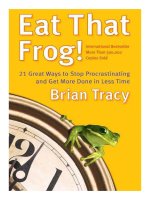
EAT THAT FROG! pps
Bạn đang xem bản rút gọn của tài liệu. Xem và tải ngay bản đầy đủ của tài liệu tại đây (299.21 KB, 124 trang )
EAT THAT FROG!
PAGE 1
TABLE OF CONTENTS
Preface
Introduction …………. Eat That Frog
Chapter 1 Set the Table
Chapter 2 Plan Every Day In Advance
Chapter 3 Apply the 80/20 Rule to Everything
Chapter 4 Consider the Consequences
Chapter 5………………Practice Creative Procrastination
Chapter 6 Use the ABCDE Method Continually
Chapter 7 Focus on Key Result Areas
Chapter 8 The Law of Three
Chapter 9 Prepare Thoroughly Before You Begin
Chapter 10…………… Take It One Oil Barrel at a Time
Chapter 11 Upgrade Your Key Skills
Chapter 12 Leverage Your Special Talents
Chapter 13 Identify Your Key Constraints
Chapter 14 Put the Pressure on Yourself
EAT THAT FROG!
PAGE 2
Chapter 15 Maximize Your Personal Power
Chapter 16 Motivate Yourself into Action
Chapter 17 Get Out of the Technological Time Sinks
Chapter 18 Slice and Dice the Task
Chapter 19 Create Large Chunks of Time
Chapter 20 Develop a Sense of Urgency
Chapter 21 Single Handle Every Task
Conclusion…………….Putting It All Together
EAT THAT FROG!
PAGE 3
PREFACE
Thank you for picking up this book. I hope these ideas help you as
much as have helped me and thousands of others. In fact, I hope that
this book changes your life forever.
There is never enough time to do everything you have to do. You are
literally swamped with work and personal responsibilities, projects,
stacks of magazines to read and piles of books you intend to get to
one of these days as soon as you get caught up.
But the fact is that you are never going to get caught up. You will
never get on top of your tasks. You will never get far enough ahead
to be able to get to all those books, magazines and leisure time
activities that you dream of doing.
And forget about solving your time management problems by
becoming more productive. No matter how many personal
productivity techniques you master, there will always be more to do
than you can ever accomplish in the time you have available to you,
no matter how much it is.
You can only get control of your time and your life by changing the
way you think, work and deal with the never ending river of
responsibilities that flows over you each day. You can only get
control of your tasks and activities to the degree that you stop doing
some things and start spending more time on the few things that can
really make a difference in your life.
EAT THAT FROG!
PAGE 4
I have studied time management for more than thirty years. I have
immersed myself in the works of Peter Drucker, Alex Mackenzie,
Alan Lakein, Stephen Covey and many, many others. I have read
hundreds of books and thousands of articles on personal efficiency
and effectiveness. This book is the result.
Each time I came across a good idea, I tried it out in my own work
and personal life. If it worked, I incorporated it into my talks and
seminars and taught it to others.
Galileo once wrote, “You cannot teach a person something he does
not already know; you can only bring what he does know to his
awareness.”
Depending upon your level of knowledge and experience, these ideas
will sound familiar. This book will bring them to a higher level of
awareness. When you learn and apply these methods and techniques
over and over until they become habits, you will alter the course of
your life in a very positive way.
EAT THAT FROG!
PAGE 5
MY OWN STORY
Let me tell you something about myself and the origins of this little
book. I started off in life with few advantages, aside from a curious
mind. I did poorly in school and left without graduating. I worked at
laboring jobs for several years. My future did not appear promising.
As a young man, I got a job on a tramp freighter and went off to see
the world. For eight years, I traveled and worked, and then traveled
some more, eventually visiting more than eighty countries on five
continents.
When I could no longer find a laboring job, I got into sales, knocking
on doors, working on straight commission. I struggled from sale to
sale until I began looking around me and asking, “Why is it that
other people are doing better than I am?”
Then I did something that changed my life. I began to ask successful
people what they were doing that enable them to be more productive
and earn more money than me. And they told me. And I did what
they advised me to do, and my sales went up. Eventually, I became
so successful that they made me a sales manager. As a sales manager,
I used the same strategy. I asked successful managers what they did
to achieve such great results, and when they told me, I went out and
did the same things. In no time at all, I began to get the same results
they did.
EAT THAT FROG!
PAGE 6
This process of learning and applying what I had learned changed
my life. I am still amazed at how simple and obvious it is. Just find
out what other successful people do and do the same things until you
get the same results. Learn from the experts. Wow! What an idea.
Success Is Predictable
Simply put, some people are doing better than others because they do
things differently and they do the right things right. Especially,
successful, happy, prosperous people use their time far, far better
than the average person.
Coming from an unsuccessful background, I had developed deep
feelings of inferiority and inadequacy. I had fallen into the mental
trap of assuming that people who were doing better than me were
actually better than me. What I learned was that this was not
necessarily true. They were just doing things differently, and what
they had learned to do, within reason, I could learn as well.
This was a revelation to me. I was both amazed and excited with this
discovery. I still am. I realized that I could change my life and
achieve almost any goal I could set if I just found out what others
were doing in that area and then did it myself until I got the same
results they were getting.
Within one year of starting in sales, I was a top salesman. A year later
I was made a manager. Within three years, I became a vice-president
EAT THAT FROG!
PAGE 7
in charge of a 95 person sales force in six countries. I was twenty-five
years old.
Over the years, I have worked in twenty-two different jobs, started
and built several companies, earned a business degree from a major
university, learned to speak French, German and Spanish and been a
speaker, trainer or consultant for more than 1000 companies. I
currently give talks and seminars to more than 250,000 people each
year, with audiences as large as 20,000 people.
A Simple Truth
Throughout my career, I have discovered and rediscovered a simple
truth. It is this: the ability to concentrate single-mindedly on your
most important task, to do it well and to finish it completely, is the
key to great success, achievement, respect, status and happiness in
life. This key insight is the heart and soul of this book.
This book is written to show you how to get ahead more rapidly in
your career and to simultaneously enrich your personal life. These
pages contain the twenty-one most powerful principles on personal
effectiveness I have ever discovered.
These methods, techniques and strategies are practical, proven and
fast acting. In the interests of time, I do not dwell on the various
psychological or emotional explanations for procrastination or poor
time management. There are no lengthy departures into theory or
research. What you will learn are specific actions you can take
EAT THAT FROG!
PAGE 8
immediately to get better, faster results in your work, and to increase
your happiness with your family and other people.
Every idea in this book is focused on increasing your overall levels of
productivity, performance and output, and on making you more
valuable in whatever you do. You can apply many of these ideas to
your personal life as well.
Each of these twenty-one methods and techniques is complete in
itself. All are necessary. One strategy might be effective in one
situation and another might apply to another task. All together, these
twenty-one ideas represent a smorgasbord of personal effectiveness
techniques that you can use at any time, in any order or sequence that
makes sense to you at the moment.
The key to success is action. These principles work to bring about
fast, predictable improvements in performance and results. The faster
you learn and apply them, the faster you will move ahead in your
career, guaranteed!
There will be no limit to what you can accomplish when you learn
how to “Eat That Frog!”
Brian Tracy
EAT THAT FROG!
PAGE 9
INTRODUCTION
This is a wonderful time to be alive. There have never been more
possibilities and opportunities for you to achieve more of your goals
than exist today. And as perhaps never before in human history, you
are actually drowning in options. In fact, there are so many good
things that you can do that your ability to decide among them maybe
the critical determinant of what you accomplish in life.
If you are like most people today, you are overwhelmed with too
much to do and too little time. As you struggle to get caught up, new
tasks and responsibilities just keep rolling in, like the waves of the
ocean. Because of this, you will never be able to do everything you
have to do. You will never be caught up. You will always be behind
in some of your tasks and responsibilities, and probably in many of
them.
The Need to Be Selective
For this reason, and perhaps more than ever before, your ability to
select your most important task at each moment, and then to get
started on that task and to get it done both quickly and well, will
probably have more of an impact on your success than any other
quality or skill you can develop.
An average person who develops the habit of setting clear priorities
and getting important tasks completed quickly will run circles
EAT THAT FROG!
PAGE 10
around a genius who talks a lot and makes wonderful plans but who
gets very little done.
The Truth about Frogs
Mark Twain once said that if the first thing you do each morning is to
eat a live frog, you can go through the day with the satisfaction of
knowing that that is probably the worst thing that is going to happen
to you all day long.
Your "frog" is your biggest, most important task, the one you are
most likely to procrastinate on if you don't do something about it.
It is also the one task that can have the greatest positive impact on
your life and results at the moment.
The first rule of frog-eating is: "If you have to eat two frogs, eat the
ugliest one first."
This is another way of saying that, if you have two important tasks
before you, start with the biggest, hardest and most important task
first. Discipline yourself to begin immediately and then to persist
until the task is complete before you go on to something else.
Think of this as a “test.” Treat it like a personal challenge. Resist the
temptation to start with the easier task. Continually remind yourself
that one of the most important decisions you make each day is your
choice of what you will do immediately and what you will do later, if
you do it at all.
EAT THAT FROG!
PAGE 11
The second rule of frog-eating is: "If you have to eat a live frog at all,
it doesn't pay to sit and look at it for very long."
The key to reaching high levels of performance and productivity is
for you to develop the lifelong habit of tackling your major task first
thing each morning. You must develop the routine of "Eating your
frog" before you do anything else, and without taking too much time
to think about it.
Take Action Immediately
In study after study of men and women who get paid more and
promoted faster, the quality of "action orientation," stands out as the
most observable and consistent behavior they demonstrate in
everything they do. Successful, effective people are those who launch
directly into their major tasks and then discipline themselves to work
steadily and single mindedly until those tasks are complete.
In our world, and especially in our business world, you are paid and
promoted for getting specific, measurable results. You are paid for
making a valuable contribution and especially, for making the most
important contribution that is expected of you.
"Failure to execute" is one of the biggest problems in organizations
today. Many people confuse activity with accomplishment. They talk
continually, hold endless meetings and make wonderful plans, but,
in the final analysis, no one does the job and gets the results required.
EAT THAT FROG!
PAGE 12
Develop the Habits of Success
Your success in life and work will be determined by the kinds of
habits that you develop over time. The habit of setting priorities,
overcoming procrastination and getting on with your most important
task is a mental and physical skill. As such, this habit is learnable
through practice and repetition, over and over again, until it locks
into your subconscious mind and becomes a permanent part of your
behavior. Once it becomes a habit, it becomes both automatic and
easy to do.
This habit of starting and completing important tasks has immediate
and continuous payoff. You are designed mentally and emotionally
in such a way that task completion gives you a positive feeling. It
makes you happy. It makes you feel like a winner.
Whenever you complete a task, of any size or importance, you feel a
surge of energy, enthusiasm and self-esteem. The more important the
completed task, the happier, more confident and powerful you feel
about yourself and your world.
Important task completion triggers the release of endorphins in your
brain. These endorphins give you a natural “high.” The endorphin
rush that follows successful completion of any task makes you feel
more positive, personable, creative and confident.
EAT THAT FROG!
PAGE 13
Develop a Positive Addiction
Here is one of the most important of the so-called “secrets of
success.” It is that you can actually develop a "positive addition" to
endorphins and to the feeling of enhanced clarity, confidence and
competence that they trigger. When you develop this “addiction,”
you will, at an unconscious level, begin to organize your life in such a
way that you are continually starting and completing ever more
important tasks and projects. You actually become addicted, in a very
positive sense, to success and contribution.
One of the keys to your living a wonderful life, having a successful
career and feeling terrific about yourself is for you to develop the
habit of starting and finishing important jobs. At that point, this
behavior takes on a power of its own and you find it easier to
complete important tasks than not to complete them.
No Short Cuts
You remember the story of the man who stops a musician on a street
in New York and asks how he can get to Carnegie Hall. The musician
replies, "Practice, man, practice."
Practice is the key to mastering any skill. Fortunately, your mind is
like a muscle. It grows stronger and more capable with use. With
practice, you can learn any behavior or develop any habit that you
consider either desirable or necessary.
EAT THAT FROG!
PAGE 14
The Three D’s of New Habit Formation
You need three key qualities to develop the habits of focus and
concentration. They are all learnable. They are decision, discipline,
and determination.
First, make a decision to develop the habit of task completion.
Second, discipline yourself to practice the principles you are about to
learn over and over until they become automatic. And third, back
everything you do with determination until the habit is locked in
and becomes a permanent part of your personality.
Visualize Yourself As You Want to Be
There is a special way that you can accelerate your progress toward
becoming the highly productive, effective, efficient person that you
want to be. It consists of your thinking continually about the rewards
and benefits of being an action oriented, fast moving, and focused
person. See yourself as the kind of person who gets important jobs
done quickly and well on a consistent basis.
Your mental picture of yourself has a powerful effect on your
behavior. Visualize yourself as the person you intend to be in the
future. Your self-image, the way you see yourself on the inside,
largely determines your performance on the outside. All
improvement in your outer life begins with improvements in your
mental pictures, on the inside.
EAT THAT FROG!
PAGE 15
You have a virtually unlimited ability to learn and develop new
skills, habits and abilities. When you train yourself, through
repetition and practice, to overcome procrastination and get your
most important tasks completed quickly, you will move yourself onto
the fast track in your life and career and step on the accelerator.
Eat That Frog!
EAT THAT FROG!
PAGE 16
CHAPTER 1
Set the Table
“There is one quality that one must possess to win,
and that is definiteness of purpose, the knowledge of what one wants
and a burning desire to achieve it.”
Napoleon Hill
Before you can determine your “frog” and get on with the job of
eating it, you have to decide exactly what it is you want to achieve in
each area of your life. Clarity is perhaps the most important concept
in personal productivity. The number one reason why some people
get more work done faster is because they are absolutely clear about
their goals and objectives and they don’t deviate from them.
The greater clarity you have regarding what you want and the steps you
will have to take to achieve it, the easier it will be for you to overcome
procrastination, eat your frog and complete the task before you.
A major reason for procrastination and lack of motivation is
vagueness, confusion and fuzzy mindedness about what it is you are
trying to do, and in what order and for what reason. You must avoid
this common condition with all your strength by striving for ever
greater clarity in your major goals and tasks.
Here is a great rule for success: "Think on paper."
EAT THAT FROG!
PAGE 17
Only about 3% of adults have clear, written goals. These people
accomplish five and ten times as much as people of equal or better
education and ability but who, for whatever reason, have never taken
the time to write out exactly what it is they want.
There is a powerful formula for setting and achieving goals that you
can use for the rest of your life. It consists of seven simple steps. Any
one of these steps can double and triple your productivity if you are
not currently using it. Many of my graduates have increased their
incomes dramatically in a matter of a few years, or even a few
months, with this simple, seven-part method.
Step One: Decide exactly what you want.
Either decide for yourself or sit down with your boss and discuss
your goals and objectives until you are absolutely, crystal clear about
what is expected of you and in what order of priority. It is amazing
how many people are working away, day after day, on low value
tasks because they have not had this critical discussion with their
manager.
Rule: “One of the very worst uses of time is to do something very
well that need not be done at all.”
Stephen Covey says that, "Before you begin scrambling up the ladder
of success, make sure that it is leaning against the right building."
EAT THAT FROG!
PAGE 18
Step Two: Write it down.
Think on paper. When you write your goal down, you crystallize it
and give it tangible form. You create something that you can touch
and see. On the other hand, a goal or objective that is not in writing is
merely a wish or a fantasy. It has no energy behind it. Unwritten
goals lead to confusion, vagueness, misdirection and numerous
mistakes.
Step Three: Set a deadline on your goal. Set sub-deadlines if
necessary.
A goal or decision without a deadline has no urgency. It has no real
beginning or end. Without a definite deadline accompanied by the
assignment or acceptance of specific responsibilities for completion,
you will naturally procrastinate and get very little done.
Step Four: Make a list of everything that you can think of that you
are going to have to do to achieve your goal.
As you think of new activities, add them to your list. Keep building
your list until it is complete. A list gives you a visual picture of the
larger task or objective. It gives you a track to run on. It dramatically
increases the likelihood that you will achieve your goal as you have
defined it and on schedule.
Step Five: Organize the list into a plan.
EAT THAT FROG!
PAGE 19
Organize your list by priority and sequence. Take a few minutes to
decide what you need to do first and what you can do later. Decide
what has to be done before something else and what needs to be
done afterwards. Even better, lay out your plan visually, in the form
of a series of boxes and circles on a sheet of paper, with lines and
arrows showing the relationship of each task to each other task.
You’ll be amazed at how much easier it is to achieve your goal when
you break it down into individual tasks.
With a written goal and an organized plan of action, you will be far
more productive and efficient than someone who is carrying his goals
around in his mind.
Step Six: Take action on your plan immediately.
Do something. Do anything. An average plan vigorously executed is
far better than a brilliant plan on which nothing is done. For you to
achieve any kind of success, execution is everything.
Step Seven: Resolve to do something every single day that moves
you toward your major goal.
Build this activity into your daily schedule. You may read a specific
number of pages on a key subject. You could call on a specific
number of prospects or customers. You can engage in a specific
period of physical exercise. You can learn a certain number of new
words in a foreign language. Whatever it is, you must never miss a
day.
EAT THAT FROG!
PAGE 20
Keep pushing forward. Once you start moving, keep moving. Don’t stop.
This decision, this discipline alone, can dramatically increase your speed
of goal accomplishment and boost your personal productivity.
The Power of Written Goals
Clear written goals have a wonderful effect on your thinking. They
motivate you and galvanize you into action. They stimulate your
creativity, release your energy and help you to overcome
procrastination as much as any other factor.
Goals are the fuel in the furnace of achievement. The bigger your
goals and the clearer they are, the more excited you become about
achieving them. The more you think about your goals, the greater
becomes your inner drive and desire to accomplish them.
Think about your goals and review them daily. Every morning when
you begin, take action on the most important task you can
accomplish to achieve your most important goal at the moment.
Eat That Frog!
1. Take a clean sheet of paper right now and make out a list of ten
goals you want to accomplish in the next year. Write your goals as
though a year has already passed and they are now a reality.
Use the present tense, positive and personal case so that they are
immediately accepted by your subconscious mind.
EAT THAT FROG!
PAGE 21
For example, you would write. “I earn X number of dollars per year.”
Or “I weigh X number of pounds.” Or “I drive such and such a car.”
2. Review your list of ten goals and select the one goal that, if you
achieved it, would have the greatest positive impact on your life.
Whatever that goal is, write it on a separate sheet of paper, set a
deadline, make a plan, take action on your plan and then do
something every single day that moves you toward that goal. This
exercise alone could change your life!
EAT THAT FROG!
PAGE 22
CHAPTER 2
Plan Every Day In Advance
“Planning is bringing the future into the present
so you can do something about it now.”
Alan Lakein
You have heard the old question, ”How do you eat an elephant?
Answer: One bite at a time!”
How do you eat your biggest, ugliest frog? The same way; you break
it down into specific step-by-step activities and then you start on the
first one.
Your mind, your ability to think, plan and decide, is your most
powerful tool for overcoming procrastination and increasing your
productivity. Your ability to set your goals, make plans and take
action on them determines the course of your life. The very act of
thinking and planning unlocks your mental powers, triggers your
creativity and increases your mental and physical energies.
Conversely, as Alex Mackenzie wrote, "Action without planning is the
cause of every failure."
Your ability to make good plans, before you begin, is a measure of
your overall competence. The better the plan you have, the easier it is
for you to overcome procrastination, to get started, to eat your frog
and then to keep going.
EAT THAT FROG!
PAGE 23
Increase Your Return on Energy
One of your top goals at work should be for you to get the highest
possible return on your investment of mental, emotional and physical
energy. The good news is that every minute spent in planning saves
as many as ten minutes in execution. It only takes about ten to twelve
minutes for you to plan out your day, but this small investment of
time will save you at least two hours (100-120 minutes) in wasted
time and diffused effort throughout the day.
You may have heard of the Six "P" Formula. It says, "Proper Prior
Planning Prevents Poor Performance."
When you consider how helpful planning can be in increasing your
productivity and performance, it is amazing how few people practice
it every single day. And planning is really quite simple to do. All you
need is a piece of paper and a pen. The most sophisticated Palm Pilot,
computer program or time planner is based on the same principle. It
is based on your sitting down and making a list of everything you
have to do before you begin.
Two Extra Hours Per Day
Always work from a list. When something new comes up, add it to
the list before you do it. You can increase your productivity and
output by 25% or more, by about two hours, from the first day that
you begin working consistently from a list.
EAT THAT FROG!
PAGE 24
Make out your list the night before, at the end of the workday. Move
everything that you have not yet accomplished onto your list for the
coming day and then add everything that you have to do the next
day. When you make out your list the evening or the night before,
your subconscious mind works on your list all night long while you
sleep. Often you will wake up with great ideas and insights that you
can use to get your job done faster and better than you had initially
thought.
The more time you take to make written lists of everything you have
to do, in advance, the more effective and efficient you will be.
Different Lists for Different Purposes
There are different lists that you need for different purposes. First,
you should create a master list on which you write down everything
you can think of that you want to do some time in the future. This is
the place where you capture every idea that comes to or every new
task or responsibility that comes up. You can then sort out the items
later.
Second, you should have a monthly list that you make up at the end
of the month for the month ahead. This may contain items
transferred from your master list.
Third, you should have a weekly list where you plan your entire
week in advance. This is a list that is under construction as you go
through the current week.