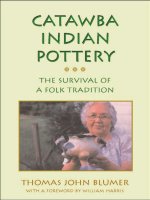
university alabama press catawba indian pottery the survival of a folk tradition jan 2004
Bạn đang xem bản rút gọn của tài liệu. Xem và tải ngay bản đầy đủ của tài liệu tại đây (1.71 MB, 248 trang )
Catawba Indian Pottery
Contemporary American Indian Studies
J. Anthony Paredes, Series Editor
Catawba Indian Pottery
The Survival of a Folk Tradition
Thomas John Blumer
With a Foreword by William Harris
THE UNIVERSITY OF ALABAMA PRESS
Tuscaloosa and London
Copyright © 2004
Thomas John Blumer
All rights reserved
Published by The University of Alabama Press
Tuscaloosa, Alabama 35487-0380
Manufactured in the United States of America
Typeface: Trump Mediaeval
∞
The paper on which this book is printed meets the minimum requirements of Ameri-
can National Standard for Information Science–Permanence of Paper for Printed Li-
brary Materials, ANSI Z39.48-1984.
Library of Congress Cataloging-in-Publication Data
Blumer, Thomas J., 1937–
Catawba Indian pottery : the survival of a folk tradition / Thomas John Blumer ;
with a foreword by William Harris.
p. cm. — (Contemporary American Indian Studies)
Includes bibliographical references and index.
ISBN 0-8173-1383-4 (cloth : alk. paper) — ISBN 0-8173-5061-6 (pbk. : alk. paper)
1. Catawba pottery—Themes, motives. 2. Catawba Indians—Industries. 3. Pottery
craft—South Carolina. I. Title. II. Series.
E99.C24 B58 2004
738′.089′9752—dc21
2003012348
British Library Cataloguing-in-Publication Data available
The Catawba tradition has entered the third millennium with
a tremendous strength. The transition is being accomplished by
a large number of master potters. Foremost in this long list are
Earl Robbins
Viola Robbins
Margaret Tucker
Cheryl Sanders
Brian Sanders
Marcus Sanders
Catawba Indian Pottery: The Survival of a Folk Tradition
is dedicated to them.
Contents
List of Figures ix
Foreword xiii
Preface xvii
1. Discovering the Catawba 1
2. A Family Economy Based on Pottery 13
3. Peddling Pottery 29
4. The Indian Circuit 46
5. Teaching the Craft 63
6. Professionalism and the Catawba Potters 74
7. A Native Resource, Clay 92
8. Tools: Ancient and Modern Adaptations 107
9. Building Pots: Woodland and Mississippian Methods 119
10. Design Motifs 149
11. The Pipe Industry 177
12. Burning the Pottery 187
Conclusion 196
References Cited 199
Index 209
Figures
1. North Carolina trade ware 39
2. Indian head jar 47
3. Early Brown family working at Schoenbrun Village, Ohio 50
4. Evelyn Brown George picking clay in Nisbet Bottoms 94
5. Larry Brown sitting inside the Blue Clay Hole 98
6. Rubbing rocks used by Doris Wheelock Blue 110
7. Incising tools used by Doris Wheelock Blue 113
8. Squeeze molds 114
9. Basic pot made with rolls 120
10. Typical Catawba cooking pots 121
11. Basic pot made with rings 122
12. Edith Harris Brown building a Catawba cooking pot 123
13. Basic pot made with a morsel of clay 124
14. Building a snake pot 126
15. Snake pots 127
16. Building a water jug 128
17. Water jugs 129
18. Building an Indian head jar 130
19. Indian head jars 131
20. Building a gypsy pot 132
21. Nola Campbell holding a green ware gypsy pot 133
22. Indian head bowls 134
23. Building a Rebecca pitcher 135
24. Rebecca pitchers 136
25. Water pitchers 136
26. Building a cupid jug 137
27. Building a wedding jug 138
28. Wedding jugs 139
29. Peace pipes 140
30. Bending an arrow pipe 141
31. Pipes 142
32. Turtle ef¤gies 145
33. Earl Robbins with a water jug 147
34. Common motifs 150
35. King Hagler signature with barred oval 154
36. Southern Cult swastika in King Hagler signature 155
37. Catawba signatures, 1765 155
38. Portrait pipes 156
39. Three bowls 157
40. Catawba woman’s dance dress 159
41. Catawba woman’s dance dress 160
42. Tattooing technique 161
43. Pine Tree George gorget, eighteenth century 162
44. Turtle pipe, nineteenth century 163
45. Sun circle motif 163
46. Barred oval 164
47. Tattoo motif, sixteenth century and contemporary 164
48. Tattoo motif, sixteenth century and contemporary 165
49. Cross designs 165
50. Swastikas 166
51. Swastikas 166
52. Sacred ¤re pattern 167
53. Undecorated peace pipe 168
54. Incised peace pipe 169
x Figures
55. Ornate incised peace pipe 169
56. Feather motif treatments 170
57. Peace pipe with feather motif 171
58. Axe pipes and comb pipes 171
59. Gypsy or medicine pot circa 1900 172
60. Snake pots 173
61. Zigzag motifs 174
62. Crosshatch and ladder motif 175
63. Crosshatch motif, arrowhead pipe, and small bowl 175
64. Burning pottery 188
Figures xi
Foreword
M
y grandmother was Georgia Harris, one of the greatest Catawba
Indian potters. Before she died in 1996 at the age of 91, she asked
her closest friend, Dr. Thomas Blumer, to deliver her eulogy. To those
who didn’t know Dr. Blumer, it may have seemed strange that a white
scholar from the Library of Congress in Washington, D.C., eulogized
an elderly Indian woman who had spent most of her life on or near the
Catawba Indian Reservation in South Carolina. But Dr. Blumer is not
simply a historian with more than 200 publications regarding the Ca-
tawba to his credit. Through his sel®ess dedication to the people and
the pottery of the Catawba, he has become our cherished friend.
I heard about Dr. Blumer before I had the opportunity to meet him.
Nearly 30 years ago, my grandmother told me about a young man who
had visited her to ask questions about her pottery and the traditions of
the Catawba potters. I sat in her kitchen and listened to her tell the
story of the young man from the University of South Carolina who had
“discovered” a wonderful art form, Catawba pottery.
Dr. Blumer became a frequent visitor to my grandmother’s house,
and his curiosity about Catawba pottery became almost an obsession,
consuming his thoughts and most of his time. His genuine apprecia-
tion of the beauty, grace, and simplicity of Catawba pottery created a
bridge between him and the usually reticent Catawba. Before long he
was spending every spare moment on the Catawba Reservation, record-
ing conversations with not only the potters but other tribal members
as well. With the limited funds of a doctoral candidate, with no grants
or donations to help him, he dedicated himself to recording the history
and art of the Catawba. And always he worked against a ticking clock,
knowing that his most important resources were the elderly potters of
the Catawba Nation.
Interestingly, Dr. Blumer’s discriminating appreciation of Catawba
pottery inspired my grandmother to produce her best work. She had
learned to make pottery from her mother Margaret Harris, and from
her grandmother Martha Jane Harris, who is considered to be the best
of the Catawba potters. Following the example of such accomplished
potters, my grandmother made pottery that was consistently excellent.
Nonetheless, I can remember, as I helped her ¤re pots in a shallow pit
in her back yard, her excitement when a pot “burned” particularly well.
Her respect for Dr. Blumer’s knowledge of Catawba pottery was such
that she would often point to her best piece and say, “I’ll bet Dr. Blumer
will buy that one.” And he often did, even when buying a pot meant
making a choice between owning that pot and having enough food
to eat the next week. He understood that each piece of pottery was
unique, that it never would be duplicated by the artist or by the ¤re.
One piece of pottery at a time, he carefully and lovingly built a collec-
tion of Catawba pottery that is unsurpassed.
When the Catawba Nation sued the state of South Carolina to settle
a 150-year-old land claim, Dr. Blumer provided support in the form of
historical research, and when the Catawba Nation was awarded a $50
million settlement in 1993, no one was happier for the Catawba than
Dr. Blumer.
That tangible support is typical of Dr. Blumer’s relationship with
the Catawba. During his early visits to the reservation, Dr. Blumer
found that the Catawba traditionally learned pottery making at the
knee of a family elder. His concern that too few of the younger tribal
members were taking up the craft led him to encourage the older pot-
ters to teach pottery-making classes. Thanks to his efforts, a revival
of interest in the making of pottery followed, and many of today’s Ca-
tawba potters can look back to those classes and remember their own
beginnings as potters.
Dr. Blumer’s knowledge of the Catawba traditions and his love of
Catawba pottery made him the perfect ambassador for the Catawba
Nation. He never refused any request for information about Catawba
pottery, and he never passed up an opportunity to make others aware
of the treasure to be found in northern South Carolina. He graciously
accepted the title of Catawba Tribal Historian and continued to donate
his time to the promotion of Catawba pottery. It was through his ef-
xiv Foreword
forts that my grandmother was awarded posthumously the National En-
dowment for the Arts “Folk Heritage Award” in 1996. It would be dif¤-
cult indeed to ¤nd a Catawba potter who has not bene¤ted from his
encouragement and patronage.
And now, with this book, Thomas Blumer bene¤ts not only the Ca-
tawba but also anyone interested in our history or our art. It can truth-
fully be said that no one knows more about the history of the Catawba
people than Thomas Blumer. And certainly no one knows more about
our pottery. Catawba Indian Pottery: The Survival of a Folk Tradition
organizes and disseminates his unique knowledge of every aspect of
Catawba Indian pottery. It brings together the experience and knowl-
edge of countless Catawba potters, many of whose voices have been
silenced over the last 30 years. Dr. Blumer’s decades of academic re-
search complements those voices by giving depth and perspective to
the personal recollections of contemporary Catawba.
Through his life’s work with the Catawba Indian Nation of South
Carolina, Thomas Blumer has become something of a Catawba trea-
sure himself. Future generations will be indebted to Dr. Blumer for his
lifelong dedication to understanding and recording the art and history
of the “People of the River.”
William Harris
Catawba Indian Nation
Foreword xv
Preface
T
his volume has been too long in the making. Aside from my own
distractions coming from those wanting Catawba information
from me, the task of examining issues connected to Catawba history
and culture is enormous. The documentation is vast and scattered. The
tradition is of great antiquity and certainly deserved the attention.
Also, although the Catawba survived the eighteenth and nineteenth
centuries, the most critical period in their history, they slipped into
obscurity. As a result, it took far too long for the American academic
community to discover this artistically lonely pottery-making com-
munity. In 1884, the U.S. Bureau of Ethnology sent Edward Palmer, a
¤eld anthropologist, to the reservation. As a result, the Smithsonian’s
Catawba collection dates from Palmer’s ¤eld trip. It is, therefore, the
oldest in the United States. George P. Merrell, John R. Swanson, and
James Mooney, to name the major contributors, made additions to
the collection. Then, in 1888, a South Carolina writer and would-
be ethnologist, MacDonald Furman, took an interest in the Catawba
and wrote about them in the local press. He alone sparked interest in
South Carolina. As a result of his efforts, the University of South Caro-
lina collection was begun early in the twentieth century. Major addi-
tions have been made in recent years by the University’s McKissick
Museum.
Palmer and Furman were followed by M. R. Harrington (1908), who
produced the ¤rst published examination of the Catawba tradition.
V. Fewkes came next in 1944 with his longer study. Since 1944 no at-
tempts have been made to discuss the Catawba tradition in a compre-
hensive way. It is, however, impossible to discuss the Catawba for very
long and not touch upon the pottery made by the Indians. Nearly every
scholar who has done any work on the Catawba has made some effort
to bring the tradition into focus. In spite of over a century of scholarly
attention, no comprehensive study of the Catawba tradition has ever
been written from the Catawba perspective. Catawba Indian Pottery:
The Survival of a Folk Tradition hopefully ¤lls this need. At long last
the Catawba themselves have a chance to speak at length about their
ancestral tradition. What they have to say will help scholars move
closer to a full recognition of the historical importance of the Catawba
contribution. The world beyond the Catawba has much to gain as this
small Nation is recognized for the cultural, artistic, and technological
bridge it offers between our times and the little understood prehistory
of the region.
The ¤rst thank you for standing by me in the making of this study
goes to my longtime friend Brent L. Kendrick. He accompanied me on
my ¤rst visits to the Catawba Reservation. Although his professional
desires took him in the direction of American Literature, he never left
off encouraging me during my long Catawba saga. He has been my edi-
tor and has always believed in my work among the Catawba. Over the
years he has believed in the value of my study, Catawba Indian Pottery:
The Survival of a Folk Tradition. He has always told me that, though
my approach to Catawba studies came with its dif¤culties, my ap-
proach of dealing directly with my primary source was the key to my
success. He was right, and I thank him.
Those Catawba Indians and individuals allied to the Nation who
have always stood by me as mentors include: Deborah Harris Crisco,
Jayne Marks Harris, William Harris, Judy Canty Martin, Billie Anne
Canty McKellar, Steve McKellar, Della Harris Oxendine, Earl Robbins,
Viola Harris Robbins, E. Fred Sanders, Marcus Sanders, Frances Canty
Wade, and Cynthia Walsh. I owe them many thanks for years of friend-
ship and support. Although they passed away long ago, this study is a
dream come true for Georgia Harris and Doris Blue.
A huge number of Catawba have supported my work over the years
and these include: Cindy Allen (potter); Hazel (Foxx) Ayers (potter);
Sara Lee Harris Sanders Ayers (master potter); Richard Bailey (Sanders
family); Helen Canty Beck (master potter, major history informant);
Lula Blue Beck (master potter, major history informant); Major Beck
(¤ddler, major history informant); Roderick Beck (potters’ support net-
work); Ronnie Beck (potter, dancer); Sallie Brown Beck (master potter);
xviii Preface
Samuel Beck (secretary/treasurer, mentor); Lillian Harris Blue Black-
welder (potter); Betty Harris Blue (potter); Brian Blue (potter); Doris
Wheelock Blue (master potter, major history informant, mentor); Eva
George Blue (potter); Gilbert Blue (chief); LeRoy Blue (major history
informant); Mildred Blue (master potter); Travis Blue (potter); Anna
Brown Branham (potter, master bead worker, language revival); William
(Monty) Branham (master potter, music composer); Ellen Canty Bridges
(gourd worker); Jennie Canty Harris Sanders Brindle (potter, major his-
tory informant); Keith Brown (master potter, spiritual leader); Larry
Brown (potter, bead worker); Roy Brown (potters’ support network);
Blanche Harris Bryson (potter, major history informant); Louise Beck
Bryson (master potter, major history informant); Mohave Sanders Bry-
son (potter); Marsha Ferrell Byrd (potter); Edwin Campbell (master pot-
ter); Nola Harris Campbell (master potter, major history informant,
mentor); Catherine Sanders Canty (master potter, major history in-
formant); Dean Canty (dancer); Jack Canty (traditionalist leader, assis-
tant chief); Jerum Canty; Ronald Canty (potter); Paige Childress (potter);
Deborah Harris Crisco (traditionalist leader, mentor); Alberta Canty
Ferrell (master potter); Betty Blue Garcia; Guy Garcia (major history
informant, drummer); Beckee Simmers Garris (potter, dancer); Charles
George (®int knapper); Cindy Ayers George (bead worker); Elsie Blue
George (potter, major history informant); Evans (Buck) George (assis-
tant chief, history informant); Evelyn Brown George (master potter,
major history informant); Phillip George (wood carver); Isabelle Harris
Harris George (potter); Kristen George (potter); Landrum George (major
history informant); Mandy George (potter); Marvin George (potter, ma-
jor history informant); Susan George (potter); Wayne George; Cheryl
Gordon (potter); Faye George Greiner (potter, basket maker); Alice Har-
ris; Bertha George Harris (master potter, major history informant);
Beulah Thomas Harris (master potter, major history informant); Curtis
Harris (potter); Donald Harris (master pipe maker); George Furman
Harris (major history informant); Georgia Harris Harris (master potter,
major history informant, mentor); Grady Harris (major history infor-
mant); Ida Harris (potter); Little Leon Harris; Melvin Harris (major his-
tory informant); Minnie Harris Sanders Harris (potter); Peggy Thatcher
Harris (potter); Reola Harris Harris (potter); Richard Harris (major his-
tory informant); Walter Harris (potter); Wesley Harris (potters’ support
network); Wilburn Harris (major history informant); William Douglas
Harris (wood carver, potter, traditionalist leader, chief); Gail Blue Jones
(potter); Brandon Leach (potter); Miranda Leach (potter); Trisha Leach
(potter); Faye Robbins Bodiford Lear (potter, spiritual leader, major his-
tory informant); Billie Anne McKellar (master potter, mentor); Ann
Sanders Morris (potter); Denise Ferrell Nichols (potter); Dawn McKel-
Preface xix
lar Osborn (potter); Sherry Wade Osborn (potter); Della Harris Oxen-
dine (master potter); Donnie Plyler (potter); Elizabeth Plyler (master
potter); Olin Plyler (wood carver); Big Bradley Robbins (potter sup-
port network); Earl Robbins (master potter, mentor); Flint Robbins (pot-
ter support network); Frank Robbins (potter support network); Little
Bradley Robbins (potter); Viola Harris Robbins (master potter, mentor);
Albert Sanders (chief, major history informant); Brian Sanders (master
potter); Caroleen Sanders (master potter); Cheryl Harris Sanders (mas-
ter potter); Clark Sanders (potter); E. Fred Sanders (potter, major history
informant, traditionalist leader, mentor, councilman); Freddie Sanders
(master potter); Marcus Sanders (master potter, traditionalist leader);
Randall Sanders (potter); Verdie Harris Sanders (potter); Willie Sanders
(major history informant); Jimmy Simmers (potter); Shelly Simmers
(dancer); Pearly Ayers Harris Strickland (potter, major history infor-
mant); Virginia Blue Trimnal (major history informant); Roger Trim-
nal (major history informant, traditionalist leader); Margaret Robbins
Tucker (master potter); Matthew Tucker (potter); Shane Tucker (potter);
Ruby Ayers Brown Vincent (potter); Florence Harris Wade (potter);
Frances Canty Wade (potter, major history informant, mentor); Gary
Wade (major history informant); Sallie Harris Wade (potter, major his-
tory informant); Clifford Watts (major history informant); Eber White
(major history informant); Charlie Whitesides (potter); Velma Brown
Whitesides (arts and crafts authority); and Clara Sanders Wilson (tradi-
tionalist leader).
Those who are allied to the Catawba Nation through marriage and
contributed to the success of my work include: Eddie Allen (®ute
maker); Mae Bodiford Blue (potter); Dennis Bryson (potters’ support);
Willie Campbell (potters’ support); Jayne Marks Harris (artist, potters’
support); Judy Leaming (support of traditionalist faction); Steve McKel-
lar (artist, potters’ support).
A large number of institutions have always stood ready to assist me
in my research needs. These include Carolinian Library, University of
South Carolina, Columbia; Catawba Nation Archives, Catawba Na-
tion, Rock Hill, South Carolina; Chester County Museum, Chester,
South Carolina; Children’s Museum, Charlotte, South Carolina; Dacus
Library, Winthrop University, Rock Hill, South Carolina; Katawba Val-
ley Land Trust, Lancaster, South Carolina; Library of Congress, Wash-
ington, D.C.; McKissick Museum, University of South Carolina, Co-
lumbia; Mint Museum, Charlotte, North Carolina; Museum of the
American Indian, Heye Foundation, Washington, D.C.; Museum of
Charleston, South Carolina; Museum of York County, Rock Hill, South
Carolina; Qualla Cooperative, Cherokee, North Carolina; Schiele Mu-
seum of Natural History, Gastonia, North Carolina; Smithsonian In-
xx Preface
stitution, Washington, D.C.; South Carolina Department of Archives
and History, Columbia; University Museum, University of Pennsylva-
nia, Philadelphia; University of North Carolina, Department of An-
thropology and Archaeology, Chapel Hill; Valentine Museum, Rich-
mond, Virginia; York County Library, Rock Hill, South Carolina.
A growing number of scholars have taken an interest in the Catawba
and the following have generously given me their time and expertise:
Ruth Byers, York County Library, Rock Hill, South Carolina; Tommy
Charles, University of South Carolina, Columbia; Joffre L. Coe, Uni-
versity of North Carolina, Chapel Hill; R. P. Stephen Davis Jr., Univer-
sity of North Carolina, Chapel Hill; Michael Eldredge, Schiele Mu-
seum of Natural History, Gastonia, North Carolina; Barbara Frost,
Cinebar Productions, Newport News, Virginia; Tom Johnson, Carolini-
ana Library, University of South Carolina, Columbia; Rita Kenion, Ar-
chaeologist; Mary Mallaney, York County Library, Rock Hill, South
Carolina; Robert Mackintosh, South Carolina Department of Archives
and History, Columbia; Alan May, Schiele Museum of Natural His-
tory, Gastonia, North Carolina; Phil Moody, Winthrop University,
Rock Hill, South Carolina; Lindsay Pettus, Katawba Valley Land Trust,
Lancaster, South Carolina; Louise Pettus, local historian, Rock Hill,
South Carolina; Brett H. Riggs, University of North Carolina, Chapel
Hill; Blair Rudes, University of North Carolina at Charlotte; Tom Stan-
ley, Winthrop University, Rock Hill, South Carolina; Sherry Staples,
Cinebar Productions, Newport News, Virginia; Ann Tippitt, Schiele
Museum of Natural History, Gastonia, North Carolina; Gene Waddell,
College of Charleston, South Carolina; Steve Watts, Catawba Village
Exhibit, Schiele Museum of Natural History, Gastonia, North Caro-
lina; Terry Zug, University of North Carolina, Chapel Hill.
Preface xxi
Catawba Indian Pottery