mainly natural numbers - studies on sequences - h. ibstedt
Bạn đang xem bản rút gọn của tài liệu. Xem và tải ngay bản đầy đủ của tài liệu tại đây (932.61 KB, 97 trang )
Mainly Natural Numbers
- a few elementary studies on Smarandache
sequences and other number problems
Henry Ibstedt
American Research Press
Rehoboth, USA
2003
The surprising behaviour of a sequence
Mainly Natural Numbers
- a few elementary studies on Smarandache
sequences and other number problems
Henry Ibstedt
Glimminge 2036
7, rue du Sergent Blandan
280 60 Broby 92130 Issy les Moulineaux
Sweden France
American Research Press
Rehoboth, USA
2003
Henry Ibstedt & American Research Press
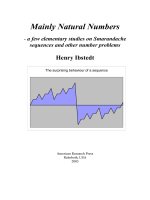
The diagram on the cover illustrates the Smarandache partial perfect additive
sequence. It has an amusing oscillating behaviour, it does not form loops and
has no terminating value. Its definition is simply
a
1
=a
2
=1, a
2k+1
=a
k+1
-1, a
2k+2
=a
k+1
+1
This book can be ordered in paperbound form from:
Books on Demand
ProQuest Information & Learning
(University of Microfilm International)
300 N. Zeeb Road
P.O. Box 1346, Ann Arbor
MI 48106-1346, USA
/>
and online from:
Publishing Online, Co. (Seattle, Washington State)
Peer Reviewers:
D. Constantinescu, College of Arts, Rm. Vâlcea, Romania.
M. Khoshnevisan, School of Accounting and Finance, Griffith
University, Gold Coast, Quensland 9726, Australia.
I. Prodan, Kishinev University, Kishinev, R. Moldova.
Copyright
2003 by
Henry Ibstedt, Glimminge 2036, 280 60 Broby, Sweden.
and
American Research Press, Rehoboth, Box 141, NM 87322, USA.
/>
ISBN: 1-931233-73-X
Standard Address Number: 297-5092
Printed in the United States of America
3
Preface
This book consists of a selection of papers most of which were produced
during the period 1999-2002. They have been inspired by questions raised in
recent articles in current Mathematics journals and in Florentin Smarandache’s
wellknown publication
Only Problems, Not Solutions.
All topics are independent of one another and can be read separately. Findings
are illustrated with diagrams and tables. The latter have been kept to a
minimum as it is often not the numbers but the general behaviour and pattern
of numbers that matters. One of the facinations with number problems is that
they are often easy to formulate but hard to solve – if ever, and if one finds a
solution, new questions present themselves and one may end up having more
new questions than questions answered.
In many practical as well as theoretical processes we repeat the same action on
an object again and again to obtain a final result or sustain a certain state. An
interesting case is when we do not know what the result will be after a large
number of repetitive actions - iterations. In this book a number of problems are
about iterations. In many cases computer simulation is followed by analysis
leading to conclusions or conjectures. The process of iterations has also been
dealt with in the authors first book
Surfing on the Ocean of Numbers
with
some applications in the second book Computer Analysis of Number
Sequences.
A brief summary will now be given about the contents of each chapter of the
book:
Chapter 1: This is in response to the question: Which is the smallest integer
that can be expressed as a sum of consecutive integers in a given number of
ways? The examination of this question leads to a few interesting conclusions.
4
Chapter II deals with interesting alterating iterations of the Smarandache
function and the Euler
φ
-function (the number of natural numbers less than n
and having no divisor in common with n) An important question concerning
the Smarandache function is resolved and an important link to the famous
Fermat numbers is established. This work has been reviewed in Zentralblatt für
Mathematik, Germany.
Chapter III is of a similar nature to that of chapter II. It deals with the
alternating iteration of the Smarandache function and the sum of divisors
function (
σ
-function). Some light is thrown on loops and invariants resulting
from this iteration. Interesting results are found but the results produce new
and very intriguing questions.
Chapter IV. An interesting iteration question was posed in the book Unsolved
Questions in Number Theory (first edition) by R.K. Guy. Why does the
repetitive application of the recursion formula x
n
=(1 +x
0
+x
1
+ …x
n-1
)/n with
x
0
=1 produce natural numbers for n=1,2, … 42 but not for n= 43. An
explanation to this was given by the author and published in Fibonacci
Quarterly in 1990 and was later referred to in the second edition of R.K. Guy’s
book. In of this book I show an iteration sequence which produces integers for
the first 600 iterations but not for the 601
st
which produces a decimal fraction.
This is the only article which is based on work prior to 1999.
Chapter V. In the previous chapters iterations have lead to loops or invariants.
The Smarandache partial perfect additive sequence has a very simple
definition: a
1
=a
2
=1, a
2k+1
=a
k+1
-1, a
2k+2
=a
k+1
+1. It does not form loops and it
does not have a terminating value. It has an amusing oscillating behavior
which is illustrated on the cover of this book.
Chapter VI. The classical definition of continued fractions was transformed to
one involving Smarandache sequences by Jose Castillo. In this article proof is
given for the fact that Smarandache general continued fractions built with
positive integer Smarandache sequences having only a finite number of terms
equal to 1 is convergent. This study, like several others from my earlier books,
has been reviewed in the Zentralblatt für Mathematik, Germany.
Chapter VII.
A k-k additive relationship involves the Smarandache function
S(n) which is defined as the smallest integer such that S(n)! is divisible by n. A
sequence of function values S(n), S(n+1)+ … +S(n+2k-1) satisfies a k-k
additive relationship if S(n)+S(n+1)+ …+S(n+k-1)=S(n+k)+S(n+k+1)+
5
…+S(n+2k-1). The analysis of these types of relations leads to the conclusion
that there are infinitely many 2-2 additive relations and that k-k relations exist
for large values of k. Only the first two solutions contain composite numbers.
An interesting observation is the great involvement of prime twins in the 2-2
relations.
Chapter VIII. An analysis of the number of relations of the type S(n)-
S(n+1)=S(n+2)-S(n+3) for n<10
8
where S(n) is the Smarandache function
leads to the plausible conclusion that there are infinitely many of those. Like in
the case of additive relationships there is a great involvement of prime twins
and composite number solutions are rare – only 6 were found.
Chapter IX.
Concatenation is a sophisticated word for putting two words
together to form one. The words book and mark are concatenated to form the
word
bookmark.
Identical words like “abcd” are concatenated to form infinite
chains like “abcdabcdabcdabcdabcd…”. This is partitioned in various way, for
example like this
abc
dabcdabcda
bcdabcd…
and the properties of the extracted worddabcdabcda is then studied. The
analysis of concatenations is applied to number sequences and many
interesting properties are found. In particular a number of questions raised on
the Smarandache deconstructive sequence are resolved.
Chapter X. In the study of a number sequence it was found that the terms
often had a factor 333667. We are here dealing with a sequence whos terms
grow to thousands of digits. No explanation was attempted in the article were
this was found. This intriguing fact and several others are dealt with in this
study, where, in a way, the concatenation process is reversed and divisibilty
properties studied. The most preoccupying questions in relation to divisibility
have always focussed on primality. In the articles in this book other divisibilty
properties are often brought into focus.
Finally I express my sincere thanks to Dr. Minh Perez for his support for this
book. Last but not least I thank my dear wife Anne-Marie for her patience with
me when I am in my world of numbers.
March 2003
Henry Ibstedt
6
7
Contents
Preface 3
I. An Integer as a Sum of Consecutive Integers 9
II.
Alternating Iterations of the Euler
φ
-Function and
the Pseudo-Smarandache Function
16
III. Alternating Iterations of the Sum of Divisors
Function and the Pseudo-Smarandache Function
26
IV. Some Sequences of Large Integers 32
V. The Smarandache Partial Perfect Additive Sequence
38
VI. Smarandache Continued Fractions
45
VII. Smarandache k-k additive relationships 59
VIII. Smarandache 2-2 subtractive relationships 68
IX. Concatenations
71
X. On a Deconcatenation Problem
83
8
9
I. An Integer as a Sum of Consecutive Integers
Abstract: This is a simple study of expressions of positive integers as sums of
consecutive integers. In the first part proof is given for the fact that N can be
expressed in exactly d(L)-1 ways as a sum of consecutive integers, L is the
largest odd factor of N and d(L) is the number of divisors of L. In the second
part answer is given to the question: Which is the smallest integer that can be
expressed as a sum of consecutive integers in n ways
.
1. Introduction
There is a remarkable similarity between the four definitions given below. The
first is the well known Smarandache Function. The second function was
defined by K. Kashihara and was elaborated on in his book
Comments and
Topics on Smarandache Notions and Problems
[1]. This function and the
Smarandache Ceil Function were also examined in the author’s book Surfing
on the Ocean of Numbers
[2]. These three functions have in common that they
aim to answer the question which is the smallest positive integer N which
possesses a certain property pertaining to a given integer n. It is possible to
pose a large number of questions of this nature.
1) The Smarandache Function S(n):
S(n)=N where N is the smallest positive integer which divides n!.
2) The Pseudo-Smarandache Function Z(n):
Z(n)=N where N is the smallest positive integer such that 1+2+…+N is
divisible by n.
3) The Smarandache Ceil Function of order k, S
k
(n):
S
k
(n)=N where N is he smallest positive integer for which n divides N
k
.
4) The n-way consecutive integer representation R(n):
R(n)=N where N is the smallest positive integer which can be represented
as a sum of consecutive integer is n ways.
10
There may be many positive integers which can be represented as a sum of
positive integers in n distinct ways - but which is the smallest of them? This
article gives the answer to this question. In the study of R(n) it is found that the
arithmetic function d(n), the number of divisors of n, plays an important role.
2. Questions and Conclusions
Question 1: In how many ways n can a given positive integer N be expressed
as the sum of consecutive positive integers?
Let the first term in a sequence of consecutive integers be Q and the number
terms in the sequence be M. We have N=Q+(Q+1)+ … +(Q+M-1) where M>1.
(1)
2
)1MQ2(M
N
−+
=
or
(2)
2
1M
M
N
Q
−
−=
For a given positive integer N the number of sequences n is equal to the
number of positive integer solutions to (2) in respect of Q. Let us write N=L⋅2
s
and M=m
⋅
2
k
where L and m are odd integers. Furthermore we express L as a
product of any of its factors L=m
1
m
2
. We will now consider the following
cases:
1. s=0, k=0
2. s=0, k≠0
3. s≠0, k=0
4. s
≠
0, k
≠
0
Case 1. s=0, k=0.
Equation (2) takes the form
(3)
2
1m
m
mm
Q
21
−
−=
Obviously we must have m≠1 and m≠L (=N).
11
For m=m
1
we have Q>0 when m
2
-(m
1
-1)/2>0 or m
1
<2m
2
+1. Since m
1
and m
2
are odd, the latter inequality is equivalent to m
1
<2m
2
or, since m
2
=N/m
1
,
N2m
1
<
.
We conclude that a factor m (
≠
1 and
≠
N) of N (odd) for which
N2m <
gives a solution for Q when M=m is inserted in equation (2).
Case 2. s=0, k≠0.
Since N is odd we see form (2) that we must have k=1. With M=2m equation
(2) takes the form
(4)
2
1m2
m2
mm
Q
21
−
−=
For m=1 (M=2) we find Q=(N-1)2 which corresponds to the obvious solution
.N
2
1N
2
1N
=
+
+
−
Since we can have no solution for m=N we now consider m=m
2
(≠1, ≠N). We
find Q=(m
1
-2m
2
+1)/2. Q>0 when m
1
>2m
2
-1 or, since m
1
and m
2
are odd,
m
1
>2m
2
Since m
1
m
2
=N, m
2
=N/m
1
we find
N2m >
.
We conclude that a factor m (
≠
1 and
≠
N) of N (odd) for which
mN
>
2
gives a solution for Q when M=2m is inserted in equation (2).
The number of divisors of N is known as the function d(N). Since all factors of
N except 1 and N provide solutions to (2) while M=2, which is not a factor of
N, also provides a solution (2) we find that the number of solutions n to (2)
when N is odd is
(5) n=d(N)-1
Case 3. s
≠
0, k=0.
Equation (2) takes the form
12
(6)
)1m2
m
mm
(
2
1
Q
1s
21
+−=
+
Q≥1 requires m
2
<L⋅2
s+1
. We distinguish three cases:
Case 3.2. k=0, m=m
1
. Q≥1 for m
1
<m
2
2
s+1
with a solution for Q
when M=m
1
.
Case 3.3. k=0, m=m
1
m
2
. Q≥1 for L<2
s+1
with a solution for Q
when M=L.
Case 4. s≠0, k≠0.
Equation (2) takes the form
(7)
)12m2
m
mm
(
2
1
Q
k1ks
21
+⋅−=
+−
Q is an integer if and only if m divides L and 2
s-k+1
=1. The latter gives k=s+1.
Q≥1 gives
(8)
12m)1
m
mm
(
2
1
Q
s
21
≥⋅−+=
Again we distinguish three cases:
Case 4.1. k=s+1, m=1. Q
≥
1 for L>2
s+1
with a solution for Q when
M=2
s+1
.
Case 4.2. k=s+1, m=m
2
Q
≥
1 for m
1
>m
2
2
s+1
with a solution for Q
when M=m
2
2
s+1
.
Case 4.3. k=s+1, m=L Q
≥
1 for 1-L
⋅
2
s
≥
1. No solution
Since all factors of L except 1 provide solutions to (2) we find that the
number of solutions n to (2) when N is even is
(9) n=d(L)-1
13
Conclusions:
•
The number of sequences of consecutive positive integers by which a
positive integer N=L
⋅
2
s
,where L
≡
1 (mod 2), can be represented is
n=d(L)-1.
• N=L no matter how large we make s.
• When L<2
s
the values of M which produce integer values of Q are odd,
i.e. N can in this case only be represented by sequences of consecutive
integers with an odd number of terms.
• There are solutions for all positive integers L except for L=1, which
means that N=2
s
are the only positive integers which cannot be expressed
as the sum of consecutive integers.
•
N=P
⋅
2
s
has only one representation which has a different number of terms
(<p) for different s until 2
s+1
>P when the number of terms will be p and
remain constant for all larger s.
A few examples are given in table 1.
Table 1. The number of sequences for L=105 is 7 and is independent of s
in N=L⋅2
s
.
N=
105
s=0 N=
210
s=1 N=
3360
s=5
L>
2
s+1
N=
6720
s=6
L<
2
s+1
Q M Q M Q M Q M
34 3 69 3 1119 3 2239 3
19 5 40 5 670 5 1342 5
12 7 27 7 477 7 957 7
1 14 7 15 217 15 441 15
6 10 1 20 150 21 310 21
15 6 12 12 79 35 175 35
52 2 51 4 21 64 12 105
Question 2: Which is the smallest positive integer N which can be represented
as a sum of consecutive positive integers in n different ways.
We can now construct the smallest positive integer R(n)=N which can be
represented in n ways as the sum of consecutive integers. As we have already
seen this smallest integer is necessarily odd and satisfies n=d(N)-1.
14
With the representation
Npp p
j
j
=
12
12
αα
α
we have
d(N)=(α
1
+1)(α
2
+1)…(α
j
+1)
or
(10) n+1=(α
1
+1)(α
2
+1)…(α
j
+1)
The first step is therefore to factorize n+1 and arrange the factors (α
1
+1),
(
α
2
+1) … (
α
j
+1) in descending order. Let us first assume that
α
1
>
α
2
> … >
α
j
then, remembering that N must be odd, the smallest N with the largest number
of divisors is
R(n)=
j
3
21
j
p 753N
α
α
αα
=
where the primes are assigned to the exponents in ascending order starting
with p
1
=3. Every factor in (10) corresponds to a different prime even if there
are factors which are equal.
Example: n = 269
n+1= 2
⋅
3
3
⋅
5 = 5
⋅
3
⋅
3
⋅
3
⋅
2
R(n)= 3
4
⋅5
2
⋅7
2
⋅11
2
⋅13=156080925
When n is even it is seen from (10) that α
1
, α
2
, … α
j
must all be even. In other
words the smallest positive integer which can be represented as a sum of
consecutive integers in a given number of ways must be a square. It is
therefore not surprising that even values of n in general generate larger
smallest N than odd values of n. For example, the smallest integer that can be
represented as a sum of integers in 100 ways is N=3
100
, which is a 48-digit
integer, while the smallest integer that can be expressed as a sum of integer in
99 ways is only a 7-digit integer, namely 3898125.
Conclusions
:
• 3 is always a factor of the smallest integer that can be represented as a
sum of consecutive integers in n ways.
•
The smallest positive integer which can be represented as a sum of
consecutive integers in given even number of ways must be a square.
15
Table 2.
The smallest integer R(n) which can be represented in n ways as
a sum of consecutive positive integers.
n R(n) R(n) in factor
form
1 3 3
2 9 3
2
3 15
3
⋅
5
4 81 3
4
5 45
3
2
⋅
5
6 729 3
6
7 105
3
⋅
5
⋅
7
8 225 3
2
5
2
9 405 3
4
5
10 59049 3
10
11 315
3
2
5
⋅
7
12 531441 3
12
References:
1. K. Kashihara, Comments and Topics on Smarandache Notions and
Problems, Erhus University Press.
2.
Henry Ibstedt, Surfing on the Ocean of Numbers, Erhus University Press,
1997.
16
II. Alternating Iterations of the Euler
φ
-Function and the
Pseudo-Smarandache Function
Abstract:
This study originates from questions posed on alternating iterations
involving the Pseudo-Smarandache function Z(n) and the Euler function
φ
(n).
An important part of the study is a formal proof of the fact that Z(n)<n for all
n
≠
2
k
(k
≥
0). Interesting questions have been resolved through the surprising
involvement of Fermat numbers.
1. The behaviour of the Pseudo-Smarandache function
Definition of the Smarandache pseudo function Z(n): Z(n) is the smallest
positive integer m such that 1+2+…+m is divisible by n.
Adding up the arithmetical series results in an alternative and more useful
formulation: For a given integer n , Z(n) equals the smallest positive integer m
such that m(m+1)/2n is an integer. Some properties and values of this function
are given in [1], which also contains an effective computer algorithm for
calculation of Z(n). The following properties are evident from the definition:
1.
Z(1)=1
2.
Z(2)=3
3.
For any odd prime p, Z(p
k
)=p
k
-1 for k≥1
4.
For n=2
k
, k
≥
1, Z(2
k
)=2
k+1
-1
We note that Z(n)=n for n=1 and that Z(n)>n for n=2
k
when k
≥
1. Are there
other values of n for which Z(n)≥n? No, there are none, but to my knowledge
no proof has been given. Before presenting the proof it might be useful to see
some elementary results and calculations on Z(n). Explicit calculations of
Z(3
⋅
2
k
) and Z(5
⋅
2
k
) have been carried out by Charles Ashbacher [2]. For k>0:
17
≡−
≡−
≡
≡
=⋅
+
+
+
+
)4(mod3kif12
)4(mod2kif12
)4(mod1kif2
)4(mod0kif2
)25(Z
1k
2k
1k
2k
k
A specific remark was made in each case that Z(n)<n.
In this study we will prove that Z(n)<n for all n
≠
2
k
, k
≥
0, but before doing so
we will continue to study Z(a⋅2
k
), a odd and k>0. In particular we will carry
out
a specific calculation for n=7⋅2
k
.
We look for the smallest integer m for which
1k
27
)1m(m
+
⋅
+
is integer. We
distinguish two cases:
Case 1:
Case 2:
m=7x m=2
k+1
y
m+1=2
k+1
y m+1=7x
Eliminating m results in
2
k+1
y-1=7x 2
k+1
y+1=7x
2
k+1
y
≡
1 (mod 7) 2
k+1
y
≡
-1 (mod 7)
Since 2
3
≡1 (mod 3) we have
If k≡-1 (mod 3) then
y
≡
1 (mod 7) ; m=2
k+1
-1 y
≡
8 mod 7); m=2
k+1
⋅
8=2
k+4
If k≡0 (mod 3) then
2y
≡
1 (mod 7), y=4; m=2
k+1
⋅
4-1=2
k+3
-
1
y
≡
3 (mod 7); m=3
⋅
2
k+1
If k
≡
1 (mod 3) then
4y≡1 (mod 7), y=2; m=2
k+1
⋅2-1=2
k+2
-
1
y≡5 (mod 7); m=5⋅2
k+1
By choosing the smallest m in each case we find:
≡−
≡⋅
−≡−
=⋅
+
+
+
)3(mod1kif12
)3(mod0kif23
)3(mod1kif12
)27(Z
2k
1k
1k
k
Again we note that Z(n)<n.
18
In a study of alternating iterations [3] it is stated that apart from when n=2
k
(k
≥
0) Z(n) is at most n
. If it ever happened that Z(n)=n for n>1 then the
iterations of Z(n) would arrive at an invariant, i.e. Z(…Z(n)…)=n. This can not
happen, therefore it is important to prove the following theorem.
Theorem:
Z(n)<n for all n
≠
2
k
, k
≥
0.
Proof:
Write n in the form n=a
⋅
2
k
, where a is odd and k>0. Consider the
following four cases:
1.
a
⋅
2
k+1
m
2.
a
⋅
2
k+1
(m+1)
3.
a
m and 2
k+1
(m+1)
4.
2
k+1
m and a(m+1)
If a is composite we could list more cases but this is not important as we will
achieve our goal by finding m so that Z(n)
≤
m<n (where we will have Z(n)=m
in case a is prime)
Cases 1 and 2:
Case 1 is excluded in favor of case 2 which would give m= a
⋅
2
k+1
-1>n. We will
see that also case 2 can be excluded in favor of cases 3 and 4.
Cases 3 and 4: In case 3 we write m=ax. We then require 2
k+1
(ax+1), which
means that we are looking for solutions to the congruence
(1) ax ≡ -1 (mod 2
k+1
)
In case 4 we write m+1=ax and require 2
k+1
(ax-1). This corresponds to the
congruence
(2) ax ≡ 1 (mod 2
k+1
)
If x=x
1
is a solution to one of the congruencies in the interval 2
k
<x< 2
k+1
then
2
k+1
-x
1
is a solution to the other congruence which lies in the interval 0 <x< 2
k
.
So we have m=ax or m=ax-1 with 0<x<2
k
, i.e. m<n exists so that m(m+1)/2 is
divisible by n when a>1 in n=a⋅2
k
. If a is a prime number then we also have
Z(n)=m<n. If a=a
1
⋅a
2
then Z(n) ≤m which is a fortiori less than n.
19
Let’s illustrate the last statement by a numerical example. Take n=70 =5⋅7⋅2.
An effective algorithm for calculation of Z(n) [1] gives Z(70)=20. Solving our
two congruencies results in:
35x
≡
-1 (mod 4) Solution x=1 for which m=35
35x≡1 (mod 4) Solution x=3 for which m=104
From these solutions we chose m=35 which is less than n=70. However, here
we arrive at an even smaller solution Z(70)=20 because we do not need to
require both a
1
and a
2
to divide one or the other of m and m+1.
II. Iterating the Pseudo-Smarandache Function
The theorem proved in the previous section assures that an iteration of the
pseudo-Smarandache function does not result in an invariant, i.e. Z(n)
≠
n is
true for n≠1. On iteration the function will leap to a higher value only when
n=2
k
. It can only go into a loop (or cycle) if after one or more iterations it
returns to 2
k
. Up to n=2
28
this does not happen and a statistical view on the
results displayed in diagram 1 makes it reasonable to conjecture that it never
happens. Each row in diagram 1 corresponds to a sequence of iterations
starting on n=2
k
finishing on the final value 2. The largest number of iterations
required for this was 24 and occurred for n=2
14
which also had the largest
numbers of leaps form 2
j
to 2
j+1
-1. Leaps are represented by ↑ in diagram 1.
For n=2
11
and 2
12
the iterations are monotonously decreasing.
III. Iterating the Euler φ Function
The function
φ
(n) is defined for n>1 as the number of positive integers less
than and prime to n. The analytical expression is given by
)
p
1
1(n)n(
np
∏
−=φ
For n expressed in the form
npp p
r
r
=⋅⋅
12
12
αα α
it is often useful to express
φ
(n) in the form
)1p(p )1p(p)1p(p)n(
r
1
r2
1
2
1
1
1
r
21
−⋅⋅−−=φ
−α
−α−α
It is obvious from the definition that
φ
(n)<n for all n>1. Applying the
φ
function to
φ
(n) we will have
φ
(
φ
(n))<
φ
(n). After a number of such iterations
20
k/j
28 27 26 25 24 23 22 21 20 19 18 17 16 15 14 13 12 11 10 9 8 7 6 5 4 3 2
2
↑
3
↑ ↑
4
↑
↑
5
↑
↑ ↑
6
↑
↑ ↑
7
↑
↑
8
↑
↑
↑
9
↑
↑
10
↑
↑
↑
↑
11
↑
12
↑
13
↑
↑ ↑
14
↑
↑
↑
↑ ↑
15
↑
↑
16
↑
↑
17
↑
↑
↑
18
↑
↑
19
↑
↑
↑
20
↑
↑ ↑
21
↑
↑
↑
22
↑
↑
23
↑
↑ ↑
24
↑
↑
25
↑
↑
26
↑
↑
↑
27
↑
↑ ↑
28
↑
↑
↑ ↑
Diagram 1.
the end result will of course be 1. It is what this chain of iterations looks like
which is interesting and which will be studied here. For convenience we will
write φ
2
(n) for φ(φ(n)). φ
k
(n) stands for the k
th
iteration. To begin with we will
look at the iteration of a few prime powers.
21
φ(2
α
)=2
α
-1
, φ
k
(2
α
)=2
α
-k
, …. φ
α
(2
α
)=1.
φ(3
α
)=3
α
-1
⋅2, φ
2
(3
α
)=3
α
-2
⋅2, …. φ
k
(3
α
)=3
α
-k
⋅2 for k≤α.
In particular φ
α
(3
α
)=2.
Proceeding in the same way we will write down φ
k
(p
α
), φ
α
(p
α
) and first first
occurrence of an iteration result which consists purely of a power of 2.
φ
k
(5
α
)=5
α
-k
⋅
2
k+1
, k
≤α
φ
α
(5
α
)=2
α
+1
.
φ
k
(7
α
)=7
α
-k
⋅
3
⋅
2
k
, k
≤α
φ
α
(7
α
)=3
⋅
2
α
φ
α+1
(7
α
)=2
α
.
φ
k
(11
α
)=11
α
-k
⋅
5
⋅
2
2k-1
, k
≤α
φ
α
(11
α
)=5
⋅
2
2
α
-1
φ
α+1
(11
α
)=2
2
α
.
φ
k
(13
α
)=13
α-k
⋅3⋅2
2k
, k≤α φ
α
(13
α
)=3⋅2
2α
φ
α
+1
(13
α
)=2
2α
.
φ
k
(17
α
)=17
α-k
⋅2
3k+1
, k≤α φ
α
(17
α
)=2
3α+1
.
φ
k
(19
α
)=19
α-k
⋅3
k+1
⋅2
k
, k≤α φ
α
(19
α
)=3
α+1
⋅2
α
φ
2α+1
(19
α
)=2
α
.
φ
k
(23
α
)=23
α-k
⋅11⋅5⋅2
3k-4
, k≤α φ
α
(23
α
)=11⋅5⋅2
3α-4
φ
α+2
(23
α
)=2
3α-1
.
The characteristic tail of descending powers of 2 applies also to the iterations
of composite integers and plays an important role in the alternating Z-φ
iterations which will be subject of the next section.
IV. The alternating iteration of the Euler φ function followed by the
Smarandache Z function.
Charles Ashbacher [3] found that the alternating iteration Z(…(φ(Z(φ(n)))…)
ends in 2-cycles of which he found the following four
1
:
1
It should be noted that 2, 8, 128 and 32768 can be obtained as iteration
results only through iterations of the type
φ
(…(Z(
φ
(n)))…) whereas the
“complete” iterations Z(…(φ(Z(φ(n)))…) lead to the invariants 3, 15, 255,
65535. Consequently we note that for example Z(
φ
(8))=7 not
15, i.e. 8 does
not belong to its own cycle.
22
2-cycle First Instance
2 - 3 3=2
2
-1
8 - 15 15=2
4
-1
128 - 255 255=2
8
-1
32768 - 65535 65535=2
16
-1
The following questions were posed:
1) Does the Z-φ sequence always reduce to a 2-cycle of the form
122
rr
212
−↔
−
for r≥1?
2) Does any additional patterns always appear first for
n
r
=−
21
2
?
Theorem: The alternating iteration Z(…(φ(Z(φ(n)))…) ultimately leads to one
of the following five 2-cycles: 2 -3, 8 - 15, 128 - 255, 32768 - 65535,
2147483648 - 4294967295.
Proof:
Since
φ
(n)<n for all n>1 and Z(n)<n for all n
≠
2
k
(k
≥
0) any cycle must have a
number of the form 2
k
at the lower end and Z(2
k
)=2
k+1
-1 at the upper end of the
cycle. In order to have a 2-cycle
we must find a solution to the equation
φ
(2
k+1
-1)=2
k
If 2
k+1
-1 were a prime φ(2
k+1
-1) would be 2
k+1
-2 which solves the equation only
when k=1. A necessary condition is therefore that 2
k+1
-1 is composite,
2
k+1
-1=f
1
⋅
f
2
⋅
…
⋅
f
i
⋅
…
⋅
f
r
and that the factors are such that
φ
(f
i
)=
2
u
i
for 1
≤
i
≤
r. But
this means that each factor f
i
must be a prime number of the form
21
u
i
+
.
This leads us to consider
q(r)= (2-1)(2+1)(2
2
+1)(2
4
+1)(2
8
+1) ….
)12(
1r
2
+
−
or
q(r)=
)12(
r
2
−
Numbers of the form F
r
=
21
2
r
+
are known as Fermat numbers. The first five
of these are prime numbers
F
0
=3, F
1
=5, F
2
=17, F
3
=257, F
4
=65537
while F
5
=641
⋅
6700417 as well as F
6
, F
7
, F
8
, F
9
, F
10
and F
11
are all known to
be composite.
23
Table 1. Iteration of p
6
. A horizontal line marks where the rest of the iterated values
consist of descending powers of 2
# p=2 p=3 p=5 p=7 p=11 p=13 p=17 p=19 p=23
1 32 486 12500 100842 1610510 4455516 22717712 44569782 141599546
2 16 162 5000 28812 585640 1370928 10690688 14074668 61565020
3 8 54 2000 8232 212960 421824 5030912 4444632 21413920
4 4 18 800 2352 77440 129792 2367488 1403568 7448320
5 2 6 320 672 28160 39936 1114112 443232 2590720
6 2 128 192 10240 12288 524288 139968 901120
7 64 64 4096 4096 262144 46656 327680
8 32 32 2048 2048 131072 15552 131072
9 16 16 1024 1024 65536 5184 65536
10 8 8 512 512 32768 1728 32768
11 4 4 256 256 16384 576 16384
12 2 2 128 128 8192 192 8192
13 64 64 4096 64 4096
14 32 32 2048 32 2048
15 16 16 1024 16 1024
16 8 8 512 8 512
17 4 4 256 4 256
18 2 2 128 2 128
19 64 64
20 32 32
21 16 16
22 8 8
23 4 4
24 2 2
From this we see that
(3) φ
()21
2
r
−
=φ(q(r))=φ(F
0
)φ(F
1
)⋅…⋅φ(F
r-1
)=2⋅2
2
⋅…⋅
1r
2
2
−
=
122 2221
r1r32
22
−+++++
=
−
for r=1, 2, 3, 4 5 but breaks down for r=6 (because F
5
is composite) and
consequently also for r>6.
24
Evaluating (3) for r=1,2,3,4,5 gives the complete table of expressions for the
five 2-cycles.
Cycle
#
2-cycle Equiv.expression
1
2
↔
3 2
↔
2
2
-1
2
8
↔
15 2
3
↔
2
4
-1
3
128
↔
255 2
7
↔
2
8
-1
4
32768
↔
65535 2
15
↔
2
16
-1
5
2147483648
↔
4294967295 2
31
↔
2
32
-1
The answers to the two questions are implicit in the above theorem.
1) The Z-φ sequence always reduces to a 2-cycle of the form
122
rr
212
−↔
−
for r≥1.
2)
Only five patterns exist and they always appear first for
n
r
=−
21
2
,
r=1,2,3,4,5.
A statistical survey of the frequency of the different 2-cycles, displayed in
table 2, indicates that the lower cycles are favored when the initiating numbers
grow larger. Cycle #4 could have appeared in the third interval but as can be
seen it is generally scarcely represented. Prohibitive computer execution times
made it impossible to systematically examine an interval were cycle #5
members can be assumed to exist. However, apart from the “founding
member” 2147483648
↔
4294967295 a few individual members were
calculated by solving the equation:
Z(φ(n)=2
32
-1
The result is shown in table 3.
Table 2.
The distribution of cycles for a few intervals of length 1000
.
Interval Cycle #1 Cycle #2 Cycle #3 Cycle #4
3
≤
n
≤
1002
572 358 70 -
10001
≤
n
≤
11000
651 159 190 -
100001
≤
n
≤
101000
759 100 141 0
1000001
≤
n
≤
1001000
822 75 86 17
10000001
≤
n
≤
100001000
831 42 64 63
100000001
≤
n
≤
1000001000
812 52 43 93