The wave
Bạn đang xem bản rút gọn của tài liệu. Xem và tải ngay bản đầy đủ của tài liệu tại đây (1.01 MB, 44 trang )
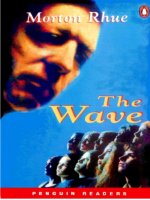
The Wave
MORTON RHUE
Level 2
Retold by Kieran McGovern
Series Editors: Andy Hopkins and
Jocelyn Potter
Pearson Education Limited
Edinburgh Gate. Harlow.
Essex CM20 2JE. England
and Associated Companies throughout the world.
ISBN 0 582 41677 9
First published in the USA by Dell Publishing Co Inc. 1981
First published in Great Britain by Puffin Books 1982
This adaptation first published by Penguin Books 1996
Published by Addison Wesley Longman Limited and Penguin Books Ltd 1998
New edition first published 1999
Second impression 2000
Text copyright C Kieran McGovern 1996
Illustrations copyright © Chris Chaisty 1996
All rights reserved
The moral right of the adapter and of the illustrator has been asserted
Typeset by RefineCatch Limited. Bungay. Suffolk
Set in 11 /14pt Monotype Bembo
Printed in Spain by Mateu Cromo. S.A. Pinto (Madrid)
All rights reserved; no part of this publikation may br rtproduced, stored
in a retrieval system, or transmitted in any form or by any means,
electronic, mechanical. photocopying, recording or otherwise, without the
prior written permission of the Publishers.
Published by Pearson Education Limited in association with Penguin Books Ltd.,
both companies being subsidiaries of Pearson Plc
For a complete list of the tides available in the Penguin Readers series please write to your local
Pearson Education office or to: Marketing Department, Penguin Longman Publishing,
5 Bentinck Street.London W1M 5RN.
Contents
page
Introduction v
Chapter 1 Hitler and the Nazis 1
Chapter 2 Winners Need Discipline! 4
Chapter 3 The Team 9
Chapter 4 Members of the Wave 11
Chapter 5 A Dangerous Experiment 15
Chapter 6 Anger and Fights 20
Chapter 7 At the Football Game 23
Chapter 8 Laurie's Story 24
Chapter 9 A Sad Day for David 27
Chapter 10 The Wave Must End! 31
Chapter 11 The Last Rally 34
Chapter 12 After the Wave 39
Activities 40
Introduction
Mr Ross showed the students a big picture of a wave. ‘This is a
wave. A wave is something that’s always moving. We’ll call our
team the Wave.’
The Wave started in Mr Ross’s history lesson. Now everybody in
the school knows about it. Most students love the Wave.
Ben Ross loves it too. But Ben’s wife, Christy, does not like it.
She thinks it is dangerous.
Laurie Saunders is one of Mr Ross’s students. She liked the
Wave when it started. But now she sees things she does not like.
And some students do not want to be in the Wave - what about
them?
Can Laurie make the other students see what is happening? The
Wave is always moving — can anybody stop it?
The things in The Wave really happened in America - in a school
in Palo Alto, California. Palo Alto is about fifty kilometres south
of San Francisco. It is near the sea and the mountains. The
weather is good all year.
In 1969 a history teacher called Ron Jones started the Wave in
one of his lessons. He wanted to teach his students about the
Nazis in World War II. He wanted them to understand what
happened to people in Germany at that time. But something
strange happened to his students! Later he said: ‘The Wave was
the most frightening thing I ever saw in a school. For three years
after it, no one talked about it.’
Ron Jones later wrote a short story about the Wave. There was
also a one-hour television film. Morton Rhue wrote his book
called The Wave in 1981.
V
Chapter 1 Hitler and the Nazis
. Ben Ross taught history at Gordon High School. One afternoon
he showed a film about Hitler and the Nazis.’ At the end of the
film, he told his students: ‘The Nazis killed more than ten million
men, women and children.’
A student near the door turned the lights on. Ben looked round.
He saw sad faces all round the room.
‘I know many of you are very sad,’ Ben told the students, ‘But
I want you to think about what you saw. Does anybody have any
questions?’
Amy Smith put her hand up. ‘What was the place in the film
called?’
‘It was called Auschwitz. The Nazis built Auschwitz to kill
people quickly.’
The room was very quiet. Amy put her hand up again. ‘Were
all the Germans Nazis?’ she asked.
‘No, most Germans were not Nazis.’
‘Did the German people try to stop them?’ Amy asked.
‘No, most Germans didn’t try to stop the Nazis,’ Ben told her.
‘Perhaps they were afraid of them.’
‘But why were they afraid?’
‘You must remember that life was very hard in Germany at mat
time,’ said Ben. ‘There weren’t very many Nazis but they had
guns. And after 1945 most Germans said, “We didn’t know that
they killed all those people. We didn’t know about Auschwitz.”’
Now Laurie Saunders put her hand up. ‘I can’t believe that,’
she said. ‘I think they knew what happened.’
Ben was happy that his students were interested. They were not
usually interested in history. ‘Only they know what they knew,’
• Adolf Hitler and the Nazis led Germany between 1933 and 1945
1
Ben told Laurie. ‘And we don’t know why most German people
did not try to stop the Nazis.’
It was time for lunch. The students left the room quickly. David
Collins looked over at Laurie. ‘Come on, Laurie,’ he said. ‘Let’s
go to lunch. I’m hungry.’
‘I’ll be down in a few minutes, David,’ said Laurie.
David went off to lunch. There were only a few students left in
the room now. Laurie looked up at Mr Ross.
‘How many people did the Nazis kill?’ Laurie asked her
teacher.
‘They killed more than six million Jews. And about four
million others.’
‘But why did they kill them? Were all the Nazis bad
people?’
Mr Ross put his books in his bag. For about a minute he was
quiet. Then he turned to Laurie. ‘I don’t know, Laurie,’ said
Mr Ross. ‘I can’t answer that question.’
♦
A few minutes later, Laurie sat next to David in the school
restaurant.
‘Look at Robert Billings,’ said David. ‘Nobody wants to sit
with him.’
Robert tried to sit next to two students from Mr Ross’s history
lesson. The students stood up and went to another table.
‘Do you think there’s something wrong with him?’ Laurie
asked.
‘I don’t know,’ said David. ‘He’s very strange. But perhaps
that’s because he doesn’t have any friends.’
David began eating again. Laurie did not eat any of her lunch.
Her face was very sad.
‘What’s wrong?’ David asked.
‘That film, David,’ Laurie answered. ‘I thought it was very sad.
Did you think it was sad?’
‘Yes, but those things happened a long time ago,’ said David.
‘You can’t change what happened then.’
‘But we mustn’t forget that it did happen,’ Laurie said.
2
‘Look at Robert Billings. Nobody wants to sit with him.’
Amy Smith and Brian Amman came over to their table.
‘I want to sit here,’ said Amy. ‘I was here first!’
‘No, I want to sit here,’ said Brian. ‘I want to talk to David
about our football team. We’re playing Clarkstown on Saturday.’
‘And I want to talk to Laurie about The Grapevine.’
David played football for the Gordon High team. Laurie wrote
for the school newspaper. It was called The Grapevine.
Laurie laughed. ‘It’s OK, there are two places,’ she said.
Brian and Amy sat down.
‘Will you win on Saturday?’ Laurie asked. ‘I’m going to write
about the game for next week’s Grapevine.’
‘I don’t know,’ said David. ‘Our players don’t have much
discipline.’
‘That’s right,’ said Brian. ‘And we don’t have any good new
players.’
♦
Later, Amy Smith and Laurie Saunders sat in the office of
The Grapevine.
‘That was a very sad film,’ Amy said. ‘What did David think of
it?’
‘David doesn’t think about sad things,’ said Laurie. ‘All he
thinks about is football.’
‘What are you and David going to do next year?’ Amy
asked.
‘I don’t know,’ said Laurie. ‘I don’t know what we’ll do when
we finish school. Perhaps we’ll go away together. I love David,
but I don’t know what is going to happen to us. We’re very
young.’
Chapter 2 Winners Need Discipline!
That afternoon Ben Ross bought some books about the Nazis.
They were for his history class. He wanted his students to under-
stand about life in Germany at the time of the Nazis.
4
That afternoon Ben Ross bought some hooks about the Nazis.
When Christy Ross came home she found her husband at the
kitchen table.
‘Why are you reading all these books about the Nazis?’
Christy asked.
‘One of my students asked me a question about them.’ said
Ben. ‘And I don’t think they can learn the answer from a book.
But I have a plan.’
The next morning Ben went to class early. When the students
arrived they saw some words at the front of the room.
‘WINNERS NEED DISCIPLINE,’ somebody read. ‘What
does that mean?’
Ben walked over and stood next to David and Brian. ‘You two
both play football. You know you need discipline to win.’
‘We never win,’ Eric said, and the class laughed.
5
‘Perhaps that’s because you don’t have any discipline,’ Ben
said.
The students were all quiet now. Ben was surprised to see that
they were interested. He took his chair and put it at the front of
the room.
‘Discipline starts with how you sit. I don’t want you to sit back
in your chairs. You must sit up. Amy, come up here.’
Mr Ross showed Amy how to sit up. Other students began to
do the same. Ben walked round the room.
‘Look at Robert, everybody,’ said Ben. ‘He’s sitting up. That’s
very good, Robert.’
Robert looked up at his teacher and smiled.
Ben returned to the front of the room. ‘Now I want you all to
get up and walk round the room. When I tell you, you must go
back to your desks.’
The students stood up and began walking round the room. Ben
watched them. Then he said, ‘Go back to your places!’
Everybody ran back to their places. ‘That wasn’t very good!’
said Ben. ‘Next time 1 want much more discipline.’
The class got up and went back to their places many times.
Each time they did it faster.
‘Now there are two more rules,’ Ben told the students. ‘They’re
for when you ask or answer a question. The first rule is that you
must stand up next to your chairs when you ask or answer a
question. The second rule is that you must say ‘Mr Ross’ before
you give your answer.’
Mr Ross walked round the room. He stopped at Brad’s desk.
‘Brad, who was the leader of the Nazis?’
Brad did not stand up. ‘I think it was . . .’
‘Wrong, Brad!’ said Mr Ross. ‘You’re forgetting the rules.’
Ben looked across the room at Robert. ‘Robert, what do we do
when we answer a question?’
Robert stood up next to his desk. ‘Mr Ross.’
‘That’s right,’ Mr Ross said. ‘Thank you, Robert.’
6
‘I don’t like this,’ said Brad.
‘That’s because you can’t do it,’ somebody said. The others
laughed.
‘Brad,’ Mr Ross said, ‘who was the leader of the Nazis?’
Brad stood up slowly and stood next to his desk. ‘Mr Ross, I
think it was Adolf Hitler.’
‘You’re too slow, Brad,’ Mr Ross said. ‘I want everybody to
give me their answers quickly. Now, Brad, try again.’
Brad jumped up next to his place. ‘Mr Ross, it was Hitler.’
Mr Ross smiled. ‘That’s better,’ he said.
After the lesson the students talked together about it.
‘That was strange!’ said Brian. ‘But 1 thought it was great!’
‘I did too,’ said Eric.
Amy laughed. ‘Anything is better than history,’ she said.
‘No, don’t laugh,’ said David. ‘This is important. It felt
different when we did those things together.’
‘Why was it important?’ said Brad. ‘Ross asked us questions
and we answered them.’
‘But we were a team!’ said David. ‘Do you remember what
Mr Ross said about discipline? I think he was right. We need that
discipline for our football team.’
♦
Late that night Ben talked to his wife about his students.
‘Usually they don’t do anything I tell them,’ he said. ‘But they
loved the new discipline. I was very surprised.’
‘Perhaps they thought it was a game,’ said Christy. ‘And they
all wanted to be the best in the class.’
‘I think that’s true,’ Ben told his wife. ‘But the strangest thing
was that they wanted me to discipline them. At the end of the
lesson they stayed in their places. It was more than a game to
them.’
Christy laughed. ‘They stayed at the end of the lesson! That’s
new! Are you going to do the same thing tomorrow?’
‘I don’t think I will,’ said Ben.
7
‘Do you remember what Mr Ross said about discipline?
I think he was right.’
Chapter 3 The Team
The next day Ben arrived late for his lesson. When he came into
the room his students stood up. Ben was surprised- He looked
round the room.
'What are you doing?' he asked.
The students looked at him but nobody spoke.
Ben walked to the back of the room. 'Robert, can you tell me
what's happening here?'
Robert jumped up next to his desk. 'Mr Ross, discipline.'
'Yes, discipline,' said Mr Ross. 'But there's something more.'
He went back to the front and wrote, 'WE ARE ALL IN THE
SAME TEAM' next to 'WINNERS NEED DISCIPLINE'.
Mr Ross turned back to the class. 'Everybody must believe in
those words,' he said. 'Now I want us to say them together.'
Round the room students jumped up and said, 'We're all in the
same team. Winners need discipline.'
Laurie was the last person to stand up. Now all the students
stood next to their desks.
Mr Ross showed the students a big picture of a wave. 'This is
a wave. A wave is something that's always moving. We'll call
our team the Wave'.
Mr Ross looked round the class. He saw that his students
wanted to hear more about the Wave 'This will be our salute,' he
said. Ben put his right hand up and moved it up and down.
'Look, my hand is a wave in the sea,' he said. Then he put his
hand on his left arm. 'Class, give our salute,' he said.
The students gave the salute. Many did it wrong. 'Do it again,'
said Mr Ross. He showed them the salute again. They all did it
again and again.
'Good,' said Mr. Ross. 'Now everybody can do the Wave
salute. This is our salute and our salute only. When you see a
Wave
9
This is our salute and our salute only. When you see a Wave
member, you must salute.’
member, you must salute. Robert, give our salute and say our
words.’
Robert jumped up and gave the Wave salute. ‘Mr Ross, we’re
all in the same team. Winners need discipline.’
‘Now everybody together,’ said Mr Ross.
♦
After school that afternoon David spoke to the other members of
the football team. ‘We must be more disciplined.’ he said.
‘What are you talking about?’ one player asked.
‘We lose games because we don’t play together,’ said David.
‘We’re not a team.’
‘I don’t want to lose any more games,’ said another player.
‘Yes, everybody in the school laughs at us,’ said another.
‘We can win,’ said David. ‘We’re playing Clarkstown on
Saturday. And we can win.’
‘But what must we do?’
Eric looked at David. The Wave was something from their
history lesson.
‘Tell them,’ said Eric. ‘Tell them about the Wave.’
‘All I know is that you start with some words,’ said David.
‘And this is the salute
Chapter 4 Members of the Wave
That evening Laurie told her mother and father about her history
lesson.
Mrs Saunders looked at her daughter. ‘I don’t think I like it,
Laurie.’
‘But we’re learning discipline, Mum. And how to work
together. We’re learning to be a team,’ said Laurie.
‘I want you to learn history,’ said Mrs Saunders.
‘You don’t understand, Mum,’ said Laurie. ‘Mr Ross is showing
11
‘You don’t understand, Mum,’ said Laurie.
‘Mr Ross is showing us something important.’
us something important. And we’re not forgetting about history.
We’re doing more homework now.’
‘I think Laurie’s history teacher knows what he’s doing,’ said
Mr Saunders. ‘1 think it’s good for the students to think about
discipline.’
Mrs Saunders said, ‘Too much discipline is dangerous.’
♦
Christy Ross also taught at Gordon High. That night Christy
stayed late at the school. When she came home she found her
husband with books all round him.
‘How is your experiment going, Dr Frankenstein?’ she asked.
‘Very well,’ said Ben. ‘The students are much more
interested in class. And they’re doing their homework.’
Christy laughed. ‘They can’t be the same students I teach!’
‘I’m very interested in this experiment,’ said Ben. ‘I want to
see what will happen next.’
Christy was not happy. There was something about Ben’s
experiment she did not like. ‘You must be very careful, Ben,’
she said.
♦
David and Laurie walked to school together the next
day.
‘We need the Wave for our football team,’ David said.
‘I think you need better players,’ Laurie said.
‘We have good players,’ said David, ‘but we’re not a good
team. The Wave can help us. I talked to the team about it
yesterday. Brian and Eric helped me.’
‘My mother doesn’t like it,’ said Laurie.
‘What does she know?’ said David. ‘Only the Wave members
understand the Wave.’
♦
When the students arrived for their history lesson that day there
was a big picture of a blue wave at the front of the room.
Mr Ross stood next to the picture. The students went quickly to
their places.
13
Mr Ross walked round the class and gave each student a yellow
card. Each card had a picture of a wave on it. Under the picture
of the wave were the words: MEMBER OF THE WAVE.
‘What are these cards for?’ asked Laurie.
The room was now very quiet. Ben turned round. ‘Don’t forget
our rules, Laurie,’ he said.
Laurie got up and stood by her desk. ‘Mr Ross, what are these
cards for?’
‘They show that you are members of the Wave. Everybody in
this room is now a member of the Wave. Now we can work
together. Students, do you believe in the Wave?’
The students stood up by their desks. ‘Mr Ross, yes!’ they all
said together.
‘So now we’re a team. You must always work together. You
must never work against any other Wave member. Do you
understand?’
‘Mr Ross, yes!’ said the class.
‘Now you go and look for new members,’ said Mr Ross, ‘But
every new member must understand our rules.’
Suddenly Robert stood up. ‘Mr Ross,’ he said. ‘I think the
Wave is great.’
Then Amy stood up. ‘Mr Ross, Robert is right. I feel the same.’
David was pleased. He stood up. ‘Mr Ross, we’re now a team.’
Mr Ross was surprised. He wanted to stop talking about the
Wave. He wanted to teach his usual lesson. But the students
wanted more of the Wave.
‘We’ll give our salute,’ he told the class. ‘Then we’ll say our
words.’
‘We’re all in the same team. Winners need discipline,’ said the
students all together.
Ben Ross looked at his students in surprise. He saw that the
Wave was not a game to them. They were the Wave now.
14
Mr Ross walked round the class and gave each student a
yellow card.
Chapter 5 A Dangerous Experiment
At lunch that day all the Wave members sat at the same table.
Brian, Brad, Amy, Laurie and David were there. Robert Billings
walked in.
‘Robert, come and sit with us,’ said David. ‘We’re all members
of the Wave.’
Robert gave the Wave salute and came to the table.
Suddenly Laurie said, ‘I think this is all very strange.’
David turned to her. ‘What’s strange?’ he asked.
‘All the things we do for the Wave,’ said Laurie.
‘It’s different,’ Amy told her. ‘That’s why it feels strange.’
‘Yes,’ said Brad, ‘we’re all together now. That’s what is great
about the Wave. We’re all members of the same team.’
‘Do you think that everybody likes that?’ Laurie asked.
15
‘Who doesn’t like it?’ David asked.
Laurie felt her face go red. ‘I don’t think I like it,’ she said.
Suddenly Brian pulled out his ‘Member of the Wave’ card.
‘Don’t forget that you are a Wave member, Laurie. You mustn’t
break Wave rules.’
‘Laurie isn’t breaking any rule,’ said David.
‘But she mustn’t say bad things about the Wave,’ said Robert
quickly.
The others looked at Robert. Robert did not usually say any-
thing. Laurie smiled.
‘I’m happy that you’re sitting with us, Robert,’ she said.
‘That’s one good thing about the Wave. Now we’re all in the
same team.’
The students at Gordon High loved the Wave. Every day there
were more new members. All round the school there were Wave
pictures. Students gave the Wave salute when they met.
Ben Ross was very surprised. ‘And my history students arc
working very well,’ he told Christy. ‘They want to say the Wave
words and give the Wave salute in every lesson. But they do
more homework than they did before.’
‘I hear that the football team are all members now,’ said
Christy. ‘But do you think that the Wave is good for the
students? Are they learning anything?’
‘Christy, the Wave is an experiment.’ said Ben. ‘There was no
discipline in this school before 1 started it. Now I tell the students
to do something and they do it. I think this new discipline is good
for them.’
♦
Laurie sat on a desk in The Grapevine office. Other students sat
on desks near her.
‘It’s always the same with this newspaper,’ said Laurie.
‘Everybody wants to see their names in The Grapevine. But
nobody wants to do the work. Alex, where’s your story about
music?’
16
‘Don’t forget that you are a Wave member, Laurie. You
mustn’t break Wave rules.’
‘What story?’ said Alex. ‘Oh yes, 1 remember. I’ll do it next
week.’
‘Alex, you need discipline to write for a newspaper!’ said
Laurie. ‘We must work as a team. I want your story tomorrow.’
Alex laughed. ‘Are you a member of the Wave?’ he asked.
‘I’m in Mr Ross’s class’ said Laurie. ‘Everybody in our class is
a member.’
‘Everybody in the school is talking about the Wave,’ said Alex.
‘Write a story about it.’
Laurie looked at the others. ‘Yes. Perhaps I will. It’s a good
story,’ she said. ‘We can ask the other students what they think.’
♦
Principal Owens wanted to see Ben Ross in his office. Was there
something wrong? Ben knew that Principal Owens wanted to
talk about the Wave.
On the way to Principal Owens’ office Ben met many
students. They all gave him the Wave salute.
The door was open, and Principal Owens sat behind his desk.
Ben was surprised when the old man smiled at him. He looked
down at Ben. ‘Tell me what this Wave thing is about, Ben,’ he
said. ‘Everybody in the school is talking about it.’
Ben told the story of his experiment.
‘It’s very strange, Ben,’ said Principal Owens. ‘Are the
students learning anything?’
‘They’re doing better than before,’ said Ben. ‘I think the
Wave is helping them.’
‘I don’t like these Wave salutes and Wave pictures,’ said
Principal Owens.
‘It’s all a game,’ said Ben-Principal Owens looked at Ben. Then
he said, ‘I’m not very happy about this thing, Ben. You must
watch it very carefully. Remember that these are young people
in your experiment. Sometimes we forget that they are young.’
18
‘Everybody in the school is talking about the Wave,’ said
Alex. ‘Write a story about it.’
Chapter 6 Anger and Fights
The next morning Laurie Saunders went to The Grapevine office.
When she opened the door, she found a letter on the floor. The
letter had her name on the front. Laurie closed the door and read
the letter.
Dear Laurie
I am a student here at Gordon High. Three days ago my friends
and I heard about this thing called the Wave. We went to
Mr Ross’s lesson to see what it was. Mr Ross told us about the
Wave rules and the Wave words. Some of my friends thought the
Wave was great. But I did not want to be a member.
The letter had her name on the front. Laurie closed the door
and read the letter.
20