Pharmacology for dentistry phần 64
Bạn đang xem bản rút gọn của tài liệu. Xem và tải ngay bản đầy đủ của tài liệu tại đây (73.58 KB, 5 trang )
r
r
e
e
t
t
p
p
a
CChh
9.1
1.4
Sulfonamides,
Pharmacodynamics
Nitrofurans and
(Mode of Action of Drugs)
Quinolones
CHEMOTHERAPY
Chemotherapy is the use of chemical
compounds for the treatment of infectious
diseases by killing or inhibiting the growth
of causative organisms without damaging
the host tissues or cells.
Paul Ehrlich demonstrated the effective
use of methylene blue in the treatment of
malaria. He also synthesized arsenical
compounds (neoarsphenamine) effective in
the treatment of syphilis. The synthesis of
newer and powerful antibacterial substances
gave the recognition to Paul Ehrlich as ‘the
father of modern chemotherapy’ and
awarded the Nobel prize of medicine in 1909.
In 1928, Sir Alexander Fleming found
that a diffusible substance was elaborated
by Penicillium notatum (a fungus) which
prevented the growth of surrounding
bacterial colonies in culture plate. He named
this as ‘penicillin’ but this discovery
remained a scientific curiosity for more than
a decade. This work was followed up by
Chain, Falk and Florey who established the
efficacy of penicillin in 1941 and in 1945,
Fleming, Chain and Florey were awarded
the Nobel Prize.
The general mechanism of action of
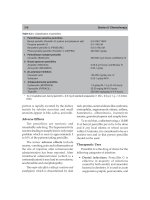
antimicrobial agents is listed in table 9.1.1.
Antimicrobials can be classified according
to type of action into:
a. Primarily bactericidal: Penicillin,
cephalosporins, aminoglycosides,
vancomycin, polypeptides, INH,
cotrimoxazole, rifampicin, fluoroquinolones, nalidixic acid.
b. Primarily bacteriostatic: Ethambutol,
erythromycin, chloramphenicol, tetracyclines, sulfonamides.
Beta lactam antibiotics having a β-lactam
ring, which includes penicillin, in which a
thiazolidine ring is attached to a betalactam
ring that carries a secondary amino group.
Other similar compounds are cephalosporins,
monobactams and carbapenems.
ANTIMICROBIALS USED IN DENTISTRY
Various antimicrobials agents is used in
dentistry for prevention of local oral wound
infection and prevention of distant infection
i.e., bacterial endocarditis. Generally,
prophylaxis by the use of antibiotics is not
required for routine type of dental surgery
Section 9/ Chemotherapy
304
Table 9.1.1: Mechanism of action of antimicrobial agents.
1. Inhibit cell wall synthesis
2. Damage to the cytoplasmic membrane
Polypeptides
Polycines
3. Inhibit protein synthesis & impairment of
functions of ribosomes
4.
5.
6.
7.
Inhibit DNA gyrase
Interfere with DNA function
Interfere with DNA synthesis
Antimetabolite action
as simple extraction and other minor
peridental procedures are associated with
very low risk of any wound infection.
Prophylaxis is recommended when the
procedure in which a prosthesis is inserted into
bone or soft tissue (e.g., dental implants), or
in other extensive reconstructive surgery.
In dentistry, the antimicrobials agents
which should be active against gram
positive cocci and oral anaerobes and which
yields peak blood levels higher than
minimum inhibitry concentration for the
common oral pathogens is recommended.
Amoxycillin, safe & bactericidal in nature is
generally the drug of choice. Antiseptic rinse
(chlorhexidine 0.2%) is also used as an
adjuvant to reduce the bacteraemia
following dental extraction. The detail
pharmacology of antimicrobial agents are
given in individual chapters.
SULFONAMIDES
Chemically, all sulfonamides may be considered to be derivatives of sulfanilamide
Penicillins, cephalosporins, bacitracin, vancomycin
and cycloserine.
Polymyxin, bacitracin, colistin.
Nystatin, amphotericin B, hamycin.
Tetracyclines, chloramphenicol, aminoglycosides,
erythromycin, clindamycin and other macrolide
antibiotics.
Fluoroquinolones i.e. ciprofloxacin, ofloxacin.
Rifampicin, metronidazole.
Acyclovir, idoxuridine, zidovudine.
Sulfonamides, sulfones, INH, ethambutol,
trimethoprim, PAS, pyrimethamine.
(p-aminobenzene sulfonamide). Sulfonamides were the first antimicrobial agents
effective against pyogenic bacterial infections. The antimicrobial compounds containing a sulfonamido (SO2 NH2) group are
called sulfonamides and a free amino group
at the para position is required for its antibacterial activity. The same sulfonamido
group is also present in other non-bacterial
compounds such as tolbutamide (oral antidiabetic drug), chlorothiazide, furosemide
and acetazolamide (diuretics) etc.
The sulfonamides can be classified
according to their therapeutic utility and
pharmacokinetic parameters (table 9.1.2).
However, because of bacterial resistance and
discovery of many safer and more effective
antibiotics, the utility of sulfonamides is
limited to few infections which are of clinical
interest.
Pharmacological Actions
The most important pharmacological action of sulfonamides is its antibacterial activity against variety of gram positive and
Sulfonamides, Nitrofurans and Quinolones
305
Table 9.1.2: Classification of sulfonamides.
I. Highly absorbed sulfonamides
a. Short acting
Sulfadiazine
Sulfadimidine
Sulfafurazole (GANTRISIN)
Sulfamethizole (UROLUCOSIL)
b. Intermediate acting
Sulfamethoxazole (used in combination with
trimethoprim; SEPTRAN: Sulfamethoxazole
400 mg + Trimethoprim 80 mg)
c. Long acting
Sulfadimethoxine (MADRIBON)
Sulfamethoxine (SULFADOXINE)
Sulfamethoxypyridazine (LEDERKYN)
Sulfamethopyrazine (used in malaria; METAKELFIN)
II. Poorly absorbed sulfonamides (for GIT local action)
Phthalyl sulfathiazole (THALAZOLE)
Succinyl sulfathiazole (SULFASUXIDINE)
Sulfaguanidine
III. Special purpose sulfonamides
Sulfacetamide (ALBUCID)
Sulfacetamide (NEBASULF)
Sulfasalazine (for autoimmune bowel disease;
SALAZOPYRIN)
Silver sulfadiazine (burn etc. local application; SILVIRIN)
Mafenide propionate (MARFANIL)
gram negative organisms (mainly bacteriostatic) and certain species of chlamydia infections such as:
• Streptococci, staphylococci, pneumococci,
gonococci, meningococci, Haemophilus
influenzae, H. ducreyi, Calymmatobacterium
granulomatis, Vibrio comma, Vibrio cholerae,
E. coli, Pasteurella pestis, Shigella.
• Actinomyces, Nocardia and Toxoplasma.
• Chlamydia causing lymphogranuloma
venereum, psittacosis, trachoma and
inclusion conjunctivitis.
2 g initially then 1 g 4-6 hourly
2 g initially then 0.5 g 6-8 hourly
2 g initially then 1 g 4-6 hourly
1.0-2 g 4-6 hourly
160 mg of trimethoprim & 800 mg of
sulfamethoxazole every 12 hourly
1 g initially then 0.5 g OD
1 g initially then 0.5 g OD
1 g initially then 0.5 g OD
3-6 g/day
3-6 g/day
3-6 g/day
10-30% eye drops
6% powder used externally
1-2 g QID initially then 0.5 g TDS-QID
1% local cream
1% local cream
Mechanism of Action
The compound sulfanilamide exhibits a
structural similarity to para-amino benzoic
acid (PABA). Woods and Fields proposed
the theory that sulfonamides, being
structurally similar to PABA, inhibit
bacterial folate synthetase so that folic acid
is not formed which is needed for a number
of metabolic reactions. Folic acid derived
from PABA is essential for bacterial
metabolism. Sulfonamides inhibit the
enzyme folic acid synthetase which is
306
involved in the conversion of PABA to folic
acid, which causes folic acid deficiency and
ultimately cause injury to the bacterial cell.
Pharmacokinetics
After oral administration, sulfonamides
are rapidly and completely absorbed from
gastrointestinal tract and approximately 70
to 90 percent of oral dose reaches to the
blood stream, but the binding with plasma
proteins differ considerably among different
groups. The highly plasma protein bound
sulfonamides have longer action. The main
site of absorption is small intestine.
Adverse Reactions
The common side effects are nausea and
vomiting. The others are allergic symptoms
including drug fever, skin rash, urticaria,
eosinophilia, photosensitization reactions,
serum sickness like syndrome. StevensJohnson syndrome and exfoliative dermatitis
are also common with longer acting agents.
The uncommon allergic reactions
include acute toxic hepatitis, toxic nephrosis
and acute haemolytic anaemia.
Sulfonamides also cause renal irritation
and may precipitate renal colic. Crystalluria,
haematuria and albuminuria can also occur
which may lead to the development of
oliguria and anuria.
The hematopoietic toxicity includes
agranulocytosis, thrombocytopenia and
rarely aplastic anaemia and in patients with
glucose-6-phosphate dehydrogenase (G-6PD) deficiency, sulfonamides may cause
intravascular haemolysis.
The other CNS effects include depression,
confusion, tinnitus, fatigue etc.
Section 9/ Chemotherapy
Therapeutic Uses
Because of development of resistance
and availability of more advanced antimicrobial agents, the use of sulfonamides is
limited. However they are used in combination with trimethoprim. The important
therapeutic uses are:
i. Urinary tract infection: Used in chronic
suppressive therapy in various UTI
conditions e.g. acute cystitis.
ii. Acute bacillary dysentery.
iii. Ulcerative colitis, mainly sulfasalazine
(a chemical combination of sulfapyridine and 5-amino salicylic acid) is used
in the treatment of ulcerative colitis.
iv. Streptococcal pharyngitis, prophylaxis
of rheumatic fever and tonsillitis.
v. Trachoma and inclusion conjunctivitis:
Sulphacetamide (10-30%) local eye
drops are used.
vi. Chancroid: Sulfadimidine may be
used.
vii. In the treatment of meningococcal
meningitis.
viii. Sulfonamides in combination with pyrimethamine are used in the treatment
of chloroquine resistant malaria.
ix. Toxoplasmosis: Sulfadiazine and
pyrimethamine combination is used.
x. Burns: Topical silver sulfadiazine or
mafenide is used.
TRIMETHOPRIM
Trimethoprim is a pyrimidine derivative
(diaminopyrimidine) related to antimalarial
drug pyrimethamine, which selectively inhibits bacterial dihydrofolate reductase, necessary for the conversion of dihydrofolate to
tetrahydrofolic acid. Sulfonamides act by inhibiting the incorporation of PABA into
dihydrofolate by bacteria. A combination of
Sulfonamides, Nitrofurans and Quinolones
307
trimethoprim and sulfamethoxazole
(cotrimoxazole) act sequentially in the same
metabolic pathway in the synthesis of nucleotides.
indications. The combination is cheaper than
newer antibiotics.
Adverse Effects
It possesses antimicrobial action against
gram positive and negative organisms
including staphylococci, streptococci, E. coli,
Salmonella and Shigella species.
All those side effects seen with sulfonamides.
NITROFURANS
Therapeutic Uses
Used in all types of infection caused
by Salmonella typhi, Klebsiella, Enterobacter,
Pneumocystis carinii etc. and many other
sulfonamide resistant stains of S. aureus,
Strep. pyogenes, Shigella, E. coli, H.
influenzae, meningococci and gonococci
etc. It is particularly effective as a second
line agent in penicillin allergic patients
and also in patients where newer
antibiotics are contraindicated or can’t be
used.
The common indications are:
i. Urinary tract infection: Acute cystitis.
ii. Bacterial diarrhoea and dysentery.
iii. Respiratory tract infection such as
chronic bronchitis and otitis media etc.
iv. In the treatment of typhoid.
v. Chancroid.
vi. Sexually transmitted diseases.
vii. Prophylaxis and treatment of certain
HIV associated infections.
viii. For the prophylaxis of certain concurrent
bacterial infections e.g. organ transplantation patients receiving immunosuppressants.
ix. Nosocomial infections.
Despite development of resistance to
this combination in certain microorganisms,
it has been used widely for several clinical
NITROFURANTOIN
Bacteriostatic drug. It is effective against
a variety of gram positive and negative
organisms including E. coli and Aerobacter.
It is most commonly used as urinary
antiseptic for prophylaxis and treatment of
urinary tract infections.
Adverse effects are nausea, diarrhoea,
haemolytic anaemia in persons with G-6-PD
deficiency and peripheral neuritis (on longterm use).
Dose: FURADANTIN; 50-100 mg
TDS-QID.
NITROFURAZONE
Bactericidal drug for both gram positive
and negative bacteria. Acts by inhibiting
enzymes necessary for carbohydrate
metabolism in bacteria. It is available as
ointment. Used for the topical treatment of
superficial wounds and skin infections.
FURACIN; 0.2% ointment/cream.
FURAZOLIDONE
This is mainly employed for the
treatment of gastrointestinal infections e.g.
bacillary dysentery, giardiasis, bacterial
enteritis etc.
Dose: FUROXONE; 100-200 mg TDSQID.