Pharmacology for dentistry phần 22
Bạn đang xem bản rút gọn của tài liệu. Xem và tải ngay bản đầy đủ của tài liệu tại đây (76.23 KB, 5 trang )
Non-Narcotic Analgesics (NSAID’s)
93
nia, leucopenia, renal and hepatic damage
and encephalopathy.
(increased production) or is drug induced
(due to reduced renal excretion by uric acid).
PENICILLAMINE
Drugs used for gout can be divided into
two groups:
The exact mechanisms of action of penicillamine in rheumatoid arthritis is not
known. After oral administration it is partly
metabolised and partly excreted unchanged.
Adverse effects include Gl upset, dose
related impairment of taste, thrombocytopenia, aplastic anemia, allergic reactions, skin
rash, fever, SLE and proteinuria.
SULFASALAZINE
When taken orally, it liberates 5-ASA (5aminosalicylic acid) and sulfapyridine in
colon. 5-ASA acts locally by inhibiting PG
synthesis and provide symptomatic relief in
ulcerative colitis. Sulfapyridine is absorbed
systemically and inhibits generation of superoxide radicals and cytokine elaboration
by inflammatory cells and is responsible for
beneficial effects in RA.
METHOTREXATE
It is a dihydrofolate reductase inhibitor
immuno-suppressant. Benefit in RA is due
to inhibition of cytokine production, chemotaxis and cell mediated immune reaction.
DRUGS FOR GOUT
Gout results from hyperuricemia i.e. increased serum uric acid levels. Normal serum uric acid level is 1-5 mg/dl. Uric acid
is formed in the metabolism of purine. When
the blood levels of uric acid are high, it precipitates in joints, cartilage, kidney and subcutaneous tissues and leads to various signs
and symptoms. Hyperuricemia is also
seen in various leukemias, lymphomas
a. Drugs for acute attack of gout: NSAIDs,
colchicine, corticosteroids.
b. Drugs for chronic gout/hyperuricemia:
Can be uric acid synthesis inhibitors
(allopurinol) and uricosurics (increase
renal excretion of uric acids) e.g.
probenecid and sulfinpyrazone.
NSAIDS
Drugs useful are indomethacin,
piroxicam or naproxen. Their usefulness is
due to strong antiinflammatory action and
can be continued for 3-4 weeks. They also
inhibit chemotactic migration of leukocytes
into the affected joint.
CORTICOSTEROIDS
Systemic/intraarticular steroids can be
used in those cases not responding to or tolerating NSAIDs/colchicine.
COLCHICINE
It is effective for treatment of acute attacks of gout. It has no effect on renal excretion of uric acid. It binds to tubulin, it interferes with function of mitotic spindles,
causes depolymerization and disappearance of fibrillar microtubules in granulocytes. In gout, the useful of colchicine is due
to the inhibition of the release of glycoproteins from granulocytes in inflamed joint
thus preventing precipitation of uric acid
crystals and release of lysosomal enzymes.
After oral administration it is rapidly
absorbed. A major part of the drug is excreted in faeces.
94
Adverse effects include nausea, vomiting, diarrhoea, abdominal pain, neuropathy,
myopathy especially in patients with decreased renal function. Prolonged therapy
may lead to aplastic anaemia, agranulocytosis, alopecia and myopathy.
Section 2/ Drugs Acting on CNS
PROBENECID
It increases the excretion of uric acid (by
inhibiting its reabsorption from kidney tubules) and hence causes reduced serum levels of uric acid.
ALLOPURINOL
After oral administration it is completely
absorbed. It is 90% plasma protein bound. It
is partly metabolised and excreted in urine.
The metabolites also have uricosuric action.
It inhibits the terminal steps in uric acid
biosynthesis by inhibiting enzyme xanthine oxidase. During therapy with allopurinol the uric acid plasma levels decline.
Adverse effects include skin rash,
gastro-intestinal irritation. Overdosage may
result in convulsions and death due to respiratory failure.
After oral intake it is absorbed relatively
rapidly. It is converted to alloxanthine which
is active and non competitive inhibitor.
It is used in chronic gout and secondary
hyperuricaemia.
It is used in the treatment of acute gout
and prophylaxis of gout.
Adverse effects include hypersensitivity reactions, maculopapular rash, urticaria,
myalgia, malaise fever, transient leucopenia or leukocytosis, hepatic damage, nausea, vomiting, diarrhoea, headache and
drowsiness.
It is indicated in primary hyperuricaemia
of gout, secondary hyperuricaemia due to
myeloid metaplasia, radiation, cancer chemotherapy, thiazide diuretics.
SULFINPYRAZONE
Pyrazolone derivative related to phenylbutazone. It has uricosuric action. It also
inhibits platelet aggregation.
It is well absorbed orally and 98%
plasma protein bound. It is excreted by active secretion in proximal renal tubule.
Adverse effects are gastric irritation
(most common), hypersensitivity reactions.
It is used in chronic gout.
tterer
p
p
a
h
CCh
2.5
1.4
Psychotropic
Pharmacodynamics
(Mode Agents
of Action of Drugs)
Psychopharmacological agents may be classified into three broad groups used in various states of psychic disorders.
1. Antipsychotic drugs or major tranquillizers used in all types of psychosis
mainly schizophrenia.
2. Antianxiety drugs or minor tranquillizers used in anxiety.
3. Antidepressants for minor and major
depressive disorders and mood
stabilisers (antimanic drugs) for mania.
ANTIPSYCHOTIC DRUGS
(MAJOR TRANQUILLIZERS)
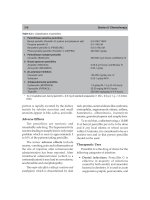
They are classified as in table 2.5.1.
Table 2.5.1: Classification of antipsychotic drugs.
I. Phenothiazines
Chlorpromazine (MEGATIL)
Triflupromazine (SIQUIL)
Trifluoperazine (NEOCALM)
II. Butyrophenones
Haloperidol (HEXIDOL)
Droperidol (DROPEROL)
Trifluperidol (TRIPERIDOL)
III. Other newer compounds
Loxapine (LOXAPAC)
Clozapine (SIZOPIN)
Pimozide (PIMODAC)
Zuclopenthixol (CLOPIXOL)
Molindone
Sulpiride
Sertindole
100-800 mg/day
50-200 mg/day
5-15 mg BD
5-10 mg/day
10 mg IM, 5-15 mg/day IV
0.5-8 mg/day
60-100 mg BD-QID
25-50 mg/day
3-4 mg/day
20-40 mg IM repeated 2-4 week interval
20-200 mg/day
0.4-2 g/day
4-24 mg/day
Section 2/ Drugs Acting on CNS
96
PHENOTHIAZINES
PHARMACOLOGICAL ACTIONS
a. Action on CNS: Effects differ in normal and psychotic individuals.
1. Sedation: They produce sedation
which does not progress to anaesthesia.
They decrease the agitation, anxiety and
aggressiveness in psychotic patient without
affecting wakefulness.
2. Antipsychotic effect: In schizophrenic
patients, they improve thought disorders,
blunted affect, withdrawal and self centered
behaviour. They also improve the hallucinations and delusions.
They produce neuroleptic syndrome
which consists of motor retardation and
emotional quietening.
In animal studies, they reduce the spontaneous motor activity and produce catalepsy (state of rigidity and immobility).
3. Action on CTZ: Chlorpromazine depresses the chemoreceptor trigger zone
(CTZ) and acts as a powerful antiemetic
agent.
4. Effect on hypothalamus: They produce
hypothermia by acting on temperature
regulating centre. They also produce
central sympathoplegia resulting in
miosis and failure in ejaculation.
They produce parkinsonism like reaction by increasing the spontaneous firing of
dopaminergic neurons of basal ganglia.
b. Effect on CVS: Chlorpromazine may
produce orthostatic hypotension probably due to inhibition of centrally mediated pressor reflexes. It also causes
prolongation of QT interval in ECG.
c. Effect on endocrine system: They can
produce amenorrhoea and galactorrhoea due to increase in serum prolactin level in females. It also blocks the
release of growth hormone, ADH and
gonadotrophin secretion.
d. Local anaesthetic: Chlorpromazine has
a potent local anaesthetic action.
e. ANS: They have varying degree of a
adrenergic blocking activity. They also
have weak anti-cholinergic, H 1 antihistaminic and anti 5-HT actions as
well.
They also cause blockade of postsynaptic monoaminergic (including 5-HT, noradrenaline and dopamine) transmission in the
brain resulting in decrease in central sympathetic activity.
Pharmacokinetics
Phenothiazines are well absorbed after
oral and parenteral administration. They are
distributed in all the body tissues and
metabolised in liver by hydroxylation and
glucuronide conjugation and demethylation.
The metabolites are excreted in urine and bile
for long period of time even after discontinuing the drug.
Adverse Reactions
CNS side effects include lethargy,
drowsiness, increase in REM sleep, restlessness, excitement and impaired psychomotor functions.
The other side effects include epileptic
seizures, disturbances in body temperature
regulation. ANS side effects include tachycardia, difficulty in micturition, inhibition
of ejaculation, postural hypotension,
blurring of vision (with thioridazine), constipation, nasal stuffiness etc.
Psychotropic Agents
97
Extrapyramidal reactions include parkinsonism, acute muscular dystonias,
akathisia, tardive dyskinesia and malignant
neuroleptic syndrome. They can also cause
hypersensitivity reaction including
cholestatic jaundice, skin rash, urticaria,
photosensitivity and contact dermatitis.
There is also blue pigmentation of skin, lenticular opacities on prolonged use of drug.
is used in hallucination, delusions, agitation, withdrawal and other schizophrenic symptoms in schizophrenia,
schizoaffective disorders, mania, hypomania and panic anxiety.
Therapeutic Uses
It is a potent antipsychotic drug. It does
not cause weight gain. Its pharmacological
effects are similar to phenothiazines.
1. Treatment of psychosis (schizophrenia): Schizophrenia is a split mind or
splitting of perception from reality.
The patient of schizophrenia is dissociated from the world around him
and lives in their own world which
is characterized by aggression, anxiety, restlessness, hallucinations and
delusions. Phenothiazines reduce the
hallucinations, aggression, anxiety
and make them acceptable and cooperative.
2. In the treatment of manic depressive
psychosis (treatment of mania).
3. In alcoholic hallucinosis and
Huntington’s disease.
4. As an antiemetic in drug and disease
induced vomiting. Also useful in morning sickness but are ineffective in motion sickness.
5. In the treatment of intractable hiccough.
6. In the treatment of behavioural disorders in children.
7. As preanaesthetic medication.
8. To produce hypothermia.
TRIFLUOPERAZINE
It is a phenothiazine derivative and
BUTYROPHENONES
HALOPERIDOL
Adverse effects include dystonia, hallucinations, restlessness, nausea, epigastric discomfort, anaemia, blurred vision,
hypersensitivity reaction, blood dyscrasia, jaundice, galactorrhoea, gynecomastia and amenorrhoea.
It is indicated in acute and chronic
schizophrenia, anxiety disorders, acute mania, hypomania and behavioural disorders
in children; antiemetic neuroleptanalgesia,
Gilles de la Tourette’s syndrome and
Huntington’s disease.
DROPERIDOL
It is a short acting neuroleptic agent used
in anaesthesia.
TRIFLUPERIDOL
It exerts sedative and tranquillizing effect and it is postulated that it blocks dopamine receptors within CNS. It is used in acute
and chronic psychoses, anxiety disorders,
mania and schizophrenia.
Side effects include nausea, epigastric
distress, dry mouth, blurred vision, jaundice, skin rash and photosensitivity.