Modern food microbiology 7th ed phần 17
Bạn đang xem bản rút gọn của tài liệu. Xem và tải ngay bản đầy đủ của tài liệu tại đây (94 KB, 5 trang )
Fresh Meats and Poultry
69
strains then cooked and stored for up to 14 days under vacuum at 4◦ C, the inoculated cells showed
a slight decline and remained essentially unchanged as product temperature decreased from 54.5 to
7.2◦ C.173 The significance of this organism in foods is discussed in Chapter 24.
Some members of the family Enterobacteriaceae have been found to be common in fresh and frozen
beef, pork, and related meats. Of 442 meat samples examined by Stiles and Ng,169 86% yielded
enteric bacteria, with all 127 ground beef samples being positive. The most frequently found were
Escherichia coli biotype I (29%), Serratia liquefaciens (17%), and Pantoea agglomerans (12%). A total
of 721 isolates (32%) were represented by Citrobacter freundii, Klebsiella pneumoniae, Enterobacter
cloacae, and E. hafniae. In an examination of 702 foods for fecal coliforms by the most-probablenumbers (MPN) method representing 10 food categories, the highest number was found in the 119
ground beef samples, with the geometric mean by the AOAC (Association of Official Analytical
Chemists) procedure being 59/g.3 The mean number for 94 pork sausage samples was 7.9/g. From
32 samples of minced goat meat, the mean coliform, Enterobacteriaceae, and APC counts were,
respectively, 2.88, 3.07, and 6.57 log10 .131 More information on the incidence/prevalence of coliforms,
enterococci, and other indicator organisms can be found in Chapter 20.
From the 563 samples of ground beef examined in the United States as noted above, 53% contained C. perfringens and 30% S. aureus.176 Using a nested polymerase chain reaction (PCR) assay,
enterotoxigenic Clostridium perfringens was found in 2%, 12%, and 0% of 50 beef, chicken, and pork
samples, respectively, in Japan.128
A study of 470 fresh sheep carcasses in Australia found the mean APC (determined at 25◦ C after 72
hours) to be 3.92 log10 /cm2 and 3.48 log10 /cm2 when determined at 5◦ C after a 14-day incubation.179
For a more extensive coverage of Gram-positive bacteria in meats, see reference 87.
Escherichia coli (Biotype I)
This bacterium is the most widely used as an indicator of the sanitary state of fresh foods, and it along
with other indicator organisms is defined and discussed in Chapter 20. An international committee has
stressed the desirability of testing for indicator organisms rather than specific pathogens in assessing
the safety of beef.17 Some findings of this organism in fresh meats are summarized below.
In a study of frozen beef patties in the United States, the mean aerobic plate count (APC) was <3.0
log10 cfu/g, and coliforms and E. coli biotype I were <1.0 log10 cfu/g.144 These investigators noted a
lack of correlation between low numbers of E. coli biotype I and E. coli 0157:H7. A Canadian study
found that coliforms and E. coli recovered from the table top and conveyor belt in a meat processing
facility were comparable to those recovered from beef cuts and sides, which emphasizes the importance
of conveying equipment as sources of these organisms to beef cuts.70
The incidence and prevalence of biotype I strains of E. coli vary widely among retail or finished
red meats. From 470 sheep carcasses studied in Australia, 75% contained this organism181 while from
812 Australian beef carcasses processed for export only, 11% were positive.141 In the United States,
E. coli was recovered from 25% of 404 ground beef samples;186 from 30% of 100 postexsanginated
pork carcasses; and from 30% of the chilled carcasses tested.172
Arcobacter and Campylobacter spp.
These genera are closely related phylogenetically, and it is not surprising that they share common
habitats. Summaries of their incidence and prevalence in a variety of meats and poultry are presented
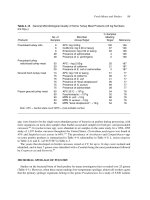
in Table 4–4. In general, Arcobacter spp. appear to be more common among poultry than red meat
products, and this is true for Campylobacter spp. A. butzleri is common, and it was found on all 25
70
Modern Food Microbiology
Table 4–4 Incidence/Prevalence of Arcobacter, Campylobacter, and Helicobacter spp. in Fresh
and Frozen Meats and Poultry
Product
Pork
Beef cattle
Turkey meat
Broilers
Broilers, chickens
Chicken
Pork
Beef
Pork
Fresh chicken
Frozen chicken
Fresh chicken
Frozen chicken
Chicken meats
Lamb liver
Pork liver
Pork liver
Ox liver
Retail pork
Broilers
Sheep carcasses
Ground beef
Swine samples
Turkey carcasses, pre-chill
Broilers
Fresh meats
Frozen meats
Chicken
Red meats
Beef cuts
Rumen, mucosal samplesa
a Rumen
Genus
% Positive/
Total Tested
Country
Reference
Arcobacter
Arcobacter butzleri
Arcobacter
Arcobacter
Arcobacter
Arcobacter
Arcobacter
Arcobacter
Arcobacter
Campylobacter
Campylobacter
Campylobacter
Campylobacter
Campylobacter
Campylobacter
Campylobacter
Campylobacter
Campylobacter
Campylobacter
Campylobacter
Campylobacter
Campylobacter
Campylobacter
Campylobacter
Campylobacter
Campylobacter
Campylobacter
Campylobacter
Campylobacter
Helicobacter pylori
Helicobacter
32/200
9/200
77/391
95/480
60/25
40/45
64/200
29/45
5/45
94/63
77/44
85/35
87/38
83/90
73/96
72/99
ca. 6/400
54/96
1.3/384
88/1,297
1.3/470
<1/563
0.99/202
41.3/1,198
27/12,233
12/405
2.3/396
30/360
5/1,800
0/20
0/105
United States
United States
United States
Belgium
Denmark
Mexico
United States
Mexico
Mexico
North Ireland
North Ireland
The Netherlands
The Netherlands
United Kingdom
United Kingdom
United Kingdom
North Ireland
United Kingdom
United States
United States
Australia
United States
United States
United States
United Kingdom
United States
United States
United States
United States
United States
United States
13
75
117
88
4
181
134
181
181
130
130
42
42
102
102
102
129
129
41
177
179
176
138
115
139
167
166
166
178
168
168
and abomasum mucosal cattle samples.
chicken carcasses examined in Denmark.4 A. cryaerophilus was recovered from 13 of the 25 carcasses,
and A. skirrowii from only two.
In their study of 200 fresh pork samples in the United States using different recovery methods,
Ohlendort and Murano136 found that 20% of low-fat but only 4% of high-fat samples contained
Acrobacter spp.; and that these organisms were more frequently isolated from younger than older
hogs.
Wild and migratory birds also carry Campylobacter spp. Among 1,794 birds representing 107
species in Europe, 22.2% harbored Campylobacter spp. consisting of 5.6, 4.9, and 0.95% of C. lari,
C. jejuni, and C. coli, respectively.182 The highest percentage of Campylobacter spp. was 76.8 among
Fresh Meats and Poultry
71
Table 4–5 Prevalence of Salmonella in Some Fresh and Frozen Meats and Poultry Products
Product
Broilers
Broilers
Egg yolks
Frozen ground turkey
Turkey carcassesa
Turkey carcasses
Turkey raw rollsb
Chicken carcasses
Chicken carcasses
Chicken carcasses
Chicken carcasses
Ground beef
Ground beef
Ground beef
Butcher shop beef
Beef carcasses
Beef carcasses
Beef carcassesc
Steer/heifer carcasses
Sheep carcasses
Pork carcasses
Pork carcasses
Swine carcassesd
Swine carcasses, chilled
Hogs
a Preprocessed; b
% Positive/Total Tested
Country
Reference
20/1,297
25.9/27
0/1,620
38/50
12/208
69/230
27/336
61/670
34.8/69
91/45
60/192
20/55
7.5/563
11/88
9.9/354
0/62
2.6/666
0/812
1/2089
5.7/470
27/49
17.5/596
73/100
0.7/122
1/8,066
United States
Korea
Korea
United States
United States
Canada
United States
Canada
Canada
Venezuela
Spain
Botswana
United States
Mexico
Botswana
Belgium
Canada
Australia
United States
Australia
Belgium
Canada
United States
United States
United States
177
26
26
78
18
105
18
105
44
150
22
65
176
85
65
99
105
141
178
179
99
105
172
172
10
Turkey carcasses processed into raw rolls; c Export samples only; d Post exsanguinated.
the 383 shoreline-foraging invertebrate feeders. Of the 464 arboreal insectivore feeders, only 0.6%
were positive for Campylobacter.182
Salmonellae
Summaries of the occurrence of Salmonella spp. on meat and poultry are presented in Table 4–5. As
is the case for Arcobacter and Campylobacter spp., meat and poultry meats continue to be common
sources of these organisms.
Salmonellae were found in 9.1% of 109 packs of chilled and 7.5% of 53 frozen packs of sausages or
8.6% overall in the United Kingdom in 2000.119 Some were isolated from fried, grilled, and barbecued
samples. Samples that were grilled for 12 min. or more reached internal temperatures >75◦ C all of
which were salmonellae-negative. None of 51 packages contained Campylobacter spp.
In regards to the source of salmonellae in preharvest pork production, a study in Brazil found that
the holding pens are significant sources of Salmonella enterica.152 These findings are based on the
study of a larger number of animals. Another study in the United States on salmonellae in the ecosystem of slaughter hogs examined 8,066 samples and found salmonellae (percentage occurrence) in the
72
Modern Food Microbiology
Table 4–6 Prevalence of Listeria monocytogenes in Some Fresh Meat and Poultry Products
Product
Broilers
Chicken
Broiler parts (raw)
Poultry parts
Turkey meat
Ground beef
Ground beef
Beef
Beef carcasses
Steer/heifer carcasses
Lamb carcasses
Pork carcasses
Pork
% Positive/No. tested
Country
Reference
15/1,297
30.2/86
62/61
13/160
5/180
12/563
16/88
4.3/70
22/62
4/2,089
4.3/69
2/49
19.1/84
United States
Korea
Finland
United States
United States
United States
Mexico
Korea
Belgium
United States
Brazil
Belgium
Korea
177
7
127
67
66
176
85
7
99
178
3
99
7
following places: 83 swine, 54 pen floor, 32 boots, 16 flies, 9 mice, 3 cats, and 3 birds.10 These investigators noted that cats and worker boots were the two most salmonellae-abundant ecological niches
in their study. The most common serotypes found were S. Derby, Agona, Worthington, and Uganda.10
In contrast to the above studies, five Swedish pig slaughterhouses were studied for the incidence of
salmonellae, and of 3,388 samples cultured, all were negative.174 In regards to S. Typhimurium, 3.5%
of 404 samples of ground beef collected throughout the United States in 1998 were positive with five
of the 14 isolates being strain DT-104A (S. Typhimurium var. Copenhagen), and they were all isolated
from samples obtained in the San Francisco area.186 Of the 404 samples, 25% contained type I strains
of E. coli. In a Canadian study of the feces contents of 1,420 healthy 5-month-old pigs, 5.2% were
positive for 12 serovars, with S. Brandenburg accounting for 42%.111 Of 112 strains of salmonellae
recovered from a poultry slaughterhouse in Spain in 1992, 77% were S. Enteritidis.22
To better understand how salmonellae are distributed throughout a broiler operation, samples were
collected and tested from the following points (along with percent positive for salmonellae): Breeder
farm (6%), hatchery (98%), previous grow-out flock (24%), flock during grow-out (60%), and carcasses after processing (7%).8 This study pointed to the hatchery as the primary site that requires
disinfection. Along lines similar to the above study, several sites in 60 small poultry slaughterhouses
(<200 birds/day) in Brazil were examined with the following results and percent positive for salmonellae: Carcasses (42%), utensils (23%), water (71%), and freezer and refrigerator (71%, 62). Overall,
41% of samples contained salmonellae, which included 17 serotypes with S. Enteritidis being the
most predominant at 30%; and S. Albany and Hadar at 12% each being the next most predominant.62
Listeria and Yersinia spp.
The prevalence of L. monocytogenes varies widely among raw red meats and poultry with the four
poultry products listed in Table 4–6 having contamination rates from 5 to 62%. The latter consisted
of raw broiler pieces, and the serotypes found were 1/2a, 1/2c, and 4b. The isolates represented 14
different PFGE (pulsed field gel electrophoresis—see Chapter 11) types.127
Raw pork and chicken products were examined for the presence of Yersinia spp. in Mexico, and
27% were positive for this genus.147 Of 706 yersiniae-like isolates, 24% were confirmed with 49%
Fresh Meats and Poultry
73
of these being Y. enterocolitica, 25% Y. kristensenii, 15% Y. intermedia, and 9% Y. frederiksenii. In a
study of 43 pork samples from a slaughterhouse, eight contained the following yersiniae species: Y.
enterocolitica, Y. intermedia, Y. kristensenii, and Y. frederiksenii.82 From a study of hogs in the United
States, 95 of 103 (92%) lots carried at least one Y. enterocolitica isolate, and 99% of the pathogenic
isolates were serotype 0:5, and 3.7% were 0:3.61 In Finland, 92% of 51 tongue and 25% of 255 ground
meat samples contained Y. enterocolitica.57 By using PCR and a culture method, >98% of the pork
tongues were positive with biotype IV being the most common. From 31 pork tongues from freshly
slaughtered animals, 21 strains were isolated with 0:8 being the most common, and 0:6, 30 the next
most common.38 A study of yersiniae in raw beef and chicken in Brazil revealed that 80% contained
these organisms with ground beef and liver accounting for 60% and pork for 20%.183
In a study of the fate of Yersinia enterocolitica in a Turkish dry sausage (sucuk), the pathogen
decreased from around 5.0 to 1.8 log10 cfu after 4 days of fermentation and to 0.5 log10 cfu/g after
12 days of drying without the direct addition of lactic acid bacteria.25 With the addition of about 7.0
log10 cfu/g each of Lactobacillus sakei and Pediococcus acidilactici, the pathogen was reduced to 0.5
log10 cfu/g after 3 days of fermentation, and none was detectable after 4 days.25
Pathogenic Escherichia coli Strains
E. coli 0157:H7 on red meats and poultry varies widely with none being found on 990 samples of
boneless beef to 17% for two red meats (Table 4–7). The 296 ground beef and cattle fecal samples were
taken from the Seattle, WA area (where the 1993 ground beef outbreak occurred). Of non-0157:H7
Stx-producing strains isolated by Brooks et al.,16 the most common serovar was 0128:H2, which
produced both Stx1 and 2 toxins, along with three others. No 0157:H7 strains were found in this study
of 218 samples.
In large and medium diameter Lebanon-style bologna, a 5-log reduction of E. coli 0157:H7 was
achieved during the smoking process.69 The fermentation process consisted of 8 hr at 26.7◦ C, then 24
h at 37.8◦ C, and finally 24 h at 43.3H◦ C, all internal temperatures. The starting material had a pH of
4.4 with 4.0% NaCl and low fat (10–13%), and it was inoculated with E. coli 0157:H7 at a level of
7.5 to 7.9 log10 cfu/g.69
Soy-Extended Ground Meats
The addition of soy protein (soybean flour, soy flakes, texturized soy protein) at levels of 10–30%
to ground meat patties is fairly widespread in the fast-food industry, at least in the United States, and
the microbiology of these soy blends has been investigated. The earliest, most detailed study is that of
Craven and Mercuri30 who found that when ground beef or chicken was extended with 10% or 30%
soy, APCs of these products increased over unextended controls when both were stored at 4◦ C for up
to 8–10 days. Whereas coliforms were also higher in beef-soy mixtures than in controls, this was not
true for the chicken-soy blends. In general, APCs were higher at the 30% level of soy than at 10%.
In one study in which 25% soy was used with ground beef, the mean time to spoilage at 4◦ C for the
beef-soy blend was 5.3 days compared to 7.5 days for the unextended ground beef.14 In another study
using 10%, 20%, and 30% soy, the APC increased significantly with both time and concentration of
soy in the blend.97
With regard to the microbiological quality of soy products, the geometric mean APC of 1,226 sample
units of seasoned product was found to be 1,500/g, with fungi, coliforms, E. coli, and Staphylococcus
aureus, counts of 25, 3, 3, and 10/g, respectively.171