Healing after loss daily meditations phần 4
Bạn đang xem bản rút gọn của tài liệu. Xem và tải ngay bản đầy đủ của tài liệu tại đây (136.07 KB, 5 trang )
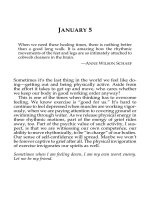
JANUARY 5
When we need these healing times, there is nothing better
than a good long walk. It is amazing how the rhythmic
movements of the feet and legs are so intimately attached to
cobweb cleaners in the brain.
—ANNE WILSON SCHAEF
Sometimes it’s the last thing in the world we feel like doing—getting out and being physically active. Aside from
the effort it takes to get up and move, who cares whether
we keep our body in good working order anyway?
This is one of the times when thinking has to overcome
feeling. We know exercise is “good for us.” It’s hard to
continue to feel depressed when muscles are working vigorously, when we are paying attention to covering ground or
swimming through water. As we release physical energy in
these rhythmic motions, part of the energy of grief rides
away, too. Part of the psychic value of such activity, I suspect, is that we are witnessing our own competence, our
ability to move rhythmically, to be “in charge” of our bodies.
Our sense of self-confidence will spread. Maybe we won’t
be forever captive to grief after all. The physical invigoration
of exercise invigorates our spirits as well.
Sometimes when I am feeling down, I am my own worst enemy.
Let me be my friend.
JANUARY 6
The best way to know God is to love many things.
—VINCENT VAN GOGH
After a severe loss, it is hard to venture any new love, let
alone to nourish wisely the loves that we have. We are consumed by our loss. What do we have to give? And if we
venture a new love, what is to protect us from the same
thing happening again?
Nothing. Yet the wisdom of the ages is that the way to
find life is to pour our love out on the rest of creation.
I remember, as a child in the aftermath of my first experience with death, thinking that the best way to shield myself
from devastation at the other losses which were bound to
occur in life was to love as many people as possible. Then
when one of them died, I’d still have all those others left to
love. I don’t know that the geometry of love works quite
that way, but it wasn’t bad for starters!
To be vulnerable is to be human at the most profound and enriching level.
JANUARY 7
Regret is an appalling waste of energy. You can’t build on
it. It is only for wallowing in.
—KATHERINE MANSFIELD
Of course there are things we regret. Things we wish we’d
done differently. Even where there has been time to say all
the appropriate things, images will flash in our minds that
we’d give a lot to be able to change. Surely our loved one
has forgiven us. Can we forgive ourselves?
I’m sorry. Please know that I loved you. I know that you loved me.
JANUARY 8
Hope is the thing with feathers
That perches in the soul
And sings the tune without the words
And never stops at all.
—EMILY DICKINSON
Sometimes we know hope as much by its absence as by its
presence. When we’re depressed, hope seems almost unknowable, a total illusion. We feel inwardly flattened, unable
to move, or as if we are just going through the motions. The
song of hope of which the poet speaks is muted. Yet the will
of the spirit, as well as of the body, is for life, even for zestful
life. Then something happens—a friend calls and we mobilize ourselves, making an effort to be useful, to ourselves or
to someone else. The energy quickens. At least the moment
has some meaning again and that persistent note of hope,
without which we cannot live, starts thrumming in our
minds once more.
Sometimes all I can hope for is that I’ll feel more hopeful tomorrow.
JANUARY 9
Something quite unexpected has happened. It came this
morning early. For various reasons, not in themselves at all
mysterious, my heart was lighter than it had been for many
weeks…. And suddenly, at the very moment when, so far,
I mourned H. least, I remembered her best. Indeed it was
something (almost) better than memory; an instantaneous,
unanswerable impression. To say it was like a meeting would
be going too far. Yet there was that in it which tempts one
to use those words. It was as though the lifting of the sorrow
removed a barrier.
—C. S. LEWIS
Sometimes we are unconsciously fearful that if we begin to
move away from our grief, we will lose what contact we
have with the one we miss so much. But maybe it is like
letting go of one’s children when they are ready to move off
on their own. If we loosen our grip, the chances of their returning are much greater, and in ways that are commensurate with who they are now. Perhaps the relinquishing of our
most intense grief makes a space into which a new relationship with the loved one can move. It is the person, after all,
whom we want, not the grief.
May I hold my grief lightly in my hand so it can lift away from
me. My connection to the one I have lost is inviolate; it cannot be
broken.