Modern food microbiology 7th ed phần 16
Bạn đang xem bản rút gọn của tài liệu. Xem và tải ngay bản đầy đủ của tài liệu tại đây (82.81 KB, 5 trang )
64
Modern Food Microbiology
external carcass biota to become normalized among carcasses, although a few days may be required.
The practical effect of this is the predictability of the biota of such products at the retail level.
BIOCHEMICAL EVENTS THAT LEAD TO RIGOR MORTIS
Upon the slaughter of a well-rested beef animal, a series of events takes place that leads to the
production of meat. Lawrie106 discussed these events in great detail, and they are presented here only
in outline form. The following are stages of an animal’s slaughter:
1. Its circulation ceases: the ability to resynthesize ATP (adenosine triphosphate) is lost; lack of
ATP causes actin and myosin to combine to form actomyosin, which leads to a stiffening of
muscles.
2. The oxygen supply falls, resulting in a reduction of the O/R (oxidation–reduction) potential.
3. The supply of vitamins and antioxidants ceases, resulting in a slow development of rancidity.
4. Nervous and hormonal regulations cease, thereby causing the temperature of the animal to fall
and fat to solidify.
5. Respiration ceases, which stops ATP synthesis.
6. Glycolysis begins, resulting in the conversion of most glycogen to lactic acid, which depresses
pH from about 7.4 to its ultimate level of about 5.6. This pH depression also initiates protein
denaturation, liberates and activates cathepsins, and completes rigor mortis. Protein denaturation
is accompanied by an exchange of divalent and monovalent cations on the muscle proteins.
7. The reticuloendothelial system ceases to scavenge, thus allowing microorganisms to grow
unchecked.
8. Various metabolites accumulate that also aid protein denaturation.
These events require between 24 and 36 hours at the usual temperatures of holding freshly slaughtered beef (2–5◦ C). Meanwhile, part of the normal biota of this meat has come from the animal’s own
lymph nodes,109 the stick knife used for exsanguination, the hide of the animal, intestinal tract, dust,
hands of handlers, cutting knives, storage bins, and the like. Upon prolonged storage at refrigerator
temperatures, microbial spoilage begins. In the event that the internal temperatures are not reduced
to the refrigerator range, the spoilage that is likely to occur is caused by bacteria of internal sources.
Chief among these are Clostridium perfringens and genera in the Enterobacteriaceae family.90 On
the other hand, bacterial spoilage of refrigerator-stored meats is, by and large, a surface phenomenon
reflective of external sources of the spoilage biota.90
THE BIOTA OF MEATS AND POULTRY
The term “biota” is used throughout this text in lieu of “flora” as a general reference to bacteria.
Flora refers to plant life. “Bacterial flora” dates back to the time when it was believed that bacteria were
primitive plants. Since bacteria are not plants, “bacterial biota or microbiota” is preferred to flora. The
major genera of bacteria, yeasts, and molds that are found in these products before spoilage are listed in
Tables 4–1 and 4–2. In general, the biota is reflective of the slaughtering and processing environments as
noted above, with Gram-negative bacteria being predominant. Among Gram-positives, the enterococci
are the biota most often found along with lactobacilli. Because of their ubiquity in meat-processing
environments, a rather large number of mold genera may be expected, including Penicillium, Mucor,
Fresh Meats and Poultry
65
Table 4–1 Genera of Bacteria Most Frequently Found on Meats and Poultry
Genus
Acinetobacter
Aeromonas
Alcaligenes
Arcobacter
Bacillus
Brochothrix
Campylobacter
Carnobacterium
Caseobacter
Citrobacter
Clostridium
Corynebacterium
Enterobacter
Enterococcus
Erysipelothrix
Escherichia
Flavobacterium
Hafnia
Kocuria
Kurthia
Lactobacillus
Lactococcus
Leuconostoc
Listeria
Microbacterium
Micrococcus
Moraxella
Paenibacillus
Pantoea
Pediococcus
Proteus
Pseudomonas
Psychrobacter
Salmonella
Serratia
Shewanella
Staphylococcus
Vagococcus
Weissella
Yersinia
Gram Reaction
Fresh Meats
−
−
−
−
+
+
−
+
+
−
+
+
−
+
+
−
−
−
+
+
+
+
+
+
+
+
−
+
−
+
−
−
−
−
−
−
+
+
+
−
XX
XX
X
X
X
X
Note: X = known to occur; XX = most frequently reported.
X
X
X
X
X
X
XX
X
X
X
X
X
X
X
X
X
X
X
X
XX
X
X
X
X
XX
XX
X
X
X
X
X
X
Fresh Livers
X
X
X
X
X
Poultry
XX
X
X
X
X
XX
X
X
XX
X
X
X
X
X
X
X
X
X
XX
X
XX
X
XX
X
X
X
X
XX
X
X
X
X
X
X
XX
66
Modern Food Microbiology
Table 4–2 Genera of Fungi Most Often Found on Meats and
Poultry
Genus
Molds
Alternaria
Aspergillus
Aureobasidium
Cladosporium
Eurotium
Fusarium
Geotrichum
Monascus
Monilia
Mucor
Neurospora
Penicillium
Rhizopus
Sporotrichum
Thamnidium
Yeasts
Candida
Cryptococcus
Debaryomyces
Hansenula
Pichia
Rhodotorula
Saccharomyces
Torulopsis
Trichosporon
Yarrowia
Fresh and Refrigerated Meats
Poultry
X
X
X
XX
X
X
XX
X
X
XX
X
X
XX
XX
XX
X
X
XX
X
X
X
X
X
XX
X
XX
XX
X
X
X
X
X
X
X
XX
X
X
X
XX
Note: X = known to occur; XX = most frequently found.
Source: Taken from the literature and from references 34, 35, and 94.
and Cladosporium. The most ubiquitous yeasts found in meats and poultry are members of the genera
Candida and Rhodotorula (Table 4–2). For an extensive review, see Dillon.35
INCIDENCE/PREVALENCE OF MICROORGANISMS IN FRESH RED MEATS
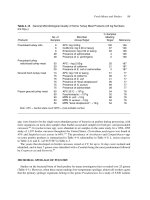
The incidence and prevalence of microorganisms in some red meats are presented in Table 4–3.
The aerobic plate counts (APCs) of the fresh ground beef in this table are considerably higher than
those reported by the U.S. Department of Agriculture (USDA176 ). In that survey of 563 raw ground
beef samples from throughout the United States, the log10 mean number for APC was only 3.90; and
1.98, 1.83, and 1.49 for coliforms, Clostridium perfringens, and Staphylococcus aureus, respectively.
To what extent these lower numbers are reflective of a trending-down of bacteria in fresh ground beef
Fresh Meats and Poultry
67
Table 4–3 Relative Percentage of Organisms in Red Meats That Meet Specified Target Numbers
(Numbers Reported are log10 cfu/g or ml)
Number of
Samples
Products
Raw beef patties
Fresh ground beef∗
Fresh ground beef
Frozen ground beef patties
Fried hamburger
Comminuted big game meats
∗ Under
Microbial
Group/Target
(All Numbers
Are log10 )
735
735
735
735
735
1,830
1,830
1,830
1,830
1,830
1,090
1,090
1,090
605
604
604
107
107
113
113
113
APC: log10 6.00 or less/g
Coliforms: log 2.00 or less/g
E. coli: log 2.00 or less/g
S. aureus: 2.00 or less/g
Presence of salmonellae
APC: 6.70 or less/g
S. aureus: 3.00 or less/g
E. coli: 1.70 or less/g
Presence of salmonellae
Presence of C. perfringens
APC: ≥7.00 or less/g at 35◦ C
Fecal coliforms: ≤2.00/g
S. aureus: <2.00/g
APC: 6.00 or less/g
E. coli: <2.70/g
E. coli: >3.00/g MPN
APC at 21◦ C; 72 h, <3.00/g
Absence of enterococci,
coliforms, S. aureus,
Salmonellae
Coliforms: 2.00 or less/g
E. coli: 2.00 or less/g
S. aureus: 2.00 or less/g
% Samples
Meeting
Target
Reference
76
84
92
85
0.4
89
92
84
2
20
88
76
91
67
85
9
76
100
170
170
170
170
170
21
21
21
21
21
142
142
142
74
74
74
43
43
42
75
96
163
163
163
Oregon law that was in effect at the time.
Note: APC = Aerobic plate count; MPN = most probable number.
or of laboratory methodology is unclear. For many decades, comminuted meats have been shown to
contain higher numbers of microorganisms than noncomminuted meats such as steaks, and there are
reasons for this:
1. Commercial ground meats consisting of trimmings from various cuts that are handled excessively
generally contain high levels of microbial contamination. Ground meats that are produced from
large cuts tend to have lower microbial numbers.
2. Ground meat provides a greater surface area, which itself accounts in part for the increased
biota. It should be recalled that as particle size is reduced, the total surface area increases with a
consequent increase in surface energy.
3. This greater surface area of ground meat favors the growth of aerobic bacteria, the usual lowtemperature spoilage biota.
4. In some commercial establishments, the meat grinders, cutting knives, and storage utensils are
rarely cleaned as often and as thoroughly as is necessary to prevent the successive buildup of
68
Modern Food Microbiology
microbial numbers. This may be illustrated by data obtained from a study of the bacteriology of
several areas in the meat department of a large grocery store. The blade of the meat saw and the
cutting block were swabbed immediately after they were cleaned on three different occasions with
the following mean results: the saw blade had a total log10 /in.2 count of 5.28, with 2.3 coliforms,
3.64 enterococci, 1.60 staphylococci, and 3.69 micrococci; the cutting block had a mean log10 /in.2
count of 5.69, with 2.04 coliforms, 3.77 enterococci, <1.00 staphylococci, and 3.79 micrococci.
These are among the sources of the high total bacterial count to comminuted meats.
5. One heavily contaminated piece of meat is sufficient to contaminate others, as well as the entire
lot, as they pass through the grinder. This heavily contaminated portion is often in the form of
lymph nodes, which are generally embedded in fat. These organs have been shown to contain
high numbers of microorganisms and account in part for hamburger meat having a generally
higher total count than ground beef. In some states, the former may contain up to 30% beef fat,
whereas the latter should not contain more than 20% fat.
Bacteria
The high prevalence of enterococci in meats is illustrated by a study conducted in 2001–2002 on
retail meats in the state if Iowa. Of 255 pork samples, 247 (97%) were positive for these organisms
with 54% of isolates being Enterococcus faecalis and 38% E. faecium.84 Of 262 beef samples, all
contained enterococci with 65% of isolates identified as E. faecium, 17% E. faecalis, and 14% E.
hirae.84
Members of the genera Paenibacillus, Bacillus, and Clostridium, are found in meats of all types.
In a study of the incidence of putrefactive anaerobe (PA) spores in fresh and cured pork trimmings
and canned pork luncheon meat, Steinkraus and Ayres165 found these organisms to occur at very low
levels, generally less than 1/g. In a study of the incidence of clostridial spores in meats, Greenberg
et al.76 found a mean PA spore count per gram of 2.8 from 2,358 meat samples. Of the 19,727 PA
spores isolated, only one was a Clostridium botulinum spore, and it was recovered from chicken. The
large number of meat samples studied by these investigators consisted of beef, pork, and chicken,
obtained from all parts of the United States and Canada. The significance of PA spores in meats is
due to the problems encountered in the heat destruction of these forms in the canning industry (see
Chapter 17).
Erysipelothrix rhusiopathiae was isolated from about 34% of retail pork samples in Japan and from
4% to 54% of pork loins in Sweden. A variety of serovars has been found in pork, and nine were found
among chicken isolates in Japan.133 The latter investigators suggested chickens as a possible reservoir
of Erysipelothrix spp. for human infections (see Chapter 31 for more on this bacterium).
The incidence of Clostridium perfringens in a variety of American foods was studied by Strong
et al.169 They recovered the organism from 16.4% of raw meats, poultry, and fish tested; from 5% of
spices; from 3.8% of fruits and vegetables; from 2.7% of commercially prepared frozen foods; and
from 1.8% of home-prepared foods. Others have found low numbers of this organism in both fresh
and processed meats. In ground beef, C. perfringens at 100 or less per gram was found in 87% of
95 samples, whereas 45 of the 95 (47%) samples contained this organism at levels <1,000/g.103 One
group was unable to recover C. perfringens from pork carcasses, hearts, and spleens, but 21.4% of
livers were positives.13 Commercial pork sausage was found to have a prevalence of 38.9%. A study
in the United States in 2001–2002 of 445 whole muscle, ground, and emulsified samples of raw pork,
beef, and chicken products found that C. perfringens spores did not exceed 2.0 log10 and averaged
1.56 log10 cfu/g.173 When several products were inoculated with ca. 3.0 log10 /g of three C. perfringens