Pediatric emergency medicine trisk 47
Bạn đang xem bản rút gọn của tài liệu. Xem và tải ngay bản đầy đủ của tài liệu tại đây (192.7 KB, 4 trang )
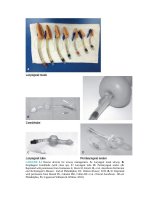
e-FIGURE 8.2 Rescue devices for airway management. A: Laryngeal mask airway. B:
Esophageal Combitube (with close up). C: Laryngeal tube. D: Perilaryngeal sealer. (A:
Reprinted with permission from Guimaraes E, Davis M, Kirsch JR, et al. Anesthesia Technician
and Technologist’s Manual . 2nd ed Philadelphia, PA: Wolters Kluwer; 2019. B, C: Reprinted
with permission from Barash PG, Cahalan MK, Cullen BF, et al. Clinical Anesthesia . 8th ed.
Philadelphia, PA: Lippincott Williams & Wilkins; 2018.)
CHAPTER 9 ■ CARDIOPULMONARY
RESUSCITATION
SAGE MYERS, DANA ARONSON SCHINASI, FRANCES M. NADEL, SHANNON M. GAINES
GOALS OF EMERGENCY THERAPY
Cardiopulmonary resuscitation (CPR) is a series of interventions aimed at
restoring and supporting vital function after apparent death. The immediate goal
of resuscitation is to reestablish substrate delivery to meet the metabolic needs of
the myocardium, brain, and other vital organs. The overall goal is to return the
child to society without morbidity related to the underlying disease or the
resuscitation process. Given the poor prognosis of children who develop
cardiopulmonary arrest, primary prevention efforts are crucial in improving
childhood mortality. This chapter will focus on the management of the critically
ill child and neonate based on the 2015 American Heart Association (AHA) CPR
Resuscitation Guidelines, Pediatric Advanced Life Support (PALS) principles, the
literature, and our experience.
INCIDENCE
It is estimated that of the more than 6,000 children who suffer an out-of-hospital
cardiac arrest (OHCA) annually, only 5% to 12% will survive, most with
significant neurologic injury. U.S. mortality rates related to age in years for 2017
are shown in Table 9.1 . There has been little improvement in pediatric OHCA
outcomes over the past two decades. Of note, mortality rates of children less than
1 year old approach the rates of people over 54 years old. Table 9.2 describes the
leading causes of death for children and young adults. After the first year of life,
unintentional injury is the most common cause of death and therefore,
preventable.
RELATED CHAPTERS
Resuscitation and Stabilization
A General Approach to the Ill or Injured Child: Chapter 7
Airway: Chapter 8
Shock: Chapter 10
Interfacility Transport and Stabilization: Chapter 11
Medical Emergencies
Cardiac Emergencies: Chapter 86
Procedures and Appendices
Prehospital Care: Chapter 134
The Children’s Hospital of Philadelphia Clinical Pathways
ED Pathway for End-of-Life Care
URL: />Authors: D. Corwin, MD; E. Friedlaender, MD, MPH; L. Zinns, MD; T.
Kang, MD, MSCE; C. Feudtner, MD, PhD, MPH; W. Morrison, MD,
MBE; J. Hwang, MD, MHS; D. Albert, RN, BSN, CPN, CPEN; W.
Frankenberger, RN, MSN, CCNS; B. Rodio, RN, BSN, CEN, CPHQ
Posted: October 2015, last revised May 2018
Clinical Pathway for Therapeutic Hypothermia Treatment for
Neonates With Hypoxic Ischemic Encephalopathy (HIE)
URL: />Authors : J. Flibotte, MD; K. Dysart, MD; J. Stoller, MD; A. Vossough,
MD; L. Billinghurst, MD; N. Abend, MD; S. Massey, MD; A. Zanno,
MD; N. Pouppirt, MD; N. Cook, MD; C. Hufnal, MD; V. Martin, MD; J.
Carroll, MSN; L. Heimall, MSN; F. Fung, MD; M. Fitzgerald, MD; A.
Bustin, PharmD; H. Monk Bodenstab, PharmD
Posted: December 2018
Clinical Pathway for the Care of Children Post-CPR
URL: />Authors: A. Topjian, MD; L. Hutchins, MSN; P. Meaney, MD; V.
Nadkarni, MD; R. Berg, MD; J. Blinder, MD; A. Dewitt, MD; T. Conlon,
MD; J. Fowler, MD
Posted: August 2013, last revised December 2015, January 2018
PATIENT CHARACTERISTICS
Age
Children less than 1 year of age have a much higher incidence and worse rate of
survival from OHCA than older children or teens. In large population-based
studies of children who were resuscitated after an OHCA, over 60% were infants.