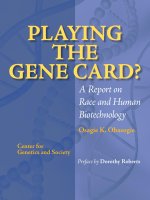
PLAYING THE GENE CARD ?
Bạn đang xem bản rút gọn của tài liệu. Xem và tải ngay bản đầy đủ của tài liệu tại đây (3.09 MB, 95 trang )
PLAYING
THE
GENE CARD?
A Report on
Race and Human
Biotechnology
Osagie K. Obasogie
Center for
Genetics and Society
Preface by Dorothy Roberts
Playing the gene Card?
A Report on Race and
Human Biotechnology
By Osagie K. Obasogie
Center for Genetics and Society
Preface by Dorothy Roberts
© 2009 Center for Genetics and Society
All rights reserved. No part of this publication may be reproduced in whole or in part without the written
consent of the Center for Genetics and Society except in brief quotations or summaries in articles and
reviews.
Center for Genetics and Society
436 14th Street, Suite 700
Oakland, CA 94612
tel 510-625-0819
www.geneticsandsociety.org
www.biopoliticaltimes.org
www.biopolicywiki.org
To download this report: www.thegenecard.org
iii
C e n t e r f o r g e n e t i C s a n d s o C i e t y
P l ay i n g t h e g e n e C a r d ?
A Report on Race and Human Biotechnology
Contents
Executive Summary vii
About the Author ix
Acknowledgments x
Preface by Dorothy Roberts, Kirkland & Ellis Professor of Law,
Northwestern Law School xi
Race Cards and Gene Cards: A Note About the Report's Title xiv
Introduction | Are 21st Century Technologies Reviving 19th Century
Theories of Race? 1
How Have New Genetic eories of Racial Dierence Developed? 1
Context: Aer the Human Genome Project 2
Key Concern: Will Commercial and Forensic Applications Revive
Biological eories of Race? 4
In is Report 5
Sidebar: What Does It Mean to Say that Race Is Not Biologically
Signicant or that It Is a Social Construction? 3
Chapter 1 | Race-Based Medicine: One Step Forward, Two Steps Back? 7
Pharmacogenomics: e Concept Behind Race-Based Medicines 8
First on the Scene: BiDil 9
Concerns about BiDil 11
Addressing Disparities in Health rough Race-Specic Pharmaceuticals 13
Conclusion: Evaluating Race-Based Medicine 15
Recommendations 15
Sidebars: Major Projects on Human Genetic Variation 8
Why Genetic Variations Matter 10
Top-Down Marketing to the Black Community 11
Contents
iv
Contents
Historical eories of Race 12
Are More Race-Based Medicines Around the Corner? 13
e Slavery Hypothesis 14
Chapter 2 | Ancestry Tests: Back to the Future? 17
African American Ancestry 17
Context: Population Genetics 18
From Groups and Populations to Individuals 23
Techniques Used by Ancestry Tests 24
Concerns about the Genetic Ancestry Industry 28
Conclusion: Resisting Racial Typologies 30
Recommendations 30
Sidebars: Native Americans and Ancestry Tests 18
Race, Intelligence, and James Watson 19
Bioprospecting and Biopiracy 20
From Race to Population and Back 21
e Business of DNA Ancestry Testing 24
Special Types of DNA 28
Human Genetic Variation—A Work in Progress 29
Chapter 3 | Race and DNA Forensics in the Criminal Justice System 31
How Does It Work? 31
How Reliable Are DNA Forensic Technologies? 32
DNA Databases 33
Cold Hits and Partial Matches 34
Whose DNA Is in ese Databases? 36
Siing DNA Databases to Catch Family Members 39
Predicting Criminality 40
Using DNA to Build Racial Proles 41
Conclusion: Eects on Minority Communities 43
Recommendations 44
Sidebars: DNA Entrapment? 32
e Scandal in Houston 33
e Innocence Project 33
v
C e n t e r f o r g e n e t i C s a n d s o C i e t y
P l ay i n g t h e g e n e C a r d ?
A Report on Race and Human Biotechnology
Contents
“e Informer in Your Blood” 34
Juking Stats 35
“e Birthday Problem” and the Limits of Forensic Database Matches 36
Minority Communities and the War on Drugs 38
Civil Liberties and DNA Databases 39
Phrenology, a Classic Pseudo-Science 41
Conclusion 45
Racial Categories in Human Biotechnology Research 45
Race Impact Assessments 46
Responsible Regulation 47
Endnotes 49
About the Center for Genetics and Society 80
vii
C e n t e r f o r G e n e t i C s a n d s o C i e t y
P l ay i n G t h e G e n e C a r d ?
A Report on Race and Human Biotechnology
Executive Summary
Race has become a prominent focus for human
biotechnology. Despite oen good intentions, ge-
netic technologies are being applied in a manner
that may provide new justication for thinking
about racial dierence and racial disparities in
biological terms—as if social categories of race
reect natural or inherent group dierences.
e Human Genome Project (HGP) and sub-
sequent research showed that there is less than 1%
genetic variation among all humans. Patterns of
mating and geographic isolation over thousands of
years have conferred genetic signatures to certain
populations. Yet scientists have found little evi-
dence to support lay understandings that social
categories of race reect discrete groups of human
dierence. While HGP ndings initially led many
to conclude that race (as it is commonly conceived
and used) is not genetically signicant, the hope
that science would promote racial healing has
largely not materialized.
In fact, trends in life science research have
shied the other way. ere are increasing eorts
to demonstrate the genetic relevance of race by
mapping this less than 1% of variation onto social
categories of race to nd genetic explanations for
racial disparities and dierences.
Many celebrate these developments as an op-
portunity to learn more about who we are and
why certain groups are sicker than others. Yet
some are struck by the extent to which these new
conversations aimed at beneting minority com-
munities echo past discussions in which the sci-
ence of biological dierence was used to justify
racial hierarchies.
Although this new research is rapidly evolv-
ing and is fraught with controversy, it is being
used to develop several commercial and forensic
applications that may give new credence to bio-
logical understandings of racial dierence—oen
with more certainty than is supported by the avail-
able evidence. is unrestrained rush to market
race-specic applications and to use DNA tech-
nologies in law enforcement can have signicant
implications for racial minorities:
■ Race-based medicines have been promoted
as a way to reduce inequities in healthcare
and health outcomes. Yet the methodological
assumptions behind them raise as many
issues as the questionable market incentives
leading to their development.
■ Genetic ancestry tests rely on incomplete sci-
entic methods that may lead to overstated
claims. e companies that sell them oen
suggest that biotechnology can authoritatively
tell us who we are and where we come from.
■ DNA forensics have been used to exonerate
those who have been wrongly convicted and
can provide important tools for law enforce-
ment. However, some forensic applications of
genetic technologies might undermine civil
rights—especially in minority communities.
Executive Summary
viii
Executive Summary
While each of these applications has been ex-
amined individually, this report looks at them to-
gether to highlight a fundamental concern: that
commercial incentives and other pressures may
distort or oversimplify the complex and discor-
dant relationship between race, population, and
genes. Applications based on such distortions or
oversimplications may give undue legitimacy to
the idea that social categories of race reect dis-
crete biological dierences.
e concerns raised in this report should not
be read as impugning all genetic research that im-
plicates social categories of race. ere is evidence
that socially constructed notions of race may
loosely reect patterns of genetic variation created
by evolutionary forces, and that knowledge about
them may ultimately serve important social or
medical goals. Yet, given our unfortunate history
of linking biological understandings of racial dif-
ference to notions of racial superiority and inferi-
ority, it would be unwise to ignore the possibility
that 21st century technologies may be used to re-
vive long discredited 19th century theories of race.
Advances in human biotechnology hold great
promise. But if they are to benet all of us, closer
attention should be paid to the social risks they
entail and their particular impacts on minority
communities.
ix
C e n t e r f o r G e n e t i C s a n d s o C i e t y
P l ay i n G t h e G e n e C a r d ?
A Report on Race and Human Biotechnology
About the Author
About the Author
Osagie K. Obasogie, JD, PhD, is
Senior Fellow at the Center for Ge-
netics and Society, an Associate
Professor of Law at the University
of California, Hastings in San Fran-
cisco, and a Visiting Scholar at the
University of California, San Fran-
cisco. His writings have spanned
both academic and public audienc-
es, with journal articles in the Yale
Journal of Law and Feminism, the
Journal of Law, Medicine, and Ethics, and Trends
in Pharmacological Sciences along with commen-
taries in outlets such as the Los Ange-
les Times, Boston Globe, San Francisco
Chronicle, and New Scientist. He is a
regular contributor to CGS’s blog
Biopolitical Times and former direc-
tor of CGS’s Project on Bioethics,
Law, and Society. Obasogie received
his B.A. with distinction from Yale
University, was a Harlan Fiske Stone
Scholar and an editor for the National
Black Law Journal at Columbia Law
School, and received his Ph.D. in Sociology from
the University of California, Berkeley.
Dorothy Roberts, JD, who
wrote the preface, is the
Kirkland & Ellis Professor
at Northwestern University
School of Law, with joint ap-
pointments in the Depart-
ments of African American
Studies and Sociology, and as a faculty fellow of
the Institute for Policy Research. She is the au-
thor of the award-winning books Killing the
Black Body: Race, Reproduction, and the Meaning
of Liberty (1997) and Shattered Bonds: e Color
of Child Welfare (2002) and a frequent speaker at
university campuses, social justice organiza-
tions, and other public forums. She serves on
the boards of directors of the Black Women’s
Health Imperative, the National Coalition for
Child Protection Reform, and Generations
Ahead, and on the Standards Working Group of
the California Institute for Regenerative Medi-
cine. She is writing a book on the politics of
race-based technologies.
Acknowledgments
I am deeply appreciative of the thoughtful and
supportive environment provided by the Center
for Genetics and Society while draing this re-
port. Sta members Richard Hayes, Marcy Dar-
novsky, Jesse Reynolds, Charles Garzon, and
Jenna Burton have been extraordinary in re-
viewing dras, oering suggestions, and simply
being the best group of people anyone could
ever work with. I am also thankful to CGS in-
terns Claudette Mestayer and Nancy Zhang for
their excellent research assistance. A special
thanks to Pete Shanks for his editorial assistance
and help with coordinating the production of
this document, to Jonathan Peck of Dovetail
Publishing Services for designing the report’s
layout, and to John Sullivan of Visual Strategies
for designing the cover.
I am also grateful to those who took precious
time out of their schedules to review this report at
various stages: Deborah Bolnick, David Chae,
David Faigman, Julie Harris, Lisa Ikemoto, Eliza-
beth Joh, David Jones, Jonathan Kahn, Jaime
King, Ethan Leib, Susan Reverby, Dorothy Rob-
erts, Aliya Saperstein, Tania Simoncelli, Kim Tall-
bear, Jessica Vasquez, and David Winicko.
O.K.O.
x
Acknowledgments
C e n t e r f o r G e n e t i C s a n d s o C i e t y
P l ay i n G t h e G e n e C a r d ?
A Report on Race and Human Biotechnology
Preface
In his 2000 manifesto against racial thinking,
Against Race, sociologist Paul Gilroy predicted that
advances in genomic research would eventually
discredit the idea of “specically racial dierences”
by rendering race a useless way of classifying peo-
ple.
1
Many researchers similarly anticipated that
the science of human genetic diversity would re-
place race as the preeminent means of grouping
people for scientic purposes. Aer all, social sci-
entists’ conclusion that race is socially, politically,
and legally constructed was conrmed by genomic
studies of human variation, including the Human
Genome Project. ese studies showed high levels
of genetic similarity within the human species.
Most genetic variation occurs within populations,
not between them.
But reports of the demise of race as a biologi-
cal category were premature. Instead of hammer-
ing the last nail in the con of an obsolete system,
the new genomics is producing a resurgence of sci-
entic interest in race-based genetic variation and
an explosion of race-based technologies. Fueled by
research funding and commercial interests, scien-
tists are incorporating race as an organizing prin-
ciple in cutting-edge genetic research.
2
Race-specic pharmaceuticals, commercial
genetic technologies for determining racial gene-
alogy, and law enforcement’s use of large DNA
data banks for suspect identication are promi-
nent examples of this scientic development.
Playing the Gene Card? A Report on Race and
Human Biotechnology analyzes the social implica-
tions of this technology’s potential to rearm the
biological meaning of race. Although each of
these technologies merits intense investigation, it
is important to consider the impact of their si-
multaneous development. is Report not only
documents the expansion of race-based technol-
ogies, but analyzes how they are linked and why
we should be concerned about them. By consid-
ering common themes marking all of these tech-
nologies, Playing the Gene Card? uncovers the full
scope of their power to aect the racial order in
America.
ere are three key problems that should
worry us. First, many of the scientic claims
promoting race-based biotechnologies are sus-
pect; we should question the validity of using
race as a proxy for both genetic dierence and
group commonality. Scientists, entrepreneurs, and
government agents have oversold the ability of
race as a biological category to improve medi-
cine, reveal our true identities, and solve crime.
Second, race-based biotechnologies threaten to
reinforce the myth that racial categories are nat-
ural rather than a classication system invented
for political ends.
Finally, these technologies reinforce the re-
lated pretense that health and other disparities
between groups are caused by biological dier-
ences rather than social inequities. Race-specic
pharmaceuticals are promoted as the solution to
Preface
xi
Dorothy Roberts
Preface
health disparities that result from the experience
of discrimination, inferior living conditions, and
inadequate health care. Commercial ancestry
testing companies attempt to restore the genea-
logical histories irreparably broken by the slave
trade. And, although DNA forensics has famously
helped to exonerate innocent people, the collec-
tion of genetic material to identify suspects poses
threats to civil liberties that will fall dispropor-
tionately on minority communities.
How can we explain the rise of race con-
sciousness at the heart of the 21st century genom-
ic revolution? Science historian Evelynn Ham-
monds observes, “. . . the appeal of a story that
links race to medical and scientic progress is in
the way in which it naturalizes the social order in
a racially stratied society such as ours.”
3
Explain-
ing racial inequality in biological terms rather
than in terms of white political privilege has pro-
foundly shaped science in America for three cen-
turies, beginning with the scientic defense of
slavery.
4
Race-based technologies have tremen-
dous potential to inuence state eorts to address
racial inequality by diverting attention from the
structural causes of racial inequities towards ge-
netic explanations and technological solutions.
5
eir expansion may help to encourage a shi in
responsibility for addressing disparities from the
government to the very individuals who suer
most from inequality.
It is critical to place these biotechnological
advances in their contemporary political con-
text.
6
e controversy over race-based technolo-
gies is occurring against the sociopolitical back-
drop of an equally heated debate about approaches
to racial equality. Colorblindness and race con-
sciousness compete as major frameworks for de-
ning the proper treatment of race in social poli-
cy. In the political arena, advocates for colorblind
policies assert that racism has ceased to be the
cause of social inequities while race conscious
policies are promoted as a necessary means for
remedying persistent institutional racism. In June
2007, the United States Supreme Court spotlight-
ed this contest in its 5–4 decision striking down
race-conscious plans to desegregate elementary
schools in Seattle and Jeerson County, Ken-
tucky.
7
e Court adopted the position that the
Constitution requires the government to be col-
orblind by paying no explicit attention to race in
policy making. As Chief Justice John Roberts
concluded, “[t]he way to stop discrimination on
the basis of race is to stop discriminating on the
basis of race.” us, race consciousness is decreas-
ing in government social policy at the very mo-
ment it is increasing in biotechnology.
e political context of race-based technolo-
gies is complicated by the tension experienced by
racial justice advocates seeking to directly confront
the very real impact of systemic racism without
reifying race as a natural division of human beings.
Some African Americans have demanded inclu-
sion in technological innovations that incorporate
biological denitions of race for the express pur-
pose of promoting racial equality. ere is strong
support for race-based medicine, for example,
among some black advocates, researchers, and
physicians precisely to redress past discrimination
and fulll longstanding demands for science to at-
tend to the health needs of African Americans.
8
Race-based biotechnologies are likely to af-
fect an even more powerful political agenda. e
diversion of attention from social to molecular
causes and solutions reinforces privatization, the
hallmark of the neoliberal state that pervades
every aspect of public policy. In the wake of glo-
balization, the United States has led industrial-
ized and developing nations in drastically cutting
social welfare programs while promoting the free
market conditions conducive to capital accumu-
lation.
9
Critical to this process of state restructur-
ing is the transfer of social services from the wel-
fare state to the private realm of the market,
family, and individual while advancing private
sector interests in the market economy. Just as
imperative to the neoliberal regime is the state’s
brutal intervention in communities of color in
the form of mass incarceration, foster care, wel-
fare behavior modication programs, and harsh
immigration enforcement and deportation. e
xii
C e n t e r f o r G e n e t i C s a n d s o C i e t y
P l ay i n G t h e G e n e C a r d ?
A Report on Race and Human Biotechnology
Preface
public is more likely to support these trends if it is
convinced that race-based technological innova-
tions can replace the need for social change.
Sociologist Nikolas Rose argues that the eort
“to control the biological makeup of the popula-
tion as a whole” distinguishes eugenics from con-
temporary biological politics’ concern with the ge-
netic health of individuals.
10
Today’s biopolitics
reects a radical change from state management of
the population’s health to individual management
of genetic risk, aided by new genetic technologies.
But we should not dismiss the relevance of eugen-
ics so categorically. Critical aspects of past eugen-
ics programs characterize both contemporary
population control policies and some genetic ad-
vances. e eugenic approach to social problems
locates them in biology rather than social struc-
ture; eugenic programs therefore sought to im-
prove society by eliminating disfavored people in-
stead of social inequities. Its chief device was to
make the social order seem natural by casting its
inequitable features as biological facts.
ere is an intense debate among genetic and
social scientists about the appropriate use of race
as a category in scientic research. e question
of biology’s proper role in dening race and ad-
dressing racial inequality is far from resolved. But
to reach ethical answers, we must put social jus-
tice at the center of the public debate. is report
concludes with helpful proposals that take social
justice into account to avoid the potential for
race-based technologies to reinforce rather than
reduce inequality. ose concerned with racial
justice in America should take heed.
xiii
xiv
Race Cards and Gene Cards: A Note About the Report’s Title
e title of this report draws upon a rhetorical
phrase common in the United States: playing
the race card. is expression alludes to a less-
than-honorable move in a proverbial card
game—where race, or an accusation of racism, is
used as a winning “trump card” that beats all
other players’ hands.
Stanford Law Professor Richard Ford notes
that “playing the race card typically involves
jumping to a conclusion not compelled by the
facts.”
11
It is most oen used to suggest that some-
one has illegitimately inserted the emotionally
charged issues of race or racism into an otherwise
rational conversation as a way to divert attention
away from more substantive issues.
One of the more famous “race card” accusa-
tions was used in the 1995 O.J. Simpson trial.
University of California, Berkeley lm studies
Professor Linda Williams writes
e “race card” was invoked as a term
during the rst O.J. Simpson double-murder
trial when the prosecution accused [defense
attorney] Johnny Cochran’s team of cheat-
ing by introducing evidence of detective
Mark Fuhrman’s racism. is evidence—of
Fuhrman’s prior use of the word “nigger”—
was called an “ace of spades” by prosecutor
Christopher Darden: “Mr. Cochran wants
to play the ace of spades and play the race
card. . . . If you allow Mr. Cochran to use
this word and play this race card, not only
does the direction and focus of the case
change, but the entire complexion of the
case changes. It’s a race case then. It’s white
versus black.”
12
e admittedly provocative analogy implied
by the report’s title should not be understood as
dismissing all genetic research that alludes to race
(or any of its many surrogates) as illegitimate.
Playing the Gene Card? readily acknowledges the
many potential benets that may come from race-
conscious biomedical and biotechnical innova-
tions. Rather, this title is oered to raise a series of
important questions that should be taken seri-
ously, including whether the less-than-precise—
and at times sensationalistic—statements about
the genetic underpinnings of race and racial dis-
parities might obscure the former’s social con-
struction and the latter’s social determinants.
Playing the Gene Card? asks whether the com-
mercial and forensic applications of recent devel-
opments in genetics are being used—perhaps un-
wittingly—as trump cards that hide the social and
molecular complexities underlying racial dispari-
ties in health, our genealogical heritages, and fo-
rensic analyses. To the extent that this may be oc-
curring, the report explores the ways that it may
reassert race as a discrete biological entity.
Race Cards and Gene Cards:
A Note About the Report’s Title
C e n t e r f o r G e n e t i C s a n d s o C i e t y
P l ay i n G t h e G e n e C a r d ?
A Report on Race and Human Biotechnology
Introduction ■ Are 21st Century Technologies Reviving 19th Century Theories of Race?
“e problem of the 20th century is the problem
of the color line,”
13
wrote W.E.B. DuBois in 1903.
Rarely have so few words been so prescient yet so
understated. DuBois prophetically captures the
signicant role that race played in many of the
nation’s struggles during the last century, from
the ravages of Jim Crow to Brown v. Board of Edu-
cation to the Civil Rights Movement to the War
on Drugs.
Despite signicant advances in race relations
and the status of people of color, racial minorities
face new challenges in the 21st century that are
unmistakably connected to past injustices. e
persistent gap in wealth between racial minorities
and their White counterparts,
14
the substantial
disparity in infant mortality between Black and
White babies,
15
and the continued racial segrega-
tion of public schools y years aer Brown that
leaves minority children with substandard educa-
tions
16
are but a few examples of the enduring
legacy of racial discrimination in America.
Yet a series of applications relying upon ge-
netic technologies are lending support to expla-
nations of racial disparities that rely more on bi-
ology than on social conditions. We are seeing a
revival of previously discredited beliefs that the
social problems and inequities that characterize
the color line come from inherent biological dier-
ences between racial groups. In a nutshell, the
color line that still divides racial groups is in-
creasingly taking on, in the view of some, a ge-
netic character.
But these new articulations of biological race
have a dierent overtone from their predecessors.
In the name of resolving racial disparities in
health, addressing disrupted genealogies, and im-
proving law enforcement, they explicitly reject the
racial subordination that fueled past eorts to
link social categories of race to inherent biologi-
cal dierences. Yet they may inadvertently lead to
similar conclusions: that various racial dispari-
ties—from why certain groups are sicker than
others to why arrest and incarceration rates are
higher among some populations—can be more
meaningfully understood through genetic than
social or environmental mechanisms.
How Have New Genetic Theories
of Racial Difference Developed?
For most of the 19th century, science played a key
role in shaping lay understandings of race. A vari-
ety of scientic theories suggested that Blacks,
Native Americans, and other racial minorities
were either an entirely separate (and inferior)
breed of humankind, or that they were less
evolved than White Americans and Europeans.
17
ese beliefs were instrumental in maintaining
systems of racial subordination.
18
By the latter half of the 20th century, a largely
shared (but by no means universal)
19
understand-
Introduction
Are 21st Century Technologies Reviving
19th Century Theories of Race?
1
Introduction ■ Are 21st Century Technologies Reviving 19th Century Theories of Race?
ing emerged: humanity is one species, environ-
mental and social pressures play a signicant part
in the variations observed across human groups
and their outcomes, and the racial distinctions
drawn by society reect shiing cultural, politi-
cal, and economic forces.
In 1950 a group of leading biologists and so-
cial scientists issued e Race Question, a state-
ment under the auspices of UNESCO, the United
Nations Educational, Social, and Cultural Orga-
nization. It read in part,
“e biological fact of race and the myth of
‘race’ should be distinguished. For all prac-
tical social purposes, ‘race’ is not so much
a biological phenomenon as a social myth
[which has] created an enormous amount
of human and social damage.”
20
Fujimura et. al. point out that “the 1950 and
1951 UNESCO statements on race are oen
cited as demonstrating that Euro-American sci-
entists in the post Second World War era were
vigilant against biological notions of racial
dierence [without acknowledging] that subse-
quent UNESCO statements critiqued racial prej-
udice and racism but did not disown the
biological concept of race itself.”
21
Shortly aer-
wards, genetic researchers began demonstrating
the limited correlation between outward phys-
ical appearance (typically the driving force
behind racial categorizations) and underlying
genetic variation.
22
Although conceptions of race ebbed and
owed throughout the 20th century, the social
construction thesis and the scientic data sup-
porting it have encouraged egalitarian sentiments
and advances in civil and human rights for racial
minorities. Today the constructionist approach to
race is itself receiving signicant challenges from
some developments in the life sciences. A consid-
erable amount of research is now being devoted
to nding genetic dierences that map onto so-
cial understandings of race. Much of this research
is premised on the idea that group dierences in
social, behavioral, and health outcomes may, in
large part, be explained by genetic variations or
frequencies associated with each group. While
the scientic evidence for these hypotheses is in
ux, it is not too soon to consider their social,
ethical, and legal implications.
At the same time that academic researchers
ferret out the signicance of these studies, new
industries are emerging based on biotech prod-
ucts that may have important consequences for
communities of color. Drug companies are begin-
ning to oer medicines for specic racial groups,
suggesting that genetic dierences between races
are signicant determinants of health disparities.
Genetic tests are being marketed to provide an-
swers about our ancestry that were thought to be
lost forever due to past geopolitical conicts. And
biotech companies are oering law enforcement
agencies high-tech tools with which to prole and
catch criminals.
Context: After the
Human Genome Project
In October 1990, the United States Department
of Energy and the National Institutes of Health
(NIH) launched an ambitious project: mapping
the entire human genome. e Human Genome
Project (HGP) announced a rst dra in 2000 to
great fanfare. e project was formally completed
in 2003, though work continues on some details.
Its ndings have been the basis of much improved
understandings about the way genes inuence
health outcomes.
One of the HGP’s most heralded ndings
was that all humans are over 99.9% similar at the
molecular level, a discovery that supports the
social rather than genetic character of racial cat-
egories. (Subsequent research has slightly raised
the initial estimate of dierence, to around
0.5%.
33
) At the time that the HGP’s results be-
came public, numerous scientists and other ob-
servers predicted that its nding of human ge-
netic similarity would nally move society
beyond biological theories of racial dierence
that have fueled centuries of racial strife.
34
is
became the basis of broader social and political
2
C e n t e r f o r G e n e t i C s a n d s o C i e t y
P l ay i n G t h e G e n e C a r d ?
A Report on Race and Human Biotechnology
Introduction ■ Are 21st Century Technologies Reviving 19th Century Theories of Race?
pronouncements such as those made by then
President Bill Clinton:
“I believe one of the great truths to emerge
from this triumphant expedition inside the
human genome is that in genetic terms, all
human beings, regardless of race, are more
than 99.9 percent the same. What this means
is that modern science has conrmed what
we rst learned from ancient fates. e most
important fact of life on this Earth is our
common humanity.”
35
3
Researchers in the social and life sciences have argued
that race is not a meaningful biological category, that
it is a “social construction” rather than a scientific fact.
But what does this mean? These phrases are
typically used to convey the ideas that
q the importance placed on the outward physical dis-
tinctions that societies traditionally use to draw racial
boundaries vary substantially over time and place,
q these physical distinctions do not reflect any
inherent meanings, abilities, or disabilities, and
q racial differences in social and health outcomes
do not correlate meaningfully with underlying
biological or genetic mechanisms.
In short, as University of California, Berkeley Law
Professor Ian Haney Lopez argues, the constructionist
view “rejects the most widely accepted understanding
of race . . . [which holds that] there exist natural,
physical, divisions among humans that are hereditary,
reflected in morphology, and roughly captured by
terms like Black, White, and Asian.”
23
There are certainly biological components to race and
health outcomes, though often only because of the way
certain groups are treated in relation to how they are
perceived.
24
A key example of this phenomenon was
demonstrated by John Hopkins epidemiologist Michael
Klag, who found that rates of hypertension among Black
Americans correspond to skin complexion; those with
darker skin have higher rates.
25
Klag showed that this is
not simply a genetic or biological phenomenon, but
rather a health outcome linked to skin tone
discrimination and the higher degree of stress
experienced by dark-skinned Blacks.
26
While the effect
was biological, the cause was largely social.
Of course, genes (along with other biological and
environmental factors) shape human variation and
outward physical appearance, and many of these
characteristics are heritable. Evolutionary dynamics
have conferred some different phenotypic traits and
genetic signatures to geographically separated groups
that may loosely resemble social categories of race.
Thus, as Francis Collins notes, the ability to identify
genetic variations that provide “reasonably accurate”
yet “blurry” estimates of portions of an individual’s
ancestry suggest that “it is not strictly true that race or
ethnicity has no biological connection.”
27
But it is important to put even loose correlations
between race and genes or genetic predispositions in
an appropriate context. An early and enduring finding
in human genetic studies is that there is typically more
genetic variation within socially defined racial groups
than between them.
28
Another consistent finding is
that for any observable “racial” trait, there are no cor-
responding genetic boundaries between population
groups. They are discordant—that is, the collection of
observable physical cues that society often uses to
create the idea of discrete racial groups are not mir-
rored by corresponding genetic boundaries.
29
Instead,
biologists find graded variations in the percentages of
groups with each characteristic.
In other words, the sharp delineations that society
makes with regards to racial categories are not mean-
ingfully reflected in our genes.
30
That is why scientists
such as Yale geneticist Kenneth Kidd conclude that
“there’s no such thing as race in Homo sapiens.
. . . There’s no place [in our genes] where you can draw
a line and say there’s a major difference on one side of
the line from what’s on the other side.”
31
To say that
race is a social construction is to emphasize that in
most cases, racial categories based upon phenotype
(physical appearance) ultimately provide a poor way to
proxy
32
individual genotype, or genetic variations that
may be exclusive to certain populations.
What Does It Mean to Say that Race Is Not Biologically Significant
or that It Is a Social Construction?
4
Introduction ■ Are 21st Century Technologies Reviving 19th Century Theories of Race?
e truths of science, it was hoped, could
promote racial healing. Yet almost as soon as this
result was announced, mapping the less than 1%
of human genetic variation onto social categories
of race became the focus of several research proj-
ects.
36
Harvard anthropologist Duana Fullwiley
provides an example of the conicting directions
of this research: “e same year that the heads [of
the Human Genome Project] repudiated race as
genetically signicant [the NIH’s Pharmacoge-
nomics Research Network] hypothesized its ne-
cessity for ‘rational medicine.’”
37
Since then, biomedical researchers and com-
panies have become increasingly interested in de-
veloping treatments that use race and ancestry
(both perceived and self-identied) as proxies for
groups’ genetic predispositions. Put dierently,
these eorts presume that social categories of race
reect medically relevant genetic dierences, even
when such dierences have not been identied.
is is better known as race-based medicine: drugs
that are developed, approved, and marketed for
specied racial groups. Only one of these drugs,
BiDil, has received FDA approval. But others are in
development and are likely to be next in line.
Meanwhile, dozens of biotechnology compa-
nies are marketing genetic testing services direct-
ly to consumers, bypassing physicians and other
health care professionals. Combined with the
power and reach of the Internet, direct-to-con-
sumer (DTC) genetic testing oers people the
ability to swab their cheeks at home, mail the
sample (along with a fee ranging from $100 to
$1000), and receive information a few weeks later.
Various testing companies claim to reveal insight
into their customers’ predisposition for certain
diseases, the optimal diet for their genotypes,
38
and even the sport in which their children are
most likely to excel.
39
e growth of DTC genetic testing has been
accompanied by much skepticism. Many medical
professionals feel that without proper counseling,
people can easily misinterpret test results and draw
inaccurate conclusions about their health. e use-
fulness of the information conveyed by such tests
has also come under re. e United States Gov-
ernment Accountability Oce—Congress’ investi-
gative arm—reports that many DTC tests purport-
ing to give genetically tailored nutritional and
health advice “mislead the consumer by making
health-related predictions that are medically un-
proven and so ambiguous that they do not provide
meaningful information to consumers.”
40
To date, there has been less public discussion
about the signicant concerns stemming from
genetic tests claiming to reveal information about
consumers’ ancestral origins, which are oen in-
terpreted as tests of racial purity and mixture. But
genetic ancestry tests are gaining popularity, es-
pecially among African Americans.
Biotechnology is also making an impact in
forensics, a eld that uses techniques such as bal-
listics, ngerprinting, and toxicology to investi-
gate crime. Two decades ago, the UK’s Sir Alec
Jereys revolutionized forensics by developing
genetic proling. is capacity to extract genetic
proles from hair or body uids le at crime
scenes has given police a powerful tool to identify
suspects.
A good part of DNA forensics’ power now
comes from massive databases storing large num-
bers of genetic proles. Once a DNA sample is
gathered from a crime scene, it can be checked
against stored proles for matches.
Whose DNA winds up in police databases?
Typically, it is people who have had previous run-
ins with law enforcement. And herein lies the risk
for minority communities: given that Blacks and
Latinos are disproportionately policed, arrested,
and prosecuted, their proles are likely to be over-
represented. is means that the signicant civil
liberties concerns raised by DNA forensics will dis-
proportionately burden these communities.
Key Concern: Will Commercial
and Forensic Applications Revive
Biological Theories of Race?
By considering these biotech applications togeth-
er, this report intends to deepen the way we un-
derstand and evaluate scientic approaches to
race in the 21st century. It appreciates and ac-
knowledges the medical, scientic and social ad-
5
Introduction ■ Are 21st Century Technologies Reviving 19th Century Theories of Race?
C e n t e r f o r G e n e t i C s a n d s o C i e t y
P l ay i n G t h e G e n e C a r d ?
A Report on Race and Human Biotechnology
vances biotechnology may yield. But it focuses on
the risk that, if we are not extremely careful, com-
mercial and forensic applications utilizing human
biotechnology may resuscitate harmful ideas
about race. Some biotechnological applications,
however well-intentioned, may in practice en-
courage the questionable idea that social catego-
ries of race accurately reect genetic dierence,
and that groups’ social and health outcomes are
determined largely by genetic predispositions
rather than social forces and institutional prac-
tices. In doing so, this report reconsiders DuBois’
color line thesis to suggest that the problem of the
21st century may not simply be the color line, but
its geneticization: increasingly sophisticated ar-
guments that social categories of race reect in-
herent genetic dierences, and that these biologi-
cal variations can explain racial dierences and
disparities without broader consideration of their
social determinants.
ere is some evidence that social categories
of race may be genetically relevant to the extent
that they may correlate with geographical origin,
broadly dened. is, in turn, may reect the his-
tories of isolation and evolution experienced by
some groups. Yet there is also evidence that today’s
applications in biomedicine, genealogy, and foren-
sics might treat race in a circular fashion. Unexam-
ined ideas and assumptions about the genetic rele-
vance of race, oen reecting lay perspectives, may
inform research questions and methodologies.
ough the results in fact reect the starting as-
sumptions, they might reinforce the notion that
social categories of race map onto meaningful ge-
netic dierences. ese ndings may then get dif-
fused throughout scientic elds, align with folk
notions of race, and become reference points as
hard evidence of a genetic basis of race.
41
is is what Troy Duster and others have
called the reication of race: transforming race as
a social concept into a specic, denite, concrete,
and now presumably genetic category which can
feed back into preexisting lay understandings of
racial dierence.
42
e potential of race-specic medicine, ge-
netic ancestry tests, and DNA forensics to revive
biological thinking about race is not necessarily
due to any ill intent on the part of researchers
working in the area of race and genetics. To the
contrary, many scientists have devoted their ca-
reers to egalitarian and praiseworthy pursuits
such as resolving health disparities and assisting
law enforcement. For example, the use of racial
categories in biomedical research has been pro-
posed as a way to make biomedicine more inclu-
sive.
43
But even with the best of intentions, com-
mercial and forensic applications of this research
can unwittingly create the very dierence they
seek to nd. As in other areas, racial injustice is
best understood as a matter of systematic out-
comes rather than a question of intentions.
Social categories of race are at times folded un-
critically into these applications, and health dis-
parities are oen treated as if they stem from slight
genetic variations rather than from well-docu-
mented social inequalities. ese dynamics might
allow less-than-robust scientic studies or weak
correlations between genetic variations and social
categories of race to be marketed as commercially
viable genetic tests or biomedicines. Society’s con-
tinued stake in the idea that social categories of
race reect signicant genetic dierences—even
when faced with substantial evidence to the con-
trary—contributes to the acceptance of these prod-
ucts. And this process might work to reconstitute
an inaccurate and unsubstantiated view of racial
dierence and disparities.
In This Report
ese technologies raise particular questions for
minority populations as patients, consumers, and
as the disproportionate subject of law enforcement.
6
Introduction ■ Are 21st Century Technologies Reviving 19th Century Theories of Race?
Playing the Gene Card? is designed to provide an
accessible assessment of three emerging biotech-
nology applications—race-based medicine, genet-
ic ancestry tests, and DNA forensics—to examine
their eects on minority communities and on our
understanding of race.
Chapter 1, Race-Based Medicine: One Step For-
ward, Two Steps Back? describes the controver-
sies around BiDil, the rst drug developed for a
specic racial group.
Attempts to understand the relationship be-
tween genetic variations and drug response rep-
resent a rst step towards what has been de-
scribed as personalized medicine: therapies that
are custom-tailored to patients with a particular
genetic makeup. is is a promising eld when
considered in terms of individual patients. But
marketing relies on appeals tailored to large num-
bers of people—that is, to particular groups. Ra-
cial groups have become an initial focus for such
marketing campaigns despite signicant ques-
tions regarding claims that the drugs in question
are in fact race-specic.
Chapter 2, Ancestry Tests: Back to the Future?
explains both the attraction and the signicant
limitations of genetic ancestry tests, as well as
their broader implications for renewing biologi-
cal theories of race.
Biotech companies target African Americans
for direct-to-consumer genetic tests that purport
to give information about their family origins.
ey oen present these ancestry tests as an end
run around the genealogical dead end produced
by the slave trade, which detached millions of Af-
rican Americans from their roots. But many of
these companies make unsupported claims about
the reliability and signicance of the test results.
And their social implications may be broader and
more signicant than commonly acknowledged.
Are ancestry tests helping to revive outmoded
theories of race, while oering misleading hope
that technology can somehow compensate for the
genealogical ruptures produced by the slave
trade?
Chapter 3, Race and DNA Forensics in the Crim-
inal Justice System, discusses how rapidly expand-
ing DNA databases and related technologies are a
civil liberties concern for all, and raise particular
concerns for communities of color.
DNA analysis has become an important tool
for law enforcement; it has also led to the exonera-
tion of many people wrongly convicted of crimes.
But critical questions need to be asked: Whose
DNA should be included in police databases? How
should we interpret the data? How long should the
government keep genetic proles in these databas-
es? Should police be allowed to store the DNA of
people merely suspected of crimes but never
charged or convicted? Should relatives of suspects
and criminals be subjected to familial searches that
implicate their privacy? Since the representation of
Blacks and Hispanics in the criminal justice system
is grossly disproportionate, there is an acute possi-
bility that this data may exacerbate discrimination
in law enforcement.
ough numerous dierences abound, to-
day’s commercial and forensic applications of
human biotechnology may potentially verge on
echoing 19th and early 20th century biological
essentialism in prioritizing racial typology over
social determinants. Given our history of using
presumed biological dierences between races to
justify unequal treatment, Playing the Gene Card?
suggests that we pay much closer attention to the
ways in which market forces and misunderstood
or misapplied science may give new legitimacy to
old theories of racial dierence.
C e n t e r f o r G e n e t i C s a n d s o C i e t y
P l ay i n G t h e G e n e C a r d ?
A Report on Race and Human Biotechnology
Chapter 1 ■ Race-Based Medicine: One Step Forward, Two Steps Back?
It is well known that people oen have dierent
reactions to medications. In most cases, the
causes of these dierences are unknown, but they
may be connected to subtle variations in individ-
uals’ DNA. Eorts to prescribe the right medica-
tion for each patient’s genome, to custom-tailor
therapies for patients with a particular genetic
makeup, are known as “personalized medicine”
and considered by many one of the great promis-
es of modern biology.
is promise of personalized medicine, how-
ever, has barely begun to be realized. While there
are limited examples where drugs can be tailored
to individual genotypes, genetic knowledge is
not yet robust enough to do this on a large scale.
Nevertheless, pharmaceutical companies are be-
ginning to develop drugs that claim to be tai-
lored for a specic racial group, otherwise known
as race-based medicines. Such medicines are
based upon the idea that specic genetic varia-
tions that are most common within particular
racial populations explain certain health out-
comes and disparities.
e rst race-specic drug was BiDil, ap-
proved in 2005 by the FDA to treat African
Americans suering from heart failure. Marketed
by the biotechnology company NitroMed as a
way to address what were perceived as racial dis-
parities in heart failure, BiDil quickly became the
poster child for revamped eorts to approach
race not merely as a social category, but as a ge-
netically relevant mechanism for understanding
human dierence and medical outcomes.
is interest in race-based medicines is part
of a broader trend, most notably articulated by
doctors such as Sally Satel who believe racial pro-
ling in medicine is good, or even necessary.
44
For Satel and others, social categories of race are
useful proxies for understanding underlying ge-
netic variations that may be unique to certain ra-
cial populations—even when such variation is
known to be relatively small.
45
From this perspec-
tive, race-specic therapies “illuminate the future
of medicine.”
46
Despite this enthusiasm and the supposed
benets for minority health care, the story of
BiDil is a cautionary tale that raises a number of
important questions:
■ Is it reasonable to assume without specic
evidence that genetic variations, which can
play a substantial role in individuals’ drug
response, can be meaningfully grouped by
social categories of race?
■ How might lingering biological theories of
race inuence well-intentioned research
agendas?
■ Is race-specic medicine the best way to use
limited resources to address racial disparities
in health?
Chapter 1
Race-Based Medicine: One Step Forward,
Two Steps Back?
7
Chapter 1 ■ Race-Based Medicine: One Step Forward, Two Steps Back?
Before delving into these questions, it is nec-
essary to have a brief understanding of the under-
lying scientic concepts used to support not only
claims about the propriety of race-based medi-
cines, but also other claims linking race and racial
outcomes to genetic dierence.
Pharmacogenomics: The
Concept Behind Race-Based
Medicines
e Human Genome Project (HGP) revealed that
humans have between 20,000 and 25,000 genes,
many fewer than was once thought. e complet-
ed sequence can now identify their locations; fur-
ther research is likely to shed greater light on how
these genes work.
Individuals’ genetic sequences are remark-
ably similar. When two people’s chromosomes are
compared, their DNA sequences can be identical
for several hundred bases.
51
But the sequences
will dier at about one in every 1,200 “letters”;
one person might have an “C” (cytosine) at a
given location while another person has a “T”
(thymine), or a person might miss part of a DNA
segment at any given point or have extra bases.
Each unique “spelling” in a chromosomal re-
gion is called an allele, while the collection of
alleles in a person’s chromosomes is called a geno-
type. is is oen contrasted with phenotype,
which is a person’s outward characteristics result-
ing from their genes’ interaction with the environ-
ment during development. For example, identical
twins have the same genotype but their pheno-
types dier, though sometimes only slightly.
Pharmacogenomics is a biomedical eld that
studies how these dierent spellings, or genetic
variations, might aect which drugs are most ef-
fective for particular genotypes. (See Figure 1, on
page 9, and “Why Genetic Variations Matter,” on
page 10.) Knowing that, researchers hope to be
able to predict which patients will respond best to
certain medications.
Pharmacogenomic research into which ge-
netic variants correlate with drug response or
disease susceptibility coupled with population
geneticists’ research into which haplotypes cor-
relate with particular ancestries—what many
scientists and laypersons closely associate with
“race”—are slowly but surely moving biomedi-
cine in the direction of developing treatments
that use race and ancestry as proxies for groups’
genetic predispositions.
52
In other words, race-
based medicine works from the premise that so-
cial categories of race dened largely by pheno-
8
Major Projects on Human Genetic Variation
q The NIH Pharmacogenetics Research Network examines the less than 1% of human genetic difference to
explore how tiny variations might underpin group differences in disease susceptibility and drug response.
47
q The Human Genome Diversity Project (now defunct) tried to use genetic data from indigenous groups around
the world in order to examine human genetic diversity.
48
q The International HapMap Project compares the genetic sequences of individuals with African, Asian, and
European ancestry to catalogue genetic differences and similarities that may help find genes linked to certain
diseases or that affect drug response.
49
q The NIH Center on Genomics and Health Disparities, launched in March 2008, promises to devote substantial
resources to using genomics to understand health disparities across different populations. The Center’s director,
Dr. Charles N. Rotimi, notes that “the priority of our center will be to understand how we can use the tools of
genomics to address some of the issues we see with health disparities.”
50
These efforts do have scientific merit. Many researchers hypothesize that the less than 1% of variation in DNA
might be relevant to racial disparities in health outcomes. The tiny difference among individuals’ shared three
billion base pairs corresponds to up to 15 million genetic dissimilarities; these may correspond to genetic varia-
tions that are linked to ancestral evolutionary dynamics in a manner that can be proxied by individuals’ outward
appearance, or phenotype.
C e n t e r f o r G e n e t i C s a n d s o C i e t y
P l ay i n G t h e G e n e C a r d ?
A Report on Race and Human Biotechnology
Chapter 1 ■ Race-Based Medicine: One Step Forward, Two Steps Back?
type or self-identication can “stand in” for
specic genetic dierences between races that
have yet to be found—and may never be.
First on the Scene: BiDil
e FDA’s approval of NitroMed’s BiDil in June
2005 as a treatment for African Americans with
heart failure was the rst time that regulatory ap-
proval had ever been given to a drug specied
only for one racial group.
Five million Americans currently suer from
heart failure.
53
Medical literature and popular
media frequently repeat the claim that Blacks die
from heart failure twice as oen as their White
counterparts. is two-to-one disparity has been
shown to be misleading,
54
but it has nevertheless
provided the moral, scientic, and commercial
justications for a race-specic approach to treat-
ing Black heart failure. e National Association
for the Advancement of Colored People, the
9
Figure 1 Grammatical analogy. (A) A one-letter variation can change the meaning of a word or affect its
meaning in a sentence. (B) Similarly, a one-letter variation in a gene sequence can affect its meaning and the
proteins that are produced. The different protein may also have further consequences, such as affecting a
person’s susceptibility to certain diseases or their response to certain drugs. (Image based upon work by
Esteban González Burchard.)
Page
Word
A Changing one letter in a word.
One letter changed Interpret sentence
Word A
Page
Word B
Cage
Sentence A
Turn the
Page
Sentence B
Turn the
Cage
Make protein
Gene
ACTGACTG
AlleleGene
Allele A
ACTGACTG
Allele B
CCTGACTG
Protein A
ACTGACTG
Protein B
CCTGACTG
B Changing one base in a gene sequence.
10
Chapter 1 ■ Race-Based Medicine: One Step Forward, Two Steps Back?
Association of Black Cardiologists, and other or-
ganizations have supported BiDil as an eective
way to curb the perceived disparity in heart fail-
ure between Blacks and Whites.
56
e story of BiDil’s clinical development goes
back many years. e original patent, which did
not mention race, was submitted in 1987.
57
Even
then, BiDil was not entirely new; rather, it com-
bined two generic drugs (hydralazine and isosor-
bide dinitrate) into one pill.
is is not to underestimate BiDil’s potential
contribution to treating heart failure; simplifying
administration can increase the likelihood that pa-
tients will use prescription drugs correctly and thus
optimize benets. But it does draw attention to the
curious fact that these particular drugs have been
used to treat heart failure in all races for decades.
BiDil was put through the required clinical
trials, but initially failed to receive FDA approval
in 1997.
58
Only then, through a retrospective
analysis of data from older clinical trials, did re-
searchers begin to argue that the outcomes of
Blacks taking BiDil were better than those of
other racial groups. In 2002, aer researchers
published a paper highlighting these race-specic
ndings, the United States Patent and Trademark
Oce issued a patent for BiDil to treat heart fail-
ure in African Americans. is patent was subse-
quently assigned to the biotech rm NitroMed.
With this new patent in hand—and an extend-
ed thirteen years of market exclusivity—NitroMed
amended BiDil’s failed application for FDA ap-
proval with a new clinical trial, called the African-
American Heart Failure Trial, or A-HeFT. is
study included only “self-identied” Blacks, and
yielded astonishing results: adding BiDil to con-
ventional heart failure therapy reduced one-year
mortality by 43%. is nding, along with the o-
cited 2:1 racial disparity in heart failure mortality,
fast-tracked BiDil for the FDA’s 2005 approval as
the rst race-specic medicine.
BiDil’s approval represented at least three dif-
ferent claims about the relevance of race to health
care and health disparities. It was:
■ the rst drug to be patented as race specic
(a legal claim about race and biology)
■ the rst to receive FDA approval as race
specic (a regulatory claim about race and
biology)
■ the rst to be marketed as race specic (an
economic claim about race and biology)
BiDil represents an important step in fram-
ing racial dierence as an indicator of signicant
genetic dierences in human populations. Steven
Why Genetic Variations Matter
The “letters” or base pairs in a genetic sequence make
up “words” (in this analogy, genes) that instruct cells
to make proteins that allow them to perform their
assigned functions. These genetic sequences contain
information that might influence physical traits,
predisposition to disease, and responses to
environmental influences.
The misspelling of one letter can change a word’s
connotation and thus how it functions in a sentence
to convey meaning, as shown in Figure 1A. This is no
less true for genes, as shown in Figure 1B.
The most common types of genetic variation are
these alternate spellings in individual base pairs,
which affect whether and how certain proteins are
made. These genetic differences are called single
nucleotide polymorphisms, or SNPs (pronounced
“snips”). Several million have been identified, but
the total number is not known. Some of these differ-
ences seem to be immaterial or compensated for
elsewhere; others can be critically important.
In addition, SNPs can be used as markers to identify
and find particular genes in sequences of DNA. For
example, a “spelling change” in a gene might increase
the likelihood that a person suffers from asthma, but
researchers might not know its location on a
chromosome. They might be able to compare the
SNPs in people who suffer from asthma with those of
people who do not. If they find a particular SNP that is
more frequent among asthma sufferers, that SNP
could be used as a marker to locate and identify
genes that may influence this outcome. As the
International HapMap Consortium notes, “systematic
studies of common genetic variants are facilitated by
the fact that individuals who carry a particular SNP
allele at one site often predictably carry specific alleles
at other nearby variant sites. This correlation is known
as linkage disequilibrium; a particular combination of
alleles along a chromosome is termed a haplotype.”
55