- Trang chủ >>
- Khoa Học Tự Nhiên >>
- Vật lý
Tài liệu Physics exercises_solution: Chapter 41 doc
Bạn đang xem bản rút gọn của tài liệu. Xem và tải ngay bản đầy đủ của tài liệu tại đây (207.28 KB, 15 trang )
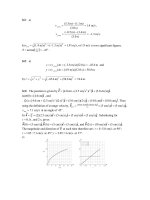
41.1:
2
34
34
2
sJ10054.1
sJ104.716
)1()1(
L
llllL
.40.20)1(
lll
41.2: a)
.2so,2
maxmax
zl
Lm
b)
.45.26)1( ll
c)
The angle is arccos
,
6
arccos
l
z
m
L
L
and the angles are, for
,0.90,1.114,7.144,2to2
ll
mm
.3.35,9.65
The angle corresponding to
lm
l
will always be larger for larger
.l
41.3:
.)1( llL
The maximum orbital quantum number
:ifSo.1
nl
5.199)200(199199200
49.19)20(191920
41.12)1(12
Lln
Lln
llLln
The maximum angular momentum value gets closer to the Bohr model value the
larger the value of
.
n
41.4: The
),(
l
ml
combinations are (0, 0), (1, 0),
)1,1(
, (2, 0),
),1,2(
),2,2(
(3, 0),
4),(4,and),3,4(),2,4(),1,4(),0,4(),3,3(),2,3(),1,3(
a total
of 25.
b) Each state has the same energy (
n
is the same),
eV.544.0
25
eV60.13
41.5:
J103.2
m100.1
C)1060.1(
4
1
.
4
1
18
10
219
0
21
0
πεr
πε
U
eV.4.14
eVJ1060.1
J103.2
19
18
41.6:
a) As in Example 41.3, the probability is
2/
0
2
0
2
322
3
22
1
422
4
4||
a
a
ar
s
e
araar
a
dr
πrψP
.0803.0
2
5
1
1
e
b) The difference in the probabilities is
.243.0)2)(25())25(1()51(
2112
eeee
41.7: a)
))((|)(||)(|||
222
ll
imim
*
AeAeθrRψψψ
,|)(||)(|
222
θrRA
which is independent of
b)
ππ
π
AπAdAd
2
0
2
2
0
22
.
2
1
12|)(|
41.8:
.)75.0(
22)4(
1
11
2
1
1212
22
4
2
0
EE
E
EEE
n
em
πε
E
r
n
a)
kg1011.9If
31
mm
r
2
29
234
49131
22
0
4
CNm10988.8
s)J10055.1(2
C)10kg)(1.602109.109
)4(
πε
em
r
eV.59.13J10177.2
18
For
12
transition, the coefficient is (0.75)(13.59 eV)=10.19 eV.
b) If
,
2
m
m
r
using the result from part (a),
eV.795.6
2
eV59.132
eV)59.13(
)4(
22
0
4
m
m
πε
em
r
Similarly, the
12
transition,
eV.095.5
2
eV19.10
c) If
,8.185 mm
r
using the result from part (a),
eV,2525
185.8
eV)59.13(
)4(
22
0
4
m
m
πε
em
r
and the
12
transition gives
(10.19 eV)(185.8)=1893 eV.
41.9: a)
21931
234
0
2
2
0
1
C)10kg)(1.60210109.9(
)sJ10626.6(
:
π
ε
πme
hε
amm
r
m10293.5
11
1
a
b)
.m10059.12
2
10
12
aa
m
m
r
c)
.m10849.2
185.8
1
m8.185
13
13
aam
r
41.10:
),sin()cos(
ll
im
mime
l
and to be periodic with period
πmπ
l
2,2
must be an
integer multiple of
l
mπ so,2
must be an integer.
41.11:
a
a
ar
s
drπre
πa
dVψaP
0
0
22
3
1
)4(
1
)(
.51)(
4422
4
422
44
)(
2
0
3
2
333
3
0
2
222
3
22
3
eaP
e
a
e
aaa
a
e
araar
a
drer
a
aP
a
arar
a
o
41.12: a)
,2b),eV102.32T)400.0)(TVe1079.5(
55
B
l
mBμE
the
lowest possible value of
.
l
m
c)
41.13: a)
4).3,2,1,,0(91)(2isstatesof#4state-
l
mllg
b)
.J1056.5eV1047.3)T600.0)(TVe1079.5(
2455
B
BμU
c)
eV1078.2)T600.0)(TVe1079.5(88
45
B44
BμU
.J1045.4
23
41.14:
a) According to Fig. 41.8 there are three different transitions that are consistent
with the selection rules. The initial
l
m
values are 0,
;1
and the final
l
m
value is 0.
b) The transition from
0to0
ll
mm
produces the same wavelength (122 nm)
that was seen without the magnetic field.
c) The larger wavelength (smaller energy) is produced from the
0to1
ll
mm
transition.
d) The shorter wavelength (greater energy) is produced from the
0to1
ll
mm
transition.
41.15: a)
B
B
,1,33
μ
U
BB
μUlnp
.T468.0
T)Ve10(5.79
eV)1071.2(
5
5
B
b) Three
.1,0
l
m
41.16: a)
B
m
e
U
22
)00232.2(
Bμ
B
2
)00232.2(
.eV1078.2
)T480.0)(TVe10788.5(
2
)00232.2(
5
5
b) Since n = 1, l = 0 so there is no orbital magnetic dipole interaction. But if
0
n
there could be since l < n allows for
.0
l
41.17:
BS
m
e
BU
zz
2
)00232.2(
.
2
where)00232.2(
)(
2
)00232.2(
BB
m
e
μBmμU
Bm
m
e
U
s
s
So the energy difference
2
1
2
1
)00232.2(
B
BμU
)T45.1)(TVe10788.5)(00232.2(
5
U
.eV1068.1
4
And the lower energy level is
).direction
ˆ
theinpointssince(
2
1
zBm
s
41.18: The allowed
),( jl
combinations are
.
2
5
,2and
2
3
,2,
2
3
,1,
2
1
,1,
2
1
,0
41.19:
j
quantum numbers are either
.4then,27and29ifSo,
2
1
or
2
1
ljll
The letter used to describe
is4
l
“g”
41.20: a)
λ
,cm21
eV)10(5.9
)sm10s)(300eV10136.4(
λ
6
815
c
f
E
hc
9
8
104.1
0.21m
)sm1000.3(
Hz, a short radio wave.
b) As in Example 41.6, the effective field is
for,T101.52
2
B
μEB
smaller
than that found in the example.
41.21: a) Classically
2
5
2
and,
mRIIωL
for a uniform sphere.
s.rad102.5
4
3
m)10(1.0kg)102(9.11
s)J105(1.054
4
3
2
5
4
3
5
2
30
21731
34
2
2
ω
mR
ω
RmωL
b)
.sm102.5)srad10(2.5m)10(1.0
133017
rωv
Since this is faster
than the speed of light this model is invalid.
41.22:
For the outer electrons, there are more inner electrons to screen the nucleus.
41.23: Using Eq. (41.27) for the ionization energy:
eV).(13.6
2
2
eff
n
Z
E
n
The
s5
electron sees
5and771.2
eff
nZ
eV.4.18eV)(13.6
5
(2.771)
2
2
5
E
41.24:
However the number of electrons is obtained, the results must be consistent with
Table (43-3); adding two more electrons to the zinc configuration gives
622
221 pss
.43433
210262
pdsps
41.25:
The ten lowest energy levels for electrons are in the n = 1 and n = 2 shells.
states.6:
2
1
,1,0,1,2
states.2:
2
1
,0,0,2
states.2:
2
1
,0,0,1
sl
sl
sl
mmln
mmln
mmln
41.26: For the
s4
state,
.26.2)6.13()339.4(4andeV339.4
eff
ZE
Similarly,
79.1
eff
Z
for the 4p state and 1.05 for the 4d state. The electrons in the states
with higher l tend to be further away from the filled subshells and the screening is more
complete.
41.27: a) Nitrogen is the seventh element (Z = 7).
2
N
has two electrons removed, so
there are 5 remaining electrons
electron configuration is
.221
22
pss
b)
eV30.6eV)(13.6
2
4)(7
eV)(13.6
2
2
2
2
eff
n
Z
E
c) Phosphorous is the fifteenth element (Z = 15).
2
P
has 13 electrons, so the
electron configuration is
.33221
2622
pspss
d) The least tightly held electron:
eV.13.6eV)(13.6
3
12)(15
2
2
E
41.28: a)
.26.1so,
4
e6.13
eff
2
eff2
ZZ
V
E
b) Similarly,
2.26.
eff
Z
c)
eff
Z
becomes larger going down the columns in the periodic table.
41.29: a) Again using
eV),(13.6
2
2
eff
n
Z
E
n
the outermost electron of the
L
Be
shell
(n = 2) sees the inner two electrons shield two protons so
2.
eff
Z
eV.13.6eV)(13.6
2
2
2
2
2
E
b) For
,Ca
outer shell has n = 4, so
eV.3.4eV)(13.6
4
2
2
2
4
E
41.30:
eV)(10.2)1(
2
ZE
kx
,0.28
eV10.2
eV107.46
1
3
Z
which corresponds to the element Nickel (Ni).
41.31: a)
Hz108.951)Hz)(2010(2.48:20
17215
fZ
m.103.35
Hz108.95
sm103.00
λ
keV3.71Hz)10(8.95s)eV10(4.14
10
17
8
1715
f
c
hfE
b) Z = 27:
m.101.79λ
keV6.96
Hz101.68
10
18
E
f
c)
m.105.47λkeV,22.7Hz,105.48:48
1118
EfZ
41.32: See Example 41.3;
)),2(2(,
22
2
2
/22
2
2
arrCe
dr
ψdr
eCr
ψr
arar
and for a
maximum, r = a, the distance of the electron from the nucleus in the Bohr model.
41.33: a)
2
4
2
0
1
2
0
2
4
2
0
1
2)4(
1
then),(.
4
1
)(and
2)4(
1
me
πε
rUEIf
r
e
πε
rU
me
πε
E
ss
a
me
πε
r
r
e
πε
2
24
)4(
1
2
2
0
2
0
b)
.
1
isand4)2(
/
3
22
2
1
2
2
1
ar
a
s
a
s
e
a
π
ψ
drrψπdVψarP
.
4
2
4
)2(
422
4
)2(
4
)2(
3
334
3
2
322
2
3
2
22
3
a
aae
a
arP
araar
e
a
arP
drer
a
arP
a
ar
a
ar
.238.013
4
e
41.34:
a) For large values of n
, the inner electrons will completely shield the nucleus, so
1
ff
e
Z
and the ionization energy would be
2
eV60.13
n
.
b)
m106.48m)10(0.529(350))350(,eV101.11
350
eV13.60
6102
0
2
350
4
2
ar
.
c) Similarly for n = 650,
650
5
2
,eV103.22
(650)
eV13.60
r
(0.529(650)
2
m.102.24m)10
510
41.35:
a) If normalized, then
.
4
4
8
1
2
32
4
14
0
2
43
2
3
2
2
0
3
2
0
2
2
0
2
2
dre
a
r
a
r
r
a
dre
a
r
r
πa
π
I
drr
ψπdVψ
ar
ar
ss
But recall
0
1
.
!
n
axn
n
dxex
So
5
2
4
3
)24(
1
)6(
4
)2(4
8
1
3
a
a
a
a
a
a
I
.normalizedisand124248
8
1
2
333
3
s
ψaaa
a
I
b) We carry out the same calculation as part (a) except now the upper limit on the
integral is 4a, not infinity.
So
.44
8
1
4
0
2
43
2
3
dre
a
r
a
r
r
a
I
ar
a
Now the necessary integral formulas are:
)2424124(
)663(
)22(
54322344
332233
3222
araarararedrer
araararedrer
araaredrer
arar
arar
arar
All the integrals are evaluated at the limits
0
r
and
.4a
After carefully plugging in the
limits and collecting like terms we have:
)]824568104()24248[(
8
1
43
3
ea
a
I
).4(Prob176.0)3608(
8
1
4
areI
41.36: a) Since the given
.||real,is)(
2222
ψrψrrψ
The probability density will be an
extreme when
.022)(
2222
dr
d
ψ
rψrψ
dr
ψ
ψ
rrψψr
dr
d
This occurs at
,0
r
a minimum, and when
,0
ψ
also a minimum. A maximum must
correspond to
.0
dr
d
ψ
rψ
Within a multiplicative constant,
,)22(
1
,)2()(
22 arar
ear
a
dr
dψ
earrψ
and the condition for a maximum is
.046or),22()()2(
22
ararararar
The solutions to the quadratic are
).53( ar
The ratio of the probability densities at
these radii is 3.68, with the larger density at
.2at0)).53( arψbar
Parts (a)
and (b) are consistent with Fig.(41.4); note the two relative maxima, one on each side of
the minimum of zero at
.2ar
41.37: a)
.arccos
L
L
θ
z
L
This is smaller for
LL
z
and
as large as possible. Thus
1and1 nlmnl
l
.
)1(
1
arccos
1)(1)(and)1(
nn
n
θ
nnllLnmL
L
lz
b) The largest angle implies
)1(,1 nlmnl
l
.)11(arccos
)1(
)1(
arccos
n
nn
n
θ
L
41.38: a)
.)1(so)1(
2222222222
lyxlzyx
mllLLmllLLLL
b) This is the magnitude of the component of angular momentum perpendicular to the
z
-axis. c) The maximum value is
,)( L1ll
when
.0
l
m
That is, if the electron is
known to have no
z
-component of angular momentum, the angular momentum must be
perpendicular to the
z
-axis. The minimum is
l
when
.lm
l
41.39:
ar
er
a
rP
24
5
24
1
)(
ar
e
a
r
r
a
dr
dP
2
4
3
5
)4(
24
1
,4;04when0
4
3
ar
a
r
r
dr
dP
In the Bohr model,
,4so
2
2
aranr
n
which agrees.
41.40:
The time required to transit the horizontal 50 cm region is
ms.952.0
sm525
m500.0
x
v
x
t
The force required to deflect each spin component by 0.50 mm is
N.1098.1
)s10952.0(
)m1050.0(2
molatoms10022.6
molkg1079.02
22
23
3
232
zz
t
z
mmaF
According to Eq. 41.22, the value of
z
μ
is
.mA1028.9||
224
z
μ
Thus, the required magnetic-field gradient is
m.T3.21
TJ1028.9
N1098.1
24
22
z
zz
μ
F
dz
dB
41.41: Decay from a
d3
to
p2
state in hydrogen means that
l
mnn and23
.0,10,1,2
l
m
However selection rules limit the possibilities for decay. The
emitted photon carries off one unit of angular momentum so
l
must change by 1 and
hence
l
m
must change by 0 or
.1
The shift in the transition energy from the zero field
value is just
)(
2
)(
2323
B llll
mm
m
Be
B
μmmU
where
3
l
m
is the
l
md3
value and
2
l
m
is the
l
mp2
value. Thus there are only three
different energy shifts. They and the transitions that have them, labeled by
,
m
are:
12,01,10:
2
11,00,11:0
10,01,12:
2
m
Be
m
Be
41.42: a) The energy shift from zero field is
0B0
,2For. UmBmU
ll
eV.108.11T)(1.40T)Ve1079.5(
)1(,1For.eV101.62T)40.1()TVe1079.5()2(
55
0
45
Um
l
b)
,λ|λ|
0
||
0
E
E
where
R
E
1
5
36
00
λ)),91()41((eV6.13(
(a).partfromeV1009.8eV1011.8eV1062.1andm10563.6
5547
E
Then,
nm0281.0m1081.2|λ|
11
. The wavelength corresponds to a larger
energy change, and so the wavelength is smaller.
41.43: From Section 38.6:
.
)(
0
1
01
kTEE
e
n
n
We need to know the difference in energy
between the
2
1
s
m
and
.00232.2states.
2
1
B
BmμBμUm
szs
So
BμUU
B
00232.2
2
1
2
1
kTBμ
B
e
n
n
)00232.2(
21
21
B
e
e
)T10482.4(
K)(300K)J10(1.381T)BJ10(9.274(2.00232)
13
2324
a)
.9999998.0T1000.5
21
21
5
n
n
B
b)
9978.0T500.0
21
21
n
n
B
c)
978.0T00.5
21
21
n
n
B
41.44
Using Eq. 41.4
,)1( llmvrL
and the Bohr radius from Eq. 38.15, we obtain the following value for
v
s.m1074.7
)m1029.5()4(kg)10(9.112
s)J1063.6(2
)(
)1(
5
1131
34
0
2
πanm
ll
v
The magnetic field generated by the “moving” proton at the electrons position can be
calculated from Eq. 28.1
T.277.0
m)1029.5()4(
)sin(90s)m10(7.74C)1060.1(
A)mT10(
sin||
4
2112
519
7
2
0
A
r
vq
π
μ
B
41.45:
s
m
can take on 4 different values:
.,,,
2
3
2
1
2
1
2
3
s
m
Each
l
nlm
state can
have 4 electrons, each with one of the four different
s
m
values.
a) For a filled
1
n
shell, the electron configuration would be
;s1
4
four electrons
and
.4
Z
For a filled
2
n
shell, the electron configuration would be
;2p2ss1
1244
twenty electrons and
.20
Z
b) Sodium has
;11
Z
11 electrons. The ground-state electron configuration would
be
.2p2s1s
344
41.46: a)
eV.666eV)6.13((7)eV)6.13(
22
Z
b)
The negative of the result of
part (a), 666 eV. c) The radius of the ground state orbit is inversely proportional to the
nuclear charge, and
m.107.567m)10529.0(
1210
Z
a
d)
,
)(
λ
22
2
1
1
1
0
E
hc
E
hc
where
0
E
is the energy found in part (b), and
nm.49.2λ
41.47:
a) The photon energy equals the atom’s transition energy. The hydrogen atom
decays from
1,to2
nn
so:
m.101.22
J101.63
s)m10(3.00s)J10(6.33
λ
J1063.1
eV)J10(1.60eV)2.10(
)1(
1
(2)
1
eV60.13
7
18
834-
18
19
22
E
hc
E
b) The change in an energy level due to an external magnetic field is just
.
B
BμmU
l
The ground state has
,0
l
m
and it is not shifted. The n = 2 state has
,1
l
m
so it is
shifted by
J1004.2
)T(2.20)TJ10274.9()1(
23
24
U
and since
m.101.53
J101.63
J102.04
m)1022.1(
λλ
λ
λ
12
18
23
7
E
E
E
E
Since the n = 2 level is lowered in energy (brought closer to the n =
1 level) the change in
energy is less, and the photon wavelength increases due to the magnetic field.
41.48:
The effective field is that which gives rise to the observed difference in the energy
level transition,
.
λλ
λλ
2
λλ
λλ
21
21
21
21
BB
e
πmc
μ
hc
μ
E
B
Substitution of numerical values gives
,T1064.3
3
B
much smaller than that for
sodium.
41.49:
a) The minimum wavelength means the largest transition energy. If we assume
that the electron makes a transition from a high shell, then using the screening
approximation outlined in Section 41.5, the transition energy is approximately the
ionization energy of hydrogen. Then
eV).6.13()1(
2
1
ZEE
For vanadium, Z = 23.
m.1089.1
J1005.1
)sm1000.3(s)J1063.6(
λ
J101.05eV1058.6
10
15
834
153
E
hc
E
For the longest wavelength, we need the smallest transition energy, so this is the
12
nn
transition
).(
K
So we use Moseley’s Law:
m.1050.2λ
Hz101.201)(23Hz)1048.2(
10
18215
f
c
f
b) The rhenium, Z = 45, the minimum wavelength is
m.1072.4λ
)eVJ10(1.60eV)6.13()44(
)sm10(3.00s)J1063.6(
)eV6.13()1(
λ
11
192
834
2
Z
hc
The maximum wavelength is
215
8
1)(45Hz)1048.2(
)sm1000.3(
λ
f
c
m.1025.6λ
11
41.50: a)
.
λ
2
λ
)00232.2(
B
e
πmc
B
hc
B
m
e
SB
μE
Z
b)
T.307.0
C)10(1.60m)(0.0350
)sm10(3.00kg109.112
19
831
π
B
41.51: a) To calculate the total number of states for the
th
n
principle quantum number
shell we must multiply all the possibilities. The spin states multiply everything by 2. The
maximum l value is (n –1), and each l value has
l
ml )12(
values.
So the total number of states is
.2
222
2
)()1(4
2
412)12(2
2
2
1
0
1
0
1
0
nN
nnn
nn
n
llN
n
l
n
l
n
l
b) The n = 5 shell (O-shell) has 50 states.
41.52:
a)
Apply Coulomb’s law to the orbiting electron and set it equal to the centripetal
force. There is an attractive force with charge +2e a distance r
away and a repulsive force
a distance 2r away. So,
.
)2(4
)()(
4
)()2(
2
2
0
2
0
r
mv
r
ee
r
ee
But, from the quantization of angular momentum in the first Bohr orbit,
vmvrL
So
3
2
2
2
2
0
2
2
0
2
)4(44
2
mrr
m
r
mv
r
πε
e
r
πε
e
mr
2
2
0
3
2
0
2
2
4
7
4
4
4
7
me
πε
r
mr
πε
r
e
m.103.02m)10529.0(
7
4
7
4
1110
0
a
And
.sm1083.3
m)10kg)(0.52910(9.11
s)J10054.1(
4
7
4
7
6
1031
34
0
mamr
v
b)
eV.5.83J1034.1)sm10(3.83kg1011.9
2
1
2
1726312
mvKE
c)
)2(44
4
)2(44
2
2
0
2
0
2
0
2
0
2
rπE
e
r
πε
e
r
πε
e
r
πε
e
PE
eV.166.9J1067.2
42
7
17
0
2
rπε
e
d)
eV,83.4eV]83.5eV9.166[
E
which is only off by about 5% from the
real value of 79.0 eV.
41.53: The potential
2
2
1
)(
xkxU
is that of a simple harmonic oscillator. Treated
quantum mechanically (see Section 40.4) each energy state has energy
).(
2
1
nωE
n
Since electrons obey the exclusion principle, this allows us to put two electrons (one for
each
)
2
1
s
m
for every value of neach quantum state is then defined by the ordered
pair of quantum numbers
).,(
s
mn
By placing two electrons in each energy level the lowest energy is then
.
][
22
)()1(
2
2
1
2
2
1
22
22
2
1
0
1
0
1
0
1
0
m
k
NwN
NNNw
NNN
w
nwnwE
N
n
N
n
N
n
N
n
n
Here we used the hint from Problem 41.51 to do the first sum, realizing that the first
value of n is zero and the last value of n is N – 1, giving us a total of N energy levels
filled.
41.54:
a) The radius is inversely proportional to Z, so the classical turning radius is
.2 Za
b) The normalized wave function is
arZ
s
e
Z
πa
rψ
33
1
1
)(
and the probability of the electron being found outside the classical turning point is
.
4
4
22
22
33
2
2
1
drre
Za
dr
πrψP
aZr
ZaZa
s
Making the change of variable
duZadraZru )(,
changes the integral to
,4
22
2
duueP
u
which is independent of Z. The probability is that found in Problem 41.33, 0.238,
independent of
Z.