17. ĐỀ SỐ 12
Bạn đang xem bản rút gọn của tài liệu. Xem và tải ngay bản đầy đủ của tài liệu tại đây (122.76 KB, 18 trang )
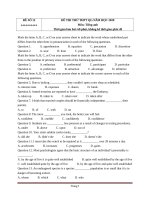
ĐỀ SỐ 12
ĐỀ THI THỬ THPT QG NĂM HỌC 2020
Môn: Tiếng anh
Thời gian làm bài: 60 phút, không kể thời gian phát đề
Mark the letter A, B, C, or D on your answer sheet to indicate the word whose underlined part
differs from the other three in pronunciation in each of the following questions.
Question 1.
A. apprehension
B. equation
C. precaution
D. discretion
Question 2.
A. sour
B. hour
C. pour
D. flour
Mark the letter A, B, C, or D on your answer sheet to indicate the word that differs from the other
three in the position of primary stress in each of the following questions.
Question 3.
A. enthusiast
B. preferential
C. participant
D. particular
Question 4.
A. preference
B. attraction
C. advantage
D. infinitive
Mark the letter A, B, C, or D on your answer sheet to indicate the correct answer to each of the
following questions.
Question 5. Due to lacking ___________, they couldn’t open a new shop as scheduled.
A. interest rates
B. expenses
C. shares
D. funds
Question 6. Armed terrorists are reported to have ___________ the Embassy.
A. taken up
B. taken to
C. taken over
D. taken after
Question 7. I think that married couples should be financially independent ___________ their
parents.
A. to
B. of
C. with
D. on
Question 8. The more ___________ you look, the better you will feel.
A. confident
B. confide
C. confidently
D. confidence
Question 9. Students are ___________ less pressure as a result of changes in testing procedures.
A. under
B. above
C. upon
D. out of
Question 10. Your sister seldom cooks meals,___________?
A. did she
B. didn’t she
C. does she
D. doesn’t she
Question 11. I must take this watch to be repaired as it ___________ over 20 minutes a day.
A. accelerates
B. increases
C. progresses
D. gains
Question 12. Most psychologists agree that the basic structure of an individual’s personality is
__________.
A. by the age of five it is quite well established
B. quite well established by the age of five
C. well established quite by the age of five
D. by the age of five and quite well established
Question 13. An endangered species is a species __________ population is so small that it is in
danger of becoming extinct.
A. whose
B. which
C. what
D. who
Trang 1
Question 14. The film __________ by the time we __________ to the cinema.
A. had already started/got
B. already started/ had gotten
C. had already started/had gotten
D. has already started/ got
Question 15. __________ they are delicious, hamburgers and French fries are too high in fat.
A. However
B. Although
C. Because
D. Despite
Question 16. __________ me to your mother when you are in New York.
A. Tell
B. Remind
C. Remember
D. Greet
Question 17. He may be shy now, but he will soon come out of his __________ when he meets
the right girl.
A. shoe
B. hole
C. shed
D. shell
Question 18. Students will not be allowed into the exam room if they __________ their student
cards.
A. don’t produce
B. didn’t produce
C. produced
D. hadn’t produced
Mark the letter A, B, C, or D on your answer sheet to indicate the word(s) CLOSEST in meaning
to the underlined word(s) in each of the following questions.
Question 19. When our rent increased from $100 to $200 a month, we protested against such a
tremendous increase.
A. light
B. huge
C. tiring
D. difficult
Question 20. The government decided to pull down the old building so that a hospital could be
built.
A. renovate
B. purchase
C. maintain
D. demolish
Mark the letter A, B, C, or D on your answer sheet to indicate the word(s) OPPOSITE in
meaning
to the underlined word(s) in each of the following questions.
Question 21. It was necessary to divide the movie ‘Roots’ into five parts in order to show it on
television.
A. adapt
B. merge
C. segment
D. transact
Question 22. That is a well-behaved girl whose behaviour has nothing to complain about.
A. good behavior
B. behaving improperly
C. behaving nice
D. behaving cleverly
Mark the letter A, B, C, or D on your answer sheet to indicate the option that best completes each
of the following exchanges.
Question 23. - Mai: “Oops! I’m sorry for stepping on your foot.”
-Hoa: “___________.”
A. Never mind
B. You don’t mind
C. You’re welcome
D. That’s fine
Question 24. - Mary: “Make yourself at home”.
Trang 2
- David: “_______________”
A. That’s very kind of you. Thank you
B. Thanks! The same to you!
C. Not at all. Don’t mention it
D. Yes, can I help you?
Read the following passage and mark the letter A, B, C, or D on your answer sheet to indicate the
correct word or phrase that best fits each of the numbered blanks from 25 to 29.
The story of gold is an adventure involving kings, queens, pirates, explorers, conquerors, and the
native peoples they conquered. Throughout history, gold has woven a magic spell over those it
touched. Gold is beautiful and rare; a soft shiny metal that can be moulded into many
(25)__________. It has been used for money, jewelry, and to decorate special buildings such as
palaces and places of worship. (26)__________ the precious metal was discovered, prospectors
rushed to mine it, starting new cities and countries as they went. Gold and the people who love it
have helped shape the world we live (27)__________ today. Gold is one of many elements, or
substances that cannot be changed by normal chemical means, that are found in the Earth’s crust.
Gold has a warm, sunny colour and (28)__________ it does not react with air, water, and most
chemicals, its shine never fades. In its natural (29)__________, gold is soft and easily shaped.
When heated to 1,062 Celsius it melts and can be poured into moulds to form coins, gold bars,
and other objects. Stories have been told, movies made and legends bom about the discovery of
the world’s great gold deposits. It is a saga of dreams, greed, ambition and exploration.
Question 25.
A. formats
B. outlines
C. shapes
D. lines
Question 26.
A. Whoever
B. However
C. Forever
D. Wherever
Question 27.
A. at
B. in
C. for
D. on
Question 28.
A. yet
B. despite
C. because
D. so
Question 29.
A. estate
B. stage
C. state
D. position
Read the following passage and mark the letter A, B, C, or D on your answer sheet to indicate the
correct answer to each of the questions from 30 to 34. The Hindu culture celebrates marriage as a
pure and pristine rite enabling two individuals start their journey of life together. It puts emphasis
on the values of happiness, harmony and growth and could be traced back from the Vedic times.
Months before the wedding ceremony, an engagement is held which is called “magni”. The
couple is blessed here with gifts, jewelry and clothes. Another important ritual is the “mehendi”
which is a paste made from the leaves of henna plant. It is the traditional art of adorning the
hands and the feet of the bride with mehendi and the name of the groom is also hidden in the
design. On the day of marriage, the couple exchanges garlands as a gesture of acceptance of one
another and a pledge to respect one another as partners which is known as “jaimala”. This is
followed by “kanyadaan”, where the father of the bride places her hand in the groom’s hand
requesting him to accept her as an equal partner.
Another ritual is the “havan” in which the couple invokes Agni, the god of Fire, to witness their
Trang 3
commitment to each other. Crushed sandalwood, herbs, sugar rice and oil are offered to the
ceremonial fire. The “gath bandhan” takes place where scarves of the bride and groom are tied
together symbolizing their eternal bond. This signifies their pledge before God to love each other
and remain loyal. The couple then takes four “mangal pheras” or walk around the ceremonial
fire, representing four goals in life: “Dharma”, religious and moral duties; “Artha”, prosperity;
“Kama” earthly pleasures; “Moksha”, spiritual salvation.
The couple also takes seven steps together to begin their journey, called the “saptapardi”. Then
the ritual of “sindoor” takes place where the groom applies a small dot of vermilion, a red
powder to the bride’s forehead and welcomes her as his partner for life. This signifies the
completion of the marriage. The parents of the bride and the groom then give their blessings,
“ashirwad” to the newly wed couple as they touch the feet of their parents.
Question 30. What might be the most suitable title for this reading passage?
A. The Hindu culture
B. The Hindu religion
C. The Hindu wedding
D. The Hindu tradition
Question 31. What do the Hindu people think about marriage?
A. It is entirely a spiritual traditional ritual allowing two individuals to live together.
B. It is a belief in the growth of a family newly formed by two individuals.
C. It is a wish of happiness and harmony to come to two individuals.
D. It is just a living-together announcement of two individuals.
Question 32. What can the word “adorning” be best replaced by?
A. decorating
B. painting
C. repairing
D. dying
Question 33. Why does the couple exchange garlands?
A. to do a ritual
B. to show both their acceptance of and the swear to respect the partner
C. to express their acceptance of one another and a wish of happiness
D. to express their vow to respect each other for the whole life
Question 34. When is the wedding ceremony completed?
A. When the parents of the bride and the groom give their blessings to the couple.
B. When the couple touches their parents’ feet.
C. When the couple makes seven steps together.
D. When the groom applies a small dot of vermillion of the bride’s forehead.
Read the following passage and mark the letter A, B, C, or D on your answer sheet to indicate the
correct answer to each of the questions from 35 to 42.
The concept of urban agriculture may conjure up images of rooftop, backyard or community
gardens scattered among downtown city streets and surrounding neighborhoods. But in the
Seattle area, and within and beyond the Puget Sound region, it means a great deal more. “Urban
Trang 4
agriculture doesn’t necessarily equate to production that occurs only in a metropolitan urban
area, “says Jason Niebler, who directs the Sustainable Agriculture Education (SAgE) Initiative at
Seattle Central Community College. “It means we are providing for growing population food
needs from surrounding rural landscapes, as well as from the core urban landscape.”
Picture a series of concentric circles, with an urban core that produces some food at varying
capacities, surrounded by a series of outlying rings of small farms that become increasingly more
rural with distance. The hope is that such land use planning, from the inner core to the outer
rings, will encourage local ecologically sound sustainable food production. This, in turn, will
create local jobs and decrease reliance on distant food products that originate from petroleumintensive large scale farms.
That’s the idea behind SAgE, believed to be the nation’s first metropolitan-based community
college sustainable agriculture program that emphasizes farming practices across diverse
landscape types from urban centers to surrounding rural environs. “It’s small scale agriculture
with an urban focus,” Niebler says. “Any urban population, large or small, can practice
sustainable agriculture, improve food security and protect the environment, which ultimately
results in resilient food systems and communities.” SAgE is a part of National Science
Foundation’s Advanced Technological Education (ATE) Program, which is providing the project
with $157,375 over two years. ATE’s goal is to support projects that strengthen the skills of
technicians who work in industries regarded as vital to the national’s prosperity
and security. The support largely goes to community colleges that work in partnership with
universities, secondary schools, businesses and industries, as well as government agencies,
which design and implement model workforce initiatives. The SAgE project focuses on the
environmental, socioeconomic, political and cultural issues related to
sustainable food systems, within Puget Sound watersheds through student and community
education and research, and technological innovation. The curriculum offers courses that cover
such issues as agricultural ecology, urban food systems, food politics and ethics, soil science,
sustainable food
production and technology, the integration of food and forests, and career opportunities.
“We’ve created a curriculum that is fundamental in nature, addressing the principles of
sustainable agriculture and what a food system is - how it functions both locally and globally,”
Niebler says. “These courses are challenging, robust and inspirational. One of the really
wonderful things about them is that we offer service learning opportunities, where students
volunteer a portion of their time to working with local partner organizations. They can do a
research project, or a service learning option. The ideal would be to prompt students into careers
that involve sustainable practices in an urban agriculture setting.”
(‘‘Promoting Sustainable Agriculture ” by Mariene Cimons)
Trang 5
Question 35. It is stated in the passage that Jason Niebler ___________.
A. preserves the core urban landscape
B. provides food for Seattle’s population
C. studies at Seattle Central Community College
D. directs the SAgE Initiative
Question 36. It can be inferred from the passage that the conventional idea of urban agriculture
___________
A. focuses mainly on agriculture within and beyond the Puget Sound region
B. aims at food production and consumption in both rural and urban regions
C. is associated with production only in metropolitan urban areas.
D. concerns with food production in any city’s surrounding areas
Question 37. The word “concentric” in paragraph 2 is closest in meaning to ___________.
A. coming from different places
B. having the same size
C. going in different directions
D. having the same center
Question 38. Which of the following is supposed to be an outcome of the SAgE’s new land use
planning?
A. dependence on distant food products
B. increased food production in large scale farms
C. employment opportunities for local residents
D. modernized farming practices in rural environs
Question 39. The curriculum of SagE at Seattle Central Community College offers courses
covering the following EXCEPT ___________.
A. agricultural ecology
B. career opportunities
C. urban system development
D. integration of food and forests
Question 40. In Niebler’s opinion, the courses offered by the SAgE project are ___________.
A. functional but impractical
B. robust but unpromising
C. challenging and costly
D. hard but encouraging
Question 41. The word “them” in paragraph 6 refer to ____________.
A. courses
B. opportunities
C. principles
D. students
Question 42. Which of the following is NOT true according to the passage?
A. The curriculum that the SAgE project designs is fundamental in nature.
B. The SAgE project alone will offer student sufficient jobs in urban agriculture.
C. ATE helps to improve the skill of technicians in the nation major industries.
D. Resilient food systems can be attributed to sustainable agricultural practices.
Mark the letter A, B, C, or D on your answer sheet to indicate the underlined part that needs
correction in each of the following questions.
Trang 6
Question 43. Digital clocks, however precise, (A) they cannot be (B) perfectly accurate because
(C) the earth’s rotation changes (D) slightly over years.
Question 44. (A) Alike other forms of energy, natural gas (B) may be used to (C) heat homes,
cook food, and even (D) run automobiles.
Question 45. The number (A) of homeless people in Nepal (B) have increased sharply (C) due to
the recent (D) severe earthquake.
Mark the letter A, B, C, or D on your answer sheet to indicate the sentence that is closest in
meaning to each of the following questions.
Question 46. He survived the operation thanks to the skillful surgeon.
A. He survived because he was a skillful surgeon.
B. He wouldn’t have survived the operation without the skillful surgeon.
C. There was no skillful surgeon, so he died.
D. Though the surgeon was skillful, he couldn’t survive the operation.
Question 47. No one has sent me that letter.
A. I haven’t been sent that letter.
B. I wasn’t sent that letter.
C. That letter hasn’t been sent me.
D. That letter has sent to me by no one.
Question 48. “Please don’t leave until I come back,” Sarah said.
A. Sarah told us do not leave until she comes back.
B. Sarah asked us do not leave until she came back.
C. Sarah told us not to leave until she came back.
D. Sarah said to us not to leave until she comes back.
Mark the letter A, B, C, or D on your answer sheet to indicate the sentence that best combines
each pair of sentences in the following questions.
Question 49. The basketball team knew they lost the match. They soon started to blame each
other.
A. Hardly had the basketball team known they lost the match when they started to blame each
other.
B. Not only did the basketball team lose the match but they blamed each other as well.
C. No sooner had the basketball team started to blame each other than they knew they lost the
match.
D. As soon as they blamed each other, the basketball team knew they lost the match.
Question 50. He wasn’t wearing a seat-belt. He was injured.
A. If he hadn’t been wearing a seat-belt, he wouldn’t have been injured.
B. If he had been wearing a seat-belt, he would have been injured.
C. If he had been wearing a seat-belt, he wouldn’t be injured.
D. If he had been wearing a seat-belt, he wouldn’t have been injured.
Trang 7
Đáp án
1-B 2-C 3-B 4-A 5-D 6-C 7-B 8-A 9-A 10-C
11-D 12-B 13-A 14-A 15-B 16-C 17-D 18-A 19-B 20-D
21-B 22-B 23-A 24-A 25-C 26-D 27-B 28-C 29-C 30-C
31-A 32-A 33-B 34-D 35-D 36-C 37-D 38-C 39-C 40-D
41-A 42-B 43-A 44-A 45-B 46-B 47-A 48-C 49-A 50-D
LỜI GIẢI CHI TIẾT
Question 1: Đáp án B
- apprehension /ˌæprəˈhenʃn/ (n): sự e sợ, sự lo lắng
- equation /ɪˈkweɪʒnn̩/ (n): phương trình (tốn học)
- precaution /priˈkɒʃn/ (n): sự phòng ngừa, sự đề phòng
- discretion /ˌdɪˈskreʃn/ (n): sự tự do làm theo ý mình, sự thận trọng
Question 2: Đáp án C
- sour /ˈsaʊər/ (adj): chua - hour /ˈaʊər/ (n): giờ, tiếng (đồng hồ)
pour /ˈpɔːr/ (v): đổ, rót, trút - flour /ˈflaʊər/ (n): bột mỳ
Question 3: Đáp án B
- enthusiast /enˈθuːziˌæst/ (n): người say mê, người có nhiệt tình
- preferential /ˌprefəˈrentʃl/ (n): được ưu đãi, ưu tiên
- participant /parˈtɪsəpənt/ (n): người tham gia, người tham dự
- particular /pərˈtɪkjələr/ (n): đặc biệt, cá biệt
Question 4: Đáp án A
- preference /ˈprefərəns/ (n): sự u thích hơn
- attraction /əˈtrỉkʃn/ (n): sự hấp dẫn, sự thu hút
- advantage /ædˈvæntɪdʒ/ (n): thuận lợi
- infinitive /ˌɪnˈfɪnətɪv/ (adj): nguyên thể, vô định (ngôn ngữ học)
Question 5: Đáp án D
A. interest rates: lãi suất
B. expenses: chi tiêu, phí tổn
C. shares: cổ phần
D. funds: quỹ, ngân quỹ, vốn
- funds: money available/ needed to spend on sth: vốn
Dịch: Vì thiếu vốn nên họ khơng thể mở được cửa hiệu mới như lịch trình.
Question 6: Đáp án C
- take up something: bắt đầu học, theo tập cái gì, bắt đầu một sở thích gì đó
- take to: trốn, chạy trốn; bắt đầu thích ai đó/cái gì đó,...
- take over: giành quyền kiểm soát, tiếp quản
- take after: giống ai
Dịch: Người ta báo cáo rằng bọn khủng bố vũ trang đã giành quyền kiếm soát Đại sứ quán.
Trang 8
Question 7: Đáp án B
- independent of sb/ sth: độc lập, không phụ thuộc vào
Dịch: Tôi nghĩ rằng các cặp đơi đã kết hơn khơng nên phụ thuộc tài chính vào bố mẹ mình.
NOTE 24:
* Một số tính từ kèm giới từ:
accustomed to
addicted to
afraid of
anxiou about
bored of
capable of
committed to
concerned about
content with
dedicated to
devoted to
disappointed with
discouraged by
excited
famous for
fond of
frightened of
guilty of
happy about
interested in
involved in
known for
opposed to
proud of
remembered for
responsible for
scared of
terrified of
tired from
tired of
worried about
He is accustomed to having his own office.
She is addicted to watching TV
She is afraid of speaking in public.
Norma is anxious about making the presentation.
I am bored of doing the same old job.
He is capable of winning a gold medal.
She is committed to improving her English.
Nancy was concerned about being late.
Tim is content with winning second place.
The organization is dedicated to ending poverty.
The money will be devoted to protecting the environment.
Fiona was disappointed with coming in third place.
He was discouraged by not getting the job.
about The researcher was excited about going to Africa.
That actor is famous for being extremely weird.
She is fond of having picnics.
She is frightened of being alone at night.
The banker was guilty of stealing money.
He was happy about winning the lottery.
She is interested in becoming a doctor.
He was involved in making the movie.
She was known for causing problems.
They are opposed to building a new road in the park.
He was proud of having completed the marathon.
She is remembered for protecting mountain gorillas.
He is responsible for causing the damage.
Tina is scared of being alone at night.
The surfer is terrified of being attacked by a shark.
She is tired from working all day.
Margaret is tired of making dinner every night.
The hikers were worried about not having enough water.
Question 8: Đáp án A
- confident (adj): tự tin
- confidently (adv): một cách tự tin
- confidence (n): sự tự tin
- confide (v): giãi bày tâm sự
Trang 9
Cấu trúc so sánh kép: The + hình thức so sánh hơn + S + V, the + hình thức so sánh hơn + S + V
(càng
...càng)
Trong câu này phía sau chủ ngữ “you” là động từ “look” nên phía trước chúng ta chọn tính từ
“confident”
Nhận xét: Sau các linking verbs (động từ liên kết) như to be, become, get, look, taste, smell, feel,
… thì chúng ta sử dụng tính từ
Question 9: Đáp án A
Cấu trúc: under pressure: chịu áp lực/ sức ép, buộc phải làm gì đó
Dịch: Những học sinh đang chịu ít áp lực hơn do những thay đổi trong phương thức kiểm tra.
Question 10: Đáp án C
- Mệnh đề đầu ở thì hiện tại đơn nên phần hỏi đi cũng ở thì hiện tại đơn => loại A, B
- Mệnh đề đầu có trạng từ tần suất “seldom” mang nghĩa phủ định nên phần hỏi đuôi dùng khẳng
định
Dịch: Chị bạn hiếm khi nấu ăn, có phải khơng?
Question 11: Đáp án D
- accelerate (v): tăng nhanh hơn, mau hơn
- increase (v): tăng
- progress (v): phát triển, tiến triển, tiến bộ
- gain (v): nhanh lose : chậm (dùng cho đồng hồ)
Dịch: Tôi phải đưa chiếc đồng hồ này đi sửa vì nó chạy nhanh hơn 20 phút một ngày.
Question 12: Đáp án B
- quite + adj/ adv: khá, hơi
- to be + quite + adj
- well established (adj): được thiết lập, ổn định, được củng cố, có uy tín
Dịch: Hầu hết các nhà tâm lý học đều đồng tình rằng cấu trúc cơ bản về nhân cách của một cá
nhân thì khá ổn định khi lên 5 tuổi.
Question 13: Đáp án A
- whose: đại từ quan hệ thay thế cho tính từ sở hữu trước danh từ đó
- which: đại từ quan hệ thay thế cho chủ ngữ hoặc tân ngữ chỉ vật
- who: đại từ quan hệ thay thế cho chủ ngữ/ tân ngữ chỉ người
- what: dùng trong mệnh đề danh từ
Trong câu này, đại từ quan hệ cần điền vào là “whose” để thay thế cho tính từ sở hữu.
Dịch: Lồi có nguy cơ tuyệt chủng là lồi mà dân số của nó q ít đến nỗi mà có nguy cơ bị tuyệt
chủng.
Question 14: Đáp án A
Trang 10
Câu này có nghĩa: Bộ phim đã được chiếu trước khi chúng tôi đến rạp chiếu phim.
Hành động “start” xảy ra trước hành động “get to the cinema” => vế trước dùng thì q khứ
hồn thành; vế sau dùng thì quá khứ đơn
Question 15: Đáp án B
- However: Tuy nhiên
- Although + a clause: Mặc dù ... nhưng
- Because + a clause: Bởi vì...
- Despite/ In spite of + Ving/ N: Mặc dù ... nhưng → A, C không phù hợp nghĩa, D sai ngữ pháp
Dịch: Mặc dù hăm-bơ-gơ và khoai tây chiên thì ngon nhưng chúng quá nhiều chất béo.
Question 16: Đáp án C
- tell (v): bảo, kể
- remind (v): nhắc nhở
- remember (v): nhớ
remember me to sb: be used to ask somebody to give your good wishes to somebody else: gửi lời
chào, gửi lời hỏi thăm
- greet (v): chào
Dịch: Nhớ gửi lời hỏi thăm của tôi tới mẹ bạn khi bạn ở New York nhé.
Question 17: Đáp án D
- Come of one’s shell: bớt nhút nhát và bắt đầu hịa đồng hơn, đỡ ngại (thành ngữ)
Dịch: Có thể bây giờ anh ấy còn nhút nhát, nhưng chẳng bao lâu nữa anh ấy sẽ đỡ ngại hơn khi
gặp một cơ gái thích hợp.
Question 18: Đáp án A
Cấu trúc câu điều kiện loại 1: If + S + V (present tense)...., S + will + V bare-inf... (điều kiện có
thể xảy ra ở hiện tại hoặc tương lai)
Question 19: Đáp án B
- tremendous (adj): to lớn - light (adj): nhẹ
- huge(adj): to lớn, vĩ đại - tiring (adj): mệt mỏi
- difficult (adj): khó khăn
Dịch: Khi tiền thuê nhà tăng từ 100 đơ la lên 200 đơ la một tháng thì chúng tôi phản đối việc
tăng mạnh như thế.
Question 20: Đáp án D
- renovate (v): đổi mới, cải tiến - purchase (v): mua
- maintain (v): duy trì - demolish (v): phá hủy, đánh đổ
- pull down: kéo xuống, phá đổ
Dịch: Chính phủ quyết định phá tòa nhà cũ để xây một bệnh viện.
Question 21: Đáp án B
Trang 11
- divide (v): phân chia, chia
- adapt (v): phỏng theo, sửa lại cho thích hợp, thích nghi
- merge (v): kết hợp, gộp lại
- segment (v): cắt ra/ chia ra nhiều phần khác nhau
- transact (v): làm kinh doanh
Vậy: divide merge
Dịch: Rất cần thiết phải chia bộ phim “Roots” thành 5 phần để chiếu lên ti-vi.
Question 22: Đáp án B
- well-behaved: cư xử tốt behaving improperly: cư xử không đúng cách, khơng thích hợp
A. cách cư xử tốt
C. cư xử đẹp
D. cư xử thơng minh
Dịch: Đó là một cơ gái có cách cư xử tốt; cách cư xử của cơ ấy khơng có gì phải phàn nàn.
Question 23: Đáp án A
- Mai: “Ối! Tớ xin lỗi vì đã dẫm lên chân cậu nhé!” - Hoa: “____________.”
A. Không sao cả đâu
B. Cậu khơng phiền
C. Khơng có gì (đáp lại lời cảm ơn)
D. Điều đó ổn mà
Question 24: Đáp án A
- Mary: Cứ tự nhiên như ở nhà nhé.
- David: “_____________”
A. Cậu thật tốt. Cảm ơn nhé.
B. Cảm ơn! Cậu cũng vậy nhé.
C. Khơng có gì.
D. Ừ, tớ có thể giúp gì cho cậu?
Question 25: Đáp án C
- format (n): định dạng, khổ
- outline (n): đề cương, đường nét
- shape (n): hình, hình dạng
mould sth into shapes: nặn/ đúc cái gì thành nhiều hình dạng
- line (n).: đường kẻ
Question 26: Đáp án D
- Whoever (pronoun): bất cứ ai, bất cứ người nào
- However (adv): tuy nhiên
- Forever (adv): mãi mãi
- Wherever (adv, conj): bất cứ nơi nào, ở nơi nào
“Wherever the precious metal was discovered, prospectors rushed to mine it, starting new cities
and countries as they went.” (Bất cứ nơi nào mà kim loại quý được phát hiện, những người thăm
dò vội vã đến để khai thác, thành lập các thành phố và quốc gia mới khi họ đến.)
Trang 12
Question 27: Đáp án B
- in the world: trên thế giới
“Gold and the people who love it have helped shape the world we live in today.” (Vàng và những
người yêu thích vàng đã giúp hình thành nên thế giới mà chúng ta đang sống ngày hôm nay.)
Question 28: Đáp án C
- yet (conj) + a clause: nhưng
- despite (prep) + N/ V-ing: mặc dù
- because (conj) + a clause: bởi vì
- so (conj) + a clause: vì vậy, cho nên
“Gold has a warm, sunny colour and because it does not react with air, water, and most
chemicals, its
shine never fades.” (Vàng có màu ánh kim và vì nó khơng phản ứng với khơng khí, nước và hầu
hết các hóa chất nên độ sáng bóng của nó chưa bao giờ phai đi.)
Question 29: Đáp án C
estate (n): bất động sản - stage (n): giai đoạn
state (n): trạng thái, tình trạng - position (n): vị trí
+ natural state: trạng thái tự nhiên
“In its natural state, gold is soft and easily shaped. When heated to 1,062 Celsius it melts and can
be
poured into moulds to form coins, gold bars, and other objects.” (Trong trạng thái tự nhiên, vàng
mềm và dễ tạo hình. Khi được đun nóng đến 1062 độ C thì nó tan chảy và có thể đổ vào khn
để đúc tiền xu, thanh vàng và các đồ vật khác.)
Question 30: Đáp án C
Tiêu đề thích hợp cho bài đọc này là gì?
A. Văn hóa Hindu
B. Tôn giáo Hindu
C. Đám cưới Hindu
D. Truyền thống Hindu
Đọc từ đầu bài đến cuối, chúng ta thấy rằng bài đọc này nói về phong tục đám cưới Hindu
(marriage, couple, engagement, bride, groom, etc.)
Question 31: Đáp án A
Người Hindu nghĩ gì về hơn nhân?
A. Đó hồn tồn là một nghi lễ truyền thống của tôn giáo cho phép 2 cá nhân sống với nhau.
B. Đó là niềm tin vào sự phát triển của một gia đình mới được hình thành từ 2 cá nhân.
C. Đó là mong muốn hạnh phúc và hịa hợp đến với 2 cá nhân.
D. Đó chỉ là lời tuyên bố sống cùng nhau của 2 cá nhân.
Trang 13
Dẫn chứng ở những dòng đầu tiên trong đoạn 1: “The Hindu cultural celebrates marriage as a
pure and pristine rite enabling two individuals start their journey of life together. It puts emphasis
on the values of happiness, harmony and growth and could be traced back from the Vedic times.”
Question 32: Đáp án A
- adorn ~ decorate (v): trang điểm - paint (v): sơn, vẽ
- repair (v): sửa - dye (v): nhuộm
“ It is the traditional art of adorning the hands and the feet of the bride with mehendi.” (Đó là
nghệ thuật
truyền thống trang điểm mehendi trên tay và chân của cô dâu)
Question 33: Đáp án B
Tại sao cặp đơi trao vịng hoa cho nhau?
A. để thực hiện nghi lễ.
B. để thể hiện sự chấp nhận và lời thề nguyền tôn trọng người bạn đời của mình.
C. để bày tỏ sự chấp nhận nhau và mong ước hạnh phúc.
D. để bày tỏ lời thề nguyền tôn trọng nhau đến suốt cuộc đời.
Dẫn chứng ở dòng đầu tiên trong đoạn 3: “On the day of marriage, the couple exchanges
garlands as a gesture of acceptance of one another and a pledge to respect one another as partners
which is known as “jaimala”.”
Question 34. Chọn D
Khi nào lễ cưới hồn thành?
A. Khi cha mẹ cơ dâu và chú rể dành lời chúc phúc cho cặp đôi.
B. Khi cặp đôi chạm vào chân cha mẹ của họ.
C. Khi cặp đôi thực hiện bảy bước với nhau.
D. Khi chú rể chấm một chấm đỏ son nhỏ trên trán của cô dâu.
Dẫn chứng trong đoạn cuối: “Then the ritual of “sindoor” takes place where the groom applies a
small dot of vermilion, a red powder to the bride’s forehead and welcomes her as his partner for
life. This signifies the completion of the marriage.”
Question 35: Đáp án D
Người ta nêu ra trong bài đọc rằng Jason Niebler __________.
A. giữ gìn cảnh quan trung tâm thành phố
B. cung cấp thực phẩm cho dân cư Seattle
C. học tại trường đại học cộng đồng Seattle
D. cai quản SAgE Initiative
Người ta nêu ra trong bài đọc rang Jason Niebler __________.
Theo dẫn chứng trong bài đọc: “Urban agriculture doesn’t..., says Jason Niebler, who direct the
Sustainable Agriculture Education (SAgE) Initiative ....”
A cai quản SAgE Initiative
Question 36: Đáp án C
Trang 14
Chúng ta có thể suy ta từ bài đọc rằng ý tưởng truyền thống về nông nghiệp ở vùng đô thị
_______.
A. tập trung chủ yếu vào nông nghiệp trong và ngồi khu vực Puget Sound
B. nhằm mục đích sản xuất và tiêu thụ thực phẩm ở cả nông thôn và thành thị
C. liên kết sản xuất chỉ trong khu vực thành thị.
D. quan tâm tới sản xuất thực phẩm ở bất kỳ thành phố nào
Theo dẫn chứng trong bài: “Urban agriculture doesn’t necessarily equate to production that
occurs only in a metropolitan urban area” (Nông nghiệp ở vùng đô thị không nhất thiết phải
giống với sự sản xuất chỉ xảy ra ở khu vực đô thị thủ đô.)
Question 37: Đáp án D
Từ “concentric” trong đoạn thứ hai có nghĩa gần nhất với
A. đến từ nơi khác
B. có cùng kích cỡ
C. đi theo những hướng khác nhau
D. có cùng trung tâm
concentric : have the same center : đồng tâm → concentric circles: vòng tròn đồng tâm
Question 38: Đáp án C
Điều nào sau đây được cho là một thành quả của dự án sử dụng đất mới của SAgE?
A. phụ thuộc vào các sản phẩm thực phẩm nhập khẩu.
B. tăng sản lượng lương thực trong các trang trại quy mô lớn
C. cơ hội việc làm cho cư dân địa phương
D. thực hành canh tác hiện đại hóa trong mơi trường nơng thơn
Theo dẫn chứng trong bài: “The hope is that such land use planning, from the inner core to the
outer rings, will encourage local ecologically sound sustainable food production. This, in turn,
will create local jobs and decrease reliance on distant food products that originate from
petroleumintensive large scale farms.” (Hi vọng rằng dự án sử dụng đất như thế này, từ tâm bên
trong ra đến các vịng trịn bên ngồi sẽ khuyến khích việc sản xuất thức ăn bền vững hợp sinh
thái địa phương. Kết quả là điều này sẽ giúp tạo ra công ăn việc làm cho địa phương và giảm sự
lệ thuộc vào các sản phẩm thức ăn từ xa ....)
Question 39: Đáp án C
Chương trình giảng dạy của SagE tại tại trường đại học cộng đồng Seattle cung cấp các khóa học
NGOẠI TRỪ ___________.
A. sinh thái nông nghiệp
B. các cơ hội nghề nghiệp
C. phát triển hệ thống đơ thị
D. tích hợp thực phẩm và rừng
Theo dẫn chứng trong bài: “The curriculum offers courses that cover such issues as agricultural
ecology, urban food systems, food politics and ethics, soil science, sustainable food production
and technology, the integration of food and forests, and career opportunities” (Chương trình
giảng dạy cung cấp những khóa
Trang 15
học bao gồm những vấn đề như hệ sinh thái nông nghiệp, hệ thống thức ăn đô thi, đạo đức và
chính trị về thức ăn, khoa học đất đai, sự sản xuất thức ăn bền vững và công nghệ,…)
Question 40: Đáp án D
Theo quan điểm của Niebler thì các khóa học được dự án SAgE cung cấp ___________.
A. thực dụng nhưng không thực tế
B. thiết thực nhưng không hứa hẹn
C. đầy thách thức và tốn kém
D. khó nhưng đáng khích lệ
Theo dẫn chứng trong bài: These courses are challenging, robust and inspirational.” (Những
khóa học này đầy tính thách thức, thiết thực và gợi cảm hứng.) → khó khăn thách thức nhưng
mang tính khích lệ
Question 41: Đáp án A
Theo dẫn chứng trong bài: “These courses are challenging, robust and inspirational. One of the
really wonderful things about them is that...” (Những khóa học này đầy tính thách thức, thiết
thực và gợi cảm hứng. Một trong những điều thực sự tuyệt vời về chúng là ....)
→ them ~ courses: khóa học
Question 42: Đáp án B
Điều nào sau đây KHÔNG đúng theo bài đọc?
A. đúng (“We’re created a curriculum that is fundamental in nature.”)
C. đúng (ATE’s goal is to support projects that strengthen the skills of technicians who work in
industries regarded as vital to the national’s prosperity and security.)
D. đúng (“We’re created a curriculum that is fundamental in nature, addressing the principles of
sustainable agriculture and what a food system is - how it functions both locally and globally”.)
B. sai vì một mình dự án SAgE sẽ không thể cung cấp cho học sinh đầy đủ các công việc ở vùng
nông nghiệp đô thị.
Question 43: Đáp án A
(they → bỏ “they”)
Trong câu này, ta đã có chủ ngữ là “Digital clocks” nên đại từ “they” phải được bỏ.
Dịch: Đồng hồ kĩ thuật số dù cho có chính xác như thế nào thì cũng khơng thể chính xác tuyệt
đối vì vịng quay của trái đất thay đổi đôi chút qua các năm.
Question 44: Đáp án A
- alike (adj, adv): giống, giống nhau, như nhau
- like (prep): giống như, như
Do đó: Alike → Like
Dịch: Giống như nhiều dạng năng lượng khác, khí tự nhiên có thể được dùng để sưởi ấm nhà
cửa, nấu ăn và thậm chí điều khiển ô tô.
Question 45: Đáp án B
The number of + N số nhiều + V chia số ít
Trang 16
A number of + N số nhiều + V chia số nhiều
Do đó: have → has
Dịch: Số lượng người vơ gia cư ở Nê-pan đã tăng mạnh vì trận động đất nghiêm trọng gần đây.
Question 46: Đáp án B
Câu ban đầu: “Anh ấy đã sống sót qua cuộc phẫu thuật nhờ vào vị bác sĩ phẫu thuật tài giỏi.
A. Anh ấy sống sót bởi vì anh là bác sĩ phẫu thuật giỏi.
B. Anh ấy đã khơng sống sót qua cuộc phẫu thuật nếu khơng có vị bác sĩ phẫu thuật giỏi
C. Đã khơng có bác sĩ phẫu thuật giỏi nên anh ấy đã chết.
D. Mặc dù bác sĩ phẫu thuật giỏi nhưng anh ấy khơng thể sống sót qua cuộc phẫu thuật.
Question 47: Đáp án A
Câu ban đầu: Không ai gửi cho tơi bức thư đó.
Đại từ “no one” mang ý nghĩa phủ định nên khi chuyển sang bị động ta phải dùng thể phủ định.
Thì của động từ được sử dụng trong câu này là thì hiện tại hồn thành.
Cấu trúc:
Chủ động S + have /has + PP + O
Bị động S (O) + have/ has + been + PP + by O(S)
Vì chủ ngữ là “I” nên ta dùng “have”; “no one” được lược bỏ và dùng thể phủ định trong câu bị
động.
Lưu ý: send sb sth ~ send sth to sb (gửi cho ai cái gì/ gửi cái gì cho ai)
Dịch: Tơi khơng được gửi bức thư đó.
Question 48: Đáp án C
Sarah nói: “Đừng rời đi cho đến khi tớ quay lại nhé.”
Cấu trúc: Ask/ tell sb (not) to do sth: yêu cầu/ bảo ai (không) làm gì
A, B, D sai cấu trúc
Question 49: Đáp án A
Đội bóng rổ biết họ đã thua trận. Họ bắt đầu đổ lỗi cho nhau.”
→ Ngay khi đội bóng rổ biết rằng họ thua trận đấu họ bắt đầu đổ lỗi cho nhau.
Cấu trúc: Hardly + had + S + PP + WHEN + S + V(2/ed) ~ No sooner + had + S + PP + THAN +
S+
V(2/ed) : Ngay khi/ Vừa mới ....thì...
- Not only có các cấu trúc như sau:
+ Not only + a clause ( đảo ngữ) ....... but + a clause as well ( as well để ở cuối)
+ Not only + a clause ( đảo ngữ) ....... but + a clause …… ( chỉ dùng but mà thôi)
+ Not only + a clause ( đảo ngữ) ....... but S also V ….
- As soon as: ngay khi
B, C, D sai nghĩa so với các câu ban đầu
Trang 17
Question 50: Đáp án D
“Anh ấy không đeo dây an toàn. Anh ấy đã bị thương.”
Đây là sự việc đã xảy ra trong quá khứ nên ta dùng câu điều kiện loại 3 để diễn tả sự việc trái
ngược với thực tế ở quá khứ.
Cấu trúc: If + S + had + PP ..., S + would/ could + have + PP ... (câu điều kiện loại 3)
A, B sai nghĩa, C sai cấu trúc câu điều kiện.
Dịch: Nếu anh ấy đã đeo dây an tồn thì anh ấy đã không bị thương.
Trang 18