subject and verb agreement
Bạn đang xem bản rút gọn của tài liệu. Xem và tải ngay bản đầy đủ của tài liệu tại đây (43.11 KB, 3 trang )
<span class='text_page_counter'>(1)</span><div class='page_container' data-page=1>
Subject and verb agreement
Definition
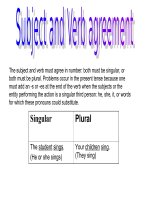
The subject of a sentence must agree with the verb of the sentence in number. A
singular subject takes a singular verb. A plural subject takes a plural vers. This is the
simple principle behind subject and verb agreement.
Examples:
John lives in the next door
The subject: John (singular )
The verb : lives (singular )
They want to finish the class early
The subject : They (plural)
The verb : want (plural)
However, the problems in subject and verb agreement are not simple like that. The
followings are some rules to help us avoid subject and verb agreement problems in our
writing.
1. Indefinite pronouns as Subject
a. Singular indefinite pronouns, such as someone/body/thing, anyone/body/thing,
everyone/body/thing, each, one, either, neither take singular verbs
Examples:
Each does his own cooking
Everyone enjoys the summertime
Someone has to be responsible
Each of the boys gets good marks
Neither of the book is mine
b. Plural indefinite pronouns, such as both, few, many, several take plural verbs
Examples:
Several of the students were invited to the party
Both of the teams play very well
Many were impressed by the guess speaker
Few of the committee attend meetings
c. All, any, most, some, and none can go with either singular or plural verbs depending
on the grammatical number of the noun they refer to
Examples:
<i>Some of the show was interesting</i>
(Some is singular because it refers to show (performance), which is singular)
<i>Some of the actors were humourous</i>
(Some is plural because it refers to actors, which is plural)
<i>None of the representatives has indecated how he or she will vote</i>
<i>None of the representatives have indecated how they will vote</i>
2. Compound subjects
a. When the subjects are joined by and, the verb will be plural in most situations
Tom and Mary are good friends
England, Scotland and Wales form Great Britain
Exceptions:
-When the noun phrases are preceded by each, every,or no, they use a singular verb
Example:
Each boy and each girl has a book
-When the noun phrases denote the same things or persons, they use a singular verb
Example:
My best friend and my adviser, Tom, is coming tonight
b. When the subjects are joined by nor, or, or not only …but also, the verb agrees
with the closer subject
</div>
<span class='text_page_counter'>(2)</span><div class='page_container' data-page=2>
Neither Anna’s neighbours nor her husband agrees with her decision
Either he or his friends were at school yesterday
Not only a dog but also two cats at at home in his garage
3. Collective nouns as Subject
Normally, these are the nouns that are singular in form but plural in meaning, so they
use a plural verb : Audience, team, family, minority, majority, band, class, club, group,
<i>committee, crew, etc.</i>
Examples:
The audience were entering the theatre
John has just arrived and now the team are all here
( Audience and team here refer to individuals or members)
<b>Notes:</b>
When the nouns act as a whole single unit, they use a singular verb
Examples:
The audience was one of the best
The team has won the semifinal
4. Nouns with a plural form as Subject
The following nouns, plural in form but singular in meaning, are always followed by a
singular verb:
-The noun news:
The news on T.Vis always depressing
-games, such as billiads, bowls, dominoes, darts
Billiards is becoming more and more popular
-Names of the cities, countries, such as Athens, Brussels, Naples, wales,etc.
Athens has grown rapidly in the past decade
Diseases/ illnesses, such as mealse, mumps
-Subjects, such as mathematics, linguistics, physics, economics, etc
Statistics is a subject at university
Acoustics is a branch of physics
Mathematics is a compulsory suject at school
Exception:
Some words ending in _ics, such as acoustics, politics, economics, ethics, phonetics,
<i>statistics, take a plural verb when the reference is specific. For example:</i>
The statistics show that out of 20,000 accidental deaths, 7000 occurred in the home
(Statistics ~ collected numbers)
The acoustics in the Festival Hall are extremely good
(Acoustics ~ sound quality)
5. When the subject in a sentence is a gerund, an infinitive verb, or a That- clause, the
verb must be singular
Examples:
Swimming is a good sport
To learn a foreign language is very necessary
That she told me yesterday was just a joke
6. Expressions of fractions and percentages as Subject
With words that indicate fractions and percentages in of phrase (object of the
preposition), the verb will be determined by the object of the preposition:
If the object of the preposition is singular, use a singular verb
If the object of the preposition is plural, use a plural verb
Examples:
</div>
<span class='text_page_counter'>(3)</span><div class='page_container' data-page=3>
7. When measurements of money, time, and distance are the subject of a sentence,
they usually require a singular verb
Examples:
One hundred dollars is a lot of money for a bottle of wine
Five kilometres is too much to run in one day
Twenty minutes is not enough to solve this problem
Two hours is a long time to wait to see a doctor
8. When the subjects are joined by the following phrases, the verb agrees with the first
subject:
<i>Together with, along with, as well as, in addition to, accompanied by</i>
Examples:
The singer, as well as the musicians, was pleased with the recording
S1 S2
Mr. John, accompanied by his wife and childen, is arriving tonight
S1 S2
9. Sometimes, the pronouns who/that /which are the Subject of a verb in the middle of
a sentence, the pronouns who/that /which become singular or plural depending on the
noun directly in front of them. Thus, if that noun is singular, use asingular verb; if that
noun is plural, use a plural verb
Examples:
Salma is the scientist who writes the reports
He is one of the men who do the work
It is the boys who have broken the window
10. In sentences beginning with here or there, the subject follows the verb
Here comes the teacher
There are many books to read
11. When the titles of books, plays, poems,etc are used as the Subject in a sentence,
they take a singular verb
</div>
<!--links-->