- Trang chủ >>
- Mầm non - Tiểu học >>
- Lớp 5
Creating the project office
Bạn đang xem bản rút gọn của tài liệu. Xem và tải ngay bản đầy đủ của tài liệu tại đây (2.06 MB, 331 trang )
<span class='text_page_counter'>(1)</span><div class='page_container' data-page=1></div>
<span class='text_page_counter'>(2)</span><div class='page_container' data-page=2></div>
<span class='text_page_counter'>(3)</span><div class='page_container' data-page=3></div>
<span class='text_page_counter'>(4)</span><div class='page_container' data-page=4></div>
<span class='text_page_counter'>(5)</span><div class='page_container' data-page=5></div>
<span class='text_page_counter'>(6)</span><div class='page_container' data-page=6>
CREATING THE
PROJECT OFFICE
A Manager’s Guide to Leading
Organizational Change
</div>
<span class='text_page_counter'>(7)</span><div class='page_container' data-page=7>
Copyright © 2003 by John Wiley & Sons, Inc. All rights reserved.
Published by Jossey-Bass
A Wiley Imprint
989 Market Street, San Francisco, CA 94103-1741 www.josseybass.com
No part of this publication may be reproduced, stored in a retrieval system, or transmitted in any form
or by any means, electronic, mechanical, photocopying, recording, scanning, or otherwise, except as
permitted under Section 107 or 108 of the 1976 United States Copyright Act, without either the prior
written permission of the Publisher, or authorization through payment of the appropriate per-copy fee
to the Copyright Clearance Center, Inc., 222 Rosewood Drive, Danvers, MA 01923, 978-750-8400,
fax 978-750-4470, or on the web at www.copyright.com. Requests to the Publisher for permission should
be addressed to the Permissions Department, John Wiley & Sons, Inc., 111 River Street, Hoboken, NJ
07030, 201-748-6011, fax 201-748-6008, e-mail:
Page 308 is a continuation of the copyright page.
Jossey-Bass books and products are available through most bookstores. To contact Jossey-Bass directly
call our Customer Care Department within the U.S. at 800-956-7739, outside the U.S. at 317-572-3986
or fax 317-572-4002.
Jossey-Bass also publishes its books in a variety of electronic formats. Some content that appears in print
may not be available in electronic books.
<b>Library of Congress Cataloging-in-Publication Data</b>
Englund, Randall L.
Creating the project office : a manager’s guide to leading
organizational change / by Randall L. Englund, Robert J. Graham, Paul C.
Dinsmore.
p. cm.
Includes bibliographical references and index.
ISBN 0-7879-6398-4
1. Project management—Handbooks, manuals, etc. 2. Organizational
change—Handbooks, manuals, etc. I. Graham, Robert J., 1946- II.
Dinsmore, Paul C. III. Title.
HD69.P75 E54 2003
658.4'04—dc21
2002152396
Printed in the United States of America
FIRST EDITION
</div>
<span class='text_page_counter'>(8)</span><div class='page_container' data-page=8></div>
<span class='text_page_counter'>(9)</span><div class='page_container' data-page=9></div>
<span class='text_page_counter'>(10)</span><div class='page_container' data-page=10>
Preface xi
The Authors and Contributors xvii
<b>PART ONE: CREATING THE CONDITIONS FOR CHANGE</b> <b>1</b>
1 Leading Organizational Change 7
2 Clear Danger: Creating a Sense of Urgency
and Economic Value 33
3 Powerful Forces: Building a Guiding Coalition 53
4 Focus: Developing and Communicating the Project Office
Vision and Strategy 83
5 Tell the Tale: Harnessing Internal Support 109
Robert Storeygard, 3M
<b>PART TWO: MAKING CHANGE HAPPEN</b> <b>125</b>
6 Contact: Managing the Change 129
</div>
<span class='text_page_counter'>(11)</span><div class='page_container' data-page=11>
<b>x</b> Contents
7 Implementing the Project Office: Case Study 167
Alfonso Bucero, PMP
8 Keep Moving: Getting Your Arms Around Chaos 197
Colonel Gary LaGassey, USAF
9 In or Out? Staffing and Operating the Project Office 219
<b>PART THREE: MAKING CHANGE STICK</b> <b>245</b>
10 Looking Forward: Embedding Project Practices
in the Culture of the Organization 249
Dennis Cohen, Strategic Management Group
11 The Tale We Tell 277
Appendix: Templates for Project Office Planning 291
References 299
</div>
<span class='text_page_counter'>(12)</span><div class='page_container' data-page=12>
<b>xi</b>
<b>PREFACE</b>
F
aster, cheaper, better. Accidental project manager. In or out? Are you doneyet? We’re in a mess! Why can’t we . . . ? If these challenges sound familiar
within your organization, welcome aboard.
This is a book about improving organizational performance by implementing
a project office system that develops project management as a core competency
and thus adds value to the organization. A project office consists of a team
dedi-cated to improving the practice of project management in the organization. The
improvement in organizational performance is achieved by obtaining more value
from projects, making project management a standard management practice, and
then moving the organization toward the enterprise project management concept.
Enterprise project management is an organization-wide managerial
philoso-phy. It is based on the idea that company goals are achievable through a web of
simultaneous projects supported by a systemic approach that includes corporate
strategy projects, operations improvement, and organizational transformation
as well as traditional development projects. This means that companies view
marketing programs, advertising campaigns, promotional events, new product
launches, software development, change management, and continuous
improve-ment, as well as traditional design and construction of new facilities, as <i>projects,</i>
</div>
<span class='text_page_counter'>(13)</span><div class='page_container' data-page=13>
The project office is the linchpin for implementing and maintaining a project
approach across the organization. The project office is a gigantic building block
for making enterprise project management become a reality in an organization.
The project office adds value to the organization by ensuring that projects are
per-formed within procedures, are in line with organizational strategies, and are
com-pleted in a way that adds economic value to the organization.
The audience for this book includes everyone involved in project
manage-ment—project managers, team members, and middle and upper managers
at-tempting to change their organizations into project-based enterprises. All projects
involve change and thus every project manager and team member is involved in
an organizational change process. Since the emphasis here is on improving the
organization through better project management practices, this book will help
project participants and managers at all levels make sense of the change processes
they are experiencing.
Inexperience and ignorance about leading organizational change can be
costly to the organization and the individual. We are not wont to disagree with an
early reviewer who said, “This book can save careers.” Another added, “This book
can save organizations!”
The book began as a result of workshops on the topic of <i>Implementing the Project</i>
<i>Office for Organizational Change,</i>sponsored by the Strategic Management Group and
R. J. Graham and Associates. These workshops blended consultants and
practi-tioners (most writers for this book participated, along with a few of their friends),
who worked through the problems and processes of changing organizations to
embrace the enterprise project management concept. This book reflects the
ma-terial covered during those workshops as well as contributions from a constituency
of consultants and practitioners through lifelong experiences. Contributors to the
book include consultants Graham, Dinsmore, and Cohen, along with
practition-ers Storeygard, Bucero, and LaGassey. Englund plays a dual role, currently a
con-sultant but drawing on many years as a practitioner and in an HP project office.
Many other professionals also graciously shared their learning and worked their
way into the collective knowledge compiled herein.
The design of the book is the result of suggestions from workshop
partici-pants. Other books on the project office acknowledge the importance of the
of-fice in facilitating change in the organization. Despite this acknowledgment,
however, concepts on using a project office as a vehicle for organizational change
are often left to the last chapter, almost an afterthought. Workshop participants
who were currently working on implementing project offices agreed that this
em-phasis, although important, came too late. It is difficult to change the perception
and function of any organizational entity after it has been established. Therefore,
</div>
<span class='text_page_counter'>(14)</span><div class='page_container' data-page=14>
if the ultimate goal is to change the organization, then that should be the focus
from the beginning. That is why we wrote this book.
The emphasis in this book is not on the day-to-day operation of the project
office, although that topic is covered. Rather, the focus is the process of
imple-menting a project office in an organization with the goal of bringing about
orga-nizational change that ultimately adds to the economic value of the organization.
Not every reader plans to go all the way to implement the <i>full Monty</i>—a
strate-gic project office—and some may even get discouraged by the pitfalls we describe.
However, we also include specific skill-building approaches and revised ways to
think about things that offer value to these readers. The implications of power,
operating across organizations, and project portfolio management processes are
examples. These have wider applications than just a project office, but are even
more potent when the PO leads the effort. We draw from a variety of fields and
historical references in pursuit of our goal to cover the <i>why, what,</i>and<i>how</i>to lead
the organizational change process.
<b>PO of One</b>
The term <i>project office</i>is not without baggage. For some people it means overhead
and bureaucracy. They want a lean organization where competencies and action
are dispersed across the organization, not in a central (expensive) unit. These same
people may ask if they can establish POs of one, meaning that each project
man-ager embodies all the traits, skills, and knowledge that we cover in this book.
We believe a PO of one is a worthy concept. We are talking about an
orga-nizational culture that supports the essence of a project office but not its
struc-ture. Individuals learning to unfreeze, change, and refreeze the people around
them offer tremendous value. The steps along the path we describe can be taken
by individual project managers. In fact, they may not have that title; they just
hap-pen to be doing projects or leading a change effort. They want the results they
create through a set of activities to be great instead of average, and the outcome
to contribute and fit with organizational goals instead of going on the shelf. The
missing pieces that help make this happen are the process, experiences, and
knowl-edge of best practices.
A PO of one may not be an established norm or term in usage, but it can live
in the hearts and aspirations of devotees. We hope this book provides inspiration.
We also hope that success then expands enterprise project management
possibil-ities to higher levels of maturity.
</div>
<span class='text_page_counter'>(15)</span><div class='page_container' data-page=15>
<b>Book Organization and Outline</b>
Organizational change comes in three phases, so this book is organized in three
parts to follow those phases. The first outlines ways to create the conditions for
organizational change. The second covers operating the project office to make the
changes themselves, and the third goes through consolidating the changes to
embed them in organizational reality.
Part One consists of the first five chapters of the book. Chapter One covers
the problems associated with organizational change processes and gives a
step-by-step guide to the process of using a project office as organizational change vehicle.
Chapter Two gives more detail on the first important step of that process,
creat-ing a sense of urgency for the change and makcreat-ing sure that the result of the change
will ultimately add economic value to the organization. Any change process
in-volves power and politics, so Chapter Three is a program manager’s guide to
or-ganizational politics with an aim toward using that knowledge for creating a
powerful coalition for change. Chapter Four covers many of the details
concern-ing the functions and operations of a project office so that organizational change
agents begin to develop a vision, strategy, and communications plan to let people
know what the office is and what it does. Chapter Five is a case study showing how
many of the concepts covered in the first four chapters were applied at 3M.
Chapter Six begins the second part of the book, covering the problems and
processes of managing change when the project office begins to have first contact
with members of the organization. Chapter Seven is a case study from HP Spain
that shows how the manager of that project office managed its interface with the
rest of the organization. Chapter Eight is another case study, from a U.S. Air Force
Base in Italy, that describes implementing a project office in a very short time,
under rapidly changing conditions, and in a highly bureaucratic organization.
Chapter Nine calls on information from case studies as it covers the important
topics of staffing and operating the project office.
Chapters Ten and Eleven cover the final part of the change process, that of
consolidating the changes to make them an organizational reality. In these
chap-ters we acknowledge that most change processes fail because they only develop
surface changes and leave the basic assumptions of organization members
un-touched. Chapter Ten covers the steps necessary to change basic assumptions of
organization members and thus integrate the new processes into the
organiza-tional culture. Chapter Eleven adds a few more important insights into the process,
and discusses the action-planning templates in the Appendix, whose use will help
make the changes stick.
</div>
<span class='text_page_counter'>(16)</span><div class='page_container' data-page=16>
We are aware that organizational change is a messy process and that few
po-tential readers for this book will follow the seemingly smooth process outlined here.
In fact, readers may find themselves at different points on the continuum of
change that the book proposes. However, we believe there is potential value for
all readers, regardless of where they are in the process.
For those just beginning to think about implementing a project office, the first
two parts are most important. The ideas and case studies presented in these
sec-tions preview problems you will face, along with suggessec-tions from those who have
gone before you. If you have implemented a project office but find that progress
has stalled, you will probably find Part One very helpful. People who experienced
stalled implementations report that they did not spend enough time—or <i>any</i>
time—creating the initial conditions for organizational change. Reviewing the first
five chapters of this book may highlight important elements that were missed,
el-ements that when put in place will move the implementation forward. Those
read-ers who have a project office operating successfully will probably want to
concentrate on Parts Two and Three so that they can prepare to consolidate the
changes and finally make an effective and efficient project-based organization an
organizational reality.
The path is arduous but worthy. We offer steps along the pathway and point
out probable hurdles and roadblocks, based on experiences of others. The hero’s
journey includes options to push on, modify your approach, or stop. This book is
designed to be your partner along the way.
<i>January 2003</i> Randall L. Englund
<i>Burlingame, California</i>
Robert J. Graham
<i>Mendocino, California</i>
Paul C. Dinsmore
<i>Rio de Janeiro, Brazil</i>
</div>
<span class='text_page_counter'>(17)</span><div class='page_container' data-page=17>
To all the executives, project managers, and professionals
who contributed directly or indirectly to this work by providing
</div>
<span class='text_page_counter'>(18)</span><div class='page_container' data-page=18>
<b>xvii</b>
<b>THE AUTHORS AND CONTRIBUTORS</b>
<b>Authors</b>
<b>Randall L. Englund</b>is an independent executive consultant, author, trainer, and
speaker, serving to guide management and project teams through an organic
ap-proach to project management. His background was as a senior project manager
at Hewlett-Packard Company (HP) in the Project Management Initiative, whose
purpose, as a corporate project office, was to lead the continuous improvement of
project management across the company.
During twenty-two years at HP, Englund consulted with product developers
on cross-organizational projects, developed workshops, documented best
prac-tices, and assisted teams to conduct project start-up meetings, implement project
management practices, and prioritize project portfolios. He was a program
man-ager in computer system product development and a major account marketing
engineer. He also worked in field service for General Electric Medical Systems.
</div>
<span class='text_page_counter'>(19)</span><div class='page_container' data-page=19>
as a New Product Development Professional and as a Certified Business Manager
by the Association of Professionals in Business Management.
Englund and Graham joined forces, leveraging their practitioner,
consult-ing, and executive education skills, to coauthor the book <i>Creating an Environment</i>
<i>for Successful Projects: The Quest to Manage Project Management.</i>Both are frequent
con-tributors to the Project Management Institute (PMI), as presenters, workshop
facilitators, and authors.
You can reach Randall Englund at
<b>Robert J. Graham</b>is an independent management consultant in project
manage-ment and organizational change. Previously he was a senior staff member of The
Management and Behavioral Sciences Center at The Wharton School,
Univer-sity of Pennsylvania. While at Wharton he taught in the MBA and Ph.D.
pro-grams and was a part of the Wharton Effective Executive program teaching
project management to practicing executives.
Graham held visiting professor positions at the University of Bath and the
Uni-versity of the German Armed Forces. He was adjunct professor at the UniUni-versity
of Pennsylvania and the Project Management Unit at Henley Management
Col-lege in England. His first book was <i>Project Management as if People Mattered,</i>followed
by <i>Creating an Environment for Successful Projects,</i>and then, with Dennis Cohen,<i>The</i>
<i>Project Manager’s MBA: How to Translate Project Decisions into Business Success.</i>
He developed a simulation,<i>The Complete Project Manager,</i>where participants
make decisions and receive feedback around a number of behavioral issues in
project management. The Strategic Management Group delivers a full
multime-dia version as a computer simulation called <i>Project Leadership.</i>
Graham has a B.S. in systems analysis from Miami University, as well as an
M.B.A. and Ph.D. in operations research from the University of Cincinnati. He was
a postdoctoral fellow at The Wharton School. In addition, he has an M.S. in
cul-tural anthropology from the University of Pennsylvania. He earned Project
Man-agement Professional (PMP) certification from the Project ManMan-agement Institute.
You can reach Robert Graham at
<b>Paul C. Dinsmore</b>is president of Dinsmore Associates and a highly respected
spe-cialist in project management and organizational change. He received the
Dis-tinguished Contributions Award and Fellow from the Project Management
Institute. He regularly consults and speaks in North America, South America,
Eu-rope, and Africa. He is the author or editor of numerous articles and several
books, including <i>Winning in Business with Enterprise Project Management</i>and the <i>AMA</i>
<i>Handbook of Project Management.</i>Dinsmore, a certified project management
</div>
<span class='text_page_counter'>(20)</span><div class='page_container' data-page=20>
sional (PMP), writes the “Up & Down the Organization” column for the Project
Management Institute’s <i>PM Network</i>magazine.
Dinsmore has a B.S. in electrical engineering from Texas Tech University, a
postgraduate degree in business administration from Getulio Vargas Foundation
in São Paulo, Brazil, and attended the Advanced Management Program at
Har-vard Business School.
You can reach Paul Dinsmore at
<b>Contributors</b>
<b>Alfonso Bucero, PMP,</b>is now an independent project management consultant
and speaker. He is operations manager of the International Institute for
Learn-ing (IIL) for Spain and Portugal. His background was as a project manager at
Hewlett-Packard Consulting, where he developed and managed the PMO
im-plementation whose purpose was the continuous improvement of project
man-agement discipline across the organization. He assisted in rolling out the PMO
practices to a global project office.
During his thirteen years at HP he managed various customer, infrastructure,
development, and change management projects. He spent the last two years at
HP selling and implementing the project office; his case, presented in this book,
explains the problems he had, the things he learned, and the way he contributed
to organizational change through a PMO implementation. Bucero has a B.S.
de-gree in computer science engineering, and he is a frequent contributor to
inter-national project management conferences and project office workshops.
<b>Dennis J. Cohen</b>is vice president and executive of the Project Management
Prac-tice area for the Strategic Management Group in Philadelphia, Pennsylvania. He
works with clients to maximize project performance. He coauthored, with Robert
Graham, the book <i>The Project Manager’s MBA: How to Translate Project Decisions into</i>
<i>Business Results.</i>He served the Wharton School as a research associate, senior
fel-low, and adjunct assistant professor of management, teaching courses in
man-agement and entrepreneurship and leading seminars in executive education
programs. Cohen holds B.A. and M.A. degrees from the University of
Califor-nia, Berkeley, and an M.B.A. from the Wharton School of the University of
Penn-sylvania, as well as M.A. and Ph.D. degrees from the University of Wisconsin.
<b>Colonel Gary C. LaGassey</b>is program manager of Aviano 2000, the largest air base
construction program in NATO and the U.S. Air Force. His Program Management
</div>
<span class='text_page_counter'>(21)</span><div class='page_container' data-page=21>
Office manages and integrates all aspects of the 264-project, $530 million upgrade
of Aviano Air Base, Italy. He has been a deputy base commander and support
group commander. Operational assignments include duty as a Minuteman launch
officer. Staff assignments include duty as a major command inspector general
team member, as a missile operations staff officer, and as a political military
plan-ner at the Pentagon.
He earned a B.A. degree in political science from the University of Maryland
and an M.A. degree in public administration from the University of Northern
Colorado. He is also a graduate of the U.S. Air Force Air War College and the
NATO Defense College. Among his numerous military awards are the Legion of
Merit and the NATO Medal for his role in the air combat campaigns in Bosnia
(1995) and Kosovo (1999). LaGassey frequently presents at PMI Symposiums
about his project office experiences.
<b>Robert L. Storeygard, PMP,</b>is an advanced project management specialist and is
the 3M Traffic Control Materials Division (TCM) Project Office. He authored
the extensive 3M Project Leadership Curriculum and teaches a number of project
management-related classes at 3M. He is also the past chair and current
interna-tional outreach chair of the 3M PMSIG, representing three thousand project
managers and leaders throughout 3M worldwide. Storeygard works extensively
in 3M’s International environment, helping to deploy PM best practices
through-out 3M’s Latin American and Asian subsidiaries. In addition, he works with
nu-merous St. Paul, Austin, and other plant sites, departments, and divisions to teach,
consult, and help deploy PM in their business and technology areas.
He is a member of the Project Management Institute and a PMP
Certifica-tion Instructor, served as the Minnesota vice president of professional
develop-ment and the National PMI Education Specific Interest Group (SIG) co-chair.
Storeygard speaks at many U.S. and international conferences on project and
portfolio management, as well as the project office, and his work and writings
have been published in numerous articles, presentations, and several books.
Storeygard has B.A. degrees in education and attended postgraduate courses in
project management.
He suggests, “If you need internal support for your PM efforts and project
offices, you need to read Chapter Five, because without it you will be pushing rope
uphill!”
</div>
<span class='text_page_counter'>(22)</span><div class='page_container' data-page=22></div>
<span class='text_page_counter'>(23)</span><div class='page_container' data-page=23></div>
<span class='text_page_counter'>(24)</span><div class='page_container' data-page=24>
PART ONE
CREATING THE CONDITIONS
FOR CHANGE
W
e write this book from the point of view of advising a small group of people,call them <i>change agents,</i>who are attempting to implement a project office to
make the organization more project-friendly. Not all readers will be directly charged
with implementing organizational change. However, since most readers are involved
with project management, they will be involved with assisting in that change.
Peo-ple involved in change processes often find them chaotic and seemingly without logic.
Understanding the entire change process from the point of view of the change agents
directing it helps all participants better understand what is happening and why.
Understanding the motives and logic of the leaders helps create better
partici-pants and followers. Each individual can also apply these steps to personal projects.
To move along the path of organizational change, we break the journey into
three segments, comprising creating the conditions for change, making the change
happen, and making change stick. The first one, creating the conditions for
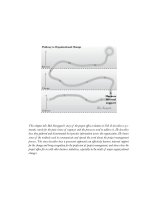
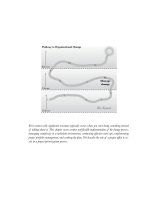
change, is covered in the next five chapters. Figure I.1 illustrates the complete
journey.
Figure I.1 depicts a small group of people, the team of change agents,
be-ginning a trek from the lower left corner. They are in a storm. Visions of a sunny
paradise (upper right corner) feel like fantasy but still capture their imagination
as something they want to achieve, something much better than their current
re-ality. Not quite revealed to them yet is the complex journey they face. Each step
along the twisted path is a chapter in this book.
</div>
<span class='text_page_counter'>(25)</span><div class='page_container' data-page=25>
Since the mission is to implement a project office as a vehicle for
organiza-tional change, the first step on the journey is to discover the processes necessary
to lead an organization to change. Following the process outlined in Chapter One,
the team identifies many clear dangers. Some of these dangers may lead to
side-tracks or discontinuing the journey. To go onward the change agents need to
cre-ate or identify a sense of urgency for the change among other members of the
organization as well as determine how their efforts will add value to the
organi-zation. Once they figure this out, the team realizes it has little chance of success
without developing some clout to deal with powerful political forces. The change
<b>2</b> Creating the Project Office
<b>FIGURE I.1. THE PATHWAY TO CHANGE.</b>
<b>1.</b>
<b>Leading organizational change</b>
<b>3.</b>
<b>Powerful forces</b>
<b>4.</b>
<b>Focus</b>
<b>5.</b>
<b>Tell </b>
<b>the tale</b>
<b>6.</b>
<b>Contact</b>
<b>7.</b>
<b>Implementing</b>
<b>8.</b>
<b>Keep moving</b>
<b>9.</b>
<b>In or out?</b>
<b>10.</b>
<b>Looking forward</b> <b>11.</b>
<b>The tale we tell</b>
<b>Refreeze</b>
<b>Change</b>
<b>Unfreeze</b>
<b>2.</b>
<b>Clear danger</b>
</div>
<span class='text_page_counter'>(26)</span><div class='page_container' data-page=26>
agents understand that few people will listen to them just because they have a good
idea. So the next step on the journey is to develop political acumen, a powerful
sponsor, and a coalition of organization members that help guide them on their
journey. With backing from that group, they proceed to focus on what functions
the project office will perform, how those functions will add value to the
organi-zation, and how they expect those functions to expand and grow. This vision and
strategy is put into a succinct plan and a language that others in the organization
understand so that the team of change agents can tell their tale—harness
inter-nal support—to enlist the help of the entire organization.
This period spent creating the conditions that will enable change is critical to
the success of the entire endeavor. Project managers recognize this time as akin
to the preparation of a project plan, which indeed it is. It is also the honeymoon
period for the project team, for during this time—while the project office is being
discussed—it will not yet affect people’s lives. That being the case, the project team
can expect that serious opposition will not yet be formed. This is analogous to the
“hundred days” that new U.S. presidents typically have before serious opposition
mounts to their policies and programs. The change agent team can expect
seri-ous opposition to arise after this part of the journey is completed. Not known yet
is what awaits them in the middle section of Figure I.1. Implementation usually
requires invading new territories or jungles—other functional areas or businesses.
Sensing invaders, the lions, tigers, and bears emerge from hiding places in the
for-est, ready to attack. For the change agent team to be ready for this opposition,
they need to develop political acumen while time is available.
Since the first part of the journey is a planning period, the team can expect
the usual problems associated with project planning. Some will say the planning
is a waste of time. Some may press for quick results and eschew the entire idea of
planning. Others may agitate to quicken the process and get into action sooner.
But project and program managers know better. They know that planning is
es-sential for success and can easily take 40 percent of the entire time allotted to a
project. For those who insist on skipping this first phase and taking a shortcut, we
offer two cautionary tales.
<b>Cautionary Tales</b>
Lands beyond the bounds of the known world tantalized the imaginations of
an-cient scholars, inspiring visions of a lush empire far to the south. Maps, drawn
from supposition and mysticism, identified this area as <i>Terra Incognita,</i>the unknown
land, newly discovered but not yet fully known. Only centuries later when brave
sailors traveled south did they discover the world was much different. As we now
</div>
<span class='text_page_counter'>(27)</span><div class='page_container' data-page=27>
know, the maps were incorrect, and their assumptions were false. However, what
lies beyond boundaries is always mysterious and awaits discovery. The emptiness
tantalizes us to explore and conquer this space.
Organizational change agents exploring the future of project management
face similar challenges as the earlier explorers. Misconceptions abound about what
is possible. Newly discovered fads drive managers to launch ill-conceived projects
or initiatives. Modern explorers also face unknowns, resistance, and chaos.
More recently, in the spring of 1846, a group of immigrants set out from
Illi-nois to make the two-thousand-mile journey to California. They planned to use
the well-known Oregon Trail. One part of this group, the Donner party, was
de-termined to reach California quickly and so decided to take a shortcut. They
trav-eled with a larger group until reaching the Little Sandy River. At this point the
larger party turned north, taking the longer route up through Oregon and then
to California. The Donner party headed south, taking an untried route known as
Hasting’s Cutoff. Since no one, including Hastings himself, had ever tried this
cut-off, they had little idea of what to expect. Their first barrier was the Great Salt
Lake Desert, where they encountered conditions that they never
imagined—sear-ing heat by day and frigid winds at night. A more formidable barrier was
en-countered in the Sierras. After a severe snowstorm on October 31 blocked the
trail, the party was forced to camp in makeshift cabins or tents just to the east of
the pass that today bears their name. The majority of these unfortunates spent a
starving, frozen winter—the worst ever recorded in the Sierras—trapped in the
mountains. The few survivors of that camp, who wound up resorting to
canni-balism to make it through the winter, reached California long after the other
mem-bers of the original Illinois group—and in far worse spirits.
The first conclusion that can be drawn for the project office team is that many
have gone before you with a journey of organizational change. Their collective
experience forms the equivalent of the Oregon Trail, a process showing a known
way to reach the desired goal. Although this path may seem long, ignore it at your
own peril. Second, although the Oregon Trail was well known and well traveled,
it was not necessarily easy. There were many difficulties along that trail and no
doubt some people died even though they were on the known route. So taking the
Oregon Trail is no guarantee of success—but it seems to greatly increase the
chances. Finally, taking a shortcut leads into unknown territory like the Great Salt
Lake Desert or <i>Terra Incognita</i>—the unknown land—as illustrated in Figure I.1.
The route may look good on the map, but the map is not the territory. The best
advice we give those considering a shortcut is from Virginia Reed, a Donner
party survivor, who said, “Remember, never take no cutoffs and hurry along as
fast as you can.”
</div>
<span class='text_page_counter'>(28)</span><div class='page_container' data-page=28></div>
<span class='text_page_counter'>(29)</span><div class='page_container' data-page=29>
<i>This chapter begins by describing the project office concept and introducing the idea that the </i>
<i>mem-bers of the project office need to think and act as organizational change agents. This is followed</i>
<i>by a discussion of the idea of planned organizational change and the role of the change agents</i>
<i>in that process. The change theme is then further developed by detailing the steps involved in </i>
<i>im-plementing a project office aimed at leading the change process. The steps include establishing a</i>
<i>sense of urgency, developing political acumen, creating a guiding coalition, developing a vision</i>
<i>and strategy, communicating the change vision, developing short-term wins, developing </i>
<i>broad-based action, consolidating the successes, and making the change stick. These steps will allow</i>
<i>you to develop a project office that can lead the change to a project-based organization.</i>
<b>1.</b>
<b>Leading organizational</b>
<b>change</b>
3. 4.
5.
6.
7.
8.
9.
10.
11.
Refreeze
Change
Unfreeze
2.
</div>
<span class='text_page_counter'>(30)</span><div class='page_container' data-page=30>
<b>7</b>
CHAPTER ONE
<b>LEADING ORGANIZATIONAL CHANGE</b>
<i>Abandon despair all ye who enter here.</i>
D
ante’s <i>Inferno</i>opens on the evening of Good Friday in the year 1300.Trav-eling through a dark wood, Dante Alighieri has lost his path and now
wan-ders fearfully through the forest. The sun shines down on a mountain above him,
and he attempts to climb up to it but finds his way blocked by three beasts—a
leopard, a lion, and a she-wolf. Frightened and helpless, Dante returns to the dark
wood. Here he encounters the ghost of Virgil, the great Roman poet, who has
come to guide Dante back to his path and to the top of the mountain.
This book is your Virgil—a guide for all those involved with project
man-agement and the move toward project-based organizations. It depicts the journey
or process of changing an organization to be more efficient and more profitable
by developing an organization-wide project management system, often called
en-terprise project management.
The enterprise approach to managing projects is a managerial philosophy
based on the principle that company goals are achievable through a web of
si-multaneous projects that calls for a systemic approach and includes corporate
strategy projects, operational improvement, and organizational transformation,
as well as traditional development projects. The concept is based on the idea that
prosperity depends on adding value to business, and that value is added by
sys-tematically implementing projects of all types across the enterprise. If those
projects are managed effectively, then the company’s bottom line will be greatly
enhanced.
</div>
<span class='text_page_counter'>(31)</span><div class='page_container' data-page=31>
Some readers may feel like Dante, facing an unknown ordeal to achieve
suc-cess that can only be imagined. Many obstacles appear like beasts along the dark
path. You, too, look for a guide and a way to reach the top of the mountain—and
have found one here. Unlike Dante, however, you will need to enlist others to join
you in the quest; no one can carry a project office alone.
Many organizations have attempted to improve their abilities and project
management over the last decade. Much of this attempt met with limited success.
People were sent out to be trained as project managers, only to find that when
they returned to the organization they were not allowed to perform in the way
they were trained. As people and organizations discovered that the individual
training approach was not leading to improvements, there arose a movement
where a person or group of people in the organization were charged with, or
charged up about, systematically improving project management practice across
the entire organization, thus helping the organization to change to an enterprise
project management system.
This venturesome group has any number of names, including a Project
Man-agement Initiative or a Project ManMan-agement Center of Excellence, with the
um-brella name <i>project office</i>currently in vogue. As these groups became successful, they
found that more of their effort was associated with organizational change than
with the practice of project management itself. Thus these groups became
pri-mary change agents, either self-proclaimed or assigned, for the process of
imple-menting enterprise project management.
Many participants in the project office movement were surprised to discover
their role as change agents. Many lamented that to be effective in this role they
should have initiated the office as an organizational change approach in the first
place. This book takes just that approach and assumes that a project office, when
properly implemented, will become a leading vehicle driving the organization
to-ward project-based operations and thus enterprise project management. The book
<b>8</b> Creating the Project Office
Establish sense of urgency—
clear danger
<b>Leading</b>
<b>Organizational</b>
<b>Change</b>
<b>to PBO</b>
Create guiding coalition—
powerful forces
Develop vision and strategy—
focus
Manage the change—
short-term wins, broad-based action,
consolidate gains
Develop broad-based action—
keep moving, implementing
Make change stick—
new PBO culture
The tale we tell
Communicate the change vision—
tell the tale
</div>
<span class='text_page_counter'>(32)</span><div class='page_container' data-page=32>
aims at helping develop this group of change agents so that their efforts will be
enthusiastically applied throughout the organization, helping them bring about
real change in the organization and avoid ending up as just another staff group.
This book is written by a combination of consultants and practitioners. As
consultants, the primary authors extract general principles for implementing a
project office and present these in chapters. There are also contributions from
practitioners who are in the trenches, actually running project offices and
apply-ing many of the same general principles. This combination of general principles
and real-life examples—theory with theory-in-practice—present an excellent road
map for future practitioners to use.
<b>The Developing Project Office Movement</b>
Project management has its roots in the construction and engineering trade.
Project management began outside the organization—the original project offices
were in trailers parked out on construction sites. Introduction of PERT charts
ushered project management into organizational settings. The real impetus to
de-veloping project management was its use in software projects and other new
prod-uct development projects. Over time, and probably after a number of resounding
failures, it became evident that project management was an important skill, one
that should be developed in order to avoid future failures. Looking further into
the future, some organizations began to see project management skill as a
com-petitive advantage. Groups were formed to look into the situation and it was at
this point, about the late 1980s and early 1990s, that we began to see project office
groups emerge. This situation, at AT&T, is typical of the period:
A small group of dedicated project managers, who had found each other in
business meetings, conferences and classes, realized that they shared the same
passion for project management. This group decided to band together to
address the prevalent project management issues that existed at that time—
constrained resources, lack of standard process or methodology, little or no
training requirements and inconsistent project performance. They knew that
most project managers in our company were operating within independent
circles, without a consistent way of doing project management. Managers of
project managers were using different criteria to determine what should be
project managed. Very few project managers had much organizational
sup-port and fewer still were trained in project management. Most, when they did
act as project managers, had it as a secondary job function [Schneidmuller and
Balaban, 2000, p. 1].
</div>
<span class='text_page_counter'>(33)</span><div class='page_container' data-page=33>
Things were similar in other organizations that addressed project
manage-ment problems. Most people became project manager by accident, and they were
appointed to the task because they had time available, not because they had any
particular project management skill. Projects were not run using any consistent
methodology, if they were using any methodology at all. This lack of project
man-agement skill, methodology, and organizational support led to most projects’ being
late, over budget, and not done to customer satisfaction.
To combat this problem, groups arose such as the Project Management
Ini-tiative at HP, described in Chapter 9 of Graham and Englund (1997). This group
was specific to the engineering function and concentrated mainly on new
prod-uct development projects, so others arose in other divisions, such as the project
of-fice developed for HP Consulting, described here in Chapter Seven. In addition,
more organization-wide groups emerged, such as the Project Management
Spe-cial Interest Group (PMSIG) at 3M, described in Chapter Five, and the Project
Management Center of Excellence at IBM, AT&T, and NCR, to name a few.
This movement to develop project offices is also spreading worldwide. The Star
Alliance, involving United and a dozen or so other airlines is one case, as is
Em-braer, a leading airliner manufacturer in Brazil.
Project office development is also happening across the organization, because
the enterprise project management concept can be applied to a business unit, a
department, or an entire corporation. It is useful to think of it in terms of levels
and typical names:
Level 1 Project level Project Control Office (PCO)
Level 2 Division or department level Project or Program Office
Project Management Center
of Excellence (PMCOE)
Level 3 Corporate level Strategic Project Office (SPO)
Thus as long as there is a multifunctional environment that requires the
si-multaneous management of numerous projects, the concept remains valid. This
means that an IT department could well use such an approach and continue to
interface with the rest of the functional organization even if the corporation did
not undergo a full conversion to the concept. At the lowest level one can find
project offices devoted to one large project or one program. These project office
groups can also be designed to work in one department, for one division, or for
one geographic location. At the highest level we find project office groups
at-tempting to change management practices throughout the entire organization.
</div>
<span class='text_page_counter'>(34)</span><div class='page_container' data-page=34>
This highest-level group, the strategic project office, is the one that has the
best chance for directing real organizational change. It is toward this group that
this book ultimately aims. However, since project offices normally evolve toward
that highest level rather than start there, we describe all types of offices and change
processes involved in the evolution to the strategic or organization-wide project
office. We also offer specific steps and skills that individual change agents can apply
to improve personal effectiveness.
The roadblocks for moving an organization project-ward are invariably the
stakeholders. Although lack of resources can also be an obstacle, people present
the major challenges. Principal stakeholders for enterprise project management
implementation are top management, project managers and team members,
func-tional managers, internal change agents, and consulting support personnel
(in-ternal or ex(in-ternal). If the initiative is top-down, starting with upper management,
then the effort of getting buy-in from the rest of the organization must be taken
on. If, on the other hand, the idea is filtering from the bottom upward, the
some-times monumental task of getting top management to provide support for the
ef-fort calls for skillful articulation and great persistence. In this book, we present a
change process that begins at the bottom and concentrates on developing project
management capabilities within one part of the organization, then later relying
on a top-down approach to spread those capabilities organization-wide.
Failure in implementing a project office is generally triggered by a
combina-tion of factors such as lack of top management support, underestimating the scope
of organizational change necessary, lack of methodology for managing projects,
insufficient efforts for developing competent project professionals, bad timing, and
inadequate management of the change process. Any one of these factors is
enough to set askew an effort to implement the enterprise project management
concept. However, people who have had difficulties with project office
imple-mentation usually say they should have taken a change management approach
from the beginning. That is, they usually began by concentrating on the functions
of the office itself rather than on the change process necessary to implement such
an office. This book examines the implementation processes of successful offices
and uses that approach to develop a general framework for success.
<b>Organizational Life Cycles and </b>
<b>Approaches to Planned Change</b>
To understand the need for organizational change, it is instructive to look at a
typ-ical organization life cycle. To an outsider, an organization may look to be in a
con-stant state of change. Much of the change in organizations can be seen as random
</div>
<span class='text_page_counter'>(35)</span><div class='page_container' data-page=35>
shifts or reactions to competitor’s product changes. Occasionally, however,
orga-nizations need planned change. The reasoning behind that suggestion is
some-thing like this. Organizations typically exploit new technology to help solve
problems. As these organizations grow they institute policies and procedures that
help them solve problems, both internal problems and problems of external
cus-tomers they serve. If these policies, procedures, or general ways of doing things
are successful, then the organization itself is successful and thrives. Over time,
however, customers’ problems change. For the organization to continue to thrive,
it must change the solution procedures or search for customers who have the old
problems that it can solve. At some point the pool of people with the old
prob-lems dries up. When that happens the organization will be forced to change its
solution processes to solve the new problems or else cease to exist. And that is
when the organization needs deliberate change processes. Many organizations
find themselves in this position today as they move toward enterprise project
management.
This need to change to more project-based procedures has recently emerged
as a necessary change in the life cycles of many organizations because more of
their work has become project work. As mentioned earlier, organizations began
by instituting procedures to solve particular problems, normally repeated
proce-dures aimed at producing standard products. Since these organizations have
sur-vived, we know that these procedures worked to solve the problems they faced.
These procedures were later refined, enlarged, and taught to succeeding
genera-tions of workers so that the organization could enjoy the economies of scale.
Pro-cedures for developing new products or custom-made products were often
haphazard as these products were usually considered to be one-offs and were a
very small part of the organization’s business. Over time, however, this changed
dramatically for most organizations. The commercial life span of most standard
products declined rapidly, giving rise to the need for project management in the
new product development process. Custom-made products or systems solutions
became the norm rather than the exception, giving rise to the need for project
management in the product production process. This change was accompanied
by the rise in the use of computers and the need for computer software and all
aspects of organizational function, giving rise to the need for project management
in the software development process. Changes in the environment, changes in
cus-tomer expectations, and changes in the technology used in organizational
processes have brought many organizations to the point where up to 80 percent
of their work is project work rather than repeat process work. These
organiza-tions are at the point in their life cycles where they need planned organizational
change to become project-based enterprises.
</div>
<span class='text_page_counter'>(36)</span><div class='page_container' data-page=36>
Planned organizational changes involve a conscious process with a specified
leader, specified goals, and a time line. That is, it is itself a project, and the project
manager should be the person in charge of implementing the project office. The
overall goal of organizational change is to institute new processes and procedures
that make enterprise project management the norm for the organization. The
time line will depend on many factors including the age of the organization, how
deeply ingrained its current procedures are, the degree of threat the organization
faces, and the amount of support given by top management. In most large
orga-nizations this process can easily span three to five or even ten years.
<b>Roles in the Change Process</b>
Four key roles must be played effectively in implementing change fully and
successfully:
• <i>Sponsors:</i>These are people who legitimize the change. They have the political
and economic resources required to initiate and sustain a change project in an
organization.
• <i>Change agents:</i>These people are responsible, with the sponsor’s approval, for
planning and executing the change project. Most of their activities focus on
the targets of the change.
• <i>Targets:</i>These are the people who must alter the way they work as a result of
the change. Targets are extremely important and active players in the
imple-mentation process.
• <i>Advocates:</i>These are the people who would like to see a change project idea
hap-pen but are not in a position to sponsor it. They, in effect, have a project and
want to identify potential sponsors and persuade them to initiate it.
From our experience, the move toward enterprise project management
nor-mally begins with a group of advocates, a group of dedicated people in the
orga-nization who want to improve project management. On rarer occasions, the
movement is initiated by an upper management sponsor. If the quest is begun by
advocates, it quickly becomes imperative for them to find an upper management
sponsor, someone with enough clout to bring about organizational change. The
change agents are that small group of the most zealous advocates who become
members of the original project office. This group often consists of practicing
project managers who want to spread the good word of project management
throughout the organization. The targets are usually other project managers, then
project team members, and finally all members of the organization.
</div>
<span class='text_page_counter'>(37)</span><div class='page_container' data-page=37>
<b>Organizational Change Versus Reorganization</b>
Planned organizational change should not be confused with reorganization. When
most people think of organizational change they think of the recurring “reorg,”
where departments are shuffled and lines redrawn on the organization chart.
Par-ticipants in this seemingly annual ritual soon recognize that reorganization itself
rarely results in real behavioral change. The usual result is that the same people
sit in different seats but produce the same products by the same processes and for
the same customers.
Reorganizations are wonderful for creating the illusion of progress while
en-suring that nothing fundamentally changes. It is an attempt to get something for
nothing—a feeling of the pleasure of progress without having to go through any
of the pain associated with real change. Reorganizations are so closely associated
with organizational change that those charged with such changes are tempted to
reach for the organization chart first thing. In fact, a reorganization is probably
the last step in any change process, a step taken to solidify changes already in
place.
It is far more effective to eschew attacking the organization chart and instead
begin by determining what needs to be done to develop real change in
organiza-tions. You can get any change process off to a good start by assembling a group of
people who want to change, having them demonstrate how the change is good for
the organization, and then working to have this change adopted throughout the
organization. We call this the “Quaker” approach to organizational change
(En-glund and Graham, 2001). The successful movement to develop project offices will
eventually lead to radical change in organization practices. As with any radical
change process, those in the vanguard—the people implementing the offices—will
often feel like missionaries introducing new practices into a hostile environment.
Early missionaries found it difficult to get other people to change their ways, and
some of them suffered mightily from the wrath of people they were trying to
change. Legends tell us how quiet, nonthreatening Quakers found a better way.
Many missionaries used a heavy-handed, command-oriented approach.
Proud native peoples rebelled and many missionaries were killed. The Quakers,
however, set up farms and produced bountiful harvests. When hungry natives saw
evidence of a rich harvest, they came to ask, “How do you produce such bounty?”
Educating the indigenous peoples to new agricultural ways was much easier once
the benefits were clear.
Business examples present similar stories: Dell Computer versus third-party
retailers . . . Southwest Airlines’ customer-oriented culture . . . eBay and
</div>
<span class='text_page_counter'>(38)</span><div class='page_container' data-page=38>
to-person Web sales. These companies succeeded in demonstrating how a new
concept can work.
Given the changes that a project office will cause in an organization, it is
es-sential that the approach to developing the office be aligned with organizational
culture. Much of the work of the project office can be seen as missionary work—
trying to convince people they will be better off if they change to new ways. The
metaphor of the Quakers’ good-neighbor approach to organizational change is
a valuable reference point to consider. It is one end of a continuum about how to
implement a project office, shown in Figure 1.1.
The other end of the continuum is the old hierarchical,
command-and-con-trol, “Attila,” do-what-I-say approach. Attila the Hun, as a leader, was able to get
people to do what he commanded, mainly through his aggressive, ambitious, and
arrogant nature. He was a savage conqueror who compelled those not destroyed
by combat to serve in his armies. He delighted in war and became a prudent and
successful general. He caused vast suffering and died, somewhat questionably,
be-fore his invasion plans could be carried out.
Many nineteenth-century industrialists built organizations designed to
trans-mit orders from the top. This worked very well in its day, generating
unprece-dented prosperity across a broad spectrum of society, but has become less effective
as the pace of change has increased in the modern world.
Change agents and their sponsors can determine their place on this continuum,
usually by honoring the existing culture. Design a plan that lines up with the
cur-rent position and then aim to shift direction over time. A hybrid strategy may be
very effective—start with a grassroots small success that is comfortable for everyone
concerned and then enlist upper management support to mandate its use across the
organization. See Figure 1.2 for a more academic treatment of change initiatives.
Leading Organizational Change <b>15</b>
<b>Attila</b>
Command and control
• Demand
• Force
• Standardize
<b>Quaker</b>
Good neighbor
• Get results
• Show benefit
• Honor culture
</div>
<span class='text_page_counter'>(39)</span><div class='page_container' data-page=39>
<b>Overall Organization Change Process</b>
Much has been written on the process of organizational change. An important
early model of organizational change was given by Kurt Lewin, who formulated
a simple three-step process of unfreeze, change, and then refreeze. Lewin points
out that the people in an organization may be frozen together with a set of
as-sumptions and procedures that were successful in the past. It is very difficult to
change anything that is frozen, so Lewin advises that before a change can take
place in any organization, first take steps to “unfreeze” it. Combining this model
with our own experience, we formed a three-phase approach:
• Creating conditions for change
• Making change happen
• Making change stick
<b>Creating Conditions for Change</b>
Changing behavior requires that organization members first stop doing what they
are doing now. Many members of organizations find this unsettling. It often means
they must abandon practices they have spent years developing. People will not
<b>16</b> Creating the Project Office
Beer and Nohria (2001) describe two basic types of change initiatives:
<i>Theory E</i>is the creation of economic value, often expressed as increased
shareholder value. Steps of the change plan are crafted and monitored from
above. Leaders focus on strategies, structures, and systems. Financial targets and
incentives dominate the agenda.
<i>Theory O</i>maintains that creating sustainable competitive advantage is the
best means of serving shareholders’ long-term interests. The emphasis is on
building organizational capability—a learning organization—and changing the
culture that creates structures and systems.
Theory E approaches are top-down, centrally planned, and highly
program-matic while Theory O is bottom-up and involves high levels of participation and
emerging cultures.
Fundamental tensions exist between Theories E and O. The challenge is to
combine the best of both.
</div>
<span class='text_page_counter'>(40)</span><div class='page_container' data-page=40>
readily do this unless they thoroughly understand why they are being asked to
make the change and how they will be better off by making that change. The
or-ganizational change agent must be ready to lead the people through these trying
times by showing why the changes are absolutely necessary and also showing
peo-ple how they will be better off by adopting project management practices.
Experience and studies show the two most important factors in successful
or-ganizational change are first that it is supported by the very top of the
organiza-tion and second that the people have a reason why they need to change. People
are much more amenable to change when they understand why it is necessary.
Thus this phase requires the change agents to create a sense of urgency by citing
the clear danger of continuing on the current path, develop a coalition of
pow-erful forces that will help to ensure the necessary support from the top, develop
and communicate a vision of how the changed organization will function, and
develop a strategy for using a project office to achieve that vision.
<b>Making Change Happen</b>
After creating the proper conditions, the change agents institute necessary changes
throughout the entire organization. Here the concentration is on building
wide-spread project management capacity. Much of this change will be accomplished by
developing a set of standard project methodologies, training organization members
on the use of these methodologies, and mentoring project managers and their
spon-sors. However, an equally important aspect of the change will be political.
Chang-ing practices and procedures will also result in a change in the power structure of
the organization, so the change agent must be politically astute and understand the
organizational power structure. During the process of change, one can expect
or-ganizational efficiency to decrease while people learn the new procedures. People
in the old power structure will repeatedly call for a return to the old ways.
<b>Making Change Stick</b>
The final phase in any change process is to refreeze behavior in the new, desired
pattern. This is where changing the organization structure will be most effective.
By this point the increased organizational capacity has shown its value and
en-terprise project management should have the support necessary from the very top
of the organization. Project management will become the way things are done.
Experiences with large organizational change usually show that about a third of
the members of the organization will find it almost impossible to make a change
and will decide to leave the organization instead. This is not an undertaking for
the faint of heart.
</div>
<span class='text_page_counter'>(41)</span><div class='page_container' data-page=41>
<b>Implementing a Project Office </b>
<b>as Organizational Change Process</b>
When organizational change to a project-based organization is the final goal,
peo-ple on the change agent team should think that way from the beginning. When
they begin by thinking of the office in narrow terms, such as helping on one
project or maybe in one department, they find it difficult to expand operations
or-ganization-wide. This is because the project office becomes associated with that
one project or with that department, not the organization as a whole. In addition,
they may have begun by concentrating on establishing standard procedures and
acquired a reputation as another set of staffers getting in people’s way. Here as
always, first impressions are lasting. For example, the first task of a project office is
often instituting standard procedures for project execution. When people in the
organization first interact with the office, they may see it as forcing them to
fol-low some restricting methodology. Once this idea gets into people’s minds, it is
difficult to convince them that project offices are really a way to institute desirable
long-term, organization-wide change. These developments make it difficult to
ex-pand the operations of a project office. If you want to move the whole
organiza-tion eventually, start out with that idea in mind.
Begin by seeing the entire movement of a project office as an organizational
change process. Since that means the team in charge of implementing the project
office must assume the role of change agent, some guidance here seems in order.
View the process as a path with distinct steps along the way. Many options exist
to continue, modify, or exit the path. We find suggestions by Kotter (1996) quite
useful in thinking through the concept of implementing a project office as an
or-ganizational change process. The next three sections describe the action areas
necessary for a successful change process. These areas are somewhat sequential,
and often overlapping.
<b>Phase 1: Creating Conditions for Change</b>
The first step in creating the conditions for change in any organization is to
es-tablish a sense of urgency for the change, a central and compelling reason why
this change must be done and must be done now. What you are proposing is a
new order of things, a new and different set of processes. Learning new processes
and doing things differently can pose difficult transition problems for many
mem-bers of the organization. So before embarking upon the process it is natural for
people to ask, “Why do we need to do this now?” With no clear danger, with no
sense of urgency that this must be done, there is little chance that members of the
</div>
<span class='text_page_counter'>(42)</span><div class='page_container' data-page=42>
organization will embrace the change. In fact, you can expect them to openly
re-sist it. These are busy people with many things to do and little time to spare for
participating in a change process unless they feel it is absolutely necessary. People
do those things they feel are in their best interest. If you want people to change,
first show them that it is in their best interest to do this and do it now. There is a
management myth often forwarded that people naturally resist change. This is
not really true; people do tend to resist change that they perceive is not in their
best interest, but they are equally quick to embrace changes that they perceive as
serving their best interest. Establishing a sense of urgency makes it clear that this
change is beneficial and well worth supporting.
There are several ways to establish a sense of urgency. The simplest is to use
the set of circumstances that led to the idea of establishing a project office in the
first place. Often an overriding factor is a project failure, and usually a failure on
a grand scale. When this is the case, you can establish a sense of urgency by
show-ing that if a project office is not established then there will be more failures like
the last one. This information can also be used in the future when people ask you,
“Why did we establish this project office in the first place?” Keep reminding
peo-ple you are there to prevent large project failures.
Another way to establish a sense of urgency is to compare what you are doing
in project management to what the best companies are doing—often called
bench-marking. Several tools are available, and using these tools often indicates that your
organization is far behind the project management practices of other
organiza-tions. This can work well if the standard for judgment is organizations your upper
managers admire. When you can show that the better organizations are
imple-menting project office groups, you can use that to establish a sense of urgency. For
example, the Chevron Corporation did a benchmarking study for project
man-agement and found that other organizations were much better than Chevron was
at both selecting projects and executing them. They realized that if they did not
improve their project selection and execution procedures, their profit levels would
be much lower than those of other oil companies. This would negatively affect
stock price and thus their ability to raise additional capital. Findings like that
cer-tainly establish a sense of urgency. As a result, a project office was established and
the Chevron project development and execution process (CPDEP) was developed
(Cohen and Kuehn, 1996). If you do not do a formal benchmarking study, then
perhaps a word from outside the organization—from customers, suppliers, or
stockholders—will work.
Another way to establish a sense of urgency is to establish a set of value
propositions for the project office that indicate how the people in the
organiza-tion, and the organization as a whole, will receive value from the work you
pro-pose. It also helps to paint a picture that describes the future organization that
</div>
<span class='text_page_counter'>(43)</span><div class='page_container' data-page=43>
embraces enterprise project management. As people see the value and understand
the enhanced capabilities of the future organization, they will determine that that
is the way they want it to be. That desire for the future state can be bolstered by
another picture of what could happen or the consequences if enterprise project
management is not embraced.
These three methods, discussed in Chapter Two, are designed to establish a
sense of urgency, a feeling within people in the organization that they had better
do this and do it now. Directors of project offices who did not establish a sense of
urgency report that they had difficulty gaining the attention of organization
mem-bers. Oftentimes when they tried to advise members of what they were doing or
trying to accomplish, they found everyone was otherwise engaged in what they
felt were more pressing problems. We find most organizations generally biased for
the immediate, preferring to solve a pressing problem rather than some vague,
longer-term problem. We do not believe we will see change in this orientation in
our lifetime, so it will always be necessary to establish a sense of urgency to get
people’s attention. Awareness of need is the first step in any change. But if you
cannot get people’s attention, you will not be able to develop that awareness. Thus
the urgency for establishing a sense of urgency.
<i><b>Develop Political Acumen.</b></i> Change will alter the status quo, so it is a good idea
for a change agent to spend time determining the lay of the land. By this we mean
to determine such things as where power truly lies in the organization, who will
benefit from the change, who will lose by it, and how deeply ingrained the
organi-zation’s current practices are. Understanding where the power lies in the
organiza-tion will be important, because the change process will soon need sponsors from
upper management ranks and will certainly benefit if those sponsors bring some
power and heft with them.
In any organization change, some people feel they will win in the change and
be better off, and others feel they will lose and thus be worse off. Expect assistance
from the first group and resistance from the second. It may be tempting to try to
ignore or go around the second group, but you can expect that the result of such
a move will probably just make the resistance stiffer. A better approach is to
change resistance to assistance by showing people how they will benefit from the
proposed change. History shows repeatedly that your biggest enemy can become
your biggest ally when it is clear that support is in those parties’ best interest. So
it is important to determine what groups may resist your efforts and show them
how they will come out ahead if they support you. We offer examples in this book
about how enlightened program managers gained this support.
It is also important to try to get some idea of just how set the organization is
in its ways. Over time, people in organizations develop processes for getting things
done and for solving their problems. These processes are practiced, refined, and
</div>
<span class='text_page_counter'>(44)</span><div class='page_container' data-page=44>
then passed on from generation to generation. Over time these practices begin to
embody Truth in the organization and those who do not support them generally
leave or are forced out. Like most groups, organizations embrace people who fit
their pattern or grow into it and expel those who do not. This recently happened
at Ford Motors. The CEO did not behave the “Ford way” and thus was replaced
by a member of the Ford family. Those left in the organization are the true
be-lievers in the goodness and righteousness of the status quo. The older and the
more successful the organization, the more deeply ingrained are its current
be-havior patterns. In general, older and larger organizations will be much more
dif-ficult to change and will take a much longer time to change than will younger and
smaller organizations. For example, NCR reported that it took five years to get
the “snowball effect” to propel project management into the forefront of its
cor-porate thinking (Kennel, 1996, p. 1), and AT&T reports it is still in an infant stage
after five years (Schneidmuller and Balaban, 2000).
Finally, learn from the past or be doomed to repeat it. Find out what
hap-pened to any failed change agents who came before you and determine what you
can do differently.
<i><b>Create a Guiding Coalition.</b></i> Once a sense of urgency is established, develop a
group of people across the organization who will help to define the changes
needed and ultimately aid the implementation process. These people need
posi-tion power and must be developed as a team. Develop a formal organizaposi-tion-wide
group of people who are interested in a project office and will help guide the
im-plementation process. A necessary part of this guiding coalition is an executive
sponsor, a person in upper management of the organization with enough power,
heft, and desire to champion change and spearhead the move to an enterprise
project management system. Also develop or partner with others who have
ex-tensive persuasive and political skills. We present a behavioral process to
accom-plish this in Chapter Three.
People who study organizational change feel that if some change is
impor-tant enough to the organization, a group of true believers who want that change
will emerge within the organization. The project office movement is no different.
Several organizations report that their guiding coalition began as a group of
like-minded people interested in improving project management, who were able to
band together based on that interest (as with the AT&T group discussed at the
beginning of this chapter). Oftentimes these groups are formalized and even have
names of their own, such as 3M’s PMSIG, mentioned earlier (and discussed in
more detail in Chapter Five). Other times a guiding coalition is developed from
a collection of individuals who make themselves known to the head of the project
office implementation team. Once these groups begin to form, it is important that
they represent a broad spectrum of the organization. It may be necessary to
</div>
<span class='text_page_counter'>(45)</span><div class='page_container' data-page=45>
recruit additional individuals so that all sections of the relevant organizational
universe are represented.
Another method for creating a guiding coalition is to develop a cross-organization
group such as a project management council. This is standard procedure in many
organizations and has been reported in several successful implementations. For
example, the Project Management Initiative at HP began with the formation of
a project management council. The group responsible for implementation of a
program management office at NCR reported that they found it useful to address
multicultural issues by establishing global and regional project management
coun-cils. These councils included top practitioners from all major geographic areas
along with representatives from other company organizations such as Human
Re-sources, Sales and Marketing, Education and Organizational Development,
Pro-fessional Services Management, and Strategic Planning (Kennel, 1996).
A most important factor in assembling this guiding coalition is the
recruit-ment or appointrecruit-ment of an executive sponsor. It is common in any
organiza-tional endeavor for people to ask, “Who in top management is back of this?”
Without someone at the top backing the endeavor, people will sense the lack of
resolve at the top of the organization and will surmise, correctly, that the project
office movement is doomed to failure. In fact, this is a self-fulfilling prophecy. If,
however, a popular and powerful person at the top of the organization becomes
the official executive sponsor of project office development and organization
members understand that this is important, they will be much more willing, even
eager, to help the process along. For example, implementation of the Project
Management Initiative at HP was greatly facilitated by the executive
sponsor-ship of Dean Morton, the chief operating officer. Likewise, the project office
group at AT&T arose from the ranks but actively sought and acquired executive
sponsorship with the rationale:
Without an executive sponsor or champion, a council lacks the power or
authority to implement its program plan. As a result, some project managers
even resisted joining the council since it had no executive backing, viewing it
as a waste of their time. The council is able to move quickly to obtain a
spon-sor. One of the existing council members had a vice president who shared the
council’s belief in project management and, when asked, willingly accepted the
role and responsibilities. This was a significant turning point for the council.
With an executive sponsor/champion, the council is able to accelerate progress
and become a legitimate entity [Schneidmuller and Balaban, 2000, p. 1].
<i><b>Develop a Vision and Strategy—Focus Your Thinking.</b></i> The vision is a picture
of the future, the strategy is a plan for developing a project office to get there.
Once a guiding coalition is in place, there is now a group that can help to
</div>
<span class='text_page_counter'>(46)</span><div class='page_container' data-page=46>
mine the vision of both the future organization and the strategy of the project
of-fice for achieving that vision. To begin, this group should work to refine the vision
of a project-based organization, the vision that was developed as a part of
creat-ing a sense of urgency. From this vision they can begin to develop a list of what
needs to be done to change the current organization to that new, project-based
state. In a way, this becomes a to-do list for the project office. This list could
in-clude many functions and processes that the project office will eventually develop.
Many of the possibilities for project office functioning will be covered in Chapter
Four. The important point here is to develop that list and the overall vision with
the aid of the guiding coalition. For example, NCR developed a vision “to be
rec-ognized as a leader in profitable multinational solution delivery in our core
in-dustries of finance, retail, and communications.” They realized that to reach this
vision several internal goals must be achieved so they developed an internal “end
state” vision:
• All bids and proposals should fall within defined risk tolerances.
• Customer solution is our delivery in project form within a 5 percent variance
from schedule and budget.
• Project teams are rewarded in terms of project success.
• Projects can be delivered seamlessly across functional areas.
• Project management can be delivered seamlessly across geographical areas.
• Project management in NCR is institutionalized.
• All projects are managed using the same processes.
With the vision and the to-do list in hand, develop a strategy for
implement-ing the vision. Experience indicates that you will not be able to implement the
entire list at once. It is just not possible, and the attempt would probably be
over-whelming to the organization. It is a much better idea to start small, to choose one
or two items from the list that you feel you can do and do well, show you can help
people in the organization when you do those things, and then build on those
suc-cesses. For example, the HP initiative began by organizing a project managers’
con-ference as a way to help assess project management needs across the organization.
Many project management offices begin by building organizational
capabil-ity, usually by developing standard project management practices for the
organi-zation. From this base they can develop more advanced functions such as project
manager training and career development as well as training all members of the
organization. They can move to the strategic office and develop capabilities for
project selection and business skills for project managers, and finally develop
ven-ture project management, where the project is truly managed as a business venven-ture.
Vision includes change away from narrow measures of success to broader
mea-sures of business performance. The vision needs to be integrated with and support
the corporate vision and strategy.
</div>
<span class='text_page_counter'>(47)</span><div class='page_container' data-page=47>
<i><b>Communicate That Change Vision—Tell the Tale.</b></i> Once the vision and strategy
is developed, communicate it to all parts of the organization. Do not leave this
task to e-mail. It is important that change agents go to divisions and departments
personally and explain how the efforts will help solve local problems. This means
that the vision and strategy statements include an assessment of how the efforts
of the project office will help the organization increase shareholder value.
De-scribing the lofty goal of increasing shareholder value will be necessary but not
sufficient. Many people in organizations have only a vague notion of how their
work affects shareholder value. They assume that if they do the work specified by
upper managers, that work will be aimed at achieving strategy and increasing
shareholder value. To have any real effect throughout the organization,
commu-nicate not only the overall vision but also how the implementation of that vision
affects the way people do everyday work. Understand, at every level of the
orga-nization, the problems people face, the procedures they currently use to solve
problems, and the ways in which the project office will help them solve their
prob-lems more easily, better, and faster. This is what people want to hear, and we do
know that people are far better at hearing what they want to hear than at picking
up unwelcome information.
Communicating a change vision can become almost a full-time occupation.
To begin the process, build up your own level of enthusiasm about the need for
the potential benefits of a project office. Your enthusiasm is important as a first
step in generating enthusiasm in others. Enthusiasm is catching, moving from one
person to another, but if it does not start with you, then there is little chance that
it will generate spontaneously. Lack of enthusiasm is also catching. If you try to
convince others of your change vision but you lack enthusiasm, they will sense
your lack of resolve, and they will respond with their own lack of resolve. Once
your enthusiasm is firmly in place, be ready to go to departmental meetings,
cof-fee talks, or whatever organizational forum is appropriate to communicate the
vi-sion, how your efforts will help the organization, and how it will help the particular
people you are addressing. Illustrations of successfully communicating visions
ap-pear in the case studies of Chapters Five and Seven.
Gear your communications program so that it will be memorable for those
people listening. In most organizations, this means creating a “hero story” about
how someone used good project management practice and saved the day. As with
most organizational stories, this one should have some basis in truth but does not
necessarily have to be completely factual. The typical hero story involves an
indi-vidual up against seemingly insurmountable odds and in an impossible situation
who somehow, at the last minute, seizes upon a unique solution and emerges
vic-torious in the face of certain defeat. The typical organizational tale will go
some-thing like this:
</div>
<span class='text_page_counter'>(48)</span><div class='page_container' data-page=48>
You know Joe, over in Systems, his projects were always late and cost a bundle,
and our customers were howling mad. Management was going to show him
the door, but Joe asked for just one more chance. Well, at the same time, our
sales force had gone out and sold the moon, promising one customer a new
system in six months. The bosses figured there was no way to make that
dead-line so they gave the project to Joe, figuring they could blame him for the lousy
job. Joe didn’t stand a chance, but you know what, he used those new project
management practices and got the job done right on time. He showed those
bosses, didn’t he, and got to keep his job to boot. Why, he might even get
the boss’s job.
<b>Phase 2: Making Change Happen</b>
<i><b>Generate Short-Term Wins.</b></i> By now the conditions for change have been set and
it is time to contact the target population—it is time to implement the change. An
important point here is to start where the pain is, solve some of the more painful
organizational problems, and show solutions that demonstrate immediate uses of
a project office. As project leader you support the overall vision and no doubt have
a plan to get to that vision, and you may have some initial steps in mind that you
think are best for the organization. However, you can probably get more
imme-diate notice if you spend initial efforts on problems that seem to be most vexing
to organization members at the current time. Perhaps it is a perceived sense of
overwork to fill out forms, or sense of lack of procedures that are generating
com-plaints from project teams. Maybe you feel it is more important to help the
orga-nization select the right projects, and in the long run this may be true. However,
while you spend time implementing project selection procedures, project
man-agers may continue to complain about lack of a shared strategy or project
exe-cution procedures. If they perceive no benefit from your project office, you will
get the reputation of being just another staff function that adds no value. First
impressions are lasting, and once this impression is in place, it is difficult to change.
This is because of Graham’s Third Law:
IF YOU’RE NOT ADDING VALUE,
THEY WON’T VALUE WHAT YOU’RE ADDING.
In addition, there will be someone in the organization who did not want the
project office in the first place, and who will trumpet that first impression to prove
they were right. Once that process starts, it is difficult to stop. So the recommended
strategy is for you to determine where the pain is now, then attack the immediate
problems and solve them to show that your operation really does add value to the
</div>
<span class='text_page_counter'>(49)</span><div class='page_container' data-page=49>
organization. Work with a group that is already sold on the need for better project
management. That will make it much easier for you to use best practices and show
the best results. Then you will be in a much better position to proceed with the
longer-term goals.
<i><b>Develop Broad-Based Action.</b></i> This is a step for you to diffuse action throughout
the entire organization. The things you and your staff and the project office can
do independently are not enough to bring about organizational change. The
change happens in any organization when there is a critical mass of people who
change their behavior to match the new vision. A critical mass is usually
consid-ered to be about two-thirds of the people in any given organization. One handy
rule of thumb is that about one-third of the people in an organization will be
ready and willing, waiting for the change, another third will be on the fence and
only change when they experience the benefits of the new process, and the final
third will resist the change until they are forced to make the change or they leave
the organization. The strategy then is to use that one-third early adopters to
demonstrate the benefits of your vision. Then use those successes to convince the
fence-sitters to join the crowd.
For people to experience the benefits of the new procedures, the procedures
must first be developed and then communicated. Most project office endeavors
begin by developing a set of standard methodologies to be used on all future
projects. This is usually followed by instituting a training program to train project
managers, project team members, and finally all members of the organization in
the use and benefits of the project methodologies.
John Kennel from NCR advises:
Educate the project management community first in order to build immediate
credibility. . . . It is absolutely necessary that every associate who functions in
the capacity of a project manager receive a complete curriculum of project
management training. . . . As you move toward a projectized company, you
must also provide training for all members of your corporation. This training
begins with project management awareness education leading to very advanced
program and international program management techniques and disciplines
[1996, p. 6].
For all this training to have any real effect, you need to generate a majority
rather quickly. Organizations discover that the benefits of training fade quickly if
the techniques that are learned are not used on the job. Therefore, to develop a
broad and solid base for future action, dedicate a significant amount of the
pro-fessional development budget to this endeavor. That powerful project sponsor will
certainly be beneficial at this point, as will good political skills for the members of
the project office team.
</div>
<span class='text_page_counter'>(50)</span><div class='page_container' data-page=50>
As the project office plan goes into implementation, conduct a start-up
process. Get everyone together to share the vision, discuss concerns, refine the
plan, and accept assignments. Work on enhancing the emotional intelligence of
the group. Also help them embrace the chaos that will ensue through their
at-tempts to manage complexity. These processes are discussed in Chapter Six.
<i><b>Consolidate Gains and Produce More Change.</b></i> This is a step for you to increase
change in the organization by using the new processes and procedures. Build on
small wins. Up to this point you have concentrated on helping the members of
the organization change by increasing organizational capabilities. Now it is
nec-essary to begin to eliminate the organizational barriers to change—often
classi-fied in terms of structures, skills, systems, and supervisors.
• <i>Structures.</i>The organizational structure is often a formidable barrier to
change, encouraging silos rather than teamwork. Oftentimes, the formal structure
makes it difficult to act across the organization, a condition that is absolutely
nec-essary for good project manager practice. Therefore, this is probably a good time
to consider a reorganization that elevates project management to the director level
with the appointment of a chief project officer. At a minimum, you need to set
conditions for teams, allocating time, space, leaders, and support.
• <i>Skills.</i>The training program by itself is not enough. The members of the
project office must also develop a robust project management development
pro-gram and career track. This requires the project office develop such services as
mentoring, consulting, certification programs, and conferences. Shift training to
leadership and behavioral skills, process skills, and business skills.
• <i>Systems.</i>The normal personnel and information systems make it difficult to
act across the organization to develop the skills and structures necessary. There is
immediate need to add a measure of teamwork in performance reviews, rewards
for teamwork as well as individual work, and some proactive accounting that
would treat each project as an entity in itself and not as an appendix of the
department. Have representatives from the human resources and accounting
func-tions on the guiding coalition.
• <i>Supervisors.</i>Massive organizational change will not happen without
back-ing of upper management and department directors. Confront nonsupportive
department directors and enlist their support. Get a focus on teamwork from the
top down, maintain clarity and shared purpose, and keep energy levels up.
Illuminating the barriers to change will be a daunting task. Developing skills
is the easiest part, so this is where most project offices concentrate their efforts. But
we know that these newly developed skills soon fade without supporting changes
in structures, systems, and supervisors. Changing structure is a political minefield,
because it requires a shift in power with the creation of a chief project officer.
With-out a very strong sponsor and support of the other organization officers, change
</div>
<span class='text_page_counter'>(51)</span><div class='page_container' data-page=51>
will be impossible. Changing systems is also difficult as much has been invested in
current systems, and the people who run them probably favor the status quo.
Fi-nally, getting the support of department directors has been notoriously difficult
over the history of the project management movement. It is here that many
change processes fail. Even when procedures have proven to be effective and the
necessary skills have been developed, the structures, systems, and supervisors do
not yield to change, and the process fails.
For this reason we opened this chapter with the reference to Dante. The sign over
the door to Hell warned him to “abandon hope.” Yet we believe there is reason
in-stead to “abandon despair”—there is a process and help to address the difficult issues.
<b>Phase 3: Making Change Stick</b>
By this point in the change process, the value of moving to enterprise project
man-agement has probably been proven many times over. Project managers have been
well trained, mentored, and supported, and good project manager practice has
become the norm. It may seem that the new practices have taken root and now
define the way things are done in the organization. However, experience indicates
that this is not necessarily true. Old habits die hard and the old culture lies just
below the surface, constantly ready to reassert itself.
Kotter (1996, pp. 145–147) described an aerospace company where a
five-year change process yielded an increase in revenues of 62 percent and an increase
in net income of 76 percent. The driver of the change, the division general
man-ager, retired—feeling that the changes had been made, the results impressive, and
the work had been done. Very soon, many of the changes that were put in place
began to unravel; many small adjustments were made, mostly imperceptible.
Within twenty-four months, some practices had regressed to where they had been
four years before. Shortly thereafter the first major performance problems began
to emerge. Kotter argues that this happens because “some central precepts in the
division’s culture were incompatible with all the changes that had been made. As
long as the division general manager and the transformation program worked day
and night to reinforce the new practices, the total weight of these efforts
over-whelmed the cultural differences. But when the division general manager left and
the transformation program ended, the culture reasserted itself ” (p. 146).
The teamwork and cross-organization cooperation necessary for enterprise
project management are antithetical to the reality experienced in most
organiza-tions. For this reason it is a good bet that the changes necessary to implement
en-terprise project management will be quite incompatible with the organization’s
culture. Even if systemic changes are made in the organization, the old ways will
still linger for many organizational generations.
Culture change is an extremely long and complicated process. It means
changing the way people construct their reality. People must experience the
</div>
<span class='text_page_counter'>(52)</span><div class='page_container' data-page=52>
nection between new action and performance improvement on many different
occasions and over a sustained period. The changes must be passed on from one
generation to another, and this will probably have to happen several times before
the organizational culture adjusts to the new reality. Process cannot be said to be
complete until the day when there is no one left in the organization who can
re-member doing things any other way.
By the beginning of the third phase of the change process, a strategic project
office should have been established. The people in this office are in a unique
po-sition to lead this final phase of the change process. An important aspect will be
their ability to follow a project from inception all the way until the end of the
product that was produced by the project. In the past, the costs for the project
were normally counted in one part of the organization, perhaps R&D, while the
benefits of the project’s product were counted in a different part of the
organiza-tion, perhaps in Marketing. Projects were seen as an expense rather than as an
in-vestment, so the return on investment in the project was rarely calculated. With
a changed accounting system and a strategic project office positioned high enough
in the organization, the accounting for the project investment as well as the
re-turn on that investment now come together in one place. This information will
help develop portfolio management and project selection procedures as well as
pave the way for developing a venture project management program, where
project managers feel responsibility beyond the completion of the project itself
and throughout the life of the project’s product.
With this final change, project management will be seen as much more than
just a set of techniques to complete projects on time and on budget. Project
man-agement practices become totally intertwined with business manman-agement
prac-tices—project and business management will be seen as the same thing.
Chapters Ten and Eleven contain a discussion of the difficulties of cultural
change, suggestions for implementing cultural change, a description of the
changes that will be necessary for venture project management to become a
real-ity, and suggestions for implementing those changes.
<b>Summary</b>
This chapter presents many concepts and ideas regarding planned organizational
change, the three phases of that change, the role of the change agent during those
phases, and the progression of project office development to support the entire
change process. The box in Figure 1.3 presents a summary of these ideas in
cap-sule form. This can be used as a one-page guide to the entire organizational
change process. Details concerning the steps in this process are given in
subse-quent chapters.
</div>
<span class='text_page_counter'>(53)</span><div class='page_container' data-page=53>
<b>30</b> Creating the Project Office
<b>Change Change Agent </b>
<b>Phase</b> <b>Processes</b> <b>Project Office Development</b>
Create Establish a sense Benchmarking (continual function).
conditions of urgency. Organizational vision.
for change Value proposition.
Develop political Stakeholder analysis.
acumen.
Create a guiding PM council with organization-wide
coalition. representation.
Powerful executive sponsor.
Develop a vision PM office vision, what it will do.
and strategy. Strategy, start small, expand with success.
Communicate Meet with all organization constituents.
that change vision. Generate their enthusiasm.
Make change Generate short- Apply standard process to some immediate
happen term wins. problem. Show value.
Level 1–PCO.
Develop broad- Develop constituency through training,
based action. mentoring, consulting, developing a career
path.
Level 2–PMCOE.
Consolidate gains Reorganization to establish a CPO.
and produce Level 3–strategic PO.
more change. Change reward system; develop portfolio
management and venture project management.
Make change Make project Change organization culture by providing
stick management leadership, training, means, and the motivation
the norm. to make the change the new reality.
</div>
<span class='text_page_counter'>(54)</span><div class='page_container' data-page=54></div>
<span class='text_page_counter'>(55)</span><div class='page_container' data-page=55>
<i>Following the process outlined in Chapter One, the first step in implementing organizational change</i>
<i>is creating a sense of urgency for that change. To implement a project office system that spans an</i>
<i>entire organization requires creating a sense of urgency among many members of the </i>
<i>organiza-tion. A short-term sense of urgency can be created by pointing to a clear danger, something that</i>
<i>threatens the future of the organization. However, experience indicates that this urgency often does</i>
<i>not last once the danger passes. In this chapter we give longer-lasting ways to create an </i>
<i>organi-zation-wide sense of urgency regarding the need to implement a project office. These consist of</i>
<i>establishing that the office will add value to the organization, comparing your organization’s project</i>
<i>management practices to those considered the best, and describing a desired future of the </i>
<i>organi-zation that is based on developing project management as a core competency.</i>
1. 3. 4.
5.
6.
7.
8.
9.
10.
11.
Refreeze
Change
Unfreeze
<b>2.</b>
<b>Urgency</b>
<b>and value</b>
</div>
<span class='text_page_counter'>(56)</span><div class='page_container' data-page=56>
<b>33</b>
CHAPTER TWO
<b>CLEAR DANGER: CREATING A SENSE </b>
<b>OF URGENCY AND ECONOMIC VALUE</b>
<i>Brutus is an honorable man.</i>
SHAKESPEARE
C
hapter One describes how organizational change efforts seem destined to failunless those directing the change can establish a sense of urgency for that
change. Pointing to a clear danger is a useful technique for getting people’s
at-tention, but that attention often wanes once the immediate danger has passed. To
build a longer-term sense of urgency we develop that step plus three additional
actions for consideration in this chapter.
1.<i>Use the clear danger.</i>The first suggestion is to concentrate on the set of
circum-stances that brought forward the need to establish better project management
in the first place, normally a project crisis or missed opportunity, and to show
how establishing a project office will help to avert such crises in the future.
2.<i>Add value to the organization.</i>Once it is shown that future crises can be averted,
the next step is to focus attention on the longer-term benefits of the project
of-fice to the organization. This is best done by developing a value proposition
indicating how the office will make the organization better and more successful.
3.<i>Benchmark current organizational practices.</i>To demonstrate this added value,
con-sider benchmarking the current practices of your organization against those
of industry leaders who have already established a project office system. If the
benchmarking shows that your organization is falling behind the industry
lead-ers, a sense of urgency for better project management will increase quickly.
</div>
<span class='text_page_counter'>(57)</span><div class='page_container' data-page=57>
4.<i>Describe a desired organization.</i>To begin the focus on benefits of organizational
change, it is useful to create a picture of the future organization, a description
of what the organization could be like once the change process is completed and
project management established as a core competency. When people see how
that type of organization will function and what it can accomplish, they will want
what they see, and there will be an urgency to start developing it immediately.
<b>Developing a Clear Danger</b>
Implementing a project office will require cooperation among many different parts
of the organization, often among organizational entities that typically do not
co-operate with each other. Developing a clear danger to the survival of the
organi-zation is one well-known way of fostering cooperation and even getting people to
temporarily suspend long-held beliefs to work toward organizational survival. For
example, in <i>Morality and Expediency,</i>Bailey (1977) describes a situation where
pro-fessors agreed to fabricate enrollment in certain courses so they would not lose
state funding. The author points out that one core value of the professor is to tell
the truth, and indicated that any professor who published a paper with lies would
be severely chastised. However, the group was willing to suspend that morality for
the expediency of maintaining a higher level of state funding.
Similarly, the members of many university departments fight each other
con-tinually, downgrading the field of study in any department but their own.
How-ever, when the state funding agency appears with a mandate for interdepartmental
cooperation, departmental members find themselves able to come together to give
a unified front and present many plans for interdisciplinary research. Of course,
those plans evaporate once the funding is secure and the usual
interdepartmen-tal animosities reemerge.
<b>34</b> Creating the Project Office
<b>Establish sense of</b>
<b>urgency— clear danger</b>
• know current problems
• add value to the organization
• compare to the best
• describe desired future state
<b>Leading</b>
<b>Organizational</b>
<b>Change</b>
<b>to PBO</b>
Create guiding coalition—
powerful forces
Develop vision and strategy—
focus
Manage the change—
short-term wins, broad-based action,
consolidate gains
Develop broad-based action—
keep moving, implementing
Make change stick—
new PBO culture
The tale we tell
Communicate the change vision—
tell the tale
</div>
<span class='text_page_counter'>(58)</span><div class='page_container' data-page=58>
These examples show a typical pattern in response to threats. That is, people
with a wide variety of often conflicting interests are able to unify and work together
when there is a clear danger. Once the sense of danger has passed, however, old
feuds and the old ways quickly reassert themselves. This response illustrates the
type of unity of purpose that change agents would like to generate to initiate any
change process. The groups of people to be convinced range far and wide across
the organization, each with its own set of problems to solve and each with its own
set of changes in mind. Your initial task as a change agent is to create a sense of
urgency concerning the need for enterprise project management and a project
of-fice that is so strong that groups with diverse agendas would be willing to abandon,
or at least temporarily suspend, their own change efforts in order to support yours.
<b>Spinning Your Wheels</b>
As noted earlier, the desire to increase project management ability often results
from a series of project failures. In many organizations, the first response to these
failures is to send a few engineers out for training in project management. The
assumption here is that project management is a skill that can be easily learned
and then practiced in the organization. The reality is that although project
man-agement skills can be learned easily enough, those skills are so antithetical to the
way most organizations function that they are not easily applied. In fact, when
engineers return to the organization, they find that their newfound skills are so
strange to organizational beliefs that attempts to practice those skills are actually
seen as career-limiting moves. For example, organization members may look
askance when the engineers suggest time for project planning, they may walk out
of meetings set up to agree on project goals, and will often bristle with
indigna-tion at any suggesindigna-tion that people work full time on one project only. As a result
of such responses, newly trained engineers either give up trying to practice project
management or leave the organization. Either way, the organization experiences
yet another failure in project management, this time with the additional pain of
spending money for training and getting nothing in return.
At some point we would hope it becomes clear to upper managers that project
management is more than just a set of skills; it is an approach to doing business
that requires wholehearted organizational support. At this point the concept of a
project office may be considered. Successive failures may warm people to the idea
that there is a need for a concentrated and dedicated group of people to
system-atically develop a project management capability within the organization. This
realization may come at the upper management level or may arise from a
groundswell across the organization. The initial urgency will be to prevent future
failures and stop spending all that money for nothing.
</div>
<span class='text_page_counter'>(59)</span><div class='page_container' data-page=59>
The causes of project failure are fairly well known: usually some
combina-tion of lack of a clear goal, lack of following a project management
methodol-ogy, lack of top managers’ support, lack of interaction with customers and end
users, or lack of trained personnel to manage the project. The change agent needs
to be ready to show how the project office addresses these deficiencies. Developing
methodology, working to increase upper management support, interacting with
customers and users, and training project managers are often introductory steps
that many project office managers take in order to attack the most urgent
orga-nizational problems. In addition, these functions are known to be critical factors in
project success (Dai, 2001). The change agent team could thus consider
imple-menting these functions as a first step in their implementation plan.
<b>Some Problems with Minimizing Cost as a Project Office Goal</b>
A project office may be pushed to minimize costs on projects. Excessive cost might
be considered part of the clear danger. Is this a viable strategy? While it may be
helpful to get people’s attention by concentrating on minimizing costs, this initial
concentration could be detrimental for the long-term future of a project office
and the organization. It will not help the project office to get a reputation of being
a watchdog for management. Also, this concentration aligns the project office with
an old perception of project management, one that will not serve the office well
in the future.
In earlier days, project management was sold as a way to minimize cost. It
was touted as a set of techniques that would enable project managers to deliver a
specified outcome at a specified time and at a minimum cost. These are the <i>triple</i>
<i>constraints,</i>the basis for early project management practice. Over time it has
be-come apparent that the triple constraints are too constraining and that they often
lead to poor decision making on projects. But since people in organizations
con-tinue to emphasize the need to minimize costs, project management techniques
stay mired in the triple constraints. This is one reason why project management
seldom concerns top managers in the organization. They see it as a set of
tech-niques for minimizing cost, not as a way of operating projects to help them achieve
strategy and add value to the organization.
This is an important issue in the framing of both the problem and the
pro-posed solution. A project crisis is good for gaining attention, but framing the
project office merely as a response to crisis will be detrimental in the long run. If
the project office is seen as a watchdog group there to oversee project spending,
it develops a negative image and there is little chance of getting cooperation from
project managers and other organization members. There is also little chance that
upper managers will associate the office with achieving strategy and change. In
</div>
<span class='text_page_counter'>(60)</span><div class='page_container' data-page=60>
framing the function and purpose of the project office, first understand people’s
concerns with costs and indeed address that concern as a part of the purpose.
Then move the function of the project office to adding economic value.
Costs are often a political football. Large construction projects such as a
Channel Tunnel or the Boston “Big Dig” are often chastised for going as much
as 500 percent over budget. However, the original budget figure is probably a lie,
a figure used to get voter approval for the project. Once the project is under way,
true costs emerge. However, since the project is already under way, voters usually
approve spending the extra money. Politicians often feel that the people will not
vote for the project if they knew how much it is really going to cost, and they may
well be correct. And politicians are not the only ones who underestimate project
costs in an effort to see a project initiated. It also happens in organizations. This
indicates that preliminary cost estimates are an important first place to look when
there is concern with cost control. This also indicates that an important additional
function of a project office is to work to produce reliable and truthful estimates of
project costs whenever projects are first being considered.
“Brutus is an honorable man” is Mark Antony’s line in Shakespeare’s<i>Julius</i>
<i>Caesar.</i>He repeated it during his oration at Caesar’s funeral. He used it to build
rapport with the audience who believed in Brutus. However, Brutus murdered
Caesar. By the end of the oration, the audience ran Brutus out of town.
For our purposes, Brutus is the budget, an emphasis on project costs.
Propo-nents of a project office need to acknowledge that costs are important. Draw a
lesson from Mark Antony’s speech as a brilliant persuasive tool. Help people come
to realize that emphasis on budget is shortsighted. Clear dangers are all around,
and narrow focus on costs is a big one. The real honor is in creating value.<i>Do the</i>
<i>right thing and the money will follow</i>is the first law of money.
People in organizations say they want to minimize cost, but do they really?
Despite all the discussion about the cost of projects that failed, it is usually plain
to see that cost would not be a factor had the projects succeeded. It seems a rule of
life that for successful projects the costs cannot be remembered while for failed
projects the costs cannot be forgotten. It is not the cost of the project that worries
people, it is the cost of the failure. This is another indication that the emphasis of
the project office should be on developing practices that minimize the chance of
project failure rather than on framing rules to minimize project costs.
People in organizations say they want to minimize cost, but do they really?
An easy retort to this idea is that it is easy to minimize project costs in any
orga-nization—just don’t do any projects. With no projects, project costs are zero. This
is quickly seen as folly; people want the benefits that the projects produce, and
they would like the benefits to outweigh the costs. It is easy to argue that firms
cannot succeed by minimizing cost, they succeed by adding value. The same is
</div>
<span class='text_page_counter'>(61)</span><div class='page_container' data-page=61>
true of project management. It is not the cost of the project that is the real
con-cern, it is the value added.
People in organizations say they want to minimize cost, but do they really?
Many people assume that if project costs are minimized, then the value added
will be maximized. However, cost must be incurred to create value and many
times the more cost incurred the more value is created. A simple example of this
is the cost of testing product ideas with potential customers. These potential
cus-tomers often come up with the best ideas, the ones that really add value to the
product. Of course, if costs are being minimized by not consulting potential
cus-tomers, then the organization builds whatever the engineers say is best. There is
a long history of product failures that followed this minimum cost route. The costs
associated with testing ideas with potential customers are usually agreed to be well
worth the investment, to ensure increased value. It is not the cost of the project
that is the real concern, it is the ability to maximize the value added.
People in organizations say they want to minimize cost, but do they really? If
you really want to know what concerns people, listen to the stories they tell. Most
of what you hear will be of the hero story variety, where someone thinks up an
ingenious idea or meets a customer expectation in a way to help save the
organi-zation. The hero story is about people overcoming enormous odds in order to
help ensure organizational survival. The hero story is seldom, if ever, about the
manager who minimized cost. If people were really concerned about minimizing
cost, then that would be the story they tell. But they don’t, so it seems that what
they are really interested in is survival. It is not the cost of the project that is the
real concern, it is the ability to maximize the value added and thereby ensure
or-ganizational survival.
The argument here is that it is difficult to create a sense of urgency for
orga-nizational change by arguing that the change will help minimize costs. This is not
where people’s interests really lie. The argument should be that instituting a
project office will help ensure that future projects add maximum value to the
or-ganization. In addition, it would be a fatal mistake to identify the project office as
a cost-cutting endeavor. Developing enterprise project management requires
co-operation on many different levels and it is difficult to get coco-operation if the
project office is seen as a cost-cutting operation. Cutting costs does not move
peo-ple’s souls, but adding economic value to help ensure organizational survival does.
<b>Adding Value to the Organization</b>
The key to the value proposition is that the project office builds organizational
ca-pability in the crisp execution of projects and thus promotes maximum benefit
from project outcomes. The ability to derive this benefit requires thinking beyond
</div>
<span class='text_page_counter'>(62)</span><div class='page_container' data-page=62>
the traditional triple constraints in project management—thinking outside the
tra-ditional project management box of outcome, cost, and schedule. Thinking
out-side the box, as shown in Figure 2.1, means that project managers conout-sider both
how their decisions affect their projects and how those decisions affect the value
of projects to the organization.
For example, decisions on outcome may affect customer satisfaction, which
in turn may affect market share and thus the ultimate value of the project
out-come to the organization. Similarly, decisions on project schedule may affect both
market share and the duration of financing for the project, both of which would
have an effect on the value of the project in the organization. So building the value
Clear Danger <b>39</b>
<b>Success of Overall Organization</b>
<b>New Product Development Project</b>
Economic value of project
<b>Outcome: product specification</b>
<b>Cost: product development cost</b>
<b>Cost: product manufacturing cost</b>
<b>Schedule: product development time</b>
Customer
satisfaction
Market
share
Capital
required
Profit
per item
sold
Break even
point
</div>
<span class='text_page_counter'>(63)</span><div class='page_container' data-page=63>
proposition requires thinking beyond what is normally assumed to be of value for
the project manager and developing the project office and subsequent project
management practices toward generating value for the general managers and the
organization as a whole.
<b>Projects as Investments, Not Costs</b>
One of the first steps in creating value for the organization is for the project
of-fice to change the organization’s mind-set so it sees projects as investments, not as
costs. Adding economic value to organization is usually understood as getting a
return on investment that is greater than the total cost of that investment,
in-cluding the cost of the capital needed to finance that investment. Projects are not
normally seen as investments because their costs are normally expensed. At first
glance, that approach looks practical; after all, the majority of project costs are
salaries, and those costs are normally expensed in the departments of people
working on the project. Because the salaries are spread across many departments
in the organization and the people work on several different things at a time, it is
often difficult to calculate the total amount of money spent on any given project.
In addition, the return—the profit generated by final project outcomes—usually
accrues to totally different departments from those that had the expenses. For these
reasons, it is difficult for organizations to determine any return on what they pay
for projects. Thus the first step in linking projects to the concept of adding
eco-nomic value is to begin to view projects as investments, not costs.
Presented here is a different way viewing projects, suggested by Cohen and
Graham (2001). We begin by looking at the cash cycle of the firm, shown in
Fig-ure 2.2, to understand return on investment.
The cycle begins by financing a sum of money, then investing that sum to
ac-quire an asset, then operating or selling that asset to generate cash, which is then
re-turned to the organization. We can look at projects the same way, as in Figure 2.3.
A sum of money is financed when the project is selected. That sum of money
is spent during the project execution. The money spent results in an asset, the
project outcome. That asset is then operated over its life cycle to generate cash,
which is then returned to the organization. If the amount of cash generated is
greater than the cost of the project plus the cost of operating the asset plus the
cost to finance the project, then there is a positive return on investment and value
is added to the organization.
The cash cycle view changes the way projects look to an organization.
Be-sides becoming investments rather than costs, projects have vastly longer lives;
they are not over when their output is first produced, they last until the
organiza-tion receives a return on its investment or abandons their output entirely. This
</div>
<span class='text_page_counter'>(64)</span><div class='page_container' data-page=64>
Clear Danger <b>41</b>
<b>FIGURE 2.2. THE CASH CYCLE OF THE FIRM.</b>
Operating
Financing
Returning Investing
<b>FIGURE 2.3. THE CASH CYCLE OF THE PROJECT.</b>
Project
outcome
life cycle
Project
selection
Return
on project
investment
</div>
<span class='text_page_counter'>(65)</span><div class='page_container' data-page=65>
view also shows that the project should not be measured on the basis of simply
producing a given product at a given cost at a given time. Rather than the
tradi-tional triple constraints, the project should be measured on the economic value
added it generates.
The project office is in a unique position to show how projects add value to the
organization by calculating both the investments and the return on investments in
one place. For the first step, the project office can help in initial project selection,
calculating both initial investment and potential returns. This service, often called
<i>project portfolio management,</i>is one that is often offered in a mature project office.
Sec-ond, the project office can be instrumental in helping with project execution to
en-hance potential returns. Training, mentoring, coaching, and consulting with project
managers and project team members are services typically offered by a project
of-fice. Third, the project office can gather results from the project outcome life cycle,
the cash flow that is generated as the project outcome operates. Finally, the project
office, since it follows projects from beginning to end, is in a good position to
calcu-late the return on investment and thus the economic value generated. Top
man-agers understand the importance of adding economic value. Positioning a project
office to perform this function aids in developing a sense of urgency for the endeavor.
<b>Developing a Value Proposition</b>
Concentrating on adding economic value for each project helps prevent future
project disasters. However, this new emphasis will come at a cost, which is the
in-vestment to be made in the project office itself. In this section we concentrate on
the value the project office adds in addition to helping individual projects. Level
1 project offices help the individual projects, whereas level 2 and level 3 offices
help the organization as a whole. One of the most important arguments for a
project office is the value proposition. The value proposition indicates how the
or-ganization will be better off by taking the recommended step. In essence, this is
the core of the argument for why people should support the project office.
<i><b>Achieving Strategy.</b></i> There is a need to prove to upper managers that project
man-agement is an important aspect for implementing strategy and that a project office
can add value to the corporation by helping the strategy implementation process.
In many organizations this will be a very hard sell. Some general managers would
find it a large stretch of the imagination to link project management to strategy
implementation.
For many years the benefits of project management have been sold in
oper-ational and not strategic terms. Because of this, general managers often think of
project management as helping in the operation of the business and not
</div>
<span class='text_page_counter'>(66)</span><div class='page_container' data-page=66>
menting strategy. However, strategy is implemented through projects. The
cur-rent organization is the sum of past projects. Strategy implementation normally
requires some combination of developing new products, entering new markets,
creating a new image, streamlining production and distribution costs, and
devel-oping new marketing programs. All these elements are achieved through projects.
In addition to executing these projects, a strategic project office can be
in-strumental in helping to choose which projects to do to implement strategy. The
ability of the project office to calculate a project economic value added will be
in-strumental in developing a portfolio process. Looking at which projects did well
in the past is an indication of which projects to choose in the future. The entire
process of linking projects to strategy and then executing those projects such that
strategy is achieved can be attributed to the operations of a project office. This is
an often overlooked value that the project office can add to the organization.
<i><b>Increasing Return on Investment.</b></i> Implementing an effective project
manage-ment program adds significant value to information technology (IT)
organiza-tions, concluded a recent survey conducted by the Center for Business Practices
(CBP), the research division of the project management consulting group PM
So-lutions. All of the forty-three senior-level project managers surveyed said that
project management initiatives improved their organizations. According to the
survey findings, effective project management programs yield an average 28
per-cent ROI and overall business improvements by an average of 21 perper-cent. The
survey evaluated the merit of project management according to twenty different
IT metrics. The most significant improvements occurred in schedule estimation
(42.1 percent) and alignment to strategic business goals (41 percent). Other major
improvements were in the areas of customer satisfaction, assessing project costs
per hour, product quality, and ability to meet project deadlines.
<i><b>Building Competitive Advantage.</b></i> Many organizations look on developing project
management capability as a competitive advantage. This can be achieved through
executing projects better so the organization is more efficient, makes better use of
its resources, or can sell project management capability as a reason to use the
or-ganization. One aircraft maintenance company adopted better project
manage-ment techniques and was able to significantly reduce lead time and thus service
aircraft much faster than its competitors. This ability to execute projects crisply
led to a competitive advantage. Whoever is in charge of implementing a project
office should determine by talking with upper managers what it is that would lead
to a competitive advantage for their organization. Then demonstrate how
estab-lishing a project office develops the desired competitive advantage through better
execution of projects.
</div>
<span class='text_page_counter'>(67)</span><div class='page_container' data-page=67>
<i><b>Creating New Products.</b></i> One of the obvious uses for project management is in
the process of creating more new products from a given workforce. For
organiza-tions that rely on new products for a large percentage of their income, the ability to
create more new products with a given set of resources can add tremendous value.
<i><b>Increasing Sales.</b></i> Achieving sales sometimes requires a project begun in the
cus-tomer’s organization in order to fully utilize the products being sold. Your
orga-nization’s capability in managing those projects in the customer’s organization
can be used to help make the deal.
<i><b>Decreasing Costs.</b></i> The project office can aid in decreasing project costs by
cre-ating repeatable elements that can be used in a variety of projects. For example, a
project office could manage a software module reuse database. Those in charge
of developing a project office should be ready to show just how much money can
be saved when each new project does not have to reinvent the wheel. Learning
from one project and applying that knowledge on the next project is an
impor-tant function of a project office and one that can lead to tangible value in
de-creasing project execution costs.
<i><b>Exploiting Unanticipated Capabilities.</b></i> Building a project office may allow you to
achieve things in the future that you cannot anticipate currently. The general idea
is that once the office is established the organization will start to use the new
ca-pabilities in ways that may be invisible in the current environment. One example
is given in Chapter Eight, where a project office established to construct housing
was suddenly asked if it could reconstruct a runway in a short time frame. From
that example the program manager states, “As the program team reviewed the
original plan and assessed it against our PM methodology, we found hundreds of
ways to accelerate the process to meet the timing deadline imposed upon us and
ensure the quality desired by the customer.” The successful program office was
then asked to manage an upcoming special event—again, a far cry from building
houses, but well within the scope of an effective project office.
<i><b>Evolving Toward Self-Funding.</b></i> Project management and the project office itself
are often seen as additional overhead costs. Resistance is to be expected from those
parts of the organization that feel they will be charged for the service and they
will not use it. One way to mitigate this argument is to plan for the project office
to evolve into a self-funding organization, one that charges for its services,
nor-mally an internal charge. In this way, costs for the services are borne by those who
receive the benefits. More adventurous organizations may also consider selling the
services of the project office to other organizations for profit.
</div>
<span class='text_page_counter'>(68)</span><div class='page_container' data-page=68>
<b>What Happens If You Don’t Do It</b>
Crawford (2001, p. 19) cites the Gartner Group strategic planning assumptions.
Their research shows establishing a project office is predictive of success in IT
projects. The Gartner Group states that companies with a project office will
expe-rience half the delay and canceled projects encountered by companies without a
project office. In addition, the lack of investment in a project office could mean
con-tinuation of the project disasters that have been experienced. Thus the clear
dan-ger becomes the negative consequences of not making the project office investment.
<b>Benchmarking Your Organization’s </b>
<b>Project Management Practices</b>
An additional tool for creating a sense of urgency is benchmarking your
organi-zation against others. Sometimes a word or two from the outside is worth a
hun-dred internal memos. Experience shows that top managers pay attention when it
is shown that their performance is lagging when compared to other organizations
that they respect. The experience at Chevron is a good example:
Between 1989 and 1992, Chevron benchmarked the performance of projects
in both their upstream and downstream business. These benchmarking efforts
found that, on average, the Chevron projects were taking longer and costing
more than those of their competitors. In response to the state of the company,
Chevron created processes for each of these business segments from early on
which focused on capital projects. In 1993, the effort was undertaken to
pro-duce a generic process . . . the resulting process is the Chevron Project
Devel-opment and Execution Process, CPDEP [Cohen and Kuehn, 1996, p. 5].
As a result of this benchmarking effort, Chevron developed a project office
with the goal of developing this process and then implementing it throughout the
organization. It is impressive how widely the process is known, implemented, and
appreciated across the company. Obviously, implementation of this process
rep-resented a radical change in Chevron project managers’ behavior. To complete
this change, they enlisted the support of the CEO:
To date, the implementation has been successful as demonstrated by the
signifi-cant improvement in Chevron’s project performance relative to its competitors.
Chevron continues to seek new opportunities to improve their return to
share-holders. The Company believes the CPDEP process will continue to provide
improvements they are seeking [Cohen and Kuehn, 1996, p. 5].
</div>
<span class='text_page_counter'>(69)</span><div class='page_container' data-page=69>
Obviously, benchmarking can be an important tool in creating a sense of
ur-gency for better project management. Several benchmarking organizations and
sur-veys are available, including the Top 500 Project Management Benchmarking
Forum, run by PM Solutions, ( />htm) and Human Systems Global Network ().
One such tool that was specifically designed to wake up upper managers is the
Project Environment Assessment Tool (PEAT), based on Graham and Englund
(1997) and administered by the Strategic Management Group (http://www.
survey.e-perception.com/peatdemo). The PEAT questionnaire measures nine
or-ganizational factors that help create an environment that supports project success:
strategic emphasis on projects, upper management support, project planning
sup-port, customer and end user input, project team development, project execution
support, communications and information systems, overall organizational
sup-port, and adding economic value. The tool was administered to eight
organiza-tions that are well known as “best practice” models in project management.
Organizations can compare how they rank by comparing their scores on each
suc-cess factor to those of the models. People can use this data to get the attention of
upper managers.
<b>Describing a Desired Organization</b>
The next suggestion to help create a sense of urgency is to describe an
organiza-tion that would be very desirable, so desirable that people feel a sense of urgency
to begin moving toward that state immediately. This provides a better idea of what
the project office is ultimately aiming to achieve. It is difficult to say what the new
organization will look like. However, we envision some sort of matrix structure,
with one side being the general operations of the business and under the control
of a chief operating officer (COO), the other side running the project operations
and under control of a chief project officer (CPO). These concepts are discussed
further in Chapter Four. More important than structure, however, is behavior. The
behavior characteristics listed in this section are based on the discussions in
Graham and Englund (1997) and Cohen and Graham (2001), which are also used
in the PEAT questionnaire. The ultimate goal of a project office system should
be to generate a desired future organization. We come back to these factors when
“Looking Forward” in Chapter Ten.
<b>Strategic Emphasis</b>
The first characteristic is a strategic emphasis for projects, which indicates how
well projects align with the strategy of the organization. Under normal
depart-mental systems we find organizations typically attempting too many projects that
</div>
<span class='text_page_counter'>(70)</span><div class='page_container' data-page=70>
have been begun independently of one another and often without knowledge of
one another, perhaps supporting some departmental strategy, and with only a
vague idea of the criteria for project success. Under a departmental system, the
sum total of projects rarely represent a coherent whole aimed at implementing
strategy of the organization.
Under the enterprise management system, all project participants will be fully
aware of their company’s business strategies and understand how projects always
link to that strategy. Members of the project core teams participate in forming
goal statements and understand how each project will add value to the
organiza-tion. Members of project teams will understand how their project is linked to
other projects and how the whole will help to implement the business strategy.
The upper management of the organization will have acted as a team to select
all the projects in the organization and will have developed clear measures for
project success.
<b>Upper Management Support</b>
The next characteristic is a high level of upper management support for projects.
Under a departmental structure upper managers tend to support projects in their
own departments and give only lukewarm support for projects in other
depart-ments—or even oppose them. For the enterprise management system projects will
no longer be associated with particular departments. Since the project will have
been selected by an upper management team, all upper managers will fully
sup-port all projects in the organization.
To accomplish this, all upper managers will need to fully understand the
project management process and to allow project team members to do their jobs
without interference—measures they will be willing to adopt because they will be
much more interested in project results than project control. Each project will
have a project sponsor, a person in upper management who is responsible for the
success of the project. Since the upper management team fully understands the
project management process, they will avoid many current interference practices
such as changing the project deadline when progress seems slower than expected,
adding people to the project at the last minute, or pulling people off the core team
during project execution.
<b>Project Planning Support</b>
A third desired characteristic is a high level of support for project planning.
Man-agers in departmental structures often fail to appreciate the amount of planning
necessary for projects, especially projects that require large interdisciplinary teams.
Under an enterprise project management system, support for project planning
</div>
<span class='text_page_counter'>(71)</span><div class='page_container' data-page=71>
and the project planning itself will be matters of routine. This means the project
core team will develop a detailed project plan where both key products and
ser-vices for the project and key project milestones will be identified and scheduled.
Historical data from past projects will be used when developing those plans so that
the team will believe the project really can be completed by the scheduled deadline.
<b>Customer and End-User Input</b>
The fourth characteristic for success is a high level of customer and end-user input
in defining the final product of the project. Under departmental systems,
depart-ment members may assume that they know best what customers want since they
are expert in that particular area. An enterprise project management system
makes no such assumption. Instead, end users of all project results will be clearly
identified and representatives of the end users will be consulted early in the project
planning process. Due to this early-and-often interaction, user expectations will
be well known, and team members will know how the end users will use the final
product as well as the problems the end users are trying to solve. And user
repre-sentatives will consult with the team on a regular basis to the point where an end
user will become a wider member of the project core team. Clear measures of
customer satisfaction and quality plans will be a part of project planning.
<b>Team Support</b>
The fifth characteristic for success involves those practices that support the project
team members and allow them to focus on the work of the project. Remember
that the three keys to success in any project are focus, focus, and focus. Ideally,
most team members will work full time on only one project. They will not feel
they are working on too many projects, and their current project will be their top
priority. A core team will be established to work on the project from beginning to
end, and all project team members will feel responsible for the final success of the
project. Upper managers will provide support for team-building activities to
pro-mote project success.
<b>Performance Support</b>
The sixth success factor is called project performance support. For this factor the
project is fully staffed, the members are given time and space to work on the
project, fermentation and creativity are encouraged so project team members can
speak the truth to upper managers, and upper managers work as a team to help
projects succeed. In addition, the organization has a formal project office with the
job of improving project manager performance.
</div>
<span class='text_page_counter'>(72)</span><div class='page_container' data-page=72>
<b>Information System</b>
The seventh characteristic is a true project management information system, one
that facilitates good communication among project team members on any given
project and also among different project teams. In addition, a PMIS would
en-sure adequate information to all stakeholders and would help to facilitate a
learn-ing environment by containlearn-ing project reviews and lessons learned from all
projects in the organization. Real organizational learning takes place when the
results of project reviews are also made available to other teams within the
orga-nization. Many organizations attempt this organizational learning feature, and a
few are able to share the learning with people on project teams. However, the
dif-ficulty is usually in making these results available to other teams within the
orga-nization. This is an important role for the project office.
<b>Organization Support</b>
The eighth characteristic is an organization designed to fully support activities of
project management. The reward system in place would be designed with project
management in mind. Project managers will be appointed to projects based on
their skill level and not just their availability. In addition,<i>project manager</i>will be a
recognized job title the organization, and project managers will be adequately
trained and will have a clear career development path.
<b>Economic Value</b>
For the ninth characteristic, project management will become much more
busi-nesslike and project managers’ success will be measured by indices such as net
present value, return on investment, and increasing shareholder value. This means
the project manager will be responsible for more than just completion of the
prod-uct. Responsibility will include how well the product achieves the goals of its
strat-egy and increases economic value of the organization. The project office will play
a large role in this transformation.
<b>On the Other Hand</b>
So far, we discussed the benefits for a project office. There is, however, another side
to the story, and the change agent team should be aware of that side. Dinsmore
(2002b) reported on a project office workshop held in Australia by the Human
Sys-tems Global Network. The group brainstormed a list of arguments both in favor
of and opposed to the PO. Husky justifications do favor the PO—consistency of
</div>
<span class='text_page_counter'>(73)</span><div class='page_container' data-page=73>
approach, a home for project management, economies of scale, learning from
ex-perience, common control and reporting procedures, ownership and
accountabil-ity of data, reduction in the risk of failure, promotion of repeatabilaccountabil-ity and reusabilaccountabil-ity.
The list goes on: greater consistency of outcomes, platform for improvement,
re-view and maintenance of standards, consistent training, auditing criteria,
develop-ment of priorities and strategies, aligndevelop-ment to business and corporate goals, links to
best practices, maintenance of knowledge base, and quality tracking.
The Human Systems Global Network was biased toward the project office,
since most participants (about seventy) hailed from some form of corporate project
management office. Yet, when asked, they readily threw rocks at the concept and
ultimately showed just cause for snuffing out any PO proposal. In spite of the
fa-vorable undercurrent, the negative arguments, once put on a flip chart and
artic-ulated to the group, were perceived as being strikingly real and thus demanding
very respectful consideration.
• Can provide no hard evidence to prove that it improves project success
• Concentrates power in parts of the organization
• Hinders project managers’ initiatives
• Increases overhead, so may not be worth the investment
• Stimulates bureaucracy
• Diffuses responsibility of project managers
• Dilutes the ability of project managers to direct activities
• Diverts good project staff from managing projects
• May multiply mistakes
• May cause distractions from delivery
• Tends to be process driven, not project driven
• Creates resentment among project managers
• Stimulates power struggles within the organization
Christine Dai (2001) supported the first argument above in her dissertation
research. She compared results from organizations with and without project
man-agement offices, along with some with an in-between form, and concluded, “For
advocates of PMOs, the findings must be rather unsettling—and surprising—
given the uniformly positive tone about PMOs seen in the literature review. In
essence, the random sample results do not show that reported project success is
higher in organizations that have PMOs in comparison with those that do not.”
The important other finding of the Dai research, however, was that reported
project success was higher in organizations that were practicing the critical
suc-cess factors. These are similar to factors mentioned by the Human Systems Global
Network group. Some organizations used a project office to develop the use of the
</div>
<span class='text_page_counter'>(74)</span><div class='page_container' data-page=74>
success factors, while others did not use such a vehicle. The important point to
re-alize here is that how organizations developed the practices was not important.
What was important was that they did develop the practices. Many organizations
find it difficult to develop the practices without establishing a dedicated group. For
these organizations, a project office becomes very important—they will not be
able to develop the practices without it. For these organizations the Dai research
should actually increase the sense of urgency for establishing a project office,
be-cause without it the critical success factors will never be developed.
<b>Summary</b>
In this chapter we develop a variety of methods for establishing a sense of urgency
for developing a project office. Potential change agents are cautioned not to rely
solely on a short-term danger because this often results in a short-term sense of
ur-gency. In particular, we argue against establishing a project office with the goal of
minimizing cost. Such an office could be seen as a watchdog for upper management
and thus have difficulty in effecting a change to enterprise project management.
A more comprehensive goal is adding value to the organization. This goal
aligns the members of the project office with the overall goal of the organization
and thus enhances their effectiveness.
Various ways the project office could add value are presented, along with a
description of how organizations would function if project management were
de-veloped as a core competency. To complete the picture, some possible negative
aspects of a project office are listed to show why some members of the
organiza-tion will not readily embrace the concept. Project office implementers should be
ready to address these negative images as a part of the process for creating a sense
of urgency.
<i>The complete successful change agent</i>
• Identifies the current pain in the organization
• Creates a picture of the new organization as so compelling and attractive that
people want it, almost desperately
• Identifies clear dangers to avoid taking shortcuts that lead to disasters
• Is not tempted to explore new lands that offer more promise than they are
ca-pable of fulfilling
</div>
<span class='text_page_counter'>(75)</span><div class='page_container' data-page=75>
<i>This chapter covers power and politics, stakeholder analysis, recruiting a powerful executive </i>
<i>spon-sor, developing the ability to speak truth to powerful people and a process for doing so, and </i>
<i>devel-oping a process for operating across organizations. The objective is to identify useful practices for</i>
<i>recruiting and managing a powerful group of people as a guiding coalition for implementing a</i>
<i>project office.</i>
1. <b>3.</b>
<b>Guiding</b>
<b>coalition</b>
4.
5.
6.
7.
8.
9.
10.
11.
Refreeze
Change
Unfreeze
2.
</div>
<span class='text_page_counter'>(76)</span><div class='page_container' data-page=76>
<b>53</b>
CHAPTER THREE
<b>POWERFUL FORCES: </b>
<b>BUILDING A GUIDING COALITION</b>
A
common theme in the success or failure of any organizational initiative isbuilding a guiding coalition—a group of sponsors and influential people who
support the change. This support (or lack of support) represents a powerful force
either toward or away from the goal. Gaining support means the difference
be-tween pushing on, modifying the approach, or exiting the path. Moderate success
may be achieved without widespread support, but continuing long-term business
impact requires alignment of power factors within the organization.
Consider an example of what can happen when a powerful force is not
in place. A participant in a project office workshop passed along this series of
correspondence:
Currently, I’m rolling out the methodology. I’ve reached about 140 end users
in IT and there’s still the business units. In a way, I am enjoying giving the
overview/rollout because I get to meet new people, hear their concerns, and
make lame jokes. So far, so good.
The next day:
The one thing I hate about training or conferences is that I get excited and
come back to work rejuvenated; ready to share what I’ve learned. More often
</div>
<span class='text_page_counter'>(77)</span><div class='page_container' data-page=77>
than not, my enthusiasm is met with apathy. Do you get these responses from
others? Do they enjoy the training but then find they aren’t allowed to practice
what they’ve learned?
This is a common problem when the environment does not support project
work, especially so when setting up a project office. Three days later, the
partici-pant found out what happens “when the bough breaks”:
Well, before I could locate new and better employment, I was told to leave
my company. Yes, either I resign or they’ll fire me. Needless to say, it’s been a
stressful week. . . . The reason I was given for this sudden decision was that the
CIO doesn’t like me. That’s what I get for using the “chain of command.”
Ap-parently, those who never speak are rewarded. I should know this by now but
I’m still an idealist and I refuse to give that up. Somewhere out there is an
em-ployer who actually wants someone as upstanding, goal and ideal oriented, and
caring as I am . . . someone whose agenda is for the good of the company and
not myself.
Advice offered back to the person at that time:
I encourage you to hang on to your values. In fact, sometimes it seems that’s
all we have to hang on to, and if we’re not strong in that regard, the going is
rougher. As we look back on times like this, it’s the right things we do that give
us satisfaction.
This person advises others:
In retrospect, these are the lessons I learned:
1. Get a commitment from an executive sponsor <i>and</i>check back
fre-quently to make sure they haven’t changed their mind about what the
<b>objec-54</b> Creating the Project Office
Establish sense of
urgency— clear danger
• understand politics
and power
• build sponsorship
and a political plan
• speak truth to power
• operate across
organizations
<b>Leading</b>
<b>Organizational</b>
<b>Change</b>
<b>to PBO</b>
<b>Create guiding coalition—</b>
<b>powerful forces</b>
Develop vision and strategy—
focus
Manage the change—
short-term wins, broad-based action,
consolidate gains
Develop broad-based action—
keep moving, implementing
Make change stick—
new PBO culture
The tale we tell
Communicate the change vision—
tell the tale
</div>
<span class='text_page_counter'>(78)</span><div class='page_container' data-page=78>
tives of the project office are. (In my case, I was not permitted to have contact
with the sponsor—the CIO. When I went over my supervisor’s head to the
CIO to discuss if the objectives are consistent with when I was hired, the CIO
found that insubordinate and believe it or not, ordered my firing. When my
boss refused to fire me, he too was “laid off,” thus eliminating our entire office.)
2. The project office director/officer/manager should be someone
inter-nal, if possible. If an outside resource is brought in, resentment from the “old
curmudgeons” (those who don’t feel they need a project office because it’s fine
as it is) will be felt and actively demonstrated.
3. Based on statement #2, if the resource is brought in from the outside,
begin evangelizing the benefits of a project office immediately . . . bottom to
top, top to bottom, it doesn’t matter. A project office is viewed as overhead so
you’ll need to win proponents ASAP.
Too late, this person learned the power of a nonguiding coalition. Getting
explicit commitments up front, the more public the better, is a key step to
imple-menting the change. It also takes follow-through to maintain the commitment.
But if commitment was not obtained initially, it is not possible to maintain
throughout.
Another scenario is described in <i>Surviving the Rise and Fall of a Project Management</i>
<i>Office</i>(McMahon and Busse, 2001). Many laudable steps occurred in the
estab-lishment of the project office. Among the challenges:
One of the early signs of trouble was the reluctance of the IS Director to
edu-cate the areas outside of IS [Information Systems] on the techniques and
ben-efits of project management. This Director felt the IS Department needed to
become experts before reaching out to other areas. This approach fostered an
“us vs. them” attitude by several business users. They expressed concern that
standards and a methodology were being imposed on them from the IS group
without the benefit of any input or training. The PMO Manager attempted to
provide some insight into the benefits of project management; however, this
was met with firm resistance.
A crack in the foundation that led to the fall:
The groundwork had been laid for staff and management participation for an
organized approach to project management. Then came disruption to the
champions’ participation in this initiative—the PMO Manager left the
organi-zation. On the heels of this departure, the PMO was dealt a heavy blow by the
departure of the only upper management champion this cause ever had—the
IS Director. Along with the arrival of a new IS Director came a new set of
ini-tiatives, which was to become the final blow for this PMO.
</div>
<span class='text_page_counter'>(79)</span><div class='page_container' data-page=79>
McMahon and Busse advise those working with project offices to build deep
roots.
The importance of building coalitions, enterprise level placement of the PMO,
and recurring staff education all contribute to building deep organizational
roots that cannot be pulled out by a change in personnel, no matter the level.
Obtain and expand sponsorship throughout your organization. This is how to
build something that will last beyond the priorities of the person who initiated
it. If your organization is considering a PMO and does not have this type of
support, this is a major risk for which a mitigation strategy must be developed.
<b>Politics</b>
Politics happen in any and all organizations. Remarkably, power and politics are
unpopular topics with many people, an attitude that makes it harder for them to
become skilled and effective. Most organizations do not suffer from too much
power; indeed, people generally feel there is too little power either being exercised
to keep things moving or available to them. They often resort to a victim mode
and feel powerless and therefore free of obligation to do anything.
However, this is an opportunity to exercise personal power. What we hear
from participants in many programs is that the biggest pitfall is not allowing
enough time to fully assess the environment—learning how to operate effectively
in a political environment.
What is a political environment? A negative reaction to the word <i>political</i>could
be a barrier to success. Being political is not a bad thing when trying to get good
things done for the organization. The political environment is the power
struc-ture, formal and informal. It is how things get done in day-to-day processes as well
as in a network of relationships. Power is the capacity each individual possesses
to translate intention into reality and sustain it. Organizational politics is the
ex-ercise or use of power.
Understand the power structure in your organization. A view of earth from
outer space would not show the lines that separate countries or organizations or
functional areas or political boundaries. The lines are manmade figments that
exist in our minds or on paper but not in physical reality.
Power is not imposed by boundaries. Power is earned, not demanded. Power
can come from your position in the organization, from what you know, from the
network of relationships you have, and possibly from the circumstances, meaning
you could be placed in a situation that has a great deal of importance and focus
in the organization.
</div>
<span class='text_page_counter'>(80)</span><div class='page_container' data-page=80>
One of the most reliable sources of power when working across organizations
is the credibility you build through a network of relationships. It is necessary to have
credibility before you can attract team members, especially the best people, who are
usually busy and have many other things competing for their time. Credibility comes
from relationship building in a political environment. Is there a credibility gap in
your environment? Be aware of the lingering effects of organizational memory—
people long remember what happened when. You can easily align with someone
who has the power of knowledge credibility, but relationship credibility is something
only you can build—or lose.
The following comments were offered by a participant in a workshop about
a process for influencing without authority: “This course might be OK for
peo-ple whose jobs are project management or leadership. It’s tough to put up with,
recognize, tend to, or pamper politically oriented people at my level—people who
actually do measurable work. I don’t have time to apply the law of reciprocity. I
think that it would be better to teach a course to the politically minded on how to
be less politically motivated.”
This man reflected an ambivalence toward politics that is detrimental to his
own success. He would probably agree with this anonymous definition we found
on a Unix discussion group: “The word <i>politics</i>is derived from the word <i>poly,</i>
mean-ing ‘many,’ and the word <i>ticks,</i>meaning ‘blood-sucking parasites.’ ” Although this
attitude is not uncommon, it stands in the way of adopting some meaningful
as-pects of the process.
Politics will be present whenever an attempt is made to turn a vision for
change into reality. It is a fact of life, not a dirty word that should be stamped out.
Consider using the following affirmation to counteract the negative attribution of
a political environment:<i>Peak-performing people use potent processes, positive politics, and</i>
<i>pragmatic power to achieve sufficient profit and keep organizations on a path toward a purpose.</i>
The challenge is to create an environment for positive politics. That is, one
where people operate with a win-win attitude, and all actions are out in the open.
This approach is the opposite of manipulation, which is a win-lose process,
employ-ing an underhanded or without-your-knowledge-of-what’s-happenemploy-ing approach.
One’s attitude toward political behavior becomes extremely important in the
modern business environment. Dr. Jeffrey Pinto, in <i>Power and Politics in Project </i>
<i>Man-agement</i>(1996, pp. 75–76), says options are to be <i>naive,</i>to be a <i>shark</i>who uses
ag-gressive manipulation to reach the top, or to be <i>politically sensible.</i>“Politically
sensible individuals enter organizations with few illusions about how many
deci-sions are made.” They understand, either intuitively or through their own
expe-rience and mistakes, that politics is a facet of behavior that happens in all
organizations. Political sensitives neither shun nor embrace predatory politics.
“Politically sensible individuals use politics as a way of making contacts, cutting
</div>
<span class='text_page_counter'>(81)</span><div class='page_container' data-page=81>
deals, and gaining power and resources for their departments or projects to
fur-ther corporate, rafur-ther than entirely personal, ends.”
<b>It’s Really a Power Thing</b>
The power wielded by a project office spans the spectrum from a sometimes
weak-kneed project support office to the powerful concept of the chief project officer
(Dins-more, 2001). Naturally, this ambiguous span of power raises questions in the minds
of other stakeholders. This in turn sets off conscious or unconscious resistance. The
PO, while seen as a savior by some, begins to look like a big bad wolf to others.
For that reason, project office efforts may get shot down before they get off
the ground—even if concrete technical reasons buttress the well-intentioned
movement. The causes that sabotage a PO’s inception range from power plays to
subtle undermining. Here are the players that can keep POs from taking hold or
ultimately cause their demise:
• <i>Big-time steamrollers.</i>Top managers often have strong views about how to
orga-nize work, perhaps with a strong process stance or quality view. Although the
PO approach is not inconsistent with other management tacks, the PO may be
seen as unnecessary organizational baggage, under the assumption that projects
should somehow work without PO support. The PO movement then is
steam-rolled under the pressure of other top management priorities.
• <i>Lateral roadblockers.</i>These players sit at the same level as the champions of the
PO cause. Resistance comes from the flanks, sparked by lack of information,
poor understanding of how other areas will be affected, and fear that the
ini-tiative will reduce the roadblockers’ relative power base within the organization.
• <i>Oblique snipers.</i>Managers with diagonal relationships may take potshots at an
attempt to restructure work using a project office tack. Their power base may
be threatened or they may not know enough about the concept to support it.
• <i>Grassroots sandbaggers.</i>At the project level, professionals are unlikely to get
en-thused about dealing with an area that may exercise control or interfere with
the status quo. Unless a real benefit is shown to project practitioners (what’s in
it for me?), then natural indifference and resistance will build and the PO
ef-fort is likely to be met with crossed arms and foot dragging.
<b>A Rose Has Its Thorns</b>
Although the PO may be seen as a sweet-smelling solution, it comes with thorny
organizational power issues. Here are some of the reasons people may resist:
</div>
<span class='text_page_counter'>(82)</span><div class='page_container' data-page=82>
• <i>The ignorance factor.</i>Even highly intelligent people are ignorant (not
knowledge-able) about certain topics. An engineer may be merrily unaware of the glories
of marketing, and a psychologist may ignore the concepts of information
tech-nology. Managers and executives may not be schooled in the concepts of
man-aging multiple projects. And they are all unlikely to support what they do not
understand.
• <i>Poor pitching.</i>The concept must be appropriately pitched to the stakeholders. If
conscious time and effort are not put into selling the idea to all those who will
be affected, then backlash is a probable by-product.
• <i>No custom fit.</i>The proposed version of the PO will work only if it fits the
com-pany culture and the situation at hand. If there is no logical technical
justifi-cation for implementing a PO, then resistance will be high.
• <i>Rowing upstream.</i>The political moment has to be right. Mergers may be in the
wind, or major market shifts, any of which may move the project office out of
the river—or over the edge of the waterfall. Or there may be an internal power
battle that blacklists your proposal.
<b>So Why Insist?</b>
It is not smart to enter battles you cannot win. So why insist if people do not clap
and cheer at your proposal for implementing or reinforcing a PO effort?
First, it is important to verify that a project office is viable and makes sense.
A PO is not the universal cure for all organizational ailments and may not apply
at all in certain situations. If, for example, people are trained and motivated,
methodologies are in place, and tools, software, and hardware are readily
avail-able—and a healthy, thriving synergistic project atmosphere exists—then there
may be no need for a project office. Or, if the company is primarily
process-oriented and works in a stable, nonchanging environment, a PO would be an
un-necessary luxury.
Yet if those conditions are lacking and the setting is fast paced and constantly
changing, then the organization probably needs a projectized culture to meet
mar-ket demands and generate desired results. One way to do this is through a project
office. If the need indeed exists, then it is worth pushing ahead.
<b>How to Deal With the Power Ploys</b>
None of the players mentioned as potential opponents are bad guys, out to
sab-otage efforts to improve company productivity. They are well-intentioned
profes-sionals concerned with getting their work done, naturally resistant to anything that
might interfere with their activities or seem unnecessary for the organization to
</div>
<span class='text_page_counter'>(83)</span><div class='page_container' data-page=83>
produce results. So to overcome these barriers, develop a strategy to deal with
power-related issues. Here are some hints:
• <i>Don’t hurry the river.</i>Things take time. Develop a strategy for involving people
and getting buy-in and implementation over time.
• <i>Show benefit to the organization and to the stakeholders.</i>Although logical technical
ben-efit to the organization is basic, the stakeholders all have their own selfish
rea-sons to support or reject such an effort. Benefit, from the standpoint of each
individual, must be shown and understood.
• <i>Look for a champion.</i>Don’t try to carry the flag by yourself. Develop strong
sup-port and avoid labeling the effort as “my idea.” Look for supsup-port at a sponsor
level and create a critical mass of support.
<b>Sponsorship</b>
Schwab established a project office that supported functional business units. A
se-nior manager provided the backbone that led to perceived value that it was
eas-ier to do business better. Then he left the company. There was a nine-month gap
before a successor was named. The project office was rudderless, and its value was
not promoted or demonstrated across the organization. Lack of management
pri-oritization led to too many people doing too many projects and making a lot of
work for themselves. Then people in the PO were laid off or dispersed into
busi-ness units.
Kent Harmon, director of R&D effectiveness at Texas Instruments, noticed a
similar phenomenon: the time required to implement a project office often
ex-ceeds the tenure of its executive sponsor. “It would be interesting to do process
control charts for supervisor tenure,” he says. “It’s like finding the longest pole in
a tent and making it shorter. It’s unbelievable but management often assumes zero
productivity loss will be incurred by these actions. Plotting success rate versus size
of the organization would probably show midsize organizations are more
suc-cessful. Our salvation is to turn despair to humor.” He predicts the cycle time for
a typical project office implementation at five to seven years. The HP Project
Man-agement Initiative operated on a ten-year cycle.
The good news is that an executive sponsor helps make a PO successful. The
bad news is that it is tough to keep your sponsor around. There are pros and cons
about where in the organization you recruit this sponsor and how to make the
choice. Someone high in the organization, say at the vice presidential level, should
certainly have enough power and experience to be effective. But make sure you
ask the key questions: Are they interested? Do they have enough time? Will they be
</div>
<span class='text_page_counter'>(84)</span><div class='page_container' data-page=84>
positioned for the next five to seven years to see the implementation through? It
is also desirable that a sponsor come from a powerful and important part of the
organization. Such a paragon may not be available; it may be necessary to trade
off some power and position for enthusiasm and time. It may only be possible to
get someone from the departmental level. If this is the case, than it seems doubly
important to ensure that your sponsor is from a powerful department that is
cen-tral to the success of the organization.
The rise and fall of a project office appears as a common theme. This may
be a natural sequence as needs of an organization change. Sometimes it becomes
obvious from political maneuverings among individuals that the project office has
outlived its usefulness or is antithetical to their needs. The Spectrum Program
Management group at HP (described in Chapter Four) experienced this activity
when functional managers disagreed with how the office was run. Additional
ex-amples in Chapters Seven and Eight show how useful it can be to put
extraordi-nary efforts into cultivating and maintaining sponsor relationships.
<b>Political Plan</b>
The quest to implement a project office requires a political management plan.
One key element is to conduct a stakeholder analysis (see Chapter Seven for one
way to do this). You quickly realize that it is impossible to satisfy everyone and that
the goal might become to keep everyone minimally annoyed and use a “weighted
dissatisfaction” index (Pinto, 1996, pp. 41–42).
Analysis of common success factors indicates that project leaders need to pay
attention to the needs of project stakeholders as well as those of project team
mem-bers. Identifying stakeholders early on leads to better stakeholder management
throughout the project. Use diagnostic tools to analyze project office stakeholders.
A stakeholder is anyone who has a reason to care about the effort—sponsoring the
change, or dependent upon, supplying, or executing it. Ask “Who could stop this
effort?”
You can build a compass like the one shown in Figure 3.1 to identify these
players. Write down names and get to know people in each area. What motivates
them, how are they measured, what are their concerns?
One approach is to assess whether they support the effort or not and whether
their organizational impact is high or low. With that assessment in hand, act
ac-cordingly:
• <i>High support, low impact.</i>Stakeholders who support the project but do not have
a lot of power to change or defend it should be kept informed and nurtured.
It is important to keep the support of these stakeholders—but not as important
</div>
<span class='text_page_counter'>(85)</span><div class='page_container' data-page=85>
as it is to keep the support of stakeholders with both high support and high
impact.
• <i>Low support, low impact.</i>Stakeholders who oppose the project and have little
im-pact on it should not be ignored, but their comments and input into the project
are not as important as are those of others. Keep these stakeholders informed
of what is going on with the project. Try to make sure that these stakeholders
do not inspire other, more influential stakeholders to oppose the project.
• <i>Low support, high impact.</i>Stakeholders who oppose the project office and have a
lot of power over it should be watched carefully throughout the life of the
proj-ect. These stakeholders should not be ignored. Communicate regularly with
them and make attempts to determine how the project office can support their
interests. Use change management and persuasion techniques to build support.
• <i>High support, high impact.</i>Nurture these stakeholders throughout the life of the
project. Keep them informed of everything that is happening with the project
office and leverage their support and impact to help gain support for the project
from stakeholders with lower levels of support or counter opposition from those
who actively oppose the project. They may be able to increase the impact of
less powerful stakeholders who support the project.
• <i>Neutral.</i>Neutral stakeholders have the potential to go either way—either
to-ward support for or opposition to the project office. Use influence techniques
to gain their support. This is particularly important for neutral stakeholders
who have high potential impact on the project.
<b>62</b> Creating the Project Office
<b>FIGURE 3.1. USE COMPASS TO IDENTIFY STAKEHOLDERS.</b>
<b>Me</b>
<b>N</b>
<b>S</b>
<b>W</b>
<b>E</b>
NE
NW
SW
SE
Management
chain
Other
entities
Direct
reports
Regulatory
agencies
Customers
and users
Field or
factory
Vendors
Other
functional
</div>
<span class='text_page_counter'>(86)</span><div class='page_container' data-page=86>
<b>Creating a Stakeholder Strategy</b>
Berger and others (1994, 1998) describe useful sets of things to do and avoid when
it comes to dealing differentially with stakeholder supporters and stakeholder
re-sistors. For supporters, they recommend enrolling stakeholders in the change
process, offering them ownership roles in it, and actively soliciting their opinions
and listening to their ideas. Despite their initial support, it is unwise to expect them
to manage or lead the change effort, and important not to dismiss or ignore their
ideas—expect too much or too little of them, and you may lose them. For those
who start out by opposing the idea, he recommends illustrating and reframing the
change in terms of how it will benefit them personally, acknowledging the
prob-lems they identify and using them to determine if all options have been explored,
and inviting them to voice their reluctance or resistance. It is crucial not to
dis-miss or ignore resistors in the hope that they will just go away, as they will
con-tinue to work for their own goals whether or not you watch them. Likewise, it is
dangerous to assume that someone who resists one change will be a resistor for all
changes—people have different priorities on different issues. It is easy to create
opposition for yourself by expecting it instead of starting with an open door.
Another approach is to diagnose levels of trust and agreement with each
stakeholder (see Figure 3.2). Based on the outcome of that diagnostic, modify your
approach to getting their commitment.
Approach stakeholders in each area starting from the position of strength.
For example, when trust is high but agreement about the change is low, start by
reinforcing the effective working relationship that exists. Express desire that this
bond will again help the two of you work through the differences. Only after
es-tablishing agreement on these objectives should you address the problem area.
Powerful Forces <b>63</b>
<b>FIGURE 3.2. DIAGNOSE STAKEHOLDERS.</b>
<i>Source:</i>Adapted from Block, 1991.
High
Agreement
Low
Comrades
Adversaries
Allies
Opponents
High
Trust
</div>
<span class='text_page_counter'>(87)</span><div class='page_container' data-page=87>
People often jump right into the problem. This prompts defensive behavior from
the other person. Taking time to reestablish rapport first can prove far more
ef-fective in helping reach a mutually satisfying solution.
Another element of a political plan is positioning. Where the project office
is located in an organization affects its power base. The concept of “centrality”
says locate it in a position central and visible to other corporate members, where
it is central to or important for organizational goals (Pinto, 1996, p. 57). The HP
Project Management Initiative started in Corporate Engineering, a good place
to be because HP was an engineering company. That put the initiative into the
mainstream instead of in a peripheral organization where its effectiveness and
exposure may be more limited. Likewise, a project office for the personal
com-puter division reported through a section manager to the R&D functional
man-ager. This again reflected centrality since R&D at that time drove product
development efforts.
Most important decisions in organizations involve the allocation of scarce
re-sources. Position and charter a project office with a key role in decision making
that is bound to the prioritization and distribution of organizational resources. Be
there to help, not make decisions. Put managers at ease and help them recognize
that they are not losing decision-making power, they are gaining an ally to
facili-tate and implement decisions.
Implicit in creating a new order is the notion that conflict is inevitable. The
use of power and politics becomes a mechanism for resolving conflict. Politics is
a natural consequence of the interaction between organizational subsystems. A
project office is best seen as a helping hand, there not to create conflict but to
pro-vide skilled facilitation leading to effective and efficient resolution. When people
find that telling their problems to the program manager helps them get speedy
resolution instead of recrimination, they feel they have a true friend, one they
can-not do without.
A well-known political tactic is to demonstrate your legitimacy and expertise.
Developing proficiency and constantly employing new best practices around
pro-gram and project management, plus communicating and promoting the services
and successes achieved, help the project office gain status in the organization.
Combined with recruitment of sponsors and management of stakeholder
rela-tions, these measures often add up to an effective political plan. This factor is a
recurring theme in all case studies in this book.
Pinto says, “Any action or change effort initiated by members of an
organi-zation that has the potential to alter the nature of current power relationships
pro-vides a tremendous impetus for political activity” (1996, p. 77). Such is the purview
of a project office for organizational change.
</div>
<span class='text_page_counter'>(88)</span><div class='page_container' data-page=88>
<b>Developing High-Level Commitment: A Business Case</b>
This case is based on the American Productivity & Quality Center’s report of a
benchmarking study of Hewlett-Packard Consulting, detailing how HP became
interested in developing a knowledge management system in 1995. Recognizing
that sharing knowledge among projects, learning from others’ successes and
mis-takes, and capturing reusable material from engagements was essential to success,
HP management wondered why the sharing and leverage of knowledge was not
occurring more often and more effectively. What needed to be done to make this
behavioral change happen?
Customers expect innovation, rapid execution, and global consistency. They
also want to tap into Hewlett-Packard’s collective knowledge when they engage
HP Consulting for their projects.
Obstacles existed primarily on an organizational level. Silo mentalities
im-peded knowledge sharing, which was neither measured nor rewarded. Providing
slack time for employees to share knowledge was a challenge. Nonstandardized
selling and implementing procedures for the same solution across the globe
chal-lenged the sharing of consistent solutions. Information was scattered all over the
organization and not accessible. In the past, investment in managing knowledge
was sporadic, bounded by organization structures, and focused on technology.
<b>Overcoming Obstacles</b>
The implementation team began by explicitly stating that knowledge was the
cur-rency of their business. The team emphasized that the organization’s ability to
grow would be directly affected by its ability to manage knowledge efficiently and
effectively across all segments of the company.
The team realized it had to sell its business case to senior management and
secure proper management sponsorship. The team knew that sponsorship could
not come from a token head only but instead had to reflect involved, passionate
sponsorship. It also had to include a senior-level manager who was willing to
be-come intimately involved in building the initiative.
The team used a parable of the biblical figure Moses to engage sponsors in
understanding their role and what was needed to make the initiative a success. In
this story, a <i>committed and involved leader</i>(Moses) had a <i>vision</i>(leading his people out
of bondage and into a land of milk and honey) and a <i>high-level sponsor</i>(God) who
was<i>able to remove obstacles</i>(the Red Sea). Moses played a <i>direct role</i>in bringing the
people to the promised land. (He took the lead in crossing the Red Sea into the
</div>
<span class='text_page_counter'>(89)</span><div class='page_container' data-page=89>
desert and led them to the Promised Land instead of simply checking on the groups’
progress on a quarterly basis!) At the end of this story, the newly appointed VP and
general manager stepped forward and said, “I’ll be Moses.” This began a wave of
support by the global leadership team that saw the initiative through its first couple
of years. The actions that followed were in the footsteps of Moses. The general
man-ager was highly involved in developing the initiative, gaining and sustaining support
from the leadership team, communicating to the organization about the importance
of knowledge management, and working closely with the team.
<b>Right Makes Might?</b>
The implementation team described in the preceding section was fortunate to
en-counter upper managers who would either initiate or support the project. More
often, program managers encounter unrealistic schedule demands, too few
re-sources, and too much to do. They find themselves between a rock and a hard
place when they try to speak this truth back to those in power.
Some have asserted that science itself is not fundamentally driven by the
search for truth. People who thought truth was an easy thing to discover often find
how difficult it can be to pin a new idea down. To counter the belief that science
is a clean, steady progression to a full understanding of all phenomena, Kuhn
(1996) illustrates that it moves by jumps and starts, with periodic changes in the
equilibrium of things.
Empirical research (Larson and King, 1996) has found that information is
often distorted and manipulated in organizations. Subordinates want to send
fa-vorable information quickly and accurately to managers, but they generally
pre-fer to distort or block unfavorable information. Similarly, managers want to accept
information favorable to their self-image and beliefs and to reject or misinterpret
negative or critical information.
The change agent team will be speaking to very powerful people and some
of the news may not be to their liking. Being “right” may not always help.
<b>Speaking Truth to Power</b>
It is often difficult to get upper management properly involved in project
man-agement processes. The truth is that upper managers may need to change their
ways to properly support and facilitate progress. It is even more difficult to give
upper managers bad news, especially when some of the news may be due to their
own lack of foresight and involvement. A key ingredient for prosperity that a
project office can offer is the cooperative partnership established with
</div>
<span class='text_page_counter'>(90)</span><div class='page_container' data-page=90>
ment. This section explores ways that program managers can get the message
through to people in power.
The key elements for change agents to speak truth to power are determining
what is bad about the news, defining and delivering the truth, using your strengths,
creating intent and motivation, and getting it done. Changes or projects that
demonstrably help solve upper managers’ problems while contributing to the
over-all welfare of the organizations have a much higher probability of receiving
en-thusiastic support. Speak that truth to the powers in your organization.
When constructing messages you expect people do not want to hear, first
un-derstand why that is the case. Sometimes the news is just too different from what
they are used to; sometimes it means they might lose power or status. It may run
counter to what they want from the world, or they may have what appear to be
good reasons to avoid thinking about it, or it may simply seem overwhelming.
<i>The news is different.</i>The truth often goes against the grain, against the way
people have learned what is true and thus the way they have ordered the world.
For example, Galileo was labeled a heretic for proposing that the earth revolved
around the sun. This idea, which was true, went against years believing and
teach-ing that earth was at the center of the universe. Belief in the new order of the
universe meant that many years of believing had to be abandoned, and this is
dif-ficult to do. Most people will not abandon such strongly held beliefs unless they
are in real pain, unless there is good reason to do so.
<i>People could lose power.</i>In Galileo’s case, the authorities knew that if they
ac-cepted the idea of the sun as center of the universe, going against what they had
said for years, they would lose their long-held power to define the world. That
would reduce their influence, which would be likely to reduce the resources
avail-able to them. Upper managers sense a loss of power to core teams. Functional
managers lose power to project offices. Whenever news means a loss of power for
someone in the organization, expect resistance to believing the news.
<i>People want it another way.</i>Many times people do not want to hear what you
have to say because they want it another way. In Japan prior to 1858, people in
power wanted to remain in isolation rather than trade with the United States.
Those who stated an unpopular opinion were executed, perhaps in hope that if
all new thinkers were gone then people could revert to the old ways. People may
believe that one way to remain the same is to get rid of all people who want
change.
<i>The news may be overshadowed by other circumstances.</i>The truth may not be heard
because of tradition. For example, telling a sailing ship’s captain he might be
wrong in calculating longitude was considered insubordination and thus grounds
for death, despite the truth of the message. It took the loss of four ships and
thou-sands of sailors (sense of urgency) before England’s Parliament (guiding coalition)
</div>
<span class='text_page_counter'>(91)</span><div class='page_container' data-page=91>
commissioned the search for a reliable timepiece to determine longitude at sea
(implement a change) and many years before it happened (making it stick). If
peo-ple feel that time-honored traditions are being violated, that act may take on more
importance than the news that is given.
<i>The message may be too much work.</i>Change is often hard work, and the change
is not seen as worth the effort. If you tell upper management they have to become
involved in order to help ensure project success, they may see it as an unwarranted
demand. They want you to solve the problems, not use their time.
These examples illustrate that although a program manager may be “right”
and know the “truth” of the situation, especially when grounded with solid
evi-dence from the project management body of knowledge, that does not ensure that
others in the organization will listen to or heed those words of wisdom.
Appar-ently, right does not make might—it takes more persuasive skills and actions to be
effective.
<b>Defining the Truth</b>
To speak truth to power, first clearly articulate the message that you want to
con-vey. What is your message? If you have a message that needs to get through, then
obviously it has not gotten through before, so ask yourself why. Review the list of
obstacles to determine what parts of the message are most uncomfortable, or
which of the reasons for resistance you can expect to meet. Knowing the source
of resistance is half the battle, for then it will not be a surprise.
Collect facts and data about the situation. Use a systematic process that
demonstrates thoroughness in the approach. Put everything together in a clear,
compelling message that describes the current pain and paints a picture of an
im-proved, desirable state.
Other truths become evident to the competent program manager: the triple
constraints of scope, schedule, and resources must balance or trade off with each
other; the organization can not deal with too many projects under way at the same
time; each project should be clearly linked with strategic objectives for the
organi-zation; the planning process takes time; and the deadlines have to match up with
data from the project planning process. A firm belief in these truths provides the
energy, passion, and courage that it takes to negotiate with management about them.
<b>Delivering the Truth</b>
Once the message is clear and you know your resistance, decide how to deliver
the message. You may have to become a revolutionary as part of delivering the
message. Some effective delivery techniques include use of inside/outsiders or of
</div>
<span class='text_page_counter'>(92)</span><div class='page_container' data-page=92>
true outside consultants, trying out the ideas as though in jest, or presenting data
from outside sources. If all else fails, you can take the revolutionary road and
sim-ply try to implement the change yourself.
<i>Use an inside/outsider.</i>An inside/outsider is a person who works inside the
com-pany but is outside the particular part of the organization that needs to change,
perhaps residing in the project office. These facilitators are skilled in processes for
getting people to talk about problem areas. The inside/outsider is important for
placing the problems in a company perspective. At HP, a member of the Project
Management Initiative corporate project office often served that purpose.
<i>Hire a consultant.</i>Another approach is to bring in a credible outsider who can
take the first bullets. The consultant can talk about how certain problems are
com-monplace in other organizations, thereby taking direct heat off the upper
man-agers. The consultant can also give examples of how other organizations solved
similar problems. Project office consultants may fulfill this role, especially if they
stay connected with other professionals in the industry.
<i>Work like a court jester.</i>One of the functions of court jesters was to tell bad news
to the king but hide it as a part of a jest. One way to work like a court jester is to
develop a list of common problems, a list so pathetic it causes laughter. Present
the list to upper managers as examples of things that happen in other
organiza-tions. Then encourage the group to discuss the list, a process that is likely to lead
them to determine that these problems may indeed be happening in your
orga-nization. Using this process you never really say that your organization has these
problems, you allow people to discover them for themselves.
<i>Develop objective data from some other source.</i>Let other people or sources identify
the problems. Employee surveys often serve that purpose at HP. The Strategic
Management Group offers PEAT (Project Environment Assessment Tool) based
around work of the authors. The Human Systems Knowledge Network has an
enterprise project management profile service that provides clients with a
com-prehensive assessment of how their enterprise-wide project management
prac-tices compare with those of other members of the network. Using such surveys
allows people to see how their organization compares to others and recognize that
it may be suffering from problems they had not noticed, whereupon you are there
to help with a solution—without having been the one to point to the problem and
thus become the bearer of bad news.
<i>Do it yourself—become a revolutionary.</i>The basic problems with being a
revolu-tionary are that you are usually alone, there is little organizational support for your
ideas, few see the need for your revolution, and you are disturbing the status quo.
If the revolution is not successful, you get shot. However, a revolution may be what
the organization needs, whether it is a sweeping change toward project-based
operations, setting up a project office for a big deal, or simply embarking on a
</div>
<span class='text_page_counter'>(93)</span><div class='page_container' data-page=93>
significant program. Enlist the help of others both inside and outside your
orga-nization through building a guiding coalition. Overcome fear with courage.
<b>Implementing the Speak Truth Process</b>
A project manager at HP sensed that the organization had serious trouble. There
was no process in place to manage the hundreds of problem issues that had been
identified. For example, there were big gaps in the new computer architecture,
problems so significant that new product development was being delayed. If the
problems were not resolved rationally, immediate decisions would have to be made
that might compromise or severely limit future options for the product line.
Archi-tects argued for the purity and integrity of the architecture. Implementers wanted
pragmatic solutions that leveraged the work completed to date. She was one
among dozens of project managers depending on the new architecture. She had
no more authority than anyone else. But she did have one difference—she was
willing to speak truth to power.
Fortunately, she had already completed a number of projects quite
success-fully. She was technically competent and could understand the difficult nature of
the problems being encountered. She knew action was necessary.
She identified the functional managers whose business was suffering because
of the problems and asked them to get together for a discussion. She put together
a presentation that clearly stated the nature of the problems and their impact on
the businesses. She proposed that each business ante up key engineers to meet in
study groups that would research the options and propose solutions. People in all
project areas needed to review the proposals and agree to adopt them. This work
would have to take place concurrently with development efforts under way. The
upper managers were clearly frustrated by the problems and concerned about
get-ting their projects completed on time. They had no spare resources to resolve
problems that they believed other people should be working on.
Her ability to articulate the current reality clearly and her passion in
de-scribing a future state that was quite different made the difference. She pointed
out the pain that could be felt by each person, she had the ability to design a
process that could lead to changes, and she linked the pain and change efforts to
needs of the business. She created a compelling picture of what needed to be
done, how to do it, and what the results would be. This council of upper
man-agers, now on board as a guiding coalition, asked her to lead the new program.
Believing in the program, she agreed to get it going. She became the leader, the
source of the guiding vision, and the workhorse. She also planned to go out of
busi-ness as a revolutionary as soon as she could. She went to the program management
department and requested a project manager. One of the authors (Englund) came
</div>
<span class='text_page_counter'>(94)</span><div class='page_container' data-page=94>
on board and gradually took over as chairman of the Architecture Control Group.
After we successfully completed the tumultuous first phase, albeit behind
sched-ule and over budget, she guided us through the retrospective analysis, saw that we
were on the right path, went back to managing her project full time, and got
pro-moted. We became quite competent on the new process and alleviated much
man-agement anxiety. The computer architecture is at the heart of the huge success
being enjoyed by HP in the computer business. The woman who initiated the
process continues taking on new development efforts within the company.
Another situation sprang from the results of an open line employee survey. A
group doing projects for the field organization scored low on empowerment.
Em-ployees reported that they had little power to make decisions. They were
con-cerned about overmanagement, conflict, mistrust, low levels of openness, and
excessive control.
One of the project managers seized the initiative. Lacking both authority and
the answers, she nevertheless looked around for help. She contacted the project
of-fice—the corporate Project Management Initiative. Armed with data from the
sur-vey, a solid proposal developed with help from the initiative, a proposed forum that
provided the opportunity for open sharing, and her willingness to make a difference,
she got upper management to commit to funding an offsite meeting for managers
and key contributors. She persuaded her peers and upper managers to participate.
Englund arranged to bring in Graham as an outside expert. Graham
de-scribed the Ten Sins of Empowerment (actually he listed only nine . . . and left
one to the groups’ own imaginations, as in Figure 3.3). Drawing on humorous
ex-amples, he succeeded in getting managers to laugh at their foibles. He played a
dual role—the consultant and the court jester. A manager at the meeting was
heard to say, “Certainly we cannot be as bad as the examples portrayed, or are
we? At least we exhibit only some, not all, of the problems.”
An exercise followed the presentation: break into smaller groups, pick one of
the sins to study, conduct a force field analysis, and present your findings to the
large group. The force field analysis consists of the following steps:
1. Describe the current situation.
2. Describe the ideal scenario.
3. Describe a worse scenario.
4. Identify factors that inhibit reaching the ideal.
5. Identify factors that prevent succumbing to the worse.
The first intriguing factor about the break-out discussions was what sins they
would pick. Would they pick the same ones or all different ones? Well, there was
a small mixture. Among the five groups, several different topics were picked. A
</div>
<span class='text_page_counter'>(95)</span><div class='page_container' data-page=95>
later discussion about action items resulted in pinpointing two areas for attention:
get to know customers better and develop a shared vision.
The general manager was pleased with the session. The truth he received was
how deeply everyone felt about the issues and the uniformity of concerns that
were shared. All involved encountered a safe environment for discussion, the
meet-ing was facilitated by someone outside the immediate business but still from within
the company, and ideas from external experts were presented as healthy models
for consideration. The focus on getting to a small list of action items plus the
in-tensity of the shared discussions furnished motivation for change. The offsite
meet-ing provided the opportunity for managers and engineers alike to discover the
issues themselves and then propose action. This approach has much more
stay-ing power than havstay-ing a new process imposed by management.
<b>Lessons Learned</b>
A business case can be made that changes are often necessary within
organiza-tions that set out to conquer new territory through projects and project teams,
guided by a project office. The role of upper managers may need to change to
<b>72</b> Creating the Project Office
<b>FIGURE 3.3. SINS OF EMPOWERMENT.</b>
Questions to ask:
• Want control or results?
• Focus on technique or goal?
• Measure input or output?
• Must team do what you say?(no)
• Are mistakes punished or supported?
Not acting on the preferred answersleads to committing these sins:
1. No focus on strategy
2. Setting arbitrary deadlines
3. Not allowing time for planning
4. Pulling people off the core team
5. Changing specifications due to anxiety
6. Adding people late in the project
7. Low focus on customer and end user requirements
8. Team set in reactive mode
</div>
<span class='text_page_counter'>(96)</span><div class='page_container' data-page=96>
support these new efforts. However, it takes concerted effort, often on the part of
project managers who are closest to the work, to speak the truth to upper
man-agers who have the authority and power to do something about what needs to
happen (see the summary chart in Figure 3.4). The change may be revolutionary
and require specific skills and process steps to be effective. In the examples given
in this chapter, change agents sought the truth beneath their frustrations and
suc-cessfully navigated the political minefields by exercising these techniques:
• Act from personal strengths, such as expert, visionary, or process owner.
• Develop a clear, convincing, and compelling message and make it visible to others.
• Use passion that comes from your deep values and beliefs about the work (if
these are not present, then find a different program to work on).
• Be accountable for success of the organization and ask others to do the same.
• Get explicit commitments from people to support the goals of the program—
then they are more likely to follow through.
• Take action, first to articulate the needs, then to help others understand the
change, and finally to get the job done.
• Tap the energy that comes from the courage of your convictions . . . and from
the preparation steps outlined above.
<b>Recruiting and Managing a Guiding Coalition: </b>
<b>Operating Across Organizations</b>
The new leadership challenge is to sense and actualize emerging opportunities. Real
power comes from recognizing patterns of change. One is the role of
interdepen-dence among complex interactions and highly distributed organizations. By
sens-ing and recognizsens-ing emergsens-ing patterns in the chaos (see discussion in Chapter Six),
managers become part of a large generative force that can reshape the organization.
Think of operating across organizations as a behavioral process, with action
steps leading to greater cooperation among diverse partners. A political plan
would not be complete without a process to influence without authority across
functional areas, businesses, and geography. Inevitably, implementing a new order
of things goes against the status quo and engenders political resistance unless
peo-ple are involved in its development. Establish a guiding coalition by systematically
applying persuasion and influence tactics. Sensing behavioral patterns and
re-sponding to them are essential skills for a program manager.
This process evolved from a number of project office implementations. As
HP gained momentum in the computer business, it needed a phase review process
that linked senior management concerns with product development progress. A
</div>
<span class='text_page_counter'>(97)</span><div class='page_container' data-page=97>
<b>FIGURE 3.4.</b>
<b>SUMMAR</b>
<b>Y OF THE SPEAK TRUTH PROCESS.</b>
<b>Get it done</b>
Articula
te need f
or c
hange
De
v
elop r
e
puta
tion as
trustw
orth
y and competent
Diagnose fr
om
other
s’ per
spectiv
e
Cr
ea
te intent
and motiv
a
tion
V
alues and beliefs in common Contrib
ute to
or
g
aniza
tion
Kno
w the b
usiness
De
v
elop small wins
W
or
k thr
ough other
s
Bring in stabiliz
er
<b>Ask w</b>
<b>hat’</b>
<b>s bad</b>
<b>about the news?</b>
Dif
fer
ent
P
eople lose po
w
er
W
ant it another wa
y
V
iola
tes tradition
T
oo m
uc
h ef
fort
<b>Deli</b>
<b>v</b>
<b>er</b>
Use insider/outsider
Use consultant
W
or
k like court jester
Get objectiv
e da
ta fr
om other sour
ces
<b>Act fr</b>
<b>om str</b>
<b>engths</b>
Use y
our passion
Be accountab
le
Get e
xplicit commitments T
ake action!
<b>Define</b>
Get facts and da
ta
F
ollo
w sustainab
le pr
ocess
Clear
, compelling message
Kno
w sour
ces of
r
esistance
<b>Speaking T</b>
<b>ruth to P</b>
<b>ow</b>
</div>
<span class='text_page_counter'>(98)</span><div class='page_container' data-page=98>
manager was chartered to develop a process that would function across the entire
computer business. He researched what other companies did, formulated a plan,
and then went on a campaign to solicit inputs from affected department
man-agers. The thoroughness of the approach resulted in getting widespread support
to implement the review process. It eventually helped resolve issues that led to
HP’s sustainable success in the minicomputer market.
A similar scenario occurred in the Sales Center. HP wanted to bid on a
cus-tom large-scale aucus-tomation project, something drastically different from the
di-rect sales off-the-shelf marketing approach. The Sales Center program manager
conducted interviews with key managers who would typically oppose
nonstan-dard business practices. His approach led to a successful order that opened up a
new professional services business model. A similar approach was adopted for
sub-sequent big deals and evolved into HP Consulting, now a significant revenue and
profit generator for the company.
Englund observed these activities and applied them repeatedly within program
management offices—developing cross-organization support for a hardware
sys-tem product life cycle, establishing study teams to resolve computer architectural
issues, and setting up a cross-functional SWAT team to identify ownership for
hard-ware and softhard-ware defect issues reported during personal computer product
de-velopment. Later, at the corporate Project Management Initiative, the results were
codified into a seventeen-step process that was then presented across the company.
Since the following process steps come from experiences in the corporate
en-vironment and from extensive sharing of practices in workshops and engagements
with proven success, it is reasonable to assume the process can work for others and
make a big difference for everyone. Greater success comes, not from applying one
piece or another, but from applying effort to all steps in the process (see Figure 3.5).
<b>Prepare for Relationship Building</b>
The dynamics of any program are aggravated by the separation of organizational
boundaries or geography. Proactive leaders recognize that people make things
happen, and that getting to know their needs is vital to changing their behavior.
Success in this environment requires extra effort to develop relationships, first to
get the support of key people and second to get commitment to the program from
each team member.
Starting with a premise that people have discretionary choice over what they
work on next, continually ask,<i>“How do I get people to work with me on this program?”</i>
There are many answers, and the answers vary by individual. Take the initiative
to pursue answers to this question with vigor, for it provides the competitive
ad-vantage that achieves higher cooperation for your programs.
</div>
<span class='text_page_counter'>(99)</span><div class='page_container' data-page=99>
The initial step in preparation is to understand why the program is
cross-or-ganizational and why specific partners need to be involved. Ask questions of
spon-sors and do research. This understanding helps explain the program to others
when seeking their support, thereby increasing credibility.
Clarify the program mission (what problem are we solving?) and develop a
personal vision for a future state that is different from present reality. The theme
for the 2002 Winter Olympics in Salt Lake City was “light the fire within.” This is
a good start, but for an enterprise project office to be successful, you also have to
light the fire within other people. Tap the pain of current problems and paint a
picture of something better. This vision becomes an energy source. It releases
pas-sion that turns into contagious energy. Make the vipas-sion visible and you will inspire
other people to wish to participate because they clearly understand and come to
believe in a similar vision. Practice your elevator speech—your ability to describe
the program to any stakeholder during a short elevator ride in terms so concise,
clear, convincing, and compelling that the person responds with “Wow, that’s
great! How can I help?”
Identify all people who will be stakeholders in your program. In each
orga-nization, recognize the influential people, ones who have position power or control
resources, those who are sensitive, articulate, competent, and socially adept.
Net-work with these stakeholders and influential people in accordance with the <i>law of</i>
<b>76</b> Creating the Project Office
<b>FIGURE 3.5. A BEHAVIORAL PROCESS </b>
<b>FOR OPERATING ACROSS ORGANIZATIONS.</b>
3.
Maintain
1.
Prepare
4.
Adapt
2.
Establish
• reciprocity
• respond and enforce
• attitude
• review
• celebrate
• what is—reasons
• what can be—vision
• people
• resources and culture
• trust
• open environment
• personal touch
• integrity
• commitment
• shared vision
• decision making
• goals
</div>
<span class='text_page_counter'>(100)</span><div class='page_container' data-page=100>
<i>reciprocity:</i>people expect a return (now or in the future) for what they give. Get
sup-port from others to extend your contacts.
Reap the synergy and productivity that comes from direct contact with
peo-ple when traveling. Estimate the additional costs to operate across organizations,
including travel and time. Develop a plan for implementing a cross-organizational
program based on actual commitments received. This is also a good time to
de-termine if costs exceed benefits. In that case, seek to contain the program.
Understand cultural differences (organizational, international, or functional)
because people’s actions, priorities, perceptions of reality, and style are highly
de-pendent on cultural values. Diversity is both the greatest asset and the greatest
li-ability of remote teamwork.
<b>Establish Relationships</b>
Establish relationship with cross-organization partners as soon as the need is
rec-ognized. Find or develop a program sponsor. Turn stakeholders and influential
people into supporters by contacting all of them directly, describing
opportuni-ties, and sharing knowledge of the program (see Figure 3.6). Solicit their hopes
Powerful Forces <b>77</b>
<b>FIGURE 3.6. GAINING COMMITMENT.</b>
A division general manager once requested development of an updated
prod-uct life cycle linked to the corporate phase review process. The Systems
Technol-ogy Group consisted of five R&D managers in one division with marketing,
support, and manufacturing in separate divisions. The manager was well aware
that the R&D managers “did not typically agree on anything,” resulting in
lengthy debates to implement something new.
A task force of experienced product developers put together a draft of a new
life cycle. The leader conducted one-on-one interviews with each manager,
soliciting concerns and objections. He took those inputs back to the task force
and incorporated them into a new design. At an R&D Council meeting, he
pre-sented each of the concerns, verified the intent, and prepre-sented the solutions. At
the end of the meeting, he asked for and received support for using the new
process on all programs.
The next step was to go back to the general manager’s staff meeting to
in-troduce and schedule rollout for the new process. The manager was amazed
that agreement had been reached, so he went around the room polling each
manager for their support. Each manager nodded agreement. They further
com-mitted to training sessions for each of their departments.
</div>
<span class='text_page_counter'>(101)</span><div class='page_container' data-page=101>
and suggestions. Write down their objections—these are gifts: the clues they offer
about what you need to do to elicit their support. Follow through with changes.
Get explicit commitments from everyone involved with the program—people are
more inclined to do something once they commit to do so.
Assume everyone who needs to be influenced is a potential ally or can
be-come one. Determine their goals, style, and needs. Imagine yourself in their
po-sition. Many interpersonal currencies can be exchanged, based on people’s needs:
exposure to new technology, information, response time, recognition, gratitude,
resources. Diagnose your relationship using the stakeholder map and plan an
ap-proach tailored to each person’s concerns.
Get all participants together face-to-face when beginning the program.
De-velop relationships and trust by doing team-building exercises. When reasons for
the cross-organizational program are explained and concerns shared, participants
come to accept one another and validate their roles. Recognize differences and
seek consensus on values. A shared vision provides the intellectual cohesion that
keeps cross-organizational partners focused.
Align priorities and establish a decision priority list based on the relative
im-portance of schedule, scope, and resources. Define a process to raise and resolve
issues quickly, including an escalation path. Separate technical from organizational
issues; keep engineers working on technical issues and escalate organizational or
business issues to a business or program team that will make the tough decisions.
Empower decision making at the lowest reasonable level. Let everybody know
how decisions are made. Document assumptions. Set up a specification change
management process that not only helps to sustain decisions and foster stability
but also permits flexibility.
Develop working goals and due dates. Because fuzzy goals become even
fuzzier over distance, document specific goals for each partner that are clear,
vis-ible, and understood by everyone. Reduce interdependencies as much as possible.
Document interface definitions and agreements that match deliverables with
de-pendencies. Structure work so teams operate separately but in unison. Get
con-spicuous buy-in for accountability and results.
<b>Maintain Relationships</b>
Be aware that weak relationships are a dominant failure factor when operating
across organizations. Trust is the foundation for effective teamwork. Maintain an
open environment. Express genuine interest in other people and what is
happen-ing in their organizations. Be visible, approachable, positive, and supportive. Avoid
favoritism. Regularly assess morale and relationships via two-way
communica-tions. Add a personal touch to communicacommunica-tions. Be authentic and maintain
in-tegrity in all dealings.
</div>
<span class='text_page_counter'>(102)</span><div class='page_container' data-page=102>
Having good plans, especially current and realistic schedules and thorough
communications, may reduce conflicts. Nurture constructive tension. Focus
en-ergy on common objectives. Make decisions based on objective criteria.
Be the leader who facilitates communications. Do this by designing easier and
more effective ways to meet information needs of all stakeholders. Meet regularly
with teams and individuals (also rotate the site) to keep focused and track progress.
Be effective in managing meetings. Publish decisions and action items. Keep
ob-jectives visible in summary reports and distribute them widely. Get updated
pro-gram documents to all sites or use a Web-based information system. Remote team
members thrive on information about the program and a connection with the
team. Even though travel budgets are usually tight, there is no substitute for
meet-ing face-to-face at least once a year to prevent or resolve major differences and to
celebrate milestones and other successes.
<b>Adapt to Changes</b>
Quickly respond to changes or variances. Rebuild teamwork by training new
peo-ple together with peopeo-ple who need a refresher. Conduct just-in-time training when
new challenges arise.
Approach other organizations with an attitude that no one site necessarily has
the right answer. It is good management to adopt successful informal practices
into formal procedures. Be sensitive to the ebb and flow of group dynamics; back
off when the natural energy of the team is at work, and push back when they go
off on tangents. By being flexible, by learning and adapting to situations as they
arise, and by working to have decisions turn out right, you may exercise more
in-fluence and achieve greater success than by trying to drive people rigidly.
Involve the complete team and make corrections based on project reviews.
Capture information from persons leaving the program. Document their
exper-tise and processes so transitions are smooth.
Upon completion of the program, conduct similar celebrations at each remote
site. When relationships change, express appreciation for the opportunity to work
together toward a common goal and for the cooperation displayed during the
pro-gram. Each program and each relationship should have a clear closure. No matter
how problematic any relationship has been, try not to burn the bridges behind you
when you part company—you may well have to work together again in the future.
<b>Summary</b>
Recognize that organizations are political. A commitment to positive politics is an
essential attitude that creates a healthy, functional organization. Create
relation-ships that are win-win (all parties gain), actual intentions are out in the open (not
</div>
<span class='text_page_counter'>(103)</span><div class='page_container' data-page=103>
hidden or distorted), and trust is the basis for ethical transactions. Determining
what people want and need and providing value to recipients are currencies of
exchange. Increased influence comes from forming clear, convincing, and
com-pelling arguments and communicating them through all appropriate means.
Ef-fective program managers embrace the notion that they are salespersons,
politicians, and negotiators. Take the time to learn the skills of these professions
and apply them daily.
Position the project office within the power base of the organization. There
is no one right answer to where the PO should report. Seek an energetic,
enthu-siastic, politically effective sponsor and stakeholder to champion and support the
effort.
Conduct a stakeholder analysis to determine supporters and resistors.
Ap-proach them differently based on the results of that analysis.
Returning to the question about getting people to work with you, you can
bring people on board by showing them that the program provides means to meet
organizational needs; participants have more fun; the experience is stimulating;
you help them more than others; they get constructive feedback; they are excited
by the vision; they learn more from you and this program; their professional needs
are met; they travel and meet people; it’s good for their careers; together we’ll
ac-complish more than separately; this is neat. . . .
This chapter covers several techniques for building a guiding coalition. The
extent that these powerful organizational forces are on board (or not) now enables
you to go ahead in a big way, modify or downscale the effort, or quit and move
on to something easier.
<i>The complete successful change agent</i>
• Becomes politically sensitive
• Identifies the sources and roles of power in the organization
• Recruits an executive sponsor
• Senses behavioral patterns and develops skills to address them
• Develops a political plan
• Manages all stakeholders
• Effectively speaks truth to power
• Applies a systematic process to operate across organizations
</div>
<span class='text_page_counter'>(104)</span><div class='page_container' data-page=104></div>
<span class='text_page_counter'>(105)</span><div class='page_container' data-page=105>
<i>This chapter describes the formulation of a project office and provides input for the change agents</i>
<i>tasked with implementing one, especially when managing multiple projects is at issue. The </i>
<i>re-sponsibility of a change agent includes forming a detailed statement about what will be different</i>
<i>in the organization and what it will look like. This chapter provides a range of alternatives and</i>
<i>trade-offs to select from. It also offers a framework of process steps and questions to answer as</i>
<i>a guideline for designing the best organizational approach and selecting the appropriate scope for</i>
<i>the context of the existing organization.</i>
<i>The purpose of this chapter is to help potential change agents focus on a vision to be achieved,</i>
<i>select an appropriate structure, and begin communicating a strategy to achieve the vision.</i>
1. 3. <b>4.</b>
<b>Vision and strategy</b>
5.
6.
7.
8.
9.
10.
11.
Refreeze
Change
Unfreeze
2.
</div>
<span class='text_page_counter'>(106)</span><div class='page_container' data-page=106>
<b>83</b>
CHAPTER FOUR
<b>FOCUS: DEVELOPING AND</b>
<b>COMMUNICATING THE PROJECT </b>
<b>OFFICE VISION AND STRATEGY</b>
P
roject offices come in various sizes and shapes. They can be almostnonexis-tent, in virtual form, or they may be formal groups that exert powerful
influ-ence across an organization. Project offices are sometimes limited to a support
role in planning and controlling a specific project; at the other extreme, they may
be charged with full responsibility for implementing a multitude of strategic
projects.
So the term <i>project office</i>covers a span of options almost as broad as the word
<i>vehicle.</i>Just as vehicles range from tricycles to eighteen-wheelers, project offices
cover an equally wide group of options, from virtual approaches to substantial
and robust formal groups. The titles tacked onto the project office concept
illus-trate the variety of approaches.
<b>The Titles</b>
A project office is not always called a project office—the names span from the
straightforward “Project Office” to sundry acronym-generators that mean
differ-ent things in differdiffer-ent settings. Here are some variations:
• Program Office
• Project Management Initiative
</div>
<span class='text_page_counter'>(107)</span><div class='page_container' data-page=107>
• Program Management Office
• Project Management Office
• Product Management Office
• Program Support Office
• Project Support Office
• Product Support Office
• Business Support Initiative
• Project Support Group
• Project Control
• Project Management Support Office
• Organization Support Project Office
• Virtual Program Management Office
• Program Support
• Project Support
• Group Program Office
• Divisional Program Office
• Project Management Center of Excellence
• Project Management Competency Center
The range of titles suggests that each project office is unique—so you could
define an infinite number of PO types. But although it is true that an individual
PO is “one and only” in some way, each can be grouped with other similar
of-fices—for instance, the soft-treading support PSO on one hand, and on the other,
the PO power-packed with authority.
<b>Project Offices: From Low-Key to Omnipotent</b>
Since the project office is designed to provide a systemic approach to managing
projects—to ensure they are supported within the organization from the
view-point of methodology, best practices, and information flow—the PO is vital for
<b>84</b> Creating the Project Office
Establish sense of
urgency— clear danger
• develop right concept
• communicate and build
commitment
• gain insights from others
• review case studies for
examples
<b>Leading</b>
<b>Organizational</b>
<b>Change</b>
<b>to PBO</b>
Create guiding coalition—
powerful forces
<b>Develop vision and</b>
<b>strategy—focus</b>
Manage the change—
short-term wins, broad-based action,
consolidate gains
Develop broad-based action—
keep moving, implementing
Make change stick—
new PBO culture
The tale we tell
Communicate the change vision—
tell the tale
</div>
<span class='text_page_counter'>(108)</span><div class='page_container' data-page=108>
an organization to reach goals and implement strategies. While a PO provides
benefits to the organization through advocating and supporting project
manage-ment, the question about how that is done raises eyebrows, internal jealousies, and
sometimes the tempers of stakeholders. This happens because expectations vary
widely regarding PO scope definition and how to structure the initiative.
Basic questions require definition. For instance, should the PO be constituted
as a staff or line function? Should it simply provide support for methodologies and
project processes, or should it have full authority to make things happen on
projects across the organization? Here are some classic approaches, starting with
the staff functions:
<i><b>Project Support Office.</b></i> One classic variation of the PO is the project support
of-fice, which provides these types of services or internal consulting:
• Planning and scheduling
• Tracking
• Contract preparation and administration
• Administrative and financial services
• Scope change administration
• Project management tools
• Project metrics
• Document management
• Asset tracking
• Status audits
These services are either provided from a centralized pool or brought into the
project team by project office staff members temporarily farmed out for the purpose.
<i><b>Project Management Center of Excellence.</b></i> Another slant on the project office
calls for those capabilities to be developed within each project, with the project
office standing in the background as the champion for boosting excellence in
project management. Organizations such as IBM call this approach the “Project
Management Center of Excellence.” A PMCOE focuses on these activities:
• Training
• Process standardization
• Internal consulting
• Competency enhancement
• Identification of best practices
• Project prioritization
• Tool definition and standardization
</div>
<span class='text_page_counter'>(109)</span><div class='page_container' data-page=109>
• Enterprise or portfolio reporting
• Advocacy of the project management cause
• State-of-the-art benchmarking
The PMCOE differs from the usual PO, being less aimed at providing
oper-ational support and more concerned with getting up-to-date methodologies and
competencies in place. The term “program office” is also sometimes used to
de-scribe the same scope of work. Figure 4.1 shows the PMCOE’s external focus in
search of project management excellence.
Can these two concepts (support and excellence) be joined under one roof ? In
other words, can the aims of the Project Support Office be joined with those of the
Project Management Center of Excellence? Although a sizable difference in thrust
exists between the two types of project office (the PSO’s internal-operational
ob-jective versus the PMCOE’s strategically focused goals), they can be combined under
special circumstances where the project office leader has the profile to maintain a
dual focus (operational and strategic). Joining the support and strategic functions,
<b>86</b> Creating the Project Office
Government
Agencies
Human
Resources
Strategic
Plans Operations
Upper
Management
Total
Quality
<b>PMCOE</b>
Professional
Institutes, Entities,
Associations
Academia and
Consultants
Suppliers and
Vendors
Other
Companies
</div>
<span class='text_page_counter'>(110)</span><div class='page_container' data-page=110>
however, presents the following challenges: it is difficult to maintain balance between
operational and strategic needs, and it is usually necessary to provide multiple
sup-port offices whereas one center of excellence is sufficient in most companies.
Is the project office as a staff function adequate to meet an organization’s
needs, or is a line role with formal project authority a better option? Both
situa-tions are addressed in the literature and are practiced in hundreds of
organiza-tions. The next two sections describe line variations of the project office concept.
<i><b>Program Management Office.</b></i> The program management office (PMO) version
puts the project office in charge of projects, giving it responsibility for resource
as-signment, recruiting, developing project managers, project selection and
prioriti-zation, alignment with business strategies, portfolio reporting, methodology and
project management processes, accountability for programs or projects, human
process change management, and coordination of project managers.
As discussed in Chapter Three, a PMO requires a solid political base. The
PMO must be part of the organization’s power structure if it is to be effective, so it
is important to assess what impact the PMO will have on existing functional
man-ager responsibilities. Fixing priorities is also part of the PMO’s responsibilities as
some projects are handled by the PMO, others by third parties and yet others at a
unit level. Regardless of who does the work, the PMO assumes responsibilities for
success on projects and manages the project managers.
<i><b>Chief Project Officer.</b></i> The chief project officer (CPO) concept takes the project
office to the top of the organization and provides central authority over strategic
projects. This position is similar to the operational, financial, and
information-management roles of the COO, CFO, and CIO. Responsibilities of the CPO
in-clude involvement in business decisions that result in new projects, strategic project
planning, setting priorities and negotiating resources for projects, oversight of
strategic project implementation, responsibility for an enterprise-wide project
man-agement system development of project manman-agement awareness and capability
throughout the organization, periodic project review, including decision to
dis-continue projects, and top level stakeholder management, facilitation, and
men-toring. Figure 4.2 shows the CPO’s range of responsibilities.
Few organizations have CPOs at this time, but the job’s formulation is a
nat-ural extension of the visioning process. The CPO population should increase as
organizations achieve higher levels on the project management maturity curve.
Many of the job’s functions will evolve as individuals and organizations find what
works and does not and then adapt.
These groupings of POs are not particularly new. With the exception of the
CPO (a more recent concept), they were recognized as appropriate groupings in
</div>
<span class='text_page_counter'>(111)</span><div class='page_container' data-page=111>
a working session of the Top 500 Project Management Benchmarking Forum held
in Milwaukee, Wisconsin, in 1996 (Toney, 2002). (The benchmarking forums are
held two to four times a year under the coordination of Frank Toney, director of
the Executive Initiative Institute, Scottsdale, Arizona. The sessions serve to gather
information on best practices and stimulate an exchange of ideas on the practice
of project management.) After considerable debate the thirty representatives who
met in Milwaukee came to consensus that the basic project office types are indeed
the PSO, PMCOE, and PMO.
<b>Variations</b>
Although the PSO, PMCOE, and PMO groupings are helpful for discussion
pur-poses, in practice POs are rarely just alike—even if they are part of the same
cate-gory. The functions described separately may fuse together into different forms. For
instance, the staff functions of the PSO and the PMCOE might merge, even though
the PSO is inwardly targeted, and the PMCOE is aimed at scanning the outside
<b>en-88</b> Creating the Project Office
<b>FIGURE 4.2. CHIEF PROJECT OFFICER.</b>
<b>CPO</b>
Strategic
project planning
Project
reviews
Priorities and
resources
Business
decisions on
new projects
Oversight of
strategic
projects
Top management
and stakeholder
interfacing
Project management
awareness and
capability
Oversight of
enterprise-wide
project management
</div>
<span class='text_page_counter'>(112)</span><div class='page_container' data-page=112>
vironment to continuously improve methodologies and PM approaches. If those
differing thrusts can be combined under the guidance of one group, then that
hy-brid form is perfectly feasible. Other possibilities include incorporating staff
sup-port functions with a PMO. Another variation couples the PMCOE with the CPO.
<b>A Vision and a Strategy for the Project Office</b>
To focus on the right concept and properly design a project office, consider
sev-eral angles, since no one-size-fits-all PO can accommodate the characteristics of
every organization. Here are questions designed to raise fundamental issues prior
to initiating design of the organization:
• <i>What is the size of the organization that the project office is to serve?</i>Is it global or
oth-erwise geographically widespread? Or is it local and concentrated? Or is the
target audience only a part of the entire organization?
• <i>What are the desired outputs of the project office?</i>Information for management?
Sup-port and internal consulting for projects? Standardization of methodologies?
Implementation of cutting-edge technologies? Stakeholder articulation?
• <i>What are the probable roadblocks to implementing the concept in the organization?</i>Lack of
upper management support? Strong resistance from the grass roots?
Underes-timating of change management necessary to implement the concept?
• <i>What is peculiar about the organization that will facilitate or hinder the PO concept?</i>Is the
company project-driven by nature (construction, software development) or is
it product-driven (soap, furniture)?
These fundamental questions set the backdrop for the project office design
process covered in this chapter. Once the underlying issues have been addressed,
a detailed approach is called for. This means analyzing the dozens of variables
that affect project office design and the subsequent performance of the PO.
Fig-ure 4.3 lists the possible variables.
After the project office design parameters are pinned down, the next step is
to formally define them. This may be conventionally registered in the form of
written documents:
• Charter
• Internal organization and external interfaces
• Policies and procedures
• Roles, responsibilities, and position descriptions
• Competency and training requirements
</div>
<span class='text_page_counter'>(113)</span><div class='page_container' data-page=113>
<b>90</b> Creating the Project Office
<b>FIGURE 4.3. FOUR CLASSES OF PO DESIGN VARIABLES.</b>
<b>Class</b> <b>Variables</b> <b>Options</b>
1. <i>Context</i> The need for a PO Market-driven? Internally driven?
The articulators Top management? Specific area?
Cross-functional?
Company background Project-driven? Functional? Other?
Implementation intent Revolutionary or evolutionary?
Intended scope of PO Purely for implementation?
Tied to business strategy?
2. <i>Organization</i> Management Premise Line or staff function?
<i>and People</i>
Direct authority CEO? Department head? Committee?
Scope of projects All projects? Major projects?
Area project?
People for projects Recruits? Trainees? Allocates? Supports?
Size Large group? Mostly virtual?
3. <i>Support</i> Methodologies Develop? Implement? Monitor?
<i>Functions</i> <sub>Tools</sub> <sub>Select? Adapt? Train?</sub>
Records maintained For all projects? Priority projects?
Type of support? Proactive? Support when asked?
4. <i>Project</i> Tracking and reporting All-inclusive for management?
<i>Execution</i>
Project by project?
Auditing Support function to PMs?
For management control?
Planning and scheduling Support to projects?
Hands on on-site assignments?
Communications On enterprise basis?
Single project support?
Change management Proactive management?
</div>
<span class='text_page_counter'>(114)</span><div class='page_container' data-page=114>
Just as in the case of any other project implementation, starting up a project
office requires a logical sequence of actions. The project involves not only
techni-cal issues but challenges of a behavioral and polititechni-cal nature. Here is the sequence:
1.<i>Assessment and conceptual design.</i>Assess current project management practices and
develop a concept that will be coherent with company needs.
2.<i>Detailed design and solution development.</i>Develop each part of the solution, including
methodology and processes, software and system requirements, and
organi-zational aspects.
3.<i>Pilot testing.</i>Test the proposed solutions on a specific project to obtain buy-in
and improve the solutions.
4.<i>Implementation.</i>Initiate use of the solutions on a broader scale. This phase
in-cludes the behavioral side of change management as well as technical
imple-mentation.
5.<i>Maintenance.</i>Manage the processes implemented to ensure optimum
perfor-mance and maintain training to develop full engagement.
Indeed, the project office is an enterprise-wide solution for tracking multiple
projects and for maintaining focus on company strategies, yet designing a PO
pre-sents sizable challenges because of the number of variables involved. The PO
function varies in scope from purely strategic to operational support to full line
responsibility for completed projects. The PO’s physical size may range from
mi-nuscule to grandiose, and the operating philosophy may often be more virtual
than real.
Consider also the norms in the organization around terms used to describe
activities. One implementation struggled when its designers rolled out a <i>pilot</i>
ver-sion, thinking of it as a prototype that would help get feedback about the design.
The problem was that most of the participants expected a pilot to be almost ready
to go, the first implementation of the final product, so they were horrified about its
weaknesses. A different iteration of a project office got a better reception when it
used the term <i>experiment,</i>which had few existing expectations in the organization,
to describe a trial run. New terms may help avoid the baggage associated with
ex-isting vocabulary.
The success of the final design is measured by the degree to which the PO
shines a powerful spotlight on project management in the organization and
en-sures that projects perform within procedures and in line with organizational
strategies. Meeting that goal requires customization based on the design questions
and parameters outlined. Unquestionably, custom tailoring is the way to go, since
in the case of the project office, one size does not fit all!
</div>
<span class='text_page_counter'>(115)</span><div class='page_container' data-page=115>
<b>After the Giant Step: </b>
<b>Communication and Building Commitment</b>
Mapping out the vision and strategy for the project office, using the variables and
options just described, is a giant step in the right direction; it makes
implement-ing a productive project office much more likely. Yet it is not enough to actually
make it happen. Although coming up with the right PO concept is indeed a
crit-ical success factor, the way the view is communicated and sold to the rest of the
organization is equally important.
Whereas formulating the concept of a project office function is primarily an
intellectual process, communicating and selling the idea resides in the behavioral
field. It involves factors like reaction to change, human ego, turf struggles, and
al-lowance for time to absorb new concepts. So once the PO concept has been
hatched (PSO, PMCOE, PMO, CPO or one of the sundry other variants), then
careful planning goes into how to garner the needed support to make the idea
come to life.
To implement any new concept—especially one as complex as a PO—it is
useful to start by putting in place a process for understanding, acceptance, and
buy-in with the principal stakeholders: the project managers, vice presidents,
func-tional managers, and support staff. To develop understanding, people have to be
exposed to the idea and then process it over a period of time, all in their own
per-sonal style. This may involve listening to a talk on the topic, participating in a
workshop, surfing the Web for more details, reading about it in the literature, and
discussing it in detail with colleagues. The process will take weeks for some
peo-ple and months for others, just to understand what the PO is supposed to do.
To get people to accept the concept involves dealing with other issues. Here
stakeholders struggle with these questions:
• How will the PO affect my present status?
• What’s in it for me?
• Will someone be trying to control what I do?
• What risks will I run by supporting the proposed PO?
• Who else is in favor of the idea?
• How does the PO affect internal politics?
Once again, it takes time for people to find answers and move on to full
acceptance.
Buy-in for the PO means that stakeholders understand and accept the
con-cept and are ready to put it into practice. For this to happen, a number of
</div>
<span class='text_page_counter'>(116)</span><div class='page_container' data-page=116>
sites are needed: genuine motivation, detailed planning, implementation, and
per-sistent follow-up.
In practice this means that the implementation of a project office should
fol-low a carefully crafted pathway to ensure that full commitment to the cause is
achieved. Steps that facilitate buy-in to the PO concept include
1.<i>Information campaign to generate understanding of concept:</i>series of lectures,
infor-mation on intranet, distribution of literature, discussion with consultants
2.<i>Forums for stimulating acceptance:</i>intranet discussions, seminars, workshops
3.<i>Special events for creating commitment:</i>start-up workshops or team integration
sem-inars to ensure all project office stakeholders are working toward the same goals
So the implementation of a successful PO depends not only on developing
the right concept for the organization but on how the idea is communicated to
primary stakeholders and the rest of the organization. That communication is
even more important, and it is highly sensitive to the need for people involved to
initially understand the PO concept, then to accept it after a process of internal
questioning, and finally to buy into the idea and fully support it.
<b>Surveys</b>
More information is becoming available about project offices. Aside from articles
and papers published by organizations like the Project Management Institute,
other information is generated in informal and formal benchmarking forums held
in local and global settings. Academia also produces studies and information on
this relatively recent solution for supporting multiple projects. This information
may provide additional guidance to compare and select among alternatives based
upon what other organizations have learned.
<b>From Down Under</b>
Summary results of a questionnaire about the project office were presented in
Sydney, Australia, in October 2001, at a workshop of the Human Systems
Knowl-edge Networks, Pacific Rim. Lynn Crawford of Pacific Rim Networks
summa-rized a survey of thirty-three member companies, including Ericsson, Sydney
Water Corporation, Road and Traffic Authority of New South Wales, Goodman
Fielder, Optus, Telestra, CS Energy, Lucent, and Resitech.
The survey, which generically referred to project offices as PSOs, covered
companies that use different titles for the PO as suggested in the beginning of this
chapter. Some observations from that study:
</div>
<span class='text_page_counter'>(117)</span><div class='page_container' data-page=117>
Most of the companies surveyed (82 percent) had more than a thousand
em-ployees. Nine percent had less than three hundred employees and the remainder
were in range between these levels. Nongovernment companies represented 55
percent of the sample, so the survey included substantial input from government
organizations. The PSOs surveyed supported different quantities of projects: 73
percent supported more than forty-one projects, 12 percent supported ten
proj-ects or less, while 15 percent supported between eleven and forty projproj-ects. Most
PSOs were physical (85 percent) while 15 percent were virtual. Over two-thirds
of the PSOs (71 percent) had line authority, while 29 percent were classified as
staff functions.
Levels of the PSO function in the organizations also varied widely. Eighteen
of the organizations surveyed had the PSO at the enterprise-wide level, while
six-teen were positioned at divisions or business units. The eighsix-teen enterprise-wide
PSOs comprised two dedicated steering committees, two enterprise-level steering
committees, eleven functional line managers, and three “others.”
Seventeen companies considered the level simply as project office or program
office, while ten organizations classified their PSOs as “portfolio offices.” Two
or-ganizations had what they called “client project/program offices.”
Funding of the PSOs fell into three categories: overhead is charged in 50
per-cent of the cases and PSO costs are charged to projects in 16 perper-cent of the cases;
in the remaining 34 percent, costs are shared between overhead and projects.
In terms of accountability, 21 percent of the organizations held the PSO
ac-countable for project management results. The remaining 79 percent structured
the PSOs as purely support functions.
The functions carried out by the PSOs were divided into the following major
categories:
• Planning and control support
• PM methodology
• PM career development
• Reporting
• PM tools
• Lessons learned
• Communications
• Linking projects to strategic goals
• Audits or reviews
• Purchasing and contract administration
• Resources management
In a further breakdown, the survey classified detailed activities by “sets”
ac-cording to the frequency in which they appeared.
</div>
<span class='text_page_counter'>(118)</span><div class='page_container' data-page=118>
<i>Top Set of Activities</i>
• Maintain PM methodology
• Provide templates
• Provide or arrange training on PM tools
• Provide policies and procedures
• Provide technical expertise on tools
• Develop policies and procedures for use of PM tools
• Develop PM methodology
• Disseminate best practices
• Select PM tools
• Set standards
• Gather project status information
• Liaise with and between functions, divisions, business units
• Provide project management benchmarking
• Work toward continuous improvement on projects
• Capture best practices
• Provide, arrange, schedule, and conduct training
• Enforce PM methodology, standards, and procedures
• Conduct periodic project performance reviews
<i>Second Set of Activities</i>
• Assist in development of project plans
• Identify best practices
• Provide support for troubled projects
• Assist with project report preparation
• Conduct and facilitate risk assessment and planning
• Foster PM community of practice
• Maintain repository of project data
• Provide project start-up support
• Develop and maintain PM Web pages
• Establish PM competence and skills assessment
• Conduct enterprise project and program reporting
• Produce internal newsletters
• Provide and arrange coaching
• Conduct postimplementation reviews
• Provide cost and time estimating consultation
• Regulate use of PM tools
<i>Third Set of Activities</i>
• Provide and arrange mentoring
• Conduct trend analysis
</div>
<span class='text_page_counter'>(119)</span><div class='page_container' data-page=119>
• Conduct team meetings and events
• Introduce project management
• Prepare exception reports
• Prepare program reports
• Prepare and maintain quality assurance and control plans
• Conduct resource planning
• Provide project portfolio management
• Develop and maintain internal PM accreditation process
• Establish and maintain issues logs
• Prepare and update project budgets
• Prepare and update project schedules
• Develop and maintain project classification system
• Assist with development of business case for projects and programs
• Promote projects
• Maintain skills data base
• Prepare project portfolio reports
<i>Fourth Set of Activities</i>
• Initiate and facilitate team building (development)
• Conduct client satisfaction reviews
• Prepare project reports
• Maintain change control log and follow-up
• Establish projects selection criteria
• Recommend cross-project resource allocation
• Validate timesheet entries and follow up on questionable items
• Enforce use of project selection criteria
• Review business benefits
• Deploy resources to projects at all locations
• Recommend and assist with strategic project termination and harvesting of
benefits
• Establish and maintain risk logs
• Maintain and disseminate technical specifications
• Provide value management
• Conduct performance reviews
• Conduct function and product audits
• Manage project extensions
• Manage contract closeout
• Track changes
• Manage purchasing
• Initiate contract changes
</div>
<span class='text_page_counter'>(120)</span><div class='page_container' data-page=120>
<b>From the United States</b>
Another survey on POs was published in <i>PM Network</i>in August 2001. Authors
Block and Frame observed that little information existed on the implementation
and configuration of project offices, although the concept has been around for
about ten years. Most POs were established in the late 1990s for specific purposes
such as dealing with the Y2K conversion, the Euro currency changeover, and
en-terprise resource planning projects.
The study was based on responses from participants in seminars conducted
by the authors, comprising seventy-four project office workers, 40 percent of
whom came from the IT field and the rest from varied industries. Most
respon-dents (81 percent) came from organizations having more than a thousand
em-ployees, while 8 percent worked in medium-sized companies with more than three
hundred employees, and 11 percent were employed in smaller enterprises (one to
three hundred employees).
These were the primary PO functions as indicated by the respondents
(mul-tiple responses were allowed):
• Establishing methods and standards, 79 percent
• Consulting, 64 percent
• Mentoring, 58 percent
• Training, 58 percent
• Project tracking, 53 percent
“Maintaining a stable of project managers” was indicated by only 28 percent
of the respondents, reflecting the fact that many PMs are fully dedicated to their
projects or operate in separate business units.
The study confirmed that POs generally tend to be small. Sixty-eight percent
of the respondents indicated POs of five or fewer people. Only 3 percent had
more than twenty people, with 22 percent having between six and ten and 8
per-cent between eleven and twenty people.
In response to the question, “Why was your PO established?” the participants
provided multiple answers:
• Lack of repeatable methods and standards (66 percent)
• Senior management directed (60 percent)
• Project delays (53 percent)
• Poor project planning (53 percent)
• Poor project performance (39 percent)
• Cost overruns (38 percent)
</div>
<span class='text_page_counter'>(121)</span><div class='page_container' data-page=121>
The question “What was the greatest contribution to your project office
suc-cess?” resulted in the responses: “competent project office professional staff ” (55
percent), and “senior management support” (51 percent).
Where is it all heading? What is the future for project offices? Authors Block
and Frame say, “Project offices will continue to proliferate in organizations, as
more and more adopt project management practices and find that they must
in-stitutionalize the project management effort in order to implement these practices
effectively” (2001).
Block and Frame observe that outsourcing is one of the options raised in the
research. David Griffith, senior partner with Solutions Integration and the
found-ing chair of PMI’s Project Management Office Special Interest Group, has seen
a substantial increase in outsourcing for many project-based services. While some
project office functions have been outsourced, organizations are tending to bring
this core management competency close to home.
<b>From the University</b>
In the doctoral dissertation “The Role of Project Management Office in
Achiev-ing Project Success” (2001), researcher Xiaoyi Christine Dai of George
Wash-ington University stated that no major empirical research study had been
conducted on the title theme or on any aspect of PMOs. She noted that existing
information was based on anecdotes, personal experiences, consulting experiences,
and analyses based on limited research efforts.
The acronym PMO was adopted in the research project even though
au-thorities in the field often use the terms <i>project office, project management office,</i>and
oth-ers such as <i>systems program office</i>synonymously. In the study a project office is
assumed to be for managing one project and a project or program management
office exists to provide supporting and facilitating services to multiple projects; it
manages no projects directly.
The survey results were obtained through two approaches. First a thousand
letters were sent randomly to selected Project Management Institute (PMI)
mem-bers. The response rate was 23.4 percent. Additional results were obtained
through a combination of e-mail and letters to 470 selected potential
PMO-re-lated candidates, which resulted in a response rate of 20.4 percent.
The research yielded significant information on the nature of PMOs and
re-lated current practices. Here is a sampling of the findings, all of which are
statis-tically justified in the dissertation.
• <i>Trend in PMOs.</i> A distinct trend involving increasing numbers of PMOs
emerged in the mid-1990s. Based on the growth patterns that resulted from the
</div>
<span class='text_page_counter'>(122)</span><div class='page_container' data-page=122>
survey, the author concluded that PMOs will continue to increase in number
at least for the next several years.
• <i>Management level for PMO establishment approval.</i>In the survey, an overwhelming
proportion of PMO establishments were approved at an upper management
level (85 percent). This supports the theory that upper management is at least
somewhat involved and interested in their respective organizations’ approach
to project management and particularly in the PMO approach.
• <i>Frequency of full-time staffing for an organization’s PMO.</i>In over 90 percent of the
cases studied, full-time staffing of a PMO was the preferred model. The
re-search did not yield accurate information on ranges and averages of staffing.
It is likely that such numbers will depend on the nature and variety of the roles
assigned to a PMO and its position within an organization.
• <i>Major functions and services of PMOs.</i>Although the range of services indicated by
the respondents was broad, the findings can be summarized as follows:
All ninety-six PMO respondents from the targeted sample reported a major
function as performing “PM standards and methods.”
The next most frequently reported item was “consulting and mentoring.”
The following functions were also mentioned frequently, though at lesser
lev-els: providing administrative support, providing and arranging PM
train-ing, and maintaining historical archives.
• <i>Survey conclusion.</i>The survey concluded that additional research is required to
yield conclusive evidence regarding the effectiveness of the PMO concept, yet
the author allowed that the research hypothesis, that the PMO presence index
has a linear influence on reported project success, “could be largely accepted.”
<b>Project Offices: Some Real-Life Cases</b>
A few cases that illustrate the wide range of POs are shown in this chapter (other
detailed cases are woven throughout the book). Settings for the POs featured here
include a multinational telecommunications company, a U.S.
government-sponsored research program, and a major IT manufacturer and service company.
<b>Part of a Global Organization—Ericsson Australia</b>
The project office effort in Ericsson Australia started in 1997 with the
establish-ment of the Center of Excellence, which lasted about twelve months and had a
staff of one. Shortly thereafter, a formal project office was located in the major
business unit, Australian Services, yet the PO maintained cross-organization
responsibility.
</div>
<span class='text_page_counter'>(123)</span><div class='page_container' data-page=123>
For the first year, the PO aimed primarily at increasing the competency level
of project management. That increased competence was designed to influence
project performance, which in turn was to increase the probability of successful
project completion. At that point the PO was acting primarily as a project
sup-port office or PSO. The roles and responsibilities for the project office in this stage
of the Ericsson development include
• Owning the PM process
• Setting standards and benchmarks
• Developing PM competence
• Owning the profession
• Achieving certification
• Justifying position in organization
Thereafter, the PO was tasked with organizational responsibilities, including
reporting on the project portfolio so the executive team could receive the
infor-mation necessary to manage the project organization. This process included the
meetings and structure to report and provide opportunity for intervention and
es-calation. This meant that the PO was beginning to act as an organization support
project office, where the scope of work transcends project management processes
and methodologies. The role includes active interfacing with the rest of the
or-ganization and an emphasis on the management of multiple projects. The roles
and responsibilities of an organization support PO include everything listed for
project support office, plus
• Drive adherence to process through reviews and other measures
• Establish management of projects
• Performance manage the project managers
• Manage forecast load
• Serve as capability owner for project management
• Continue to justify position in organization
The organization support PO therefore covers both project management
competence and organization competence. This PO is designed to boost not only
project competence and performance but organization competence and
perfor-mance as well.
In mid-2001, during a reorganization, the project office staff proposed the
adoption of a “business delivery model,” with project office project managers
shar-ing responsibility for business-related results, includshar-ing an agreed margin. The
</div>
<span class='text_page_counter'>(124)</span><div class='page_container' data-page=124>
roles and responsibilities of a business delivery PO include everything listed for
project management support office, plus
• Support presales activities
• Be accountable for estimating process
• Manage order desk and end-to-end delivery process
• Provide business support, such as risk analysis for technical, commercial, and
project definitions
• Drive project management performance
• Be accountable for delivering the agreed margin
The organization changes caused by the transition from manufacturing-based
company to global supply chain resulted in a dramatic increase in the percentage
of income directly generated by projects. Throughout the implementation of the
project office concept, upper management was supportive and helped maintain
the momentum. During 2001, with the slowdown in the telecommunications
in-dustry, major downsizing took place and this slowed the implementation of the
business model PO, which is still under way at this writing.
Challenges faced in implementing and operating the project office concept
stemmed in part from two other business units, Marketing & Sales and Services,
which were responsible for delivering the contracted requirements. Establishment
of the PO and associated processes made project performance more visible to the
organization as a whole. Consequently, considerable friction appeared between
various sectors of the organization.
Is Ericsson in Australia a more productive company due to implementation
of project offices? According to Chris Cartwright, project management
compe-tence manager of Ericsson Australia’s project office, “This is almost impossible to
measure with all the major changes internally and externally within the industry
and the company. What it has done is to raise the whole issue of project
perfor-mance and provided the framework to manage this.” He also notes that the
in-creasingly project-based culture at Ericsson is reflected in the monthly leadership
forums, where the CEO opens the session with traditional financial results and
immediately thereafter presents project performance results.
<b>A Pioneering PMO</b>
In 1977, the Pacific Northwest Laboratory (PNL), which is operated for the U.S.
Department of Energy by Battelle Memorial Institute in Richland, Washington,
embarked on a program to improve project performance. The projects were
</div>
<span class='text_page_counter'>(125)</span><div class='page_container' data-page=125>
largely aimed at developing new energy sources, improving existing energy
sources, and examining methods for containing and disposing of nuclear waste
generated from power reactors. To improve project performance, the lab decided
to use a centralized approach to manage research projects that ran the gamut from
early stages of research to beginning stages of development. Lee R. Lambert, now
a consultant, was hired to lead the project management enhancement program.
An initial question generated discussion among principal stakeholders: should
the project management office be structured as a control function with its costs
allocated to organization overhead, or should it be perceived as a value-added
function and be obliged to pay its own way. The charge-to-overhead approach
would constitute a service tax assessed to all projects, whether the project
man-agers wanted the service or not. Under the second premise, the PMO would
pro-vide recognized value, and R&D scientists would be willing to pay for the service
from their research budgets. The value-added philosophy assumed that once the
value of the support was demonstrated, every project manager would want to take
advantage of the project management support. They selected the value-added
alternative.
Process structure, procedures, discipline, and consistency in approach to
man-aging PNL’s projects were initially lacking, and these project management
com-petencies would be a part of the new organization’s charter. But, because the fear
of being controlled (interpreted as stifling creativity by the scientists) in an R&D
environment was substantial, PNL chose a nonthreatening name for this new
or-ganization: Management Information and Support (MIS).
The consistently demonstrated success of the service was almost immediate,
according to Lambert; projects that used it got better results, were faster and more
cost effective, and had better communications, and research project managers
quickly grasped the potential return on their investment for using the concept.
The feedback cited better work definition, more realistic schedules, much more
effective use of resources among multiple projects, and ability to separate the truly
important issues from the unimportant—all leading to timely and informed
deci-sions and satisfied customers.
The demand for project support exceeded the supply of qualified project
management staff available in MIS. Recruiting became aggressive. The focus was
internal as the MIS group sought to enlist staff from the technical disciplines to
which they would eventually be providing project management support. Many of
PNL’s qualified technical people opted to change career paths to join this new
ser-vice group. In about three years the organization grew from one to nineteen
peo-ple—all fully funded by the research projects they supported.
Several factors were key to achieving successful implementation of the PMO
philosophy. First, it was handled using the principles of project management, with
</div>
<span class='text_page_counter'>(126)</span><div class='page_container' data-page=126>
a focus on planning for success using the value-added component as the benefit
hook. And constant assessment and evaluation of the perception of benefit from
MIS services to the users allowed the PMO to concentrate on achieving
consis-tency and discipline without reducing the project managers’ ability to deliver
in-novative, creative, and high-quality R&D products.
After three years of operation, senior management reportedly considered
eliminating the MIS organization, which would require the R&D groups to
pro-vide their own project support resources. In response to this proposal, the R&D
scientific community rallied in support of maintaining MIS as established, thus
providing testimony to the success of the value-added approach.
Through stakeholders transferred to other projects, the MIS story eventually
trickled up to corporate level at Battelle Memorial Institute. In 1981, Battelle
es-tablished the ultimate PMO—the Battelle Project Management Division, which
eventually grew to more than three hundred employees devoted exclusively to the
management of large, complex, R&D-driven projects. Substantial effort was made
early on to establish and integrate enterprise-wide information systems including
accounting, procurement, quality, policies and procedures, and training and staff
development for the fully dedicated project management division.
Four years later, BPMD was formally recognized for its solid processes when
it became the first nonmilitary R&D organization to receive a U.S. government
Validation Certificate for its project management system. To this day, Battelle
con-tinues using its PMO approach for managing R&D projects.
<b>A Complex Setting: HP’s Spectrum Program</b>
Program Management in Hewlett-Packard’s Information Technology Group
(ITG) evolved from the need for coordination of a major priority project—the
Spectrum family of Reduced Instruction Set Computing (RISC)
architecture-based computer systems, later known as HP-PA, Hewlett-Packard Precision
Ar-chitecture. These activities occurred in the 1986–1990 time frame, when the new
product platform was developed and became the basis for a prolonged,
success-ful product family. The objective of ITG Spectrum Program Management was
to provide systemwide, multidivisional product-oriented information for tracking
product development and focusing management attention on high-leverage items
in a highly matrixed organization.
The need for establishing a program management initiative for the Spectrum
program became apparent after a number of dysfunctions in communications
be-tween technical professionals. For instance, engineers writing software did not get
answers to questions or found that their code no longer worked with an enhanced
version subsequently developed by another lab. Also, functional-level managers
</div>
<span class='text_page_counter'>(127)</span><div class='page_container' data-page=127>
were called upon to do strategic planning but also had to meet deliverables and
handle day-to-day decisions. Additionally, skepticism became prevalent—people
no longer trusted each other to communicate changes that might adversely affect
another lab. Although programs were clearly in place, the corresponding processes
for managing the programs were lacking.
Peak ITG PM group full-time head count reached about twenty people,
drawn from a variety of technical, professional positions. Temporary
coordina-tors were sometimes brought in full time for a month or two around major
mile-stones. The group was physically located in Cupertino, California. Remote
members of the group came to the Cupertino headquarters periodically for
meet-ings and specific tasks. The only virtual activities during this phase were conducted
via e-mail. ITG PM was assigned a conference room (called the “war room”)
where core teams met weekly and schedules were posted on the walls.
The political situation, especially around the manager’s Type A approach and
a reporting relationship directly to the group manager, eventually led to splitting
the group into separate hardware and software program management groups with
new managers for each area. In early 1988, the groups were physically moved into
different buildings to be closer to their development teams. Although an attempt
was made to stay unified and share experiences, in practice the groups became
more independent. Later the work diffused into the divisions.
The ITG Program Management group focused on key elements to ensure
project performance. This was the main thrust of ITG PM’s efforts:
• Form a multidisciplinary program or “core” team to oversee progress. This
team works together from start to finish of the program and meets weekly.
• Develop a consolidated systemwide schedule and define individual milestones.
An accompanying document is the Definition of Milestones.
• Publish a System Specification. This document lists all high-level committed
features of the system.
• Be an independent organization to facilitate the development process and
re-solve issues. This means setting agendas for program team or ad hoc meetings,
taking minutes, summarizing and recording agreements, determining
owner-ship and due dates for action items, writing status memos for upper
manage-ment, and keeping teams on track.
• Operate a document control center. This library has all the documents—
External Specifications, Investigation Reports, System Requirements
Defini-tions—and plans from all projects in the Spectrum Program.
• Manage prototype hardware. Where divisions used to make only a handful of
products, even through pilot run, the Spectrum Program required hundreds of
both lab and production prototypes.
</div>
<span class='text_page_counter'>(128)</span><div class='page_container' data-page=128>
• Assist other areas. ITG Program Management was also called upon by the
Sys-tem Architecture Lab to facilitate an issue resolution process.
<i><b>Phase Reviews.</b></i> A process called “phase reviews” emerged as a viable means to
achieve consensus among all suppliers on a system for a customer. It also provided
corporate management with visibility into major programs. The objectives of the
phase review process are to define the computer product implementation review
and control process when multiple HP development entities are involved, and to
assure that complementary functional (matrix organization) activities are staffed
and under way during the product life cycle, so that all pieces are in place when
products are announced, sold, and shipped to customers.
Each phase review meeting must answer the question, “Should this system or
project continue?” Each review stage has a template defining objectives and
ma-terial to be included and providing space to record responses and commitments.
The program management office assisted in preparation and running of phase
review meetings.
These are the phases:
<i>Title</i> <i>Exit Objective</i>
Phase 0 Product Planning Objectives and strategy
Phase 1 Study Commit to product objectives
Phase 2 Design Commit to functionality, cost, performance,
schedule
Phase 3 Develop Start beta test
Phase 4 Qualify and Produce Ship
Phase 5 Verify and Audit Assure satisfaction; define enhancements,
new marketing strategies, or program
termination
<i><b>The Process.</b></i> The Program Management group at ITG perceived its role as
im-plementers of a process to ensure that things happen, and subsequently as
facili-tators for carrying out the necessary follow-up to produce results. In this facilitation
process, three common questions reflect the group’s working philosophy: What is
the issue? Who has ownership? When is it due? All three questions required full
responses, documentation, and resolution.
The ad hoc small team concept also worked well when methodology was not
clear about metrics on subjects such as system performance. In situations
requir-ing special efforts, engineers and managers from labs and marketrequir-ing were pulled
</div>
<span class='text_page_counter'>(129)</span><div class='page_container' data-page=129>
together as a “tiger team” (a tiger is loose in the woods and this team is assembled
with the one task of slaying the tiger). ITG Program Management typically
de-termined the participants, arranged the time and conference rooms, planned the
agenda and objectives, ran the meeting, and summarized the conclusions.
The Program Management group found that success on projects came from
leading efforts through the internal process: the customer (Marketing) provides a
system requirements definition; the suppliers (R&D) respond with a system
spec-ification; and the changes are requested, reviewed, approved, and distributed
through a change control process. That process served to keep track of changes
to the product, make sure the right changes were made, and communicate when
changes were made.
The Program Management group at ITG did not replace functions of line
managers. It was designed to complement line activities by looking for cracks or
chasms in the projects and helping build bridges leading toward resolution.
<b>Summary</b>
Project offices cover a lot of ground. They range from the slightly supportive at
one extreme to the all-powerful at the other. The names vary greatly, reflecting
the myriad versions that exist. To focus on an appropriate vision and strategy for
a project office, go through an analytical process involving variables and options
related to the context, the organization and people, the support functions, and the
project execution responsibility. Once the right concept is hatched, then involve
stakeholders in the movement through a carefully thought-out communications
plan, taking into account the need for all to understand the concept, accept it, and
finally buy into it.
Surveys are few in number and probably not fully representative of what is
going on in terms of project offices. Yet they offer insight and provide a basis for
comparison. Specific case summaries confirm the wide range of project office styles
in three distinct organizations. They show the variability in design and shifting roles
over time, depending on organizational context. All implementations reflect a
com-mon commitment to achieving greater consistency and success through a
coordi-nated focus on project management. Subsequent chapters in this book reinforce
the need to ground the vision and strategy to the culture of the organization, then
seek to extend and change the approach toward enterprise project management.
<i>A complete successful change agent</i>
• Formulates a compelling vision of a future, desirable state much improved over
the present
</div>
<span class='text_page_counter'>(130)</span><div class='page_container' data-page=130>
• Understands the current organizational context as a basis for making changes
• Researches project office alternatives both within and outside the current
organization
• Begins planning an implementation strategy
• Thinks big but starts small, developing small wins that build confidence to
continue
• Develops a communications plan
• Brings a focus on achieving results through project management
• Knows that one size does not fit all
</div>
<span class='text_page_counter'>(131)</span><div class='page_container' data-page=131>
<i>This chapter tells Bob Storeygard’s story of the project office evolution at 3M. It describes a </i>
<i>sys-tematic search for the pain (sense of urgency) and the processes used to address it. He describes</i>
<i>how they gathered and disseminated best practice information across the organization. He shares</i>
<i>some of the methods used to communicate and spread the word about the project management</i>
<i>process. The story describes how a grassroots approach can effectively harness internal support</i>
<i>for the change and bring recognition for the profession of project management, and shows how the</i>
<i>project office fits in with other business initiatives, especially in the midst of major organizational</i>
<i>changes.</i>
1. 3. 4.
<b>5.</b>
<b>Harness</b>
<b>internal</b>
<b>support</b>
6.
7.
8.
9.
10.
11.
Refreeze
Change
Unfreeze
2.
</div>
<span class='text_page_counter'>(132)</span><div class='page_container' data-page=132>
<b>109</b>
CHAPTER FIVE
<b>TELL THE TALE: </b>
<b>HARNESSING INTERNAL SUPPORT</b>
Robert Storeygard, 3M
W
e hope by now you believe project management is a discipline that hastremendous merit and bottom-line impact for organizations. You may have
even come to the conclusion that a project office or similar PM function may be a
good idea for your organization to embrace in order to shepherd and sustain the
introduction and practice of this discipline. But unless the function is tied to the
very lifeblood of the organization, it will be short-lived at best.
<b>Finding Out Where It Hurts</b>
How did Bob Storeygard tie the project office functions to the lifeblood of the
or-ganization at 3M? First of all, by knowing the starting point. As a number of areas
at 3M were beginning to put together efforts to launch project office initiatives,
they first collectively needed to address two questions:
• Do we have sufficient value to offer the organization in terms of project and
portfolio management skills and techniques that would merit establishment of
physical entities to deploy and sustain them?
• Is there enough identified and focused pain in the organization that people
rec-ognize the need for such help?
</div>
<span class='text_page_counter'>(133)</span><div class='page_container' data-page=133>
If the answer was no to the first question, they were not ready to approach
the organization with the idea. Opening a project office prematurely can be
dev-astating. They needed to have their own act together first before marketing
them-selves and the project office concept to others.
If the answer to the first question was yes and the second question was no,
then their job changed, because the organization was not ready to hear what they
had to offer . . . yet. They found they needed to intelligently bide their time and
help the organization get in touch with its own pain. To do this, they created some
initial “organizational pre-assessments” that would help organizations get
con-sensus on identifying where they currently were in terms of markets, competition,
internal issues, and skill sets. They approached this, of course, with a PM mind-set,
but they did not limit or significantly steer the pre-assessments toward PM
solu-tions to their issues. They let the chips fall where they might. Most organizasolu-tions
were just grateful to have someone independently work with them to help them
clarify their own business situation. Sometimes it just takes someone with an
out-side business perspective to help a group see things more objectively and clearly.
Here are a few questions (and examples) that they used at 3M to guide
orga-nizations through the recognition process:
• What are the biggest or most aggravating business pains in your organization?
(Identification: products fail to commercialize, loss of customers.)
• Does your intuition tell you that these pains could be from PM-related sources?
(Relationships: lack of methodology, poor communications, or lack of
stake-holder management.)
• Are your conclusions just your opinion, or do others who have observed or
ex-perienced the pain share them? (Validation: the pain is only seen in this
orga-nization, it’s rampant across my area or in other areas.)
• Who else in the larger organization is experiencing similar pains?
(Corrobora-tion: another similar division experiencing same problems, industry groups
formed to deal with it.)
<b>110</b> Creating the Project Office
Establish sense of
urgency— clear danger
• find where it hurts
• organize believers
• get the word out
• sustain the path
<b>Leading</b>
<b>Organizational</b>
<b>Change</b>
<b>to PBO</b>
Create guiding coalition—
powerful forces
Develop vision and
strategy—focus
Manage the change—
short-term wins, broad-based action,
consolidate gains
Develop broad-based action—
keep moving, implementing
Make change stick—
new PBO culture
The tale we tell
<b>Communicate the change</b>
<b>vision—tell the tale</b>
Staff and operate—
</div>
<span class='text_page_counter'>(134)</span><div class='page_container' data-page=134>
If the answers to the two stem questions were both yes, then they realized that
they had passed the first major project office gauntlet and were ready to proceed.
But before moving on, they made sure to document their findings thoroughly from
the pre-assessment activity. That was an essential step because such findings, in
most cases, form the ideal basis for an initial offering of project office services to
be introduced later.
Much of this early pre-assessment work with organizations at 3M began with
concentrated efforts staffed through IT Education and Consulting groups. Similar
but more product-focused versions of this effort were also being done in the
En-gineering and Product Commercialization areas. These efforts extended not only
to IT-related groups domestically (within the United States) but also to
interna-tional operations in Latin America, the Pacific Rim, and Europe.
Although these individual efforts netted some early success in helping
orga-nizations identify their business pain and situations, they were not always
coordi-nated with or designed to enhance one another. Some of the key learnings and
value came from helping organizations examine their business issues as well as
their project and resource allocations and where that money was going. In some
cases it confirmed good methods and techniques already in place, and in others
it pointed up the lack of them.
These efforts helped various organizations within 3M identify their strengths
and weaknesses, their position in their marketplaces, and suggested how the
judi-cious application of project and portfolio management techniques might further
their efforts.
So now the change agents knew they had something of value to offer and that
the organization at large looked ripe to hear what they had to say and how they
proposed to help. The next major question they addressed was, “What do we do
about it?”
<b>Early Attempts at Pain Relief</b>
They realized that it would be premature to go straight for the implementation of
a formal project office. A full-blown office is rarely the first or the wisest step to
take in providing immediate relief to the organization. Using semimilitary
par-lance, they needed some preliminary efforts:
• <i>Triage:</i>Identify the more needy situations and help stem the bleeding (get some
basic charters, plans, and communication mechanisms in place).
• <i>Stealth Missions:</i>Dive into serious pain situations (with permission, of course) and
remove—in some cases, bomb—the pain to get it out of the way quickly and
efficiently (get a sponsor in place for a project, remove a troublesome or
non-functioning team member, help retain a customer through communication).
</div>
<span class='text_page_counter'>(135)</span><div class='page_container' data-page=135>
• <i>Reindoctrination:</i>Reeducation is sometimes needed to help people understand
how to operate in a new environment where project management can be a
major weapon. (Caution—beware the “sheep-dip approach” to training. That
is, don’t try to put everybody in the organization through the same training at
the same time, regardless of whether they are ready to apply it or not.) As
Storeygard notes, “effective training still needs to be done in the context of real
work and done in a timely fashion.”
Beyond these first steps, they needed to begin to build momentum at 3M toward
change by finding other victims of similar business pain, commiserating with them,
and beginning to provide opportunity for them to gather, share frustrations, vent,
and eventually exchange best practices and ways to deal with the pain. At 3M, this
began in the late 1980s with the formation of the Project Management Special
In-terest Group (PMSIG). This is a group that began with a half-dozen “believers”
from various disciplines across the company, and today stands at over three
thou-sand managers, project leaders, and team members in 3M worldwide.
The original organizing members of the PMSIG, convinced of the power of
PM and possessed of a passion for the discipline (vitally important), began
iden-tifying and coalescing project leaders, managers, and others tasked with various
forms of project leadership throughout 3M. They came together at first in a
loose-knit confederation, but soon they gathered executive sponsorship and formed the
PMSIG Steering Committee, which guided a number of years of unprecedented
growth through means such as monthly presentations, a well-done but short
newsletter, and a series of mini-conferences. Their executive sponsorship group
and the PMSIG Steering Committee were the “guiding coalition” (discussed in
Chapter Three) for many years and became the PM champions that were and are
the vanguard of 3M’s PM deployment efforts today. Storeygard says, “An
impor-tant lesson learned was to seek these champions in various areas of the
organiza-tion so as to spread the message quicker and more efficiently.”
<b>Concrete Second Steps to Deal with PM Pain</b>
These early attempts at pain relief began to focus the organization to allow them
to take more definitive steps in moving the effort forward. Here are additional
steps taken to further build the foundation for eventual project offices:
1. Continued to document the business pain discovered, identified the sources,
and began to develop organizational and individual PM assessment tools based
on the pre-assessment questions. The results allowed them to immediately
</div>
<span class='text_page_counter'>(136)</span><div class='page_container' data-page=136>
vide help to the organization as well as put the business case together for
even-tual project offices.
2. Continued to find or create PM champions, locating or working with
some-one in a position of influence, usually a middle or top manager, who got it—
who could both see and articulate what PM could do for their organization.
They helped lead the charge.
3. Continued coalescing the believers (others who knew PM could make a
dif-ference in their organizations) into the PMSIG support group and
encourag-ing champions to lead and leverage this group.
4. Seriously approached developing a PM curriculum, not as a silver bullet but
as a knowledge and personnel development mechanism for sponsors, project
leaders, and team members. This was spearheaded at 3M by Storeygard
through the IT Education area, but was soon broadened and contributed to
by a number of areas through the PMSIG. It is still in active usage through
the 3M Learning Center.
5. Created or obtained models of what success looks like. For example, they
de-veloped the Project Leader Competency Mode1 (see Chapter Nine) and the
PM Maturity Model (see Figure 5.1) and began a corporate dialog about them.
The PM Maturity Model was created by Bob Storeygard and Jesus Diaz
deLeon to help people understand and physically observe the maturation of
their organizations as they began to practice the PM discipline more deeply.
They viewed this as the “Stairway to PM Maturity” and encouraged
organi-zations to keep the path visible as a reminder of how to move their
organiza-tions toward fuller maturity in the discipline.
6. Documented processes of how projects should ideally be run and cross-checked
them with current methods in their shop, if any (add, replace, change).
7. Documented processes of how work actually gets into and out of the pipeline.
This was the beginning of their portfolio management assessment.
8. Further developed the concept, knowledge, and reality of sponsorship for
projects and programs. This was based on earlier work with developing PM
champions.
<b>Getting the Word Out</b>
Once these concrete steps were under way, the group needed to get the word out
that this was not some new corporate fad, it was—and is—a new way of doing
business, and it is here to stay. This next set of ideas involved employing their best
communications and selling skills (core to a good project leader, by the way) to get
the organization’s attention. They tried these ideas to get the word out:
</div>
<span class='text_page_counter'>(137)</span><div class='page_container' data-page=137>
<i>They got their newly formed PM coalition (the PMSIG) in the way of some serious </i>
<i>cor-porate business pain, put their techniques to work, and helped the sufferers out.</i>This quickly
gained tremendous credibility for the PMSIG. The 3M PMSIG, through several
events and meetings, got the entire corporation at least talking about PM and what
it could do to help people get organized better and get products out faster. The
PMSIG leaders then lent aid to a number of organizations that wished to
seri-ously deploy PM, producing somewhat of a domino effect in the company—
which continues to this day.
As the PMSIG continued to raise general PM awareness throughout the
com-pany, many organizations were curious to see if this new way of doing things
<b>114</b> Creating the Project Office
<b>FIGURE 5.1. THE PROJECT MANAGEMENT MATURITY MODEL AT 3M.</b>
<b>Exper</b>
<b>tise</b>
<b>Time</b>
Project Leadership
Curriculum
Sponsors
Pilots
Teams
Plans
Consulting
Processes
Steering Committee Repositories
PM Champion and Project Office
Networking
Career Path
PM Champions
Training Competency Model
Project
management
methodology
Application of
project
management and
methodology
Building
infrastructure
Integration/
networking
“continuous—
improvement”
Becomes a core
competency—
“shop standard”
</div>
<span class='text_page_counter'>(138)</span><div class='page_container' data-page=138>
would be good for their business. As with any new initiative, some early adopters
led the way in deploying PM methods, techniques, and tools in their
organiza-tions, with the expertise and help of some of the PMSIG leaders. Soon, their
or-ganizations began to emerge as ones with a much better feel for their business
issues and competitive position, as well as increased productivity and success rates
in their project efforts. More organizations then requested this help as well,
know-ing full well that it was goknow-ing to be a significant effort in terms of time and
re-sources to make the shift.
<i>They made PM education and networking opportunities readily available and visible.</i>The
3M Project Leadership Curriculum is regularly available internally, along with
the Project Leader Competency Model. The company’s Education Web site
pro-vides the delivery mechanism, along with ready access to contacts, advice, and
help, provided mostly by the 3M Learning Center and their involvement with the
Minnesota PMI Chapter. PMSIG and PMI-related events are well publicized to
the corporate population.
<i>They started gathering and disseminating PM best practices that really made a difference</i>
<i>in their organizations and the industry at large.</i>This requires good communications
plan-ning, information repository sites, and technology, as well as the discipline and
volunteer personnel (since most PMSIG involvement is voluntary) to keep the
in-formation up to date. This effort has sometimes suffered as time pressures to
de-liver products into the marketplace compromise infrastructure improvement (a
continual balancing act).
<i>They began coalescing project leaders into a definable group with its own identity.</i>They
also pushed for the emergence of project leader and project manager job titles
and descriptions, as well as bona fide career paths. It is a cultural change for many
organizations to begin thinking about project management as career ladder, but
such ladders are rapidly developing across the industry. The combined project
leader and project manager position calls for a unique mix of technical and
man-agerial skills that does not precisely fit in either traditional career ladder. They are
making headway at 3M, but it is still a struggle to change long-held views of the
world.
<i>They sought out potential pilot projects.</i>The goal was to find programs that were in
the midst of serious pain, engage them, and use PM skills and techniques to help
them get better results.
<i>They continued to build core knowledge and practitioners of good sponsorship through </i>
<i>pre-sentations and peer-to-peer networks.</i>Sometimes a PM industry messenger of some
rep-utation can help move an organization forward, even though the messenger
probably conveys the same message told from the inside. It may be irritating to
contemplate an outsider’s effectiveness if you’ve been trying to spread the same
word to deaf ears, but get over it . . . use whatever works to move forward.
</div>
<span class='text_page_counter'>(139)</span><div class='page_container' data-page=139>
<i>They periodically take stock of PM penetration into larger organizations to see how well</i>
<i>and deeply PM has been deployed.</i>This is a key item for project office preparation—if
there is enough critical mass to make a group receptive to a sustaining PM
pres-ence (the foundation for deploying project offices), it’s time to move. If they pull
the trigger too early and try to create a project office before the critical mass is
there, they run the risk of firing a dud!
The key model created at 3M to assess PM penetration is shown in Figure
5.2. It has become known affectionately as “The PM Temple” (no religious
<b>affil-116</b> Creating the Project Office
<b>FIGURE 5.2. THE PROJECT MANAGEMENT TEMPLE AT 3M.</b>
<i>Source:</i>Adapted from material copyright Robert Storeygard and 3M. Used with permission.
<b>Project Management</b>
<b>Vision and Principles (Culture)</b>
<b>Portfolio Management Process</b>
Portfolio Management Team
<b>Project Management Process</b>
Business
Needs Selection
Prioritization
Realization
of Benefits
Improved
Business
Performance
Initiation Managing Closing
Project Leader and Team
Managing Portfolio
Policies, Processes, Procedures, and Tools
Methodologies and Techniques
Project Management Discipline
Steering
Committee
Project
Sponsor
Functional
Management
PM
Champion
</div>
<span class='text_page_counter'>(140)</span><div class='page_container' data-page=140>
iation intended) and is intended to show what the components of a
comprehen-sive, helpful, and healthful PM environment look like.
This model came out of work with international subsidiaries that, as they
began the training and deployment for PM methods, techniques, and tools, asked
for a one-page summary of the whole PM environment for executive
manage-ment. The PM Temple eventually became a standard tool for illustrating what
the major components of the environment should be. It can also be used as a
vi-sual checklist during an organizational PM assessment to see what components
are in place, or not. Some organizations have gotten even more creative in
color-coding parts of the diagram to indicate strengths, weaknesses, or in-process
com-ponents. In other words, the PM Temple can be used as a barometer to gauge
how well (or poorly) an organization is performing in creating a healthful,
help-ful PM environment. For more explanation of the diagram and 3M’s use of it,
refer to Storeygard (2001).
<b>Sustaining the Path</b>
Once they had momentum going in PM rollouts in various organizations, they
had to find a way to keep the momentum going, and to periodically reinvent the
movement to keep it fresh, relevant, and visible.
One of the critical things they found at 3M is that the creation,
implementa-tion, and continued improvement of both personal and organizational PM
as-sessment tools (whether purchased or home-grown) provide an essential entrée
into helping the business groups. These tools typically assess the situation against
the models mentioned earlier to help organizations realize where they are
start-ing from in their rollout of PM. The models paint the picture of what a
success-ful environment looks like, and the assessment tools then provide ways to inquire
about, quantify, and qualify where an organization is now so PM staff can be more
prescriptive in helping people move forward.
After the assessments are complete, specific rollout plans are made to begin
the distribution, training, and implementation of various PM techniques, tools,
and methods. Some assessments result in the immediate realization that people
either wish to or need to establish a project office–type function to handle the
roll-out of PM. Alternatively, many organizations move somewhat slower and want
to see proof first that the PM rollout can indeed bring the sort of organizational
improvements that are desired before they make any permanent investment of
personnel. In this case, at a minimum, besides the PM rollout team or
individu-als, Storeygard highly recommends the formation of a PM task team, comprising
key managers and project leaders within the target organization who can help
oversee and assist with the initial PM rollout.
</div>
<span class='text_page_counter'>(141)</span><div class='page_container' data-page=141>
Once the organization begins to regularly embrace and practice solid PM
techniques and methods, the foundation is laid for further consideration or
cre-ation of a project office. The office serves as a sustenance mechanism to keep the
organization on track and moving forward as it continues to embrace PM ever
more deeply.
The formation of a corporate support group for PM does much to awaken
the whole organization to the need for PM and to enable the sharing of best
prac-tices. However, over time, organizations tend to become stagnant if not reinvented
or challenged. There are also ongoing changes and business pressures that cause
stress in terms of participating in this type of group; people lose interest if they
discover their participation is not reflected in performance appraisals, or if they
get no relief from other time pressures. As the 3M PMSIG has prepared fertile
ground for PM and planted seeds all over the corporation, many new PM
enti-ties have sprung up to reflect the current business challenges and conditions and
facilitate the migration of PM best practices within the corporation.
For example, as more project offices are formed, the PMSIG developed a
sub-group called the POF (Project Office Forum), made up of the heads of many of
the smaller (and larger) project offices throughout the company. POF meetings
are similar to the larger meetings of the PMSIG but differ in scope and content.
Several of the larger divisions also formed smaller focused groups of project
lead-ers and team memblead-ers, such as the Project Management Professional Association
within Corporate IT Applications, and the Project Leader Forum in Traffic
Con-trol Materials.
These support groups also need to be careful to reexamine and reinvent
them-selves periodically so that they stay in touch with the true pain of the
organiza-tion and do not just become part of the corporate bureaucracy.
Several other ideas are currently in use to keep the PM support movement
alive at 3M:
• Continue to encourage and provide opportunities for project leadership career
growth, including such things as formal career paths, external or internal
cer-tification, greater program and project visibility, and recognition.
• Encourage the maintenance of flexible methodology frameworks that can
pro-vide standardization at a higher level but enable substantial discretion and
flex-ibility at the detail level—in other words, they do not want to standardize
themselves into a corner! People will run the opposite way if too much rigor is
imposed on them.
• Continue to review, update, amend, and enhance the models (competency and
environment) that guide the project and portfolio management environment.
• Provide a framework and implementation assistance for the establishment of
new project offices.
</div>
<span class='text_page_counter'>(142)</span><div class='page_container' data-page=142>
At 3M they developed an internal document called the Project Office
Im-plementation Kit, which helps new offices get going. The POIK, as it is
affec-tionately known, is a compilation, synthesis, and distillation of many PM industry
books and articles that have been written about project offices. It is an attempt to
boil all available information down to the essence of what future (and current, for
that matter) project leaders need to know to get their offices defined and
imple-mented. It also serves as a reference to help them sustain their efforts. The
on-going update of this document is also handled through the Project Office Forum
so it always stays in touch with what is currently needed. Here are a few examples
of what the POIK contains and how it is being used:
<i>The first section simply tries to clarify what a project office is (or could be) and how it can</i>
<i>benefit the organization.</i>It also points out that not all POs are created equal—they can
exist at a number of levels in the organization and can scale their services across a
wide range of activities. Many people at 3M use this section to introduce the PO
concept to their organizations, and if they cannot get their basic understanding
and buy-in from this, then they realize that they are not ready to launch a PO yet.
<i>The second and third sections explore the range of functions and services a PO could </i>
<i>pro-vide and how these services manifest themselves.</i>Organizations have used these two
sec-tions in various ways, for example, as a service check against what they do now to
see if they are providing an adequate level of service for the kind of office they
are, or to help in defining the services their new office will try to provide. The
crit-ical thing these sections offer, in addition, is to clarify what roles are appropriate
for the PO to play, as opposed to the actual project leaders and managers in the
organization. It is important to note that at 3M, in most areas, project leaders do
not reside in the project office itself, they remain in their functional areas.
<i>The fourth and fifth sections of the POIK deal with how to plan, design, and implement a</i>
<i>chosen level of project office.</i>These are the newest and least proven sections of the
doc-ument. Many offices have enough baseline information to proceed with their own
plans after applying the first several sections of the POIK. These sections have
been very helpful for offices that want more detailed support about doing needs
analysis, determining levels of readiness, and actually laying out office plans.
This document is still a work in progress; it will change as the prevailing
busi-ness environment changes. The next edition will focus more on the sustaining
mechanisms and metrics existing offices can use to report on their impact to the
organization in which they reside.
<b>Futures for PM Converts</b>
As more people and organizations come into the PM fold, Storeygard offers some
words of advice he thinks will take the movement to new heights: “The more that
project offices and project leaders can prove that their efforts contribute not only
</div>
<span class='text_page_counter'>(143)</span><div class='page_container' data-page=143>
to the bottom-line profits of an organization but also to the top line in the way
that efforts are selected and managed, the more respect and positional power they
will have. This will require much better metrics and reporting on paybacks for
PM investments to sustain and promote further PM rollouts in the future.”
At 3M, people are beginning to see increased creation and use of project
dashboards that inform organizations of their project and program progress.
Many 3M project offices are now actively involved in helping divisions set up
bal-anced scorecards, to monitor their organizations. However, Storeygard advises,
“One man’s metric is another man’s chaff. Your metrics are <i>your</i>metrics, so
de-termine what is critical to the success of your business and focus there!”
Enter-prise PM tools are now also getting much more consideration and use at 3M than
in the past, despite their substantial cost.
Part of the challenge for project offices and PM rollouts in organizations
re-mains, however, to find more and varied ways to engage middle and top level
management, not only in supporting PM efforts but in helping these managers
walk the talk themselves as the very future of their discipline moves more toward
project and program realms. Storeygard predicts that management’s ability to not
only support PM but also practice it will be key to future business success. Many
of 3M’s more successful business unit leaders are now seeing their roles much
more in terms of being project portfolio managers. They also are beginning to
re-alize that if PM is perceived as “only good for the troops under them,” then their
success will be limited. Good PM needs to be practiced up and down the entire
organization to be truly successful.
As project offices mature, they must also recognize the need to acquire new
skills themselves to remain relevant. And one of the best ways to do that is to get
involved with benchmarking and collegial relationships with other companies and
associations actively involved in the furtherance of the discipline of PM (PMI,
PDMA, IEEE, to name a few). The minute a project office feels it has its act
to-gether and knows all it needs to know, stagnation sets in.
As with most innovative organizations, the 3M groups need to be continually
infused with new ideas and be informed by current and critical business needs and
issues to remain relevant. They have tried several organizational models designed
to accomplish this. In the case where the project office is in the line organization
and does not have project leaders within the office, but distributed out in their
functional areas, the project leaders themselves bring real-world cutting-edge
per-spectives. The other prevalent model used within corporate staff environments is
to periodically circulate project office personnel out into the line organizations for
projects or even short to mid-term assignments (anywhere from six months to
be-tween three and five years) to get line experience that can then be brought back
into the staff organization. Both these models enable the project office
perspec-tive to remain fresh and aligned to current business needs.
</div>
<span class='text_page_counter'>(144)</span><div class='page_container' data-page=144>
Bob Storeygard is currently on one of those line assignments in Traffic
Con-trol Materials. He says, “Once we proved the worth of project management, I’m
getting an avalanche of business, firing on all cylinders!”
<b>Epilogue: How Does the Project Office </b>
<b>Fit In with Major Organizational Change?</b>
Finally, a few thoughts on how the project office movement can contribute to the
company in the midst of major organizational change. Organizations face many
initiatives that come about as a result of business circumstances, such as quality
programs, regulatory requirements, and industry issues.
The introduction and institutionalization of Six Sigma at 3M is one example.
Six Sigma has been infused at 3M on a grand scale and has brought many solid
quality and measurement techniques and tools more into the forefront than ever
be-fore. Although the movement does contain noticeable aspects of project
manage-ment, it focuses more on the hard side of PM—tools, deliverables including charters
and control plans, and technical road maps—than it does on the soft side topics of
team formation, conflict resolution, reporting, and communication. This is where
the project office helps supplement and strengthen Six Sigma projects, as well as
helping existing PM components to be more robust. Six Sigma is an initiative that
is not going to go away. It is now a part of daily and ongoing corporate life at 3M,
so the PM infrastructure will need to continue to help foster, sustain, and enhance
its adoption.
As new corporate initiatives are implemented in response to changing
busi-ness climates and economic times, a committed PM environment will continue to
support those initiatives by espousing and following a few commonsense practices:
• Take a lesson from Robert Greenleaf ’s Web site ()
and exhibit a “servant leadership” attitude. This seeming oxymoron, in a PM
context, means to 3M that project offices should always be prepared to help
and equip someone else to shine, whether a manager, project leader, or other
colleague.
• The efforts of the project office must be additive, not obstructionist. PO staff
take the good ideas they find as they work with organizations and help
aug-ment those ideas with solid PM practices, rather than imposing a set of
regu-lations on the groups they are supposed to be assisting.
• The adept project office is always ready to meet a new challenge by being
flex-ible and ready, but not directive. People look to project offices for skillful help
as well as connections and networking, and the PO staff need to be prepared
to offer both.
</div>
<span class='text_page_counter'>(145)</span><div class='page_container' data-page=145>
• Cooperate with those seeking the project office’s help, especially if they are
making a good-faith effort to learn and adopt new practices. Eventually this
will develop the kind of reputation that will encourage others to seek the project
office out for help.
By following this sort of road map to establish and harness PM support within
the 3M organization, project offices will continue to have an undeniable and
last-ing positive effect on the company.
<b>Author Comments</b>
The 3M case is an example of a bottom-up, internal group implementation
ef-fort where many suggestions from the first four chapters were applied. The clear
danger was the identified and focused pain in the organization. The PM
advo-cates began to add value by focusing first on current problem areas and
provid-ing specific help to solve them usprovid-ing PM-related techniques. Internal assessments
created even more clarity—people could finally see the real causes behind many
of their organizational woes. A powerful guiding coalition was seen in the
execu-tive sponsorship group and the Project Management Special Interest Group
Steer-ing Committee. To help the team stay focused they prepared a model of what
success would look like, the PM Maturity Model.
They were able to start small, helping people apply tools such as
methodolo-gies and project charters, then move to project manager training. They created a
groundswell of PM practitioners throughout 3M by getting them to rally to the
PMSIG as a group that could actually effect change. Later they developed project
management sponsors, encouraged a project manager career path, and began
portfolio assessment services.
Communications were effective. PMSIG members had some successes and
others began to ask for assistance. It was helpful to set up Web sites and publish
their competency model and PM curriculum. In addition, the Project
Manage-ment Temple works well as a one-page executive summary on the components of
a good project environment.
A good example of consolidating wins to promote more change appeared in
the distribution of the framework for implementation of a new project office, the
Project Office Implementation Kit.
The 3M case illustrates the one-step-at-a-time approach to implementing the
project office, beginning with the need to assess the value to the organization of
instituting the PO concept, and to see if enough accumulated pain exists in the
company for stakeholders to recognize a need for help. It was decided at 3M not
</div>
<span class='text_page_counter'>(146)</span><div class='page_container' data-page=146>
to plunge immediately into creating a formal organization, but rather to use more
subtle approaches involving temporary support and stealth missions aimed at
re-solving pending challenges and at the same time demonstrating the benefit of
project management. Further steps, in an articulated political approach, were
taken to strengthen the project management cause. These included launching the
PMSIG, identifying PM champions, creating a PM curriculum, and developing
maturity and project leadership models.
Once the basics were in place, the group of PM change agents perceived the
need to spread the word, that is, to do marketing on the topics of project office
and project management. Through the PMSIG, 3M project practitioners were
brought together for the first time. PM education and networking opportunities
were also made readily available and visible. PM best practices were gathered.
More information began being disseminated. People given project leadership
po-sitions, such as technicians, could realize a whole new career path in project
man-agement. The PMSIG leadership created a new and significant realization among
management ranks that project management is a viable career path. Potential pilot
projects and programs using more explicit project management techniques were
undertaken.
Periodically the movement was reinvented to keep it fresh, relevant, and
vis-ible. To do this, assessments were applied to determine the organization’s
re-quirements. After the assessments were completed, rollout plans were made for
the distribution, training, and implementation of various PM techniques, tools,
and methods. Project offices serve as a mechanism to keep activities on track.
Storeygard also evangelizes for a stronger link between project decisions and
for translating them into business success, formulating a balanced scorecard set of
metrics as suggested by Cohen and Graham (2001) and covered further in
Chap-ter Ten.
As project offices mature, they need to get involved with benchmarking projects
and networking relationships with other companies and associations. Project
of-fices can also contribute to the company during major organizational change. As
ambassador and caretaker of project management applications and techniques,
the project office can make significant contributions in virtually all organizational
settings. The recurring theme is to continually harness internal support.
</div>
<span class='text_page_counter'>(147)</span><div class='page_container' data-page=147></div>
<span class='text_page_counter'>(148)</span><div class='page_container' data-page=148>
PART TWO
MAKING CHANGE HAPPEN
I
n this part of the book, the emphasis changes from planning to doing. The firstpart was concerned mainly with creating conditions so that change could
hap-pen. Entering this part it is assumed that many of those conditions are in place.
Now it is time for the project office team to make contact with those people in the
organization who must actually carry out the planned changes. It is an accepted
military dictum that “no plan ever survives contact with the enemy.” The
mem-bers of the organization are not enemies in the classic sense, of course, but they
can be expected to respond in ways that are not expected, not planned, or not
even imagined. From this we can construct a parallel organizational change
dic-tum: “No change plan ever survives contact with the members of the
organiza-tion for whom the change is planned.”
The following observations will ease the transition:
• Be flexible—a plan is a metaphor, not a law. Treat the organizational change
plan you have developed as a guide to behavior and not as an imperative. This
is the essential idea behind another accepted military dictum: “A plan is
noth-ing, but planning is everything.”
• Beware—things may go too easily at first. Change agent teams often report
that initial efforts meet with quick acceptance. This often instills a false sense
of security, an idea that things will continue without much resistance. However,
what it usually means is that the opposition has been caught off guard. It is
</div>
<span class='text_page_counter'>(149)</span><div class='page_container' data-page=149>
easy to prevail until the opposition gets organized. An example of this is the
“hundred days” that new presidents have to actually make some changes, until
the opposition in Congress gets organized.
• Be alert—unforeseen opposition could arise at any moment, and it may go well
beyond verbal resistance. We now enter the middle section of Figure I.1, where
the beasts come out of the jungle in response to invaders. For example, the
sec-ond case study in this part discusses a runway repaving project that was delayed
because a group with a political agenda backed up by sledge hammers
de-stroyed some crucial equipment.
• Be ready—you will need to improvise and make changes in the plan to adapt it
to reality. Remember that you have three choices for every step in the plan.
First, you can exit that step, leave it if it does not seem to be working. The
sec-ond choice is to modify that step, making change based on the reality
encoun-tered. The third choice is to push on if the step seems to be working, even if
not quite as planned.
The basic plan that has been suggested so far is to find a small project that is
in trouble, show how standard project management methods can help the project,
generate a win from this project, and then use that win to develop legitimacy and
move on to larger projects. However, this may not be possible. The project office
team may suddenly find themselves involved in a huge, highly visible,
bet-the-com-pany type project. This case requires a radically different approach, an obvious
change in plan.
Some suggest that to develop broad-based actions toward a project office
should begin with project manager training and then develop expertise so it can
eventually help in project portfolio management. However, it may be that assisting
in portfolio management is the first task that the project office members are
as-signed. Again, a change in plan would be needed.
The basic theme here is that contact with the organization can often result in
situations that seem chaotic. Given the uncertainty involved in organizational
re-sponses, it is not easy in a book to present an organized approach to responding
to chaotic situations. As a result, the reader may experience this section as a bit
chaotic itself as we present a series of organizational situations and the responses
of the project office teams.
Chapter Six presents some structure to help understanding by giving creative
and flexible ways to manage chaos, manage complexity, assist in project portfolio
management, and generally operate in an organizational environment. This is
fol-lowed by two wide-ranging case studies of project office implementation. The first
example is in a high-tech office environment and illustrates the evolution of a
project office within a business organization. This example shows the typical life
</div>
<span class='text_page_counter'>(150)</span><div class='page_container' data-page=150>
cycle of a project office; it follows a process much like that outlined in Part One
of this book. The second example is from a U.S. Air Force base in Italy. This
ex-ample is a bit more chaotic as a project office was created to help make sense of
a large, multiproject construction program. This example also shows how a project
office can work with a coalition of organizations where the only thing constant
was the construction site. The examples are then followed by Chapter Nine, which
uses lessons from the case studies to suggest techniques for staffing and operating
the project office.
</div>
<span class='text_page_counter'>(151)</span><div class='page_container' data-page=151>
<i>First contact with significant resistance typically occurs when you start doing something instead</i>
<i>of talking about it. This chapter covers creative and flexible implementation of the change process,</i>
<i>managing complexity in a turbulent environment, conducting effective start-ups, implementing</i>
<i>project portfolio management, and working the plan. We describe the role of a project office to </i>
<i>as-sist in a project prioritization process.</i>
1. 3. 4.
5.
<b>6.</b>
<b>Manage</b>
<b>change</b>
7.
8.
9.
10.
11.
Refreeze
Change
Unfreeze
2.
</div>
<span class='text_page_counter'>(152)</span><div class='page_container' data-page=152>
<b>129</b>
CHAPTER SIX
<b>CONTACT: MANAGING THE CHANGE</b>
A
t this point the reader has read about the change process and may be readyto go on a <i>quest:</i>an act or instance of seeking defined as pursuit or search, or
as a chivalrous enterprise in medieval romance usually involving an adventurous
journey.
Don Quixote immersed himself in reading tales of chivalry; he then
ex-changed a modest country life for that of a knight-errant full of zeal to perform
heroic deeds. His exploration of life’s biggest questions, in which he discovered
things and people were not what they seem, develops through a series of
inge-nious and animated anecdotes, such as tilting at windmills believing them to be
opponents in battle.
Like Don Quixote, modern managers may read all the literature about project
management and want to embark on a quest to implement a project office—only
to find themselves dreaming what appears to be a dream as impossible as Don
Quixote’s. The vision is there but implementation struggles. Too many projects
are under way, cooperation is lacking, and chaos reigns.
People may not pay much attention to the project manager-errant during the
planning phase, but their resistance will surely arise when they discover how the
change affects them. Contact occurs. All animals emerge from the jungle to
chal-lenge intrusion by new players into their territory. It is now time to manage the
change.
</div>
<span class='text_page_counter'>(153)</span><div class='page_container' data-page=153>
The dream of implementing a strategic project office requires a clear linkage
between strategy and a portfolio of projects. This needs to happen at the front
end of every product life cycle. Our earlier work (Graham and Englund, 1997)
put together ten pieces of a puzzle (each piece a chapter in the book) that create
an environment for successful projects. This chapter expands on one of those
con-cepts, linking projects to strategy.
<b>Managing Complexity</b>
Remember Sisyphus, from Greek mythology. The gods condemned Sisyphus to
keep rolling a rock to the top of a mountain, whence the rock would fall back of
its own weight. They could think of no more dreadful punishment than futile and
hopeless labor. Sisyphus is the absurd hero, as much through his passions as through
his torture. His scorn of the gods, his hatred of death, and his passion for life won
him that unspeakable penalty, in which his whole being is exerted toward
accom-plishing nothing. This is the price that must be paid for the passions of this earth,
says Albert Camus ([1942] 1991). Sisyphus, proletarian of the gods, powerless and
rebellious, knows the whole extent of his wretched condition; it is what he thinks
of during his descent. The lucidity that was to constitute his torture at the same
time crowns his victory—there is no fate that cannot be surmounted by scorn.
Sisyphus is without hope. He abandons any illusion that he might succeed at
the assigned task. Once he does so, Camus considers him a hero because Sisyphus
begins to view his ability to do the task again and again—enduring the
punish-ment—as a form of victory. Unfortunately, too many modern organizations
<b>cre-130</b> Creating the Project Office
Establish sense of
urgency— clear danger
• manage complexity
• conduct program start-up process
• implement consistent methodology
• sustain balance
• practice project portfolio management
• review case studies—work the plan
<b>Leading</b>
<b>Organizational</b>
<b>Change</b>
<b>to PBO</b>
Create guiding coalition—
powerful forces
Develop vision and
strategy—focus
<b>Manage the change—</b>
<b>short-term wins, broad-based</b>
<b>action, consolidate gains</b>
Develop broad-based action—
keep moving, implementing
Make change stick—
new PBO culture
The tale we tell
Communicate the change
vision—tell the tale
Staff and operate—
</div>
<span class='text_page_counter'>(154)</span><div class='page_container' data-page=154>
ate heroes just like Sisyphus, trying to do too many projects with no hope of
com-plete success.
Instead of pushing incessantly, it is far more productive to create a center of
pull and channel energy. Compare how difficult it is to push a piece of string and
how easy it is to pull it. The challenge is to access power and overcome inertia.
Reframing mental attitude is a good start. Success also requires patience, because
you cannot push a river, either. Things go at their own speed.
One way to reframe attitude to be more effective during implementation is
to create new metaphors and name the chaos. This works because naming
ob-stacles removes ambiguity and fear of the unknown. The unknowns now have
names that we can talk about and address. The next step is to tame the chaos.
Think of the fox in Antoine de Saint Exupery’s<i>The Little Prince:</i>
“If you tame me, it will be as if the sun came to shine on my life. I shall know
the sound of a step that will be different from all the others. Other steps send
me hurrying back underneath the ground. Yours will call me, like music, out
of my burrow. . . . One only understands the things that one tames. . . .”
“What must I do to tame you?” asked the little prince [(1943) 1971, p. 83].
He learned:
• Patience
• Dependability and predictability
• The need to spend time together
• The need to take care of what you tame; protect and nurture it
• The need to choose the very few to tame that you will commit to
Margaret Wheatley (1994) says that to survive in a world of change and
chaos, it is necessary to accept chaos as an essential process by which natural
sys-tems, including organizations, renew and revitalize themselves. Information is the
primary organizing force in any organization, and should therefore be shared
widely. Successful change agents develop the rich diversity of relationships that
are all around to energize teams; they also embrace vision as an invisible field that
enables re-creation of workplaces and the world.
A change agent cannot rush into implementation alone or armed just with a
plan. Resistance will erupt. The theme of chaos recognizes that project
environ-ments often appear unpredictable, disorderly, and sensitive to small changes.
How-ever, through all this, people respond in remarkably similar ways. The skilled
program manager looks for patterns of similar behavior and for patterns in the
chaos. Small changes in initial conditions have enormous consequences that can
</div>
<span class='text_page_counter'>(155)</span><div class='page_container' data-page=155>
work to your benefit . . . or detriment. For example, if people did not participate in
the planning process (initial condition), a program start-up meeting may be a
dis-aster (consequence), with new objections arising that you never thought of before.
An adjunct of chaos theory—fractal geometry—says that similar patterns
take place across layers. It is not only upper managers who care about purpose
and vision but also the rank and file. In an organization—as you move up or
down—you find many similar needs and corresponding responses.
The hope is that working together is a source of meaning and purpose in life,
not just the requirements of a job. People aligned with their passion fully engage,
and this leads to extraordinary achievements. Managers in organizations manage
complexity by establishing a shared sense of purpose and an environment for
peo-ple to interact.
<b>Program Start-Up Process</b>
Lewin and Regine advise people to “embrace chaos as a process of creative
de-struction, a time for fundamental change, to reorganize, to rearrange” (2000,
p. 34). Effective teams emerge out of shared purpose, urgency, mutuality, and care.
The first step is to examine your own ideas, thoughts, and sources of
influ-ence. Reread Chapter Three on powerful forces. People who are good at getting
results have a process they use—it comes from experience, best practices, proven
processes, and research. They tame chaos by applying a systematic, repeatable
process for building relationships.
The process of operating across organizations involves several discrete steps:
• <i>Prepare.</i>Do your homework, be clear about expected outcomes from the
im-plementation project. Stay focused on a clear, convincing, and compelling
out-come. A clearly articulated, compelling vision is an organizing factor in the
chaos.
• <i>Establish.</i>During the start-up step, get explicit commitments from the people
who will support or use the project office based on a vivid, shared vision
state-ment. Use reciprocity—what you exchange with people is a powerful tool for
influence. Determine how all people will work together and make decisions.
• <i>Maintain.</i>This is the steady state throughout the program life cycle. Focus on
trust and integrity as enduring values, and point out the benefits of working in
an open environment where people find more value in cooperating and
com-municating than not. Trust seems intangible but it is built with every contact;
the more personal and respectful the contact, the more trust.
</div>
<span class='text_page_counter'>(156)</span><div class='page_container' data-page=156>
• <i>Adapt.</i>Adjust to changes, whether through enforcing commitments that are not
being upheld or changing your attitude toward other organizations.
Attitude comes across like a half-peeled orange—people smell it across the
room. Expect some level of chaos as a good thing. Using a model to manage chaos
is a means to demonstrate confidence and provide a role model for others. The
effect is more control over the environment and more order in it.
To engage others, recognize the problem of <i>entropy</i>—the degradation of
mat-ter and energy in the universe to an ultimate state of inert uniformity. When
en-tropy takes over as a result of lack of attention either by management or by project
leaders, what appears is reduced energy and increased chaos. When everything is
a priority, nothing is a priority. It is hard to find focus in all the chaos, in a situation
of “too much of too much.” Implementing a change starts with overcoming
iner-tia and then maintaining momentum. Be prepared to expend tremendous amounts
of energy. People respond to that energy because it brings life and order. Just make
sure it is energy with good purpose. When you lose people, a leader, a team
mem-ber, or a sponsor from a project, you also lose their vision, focus, and energy.
As a change agent, you face an environment where you are asking people to
act differently, on something they may not understand or agree with, and you have
very little authority. That makes it appear unpredictable and chaotic. The
orga-nization almost certainly expects the implementation project to create something
specific in a deterministic manner, and your support may grow shaky when
peo-ple perceive that is not happening.
No matter how much others urge you to try for deterministic results,
how-ever, do not expect complete control and order—they are illusions. You can still
get results without experiencing complete control and order. Control what you
can and deal with what you cannot by designing contingency plans as part of a
risk management process conducted with the implementation team during a
start-up meeting.
Recognize that command and control, hierarchy, and unquestioned authority
are on the wane in modern organizations. Electronic communication,
cross-func-tional teams, globalization, and the free flow of ideas and people are on the
in-crease. The bottom line is that the environment we work in has shifted a lot. This
values shift requires moving from Know How and Know What to Know Why.
“What should I do,” shifts to “Why should I do it?” The changing role of
pro-gram manager is in moving a team forward. You no longer drive a project; you
have to create pull.
Focus on tactics to tame the organizational chaos. As part of the project
of-fice start-up process, begin relationship building with definitions and your role in
</div>
<span class='text_page_counter'>(157)</span><div class='page_container' data-page=157>
supplying clarity to other people in the organization. From your preparation work,
described in earlier chapters, put these statements on the table for review,
discus-sion, refinement, and agreement:
• Define a <i>purpose statement</i>—the enduring reason for a group of people to work
together.
• Define a <i>driving vision</i>—a vivid description of a future state associated with
pro-gram success. One of the biggest gaps in organizations is between current
re-ality and a future vision. Energy can be released by exercising the tension
between the two, as in an outstretched rubber band. (And like a rubber band
it could mean trouble if you release it too fast, such as in a reorganization.)
• Translate the vision into <i>mission statements</i>—specific deliverables the program
will achieve.
• Then define<i>goals</i>for individuals, including action items and due dates.
Another factor for building energy around the change process is the
emo-tional intelligence of the implementation team. Emoemo-tional intelligence has been
cited as being as critical as cognitive intelligence (often referred to as IQ) to an
in-dividual’s effectiveness.
New research shows that emotional intelligence at the group level is just as
critical to group effectiveness. Teams that develop greater emotional intelligence
boost their overall performance (Druskat and Wolff, 2001). Three conditions are
essential to group effectiveness: mutual trust among members, a shared sense of
identity as a unique and worthwhile group, and a sense of group efficacy, that is,
the belief that the team can perform well and members are more effective
work-ing together than apart.
Building group emotional intelligence is about bringing emotions deliberately
to the surface and understanding how they affect teamwork. It is also about
be-having in ways that build relationships both inside and outside the team and that
strengthen the team’s ability to face challenges. “Emotional intelligence means
ex-ploring, embracing, and ultimately relying on emotion in work that is, at the end
of the day, deeply human,” say Druskat and Wolff (2001, p. 83). They depict group
emotional intelligence as the platform that leads to trust, identity, and efficacy—
which lead to participation, cooperation, and collaboration, all of which lead
ulti-mately to better decisions, more creative solutions, and higher productivity.
Starting up the change process is an appropriate time to factor in group
emo-tional intelligence. Some professionals find this uncomfortable, preferring to stick
to the tasks or technical challenges of running a program. Nonetheless, creating a
safe place for discussion and taking the time to talk, perhaps even vent frustrations,
is a necessary investment. It honors people’s willingness to change when they come
</div>
<span class='text_page_counter'>(158)</span><div class='page_container' data-page=158>
to understand how the change affects them personally and positively. For
exam-ple, finding a great group of interesting people to work with may be sufficient to
overcome resistance to aspects of the change project perceived as onerous.
Creating conditions for creativity, productivity, and innovation to emerge
re-quires complex interactions. You do not know where the next great ideas will come
from, but they are out there, in people’s minds. Encourage cross-communication
and informal networks. Successful people make contacts with a wide variety of
other people, sharing ideas and experiences.
Modern work already requires much time to communicate with people.
Per-haps it is bad news, but the lesson is that it may take even more time to be effective
in truly communicating with people. That extra effort is vital to success.
The extra effort invested in the time element is an increasing requirement
be-cause so much of our vaulted technology is impersonal. The author of <i>Megatrends,</i>
John Naisbett, prescribes in <i>High Tech High Touch</i>(1999) that it is necessary to
bal-ance high tech with high touch to recover the personal element that is so
impor-tant to effective relationships. Although technology is an integral part of the
evolution of culture, it tends to pull us into a Technologically Intoxicated Zone.
High tech high touch is a human lens that embraces technology but preserves our
humanness. Take the effort to be a real person and acknowledge others as real
people trying to work together.
Ask what kind of problem are you solving. Globally dispersed teams and
project offices may struggle for weeks or months to resolve a critical issue remotely.
An in-person meeting where you finally understand each other’s issues often solves
the issue in hours. One U.S. program manager, on vacation in Ireland, stopped
by to visit a counterpart in person. Months of resistance and frustration
subse-quently resolved themselves within several weeks.
Match your approach to people based on the context of the situation.
Build-ing trust happens best when people are in the same place at the same time. This is
why in-person program start-up meetings are so important. Later in the program
you can use other tactics of anyplace or anytime interactions because you already
built personal relationships. Consider the severity of the issue you are
communi-cating—if high context, such as significant changes, personal or emotional issues,
use in-person or person-to-person phone calls. Lower context items such as the
current state of project work may easily be communicated in e-mail or memos. If
it is important to get the words correct, write it down.
Program managers are partners with upper managers to create an
environ-ment for successful projects. Generate pull and exciteenviron-ment. Enforce discipline,
fol-low through on commitments made, and tap support of management to create
consequences for people to change behaviors. One of the competencies of
effec-tive program managers is their ability to operate in ambiguity, especially at the
</div>
<span class='text_page_counter'>(159)</span><div class='page_container' data-page=159>
beginning of the program, and move into clear deliverables and results by the end
of the program. The way to get things done is through influence; create an
envi-ronment where you can be influential. Influence comes from relationships based
on trust, mutual beliefs, and comfort in working with each other.
How you view your role will affect how you behave toward people. If you
think you are the only driver of the change, the strongman leader, you unwittingly
set yourself up as a bull’s-eye or target. People will miss no opportunity to take
shots at you. To proactively start up the change effort:
• Be clear about reasons for starting the effort. Give people time to become
ac-quainted and begin working together.
• Prepare to overcome barriers:
<i>Time.</i>Getting focused on common objectives and language minimizes
mis-understandings and saves time in the long run, even though it may appear
to take time at first.
<i>Travel.</i>Rework and inefficiencies are reduced by the trust, relationship, and
sharing of perspectives that develop during an in-person start-up
work-shop.
<i>Schedules.</i>People make time for what is important.
• Allow more time when working with global teams. Design an agenda with
suf-ficient time for discussion of major elements associated with the program.
Cover important, high-priority items first.
• Encourage discussion and clarifying questions so that each person understands,
shares, and takes ownership for creating a future state that is clear and
com-pelling. A shared vision builds motivation. Be careful about proceeding
with-out complete buy-in to the vision because progress is difficult when people work
toward different ends.
• Develop a program objective statement—a one-sentence description of what
you are going to do (scope), by when (schedule), and for how much (resources).
Use ordinary language, not jargon or buzzwords.
• Validate all objectives, deliverables, schedules, roles, and responsibilities with
the program sponsors. Reconcile any differences with the team.
• Identify assignments, owners, and due dates.
<b>Methodology</b>
The steps just outlined hint at a common methodology. Managing change is
greatly facilitated by implementing a consistent approach to projects, using
lan-guage that all project participants understand so they all know what to expect.
The HP Project Management Initiative taught a generic model in a
three-day course titled “Project Management Fundamentals” that could be applied to
</div>
<span class='text_page_counter'>(160)</span><div class='page_container' data-page=160>
any type of project in any business. It included simple templates but not thick
binders of forms. Too much paperwork would be counterproductive to the goal
of first understanding and then being willing to apply the process.
At this stage of the change process, the change agent should vigorously
em-ploy the organization’s existing project management methodology—or seek one
out if the organization does not have one. Having a repeatable methodology right
now is better than waiting for a perfect one. Many experienced practitioners say
it does not matter what process you use so long as you use a process. A very good
place to start is with the five steps shown in Figure 6.1.
Take time to train people on use of the methodology. IBM’s Project
Man-agement Center of Excellence developed a core course and then customized
mod-ules and case studies for different business units.
Once the basic course is in place, the next, or parallel, step is to include
train-ing on the behavioral, organizational, and business aspects of dotrain-ing projects.
Al-though not common, a preferred approach is to train upper managers on these
topics first, then roll out the training across the organization. The project office
may also want to offer, or broker, consulting to help people implement the steps
learned in the training. Plan to include project portfolio management training and
facilitation services, either as the organization is ready for it or as a way to
cap-ture attention about the organization’s project culcap-ture.
<b>Unintended Consequences of Change</b>
Change agents, the people proposing and pushing for change, usually stress the
positive consequences of change as they see them. That is, they stress how
peo-ple will be better off—given their interpretation of <i>better</i>—and often ignore, or are
Contact <b>137</b>
<i>Source:</i>Adapted from <i>Project Management Body of Knowledge</i>(Project Management Institute,
2000).
Closing
Executing and
Controlling
Planning
Initiating
Organizational learning
Agreement Refine plan
</div>
<span class='text_page_counter'>(161)</span><div class='page_container' data-page=161>
unaware of, potential negative consequences. It turns out that people often find
themselves much worse off, usually because they have a different interpretation of
what is better <i>for them.</i>Anthropological studies are replete with descriptions of
sit-uations where people from outside a culture attempted to make life better for its
members but actually made things worse from the point of view of those they were
trying to help. Figure 6.2 provides valuable modern lessons for change agents.
Despite the fact that the proposed change looks good and righteous to you, it
may not look that way to others. It is possible that there will be unintended
con-sequences to the proposed change, and these concon-sequences may do more harm
than good.
The change agent should be on the lookout for such unintended
conse-quences and make adjustments to minimize them. In the Yir Yoront example,
dis-tributing axes directly to women and children contributed to the confusion of
<b>138</b> Creating the Project Office
<b>FIGURE 6.2. UNINTENDED CONSEQUENCES IN REAL LIFE.</b>
Spicer (1952) describes a typical example in<i>Steel Axes for Stone Age Australians</i>
(pp. 69–90).Missionaries in Australia, as part of their plan for raising native
liv-ing standards, made it possible for aboriginals to earn Western goods the
mis-sionaries considered “improving.” Under certain circumstances these goods
were handed out gratis. The handouts included steel axes that replaced old
stone axes. Perhaps unknown to the missionaries, stone axes had gained a
po-sition of cultural significance in certain aboriginal tribes. For these tribes, the
in-troduction of the steel ax degraded their life as they experienced it.
</div>
<span class='text_page_counter'>(162)</span><div class='page_container' data-page=162>
ownership, which was then partially responsible for the introduction of stealing
and trespassing. Perhaps if the axes had been distributed only to the men, then
ownership would have remained clear, and stealing might not have arisen. Of
course, this is speculation and a change in distribution might have had no effect.
In addition, there was little incentive for missionaries to change their ways
because the indigenous tribes were not in positions of power. But in organizational
situations the people affected by the change program often are in positions of
power and thus their points of view need to be taken into consideration.
The change agent should be particularly sensitive to other people’s points of
view when beginning to implement changes. Investigate or speculate about what
unintended consequences may occur or simulate or prototype what might
hap-pen in the organization when a project office takes on increasing responsibilities
in new territories.
<b>Sustaining Balance</b>
Managing change requires a balancing act. Project management deals with the
triple constraints of scope, schedule, and resources, but it has another triangle to
consider as well (see Figure 6.3). Management charters projects to achieve a level
of <i>performance,</i>getting results. But what is the <i>experience</i>of team members on those
projects—what do they encounter as they work to create those results? Is it stress,
burnout, and fatigue that leave them thinking, “never again”? Or is it energizing,
fun, rewarding, productive? Do people at the end of projects rapidly disappear or
do they say, “Call on me next time you’re doing a project—I really enjoy working
with you”? If the experience is not good, over time project performance goes
down. What type of <i>learning</i>takes place, both during and at the end of the project?
Contact <b>139</b>
<b>FIGURE 6.3. THE WORK TRIANGLE.</b>
Learning
</div>
<span class='text_page_counter'>(163)</span><div class='page_container' data-page=163>
If people (and organizations) do not learn from mistakes or get reinforcement for
what they did well, performance over time goes down.
Informal surveys among workshop participants typically reveal that most
at-tention is focused on results. Very few program objectives include “have fun” and
“get better at doing projects.” When they do, however, you find an energizing
at-mosphere where amazing and wonderful things happen.
Timothy Gallwey says, “The three sides of the work triangle are part of an
interdependent system. When either the learning or the enjoyment side is ignored,
performance will suffer in the long run. When it does, management feels
threat-ened and pushes even harder for performance. Learning and enjoyment
dimin-ish even further. A cycle ensues that prevents performance from ever reaching its
potential” (2000, pp. 86–87). He adds, “When a few individuals make the
com-mitment to their own learning and enjoyment, they serve as catalysts for others
by the qualities they express while doing their work. Those who accept such a
challenge may accomplish much more as a result of their work than the
perfor-mance results they are compensated for” (p. 106).
To implement a project office for organizational change, strike a dynamic but
balanced relationship among these three factors. The project office is in an ideal
location to do this.
Sustaining balance requires great care when working among a variety of
situa-tions. Managing change to a project environment involves a similar quest to the story
in Figure 6.4—and sometimes the same outcome. All too often, in working with good
people and the best of intentions, we engage in too many projects with unclear
ob-jectives, fighting for resources, and the politics get ugly. To create a different scenario—
<i>the good, the true and the beautiful</i>—the three factors we need to balance are professional
project managers, upper management, and the enterprise project management
process. All three viewpoints need to be balanced and integrated. Good people are
es-sential to make the project office successful. Upper managers need to act with
au-thenticity and integrity. Processes are the methods and tools to get the job done.
<b>140</b> Creating the Project Office
</div>
<span class='text_page_counter'>(164)</span><div class='page_container' data-page=164>
Be guided by an inner knowing that the practices and processes employed, in
the hands of master program managers and teams, are proven tools to craft
out-standing results. All three categories or players are necessary before you have a
decent story to tell. Help people sense the excitement that comes from creating
something wonderful together.
Several cautions are in order, however. Watch out for these potential sources
of sabotage:
• Staffing the office with the wrong people, both in abilities and attitude, can be
disastrous.
• Upper managers who go through the motions of support for the sake of
ac-tion provide only an illusion of productivity. People in the organizaac-tion sense
the lack of authenticity and integrity and do not put heartfelt effort into the
process.
• Most managers say they want results, but careful observation of actions often
indicates they are more interested in control. Control is usually an illusion, so
focus effort on results, not on controls.
• Software tools are not project management. Implement common tools and
procedures, but only after the process resides in the heads, hearts, and souls of
participants.
• If organizations do not clarify and prioritize strategic goals, individuals decide
on their own. Then you get whatever people want to do, not necessarily what
is strategically important. The de facto strategy for the organization becomes
the sum of uncoordinated individual actions.
Noted systems thinker Peter Senge (1999) offers another caution related to
purpose and direction of the organization, “Conversations about power
struc-tures or control, without including consideration of where the organization needs
to go, are counterproductive. They lead to organizations where control itself
be-comes part of the organization’s purpose” (p. 367). He also goes on to suggest that
people with internal networking capabilities are the ones who make change
hap-pen, “Ironically, those with the least formal organizational authority may hold
many of the keys to better understanding the leadership communities that will
determine organizational vitality in the future” (p. 568).
<b>Project Portfolio Management</b>
Managing or overseeing a portfolio of projects to achieve strategic goals is
start-ing to come under the purview of a project office. It is one of the last areas to be
developed or usually occurs at higher levels in a project management maturity
</div>
<span class='text_page_counter'>(165)</span><div class='page_container' data-page=165>
model. Investing in a project office to implement this process offers perhaps the
highest potential for significant return to the organization. Its political nature also
makes it one of the most difficult areas to implement.
Robert Cooper (1998) describes the way many organizations flow projects
through a tunnel: all projects or product ideas begin (go in), are in the dark most
of the time, and all attempt to go to market (come out), most resulting in failure.
A preferred model is to funnel good ideas into the critical few projects and focus
on making them successful—<i>funnels not tunnels.</i>The linkage to strategy via a
dis-ciplined process can make this happen. A project office is the means to apply the
discipline.
EXFO, an electro-optical engineering company in Canada, uses the concept
of “funnel-to-tunnel” process to meet system objectives. Early product decision
checkpoints focus on strategic fit and the business case. The middle checkpoint
evaluates the technology fit and the ability to execute the project. From this point,
projects are expected to go all the way through even though there are more
check-points. The PMO coordinates the process and provides data.
The advantages are products that meet market requirements, better control
of project time-to-market, and increased return on investment (ROI). Since its
founding in 1985, EXFO has achieved 50 percent annual growth and employs
over a thousand employees. About 20 percent of those people work in R&D.
Prod-uct development process principles include concurrent engineering, prodProd-uct
evo-lution through complete operational iterations, and built-in flexibility to adapt
phases to each project.
Embarking on a strategic process for linking projects to strategy is a bit like
the song “Three Coins in a Fountain”—everyone wants to make sure their
projects survive the funneling process.
A<i>vicious loop</i>ensues (Figure 6.5) if there is no time to create a clear and widely
understood business vision: with no consistent prioritization of work, the vast
di-versity of activity leaves even less time to prioritize; then choices are made in
iso-lation, which creates duplication of effort or gaps in the product line; business
results are unsatisfactory and that brings us full circle around the loop to the lack
of a clear business vision.
Managers better serve their organizations when they focus attention on areas
that can make the greatest impact. Focusing on individuals affects only 1 to 2
per-cent; doing training covers only 10 to 15 percent. Research shows that greater
im-pact is achieved when 80 to 85 percent of managerial effort is focused on the
environment—setting expectations and standards, providing more feedback,
point-ing out consequences, job engineerpoint-ing, and strategic alignment.
Steven Wheelwright also made the point for a PDMA International
Confer-ence audiConfer-ence that greater impact is possible when upper managers invest more
</div>
<span class='text_page_counter'>(166)</span><div class='page_container' data-page=166>
time in the front end of a product life cycle, when most important decisions are
made. Instead they often wind up spending too much time on eleventh-hour crises.
Such firefighting tends to look like an easy choice because the issues are clear and
rewards are evident, whereas the fuzzy front end requires operating in greater
am-biguity and with less tangible rewards, but more effective front-end work would
lead to less need for firefighting.
<b>The Linking Process</b>
There is an inherent conflict between how a corporation gets measured by the
out-side world and how businesses are run. Portfolio management generally tries to work
within these conflicting systems by focusing on businesses that are creating value,
but there is no one right method for portfolio management. Most project
manage-ment entities focus on new business, but some are starting with exit strategies—
getting out of existing businesses—in order to free up cash.
In general, groups respond favorably to the idea of portfolio management,
but few yet appear to do it particularly well or systematically. Divisions like the
idea of tailored measures and clear strategic direction from above, but they also
respond defensively as the resource evaluation process progresses. Many entities
Contact <b>143</b>
<b>FIGURE 6.5. A VICIOUS LOOP.</b>
Choices
made in
isolation
No clear
business
vision
Results
less than
satisfactory
Disintegration No time
Even less time
Duplication
and gaps
</div>
<span class='text_page_counter'>(167)</span><div class='page_container' data-page=167>
discover as they begin talking about the portfolio that they lack a commonly
un-derstood strategic direction, or that they are unable to define their strategic
busi-ness units.
You can manage this change by operating in a <i>virtuous loop</i>(Figure 6.6) that
addresses most of these issues. This loop represents an experiential mental model
for linking projects to strategy (see Englund and Graham, 1999; Englund, 2000).
The emphasis is on a process approach to selecting a portfolio of projects to meet
strategic goals. It begins with a focus on what the organization should do; then
moves into what it can do; a decision is made about the contents of the portfolio;
and the portfolio plan is implemented. The steps continue in an iterative fashion.
Each step has a series of outputs, and outputs of succeeding steps build upon
predecessor steps. The steps and outputs are interdependent, as in a true system
dynamics model. Developing and implementing a process such as this means that
a successful approach can be achieved, replicated, improved, and shared.
An imperative for management is to work together as a team to implement
this process. The ancient Hermetic principle of correspondence says <i>as above, so</i>
<i>below.</i>The idea is that the world is a mirror of heaven—a reflection. Dissension in
the ranks of upper management will be reflected in the behavior of project teams.
By working together, especially on project prioritization, instead of bickering across
<b>144</b> Creating the Project Office
<b>FIGURE 6.6. A VIRTUOUS LOOP.</b>
3.
Decide
1.
What we
should do
4.
Do it!
2.
What we
</div>
<span class='text_page_counter'>(168)</span><div class='page_container' data-page=168>
the organization, upper managers model the behavior they want from project
teams. The commitment becomes to fully fund and staff projects selected for the
<i>in-plan.</i>Getting people involved in the process is about the only antidote to avoid
or ameliorate the political behavior that erupts anytime a change is introduced.
Stephen Bull, VP of engineering for EXFO in Canada, reports that their
management team spends a full week each quarter on its portfolio review process.
During the first three days they review strategy, business plans, project results and
reviews, and new project presentations. The next two days they go through
mar-keting prioritization and final prioritization with “loading.” Managers from
engi-neering, logistics, production, and marketing must all work together. Criteria to
select and prioritize projects include company strategies, market potentials,
fi-nancial estimations, and R&D forces. The process allows them to coordinate R&D
resource availability with project priorities. They balance the portfolio with 65
percent new product projects, 25 percent incremental improvement type projects,
and 10 percent for platform and research projects. Their complete new product
development process system organizes project selection, prioritization, planning,
following, and closure. This system is based on three axes: project portfolio
man-agement, product development process, and project environment. The PMO is
at the heart of the system. This management and process commitment is key to
the company’s market success and maintaining its 50 percent annual growth rate.
At the end of a process like this you have
• A system of interrelated projects that all help implement strategy.
• A priority for each project that all department managers agree upon.
• A list of funded projects based on current resources.
• A list of future projects to be launched when more resources become available.
It is important to have a process person involved to guide this activity. Ideally
that capability resides in a project office and is available across the organization.
The role is to guide teams to implement this process and provide the linkage,
in-voking creative involvement from team members, discipline, dialogue, and work
plans that support organizational goals. A project office that attempts to take over
project prioritization from the business unit is asking for trouble. Ownership needs
to reside with the people responsible for the outcome. A PO serves best when it
shares its expertise and skill in guiding a business to prioritize its portfolio of
projects.
This process is not meant to consistently score a portfolio no matter who does
it. Depending on the strategy and criteria that a team selects, the outcome is a
unique portfolio of projects that reflects the ingenuity, capabilities, and
commit-ment of the people involved. This is a recipe for successful innovation:
</div>
<span class='text_page_counter'>(169)</span><div class='page_container' data-page=169>
• A process is repeatable and improvable.
• Selecting among choices happens at all levels in an organization.
• Defining criteria clears up misunderstandings.
• Criteria for success vary depending on business and development stage.
• Pairwise comparisons of projects under each criterion ease decision making.
• Explicit commitments create action.
• Prioritizing and selecting fewer projects creates greater capacity within the
organization.
• A balanced mix of projects within a program portfolio supports strategy.
<b>Organizational Approaches</b>
Other stories document the rise and fall of a PMO. A project management office
usually starts with good intentions, and often with initial good results:
A steering committee comprised of representation from upper management
as well as key functional units developed a prioritization process. The first step
in this process was to define existing projects and create an inventory of current
and requested work. Each function then brought to the table their prioritized
requests. At a subsequent working session, the prioritized requests were then
reprioritized based on benefit to the organization. The result became the
priorities for IS project work and the beginning of the need for portfolio
man-agement. This was the first time the organization prioritized projects across
functional areas based on business needs. While this process was painful the
first time, it became a way of doing business and was repeated on a quarterly
basis. The other directors became converts as they saw the entire picture and
began to understand some of the unique challenges facing IS [McMahon
and Busse, 2001, p. 2].
Sometimes the motivation to do these good deeds does not last. Y2K
pro-grams drew a lot of attention and a lot of resources. Surviving this effort—
although a general relief—reduced the incentive for developing an
enterprise-wide PMO in many organizations. There was even a backlash: “Functional groups
resented the budget dollars spent for Y2K and felt IS had dominated the budget
process and now it was their turn for their initiatives” (McMahon and Busse, 2001,
p. 2). Many factors led to final dissolution of the PMO, including reorganization:
One of the first acts of the new IS Director was a reorganization. Staff were
shifted into various inappropriate roles in a newly created group, yet were still
expected to function as project managers. This was an unrealistic expectation
</div>
<span class='text_page_counter'>(170)</span><div class='page_container' data-page=170>
for the staff to attain. There was no solid future direction provided to the
project managers. The impact of these organizational changes was:
• Low morale
• Increased use of sick and vacation time
• Staff turnover
• Impact to productivity
The IS reorganization was the final blow to the PMO; in effect, the
orga-nization came full circle back to the chaos that existed prior to the
establish-ment of the PMO [McMahon and Busse, 2001, p. 3].
<b>Project Office Facilitation Role</b>
Here’s a tale to illustrate how this all works: Greg was the process manager for his
business group, not his usual assignment but another accidental responsibility the
group manager asked him to take on. Projects were not getting completed on
schedule, and business commitments to customers were not being met. People
were confused—should they focus on completing financial transactions or on an
assignment to develop a new service? Frustrations mounted from arguments about
what services to offer and how they would operate. Changes constantly interrupted
work flows. Too many disparate activities were under way. Greg’s assignment was
to set up a process to prioritize projects in the organization.
The business team got together out of town and went through a
prioritiza-tion process. People had their say, and they left with acprioritiza-tion items. However, Greg
got no response to his requests for completed assignments.
Prior to the next meeting, Greg contacted his corporate project office that
of-fered training, consulting, and best practices documentation. He asked if anyone
had experience on project portfolio prioritization, because he was floundering on
his own. A journal reprint (Englund and Graham, 1999) described the exact
ap-proach he was looking for. He found somebody in the project office who had gone
through the process before, could steer the team along a proven path, and help
them avoid the inevitable pitfalls.
The project office facilitator conducted a series of discussions and interviews
with key players to assess the current situation. The group general manager was
a forward-looking visionary, conjuring up multiple possibilities for new businesses
and stretching his staff to determine feasibility. Division staff people were
over-whelmed, however, by a series of current contracts they were struggling to execute.
New business ideas were low priority for them. Recurrent communication
con-flicts were the norm.
</div>
<span class='text_page_counter'>(171)</span><div class='page_container' data-page=171>
Together they established a plan. Conduct a series of three meetings with the
group management staff that would result in a prioritized plan of record,
realis-tically staffing in-plan projects and listing future projects in an out-plan. Start with
a vision statement, develop criteria for selecting projects, and apply to all projects.
The first meeting was set. The forward-looking vision was distributed in
ad-vance. The day before the meeting, the group manager reported a change in his
travel plans abroad that prevented him from getting to the meeting. The meeting
was held anyway and almost resulted in disaster. How can we discuss the vision
without the general manager present? Feelings of powerlessness emerged but were
quickly squelched by the facilitator, who pointed out that the business team now
had an opportunity to express their own dreams and concerns, which could then
be reconciled with the general manager’s.
The group chartered a subteam to suggest categories and criteria for project
selection. The project office consultant facilitated several subteam meetings.
In-dividuals brainstormed criteria on Post-it notes and put them on the white board.
The next exercise was sorting them. Categories emerged, not out of discussion
but naturally from people concurrently moving sticky notes around the board.
They ultimately labeled the categories as <i>sustaining business, new business,</i>and<i>must-do</i>
<i>projects.</i>
How much should each category be weighted? Strong feelings emerged that
sustaining projects were desperately needed to resolve current problems and keep
the company in business. They gave that category a weight of 50 percent. New
business came in at 30 percent and must-do at 20 percent. The must-do category
recognizes that legal, environmental, or safety issues preempt resources from other
projects.
Developing criteria within each category was a struggle until they came to
re-alize, at the facilitator’s unceasing prompting, that a core set of criteria, which
they could influence, would support organizational goals. See Figure 6.7 for the
criteria they developed. For example, ROI is a calculated number and is based on
many factors beyond or indirectly related to project results. However, projects
ei-ther support the ability to achieve revenue in the numerator or reduce costs in the
denominator. Revenue directly relates to retaining sales from existing customers
or to gaining new customers. So they selected criteria for the ability to retain and
gain customers; projects enabling more of both scored higher. The subcriteria
listed under Competitive Offering provide tangible means to compare projects.
Individuals on the subteam voted their relative weightings for criteria, and
the average was computed to establish criterion weights:
Ability to execute 35 percent
Productivity and competency 25 percent
</div>
<span class='text_page_counter'>(172)</span><div class='page_container' data-page=172>
Strategic fit 20 percent
Competitive offering 20 percent
Despite initial doubts that their input would be valued, team members
de-signed a plan for balancing the general manager’s forward-looking vision with
re-alities of executing current projects. Upon reconvening the management team
with the subteam, the facilitator reopened discussion about vision and direction,
since the general manager was now present. A welcome surprise (and an <i>Ah ha</i>
entered into the facilitator’s knowledge base) was that starting with a sense of
di-rection and defining categories and criteria and weighting factors offered a
con-vergence path. They would and could do it all (but not do all projects). The lesson
learned was that the iterative process of forming goals and defining criteria to
as-sess whether they are being met are inextricably intermixed—each supports the
other and both are required.
The general manager and his staff embraced recommended criteria that
came out of intense collaboration within the subteam. Instead of pushing his own
agenda, the manager was pulled by the thoroughness and integrity that emerged
from this work. Everyone agreed to move on to the next step—capture a project
list and apply the criteria.
Using electronic media, the project managers used the criteria from the
spreadsheet in Figure 6.7 to self-score their projects against the criteria. The
project office consolidated all projects into a master list. Scores were presented
and discussed at the next meeting to ensure agreement.
“How many people are available to do projects?” The consolidated worksheet
indicated 224 people were required to do all fifty-one projects that needed to be
completed over the following year (Figure 6.8). Silence. Finally the IT manager
led the group to guesstimate that seventy-five people were available to work on
projects that year.
At this point it is not important for the numbers to be totally accurate. The
broad-brush picture shows too many projects under way or contemplated by too
few people. It also shows underinvestment in sustaining projects and
overinvest-ment in new business projects, compared to the desired mix. The first task is to
get assignments in line with organizational goals and capacity. Fine-tuning
hap-pens later based on actual project planning after adjustments are made—projects
funded, postponed, or cancelled. Careful review becomes especially important for
projects around the cut line.
Note that headcount resources are the constraining factor in this example.
Other cases may use total dollars or other units pertinent to the business.
The <i>cut line</i>in each category is a product of resources times desired mix. For
example, 75 people ×50 percent =37.5 head count (HC) that can be applied to
</div>
<span class='text_page_counter'>(173)</span><div class='page_container' data-page=173>
sustaining business projects. Apply the same arithmetic to the percentage desired
for each category to determine cut lines. Figure 6.9 shows these calculations.
The true test came when the group assessed the prioritized project list. One
business manager felt threatened when a large project within his department fell
below the cut line. In the past, this particular manager would have found a way to
implement it on his own. He argued the project was a good one and promised high
return on investment. This pattern of behavior had created some of the unit’s
cur-rent problems—all projects under consideration were good ones, the resources just
were not sufficient to do them all. The team usually operated virtually across
in-ternational boundaries, allowing autonomous action, free of challenge. But this
was a mandatory in-person meeting. The project office facilitator drove the process
and kept the managers on track to achieve a plan they would all support. One
man-ager openly questioned if the other would stick to the plan. This was not a
<b>com-150</b> Creating the Project Office
<b>FIGURE 6.7. WORKSHEET OF SAMPLE CRITERIA.</b>
<b>Ability to Execute</b> <b>Productivity</b>
Sustaining
business
50%
Time to
complete
Resources
required
Right
resources
available
Geographic
dispersion
Full time
versus
part time
Workload
reduction,
productivity
improvement
Time
and
breadth
<b>Strategic Fit</b> <b>Ability to Execute</b>
New
business
30%
Market
attractiveness
Supports
business
strategy for
business
Importance
as a core
competency
(strategic
leverage)
Worldwide or
multinational
benefit
Time
to
complete
Resources
required
<b>Ability to Execute</b>
</div>
<span class='text_page_counter'>(174)</span><div class='page_container' data-page=174>
fortable moment. She persisted in questioning, and he hesitated to commit. A safe
environment allowed this confrontation to happen without doing any damage.
What happened next was creativity forged out of desperation. Instead of
doing the whole large project, the manager agreed to start with a small subset
whose return potential was high and whose profile more closely aligned with the
criteria. Besides, the resources required were overseas and could not be deployed
on projects above the cut line because of either skill set or geographic location.
The group agreed to take an option on this project—start with a small investment
and reevaluate later if further investment is warranted. Another approach would
have been to invest <i>seed money</i>—usually a small amount—in an idea or venture,
and fund the project fully later if a harvest developed.
Through open, face-to-face discussions, led by an outside facilitator from the
proj-ect office, the entire group came to agreement on how best to achieve division-wide
Contact <b>151</b>
<b>Strategic Fit</b> <b>Competitive Offering</b>
Supports
business
strategy for
organization
Critical to
maintain
business
Importance
as core
competency
Worldwide
or multinational
benefit
Builds
competitive
advantage
(attracts new
customers)
Customer
loyalty
(keeps existing
customers)
<b>Ability to Execute</b> <b>Competitive Offering</b>
</div>
<span class='text_page_counter'>(175)</span><div class='page_container' data-page=175>
goals. The leader’s support for the integrity of the process created an environment
that allowed this team to succeed.
The general manager demonstrated further integrity when he asked the team
to help him identify the top three projects. Since he had a meeting with his
man-ager the next day and needed to report how the organization would meet its goals,
the general manager solicited input from the team. Now they knew he seriously
wanted their involvement and would act on it. This was not a “going through the
motions” exercise; the business would be run according to the results of the
process that they were part of creating and implementing.
In this example, the project office facilitator came into a chaotic situation and
invoked portfolio and behavioral processes to manage the complexity. Greg went
back to his “real job,” happy that experts from the PO were available when he
needed them.
<b>Portfolio Tools</b>
A typical way to prioritize items is to brainstorm and then have people vote their
top three favorites. Type the items into a computer, arrange them in categories,
project them onto a white board, and mark votes on the board. Record results
with a digital camera. The most popular items become quite evident.
<b>152</b> Creating the Project Office
<b>FIGURE 6.8. SUMMARY OF PROJECTS.</b>
<b>Category</b> <b>Head Count</b> <b>Actual Versus</b>
<b>Target</b>
22 Sustaining
projects 80 Person-months
36% versus
50%
23 New
business projects 120 Person-months
54% versus
30%
6 Must-do
projects 22 Person-months
</div>
<span class='text_page_counter'>(176)</span><div class='page_container' data-page=176>
Contact <b>153</b>
<b>FIGURE 6.9. WORKSHEET FOR PROJECT PRIORITIZATION.</b>
<b>Category</b> <b>Project</b>
<b>Head</b>
<b>Count</b>
<b>Cumulative</b>
<b>Head Count</b>
1 Sustaining ATLAS 4 4
75 x 50% = 37.5
2 Sustaining Scancom 2 6
3 Sustaining Voltaire 3 9
4 Sustaining Data Mart 3 12
5 Sustaining Rational 17 29
6 Sustaining Migrations 3 32
7 Sustaining Rulings 2 34
8 Sustaining Back office 1.5 35.5
9 Sustaining Supplier payments 2 37.5
10 Sustaining Hoshin2000 12 49.5
75 x 30% = 22.5
<b>Category</b> <b>Project</b>
<b>Head</b>
<b>Count</b>
<b>Cumulative</b>
<b>Head Count</b>
1 New Business E-commerce 2 2
2 New Business Transfer channel 5 7
3 New Business Enhancements—New sales 1.5 8.5
4 New Business Hoshin2000, Stage 3 12 20.5
5 New Business Global?? 6 26.5
6 New Business Total E-finance 14 40.5
7 New Business Quote tools 5 45.5
8 New Business Online financing 6 51.5
9 New Business E-Finance 4 55.5
75 x 20% = 15
<b>Category</b> <b>Project</b>
<b>Head</b>
<b>Count</b>
<b>Cumulative</b>
<b>Head Count</b>
1 Must Do Star$ roll out 2 2
2 Must Do Hoshin2000, Stage 1 12 14
3 Must Do Phase 1 3 17
4 Must Do Phase 2 5 22
</div>
<span class='text_page_counter'>(177)</span><div class='page_container' data-page=177>
This does not, however, deal with varying degrees of interest or complexity.
A simple alternative is to list projects and criteria in a matrix like the one in
Figure 6.10, assign weightings to the criteria, and vote each project a score from 1
to 5 for each criterion.
The spreadsheet computes the math. This way items that have medium
im-portance across the board start surfacing because they do not lose out to the
pop-ular vote. They may represent an excellent compromise. For example, Project 4
would not have made the cut because of low profit potential, but it has excellent
strategic fit and market growth and is valuable to keep in the portfolio. Here is
how to use the matrix:
• List projects in the left-hand column.
• List criteria in the top row; weight each criterion as a percentage of 100.
• Working vertically, evaluate each project on how well it meets each criterion.
• Use a 1–5 scale.
• Multiply each cell by its weighting; add the product of the multiplication across
the rows.
• The end of each row is a total priority score; indicate or sort the relative
rank-ings.
The examples present a spreadsheet approach to the plan of record. You can
also display the plan in project management software, using one of the enterprise
project management software packages available in the marketplace. These are
especially helpful to capture project data over an intranet, display either summary
or detail project information, and access reports from anywhere in the company.
<b>154</b> Creating the Project Office
<b>FIGURE 6.10. A SIMPLE PRIORITIZATION MATRIX.</b>
<b>Criteria</b>
<b>Pr</b>
<b>ojects</b>
<b>Profit</b>
<b>Potential</b>
<b>25</b>
Project 1 3
Project 2 5
Project 3 3
Project 4 1
<b>Strategic</b>
<b>Fit</b>
<b>20</b>
1
5
4
5
<b>People</b>
<b>Development</b>
<b>15</b>
1
5
2
5
<b>Totals</b>
<b>100</b>
310
420
265
400
<b>Market</b>
<b>Size</b>
<b>40</b>
</div>
<span class='text_page_counter'>(178)</span><div class='page_container' data-page=178>
Be careful of software that requires the entry of extensive project data before
doing anything useful. People weary of this process before getting to the good
stuff. Start instead with a top-down approach. Structure the desired categories
and prioritized projects that support what the organization should be doing. With
a proposed in-plan, capture more detailed project information from core teams
that are assembled to determine feasibility. Then reconcile efficacy of the
port-folio. A plan of record might look like Figure 6.11.
<b>Start-Up Example: Timbrasil</b>
One organization that incorporated elements of group effectiveness in its
pro-gram start-up efforts was Timbrasil, a wholly owned subsidiary of Telecom Italia
Mobile. In 1999, the company won a bid to privatize part of the state-owned
Brazilian telephone system. Timbrasil then set up headquarters in Rio de Janeiro
to manage the installation and operations. The geographic area covered included
the states of Rio de Janeiro, Pará, Federal District of Brasilia, Rio Grande do Sul,
and part of São Paulo. These were the required activities:
• Set up offices in Brazil.
• Recruit project office personnel.
• Develop detailed implementation plans.
• Initiate operations.
The TIM Brazil project office, called Business Support and Integration (BSI),
consists of ten people responsible for accompanying the start-up projects in Brazil.
The group tracks critical activities and reports progress to the Boards and CEOs
of TIM in Brazil and in Italy. BSI’s principal scope is to provide support and
trou-bleshooting to ensure that objectives are met within the established time frame.
BSI’s primary functions are to promote integration, provide coordination,
facili-tation, and support, and consolidate information.
Three categories of projects make up BSI’s portfolio: marketing mix, client
interface, and business operations infrastructure. Project activities include finance
and logistics, interconnectivity and roaming, market demand, value-added
ser-vices, network processes and HR, information technology, call centers and
indi-rect sales, market analysis, launch program, communications plan, network
construction, and direct sales.
In November 2001, BSI’s director decided to carry out a two-day program
aimed at creating a stronger team spirit with the group itself and with principal
clients and interfaces. The program used outdoor experiential learning techniques
on the first day. The twenty-five participants executed tasks that required strong
</div>
<span class='text_page_counter'>(179)</span><div class='page_container' data-page=179>
<b>156</b> Creating the Project Office
<b>FIGURE 6.11. SAMPLE PLAN OF RECORD.</b>
<b>Priority</b> <b>Project</b> <b>Head Count</b>
<b>Strategic Category</b>
<b>ID</b>
1
2
3
4
5
6
7
8
9
10
11
12
13
14
15
16
17
18
19
20
21
22
23
24
25
26
27
28
29
30
31
In-Plan
Platform (Mix = 40%)
Out-Plan
Enhance (Mix = 20%)
In-Plan
Out-Plan
R & D (Mix = 30%)
In-Plan
Out-Plan
</div>
<span class='text_page_counter'>(180)</span><div class='page_container' data-page=180>
Contact <b>157</b>
<b>Apr</b> <b>May</b> <b>Jun</b> <b>Jul</b> <b>Aug</b> <b>Sep</b>
<b>Feb</b> <b>Mar</b>
</div>
<span class='text_page_counter'>(181)</span><div class='page_container' data-page=181>
team interaction. The second day involved a forum of discussions regarding the
role of BSI. It focused on the challenges to obtain timely and accurate
informa-tion. The event was hailed as a milestone in developing effective relations between
BSI team members and clients.
This case illustrates the role of a project office with the project portfolio plus
a start-up process for managing expansion into a new territory.
<b>Start-Up Example: Brazil in Action</b>
In August 1996, the Brazilian government launched a program of forty-two
strate-gic projects designed to promote sustainable development and new investments,
and to reduce social inequities. In early 1999, that program increased to fifty-eight
projects.
During the first four years, approximately R$70 billion (US$35 billion) was
invested in the projects, with over 60 percent going toward improving the social
welfare of the population and the remainder aimed at infrastructure projects. The
key strategies for the program included careful selection of projects, use of project
management approaches, and partnering agreements between the government
and the private sector. Of the forty-two initial projects, twenty-five met or
ex-ceeded initial objectives at the end of the four-year period.
The projects chosen included those with a high probability of creating a more
competitive economy, reducing production and commercial costs, eliminating
bot-tlenecks, and improving qualifications of the labor force.
A good example is the Bolivia-Brazil gas pipeline. For every dollar invested
in the pipeline, an additional seven dollars is expected to be generated in new
cap-ital projects such as power plants that will burn Bolivian natural gas.
Likewise, the modernization program for the Port of Suape plans to
gener-ate at least 3.5 times its initial investment, with the installation of port support
ser-vices and plants for ceramics, textiles, metallurgy, and packaging. The widening
of the highway from Belo Horizonte to São Paulo is also calculated to provide
similar spin-off investments.
Other important infrastructure projects in the Brazil in Action program
in-clude the jungle highway from Manaus, Brazil, to Caracas, Venezuela, the
North-South Transmission Line, and the Araguaia-Tocantins river navigation project.
<b>Project Management</b>
The program was managed by using an innovative approach not normally found
in Brazilian government circles. A management by projects philosophy was
ap-plied, aimed at completing projects on time, within budget, and to specified
</div>
<span class='text_page_counter'>(182)</span><div class='page_container' data-page=182>
quirements. The objective was to implement a results-oriented approach using
modern management techniques. These principles guided the management model:
• A project logic is used in organizing actions and tasks.
• Each project is assigned a project manager.
• Adequate resources are assigned to each project.
• Managers and project staff have online project information.
• Barriers are dealt with through cooperation.
Each assigned project manager was held responsible for obtaining desired
re-sults. Criteria used for selecting managers included leadership, negotiation skills,
proactiveness, and troubleshooting abilities. Managers carried out their missions
with great success, proving that there is a high degree of competence available in
the public sector. Maria Lúcia Sotério di Oliveira, manager of a financing project
for low-income housing, stated that the project management approach
“con-tributed substantially towards meeting the goals of the Letter of Credit program
within the three-year timeline established.”
The “every project has a project manager” approach represented a significant
change from the previous mixed-responsibility model. Says Ludgério Monteiro
Corrêa, program manager for the National Family Agriculture Program,
“Hav-ing an available and will“Hav-ing person with name and telephone number responsible
for achieving project results” made a vital difference in implementing government
programs.
An online management information system was implemented, providing
in-terconnections among project managers, partners, and government
administra-tors. This allowed stakeholders to access up-to-date information on project status
and apply timely corrective measures.
<b>Tracking and Support</b>
To support the project and provide reliable tracking information, a task force was
organized within the Planning Ministry. The task force used the management
in-formation system to provide inin-formation to various governmental levels,
includ-ing other ministries and the office of the president, so that decisions could be
expedited and roadblocks could be removed. The task force’s hands-on
manage-ment approach yielded dividends both for infrastructure projects and social
pro-grams. For instance, the Bolivia-Brazil gas pipeline was completed 20 percent
under budget; the North-South Transmission Line was finalized on schedule; and
the Port of Sepetiba, near Rio de Janeiro, was terminated prior to the scheduled
date of completion. Even for social programs, traditionally difficult to control, the
management approach proved effective for many programs—Line of Credit,
</div>
<span class='text_page_counter'>(183)</span><div class='page_container' data-page=183>
Agrarian Reform, Basic Sanitation Reform, Direct Financing for Schools, and
National Program for Requalification of Labor—all of which surpassed the
orig-inal goals established in 1996.
The Brazil in Action program finished in December 1999 and set a new standard
for project management in the Brazilian Government. The subsequent program for
the 2000–2003 period, called Advance Brazil, came about from lessons learned on
the pioneering Brazil in Action program. Municipal and state governments were also
influenced to use similar approaches in their respective administrations.
As a result of the groundbreaking successes in the Brazil in Action program,
the Brazilian government budget system was altered to better reflect the
interdis-ciplinary reality of projects programmed for the 2000–2003 period. The old
func-tional criteria for budgeting gave way to a project-based approach more consistent
with the nature of the projects.
Projects must make a significant contribution to improvement of society in
some manner. These are the criteria that govern project selection:
• Create a macroeconomic setting that helps stimulate sustained economic growth.
• Stabilize the government’s finances.
• Raise the educational level of the population and increase the skill level of the
labor force.
• Reach US$100 billion in exports by 2002.
• Become more competitive in the agribusiness sector.
• Develop the tourism industry.
• Develop the arts and culture as an industry.
• Modernize basic infrastructure and improve the quality of service in the
tele-communications, power, and transportation sectors.
• Promote the modernization of production methods in order to stimulate
com-petition in the internal Brazilian market.
• Increase access to work opportunities and the quality of jobs.
The Advance Brazil program includes investments of approximately R$317
billion (US$150 billion) in energy, transportation, telecommunications, social
de-velopment, ecology, information, and knowledge, all necessary to obtain the
growth and modernization desired for various regions of the country. The projects
were designed and chosen to have a strong impact on society in terms of
subse-quent investments, additional jobs, increase in income and, social development.
The projects were chosen in integrated clusters. For instance, a railroad is
associ-ated with highways, river transportation, ports, electric power, and
telecommuni-cations, which subsequently will have an impact on social development programs,
technological capacity, and the ecology.
</div>
<span class='text_page_counter'>(184)</span><div class='page_container' data-page=184>
Initially, private sector investment in the Brazil in Action program amounted
to 25 percent of the total investment. In the beginning of the Advance Brazil
pro-gram, that investment percentage rose to 33 percent. The Brazilian government
hopes to increase that private sector contribution to 50 percent.
<b>Working the Plan</b>
There are other roles a project office can play. Birkinshaw and Hood (2001)
sug-gest ways to unleash innovation, especially across geographical boundaries:
• Give seed money to subsidiaries.
• Use formal requests for proposals.
• Encourage subsidiaries to be incubators.
• Build international networks.
These suggestions come in response to observations that no one has a
mo-nopoly on great ideas, least of all headquarters, and that bright ideas can get
ma-rooned on desert islands.
A project office needs to avoid positioning itself as a bureaucratic harpoon.
One mind-set is to recognize how distance can become an advantage: distance
al-lows remote units “to experiment with unconventional or unpopular projects that
would be closed down if they were more visible to headquarters. It allows them
to become incubators that can provide shelter and resources for businesses that
are not yet strong enough to stand on their own,” say Birkinshaw and Hood (2001,
p. 135). They point out that Ericsson became successful in digital radio
technol-ogy and handsets although both businesses struggled to gain acceptance during
development. A unit president moved himself and his team to southern Sweden so
as to gain the time and space to establish the business without interference from
corporate executives.
This strategy, however, represents a risk that the new business may not
achieve in-plan status within the corporate portfolio. “The critical success
fac-tor is typically how well the project champion is connected with other parts of
the corporation.” A key role for upper management teamwork is to serve as idea
brokers, balancing the portfolio of businesses by staying connected via
interna-tional networks. The project office can be the conduit for these communication
paths.
Distance can also become a disadvantage. Levy (2001) documented five
steps to failure that first arose out of observing the Nut Island sewage treatment
plant:
</div>
<span class='text_page_counter'>(185)</span><div class='page_container' data-page=185>
• Management attention was riveted on high-visibility problems so it assigned a
vital, behind-the-scenes task to an autonomous team that self-organized around
a distinct identity.
• Management ignored the team’s requests for help.
• An us-against-the-world attitude developed into an isolation mentality, but
man-agement viewed the team’s silence as a sign that all was well.
• Management did not expose the team to external perspectives and practices
so the team made up its own rules—which masked grave deficiencies in team
performance.
• Management and the team held distorted pictures of reality until external
events broke the stalemate. The Nut Island program was finally disbanded after
thirty years of effort left Boston harbor no cleaner than when the core team
first came together.
How to stop this effect?
• Install performance measures and reward structures tied to internal operations
and company-wide goals. Reward mission-oriented rather than task-driven
results.
• Establish a hands-on management presence to detect early warnings of
prob-lems and give the team a sense that they matter and are listened to.
• Integrate team personnel with people from other parts of the organization to
expose them to new ideas and practices and encourage big picture thinking.
• Rotate managers and workers to discourage institutionalization of bad habits.
In essence, a project-based organization supports multiple reporting
rela-tionships, shared accountability, shared rewards, team effort, and shared decision
making—all capable of generating increased chaos. The project office is a
facili-tator of this culture and its salvation for creating results.
<b>Summary</b>
There is no more magic to tame organizational chaos other than basically putting
in extra effort focused on relationships. Win over allies by the ability to influence
people. Especially in the beginning of any change effort, influence early and often
because the more influence exerted at the beginning by getting explicit
commit-ments from people, the easier it is later.
“Separate organizational from technical issues” is a lesson learned when
work-ing with a large cross-organizational effort on computer architectural issues. We
</div>
<span class='text_page_counter'>(186)</span><div class='page_container' data-page=186>
kept engineers working alone far too long on issues that required more
cross-or-ganizational assessment and a business decision. If issues are truly technical, by
all means keep engineers working on them. Be sensitive, however, to situations
where traoffs among competing solutions will be required. Escalate these
de-cisions to the core or functional team.
Chaos builds tension and conflict but it also breeds creativity. Out of creativity
comes closure so you move forward. With the focus that closure brings, you gain
people’s commitment, but you still need the power of a coalition. Effective
com-munications are a face-to-face process to build trust.
Organizational chaos in fast-moving organizations behaves much like the
turbulent flows often seen in air or water, and many of the same concepts apply
to overcoming social entropy and channeling human turbulence to get results.
Chaos theory, when applied to managing complexity in organizations, helps us
to look for patterns in randomness and understand that behavior in each fractal
layer is a reduced-size copy of the whole, exhibiting all its similar but chaotic
traits—unpredictable and sensitive to small changes. A few rules of human
be-havior turn out to guide many patterns or responses. Look for these bebe-havioral
patterns and build up your internal alliances by mastering the universal
princi-ples they embody:
• People respond to energy; otherwise entropy sets in.
• People make the difference, not tasks, tools, or processes. Put extra effort into
establishing and maintaining effective relationships with partners.
• You learn more by asking true inquiry questions than by telling people or
ad-vocating your own points of view. Effective leaders are known by the quality
of the questions they ask.
• To influence others, use hard data and big numbers; then describe in vivid
word pictures how the future will be different when the program is successful.
Ask people for their commitment to this endeavor because people are more
likely to follow through when they make explicit commitments. Tap the power
of the word <i>because.</i>
• Commitments are not effective if there are no consequences for not following
through. Processes that support consequences can change behavior. Be an
en-forcer through positive reinforcement.
People put in effort where they find value. Provide more feedback to others
than they get anywhere else, employ currencies of exchange such as recognition
and inspiration, and create learning opportunities to tap into the universal innate
curiosity to learn. Put fun on the agenda. Create positive experiences where
peo-ple keep coming back to work with you again and again.
</div>
<span class='text_page_counter'>(187)</span><div class='page_container' data-page=187>
<i>A complete successful change agent</i>
• Applies effective strategies for managing change and achieving successful
con-tact across the organization
• Expects resistance and plans for surprises
• Tames organizational chaos through a clear sense of purpose and robust
in-teractions
• Is creatively adaptable
• Watches out for unintended consequences
• Involves sponsors, change agents, and change targets in formulating and
im-plementing effective process changes
• Conducts a start-up process that gets people connected
• Implements standard procedures, gets groups to use those procedures, and
manages the resistance that arises
• Facilitates prioritization of projects in the portfolio based on their
contribu-tions to organizational goals
• Focuses on the critical few projects
• Recognizes and operates by the few simple rules that guide human behavior in
organizations
• Continually applies the lessons of complexity science
</div>
<span class='text_page_counter'>(188)</span><div class='page_container' data-page=188></div>
<span class='text_page_counter'>(189)</span><div class='page_container' data-page=189>
<i>This chapter describes how program manager Alfonso Bucero and his team implemented a project</i>
<i>office and managed the cultural change using project management skills in a professional delivery</i>
<i>organization—Hewlett-Packard Consulting in Madrid, Spain. A project office implies </i>
<i>innova-tion because it changes the way an organizainnova-tion proceeds, in this case creating the ability for project</i>
<i>managers to keep focused on the client and perform high-quality project management. The office</i>
<i>needs to analyze all internal and external stakeholders and their expectations, assign the team,</i>
<i>divide all activities into functional groups, and, most important, create a very effective and </i>
<i>em-powered team. Also included is the evolution from a local to a global PMO.</i>
1. 3. 4.
5.
6.
<b>7.</b>
<b>Implementing</b>
8.
9.
10.
11.
Refreeze
Change
Unfreeze
2.
</div>
<span class='text_page_counter'>(190)</span><div class='page_container' data-page=190>
<b>167</b>
CHAPTER SEVEN
<b>IMPLEMENTING THE PROJECT OFFICE:</b>
<b>CASE STUDY</b>
Alfonso Bucero, PMP
F
oundation work on the HP Spanish project office began in September 1999.As the organization grew in terms of projects and people, knowing more
about project status became a real issue from management’s perspective.
The Spanish project office arose from the need to relieve project managers
of administrative tasks associated with managing projects in the “solutions
busi-ness.” The Hewlett-Packard Consulting Organization (HPC) provides solutions
to “implement a customized software solution that migrates from a mainframe
infrastructure to Open Systems.” The management team often focused only on
numbers and outcomes, wanting good project results but not worrying about
cre-ating and maintaining the right environment for project success. The project
man-ager is supposed to manage customer expectations to get things done. It becomes
difficult to maintain this focus while also dealing with many internal
organiza-tional concerns. Management came to believe there should be help for project
managers to improve their efficiency, facilitate getting the right tools, and align
services with the needs of the project environment.
Communication and documentation with the client and within the delivery
organization are key to the project delivery process. Difficulties increase when the
culture does not support project work. Project managers often find themselves on
their own when dealing with internal and external stakeholders during the project
life cycle. Sponsorship was an unknown term.
</div>
<span class='text_page_counter'>(191)</span><div class='page_container' data-page=191>
At the beginning of the project, Bucero—the assigned senior program
man-ager—ran a survey to determine how well HPC supported project management.
Sixty-five percent of the staff answered the survey. The results identified specific
areas where the project culture was weak:
• No holistic view of the project portfolio
• Lack of knowledge or access to reuse previous work
• No consistent approach for complex projects
• Lack of project culture
• No consistent PM skills
• Poor scope definition, validation, and management
• Bad risk identification
• Lack of sponsorship
• Project closing delays
The results indicated HP needed an effective infrastructure for people,
processes, and tools in the project office.
<b>Mission and Objectives</b>
People who have never worked on a project have difficulty understanding that, to
achieve project success, the organization must support the project manager. It took
almost six weeks to get an agreement with the management team about the
rea-son for this project.
<b>168</b> Creating the Project Office
Establish sense of
urgency— clear danger
• establish infrastructure:
• people, processes,
and tools
• manage stakeholders
• evolve capabilities
and capacity
• review case studies
<b>Leading</b>
<b>Organizational</b>
<b>Change</b>
<b>to PBO</b>
Create guiding coalition—
powerful forces
Develop vision and
strategy—focus
Manage the change—
short-term wins, broad-based
action, consolidate gains
<b>Develop broad-based action—</b>
<b>keep moving, implementing</b>
Make change stick—
new PBO culture
The tale we tell
Communicate the change
vision—tell the tale
Staff and operate—
</div>
<span class='text_page_counter'>(192)</span><div class='page_container' data-page=192>
The big question Bucero had to deal with was, “Why do we need a project
of-fice at all?” He explained to the management team that the project ofof-fice adds
value to project team members by providing mentors, consultants, training,
struc-tured intellectual capital, and tools to be more effective. The project office also adds
value to HPC by providing culture shift to project management, reusable tools and
techniques, document and methodology support, global recognition, profitability
improvement, and quality support. And the project office adds value to customers
by providing visible signs of HP commitment, competent HP team support, and
quicker and more effective answers. The key to setting upper management
sup-port at this point was showing how the PMO solved current problems and
pro-vided immense business impact. A complete business case was presented to the
management team in the language and format of “management think.”
The business case presented tangible benefits that could be achieved in a short
time. The content of that presentation was to explain the PMO value to the
or-ganization, cost, flexibility and creativity obstacles, PMO functions, staffing,
loca-tion, virtual teams, and establishing the project office.
Bucero defended the value of a PMO to project team members, providing
mentoring and consulting services, training, tools to be more effective, a project
library, global recognition, profitability improvement, and organizational
im-provement and quality support.
Explaining the value to the organization, he described the benefits of the
cul-tural shift to project management, in terms of reusable tools and techniques,
ad-ministrative support, visible signs of management commitment, competent project
team support, and quicker and more effective answers to questions.
In terms of cost, he argued that although establishing and running a PMO
would not be cheap, it would be worthwhile because it would be no more
expen-sive than the cumulative cost of conducting project efforts without such an office,
and might well cost less in the long run. A major feature of a PMO would be a
com-prehensive approach to PM, and it would pay for itself very soon. The PMO would
help project managers feel they were not alone on the customer site. Somebody was
supporting them from the HP organization in a way that would make them feel
more comfortable not only to implement and execute projects but also to sell more.
The business case also included a role for the PMO to support creativity,
re-flecting a bias toward centralized decision making, and supporting team members
to be more effective. The PMO team would be there to help project managers
and project teams, not thwart their efforts to do the right thing. The first key
suc-cess factor is to support project managers.
In terms of services, he proposed to start with a Document Management
Sys-tem group (DMS) as a first priority, helping PMs and consultants to generate bids
faster and with higher quality.
</div>
<span class='text_page_counter'>(193)</span><div class='page_container' data-page=193>
Regarding PMO staff he proposed two alternatives:
• To serve in a simple support and facilitation role, the PMO would only need
three or four people.
• To play a central role in guiding an organization’s project efforts, the PMO
would need up to a dozen people.
He argued the approach selected would make a big difference to the kinds of
efforts the office would carry out.
One key factor considered was the visibility and accessibility of this group of
people. The PMO should be located where it made most sense, in this case inside
the existing department where it is accessible by all project managers and
con-sultants. The HPC Project Office belongs to the Business Operation group at HP
Consulting. They assigned a physical location for the office at the beginning of
the project and hung up a poster with the words “Project Office” above the
phys-ical space designated for the office. The advantages were that everybody could
see where the project office was located and identify where to go to request
ser-vices. Eventually the team members all added a PMO logo on their badges.
Project office members identified as a team and worked in that way.
He also included comments about their virtual world, arguing most projects
are in remote sites. The PMO, as the link between project managers and the rest
of the organization, greatly facilitates the reuse of libraries, methods, and
stan-dards. He told them establishing a PMO requires a lot of effort, and it demands
thorough and careful planning.
Finally he got management agreement about the mission and objectives for
this project. Some discussions were kept between the management team and
him-self to achieve this agreement because some people perceived the PMO was a
bu-reaucratic organism. He demonstrated there were more and more projects under
way; lack of knowledge about project management existed; and new people in
the organization had little experience in project management. Following the
ap-proach in Figure 7.1, the proposal was presented, studied, discussed and finally
accepted by the management team in February 2000. The PMO project started
on March 1 at the Madrid office.
Progress was aided by collecting data on current projects that encountered
extreme deviations and showing this information at management meetings. He
audited projects that suffered from lack of scope and risk planning, noting the cost
impact on the organization. He demonstrated that most projects had no formal
sponsor and explained that impact on the organization. Making a presentation to
the management team and setting clear expectations and deliverables at the
be-ginning were key to achieving the go-ahead decision.
</div>
<span class='text_page_counter'>(194)</span><div class='page_container' data-page=194>
Because project managers were used to doing all the work themselves,
in-cluding documentation and project file archiving, and did not know that help was
available, a marketing campaign was necessary to communicate the existence of
the PO and sell its benefits to the whole organization.
Bucero announced the PO’s mission statement:<i>To support HP Project Managers</i>
<i>during the project selling and delivery processes so they can focus on high-quality project </i>
<i>man-agement and added value.</i>He followed up by describing its objectives as follows:
• Relieve HP consultants of standard activities (low added value)
• Provide quality assurance within the project delivery process
• Serve as a breeding ground for knowledge sharing, conducting project snapshots
• Be the home front for all PM initiatives
<b>Scope</b>
The project office was born to relieve consultants and project managers of some
administrative activities in the delivery of customer projects, helping them to focus
on project management activities. Project office duties include managing the
Implementing the Project Office <b>171</b>
<b>FIGURE 7.1. APPROACH TO PROPOSING AND IMPLEMENTING A PMO.</b>
Conduct
assessment
Obtain
funding and
staffing
Conduct
pilot test
Roll
out
Determine
functions
and staffing
Identify
sponsor
Prepare
communications
plan
</div>
<span class='text_page_counter'>(195)</span><div class='page_container' data-page=195>
project file—the documents to be authorized during the project life cycle—as well
as supporting proposal development, taking project meeting minutes, distributing
documentation, managing labor time registration, assuring invoicing schedule is
followed, and backing up the project manager.
After breaking down the first objective into smaller activities, one question
came to mind:
How did the end users feel about it?
The program manager had several meetings with consultants and project
managers to verify the initial scope. Figure 7.2 shows the different types of
meet-ings he conducted.
These meetings were extremely valuable. Getting these people involved from
the beginning was the only way to convince them to use the project office. Bucero
notes that being aligned with real user needs was his personal objective during the
whole project.
<b>PMO Meetings</b>
These meetings were conducted on a monthly basis and tremendously aided the
scope verification and management processes. “All the time invested preparing
<b>172</b> Creating the Project Office
<b>FIGURE 7.2. SCHEDULE OF MEETINGS.</b>
<b>Presenter</b>
<b>Management</b>
<b>Meetings</b>
PMO lead
<b>Duration</b>
1 hour
<b>Preparation</b>
<b>Effort</b>
2 hours
preparing
strategy
and material
<b>Material</b>
<b>Delivered</b>
<b>Objective</b>
Slides
copy and
PMO
white
paper
Inform and
get upper
management
commitment
<b>Attendees</b>
<b>Meeting</b>
<b>Type</b>
Management
team
<b>PM</b>
<b>Meetings</b>
PMO lead 2 hours 4 hours
preparing
material and
examples
Slides
copy and
PMO
proposed
services
Share plans
and ideas
and ask for
feedback
Project
managers
<b>Presales</b>
<b>Consultants</b>
<b>Meetings</b>
PMO lead
and PMO
coordinator
</div>
<span class='text_page_counter'>(196)</span><div class='page_container' data-page=196>
and running these meetings was extremely helpful for me to implement the
PMO,” says Bucero.
Participants in these meetings defined the following responsibilities for the
project office throughout the project delivery process:
• Make sure that mandatory documents are used.
• Improve quality system.
• Guide project manager through PM methodology.
• Report to project manager about project status and progress (alerts!).
• Monitor outstanding actions.
• Track labor time.
• Provide third-party and subcontractor management.
Knowledge sharing is another key element in project office success; it is even
more relevant when the project culture level is very low. The PO also needed to
support project snapshots and establish a PM coaching program.
The project office advises Resource Management personnel regarding project
manager allocation. This includes sharing knowledge about PM soft skills and best
practices in conjunction with the Human Resource manager. It acts as a
central-ized organ that collects documentation for reuse and provides collected
docu-mentation when needed in other projects.
The project office is the home front for all PM initiatives, facilitating PM
Fo-rums and establishing a PM coaching and mentoring program.
<b>Outside the Scope</b>
The project office must not be a black hole that absorbs everyone’s project
prob-lems, logistical glitches, and other difficult issues. This group is not covering
non-operational activities, not doing all activities presently executed by administrative
people, not substituting PM work, and not curing all the organization’s ills. It is
providing support and information for project managers, and needs to keep the
difference straight.
<b>Critical Success Factors</b>
Bucero sums up his experience as follows:
In all the projects I managed in my professional career, I found that project
suc-cess depends on how well you work with and lead people. The project office
approach must be aligned with the culture of the organization. Technical
prob-lems can be solved with new releases or different hardware or software, but it is
</div>
<span class='text_page_counter'>(197)</span><div class='page_container' data-page=197>
different when we talk about people interactions and relationships among
team members. Although we identified some factors as critical in the PMO
implementation project, one of the most important things is to focus on being
prepared to answer questions and demands. Each consultant and PM expects
the PMO to be there to help them on a daily basis and that means to be
pre-pared for a world of uncertainty. Many times the type of demand is driven by
pressure in terms of time or expectations, and we as PMO members need to
transmit feasibility and security. I always ask for proactive behavior from each
PMO team member.
Bucero’s critical factors:
• Scope agreement and setting clear expectations between all users and
stake-holders. (This took some weeks of meetings and validations.)
• Forming, storming, and norming the PMO team. (In this case, 80 percent of
the team were contractors rather than employees. This required additional time
for initial training on methods, tools, and procedures.)
• Clearly defined functions, roles, and responsibilities for the PMO. (Bucero
ver-ified each person’s expectations in one-to-one talks.)
• Sponsorship from upper-level management. (Bucero asked the general
man-ager to request that people use the project office services.)
• Clear communication plan deployment. (A stakeholder map guided this activity.)
• Periodic communications to the management team and to the end users about
project status. (Bucero participated in meetings at all levels of the organization.)
<b>The Plan</b>
Starting with a deliverables-oriented work breakdown structure (WBS), Bucero
elaborated a plan among team members. Elapsed time for completing the
imple-mentation plan was eighteen months, but he had to demonstrate that the PMO
added value to the business month by month. That made the two first months
dif-ficult as it was hard to come up with concrete results so quickly, especially given
that all team members were new hires. He received much pressure from the whole
organization. Reducing the time to prepare proposals and clarifying scope helped
to ease the pressure.
He organized the PMO project in the four stages outlined in the center of
Figure 7.3 and described in subsequent sections.
<i><b>Stage 1: Set-Up and Rollout.</b></i> Project managers know that starting up a project
is always hard. First, you have to “create the basement for the building.” The first
</div>
<span class='text_page_counter'>(198)</span><div class='page_container' data-page=198>
<b>Ob</b>
<b>je</b>
<b>c</b>
<b>t</b>
<b>i</b>
<b>v</b>
<b>e</b>
<b>s</b>
<b>W</b>
<b>h</b>
<b>y</b>
<b>d</b>
<b>ow</b>
<b>en</b>
<b>ee</b>
<b>da</b>
<b>pla</b>
<b>n?</b>
<b>Milestones</b> • M1: 2nd month • M2: 6th month • M3: 10th month • M4: 18th month <b>Measur</b>
<b>es</b>
• 100% on-time
<b>Sta</b>
<b>g</b>
<b>es</b>
<b>Mana</b>
<b>g</b>
<b>ement R</b>
<b>epor</b>
<b>ting</b>
• Monthly integ
ra
ted sta
tus
• Quarter
ly e
x
ecutiv
e r
e
port
• Y
ear
ly r
e
view - quarter
ly
summar
y, accomplishments
,
and lear
nings
<b>Comm</b>
<b>unications</b>
• PMO newsletter
s
• E-mail • Inter
nal w
eb site
<b>Situations</b>
W
e r
ecogniz
e the
importance of
sharing
our practices
. <sub>W</sub>e want g
lobal
consistency in w
ha
t
w
e deliv
er to our
inter
nal clients
.
W
e want g
lobal
consistency in w
ha
t
HPC deliv
er
s to clients
W
e ar
e g
lobally
distrib
uted.
T
o kee
p our
stakeholder
s
inf
or
med.
T
o shar
e our
practices
.
T
o make it happen, we need a plan.
<b>Sta</b>
<b>g</b>
<b>e 1</b>
<b>Sta</b>
<b>g</b>
<b>e 4</b>
• Contin
uous
impr
o
v
ement
<b>Sta</b>
<b>g</b>
<b>e 3</b>
• Fully functional
<b>Sta</b>
<b>g</b>
<b>e 2</b>
• Opera
tional
• Set-up and R
ollout
W
e implement based on our <sub> client needs—w</sub>
hic
h ar
e
dif
fer
ent, b
ut similar
.
A
pril
30th f
or
FY
’00
A
ugust
30th f
or
FY
’00
December
31st
FY
’01
Se
ptember <sub>30th f</sub>
or
FY
’01
<b>FIGURE 7.3.</b>
<b>A PMO IMPLEMENT</b>
<b>A</b>
</div>
<span class='text_page_counter'>(199)</span><div class='page_container' data-page=199>
activity was to establish the necessary infrastructure, staff the PMO, and define
roles and responsibilities with clear objectives for all team members.
Due to internal resource restrictions, Bucero had to use outsourced people.
As soon as the PMO project was approved, he asked the project sponsor for six
resources to staff the PMO. Management suggested they start with three people
and look at the results. He then asked for three people but started with two,
fol-lowing this process:
After explaining the main functions and responsibilities to each candidate,
questions that helped understand their people skills were “Will you be able to
con-tribute added value?” and “What does customer service mean to you?”
Team member selection followed these steps:
1. People solicitation from third parties according to document management skills
(office skills were previously defined)
2. People interviews (face-to-face interviews with the PMO lead)
3. Dry run test (documents and presentation elaboration)
Initially Bucero focused on finding people with office and administrative skills
because the document management system was their first priority for PMO
im-plementation. He also observed desire for the job, looking for assertive and
proac-tive people. “I appreciate the attitude of people during the interviews more than
having the best skills. I selected open-minded people who are ready for action. I
try to transmit the need for proactive behavior and transparent communication.
Sentences like ‘passion, persistence, and patience’ were ways to involve new
peo-ple in the PMO. We are customer focus-oriented. Since the PMO must help
proj-ect managers to focus on projproj-ect management practices, PMO team members
cannot wait around; they need to move forward.”
This process worked during the first six months; acquisition of the three
ini-tial members enabled Bucero to demonstrate performance improvements to the
management team in the process of generating project documentation. “That fact
proved PMO people were adding value to the organization and enabled me to
ask for more resources.”
Sharing the PMO project vision among team members was another key to
project success. Every team member knew project goals before starting their tasks.
Bucero delivered presentations to the whole team that shared the project mission,
the objectives, the stakeholders, and the environment. In that way people took
project ownership and felt more identified with the main objectives.
Since most people staffing the PMO were outsourced, he provided them with
internal training to get them more involved and prepared in terms of tools and
</div>
<span class='text_page_counter'>(200)</span><div class='page_container' data-page=200>
internal organizational procedures. These circumstances required him to put a
lot of care into the team-building process. People came from different
organiza-tions with different skills and patterns of behavior. “I had to establish clear and
simple rules from the beginning to work quickly among team members to define
‘how to understand and serve our customers.’”
He employed these tips during the PMO implementation project:
• I always assumed that people working in the project know more about how to
do their job than I do. I listened to their ideas and suggestions.
• While team members planned for execution, I as program manager planned
for contingencies.
• When my team did good work, I told them.
• I never delayed dealing with bad news; tomorrow might be too late to address
critical issues.
• I never delegated tough decisions.
• I communicated, communicated, and communicated, having lunch with my
team, meeting them weekly.
• When people came with a problem, I asked them for a solution. I empowered
people because they usually know better what needs to be done than I do.
• When I observed bad performance I spoke directly with the person who was
not performing well.
At the end of this stage the group published a <i>PMO Services Bulletin</i>that was
distributed to the whole organization. The elapsed time for this stage was two
months.
<i><b>Stage 2. Operational.</b></i> This stage started as soon the team started to work
to-gether and all the initial PMO services were defined, published, and distributed.
The elapsed time for Stage 2 was four months.
As a team the group delineated the structure of the PMO and used the PM
software defined at corporate level for assigning communication, methodology,
training, and tracking processes. One key activity during this period was defining
PMO success metrics. Bucero attended most management meetings and dealt
with the critical stakeholders. In those meetings he requested feedback from all
attendees in order to address problems and fine-tune the affected processes.
The establishment of priorities was another important activity. Bucero used
a stakeholder analysis tool to find out where and for whom priorities existed,
ap-plying his best efforts. The final objective for this phase was to have a database
with historical data, which helped show results to upper management.
</div>
<!--links-->