Cảm biến trong sản xuất P20
Bạn đang xem bản rút gọn của tài liệu. Xem và tải ngay bản đầy đủ của tài liệu tại đây (419.5 KB, 14 trang )
workpiece is moved at a low feed speed until the first chip formation is visible
with the naked eye. The precision and consistency of this feed operation depend
heavily on the experience of the machine operator and generally fluctuate by at
least 1–2 lm. This, however, is intolerable for demanding applications of the mi-
cro-structure technique or for measuring coated sample parts.
5.4
Environmental Awareness
F. Klocke, RWTH Aachen, Aachen, Germany
Ecological issues are assuming increasing importance in many areas of the econo-
my as a result of legislation and growing public awareness. Manufacturing, char-
acterized by a chain of resource-intensive processes and by large quantities of
waste materials and emissions, is frequently the focus of interest. Government-im-
posed environmental regulations and increased cost pressure in conjunction with
the need to prevent the production of waste materials or to dispose them appro-
priately are forcing companies to introduce innovative, environmentally compati-
ble manufacturing processes. In the manufacturing environment, the starting
points for ecologically oriented improvement lie in the need to prevent the genera-
tion of waste materials and pollutants in the first place, or to reduce the volumes
produced and re-use them. The advantages which stand to be gained as a result
of the application of more environmentally compatible technologies are clear: re-
duced levels of energy consumption, waste, and disposal costs, together with high-
er employee motivation and lower rates of absenteeism due to illness [1].
In the successful, practical application of process monitoring systems and com-
ponents, monitoring- and sensor-related solutions are adapted to meet the specific
requirements of the machining task concerned. This demands precise knowledge
of the machining operation, ie, the manufacturing environment, the machining
process, and any potential process malfunctions [2–4]. The requirements relating
to the monitoring system may, however, differ considerably in terms of the objec-
tives and the implementation of the monitoring system.
A reduction in the quantity of cooling lubricant used in machining operations
is a good example of the specific demands imposed on process monitoring and
sensor systems by manufacturing processes which have been optimized in terms
of environmental compatibility. On the one hand, the application of sensors is
simplified since the requirements relating to the robustness and coolant resis-
tance of the sensors are lower in this case. On the other hand, a reduction in the
amount of cooling lubricant used frequently increases the degree of thermal load
to which the parts are subjected. It therefore becomes more important to monitor
any temperature-related change in dimensional and form accuracy or in the struc-
ture of the material of the finished parts. The influence exerted on the structure
is critical, particularly in machining operations conducted on hardened materials.
Demands made on the monitoring system and on measurement engineering,
which arise from the specific boundary conditions of environmentally compatible
363
Sensors in Manufacturing. Edited by H.K. Tönshoff, I. Inasaki
Copyright © 2001 Wiley-VCH Verlag GmbH
ISBNs: 3-527-29558-5 (Hardcover); 3-527-60002-7 (Electronic)
manufacturing processes, are analyzed and discussed below. The priorities will be
the reduction in the volume of cooling lubricant used, extending to minimal lubri-
cation and dry machining, as well as the working surroundings and the risk to
which the machine operator is exposed by the emissions released during the ma-
chining operation. Examples of some approaches to the problems posed by the
need to apply metrological techniques in order to measure relevant process vari-
able are presented here for machining operations conducted using both geometri-
cally defined and undefined cutting edges.
5.4.1
Measurement of Emissions in the Work Environment
Manufacturing is characterized by the combination of an extensive range of differ-
ent types of substance and material flows. The substance flows are composed par-
ticularly of emissions, which are released during the manufacture of a product,
depending on the processes and materials used. In the specific case of dry ma-
chining, the emissions are in the form of particles, which require the application
of measurement techniques in order to gage their impact on the working environ-
ment and to be able to take appropriate measures, if necessary [5, 6].
5.4.1.1
Requirements Relating to Emission Measuring Techniques for Dry Machining
The type and volume of emissions which occur in dry machining operations de-
pend on the machining operation used, the process control system and the ma-
chining parameters. In principle, however, a distinction can be drawn between
aerosols (solid and liquid particles), gases, and vapors. Certain characteristics
must be established before any conclusive data relating to the impact of emis-
sions on the working environment can be released. The effects on the human or-
ganism depend on the characteristics of the material in question, particle geome-
try, the concentration, and the reaction time. Additionally, small particles released
in the course of the cutting process can have an adverse effect on the process or
can increase the level of wear sustained by machines and facilities [7–10].
5.4.1.2
Sensor Principles
One of the prerequisites for the reliable determination of emission characteristics is
the selection of an appropriate measuring technique and sensor. The two fundamen-
tal procedures in any measurement are sampling and analysis. The function of sam-
pling is to take a sample of the air at the measuring location and to ensure that it is
available for analysis. A further distinction can be drawn between continuous sam-
pling without enrichment and sampling the materials which do not belong in the
air, on a sample carrier. Passive sampling can be performed on gases and vapors
by enrichment, diffusion, or permeation. In active sampling operations which can
be conducted on gases, vapors, and aerosols, the air containing pollutants is sucked
5 Developments in Manufacturing and Their Influence on Sensors364
in and the pollutant is separated off using a sample carrier. This type of sampling
operation is followed up by a chemical or physical laboratory analysis of the materi-
als measured, which do not occur naturally in the air. For many areas of application
for continuous sampling, there is a wide range of measuring instruments, the ma-
jority of which use electrical and optical measuring principles [11–14].
There are various collections of recognized measuring operations and direc-
tories listing external measuring centers which are useful sources of information
to assist in the selection of suitable measuring techniques. Information and cata-
logues can be obtained from national employer’s liability insurance associations
and from institutions for engineering safety standards at the workplace (eg, BIA
(Berufsgenossenschaftliches Institut für Arbeitssicherheit, Germany), NIOSH
(National Institute for Safety and Health, USA), OSHA (Occupational Safety and
Health Administration, USA)).
5.4.1.3
Description of Selected Measuring Techniques
Selected analysis and monitoring techniques used for aerosols in the working en-
vironment around dry machining operations are described in the following.
The instruments used most frequently to measure aerosol presence are scat-
tered light-measuring devices. This technique is based on the principle of direct-
ing light waves away from their original direction by refraction, reflection, and dif-
fraction caused by small particles. The diameter of the particles can be measured
directly by evaluating the intensity, frequency, or phase of the scattered light. A
distinction is drawn between instruments which detect the scattered light of a
group of particles (photometer) and those which measure the particles individu-
ally (optical particle counter) [13–17].
The phase Doppler anemometer technique permits the dynamics of the particle
to be measured, ie, simultaneous measurement of the size, speed, and concentra-
tion. As soon as small particles exceed a measured volume consisting of a system
of plane-parallel interference bands, scattered light is produced which is ampli-
tude modulated due to the interference phenomenon. Initially, this scattered light
is used to measure the particle speed (laser Doppler anemometer). Particle size
can be determined by evaluating the additional information provided by the phase
position of the scattered light. The application of phase Doppler anemometers is
limited largely to virtually spherical, transparent particles [18].
Numerous measuring instruments used to determine the particle size distribution
exploit the principle that the aerodynamic diameter of a particle can be determined
from its acceleration. A nozzle is used to accelerate the aerosol and the aerodynamic
particle diameter is determined by measuring the time required by the particles to
travel between two points. This technique can also be used to collect further infor-
mation about other aerosol characteristics such as the distribution of the number
of particles, their surface dimensions, or mass concentration [13].
The measuring techniques previously listed generally assume virtually spherical
particle geometries and are unsuitable for measuring fibers. Some manufacturers
also produce fiber measuring instruments capable of displaying the results imme-
5.4 Environmental Awareness 365
diately. These use the characteristics of the light signals which are scattered by
the fibers. The problems in connection with the optical measurement of fiber
dust arise from the random orientation of these particles in space, which causes
irreproducible measurement results. The orientation of the fibers with their axis
in one direction can, however, be achieved when a directed electrical field is used.
However, the accuracy of the instruments currently available has been insuffi-
ciently high to warrant replacing the microscopic techniques traditionally applied
to evaluate fiber dust [13, 17, 19].
In comparison with the particle measuring techniques in which aerosol parti-
cles are separated from a sample carrier, the optical particle measuring instru-
ments all operate in non-contact mode, thus avoiding most of the faults resulting
from the sampling procedure itself [16].
5.4.1.4
Example of Application
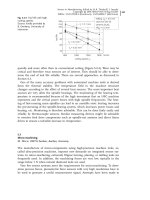
Cutting operations conducted on fiber-reinforced plastics are associated with the
well-known problem of the release of dust, which is why an extraction system
must normally be used during the machining process. The objective was to mea-
sure the efficiency of emission recording in the case of a machine design, which
had been adapted to meet the needs of a concrete machining situation (Figure
5.4-1). A measuring technique in which scattered light photometry is combined
with gravimetric particle analysis permitted comparison of the progressions with
time of the alveolar mass concentration with and without extraction. As demon-
strated by a comparison of the caliper gage, a proportion of fine dust is recorded
very rapidly and reverts to the starting level about 100 s after conclusion of the
milling operation [20].
5 Developments in Manufacturing and Their Influence on Sensors366
Fig. 5.4-1
Comparison of the aerosol concentration with and without an extraction facility
5.4.2
Dry Machining and Minimum Lubrication
Cooling lubricants have come to be accepted as essential elements in production
engineering. In many cases, they guarantee the quality of the machining outcome
in terms of tool life, surface quality, and part accuracy. However, in recent years,
the steadily increasing pressure on costs in manufacturing industries coupled
with more pressing questions relating to environmental compatibility and dispo-
sal of waste materials have caused many users to reexamine their use of cooling
lubricant [21, 22]. Against this background, it is easy to understand why industry
and research are putting so much effort into prolonging the service life of cooling
lubricants and reducing the amount required to zero – dry machining – if possi-
ble [23].
Generally, dry machining tends to facilitate the use of sensors to record and
monitor process variables. New or at least extended tasks arise, however, in the
field of temperature measurement. Process temperatures rise as a result of the
elimination of the cooling lubricant functions of cooling, lubrication, and chip
transport. This makes it all the more important to be able to determine the tem-
peratures of tools and workpieces.
5.4.2.1
Measuring Temperatures in Dry Machining Operations
The measurement of temperature during machining operations has been the sub-
ject of a number of investigations over many years. A comprehensive overview of
temperature measuring techniques was given by Lowack [24] and Kassbaum and
Löffler [25].
Owing to the process characteristics, not all of the methods are suitable for in-
process monitoring but can be used in basic investigations, eg, to determine the
input quantities for modeling. The methods which are suitable for process moni-
toring are presented in the following.
The use of thermal converters to measure temperatures in tools and workpieces
is one of the contact methods of determining temperature. This type of tempera-
ture measurement shows not the temperature in the object being measured, but
the temperature of the sensor. Ideally, the sensor and the object to be measured
are at the same temperature. In reality, this applies only in some cases. Heat
sources and heat sinks result in permanent heat transport [26].
The temperature field in tools has also been determined using a series of opti-
cal temperature measuring techniques [24]. Thermal imaging is a non-contact
measuring technique based on heat radiation and is therefore particularly suitable
for measuring the temperature of a rotating tool [27]. The measuring point, how-
ever, must be on a visible surface in order to ensure that in a drilling operation,
for example, the tool temperature can be measured at the point of exit of the tip
of the drill bit from a through hole.
A further feature of this technique is the considerable requirement for calibra-
tion. The direct correlation between the level of heat radiated and the absolute
5.4 Environmental Awareness 367