Unit 4. Volunteer work
Bạn đang xem bản rút gọn của tài liệu. Xem và tải ngay bản đầy đủ của tài liệu tại đây (144.88 KB, 10 trang )
<span class='text_page_counter'>(1)</span><div class='page_container' data-page=1>
Class(es): 11A
<i><b>UNIT 4: VOLUNTEER WORK (READING)</b></i>
<b>I.AIMS AND OBJECTIVES</b>
<b>1.Language content: To provide the students with some words about volunteeer work </b>
<b>2.Language function: Understanding more about volunteeer work.</b>
<b>3.Educational aim:</b>
<b>4.Language: Vocabulary: volunteer(v), volunteer(n), voluntary(a)…. </b>
<b>II.TEACHER’S AND STUDENTS’ PREPARATION</b>
<b>1. Method : Communicative Approach</b>
<b>2. Skills: Integrated skills (pay much attention to reading skill)</b>
<b>3.Techniques: questions-answers, explanation, definition …</b>
<b>4. Teaching aids needed : colour chalk, textbook, pictures…</b>
<b>5.Students’ preparation: Prepare the lesson at home</b>
<b>III.PROCEDURE IN CLASS</b>
<b>1.Stabilization:(1min) Greeting.</b>
<b>2.Checking up the previous knowledge: No checking </b>
<b>3.Presentation of the new materials:</b>
<b>Teaching</b>
<b>steps, time</b>
<b>location</b>
<b>Teacher’s activities</b> <b>Students’ activities</b> <b>The lesson content</b>
<b>I.Prese</b>
<b>ntation</b>
<b>of the </b>
<b>new </b>
<b>materi</b>
<b>al</b>
34mins
<b>I. Warm up: </b>
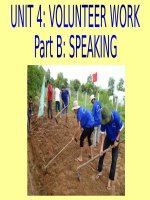
- Asks the question: What are the
people in the pictures doing?
- Tells the aim of the new lesson. (In
our lesson today, you will know
about volunteer work in the USA.)
<b>II. Pre-reading:</b>
- Helps the students know the
meaning of some words:
+ volunteer(v)
+ volunteer(n)
+ voluntary(a)
+ orphanage(n)
<b>III.While-reading:</b>
<b>* Task 1: </b>
- Has students complete each of the
following sentences individually.
- Checks the answers with the whole
class and gives correct answers.
<b>* Task 2: </b>
<b>- Has students choose the best </b>
answer from A, b, C or D for each of
the following sentences.
- Checks the answers with the whole
class and gives correct answers.
<b>* Task 3: </b>
<b>- Has students practise asking and </b>
answering the questions in pairs.
- Makes comments and gives the
correct answers.
<b>IV. Post-reading:</b>
<b>I. Warm up: </b>
Listen to the teacher
<b>II. Pre-reading:</b>
Listen, guess the meaning
of the words and take notes.
<b>III.While-reading:</b>
<b>* Task 1: </b>
Complete each of the
following sentences.
Listen to the teacher.
<b>* Task 2: </b>
Choose the best answer
from A, b, C or D for each
of the following sentences
in pairs.
<b>* Task 3: </b>
Listen to the teacher and
take notes.
<b>IV. Post-reading:</b>
<i><b>UNIT 4: VOLUNTEER WORK</b></i>
<i><b>(READING)</b></i>
<b>I. Vocabulary:</b>
+ volunteer(v)
+ volunteer(n)
+ voluntary(a)
+ orphanage(n)
<b>II/ Reading comprehension:</b>
<b>* Task 1: </b>
<b>Answers:</b>
1. voluntary 2. voluntarily
3. volunteers 4. volunteered
<b>* Task 2: </b>
<b> Answers: </b>
1. A (line 1-2, paragraph 2)
2. D (line 3-4, paragraph 2)
3. B (line 3-4, paragraph 4)
<b>* Task 3: </b>
1. They read books to the people
there, play games with them or listen
to their problems.(line 7-10, paragraph
1)
</div>
<span class='text_page_counter'>(2)</span><div class='page_container' data-page=2>
<b>steps, time</b>
<b>location</b> <b>Teacher’s activities</b> <b>Students’ activities</b> <b>The lesson content</b>
<b>II.Cons</b>
<b>olidation</b>
<b>III.Home</b>
<b>work</b>
5mins
- Has students discuss the questions
in groups:
<i>Why do people do volunteer work?</i>
- Makes comments.
No consolidation
Gets the students to learn new
words, answer the questions again
and to prepare for the next lesson.
Discuss the questions in
groups:
<i>Why do people do volunteer</i>
<i>work?</i>
Listen to the teacher and
take notes.
<b>III/ Homework</b>
- Learn new words, read the text and
answer the questions again
</div>
<span class='text_page_counter'>(3)</span><div class='page_container' data-page=3>
Class(es):11A
<i><b>UNIT 4: VOLUNTEER WORK (SPEAKING)</b></i>
<b>I. AIMS AND OBJECTIVES</b>
<b>1. Language content: To help students know how to talk about volunteer work & identifying types of volunteer work.</b>
<b>2. Language function: Talking about volunteer work and identifying types of volunteer work.</b>
<b>3. Educational aim:</b>
<b>4. Language: Vocabulary: invalid, martyr, intersection</b>
<b>II. TEACHER’S AND STUDENTS’ PREPARATION</b>
<b>1. Method : Communicative Approach</b>
<b>2. Skills: Integrated skills </b>
<b>3. Techniques: questions-answers, explanation, pairwork, groupwork, role-play</b>
<b>4. Teaching aids needed: colour chalk, textbook, handouts, pictures</b>
<b>5. Students’ preparation: Prepare the lesson at home</b>
<b>III. PROCEDURE IN CLASS</b>
<b>1. Stabilization:(1min) Greeting.</b>
<b>2. Checking up the previous knowledge (5mins) * Questions: Answer the questions: </b>
1. What do high school and college students usually do as volunteers in hospitals, orphanages or honmes for the aged?
2. How do volunteers help disadvantaged and handicapped children to overcome their difficulties?
<b>3.Presentation of the new materials:</b>
<b>Teaching</b>
<b>steps, time</b>
<b>location</b>
<b>Teacher’s activities</b> <b>Students’ activities</b> <b>The lesson content</b>
<b>I.Prese</b>
<b>ntation </b>
<b>of the </b>
<b>new </b>
<b>material</b>
34mins
<b>I. Warm up: </b>
- Has students answer the questions:
+ Do you want to be a volunteer?
+ Have you ever done volunteer
work?
- Tells the aim of the lesson.(In our
speaking lesson today, we talk about
types of volunteer work).
<b>II. Pre-speaking:</b>
- Helps students understand more
about the meaning of some words
and some necessary language for
talking about parties:
+ invalid(n)
+ martyr(n)
+ intersection(n)
<b>III.While-speaking:</b>
<b>* Task 1: </b>
- Has students decide which of the
following activities are volunteer
work in pairs.
- Makes comments.
<b>* Task 2: </b>
<b>- Works with a good student to give </b>
a model.
<i>A: What kind of volunteer work are </i>
<i>you participating in?</i>
<i>B: I’m taking part in directing the </i>
<i>traffic.</i>
<i>A: What exactly are you doing?</i>
<i>B: I’m directing vehicles at the </i>
<b>I. Warm up: </b>
Answer the questions.
Listen to the teacher.
<b>II. Pre-speaking:</b>
Listen, guess the meaning
of the words and take notes.
<b>III.While-speaking:</b>
<b>* Task 1: </b>
Decide which of the
following activities are
volunteer work in pairs.
Listen to the teacher.
<b>* Task 2: </b>
A good student practises
with the teacher.
<i><b>UNIT 4: VOLUNTEER WORK</b></i>
<i><b>(SPEAKING)</b></i>
<b>I. Vocabulary and languages:</b>
+ invalid(n)
+ martyr(n)
+ intersection(n)
<b>II/ Speaking tasks:</b>
<b>* Task 1: </b>
Decide which of the following
activities are volunteer work in pairs.
<b>* Task 2: </b>
<i>A: What kind of volunteer work are </i>
<i>you participating in?</i>
<i>B: I’m taking part in directing the </i>
<i>traffic.</i>
</div>
<span class='text_page_counter'>(4)</span><div class='page_container' data-page=4>
<b>steps, time</b>
<b>location</b> <b>Teacher’s activities</b> <b>Students’ activities</b> <b>The lesson content</b>
<b>II.Cons</b>
<b>olidation</b>
<b>III. Home</b>
<b>work</b>
5mins
<i>intersections.</i>
<i>…..</i>
- Makes corrections in
pronunciation, intonation and
grammar
<b>IV. Post-speaking: </b>
<b>* Task 3: </b>
- Has students talk about a kind of
volunteer work their friends and they
usually do to help people.
- Calls on some students to report
about their ideas in front of the class.
- Makes comments.
No consolidation
Gets the students to write a
paragraph about a kind of volunteer
work their friends and they usually
do to help people; and to prepare for
the next lesson.
Listen to the teacher.
<b>IV.Post-speaking: </b>
<b>* Task 3: </b>
Talk about a kind of
volunteer work their friends
and they usually do to help
people.
Listen to the teacher.
Listen to the teacher and
take notes.
<i>intersections.</i>
<i>…..</i>
<b>* Task 3: </b>
Decide on the following things to
come up with a plan for their parties.
<b>III/ Homework</b>
- Write a paragraph about a kind of
volunteer work their friends and they
usually do to help people.
- Prepare for the next lesson.
</div>
<span class='text_page_counter'>(5)</span><div class='page_container' data-page=5>
Class(es): 11A
<i><b>UNIT 4: VOLUNTEER WORK (LISTENING)</b></i>
<b>I.AIMS AND OBJECTIVES</b>
<b>1.Language content: To help students listen some information about the parties.</b>
<b>2.Language function: Listening some information about the parties.</b>
<b>3.Educational aim:</b>
<b>4.Language: Vocabulary: funraising, donation</b>
<b>II.TEACHER’S AND STUDENTS’ PREPARATION</b>
<b>1. Method : Communicative Approach</b>
<b>2. Skills: Integrated skills (pay much attention to listening skill)</b>
<b>3.Techniques: question-answer, explanation, discussion </b>
<b>4.Teaching aids needed: colour chalk, textbook, pictures, handouts, </b>
<b>5.Students’ preparation: Prepare the lesson at home</b>
<b>III.PROCEDURE IN CLASS</b>
<b>1.Stabilization:(1min) Greeting.</b>
<b>2.Checking up the previous knowledge(5mins)* Questions: Talk about a kind of volunteer work you usually do to </b>
help people.
<b>3.Presentation of the new materials:</b>
<b>Teaching</b>
<b>steps, time</b>
<b>location</b>
<b>Teacher’s activities</b> <b>Students’ activities</b> <b>The lesson content</b>
<b>I.Prese</b>
<b>ntation</b>
<b>of the </b>
<b>new </b>
<b>materi</b>
<b>al: </b>
34mins
<b>II.Conso</b>
<b>lidation</b>
<b>III.Home</b>
<b> work</b>
5mins
<b>I. Warm up: </b>
- Gets the students to answer the
questions: <i>Are they volunteer work?</i>
- Tells the aim of the new lesson.
<b>II. Pre-listening:</b>
- Pre- teaches vocabulary:
+ funraising activities(n)
+ donation(n)
+ co-operate(v)
+ co-ordinate(v)
<b>III.While-listening:</b>
<b>* Task 1: </b>
- Has students fill in the missing
information (individual work).
- Gives the correct answers.
<b>* Task 2 </b>
- Has students answer the following
questions in pairs.
- Makes comments and gives correct
answers.
<b>IV.Post-listening:</b>
- Has students summarize the story
about Spring School, using the
following suggestions in groups:
- Makes corrections and gives final
comments.
No consolidation
Gets the students to summarise the
main points of the lesson, learn by
heart all new words and to prepare
for the next lesson.
<b>I. Warm up: </b>
Answer the questions.
Listen to the teacher.
<b>II. Pre-listening:</b>
Listen, guess the meaning of
the words and take notes.
<b>III.While-listening:</b>
<b>* Task 1: </b>
Listen to the teacher and take
notes.
<b>*Task 2</b>
Answer the following
questions in pairs.
Listen to the teacher and take
notes.
<b>IV.Post-listening:</b>
talk about Mai’s birthday party
in groups.
Listen to the teacher.
Listen to the teacher and take
notes.
<i><b>UNIT 4: VOLUNTEER WORK</b></i>
<i><b>(LISTENING)</b></i>
<b>I. Vocabulary:</b>
+ funraising activities(n)
+ donation(n)
+ co-operate(v)
+ co-ordinate(v)
+ sponsor(n)
+ sponsor(n): nhà tài trợ
<b>II.Listening tasks:</b>
<b>* Task 1: </b>
<b>→ answers:</b>
1. informal
2. 30 street children
<b>* Task 2</b>
<b>→ answers:</b>
1. It provides classes to
disadvantaged children in Ho Chi
Minh City.
2. Dance, theatre, singing and
circus classes were set up in 1999.
<b>V. Homework</b>
- Summarise the main points of the
lesson, learn by heart all new
words.
</div>
<span class='text_page_counter'>(6)</span><div class='page_container' data-page=6>
Class(es): 11A
<i><b>UNIT 4: VOLUNTEER WORK (WRITING)</b></i>
<b>I.AIMS AND OBJECTIVES</b>
<b>1.Language content: To help students know how to write a formal letter expressing gratitude.</b>
<b>2.Language function: Writing a formal letter expressing gratitude.</b>
<b>3.Educational aim: To educate in the student the important role of parties in life.</b>
<b>4.Language: Vocabulary: issue(v), amount(n)</b>
<b>II.TEACHER’S AND STUDENTS’ PREPARATION</b>
<b>1. Method : Communicative Approach</b>
<b>2. Skills: Integrated skills </b>
<b>3.Techniques: questions-answers, explanation, translation. </b>
<b>4. Teaching aids needed : colour chalk, textbook, charts</b>
<b>5.Students’ preparation: Prepare the lesson at home</b>
<b>III.PROCEDURE IN CLASS</b>
<b>1.Stabilization:(1min) Greeting.</b>
<b>2.Checking up the previous knowledge(5mins) * Questions: Talk about Spring School.</b>
<b>3.Presentation of the new materials:</b>
<b>Teaching</b>
<b>steps, time</b>
<b>location</b>
<b>Teacher’s activities</b> <b>Students’ activities</b> <b>The lesson content</b>
<b>I.Prese</b>
<b>ntation</b>
<b>of the </b>
<b>new </b>
<b>materi</b>
<b>al: </b>
34mins
<b>I. Warm up: </b>
- Asks the students:
+ What kind of letter is it?
- Tells the aim of the new lesson.
<b>II. Pre-writing:</b>
+ issue(v)
+ amount(n)
- expressions
<i>+ On behalf of ... I am writing to </i>
<i>thank you for...</i>
<i>+ I would like to offer my sincerest </i>
<i>thanks to you for ...</i>
<i>+ My heartfelt thanks go to you for ...</i>
<i>+ I am very much obliged to you </i>
<i>for ...</i>
<i>+ I owe a great debt of gratitude to </i>
<i>youfor...</i>
<i>+ I would like to give special thanks </i>
<i>to you for...</i>
<b>III.While-writing: </b>
<b>* Task 1: </b>
- Has students read the letter and
underline the sentences that express
the following points individually.
<b>* Task 2: </b>
- Has the students write a letter to
acknowledge the receipt of donation
and express their gratitude in groups.
<b>IV. Post-writing: </b>
- Has students read their group’s best
writing, and ask students to give
comments.
<b>I. Warm up: </b>
Answer the question.
+ letter of invitation
Listen to the teacher.
<b>II. Pre-writing:</b>
Listen, guess the meaning of
some words and take notes.
<b>III.While-writing: </b>
<b>* Task 1: </b>
Read the letter and underline
<b>* Task 2: </b>
Write a letter to acknowledge
the receipt of donation
<b>IV. Post-writing:</b>
Work in groups of five, read
and correct their friends’
writing.
<i><b>UNIT 4: VOLUNTEER WORK</b></i>
<i><b>(WRITING)</b></i>
<b>I. Vocabulary:</b>
+ issue(v)
+ amount(n)
* Some useful expressions
<i>+ On behalf of ... I am writing to </i>
<i>thank you for...</i>
<i>+ I would like to offer my sincerest</i>
<i>thanks to you for ...</i>
<i>+ My heartfelt thanks go to you </i>
<i>for ...</i>
<i>+ I am very much obliged to you </i>
<i>for ...</i>
<i>+ I owe a great debt of gratitude </i>
<i>to youfor...</i>
<i>+ I would like to give special </i>
<i>thanks to you for...</i>
<b>II. Writing tasks:</b>
<b>* Task 1: </b>
<b>→ Answer: </b>
+The opening of the letter: S.1
+ The donated amount: sentence 1
* Task 2:
<b>* A sample letter:</b>
Hanoi, Viet Nam
May 10, 2006
Dear Sir,
</div>
<span class='text_page_counter'>(7)</span><div class='page_container' data-page=7>
<b>location</b>
<b>II.Conso</b>
<b>lidation</b>
<b>III. Home</b>
<b> work</b>
5mins
- Gives feedback.
<b>* A sample letter:</b>
Hanoi, Viet Nam
May 10, 2006
Dear Sir,
I am very happy to receive a donation
of one million doing from your
organization some days ago. The
money will help us to build our school
library. We will certainly issue a
receipt as soon as possible.
I would like to express our thanks for
the donation from your organization
and hope to get more assistance and
cooperation from your company in the
fuutre.
I look forward to hearing from you
soon.
Your faithfully,
Secretary
School Building Fund
No consolidation
Gets the students to write a thank-you
letter at home and to prepare for the
next lesson.
Listen to the teacher and take
notes.
Listen to the teacher and take
notes.
donation of one million doing from
your organization some days ago.
The money will help us to build
our school library. We will
certainly issue a receipt as soon as
possible.
I would like to express our thanks
for the donation from your
organization and hope to get more
assistance and cooperation from
your company in the fuutre.
I look forward to hearing from you
soon.
Your faithfully,
Secretary
School Building Fund
<b>III/ Homework</b>
- Write a thank-you letter.
- Prepare for the next lesson.
</div>
<span class='text_page_counter'>(8)</span><div class='page_container' data-page=8>
Class(es): 11A
<i><b>UNIT 4: VOLUNTEER WORK (LANGUAGE FOCUS)</b></i>
<b>I.AIMS AND OBJECTIVES</b>
To help students distinguish the sounds /w/ and /j/ and pronounce the words and sentences containing these sounds
correctly.
<b>* PRONUNCIATION: /w/ and /j/</b>
<b>* GRAMMAR: Gerunds and present participles; Perfect gerunds and perfect participles.</b>
<b>II.TEACHER’S AND STUDENTS’ PREPARATION</b>
<b>1. Method : Communicative Approach</b>
<b>2. Skills: Integrated skills </b>
<b>3. Techniques: questions-answers, explanation, tense using, sentence completion. </b>
<b>4. Teaching aids needed : colour chalk, textbook, handouts, realia</b>
<b>5. Students’ preparation: Prepare the lesson at home</b>
<b>III.PROCEDURE IN CLASS</b>
<b>1. Stabilization:(1min) Greeting.</b>
<b>2. Checking up the previous knowledge(5mins)* Questions: Read the letter and underline the sentences that express</b>
the following points:
a. The opening of the letter c. The way(s) the money is used e. The gratitude to the donor
b. The donated amount d. The way the receipt is issued f. The closing of the letter
<b>3.Presentation of the new materials:</b>
<b>Teaching</b>
<b>steps, time</b>
<b>location</b> <b>Teacher’s activities</b> <b>Students’ activities</b> <b>The lesson content</b>
<b>I.Prese</b>
<b>ntation</b>
<b>of the </b>
<b>new </b>
<b>materi</b>
<b>al: </b>
29mins
<b>A. PRONUNCIATION</b>
<b>I. Lead-in: </b>
- Introduces the sounds /w/ and /j/.
<b>II. Pre-practice:</b>
- Models the two sounds /w/ and /j/
for a few times and explains the
differences in producing them.
- Corrects if students pronounce the
target words incorrectly.
<b>III. Controlled -practice:</b>
- Has students read aloud the given
sentences in pairs.
- Corrects their mistakes.
<b>IV. Free-practice:</b>
- Has students give examples with the
sounds /w/ and /j/.
- Gives comments.
<b>B. GRAMMAR</b>
<b>1. GERUNDS & PRESENT </b>
<b>PARTICIPLES </b>
<b>2. PERFECT GERUNDS & </b>
<b>PERFECT PARTICIPLES</b>
<b>I. Lead-in: </b>
- Has students answer the questions:
- Tells the aim of the new lesson.
<b>II. Pre-practice:</b>
<b>- Elicits the forms and usages of </b>
gerund or present participle, perfect
gerund or perfect participle from
<b>A. PRONUNCIATION</b>
<b>I. Lead-in:</b>
Listen to the teacher.
<b>II. Pre-practice:</b>
Listen to the teacher and
take notes.
Listen to the teacher.
<b>III.Controlled -practice:</b>
Read aloud the given
sentences and underline the
words with the sounds /w/
and /j/ in pairs.
<b>IV. Free-practice:</b>
Give examples with the
sounds /w/ and /j/.
Listen to the teacher.
<b>B. GRAMMAR</b>
<b>1. GERUNDS & </b>
<b>PRESENT PARTICIPLES</b>
<b>2. PERFECT GERUNDS </b>
<b>& PERFECT PARTICIPLES</b>
<b>I. Lead-in: </b>
Answer the questions:
Listen to the teacher.
<b>II. Pre-practice:</b>
Listen to the teacher,
answer the question and
take notes.
<i><b>UNIT 4: VOLUNTEER WORK</b></i>
<i><b>(LANGUAGE FOCUS)</b></i>
<b>I. PRONUNCIATION</b>
<b>/w/ and /j/</b>
<b>II. GRAMMAR</b>
<b>1. GERUNDS & PRESENT </b>
<b>PARTICIPLES 2. PERFECT </b>
<b>GERUNDS & PERFECT </b>
<b>PARTICIPLES</b>
</div>
<span class='text_page_counter'>(9)</span><div class='page_container' data-page=9>
<b>location</b>
students.
<b>2. Present participle: </b>
<b>a. as part of the continuous form of </b>
<b>a verb</b>
Example: <i>I am <b>working</b>.</i>
<i> She was <b>dancing</b>.</i>
<b>b. after verbs of movement/position </b>
<b>in the pattern:verb+present participle</b>
Example:
<i>- My mother used to go <b>shopping</b></i>
<i>everyday.</i>
<b>3. Perfect gerund and perfect </b>
<b>participle</b>
<b>a. Perfect gerund:</b>
- Form: having + P.P
Example:
<i>He was accused of deserting his ship </i>
<i>= He was accused of having deserted </i>
<i>his ship.</i>
<b>b. Perfect participle:</b>
- Form: having + P.P
- Use:
Example:
<i>He had been living there for such a </i>
<i>long time that he didn't want to move </i>
<i>to another town. →Having lived there</i>
<i>for such a long time, he didn't want to</i>
<i>move to another town.</i>
<b>III.Controlled -practice:</b>
<b>* Exercise 1: </b>
- Has students complete the sentences
with an appropriate gerund of the
verbs from the box individually; then
check their answers with a partner.
- Checks the answers with the whole
class and provides correct answers.
<b>* Exercise 2: </b>
- Has students complete the sentences
- Checks the answers with the whole
class and gives correct answers.
<b>* Exercise 3: </b>
<b>- Has students put the verbs in </b>
brackets into the perfect
gerund/perfect participle individually;
then check their answers with a
partner.
<b>IV. Free-practice: </b>
- Has students do some more
exercises in pairs.
- Goes around the class and provides
help when necessary.
- Calls on some students to write the
sentences on the board.
- Checks the answers with the whole
class and gives correct answers.
<b>II.Controlled -practice:</b>
<b>* Exercise 1: </b>
Complete the sentences
with an appropriate gerund
of the verbs from the box
individually;
<b>* Exercise 2: </b>
Complete the sentences
with an appropriate present
participle of the verbs
<b>* Exercise 3: </b>
Put the verbs in brackets
into the perfect
gerund/perfect participle.
<b>IV.Free-practice: </b>
Do some more exercises in
pairs.
Write the sentences on the
board.
function as a noun (although it looks
like a verb), so it can be used:
<b>2. Present participle: </b>
<b>a. as part of the continuous form </b>
<b>of a verb</b>
Example: <i>I am <b>working</b>.</i>
<i> She was <b>dancing</b>.</i>
<b>b. after verbs of movement/position </b>
<b>in the pattern:verb+present participle</b>
Example:
<i>- My mother used to go <b>shopping</b></i>
<i>everyday.</i>
<b>3. Perfect gerund and perfect </b>
<b>participle</b>
<b>a. Perfect gerund:</b>
- Form: having + P.P
Example:
<i>He was accused of deserting his ship</i>
<i>= He was accused of having </i>
<i>deserted his ship.</i>
<b>b. Perfect participle:</b>
- Form: having + P.P
- Use:
Example:
<i>He had been living there for such a </i>
<i>long time that he didn't want to </i>
<i>move to another town. →Having </i>
<i>lived there for such a long time, he </i>
<i>didn't want to move to another town.</i>
<b>III. Exercises:</b>
<b>* Exercise 1: </b>
<b>→ answers:</b>
1. hearing 4. meeting 7. starting
2. bending 5. spending
3. behaving 6. waiting
<b>* Exercise 2: </b>
<b>→ answers:</b>
1. burning - rising 3. lying
2. reading 4. shopping
<b>* Exercise 3: </b>
<b>answers:</b>
</div>
<span class='text_page_counter'>(10)</span><div class='page_container' data-page=10>
<b>steps, time</b>
<b>location</b> <b>Teacher’s activities</b> <b>Students’ activities</b> <b>The lesson content</b>
<b>II.Cons</b>
<b>olidation</b>
<b>(5mins)</b>
<b>III.Home </b>
<b> work</b>
5mins
- Has students repeat the forms of
gerund or present participle, perfect
gerund or perfect participle.
- Makes comments.
Gets the students to review the
grammar points they have learnt and
to prepare for the next lesson.
Listen to the teacher and
take notes.
<b>III/ Homework</b>
- Review the grammar points the
students have learnt.
</div>
<!--links-->