E8 W 5 P13-15 UNIT 3 SPEAK LISTEN READ WRITE
Bạn đang xem bản rút gọn của tài liệu. Xem và tải ngay bản đầy đủ của tài liệu tại đây (217.28 KB, 16 trang )
<span class='text_page_counter'>(1)</span><div class='page_container' data-page=1>
<b>Date of planning:14/9/2018 Period: 13</b>
<b> </b>
<b>UNIT 3: AT HOME</b>
<b>LESSON 2: SPEAK + LISTEN</b>
<b>A.Objectives:</b>
<b>1. Aims: By the end of the lesson, ss will be able to describe positions of things in the </b>
kitchen and ss will be able to listen to a dialogue about how to cook a meal and check
the right items
<b>2. Practice skill: </b>
- Practice listening, speaking.
<b> 3. The knowledge needs to get:</b>
<b>+ Standard knowledge:Describe positions of things in the kitchen, Listen to a dialogue</b>
about how to cook a meal and check the right items.
<b> + Advanced knowledge: Describe positions of things in the kitchen and other places </b>
in their house, Write a passage to guide how to cook Chinese Fried Rice
<b>4. Basic language:</b>
<b>+ Vocabulary: bowl(n); plate(n) ; rug(n); cushion(n). fried rice(n); garlic(n) ; </b>
teaspoon(n); until(prep); ham(n).
+ Structures: - The + N + be + prepositions of position + the + N
S
- Let’s put …+ prepositions of position + the + N
<b>5. Attitude:</b>
Help ss to have good consciousness in order to describe positions of things in the
room, listen to a dialogue about how to cook a meal. Learn hard and to be tidy
<b>B. Teaching- aids: </b>
Lesson plan, textbooks, pictures, poster.
<b>C. Methods:</b>
- Model-Talk-Practice, individual work, pair work
- Some techniques can be used: Networks, Asking and Answering, Rub out and
Remember, Predictions.
<b>D. Procedure :</b>
<b>I.Organization: ( 1 minute)</b>
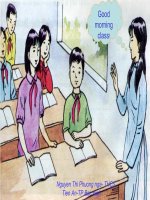
<b>-</b> Greeting: Good morning!
<b>-</b> Who’s absent today?
<b>Class</b> <b>Date of teaching</b> <b>Absent students</b>
<b>8</b>
<i><b>Teacher’s and students’ activities</b></i> <b>Content</b>
II.Warm up (5’)
- T divides the class into 2 teams, shows
the picture on page 28.
</div>
<span class='text_page_counter'>(2)</span><div class='page_container' data-page=2>
- T asks them to study the things in the
picture for 30 seconds.
- T takes away the picture and asks Ss to
write down as many things as they can
remember. Which team having more
things wins the games.
- T asks Ss the positions of the items in
the picture.
- Ss work in pairs (ask and answer
together)
- Ss ask and answer in pairs (opened
pairs, closed pairs)
- Ss write in the notebooks
<b>II. New lesson:</b>
<b>* Speaking</b>
<b>1.Pre speaking (5’)</b>
- T gives an example
- T gets Ss to work in pairs, talking about
the position of each item
- Ss work in pairs while looking at the
picture
<b>2.While speaking (8’)</b>
- T sets the scene:” Mrs. Vui bought new
furniture for her living-room, but she
can’t decide where to put them. You
should help her to arrange the furniture”
- T asks Ss to look at the picture and
arrange
- Ss work in pairs (arrange the furniture)
- T asks Ss to practice speaking
If they agree, they use :
OK
Group B
<i><b>1. Look at the picture. Work with a</b></i>
<i><b>partner. Talk about the position of</b></i>
<i><b>each item: </b></i>
- Where is the clock?
<i>It’s above the fridge</i>
- Where is the fruit?
<i>It’s in the bowl</i>
- Where are the flowers?
<i>They’re on the table</i>
- Where is the rice cooker?
<i>It’s next to the bowl of fruit</i>
- Where is the cupboard?
<i>It’s on the wall, above the counter</i>
- Where are the knives?
<i>They’re on the wall, under the</i>
<i>cupboard</i>
- Where is the dish rack?
<i>It’s on the counter, next to the bowl</i>
<i>of fruit</i>
<i><b>2. Work with a partner and arrange</b></i>
<i><b>the furniture. </b></i>
<i>Ex: - Let’s put the clock on the wall,</i>
between the shelf and the picture
- OK, I think we ought to put the
T.V and the stereo on the shelf
- I think the coffee table should be
between the couch and the armchair
- Let’s put the telephone next to
the couch
</div>
<span class='text_page_counter'>(3)</span><div class='page_container' data-page=3>
You are right
If they disagree, they use :
No, I think we’d better / ought to
put …
I think it should be …
<b>3.Post speaking (5’)</b>
Ss tell about the furniture in their kitchen
*LISTENING
<b>1. Pre - listening : (5’)</b>
- T asks some questions
- Ss answer
- All right today we will learn how to
cook the fried rice “The special Chinese
fried rice”
- T asks Ss to look at the pictures on page
30 and match these words with the
correct pictures
- Ss match
- T asks Ss to read again these words
( chorus, individually)
- T points at each picture, asks Ss to read
again
- Ss read again (chorus)
Checking:
- T cleans all words, asks Ss to write
again
- Two Ss from 2 groups write again on
the board (one faster is the winner). Clap
the hands group
Predictions:
- T asks: Now you look at the pictures
and guess 4 things used to cook the
Special Chinese Fried Rice (in 2
minutes)
- Ss guess a1 or a2, b1 or b2, etc…
- T asks Ss to stop and compare together
(in 1 minute)
shelf
- I think the shelf ought to be a one
of the corners, opposite the couch.
<b> Pre - listening :</b>
- Do you usually have breakfast before
going to school?
- What do you often have for
breakfast?
- Do you like to eat fried-rice?
- Do you know how to make this
food?
Matching:
- Chicken and peas
- Fried
- A steamer
- Garlic and onions
- A pan
- Noodles
- Ham and peas
- Garlic and green peppers
Rub out and Remember:
Predictions:
Look at the pictures, check the
right item to cook the Special
Chinese Fried Rice
</div>
<span class='text_page_counter'>(4)</span><div class='page_container' data-page=4>
- T asks: Who can write on the board
your guessing?
- A student writes on the board
- T says: Thank you, now all of you
listen to the tape
<b>2.While - listening : (8’)</b>
- Ss listen and write
- T plays the tape again
- Ss listen carefully
- T asks Ss to write on the board
- Ss write on the board
- T corrects
- Ss notice
<b>3. Post - listening :(5’)</b>
- T asks: After you listen, you choose 4
things from 8 pictures used to cook the
Special Chinese Fried Rice. How do we
cook it?
- T retells how to cook it
- Ss listen
- T asks Ss to work in groups
- 4 groups of Ss retell and write on the
posters
- Each group retells
- T asks another groups observe
- T remarks, gives marks each group
- T calls a student retells how to cook it
- A student points at the pictures and
retells
- T gives feedback and marks
- A student writes on the board how to
cook the Special Chinese Fried Rice
- T gives feedback and marks
- T says: beside the Special Chinese
Fried Rice, who can cook other food?
- Ss answer
- Ss listen
Mark
<b>Post - listening :</b>
Write-it-up :
<i><b>How to cook the Special Chinese</b></i>
<i><b>Fried Rice</b></i>
- First : use a big pan
- Then : pour some oil in, wait until
it’s hot
- Next : fry the garlic and the green
peppers
- After that : put the ham and the peas
into
- Finally : put some rice and add some
salt in
<i><b>IV. Summary(1’)</b></i>
- T reminds Ss the way to describe furniture in the living-room and make food.
<i><b>V.Homework:(2)</b></i>
</div>
<span class='text_page_counter'>(5)</span><div class='page_container' data-page=5>
- Prepare : Unit 3: L3 Read (page 31)
<b>*Evaluation:</b>
- Contents: ………..
- Methods: ………..
- Time: ………
……….
</div>
<span class='text_page_counter'>(6)</span><div class='page_container' data-page=6>
<b>Date of planning: 14/9/2018 Period : 14</b>
<b> </b>
<b>UNIT 3: AT HOME</b>
<b>LESSON :3 READ</b>
<b>A.Objectives:</b>
<b>1. Aims: By the end of the lesson, ss will be able to read and understand a passage </b>
about the safety precautions in the home
<b>2. Practice skill: </b>
- Practice reading.
<b> 3. The knowledge needs to get:</b>
<b>+ Standard knowledge: Read and tick the boxes, then correct the false ones (exercise </b>
1) and answer the questions (exercise 2)
<b> + Advanced knowledge: Write a list of the things that children should or shouldn’t do </b>
to be safe at home
<b>4. Basic language:</b>
+ Vocabulary: safety (n); precaution (n); chemicals (n) ; lock (v); soft (a); dangerous
(a); match (n); destroy (v) ; injure (v); cause a fire(v); cover(v); electrical socket;
kill(v); object(n).
+ Structures: Present simple, must, have to
<b>5. Attitude: Educate Ss to have safety precautions at the home</b>
<b>B. Teaching- aids: </b>
Lesson plan, textbooks, pictures, poster.
<b>C. Methods:</b>
- Model-Talk-Practice, individual work, pair work
- Some techniques can be used: Matching, Slap the board, Predictions
<b>D. Procedure :</b>
<b>I.Organization: ( 1 minute)</b>
<b>-</b> Greeting: Good morning!
<b>-</b> Who’s absent today?
<b>Class</b> <b>Date of teaching</b> <b>Absent students</b>
</div>
<span class='text_page_counter'>(7)</span><div class='page_container' data-page=7>
<b>Teacher’s activities</b> <b>Students’ activities</b>
<b>II. Warm up: (5’) </b>
- Ss remind how to do “Salad” Others
listen
- T remarks and gives Ss how to do
“Salad”
- T gives Ss to match (ingredients) to do
“Salad”
- Ss match
1. Lecture 5. cucumber
2. carrot 6. salad oil
3. onions 7. salt
4. tomatoes 8. apple
Keys
1 - c 5 - f
2 - e 6 - d
3 - h 7 - a
4 - b 8 - g
<b>III. New lesson:</b>
<b>Step 1.Pre reading (10’)</b>
*Aim: -SS can understand and
pronounce the new words.
T introduces the content of the lesson:
The safety precautions at the home
*Methods: Slap the board, T/F
* Work arrangement: Pair, group work,
Individual
* Time: 10’
* Procedure
<b>1. Vocab</b>
- T reads once - Ss listen
- T reads again - Ss read after and guess
the meaning
- T asks Ss to read one more time (in
chorus, individually)
- T corrects if necessary
Checking :
- T puts new words all over the board
- T calls 2 Ss to the front of the class. asks
them to stand at an equal distance from
the board
- T calls out one of the new words (in
Matching: (Ingredients)
a. dầu thực vật
b. cà chua
c. xa lách
d. 1 quả táo
e. củ cà rốt
f. dưa chuột
g. muối
h. củ hành
New words:
- a pre’caution : (translation): sự đề
phòng
- a ‘socket : (realia): ổ cắm điện
- a match : (realia): que diêm
- an ‘object : (translation): vật, đồ
dùng
- ‘safety (a) : (translation): sự an toàn
- (to) ‘destroy : (translation): phá hủy
- (to) ‘injure : (picture): làm bị
thương
Slap the board :
</div>
<span class='text_page_counter'>(8)</span><div class='page_container' data-page=8>
Vietnamese) in aloud voice
- 2 Ss must run forward and slap the word
on the board. The one who first slaps the
correct word is the winner and gets mark
the asks 2 more Ss to come forward, etc
…
<b>2.While – reading: (16’)</b>
*Aim: -SS can read, understand the text
check T/F and answer the questions.
*Methods: T/F, Q & A
* Work arrangement : Individual, pair
work
* Time: 16’
* Procedure
- T asks Ss to read the statements and
guess which is True, which is False
- Ss read the poster and check their
Predictions
- Ss correct if the statements are false
- T asks Ss to work in pairs to find out the
answers of these questions
- T gives feedback
- T asks Ss to work in opened pairs and
then closed pairs
- Ss practice
<b>3. Post - reading : (10’)</b>
*Aim: -SS can discuss about Safety
precautions in the street and at school.
*Methods: Discussion
* Work arrangement: Individual, pair
work
* Time: 10’
1. True or False? Check ( ) the
boxes. Correct the false statements:
Guess Correct
a.
b.
c.
d.
e.
f.
F
T
F
F
T
T
a. It is safe to keep medicine in locked
cupboard.
c. A kitchen is a dangerous place to
play.
d. Playing with one match can cause a
fire.
2. Ask and answer
a. Because children often try to eat
and drink them
b. Because the kitchen is a danger
-our place
c. Because playing with one match
can cause the fire
d. Because children often try to put
something into electrical sockets and
electricity can kill
e. Because the dangerous objects can
injure or kill children
Discussion:
a. Safety precautions in the street
To stay safe walking, follow these rules of
the road
-If there is no sidewalk and you must walk
on the side of the road, choose the side
where you are facing oncoming traffic
</div>
<span class='text_page_counter'>(9)</span><div class='page_container' data-page=9>
* Procedure
- T asks Ss to work in groups, discussing
about the topic
- Ss work in groups
wise to cross only when you have the
pedestrian crossing light
- Share the road and path with bikes and
runners
b. Safety precautions at school
<i><b>IV. Summary(1’)</b></i>
T reminds ss of the question beginning with “BECAUSE” and how to answer it.
<i><b>V. Homework:(2’)</b></i>
- Write again the answers 2 page 32 at home
- Do exercises 5, 6 page 24, 25
- Learn by heart new words
- Prepare: Unit 3: L 4 Write (page 32, 33)
<b>*Evaluation:</b>
- Contents: ………..
- Methods: ………..
- Time: ………
…….
……….
11 Walking Safety Rules
<b>How to Stay Safe Walking on the Sidewalk, Path, or Road</b>
By Wendy Bumgardner | Reviewed by Richard N. Fogoros, MD
Updated January 13, 2018
Pin
Flip
Email
PRINT
Wendy Bumgardner ©
More in Walking
Beginners
Walking for Weight Loss
Treadmill Walking
Long Distance Walking
Walking Fast
Gear and Clothing
Pedometers and Fitness Bands
Injuries and Prevention
VIEW ALL
</div>
<span class='text_page_counter'>(10)</span><div class='page_container' data-page=10>
1. Walk Facing Traffic When Walking on the Side of the Road
If there is no sidewalk and you must walk on the side of the road, choose the side where you are facing
oncoming traffic. In North America, this is the left side of the road. This gives you the best chance to
see traffic approaching closest to you and take evasive action when needed. This may be confusing
because the opposite rule is true for cyclists, who cycle in the same direction as the traffic flow.
2. Cross Safely
Your mother was right—you should look both ways before crossing any street. At controlled
intersections, it is wise to cross only when you have the pedestrian crossing light. Even then, drivers
and bikers may have a green light to turn and won't be expecting you to be in the crosswalk. Make eye
contact with any drivers who may be turning. Give them a wave. Make sure they see you. In an
interaction between a vehicle and a walker, the walker can only lose. It can be tempting to
simply jaywalk, but that is not only a safety hazard, it can result in getting a ticket.
3. Walk Single File When Not Separated from the Road
Unless you are on a sidewalk separated from the road or you are in a wide bike/pedestrian lane, you
should walk in single file. This is especially important on a road with lots curves and where traffic has
only a split second chance of seeing you before hitting you. While it can be enjoyable to walk down
the road two to three abreast chatting merrily, drivers don't expect it and you may lose your best
walking buddies.
4. Stay Aware of Bikes and Runners
Share the road and path with bikes and runners. Bike riders should alert you when approaching from
behind with a bike bell or a "passing on the left/right." Listen for them, and move to walk single file,
allowing them to pass safely. Runners should also call out for passing. Bike-walker collisions can
result in broken bones or head injury for either—and you aren't wearing a helmet.
5. Be Visible
</div>
<span class='text_page_counter'>(11)</span><div class='page_container' data-page=11>
6. Be Predictable
Make a practice of staying on one side of the path while walking rather than weaving randomly from
side to side. Watch your arm motions, or you may end up giving a black eye to a passing walker,
runner, or biker.
7. Keep the Volume Down
Don't drown out your environment when listening to music with your earbuds or headphones. Keep
the volume at a level where you can still hear bike bells and warnings from other walkers and runners.
Your audiologist will also thank you.
8. Hang Up and Eyes Up
Distracted walking due to chatting, texting, or playing games like Pokemon Go on a mobile device
while you walk is as dangerous as doing those things while driving. You are distracted and not as
aware of your environment. You are less likely to recognize traffic danger, tripping hazards, or passing
joggers and bikers. Potential criminals see you as a an easy target. Adopt habits that can keep your
phone in your pocket, or at least make it a practice to stop in a safe place to complete your phone tasks
before moving on.
9. Walk Dogs on Short Leashes
It is terrifying and tragic to witness dogs running out in to traffic or getting into a fatal dog fight,
whether on leash or off leash. But when walking your dog on a long leash there is also a danger that
you will trip other walkers or bikers. You will keep your dog safer as well as those who pass by you if
you use proper leash walking etiquette.
10. Know When to Stop Walking
Heat sickness, dehydration, heart attack, or stroke can strike walkers of any age. Learn the symptoms
of medical emergencies and carry a cell phone to dial 911. Even if you are a seasoned and well-trained
walker, you may experience one of these problems and need to cut your walk short. Encourage your
walking friends to stop when they show any concerning symptoms.
11. Be Aware of Stranger Danger
</div>
<span class='text_page_counter'>(12)</span><div class='page_container' data-page=12>
a store or public building to avoid them. Acting alert and aware can convince bad guys you are not an
easy target.
Use these rules to enjoy safer walking workouts and avoid injuries and accidents.
6 Rules for School
Safety
Back-to-school does not have to mean back-to-worrying.
BY SCHOLASTIC PARENTS STAFF
AGES
5-13
<i>Back-to-school doesn't have to mean back-to-worrying. Though safety inside your</i>
child's school is ultimately the responsibility of the principal and school staff, parents
can take a few basic steps to ensure a safe school experience, too. These are
recommended by the National Association of Elementary School Principals:
1. <b>Learn the school's emergency procedures. Emergency plans and phone</b>
numbers are usually included in school handbooks and posted in classrooms.
Taking a few extra minutes to familiarize yourself and your child with
emergency information can give him the confidence he needs to act quickly in
emergency situations.
2. <b>Know travel routes to and from the school. Make sure you and your child</b>
know both primary and alternate routes. In an emergency, roads can be
blocked and it's important to have a backup plan.
3. <b>Know and follow school security and safety measures. These might include</b>
signing in when visiting the school, being escorted when walking through the
building, or wearing a visitor pass. Following these procedures also sets a great
example for your kids.
4. <b>Talk with your child about safety. Be specific. Talk about instinct and paying</b>
</div>
<span class='text_page_counter'>(13)</span><div class='page_container' data-page=13>
(find a teacher, call 911, etc.). Make sure she knows how to contact you or
a trusted neighbor who is likely to be at home.
5. <b>Inform school staff about health and emotional concerns. Whether your</b>
child has a food allergy, a physical disability, or has been subject to bullying,
make sure to keep your child's teachers and principal in the loop.
6. <b>Get involved. Talk with the principal about what you can do to increase school</b>
safety, such as organizing parents to form a neighborhood watch before and
after school. Sometimes parent groups are highly successful in making
improvements in traffic safety during drop off and pick up times.
<b>MORE: Shop Back-to-School Stories</b>
<b>Date of planning:14/9/2018 Period: 15</b>
<b>UNIT 3: AT HOME</b>
<b>LESSON :5 WRITE </b>
<b>A.Objectives:</b>
<b>1. Aims: By the end of the lesson, ss will be able to write a description of a room using </b>
word cues and the picture
<b>2. Practice skill: </b>
- Practice writing.
<b> 3. The knowledge needs to get:</b>
<b>+ Standard knowledge: Write a description of the kitchen using word cues and the </b>
picture cues
<b> + Advanced knowledge: Write a description of a room well.</b>
<b>4. Basic language:</b>
+ Vocabulary: corner (n); oven(n); towel rack(n); counter(n); beneath(prep); ; jar(n);
flour(n); lighting fixture(n); above(prep); vase(n); wardrobe(n)
+ Structures: Structure of describing the position
On the other side
In the right corner
<b>5. Attitude:</b>
Help ss to have good consciousness in order to write a description of a room using
word cues and the picture. Help ss to learn hard and be tidy
<b>B. Teaching- aids: </b>
Lesson plan, textbooks, pictures, poster.
</div>
<span class='text_page_counter'>(14)</span><div class='page_container' data-page=14>
- Model-Talk-Practice, individual work, pair work
- Some techniques can be used: Network, Rub out and Remember, Asking and
Answering
<b>D. Procedure :</b>
<b>I.Organization: ( 1 minute)</b>
<b>-</b> Greeting: Good morning!
<b>-</b> Who’s absent today?
<b>Class</b> <b>Date of teaching</b> <b>Absent students</b>
<b>8</b>
<b>Teacher’s and Students’ activities</b> <b>Content</b>
Revision :
- T calls Ss to remind “Danger in the
home for children”
- Ss write on the board
Chatting:
- T asks St about the room / 32
- Ss answer
<b>III. New lesson:</b>
<b>1. Pre - writing:(7’)</b>
*Aim: -SS can understand and
pronounce the new words about the
room .
T introduces the content of the lesson:
writing a description of a room
*Methods: R & R, Q & A.
* Work arrangement: Pair, group work,
Individual
* Time: 7’
* Procedure
<b>II. Warm up(5’) </b>
- Which room is this?
- What’s this?
- Where is it?
New-words:
- ‘folder : bìa cứng (làm cặp giấy)
- ‘wardrobe: tủ áo
- be’neath (adv/adj): ở phía dưới
- ‘towel rack : giá treo khăn
- ‘dish rack : gác đĩa
</div>
<span class='text_page_counter'>(15)</span><div class='page_container' data-page=15>
Pre-teach:
- T reads once - Ss listen
- T reads again - Ss read after and guess
the meaning
- T asks Ss to read one more time (in
chorus, individually)
- T corrects if necessary
Checking :
- T gets Ss to copy the words into their
books and then asks them to close the
books
- T rubs out the new words one at a time.
Each you rub out a word in English,
point to the Vietnamese translation and
ask “What’s this in English?” When all
the English words are rubbed out, to
through the Vietnamese list and get Ss to
call out the English words
- T asks Ss to read the description of
Hoa’s room, then ask some
comprehension questions
- Ss read in silence then answer the
questions (individually) then in pairs
Answers:
a. There is a desk on the left of the room
b. The bookshelf is above the desk
c. There is a window on the right side of
the room
d. the wardrobe is beside the window
and opposite the desk
<b>2. While - writing :(15’) </b>
*Aim: -SS can understand and practice
writing a description
*Methods: Writing
* Work arrangement: Individual, pair
work
* Time: 15’
* Procedure
- T asks Ss to describe Hoa’s kitchen
using the given cues
- Ss write (individually)
<i>1. Read the description of Hoa’s room</i>
<i>(page 32) : </i>
Question<b> s :</b>
a. What is there on the left of the room?
b. Where is the bookshelf?
c. What is there on the right side of the
room?
d. Where is the wardrobe?
<i>2. Now write a description of this</i>
<i>kitchen (page 33)</i>
- This is Hoa’s kitchen
- There is a refrigerator on the right
corner of the room
- Next to the refrigerator is the stove
and the oven
- On the other side of the oven, there is
a sink and next to the sink there is a
towel rack
</div>
<span class='text_page_counter'>(16)</span><div class='page_container' data-page=16>
<b>3.Post writing(8’)</b>
- T asks Ss to share with their partners
- T corrects the mistakes
<i><b>IV. Summary (1’)</b></i>
- Talk to their partners about their
room / living room / kitchen
<i><b>V. Homework: (2’)</b></i>
- Write a description of their
bed-room / living bed-room
- Learn by heart new words
- Prepare : Unit 3: L5 Language
focus page 34, 35
--- On the shelves and on the counter
beneath the window, there are jars of
sugar, flour and tea
- In the middle of the kitchen, there is a
table and there are four chairs
- The lighting fixture is above the table,
and directly beneath the lighting fixture
is a vase with flowers
<b>*Evaluation:</b>
- Contents: ………..
- Methods: ………..
- Time: ………
</div>
<!--links-->