Tải Đề thi khảo sát chất lượng lần 1 môn Tiếng Anh lớp 11 trường THPT Hàn Thuyên, Bắc Ninh năm 2015 - 2016 - Đề thi KSCL môn Tiếng Anh lớp 11 có đáp án
Bạn đang xem bản rút gọn của tài liệu. Xem và tải ngay bản đầy đủ của tài liệu tại đây (150.78 KB, 7 trang )
<span class='text_page_counter'>(1)</span><div class='page_container' data-page=1>
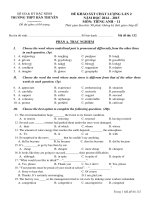
SỞ GD&ĐT BẮC NINH
<b>TRƯỜNG THPT HÀN THUYÊN</b>
<i>(Đề có 05 trang)</i>
(64 câu trắc nghiệm và phần tự luận)
<b>ĐỀ KHẢO SÁT CHẤT LƯỢNG LẦN 1</b>
<b>NĂM HỌC 2015 - 2016 </b>
<b>MÔN: TIẾNG ANH LỚP: 11</b>
<i><b>Thời gian làm bài: 90 phút, khơng kể thời gian phát đề</b></i>
Họ và tên thí sinh:... Số báo danh:...
A.
<b> PHẦN I : TRẮC NGHIỆM (8 điểm - H ọc si nh làm bài ra phiếu trả lời trắc nghiệm ) </b>
<i><b>Mark the letter A, B, C, or D on your answer sheet to show the underlined part that needs </b></i>
<i><b>correction in each of the following questions.</b></i>
<b>Câu 1: New laws should be introduced to reduce the number of traffic in the city</b> centre .
A B C D
<b>Câu 2: One of the students who are being considered for the scholarship are from this university </b>
A B C D
<b>Câu 3: The tickets that you ordered they will be delivered</b> tomorrow
A B C D
<b>Câu 4: In my opinion, I think all my classmates but Tom like our teacher of English.</b>
A B C D
<b>Câu 5: I'm so sad that there is no point in make him learn hard in this semester</b>
A B C D
<i><b>Read the following passage and blacken the letter A, B, C, or D on your answer sheet to indicate </b></i>
<i><b>the correct answer to the following questions.</b></i>
Last week I went to visit Atlantic College, an excellent private college in Wales. Unusually, it
gives people much needed experience of life outside the classroom, as well as the opportunity to study
for their exams. The students, who are aged between 16 and 18 and come from all over the world,
spend the morning studying. In the afternoon they go out and do a really useful activity, such as
helping on the farm, looking after people with learning difficulties, or checking for pollution in rivers.
One of the great things about Atlantic College students is that they come from many different
<i><b>social backgrounds and countries. As few can afford the fees of £20,000 over two years, grants are</b></i>
available.
A quarter of students are British, and many of those can only attend because they receive
government help.
“I really admire the college for trying to encourage international understanding among young
people", as Barbara Molenkamp, a student from the Netherlands, said. ''You learn to live with people
and respect them, even the ones you don't like. During the summer holidays my mother couldn't
<i><b>believe how much less I argued with my sister."</b></i>
<i><b>To sum up, Atlantic College gives its students an excellent education, using methods which really </b></i>
seem to work.
<b>Câu 6: What is the writer trying to do in the text?</b>
<b>A. give an opinion about a particular student</b>
<b>B. give an opinion about a special type of education</b>
<b>C. describe the activities the students do in their free time</b>
<b>D. describe his own experience of education</b>
<b>Câu 7: What can a reader find out from this text?</b>
<b>A. how to become a student at Atlantic College</b>
<b>B. what kind of programme Atlantic College offers</b>
<b>C. what the British education system is like</b>
<b>D. how to get along better with other people</b>
</div>
<span class='text_page_counter'>(2)</span><div class='page_container' data-page=2>
<b>Câu 8: What is the writer's opinion of Atlantic College?</b>
<b>A. It doesn't allow students enough study time.</b>
<b>B. Its students are taught to like each other.</b>
<b>C. It doesn’t give good value for money.</b>
<b>D. Its way of teaching is successful.</b>
<b>Câu 9: How has Barbara changed since being at Atlantic College?</b>
<b>A. She knows a lot about other countries.</b>
<b>B. She is more confident than her sister now.</b>
<b>C. She finds it easier to get on with other people.</b>
<b>D. She prefers her new friends to her family.</b>
<i><b>Câu 10: The word "</b><b>argued"</b><b> in the third paragraph is closest in meaning to </b></i> _.
<b>A. quarreled</b> <b>B. respected</b> <b>C. admired</b> <b>D. regarded</b>
<b>Câu 11: Besides studying for the exams, the students at Atlantic College are given </b> _
<b>A. many experience of how to behave</b>
<b>B. needed experience of life inside theclassroom</b>
<b>C. a lot of needed experience of life outside the classroom</b>
<b>D. much time to play games online.</b>
<i><b>Câu 12: The word "</b><b>afford"</b><b> in the second paragraph is closest in meaning to </b></i> _.
<b>A. pay</b> <b>B. do</b> <b>C. buy</b> <b>D. have</b>
<b>Câu 13: The students at Atlantic College are from all over the world and </b> .
<b>A. A quarter of them are from Asia</b>
<b>B. three quarters of them are not from Britain</b>
<b>C. most of them are British</b>
<b>D. All of them are American.</b>
<b>Câu 14: Barbara Molenkamp is a student from………</b>
<b>A. Holland</b> <b>B. Poland</b> <b>C. Ire-land</b> <b>D. England</b>
<i><b>Câu 15: The word "</b><b>to sum up"</b><b> in the last paragraph is closest in meaning to </b></i> .
<b>A. on general</b> <b>B. in conclusion</b> <b>C. with support</b> <b>D. with help</b>
<i><b>Blacken the letter A, B, C or D on your answer sheet to indicate the correct answer to each of the </b></i>
<i><b>following questions.</b></i>
<b>Câu 16: The children appear </b> _ about the trip
<b>A. to be excited</b> <b>B. being excited</b>
<b>Câu 17: “Anything else ?”</b> “ ”.
<b>C. to excite</b> <b>D. exciting</b>
<b>A. Not at all</b>
<b>C. Yes, that’s all</b> <b>B. Not,that’s allD. Not today, thanks</b>
<b>Câu 18: The girl </b> is our neighbor.
<b>A. talking to the lady over there</b> <b>B. was talking to the lady over there</b>
<b>C. is talking to the lady over there</b> <b>D. talks to the lady over there</b>
<b>Câu 19: He talked as if he </b> where she was.
<b>A. had known</b> <b>B. were knowing</b> <b>C. knew</b> <b>D. would know</b>
<b>Câu 20: My daughter is going to </b>
<b>-A. be cut her hair</b> <b>B. have her hair cutted</b>
<b>C. get cut her hair</b> <b>D. have her hair cut</b>
<b>Câu 21: Mr Gibbon usually drinks mineral water, but in this party he </b> champagne.
<b>A. is drinking</b> <b>B. has drunk</b> <b>C. drinks</b> <b>D. will drink</b>
<b>Câu 22: you have got a lot of friends, </b> _ ?
</div>
<span class='text_page_counter'>(3)</span><div class='page_container' data-page=3>
<b>Câu 23: Jack can speak two languages. One is English. </b> is Vietnamese.
<b>A. Another</b> <b>B. Other</b> <b>C. The other</b> <b>D. Others</b>
<b>Câu 24: Don’t ask me anything about sports. I like </b> football tennis.
<b>A. both / and</b> <b>B. either / or</b>
<b>C. neither / nor</b> <b>D. not only/ but also</b>
<b>Câu 25: quarrelled with her boyfriend yesterday, she doesn’t want to answer his phone call.</b>
<b>A. Because hadn’t</b> <b>B. Because having</b> <b>C. Having</b> <b>D. Having not</b>
<b>Câu 26: Lomonosov with his classmates </b> very intelligent.
<b>A. are</b> <b>B. have been</b> <b>C. were</b> <b>D. was</b>
<b>Câu 27: It was _ </b> that everybody wanted to go on a picnic.
<b>A. such a nice weather</b> <b>B. so nice weather</b>
<b>C. such weather a nice</b> <b>D. such nice weather</b>
<b>Câu 28: They got good marks in the last exams.They_ </b> very hard.
<b>A. may learn</b> <b>B. must learn</b>
<b>C. must have learnt</b> <b>D. learned</b>
<b>Câu 29: The more you talk about the matter, </b>
<b>A. the worse seems the situation</b> <b>B. the situation seems the worse</b>
<b>C. the worse the situation seems</b> <b>D. the situation seems worse</b>
<b>Câu 30: The car burst into </b> but the driver managed to escape.
<b>A. heat</b> <b>B. burning</b> <b>C. flames</b> <b>D. fire</b>
<b>Câu 31: It seems impossible </b> terrorism in the world.
<b>A. put an end of</b> <b>B. to put an end to</b>
<b>C. putting an end to</b> <b>D. stop at</b>
<b>Câu 32: did Arthur realize there was danger</b>
<b>A. After he had entered the store</b> <b>B. When he entered the store</b>
<b>C. Upon entering the store</b> <b>D. Only after entering the store</b>
<b>Câu 33: He asked me </b> of the film
<b>A. what do I thought</b> <b>B. What do I think</b>
<b>C. What I think</b> <b>D. what I thought</b>
<b>Câu 34: We get </b> _ a mess with the credit card payments.
<b>A. over</b> <b>B. about</b> <b>C. in</b> <b>D. into</b>
<b>Câu 35: They insist that the old man </b> for the broken vase.
<b>A. pay</b> <b>B. pays</b> <b>C. has to pay</b> <b>D. paid</b>
<b>Câu 36: ? she is a teacher</b>
<b>A. What does he do B. Who is she</b> <b>C. What is her job</b> <b>D. What is she</b>
<b>Câu 37: He risks </b> into her company
<b>A. invest</b> <b>B. invested</b> <b>C. investing</b> <b>D. to invest</b>
<b>Câu 38: We are the first ones </b> _him about the report this morning.
<b>A. asking</b> <b>B. ask</b> <b>C. to ask</b> <b>D. to be asked</b>
<b>Câu 39: They have been living there </b> They were in grade 7.
<b>A. as</b> <b>B. when</b> <b>C. since</b> <b>D. for</b>
<b>Câu 40: Angela is not only a capable reporter </b> _a promising writer.
<b>A. and</b> <b>B. but also</b> <b>C. as well as</b> <b>D. or</b>
<i><b>Read the following passage and blacken the letter A, B, C or D on your answer sheet to indicate the </b></i>
<i><b>correct word for each of the blanks in the following question.</b></i>
SPRING FESTIVALS
</div>
<span class='text_page_counter'>(4)</span><div class='page_container' data-page=4>
death and resurrection of Jesus Christ.
Easter, however, is not the (43) spring festival. In Sweden, people celebrate the end of the winter
by making(44) bonfires. Fire also plays an important part in the Hindu festival of
Holi. In some villages children are (45) round bonfires by their mothers to protect them (46)
danger in the coming year. Buddhists in Thailand soak(47) in water when
celebrating their New Year, which (48) in the middle of April. In Antigua in Guatemala
they carpet the streets with flowers. Chinese spring parades are (49) _ colourful, but (50)
flowers they have large dragon puppets which dance in the streets.
<b>Câu 41: A. earliest</b> <b>B. previous</b> <b>C. latest</b> <b>D. old </b>
<b>Câu 42: A. which</b> <b>B. when</b> <b>C. because</b> <b>D. by then </b>
<b>Câu 43: A. one</b> <b>B. single</b> <b>C. lonely</b> <b>D. only </b>
<b>Câu 44: A. tremedous</b> <b>B. giant</b> <b>C. extreme</b> <b>D. huge </b>
<b>Câu 45: A. brought</b> <b>B. gone</b> <b>C. carried</b> <b>D. run </b>
<b>Câu 46: A. in</b> <b>B. against</b> <b>C. out of</b> <b>D. from </b>
<b>Câu 47: A. one other</b> <b>B. each other</b> <b>C. mutually</b> <b>D. through</b>
<b>Câu 48: A. happens</b> <b>B. falls</b> <b>C. occurs </b> <b>D. appears</b>
<b>Câu 49: A. equally</b> <b>B. not less</b> <b>C. as</b> <b>D. the same</b>
<b>Câu 50: A. place of</b> <b>B. in spite of</b> <b>C. on behalf of</b> <b>D. instead of</b>
<i><b>Blacken the letter A, B, C or D on your answer sheet to indicate the word with the main stress </b></i>
<i><b>different from that of the other three words in each question.</b></i>
<b>Câu 51: A. appreciate</b> <b>B. experience</b> <b>C. embarrassing</b> <b>D. situation</b>
<b>Câu 52: A. excited</b> <b>B. interested</b> <b>C. confident</b> <b>D. memorable</b>
<i><b>Blacken the letter A, B, C, or D on your answer sheet to indicate the word or phrase that is </b></i>
<i><b>OPPOSITE in meaning to the underlined part in each of the following questions.</b></i>
<b>Câu 53: The consequences of the typhoon were disastrous due to the lack of precautionary measures.</b>
<b>A. damaging</b> <b>B. beneficial</b> <b>C. severe</b> <b>D. physical</b>
<b>Câu 54: Vietnam’s admission to the World Trade Organisation (WTO) has promoted its trade </b>
relations with other countries.
<b>A. boosted</b> <b>B. expanded</b> <b>C. restricted</b> <b>D. balanced</b>
<i><b>Blacken the letter A, B, C, or D on your answer sheet to indicate the word or phrase that is </b></i>
<i><b>CLOSEST in meaning to the underlined part in each of the following questions.</b></i>
<b>Câu 55: We wish you both health and longevity</b>
<b>A. a long life</b> <b>B. exciting life</b> <b>C. easy life</b> <b>D. happy life</b>
<b>Câu 56: The law in my garden needs mowing every month</b>
<b>A. repairing</b> <b>B. cutting</b> <b>C. making</b> <b>D. mending</b>
<i><b>Read the following passage and blacken the letter A, B, C, or D on your answer sheet to indicate </b></i>
<i><b>the correct answer to the following questions.</b></i>
</div>
<span class='text_page_counter'>(5)</span><div class='page_container' data-page=5>
In the “sound-on-film” system, sounds were recorded as a series of marks on celluloid which
<b>could be read by an optical sensor. These signals would be placed on the film alongside image,</b>
guaranteeing syncronization. Short feature films were produced in this way as early as 1922. This
system eventually brought us “talking pictures”.
<b>Câu 57: The passage is mainly about the _ </b> _
<b>A. disadvantages of syncronized sound</b> <b>B. development of sound with movies</b>
<b>C. research into sound production</b> <b>D. history of silent movies</b>
<b>Câu 58: According to the passage, films using sound effects were screened </b>
<b>A. before 1896</b> <b>B. as early as 1896</b> <b>C. as early as 1922</b> <b>D. in 1927</b>
<b>Câu 59: The word “screenings” is closest in meaning to </b>
<b>A. projections</b> <b>B. revelations</b> <b>C. demonstrations</b> <b>D. diversions</b>
<b>Câu 60: Which of the following is NOT mentioned as producer of sound to accompanies movies?</b>
<b>A. a single pianist</b> <b>B. a jazz singer</b> <b>C. a gramophone</b> <b>D. a small band</b>
<b>Câu 61: The phrase “these signals” refers to </b>
<b>A. marks</b> <b>B. sensors</b> <b>C. series</b> <b>D. sounds</b>
Blacken the letter A, B, C or D on your answer sheet to indicate the word whose underlined part is
pronouned differently from the other three in each question.
<b>Câu 62: A. religion</b> <b>B. glance</b> <b>C. imagine</b> <b>D. geography</b>
<b>Câu 63: A. looked</b> <b>B. helped</b> <b>C. turned</b> <b>D. noticed</b>
<b>Câu 64: A. bride</b> <b>B. fridge</b> <b>C. bridge</b> <b>D. driven</b>
<b>B. PHẦN II: TỰ LUẬN (2 điểm - Học sinh làm bài ra tờ giấy thi) </b>
<b>I.Give the corect tense of the verbs in brackets. (0.5 point)</b>
1. That was the first time Ba (drink) that kind of soft drink.
2. We are sure that Tom (pass) the final exams.
3. By the time he moved to London, he (live) in Newyork for 3 years.
4. I am very tired, I (work) hard all day today.
5.When I saw them, they (wear) baggy trousers.
<b>II. Give the correct form of the words in the brackets (0,5 point)</b>
1.It’s a…… to see you again after a long time. (pleased)
2.The young couple had been ……. For 10 years after they got married. They were thrilled to have a
child. (children)
3.He won the first prize because he was very …….. (study)
4. They refuse to………. the need for reform (know)
5. Nam and Ha won their first and second prizes……… (respect)
<b>III. Finish each of the following sentences in such a way that it means the same as the sentence </b>
<b>printed before it. (1 point)</b>
1. He had locked the door then he went to bed
Having
2. John expected them to appoint him as headteacher of the school.
John expected
3. He remembered his sister taking him to her school last year.
He remembered
4. The fox tried in vain to pick the grapes.
In ...
5.Tuan,Phong and Xuan are some of the best students at English in our class.
Among
</div>
<span class='text_page_counter'>(6)</span><div class='page_container' data-page=6>
<b>---ĐÁP ÁN</b>
<b>Câu</b> <b>Mã đề</b>
<b>132 209 357 485 570 628 743 896</b>
1
C
A
B
C
B
C
B
B
2
D
C
D
A
D
C
B
D
3
C
B
A
B
A
D
C
D
4
A
D
B
B
D
C
A
D
5
B
B
D
D
A
A
C
B
6
B
C
A
C
D
C
A
B
7
B
B
D
B
B
D
B
A
8
D
B
A
D
C
C
A
C
9
C
B
C
C
C
A
B
B
10
A
B
A
C
D
B
B
B
11
C
A
D
C
C
A
C
C
12
A
D
D
D
A
D
A
D
13
B
A
C
C
B
B
B
B
14
A
A
C
A
B
C
B
A
15
B
D
C
B
C
B
A
B
16
A
A
B
A
D
C
D
D
17
D
D
D
D
A
A
D
A
18
A
A
C
C
A
C
D
D
19
A
C
C
C
C
C
D
B
20
D
A
A
D
B
A
D
D
21
A
D
D
A
B
D
C
D
22
D
D
A
B
B
A
A
B
23
C
C
C
B
C
B
C
C
24
C
C
C
A
D
B
B
B
25
C
C
A
A
B
D
A
B
26
D
B
B
B
B
D
D
A
27
D
D
A
D
B
A
B
B
28
C
D
B
D
C
B
D
B
29
C
D
B
A
B
B
C
B
30
C
A
D
A
A
B
B
C
31
B
D
C
C
D
C
B
D
32
D
A
A
B
A
B
B
D
<b>Câu</b> <b>Mã đề</b>
<b>132 209 357 485 570 628 743 896</b>
33
D
C
B
B
D
B
A
C
34
D
C
D
B
D
B
A
A
35
A
A
D
C
C
A
A
D
36
D
C
C
B
B
A
C
A
37
C
C
B
A
A
C
D
C
38
C
B
D
C
C
B
D
C
39
C
C
C
B
A
A
D
D
40
B
A
C
C
A
D
A
C
41
A
B
D
B
D
A
C
A
42
B
C
A
A
D
D
C
B
43
D
B
B
D
A
D
D
A
44
D
A
A
A
D
C
C
D
45
C
B
B
D
C
B
D
C
46
D
B
D
D
D
A
C
C
47
B
D
B
C
D
C
C
C
48
B
C
D
B
C
A
D
A
49
A
D
B
A
B
A
B
A
50
D
C
B
C
B
D
C
A
51
D
A
A
A
A
D
A
C
52
A
B
C
A
D
A
C
A
53
B
B
C
D
B
D
B
A
54
C
D
D
D
C
C
B
D
55
A
D
C
A
C
D
A
C
56
B
D
A
D
C
D
C
C
57
B
A
B
C
A
C
D
A
58
B
D
C
D
C
B
C
C
59
A
A
B
D
C
B
A
D
60
B
A
B
C
A
A
B
A
61
A
B
A
B
D
D
A
C
62
B
C
A
B
A
D
D
B
63
C
C
A
A
B
C
A
A
</div>
<span class='text_page_counter'>(7)</span><div class='page_container' data-page=7>
<b>ĐÁP ÁN PHẦN TỰ LUẬN</b>
<b>I. Give the corect tense of the verbs in brackets. (0.5 point)</b>
1. had drunk
2. will pass
3. had been living / had lived 4. have been working
5. were wearing
<b>II. Give the correct form of the words in the brackets (0.5 point)</b>
1. pleasure
2. childless 3. studious 4. acknowledge
5. respectively
<b>III. Finish each of the following sentences in such a way that it means the same as the </b>
<b>sentence printed before it. (1point)</b>
1. Having locked the door, he went to bed
2. John expected to be appointed the headteacher of the school 3.He remembered being taken to
her sister’s school last year. 4. In vain did the fox try to pick the grapes
</div>
<!--links-->